
Last updated: 25 October 2026 · Charters, audit reports, insurance statements, asset counts and billing terms rechecked on BitGo, Coinbase and Fidelity Digital Assets pages on 25 October 2026
BitGo vs Coinbase Prime, with Fidelity Digital Assets as the third option, is a choice between three qualified custodians with different strengths. BitGo is the broadest custodian, with an OCC national trust bank, 1,700+ assets and a stated $250M insurance policy. Coinbase Prime is the pick when custody has to sit next to trading, financing and staking. Fidelity Digital Assets suits institutions that want a national trust bank backed by Fidelity Investments for a short list of major assets.
We scored all three on the same six weighted criteria used across our digital asset custody hub, mapped which legal entity would hold your assets, and turned the one billing method any of them publishes into numbers you can check against a quote. The scoring rules are on our methodology page.
TL;DR
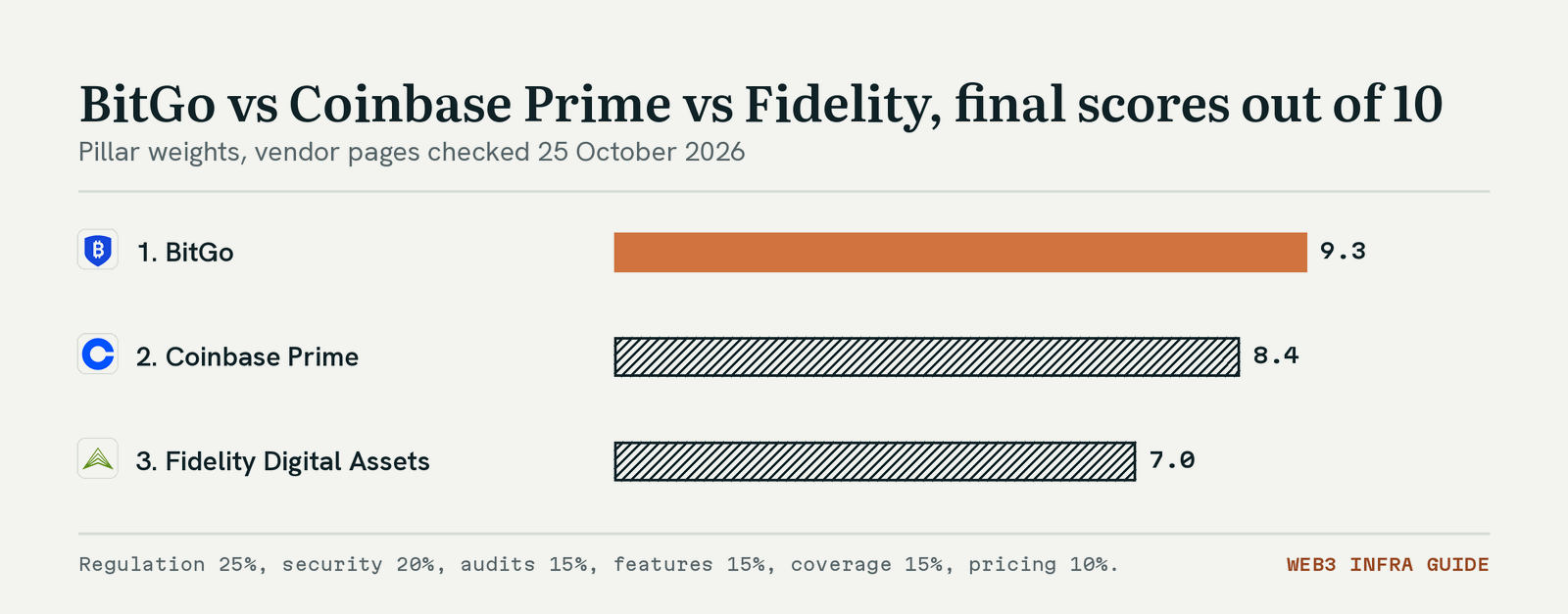
- Scores out of 10: BitGo 9.3, Coinbase Prime 8.4, Fidelity Digital Assets 7.0. Fidelity matches BitGo on charter but publishes the least about assets, features and price.
- Two of the three are now OCC national trust banks: BitGo Bank & Trust, N.A. and Fidelity Digital Assets, National Association, which Fidelity says received its charter in 2025. Coinbase Custody Trust Company is a New York limited purpose trust company.
- All three name SOC 1 and SOC 2 reports. Coinbase and Fidelity state Type II (Type 2), and Coinbase names Deloitte & Touche as auditor. BitGo names SOC attestations without the type.
- Only BitGo states an insurance figure: up to $250M for assets where BitGo Bank & Trust holds all keys. Coinbase states no amount, and Fidelity says digital assets are not FDIC insured.
- Coverage: BitGo lists 1,700+ assets, Coinbase Prime 470+ for custody and 15 staking networks. Fidelity names Bitcoin, Ether and Solana capability launches but publishes no asset list.
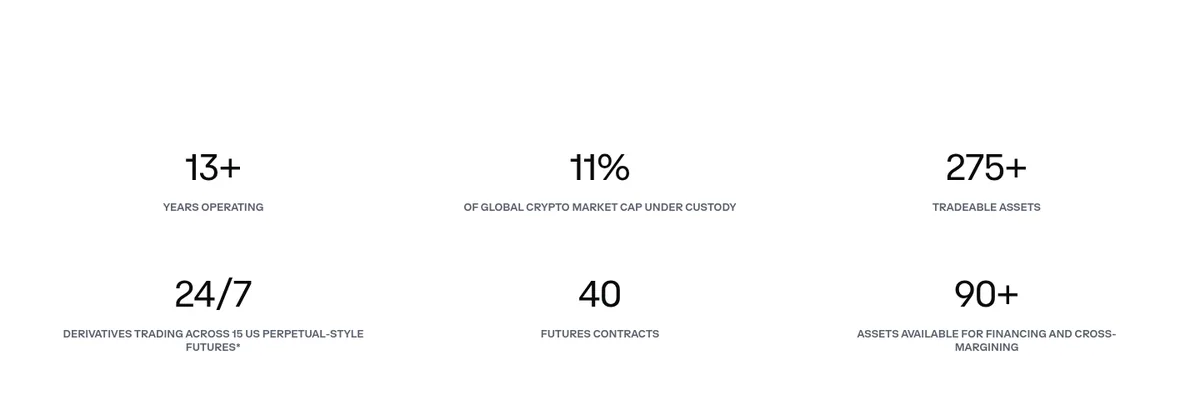
- Coinbase says it holds 11% of global crypto market cap in custody. Against a $2.69T market cap on CoinGecko at 9 PM IST on 25 October, that implies about $296B.
The Decision Kernel
Start with what the custodian must do besides hold keys, and which of your assets it must support on day one. If custody is all you need, the charter and asset list decide it. If you also trade, borrow or stake, the integrated platform matters more than the charter.
- Pick BitGo if you need the widest asset support, regional entities outside the US and a stated insurance figure. It holds licences in the US, New York, Singapore, Dubai, the EU and Switzerland.
- Pick Coinbase Prime if your fund trades actively and wants custody, execution, margin financing and staking with one counterparty and one login.
- Pick Fidelity Digital Assets if your investment committee wants a Fidelity Investments business and a federal trust charter, and your book is mostly Bitcoin, Ether and Solana.
- Use two of them if counterparty concentration is a board concern. A common split is a long-term reserve at one bank-chartered custodian and a trading balance at Coinbase Prime.
Verdict: BitGo for breadth and stated insurance, Coinbase Prime for custody plus trading, and Fidelity Digital Assets for a conservative Bitcoin, Ether and Solana mandate.
How We Compared the Three
We used the six weighted criteria from our digital asset custody hub, scored each from 1 to 5 and doubled the weighted sum. Inputs come from provider pages read on 25 October 2026. Facts missing from the provider site scored as not disclosed. The full rules are on our methodology page and our editorial policy.
- Regulation and segregation, 25%: the charter or licence of the entity that holds assets, segregation and qualified custodian status.
- Security and key control, 20%: cold storage, multisig or MPC design, approval policies and how much of the design is published.
- Audits and insurance disclosure, 15%: SOC 1 and SOC 2 Type II reports, ISO 27001 and any stated insurance amount.
- Features, 15%: staking, trading, financing, settlement and onchain access.
- Coverage, 15%: stated assets and chains, plus regulated regions.
- Pricing transparency, 10%: 5 for a full public price list, 4 for a public entry price with overage terms, 3 for a public price on a secondary product or a free tier, 2 for a billing method only, 1 for nothing.
| Custodian | Regulation (25%) | Security (20%) | Audits (15%) | Features (15%) | Coverage (15%) | Pricing (10%) | Score |
|---|---|---|---|---|---|---|---|
 | 5 | 5 | 4 | 5 | 5 | 3 | 9.3 |
 | 4 | 5 | 4 | 5 | 5 | 1 | 8.4 |
 | 5 | 4 | 4 | 3 | 2 | 1 | 7.0 |
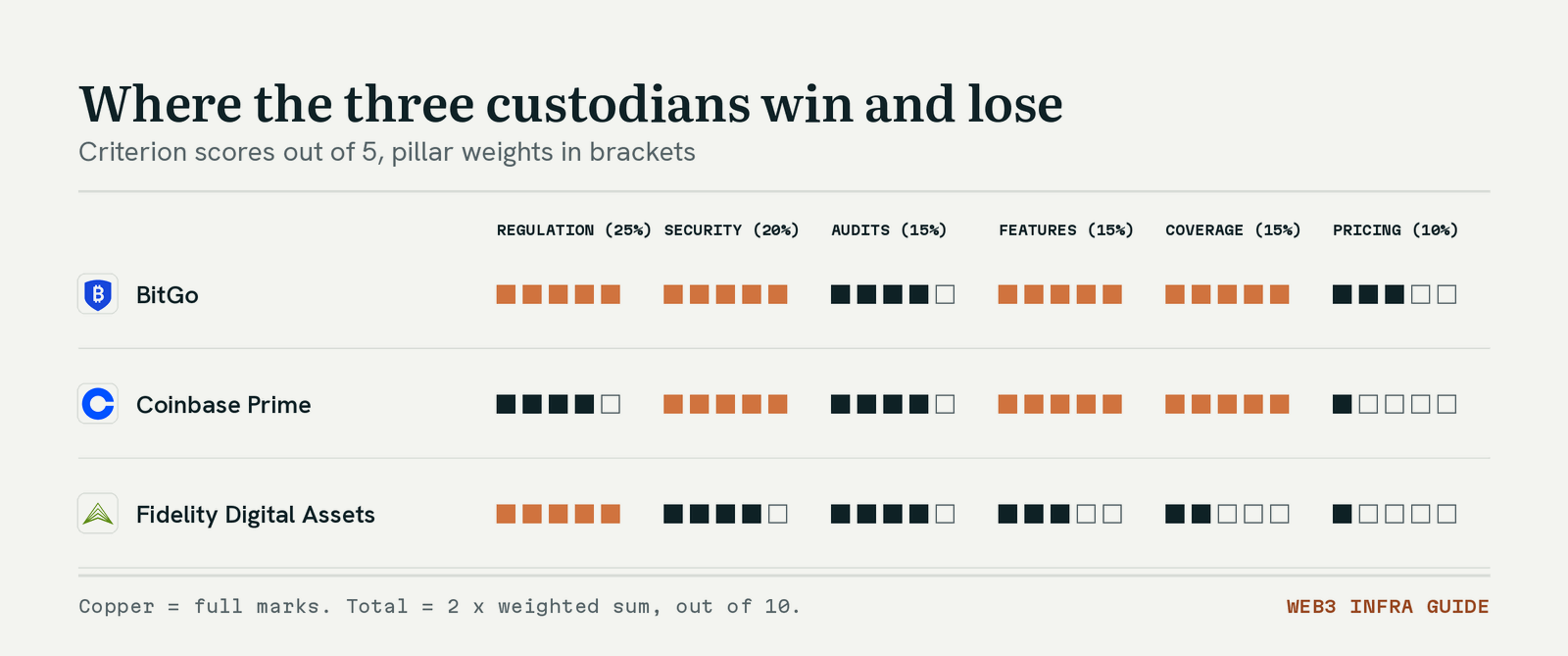
The grid shows why the totals spread out. Fidelity Digital Assets ties BitGo on regulation, beats Coinbase there, and matches both on audits. It loses most of its ground on coverage and features, because it publishes no asset list and no staking or onchain wallet product. Coinbase Prime ties BitGo on security, features and coverage and loses on charter type and price disclosure.
BitGo vs Coinbase Prime vs Fidelity at a Glance
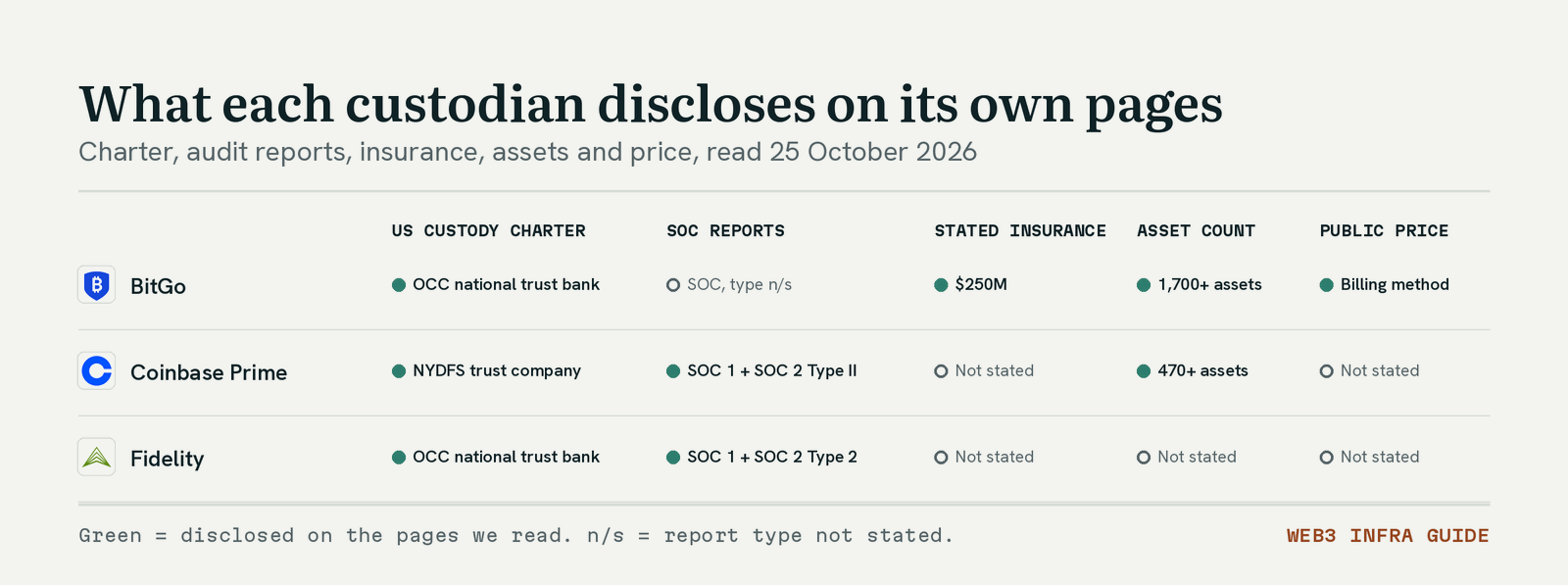
This table puts the facts a due diligence questionnaire asks for in one place, using only what each custodian states on its own site. None of the three publishes a custody rate, so every price comparison starts with a written quote.
| BitGo | Coinbase Prime | Fidelity Digital Assets | |
|---|---|---|---|
| US custody entity | BitGo Bank & Trust, N.A. (OCC national trust bank) | Coinbase Custody Trust Company, LLC (NYDFS limited purpose trust) | Fidelity Digital Assets, National Association (OCC national trust bank) |
| Other regulated entities | NYDFS trust company, MAS, Dubai VARA, MiCAR via BaFin, VQF in Switzerland | Coinbase, Inc. NYDFS licence; MiCA licence across 27 EU states | Fidelity Digital Assets, Ltd. registered with the UK FCA for AML |
| Key model | Multisig and MPC, 100% cold storage for qualified custody | Coinbase Vault: cold storage with consensus computation | Offline, cold-vaulted, multi-site storage with multi-tier approvals |
| Audit reports named | SOC attestations, type not stated | SOC 1 Type II and SOC 2 Type II by Deloitte & Touche | SOC 1 Type 2 and SOC 2 Type 2, annually |
| Stated insurance | Up to $250M (Lloyd’s and European syndicate) | Not stated | Not stated; not FDIC insured |
| Assets | 1,700+ assets | 470+ in custody, 275+ tradeable | No list; Bitcoin, Ether and Solana capabilities named |
| Staking | Protocol staking, Babylon and Core BTC staking, EigenLayer restaking | 15 networks from Vault storage | Not offered on its pages |
| Trading and financing | Trading, financing and Go Network settlement | Smart order routing, margin financing on 90+ assets, 40 futures contracts | Execution from cold storage, 23/7 trading, collateral accounts |
| Public price | Billing method published; no rates | Not published | Not published |
Which Legal Entity Holds Your Assets
Brand names hide the part auditors care about: which legal entity signs your custody agreement and which regulator supervises it. Since Fidelity received its federal charter, two of these three custodians sit under the OCC, which makes the qualified custodian question simpler for registered advisers. Our crypto custody models guide explains how a qualified custodian differs from MPC and self-custody.
| Custodian | Entity | Regulator and status | Role |
|---|---|---|---|
| BitGo Bank & Trust, National Association | OCC, national trust bank with fiduciary and custodial powers | US qualified custody |
| BitGo New York Trust Company, LLC | NYDFS qualified custodian | New York custody |
| Coinbase Custody Trust Company, LLC | NYDFS limited purpose trust company, fiduciary under New York banking law | Qualified custody for Prime |
| Coinbase, Inc. | NYDFS virtual currency licence; not SEC or CFTC licensed | Trading and platform services |
| Fidelity Digital Assets, National Association | OCC national trust bank charter (2025) | Custody and trading |
| Fidelity Digital Assets, Ltd. | UK FCA registration under the Money Laundering Regulations | UK and European clients |
Fidelity’s own timeline shows the path: Fidelity Digital Asset Services, LLC received a New York limited purpose trust charter in 2019, and Fidelity Digital Assets, National Association received its OCC charter in 2025. For Coinbase, the SEC Division of Investment Management’s 30 September 2025 staff letter lets advisers treat a qualifying state trust company as a bank for crypto custody when its conditions are met, which covers the New York trust company model.
Security and Key Management
All three keep client assets in cold storage, but they publish very different amounts of detail about how keys are generated, split and approved. BitGo publishes the most about its key design, Coinbase describes a proprietary vault, and Fidelity lists controls without naming a signing scheme.
- BitGo: multisig and MPC key management, with qualified custody held 100% in cold storage, and BitGo’s insurance applies where BitGo Bank & Trust holds all keys.
- Coinbase Prime: Coinbase Vault storage, which it describes as physical security, consensus computation and strict process controls, built on 12+ years of in-house key generation and cold storage work, per its custody page. Clients set consensus settings and user roles.
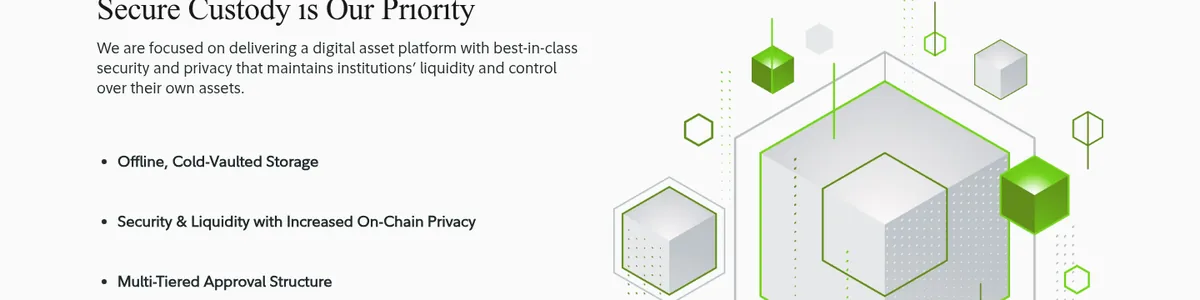
- Fidelity Digital Assets: offline, cold-vaulted storage across multiple sites with a multi-tiered approval structure, per its custody and trading page. Trades execute without moving assets out of cold storage.
Ask each finalist the same three questions in writing: how many people must approve a withdrawal from cold storage, how long a cold withdrawal takes from request to chain, and who can recover access if a key holder leaves. Those answers matter more than the marketing names.
Audits, Insurance and Disclosure
Due diligence teams ask for the charter, the SOC reports, ISO 27001, insurance and price. Coinbase and Fidelity publish the report types, BitGo publishes the only insurance figure, and none of the three names ISO 27001 on the custody pages we read.
- BitGo insurance: up to $250M for assets where BitGo Bank & Trust holds all keys, placed through a Lloyd’s of London and European syndicate, with excess specie cover available through its broker, per its insurance page.
- Coinbase audits: Coinbase Custody Trust Company maintains SOC 1 Type II and SOC 2 Type II audits by Deloitte & Touche. No insurance amount is stated on its Prime pages.
- Fidelity audits: SOC 1 Type 2 and SOC 2 Type 2 audits annually. Its pages say digital assets are not insured or guaranteed by the FDIC or any other government agency.
- What to request: the latest SOC 1 and SOC 2 reports with the bridge letter, and the insurer, limit, deductible and exclusions for any cover a custodian cites.
What a Custody Quote Will Cost
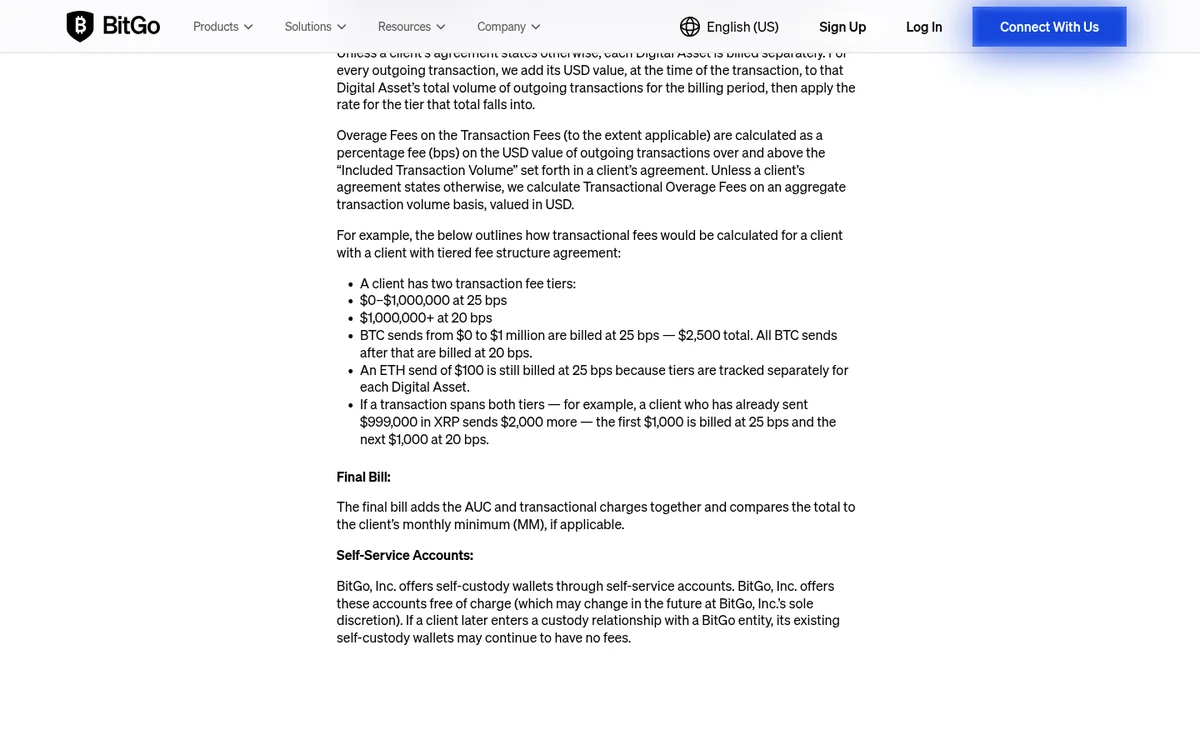
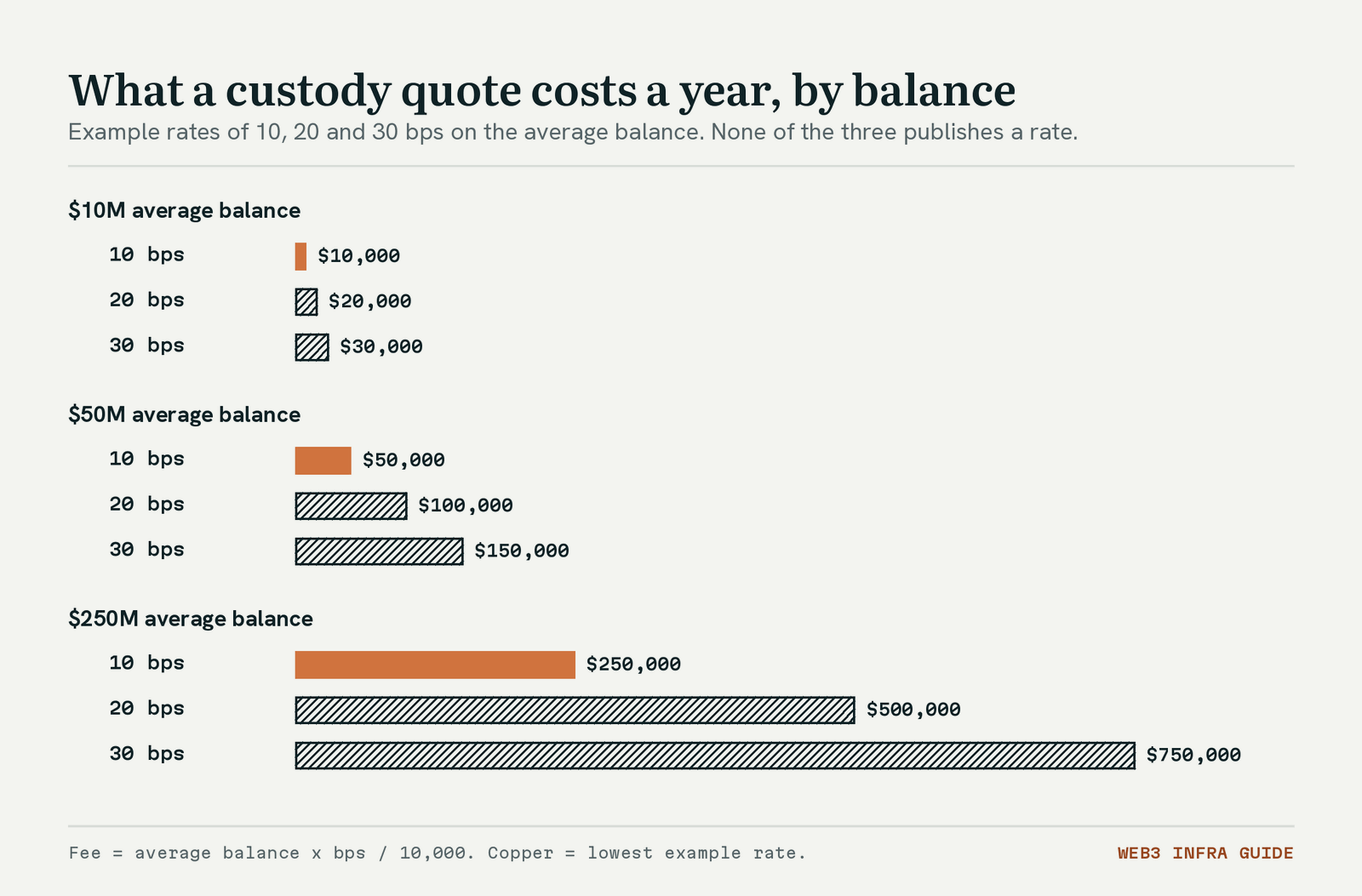
None of the three publishes a custody rate. Only BitGo publishes how it bills, in its billing methodology: basis points on each asset’s monthly average of hourly USD balances, plus basis points on outgoing transfers. Every 10 bps of custody fee on a $250M balance is $250,000 a year, so a few basis points of negotiation outweigh any software fee.
| Average balance | 10 bps a year | 20 bps a year | 30 bps a year |
|---|---|---|---|
| $10M | $10,000 | $20,000 | $30,000 |
| $50M | $50,000 | $100,000 | $150,000 |
| $250M | $250,000 | $500,000 | $750,000 |
Hourly averaging means the fee follows prices, not just holdings. If you hold the same coins all month and their price falls 30% halfway through, the average USD balance falls 15%, and so does that month’s custody fee. A fee charged on month-end balances would fall the full 30% instead, so ask each custodian which balance it bills on, using the formula fee = average_balance x bps / 10,000.
# Custody fee on an hourly-averaged USD balance
balance_start = 50_000_000          # $ at the start of the month
hours = 720                          # 30-day month
balances = [balance_start] * 360 + [balance_start * 0.70] * 360
avg = sum(balances) / hours          # $42,500,000
bps = 20                             # example quote
monthly_fee = avg * bps / 10_000 / 12
print(round(monthly_fee))            # 7,083

# BitGo's own worked example: sends at 25 bps to $1M, 20 bps above
print(1_000_000 * 0.0025 + 500_000 * 0.0020)   # 3,500 on $1.5M of sends
BitGo’s transaction tiers in that example are its own illustration, not a price list. Coinbase Prime and Fidelity Digital Assets do not publish a billing method, so ask both how they compute the balance, whether staking rewards carry a fee, and whether trading commissions replace or add to custody fees.
Coinbase’s Custody Share, Converted to Dollars
Coinbase Prime’s home page says it holds 11% of global crypto market cap in custody. Applied to the $2.69T total market cap that CoinGecko reported at 9 PM IST on 25 October 2026, that is about $296B of assets. Coinbase does not date its 11% figure, so treat this as an order of magnitude, not a reported balance.
total_market_cap = 2_688_482_448_524   # CoinGecko global, 25 Oct 2026, 15:30 UTC
coinbase_share = 0.11                    # stated by Coinbase, undated
print(total_market_cap * coinbase_share / 1e9)   # ~295.7 ($B)
Scale cuts both ways. It means deep operational experience and liquidity next to custody, and it also means concentration: if your fund’s adviser, prime broker and custodian are all Coinbase entities, your due diligence should cover the separation between them. You can rerun the math with the current figure on CoinGecko global charts.
1. BitGo
- Licences: BitGo Bank & Trust under the OCC, BitGo New York Trust Company under NYDFS, plus MAS in Singapore, VARA in Dubai, MiCAR via BaFin and VQF in Switzerland, per its licences page.
- Staking: protocol staking with no pooling and segregated assets, Babylon and Core BTC staking, and EigenLayer restaking from custody wallets.
- Billing: a published method with custody and transaction fees in basis points, but no rates.
- Weaknesses: no public custody rate, and its pages name SOC attestations without the report type.
Verdict: BitGo scores 9.3. It is the default for funds and corporates that need a federally chartered custodian with the broadest asset and regional coverage.
2. Coinbase Prime
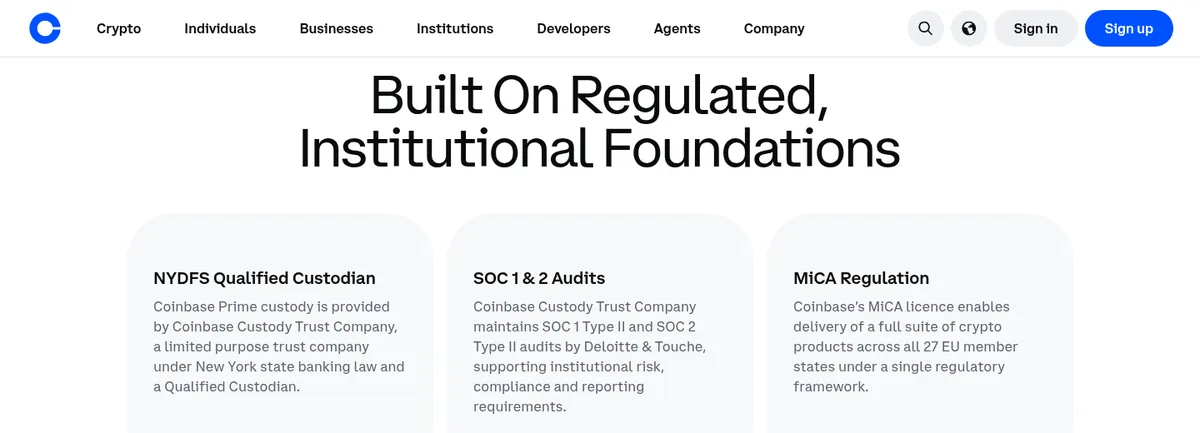
- Custody: Coinbase Custody Trust Company, a fiduciary under New York banking law and a qualified custodian, with 470+ assets, per its custody page. A Custody Only tier is available.
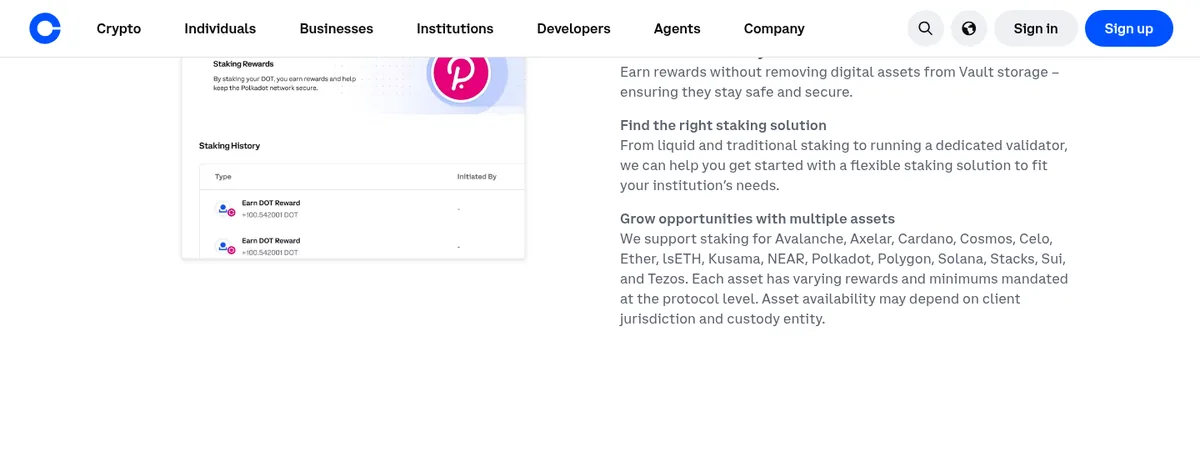
- Staking: 15 networks including Ether, Solana, Cardano, Polkadot and Sui, with rewards earned without leaving Vault storage, plus governance voting.
- Trading and financing: 275+ tradeable assets, margin financing and cross-margining on 90+ assets, and 40 futures contracts.
- Weaknesses: a state rather than federal charter, no stated insurance amount and no public price.
Verdict: Coinbase Prime scores 8.4. Choose it when trading liquidity, financing and staking matter as much as custody.
3. Fidelity Digital Assets
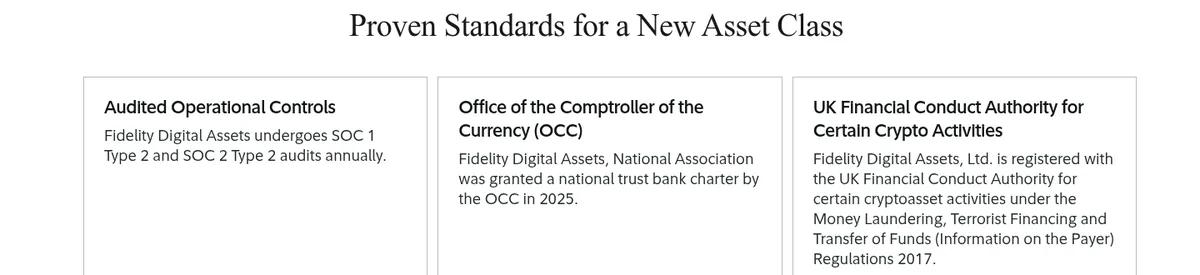
- Charter: Fidelity Digital Assets, National Association was granted a national trust bank charter by the OCC in 2025, per its custody and trading page.
- Trading: smart order routing across a global liquidity network, private transactions from cold storage, and 23/7 trading with real-time settlement.
- Stablecoin: it issues the Fidelity Digital Dollar (FIDD), launched in 2026, with monthly reserve reports examined by PricewaterhouseCoopers.
- Weaknesses: no published asset list, no staking product on its pages, no stated insurance amount and no public price.
Verdict: Fidelity Digital Assets scores 7.0. Pick it for a conservative mandate in major assets where the Fidelity name and a federal charter carry weight with your board.
Running Two of Them Together
Many institutions split custody across providers to limit counterparty risk or to pair a reserve custodian with a trading venue. If you combine custodians, write down which entity holds each balance and who can approve moves between them, because that is where audits find gaps.
- BitGo reserve plus Coinbase Prime trading: long-term holdings at BitGo Bank & Trust, and a trading float at Coinbase Prime for execution and financing.
- Fidelity reserve plus Coinbase Prime: Bitcoin, Ether and Solana reserves at a Fidelity national trust bank, with long-tail assets and staking at Coinbase Prime.
- BitGo plus Fidelity: two OCC-chartered custodians for the same assets, useful when your policy caps exposure to any single custodian.
- For more options, see our institutional custodians hub.
Due Diligence Checklist
Send the same questions to all three custodians before you sign, and compare the written answers side by side. Each item maps to a row in the tables above, so gaps in public disclosure become explicit questions rather than assumptions.
- Name the exact legal entity that will hold your assets, its regulator and its charter.
- Ask for the latest SOC 1 Type II and SOC 2 Type II reports and the bridge letter.
- Get the insurance certificate if cover is cited: insurer, limit, whether it is shared and what it excludes.
- Ask how the custody fee is computed: rate, balance basis (hourly, daily or month-end) and transaction fees.
- Confirm asset support for every coin you hold today and plan to hold within a year.
- Run a pilot cold withdrawal and record the time from request to on-chain confirmation.
- Plan the exit: how to move assets to another custodian, how long it takes and what it costs.
Final Ranking
BitGo wins on breadth, regional licences and stated insurance. Coinbase Prime is a strong second because custody comes with trading, financing and staking. Fidelity Digital Assets ranks third on our weights only because it publishes so little about assets and features, and it is a sound choice for a narrow, conservative mandate.


Verdict: Shortlist BitGo if you need breadth, Coinbase Prime if you trade, and Fidelity Digital Assets for a federal charter on major assets. Ask all three for SOC reports and a written fee schedule before signing.
Frequently Asked Questions
Is BitGo or Coinbase Prime better for institutional custody?
BitGo scores 9.3 against 8.4 for Coinbase Prime on our weights. BitGo has an OCC national trust bank, 1,700+ assets and up to $250M of stated insurance. Coinbase Prime is better when you also need trading, margin financing and staking from the same account and counterparty.
Is Fidelity Digital Assets a qualified custodian?
Fidelity Digital Assets, National Association says it was granted a national trust bank charter by the OCC in 2025, and it provides custody and trading of digital assets. It undergoes SOC 1 Type 2 and SOC 2 Type 2 audits annually. Confirm qualified custodian treatment with your counsel for your specific mandate.
Which custodian supports the most assets?
BitGo lists 1,700+ supported assets, the most of the three. Coinbase Prime supports 470+ assets in custody, 275+ for trading and 15 for staking. Fidelity Digital Assets does not publish an asset list and names Bitcoin, Ether and Solana capabilities, as checked on 25 October 2026.
Are BitGo, Coinbase Prime and Fidelity Digital Assets insured?
Only BitGo states an amount: up to $250M through a Lloyd’s of London and European syndicate for assets where BitGo Bank and Trust holds all keys. Coinbase states no figure on its Prime pages, and Fidelity says digital assets are not insured by the FDIC or any government agency.
How much does institutional crypto custody cost?
None of the three publishes a custody rate. BitGo publishes its method: basis points on the monthly average of hourly USD balances plus basis points on outgoing sends. At example rates, 10 bps on a $50M balance is $50,000 a year and 20 bps is $100,000, so get written quotes from each.
Does Fidelity Digital Assets offer staking?
Fidelity Digital Assets does not list a staking product on its institutional pages, which cover custody, execution from cold storage, collateral accounts and its FIDD stablecoin. BitGo and Coinbase Prime both offer staking from custody, with Coinbase listing 15 supported networks on its custody page.