
Last updated: 25 October 2026 · Prices, wallet limits, key models, audit reports and deployment options rechecked on every vendor’s own pages on 25 October 2026
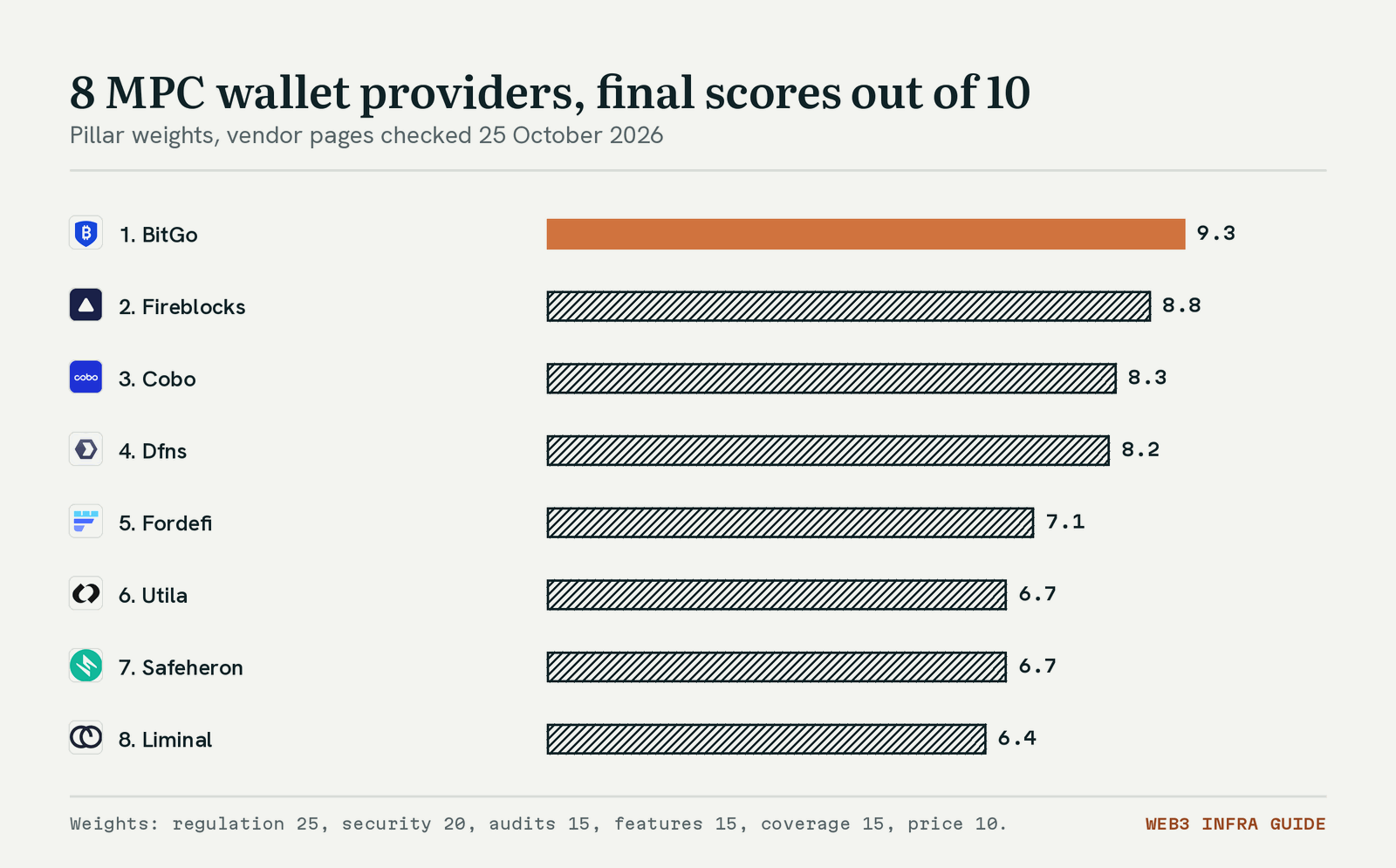
The best MPC wallet providers for institutions in 2026 are BitGo, Fireblocks, Cobo and Dfns. BitGo leads because it pairs threshold signing with an OCC chartered trust bank, Fireblocks has the deepest security and network features, Cobo publishes the most complete price list, and Dfns is the cheapest at scale and the only one here that sells a full on-premises deployment on its pricing page. We scored eight providers on the six weighted criteria used across our digital asset custody hub and priced year one by wallet count from public list prices.
An MPC wallet splits signing power into key shares held by different parties, so no single device or employee can move funds alone. The question an institution has to answer is who holds those shares, on what hardware, and whether any of it can run inside its own perimeter. That is what this guide compares, alongside price and audits. Scoring rules are on our methodology page.
TL;DR
- Ranking: BitGo 9.3, Fireblocks 8.8, Cobo 8.3, Dfns 8.2, Fordefi 7.1, Utila 6.7, Safeheron 6.7 and Liminal 6.4.
- Only Dfns and Safeheron state a self-hosted option on the pages we read: Dfns runs on-premises in Intel TDX, AWS Nitro or IBM HPVS enclaves, and Safeheron sells a privatized MPC Node suite.
- Cheapest list price at 1,000 wallets: BitGo self-service at $0, then Cobo at $4,788 and Safeheron at $5,750 a year. Fireblocks costs $23,994 in year one at list price.
- At 10,000 wallets, Dfns Basic at $8,000 a year is cheapest. Above 4,750 wallets it undercuts Safeheron, if you need 3 blockchains or fewer.
- At 50,000 wallets, Dfns Pro ($35,000), Safeheron ($35,150) and the Fireblocks Custom floor ($36,000) land within $1,000 of each other, while Cobo Standard reaches $79,488.
- Every provider here names SOC 2 Type II except BitGo, whose security page names SOC attestations without the report type.
The Decision Kernel
Start with the custody model, not the brand. If a regulator or auditor needs a qualified custodian, MPC software alone does not meet that need, whoever sells it. Our Fireblocks alternatives guide covers both custodians and MPC platforms, and our Fireblocks vs Utila vs Dfns comparison goes deeper on three of the platforms ranked here.
- You need a chartered entity in the stack: shortlist BitGo, which runs BitGo Bank & Trust, N.A., an OCC chartered trust bank.
- You want the broadest MPC platform and can pay for it: shortlist Fireblocks. It scores 5 on security, audits, features and coverage.
- You must keep every key share inside your own infrastructure: shortlist Dfns (on-premises on Enterprise) and Safeheron (MPC Node suite).
- You run thousands of user wallets on a budget: shortlist Dfns and Cobo. Both publish per-wallet limits and price them openly.
- You trade DeFi every day: shortlist Fordefi, an MPC wallet and web3 gateway now owned by Paxos.
Verdict: Pick BitGo or Fireblocks when governance and coverage matter most, Dfns when you need self-hosting or high wallet counts, and Cobo when you want the lowest published price under 10,000 wallets.
How We Scored the Providers
We scored each provider from 1 to 5 on six weighted criteria and doubled the weighted sum to give a score out of 10, using vendor pages read on 25 October 2026. Anything a vendor did not state on its own pages was scored as not disclosed. The weights match our custody pillar. Full rules are on our methodology page and our editorial policy.
- Regulation and segregation, 25%: the charter or licence of the entity in the stack. Pure software vendors score 2.
- Security and key control, 20%: MPC or threshold design, share placement, enclaves or HSMs, policy engine and device binding.
- Audits and insurance disclosure, 15%: 5 for SOC 2 Type II plus ISO 27001 plus another certification or a stated insurance amount, 4 for SOC Type II with ISO 27001, 3 for SOC 2 Type II only.
- Features, 15%: wallet types, staking, DeFi access, exchange connectivity and APIs.
- Coverage, 15%: stated chains and assets.
- Pricing transparency, 10%: 5 for a full public price list with limits and overage, 4 for a public entry price, 3 for a free tier or billing method plus a secondary price, 1 for nothing.
| Provider | Regulation (25%) | Security (20%) | Audits (15%) | Features (15%) | Coverage (15%) | Pricing (10%) | Score |
|---|---|---|---|---|---|---|---|
 | 5 | 5 | 4 | 5 | 5 | 3 | 9.3 |
 | 3 | 5 | 5 | 5 | 5 | 4 | 8.8 |
 | 3 | 4 | 4 | 5 | 5 | 5 | 8.3 |
 | 2 | 5 | 5 | 5 | 4 | 5 | 8.2 |
 | 2 | 5 | 3 | 5 | 5 | 1 | 7.1 |
 | 2 | 4 | 3 | 4 | 4 | 4 | 6.7 |
 | 2 | 4 | 4 | 4 | 3 | 4 | 6.7 |
 | 2 | 4 | 4 | 4 | 4 | 1 | 6.4 |
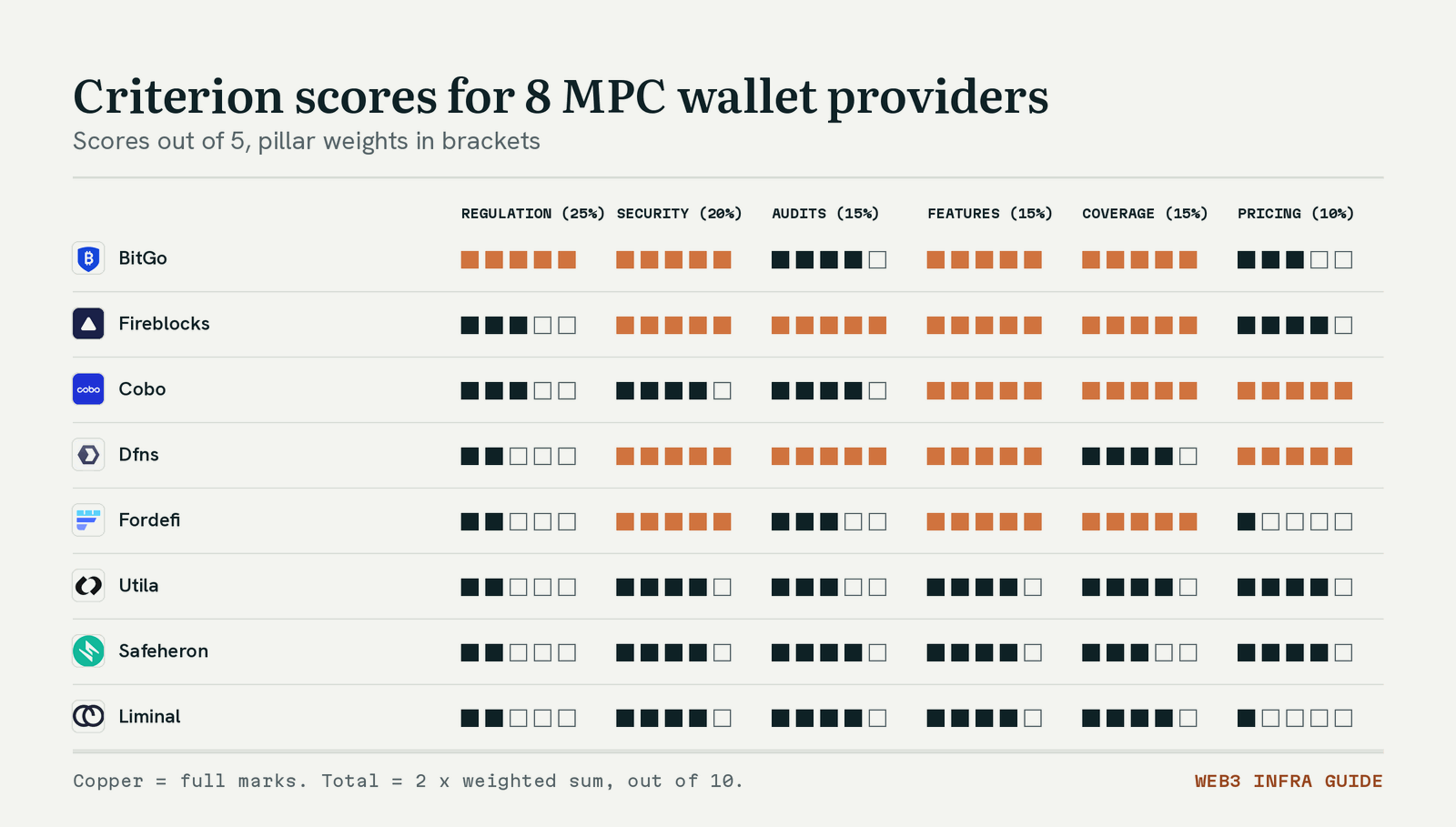
The grid shows where the points come from. All eight providers score 4 or 5 on security, so key management alone rarely separates them. Regulation separates BitGo, pricing transparency lifts Cobo and Dfns, and missing prices pull Fordefi and Liminal down.
Who Holds the Key Shares
Every vendor here says no single party can sign alone, but they place the shares very differently. Two-party designs such as Utila and Fordefi mean the vendor always holds one share, so a vendor outage can pause signing even though it cannot steal funds.
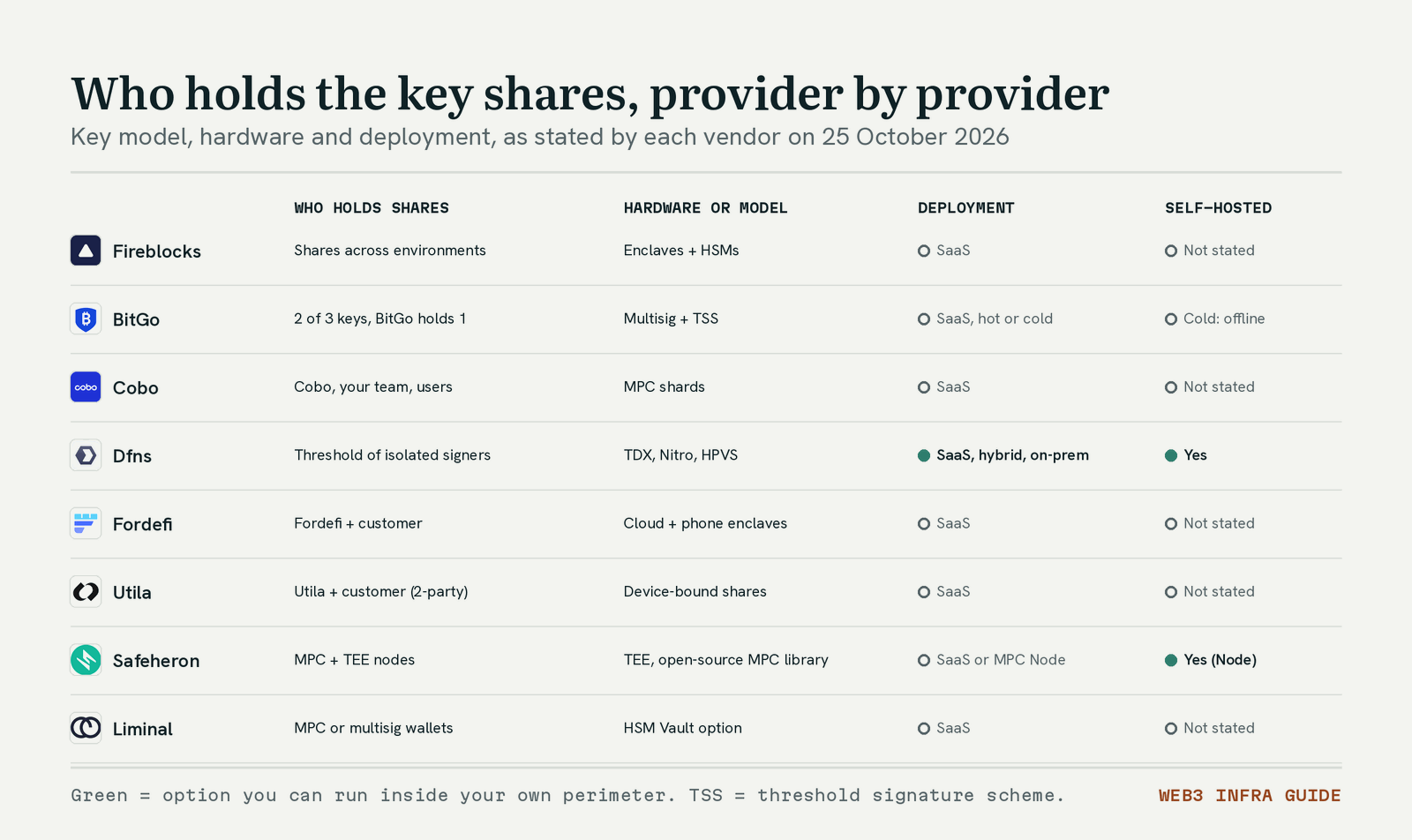
| Provider | Who holds shares or keys | Hardware or model | Self-hosted option stated |
|---|---|---|---|
| Key shares distributed across environments | Secure enclaves and HSMs, TEE-protected approval devices | Not stated on pages read |
| Client key and backup key with you, platform key with BitGo | Multisig and threshold signatures (TSS), hot or offline cold | Cold wallets sign offline, BitGo countersigns |
| Shards split across Cobo, your team and users | MPC with policy-based approvals | Not stated on pages read |
| Threshold quorum of isolated signers, no full key ever exists | Intel TDX, AWS Nitro or IBM HPVS enclaves | Yes, hybrid on Pro and on-premises on Enterprise |
| Fordefi share on AWS, customer share on phone or server | Cloud and mobile secure enclaves | Customer share can run on your server |
| Two shares: Utila and the customer | Device-bound shares, passkeys and biometrics | Not stated on pages read |
| MPC shares protected by TEEs | Open-source C++ MPC-TSS library | Yes, privatized MPC Node suite |
| MPC or multisig wallets, hot and cold | HSM Vault product | Not stated on pages read |
Ask every finalist the same three questions in writing: which shares does the vendor hold, what happens to signing if the vendor is offline for a day, and how you export or recover keys if you leave. The answers matter more than the protocol name.
Year-One Cost by Wallet Count
Most MPC pricing comparisons focus on volume. Wallet-heavy teams such as exchanges, payment firms and wallet-as-a-service builders hit wallet limits first, so we priced year one at 1,000, 10,000 and 50,000 wallets, with 3 users and a modest $250K of outbound volume a quarter. The cheapest provider changes at each size: Cobo at 1,000 paid wallets, Dfns at 10,000 and Dfns again, narrowly, at 50,000.
| Provider | A: 1,000 wallets | B: 10,000 wallets | C: 50,000 wallets |
|---|---|---|---|
| $0 (Self-service, free (may change)) | Quote only (Terms at scale not stated) | Quote only (Terms at scale not stated) |
| $4,788 (Starter) | $11,988 (Starter or Standard (tie)) | $79,488 (Standard) |
| $5,750 (Starter, yearly billing) | $11,150 (Starter, yearly billing) | $35,150 (Starter, yearly billing) |
| $8,000 (Basic) | $8,000 (Basic) | $35,000 (Pro) |
| $9,588 (Starter) | Quote only | Quote only |
| $23,994 (6 mo Essentials + 6 mo Custom floor) | from $36,000 (from: Custom floor, over 5,000 wallets) | from $36,000 (from: Custom floor, over 5,000 wallets) |
| Quote only | Quote only | Quote only |
| Quote only | Quote only | Quote only |
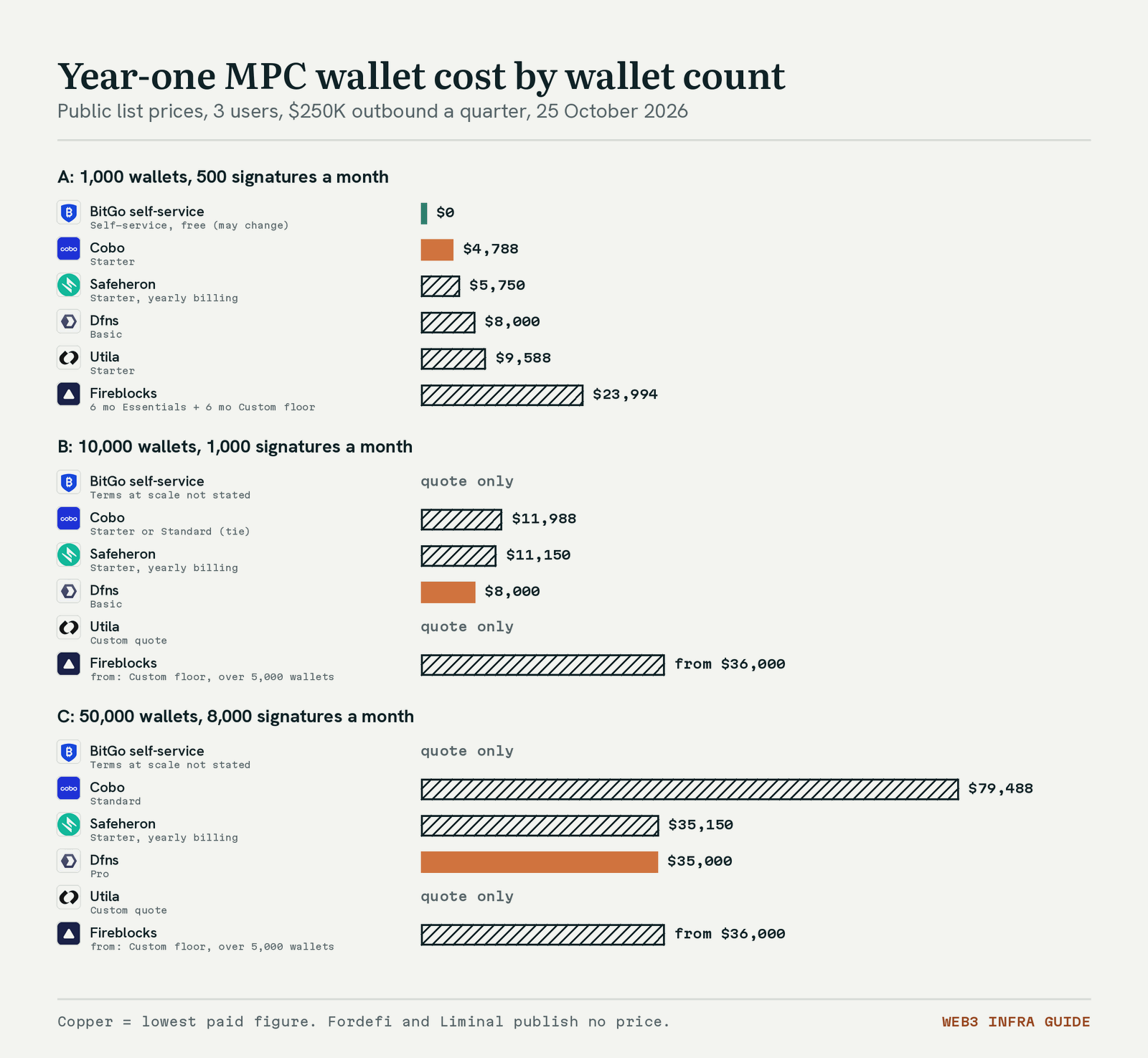
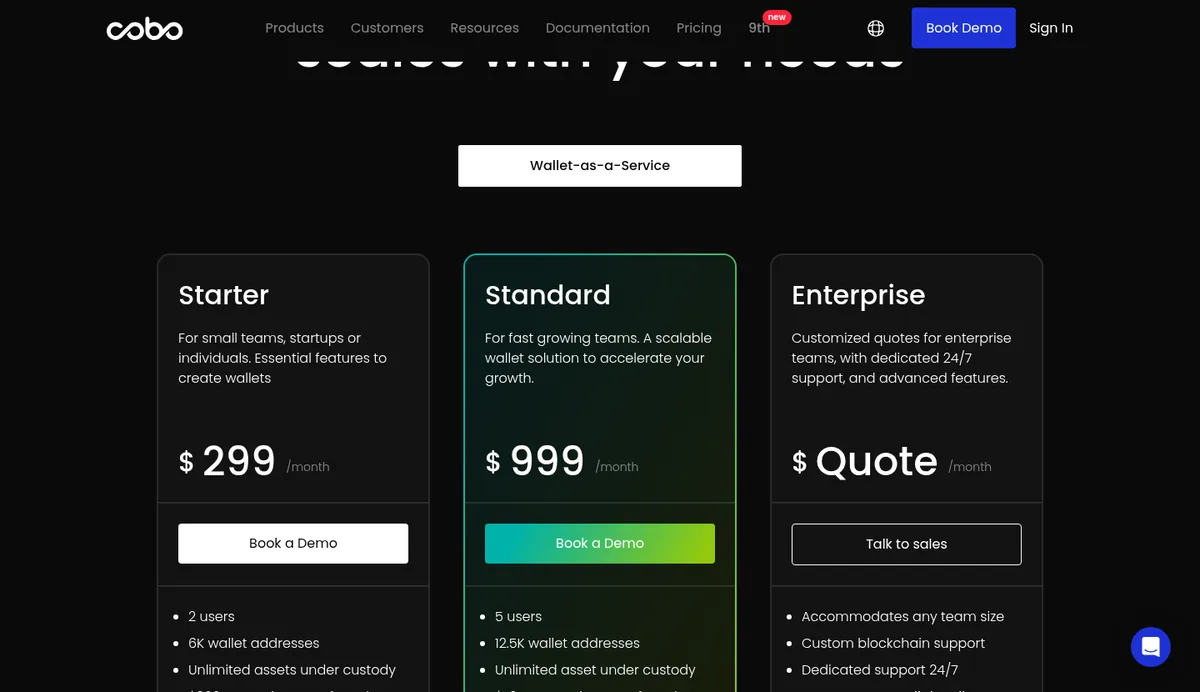
The plan limits behind the math: Cobo Starter is $299 a month with 2 users and 6,000 wallet addresses, Standard is $999 with 5 users and 12,500, extra addresses cost $0.15 and extra users $100. Cobo does not state the billing period for the address charge, so we model it as monthly, the more expensive reading.
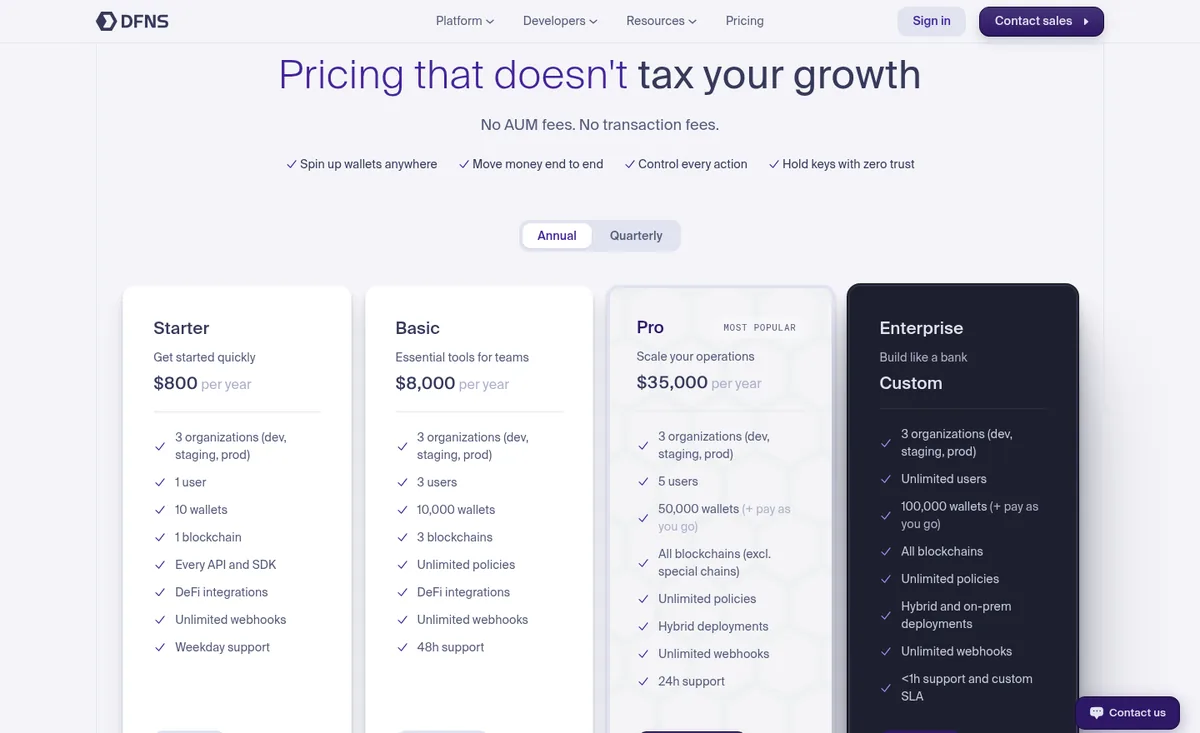
Dfns Basic is $8,000 a year for 3 users, 10,000 wallets, 3 blockchains and 1,000 signatures a month, and Pro is $35,000 for 5 users, 50,000 wallets, all standard chains and 10,000 signatures. Safeheron Starter is $5,750 a year for 1,000 wallets plus $0.05 per extra wallet a month. Fireblocks Essentials includes 5,000 embedded wallets for up to 6 months, so scenarios B and C start at the $36,000 Custom floor.
# Year one, 3 users, $250K outbound a quarter
def safeheron(w):
    return 5_750 + max(0, w - 1_000) * 0.05 * 12
def cobo_std(w):
    return (999 + max(0, w - 12_500) * 0.15) * 12

safeheron(10_000)  # $11,150
safeheron(50_000)  # $35,150
cobo_std(50_000)   # $79,488

# Break-even wallet counts
# Dfns Basic vs Safeheron: 4,750
1_000 + (8_000 - 5_750) / 0.6
# Dfns Pro vs Safeheron: 49,750
1_000 + (35_000 - 5_750) / 0.6
# Dfns Pro vs Cobo Standard: about 25,284
12_500 + (35_000 - 11_988) / 1.8
Change the inputs to match your book. The 0.05 * 12 term is why per-wallet fees dominate at scale: each extra Safeheron wallet costs $0.60 a year and each extra Cobo address $1.80 a year under our monthly reading, while Dfns Pro holds a flat fee up to 50,000 wallets. Dfns Basic is limited to 3 blockchains, so a team on more chains should compare against Pro.
1. BitGo
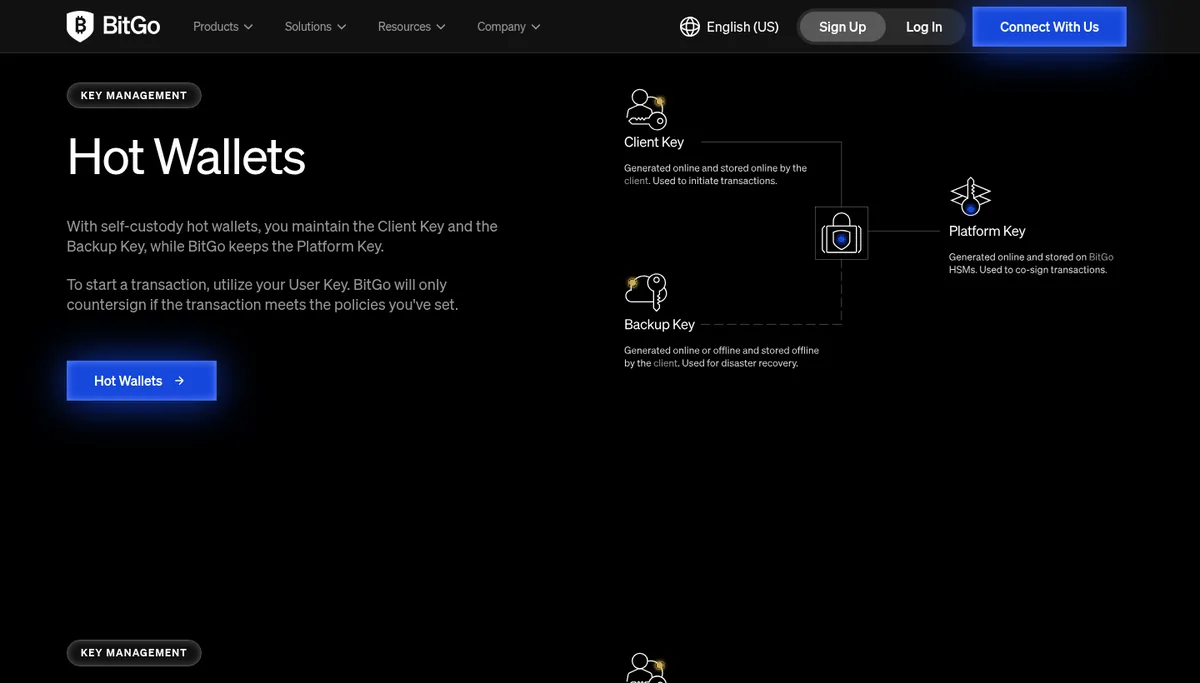
- Key model: hot wallets sign online with BitGo countersigning, and cold wallets are half-signed offline and uploaded for countersigning, per its self-custody page.
- Pricing: self-service self-custody accounts are free of charge, which BitGo says may change, per its billing methodology.
- Regulation: BitGo Bank & Trust, N.A. is an OCC national trust bank, with further entities listed on its licences page.
- Weaknesses: the security page names SOC attestations without the report type, and the free tier’s limits for large programmatic wallet fleets are not stated.
Verdict: BitGo scores 9.3. Choose it when you want MPC or multisig self-custody now and a qualified custodian under the same vendor later. Our custody models guide explains when that move makes sense.
2. Fireblocks
- Security: HSMs, secure enclaves, zero trust architecture and NCC-audited cryptographic libraries, per its security page.
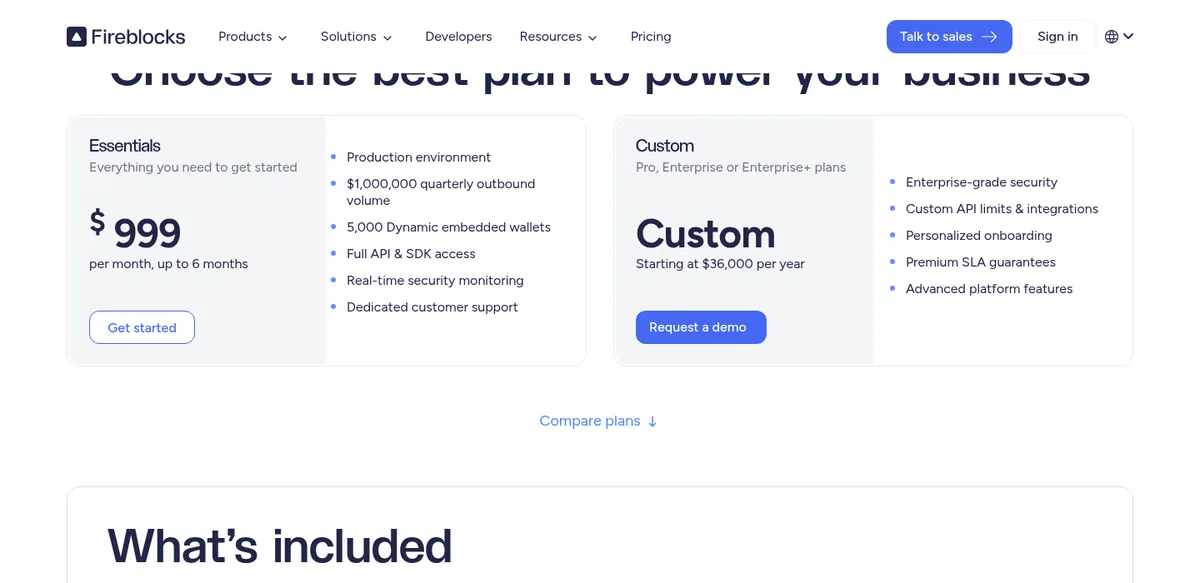
- Pricing: Essentials is $999 a month for up to 6 months with $1M of quarterly outbound volume, 5,000 embedded wallets and 0.20% overage, then Custom from $36,000 a year, per its pricing page.
- Network: 80+ blockchains, 2,000+ counterparties, 30+ exchange integrations and over 99.97% monthly uptime.
- Weaknesses: the Essentials window ends after 6 months, the Custom overage rate is not public, and no self-hosted option is stated on the pages we read.
Verdict: Fireblocks scores 8.8. Choose it when you need the broadest MPC platform, deep exchange connectivity and the strongest audit set, and the budget allows Custom pricing.
3. Cobo
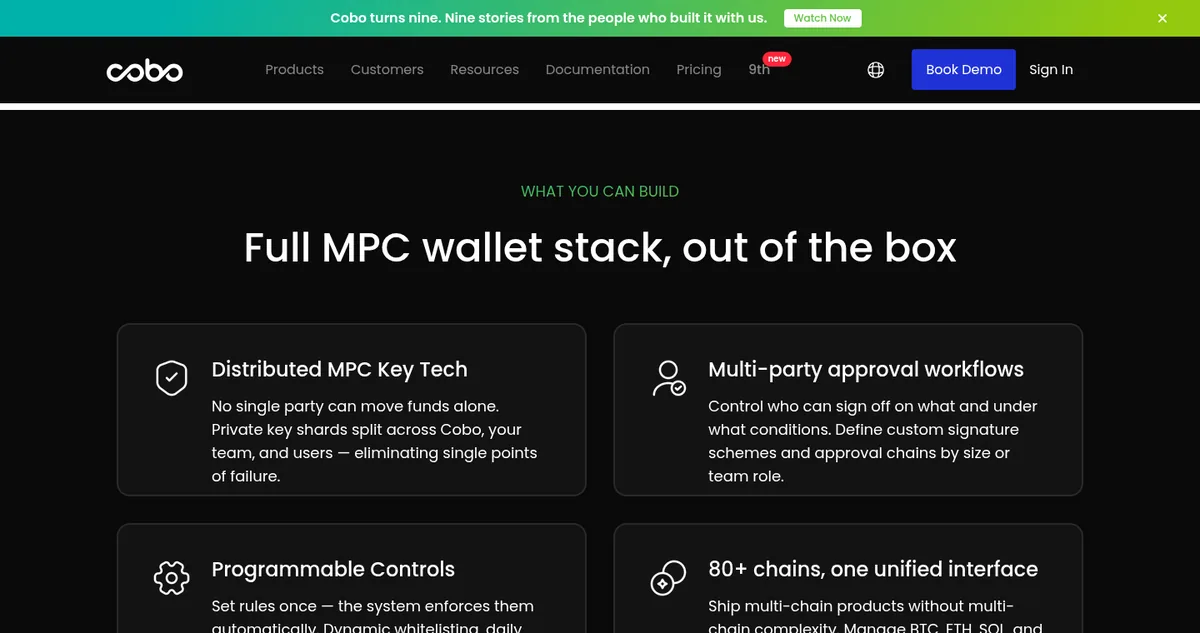
- Plans: Starter $299 a month (2 users, 6,000 addresses, $300K outgoing, 15,000 API calls) and Standard $999 a month (5 users, 12,500 addresses, $1.25M outgoing, 65,000 API calls), per its pricing page.
- Overage: $0.15 per extra address, $100 per extra user, and 0.20% or 0.16% on volume above the plan.
- Audits: SOC 2 Type II and ISO 27001, with a 14-day free trial, per its MPC wallet page.
- Weaknesses: per-address fees make it the most expensive published option at 50,000 wallets, and no insurance amount is stated.
Verdict: Cobo scores 8.3. It is the best value for teams under about 25,000 wallets that want a full public price list.
4. Dfns
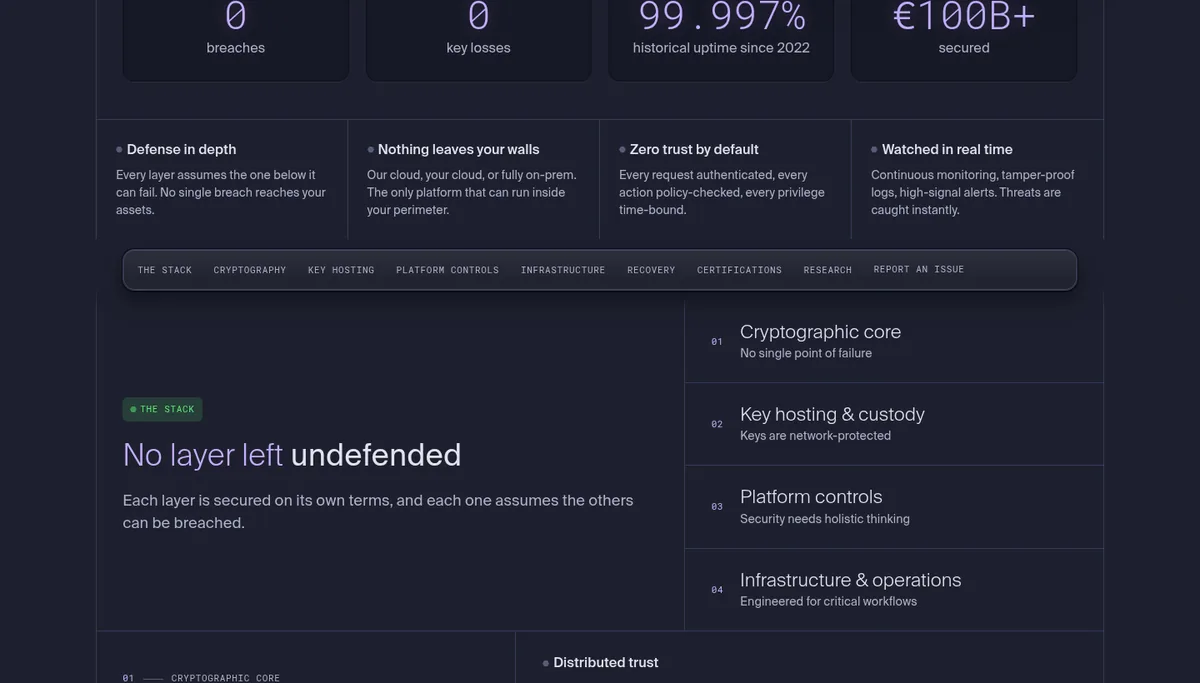
- Deployment: its cloud, your cloud or fully on-premises, inside Intel TDX, AWS Nitro or IBM HPVS enclaves, per its security page.
- Plans: Starter $800 a year (10 wallets), Basic $8,000 (10,000 wallets, 3 blockchains), Pro $35,000 (50,000 wallets plus pay as you go) and custom Enterprise, with no AUM or transaction fees and a 30-day trial, per its pricing page.
- Audits: SOC 2 Type II by Deloitte and ISO 27001, 27017 and 27018 by KPMG.
- Weaknesses: no licence is stated, and signature caps (1,000 a month on Basic) can force an upgrade before wallet limits do.
Verdict: Dfns scores 8.2. Choose it for wallet-heavy products, banks that must self-host, and any team above roughly 5,000 wallets.
5. Fordefi
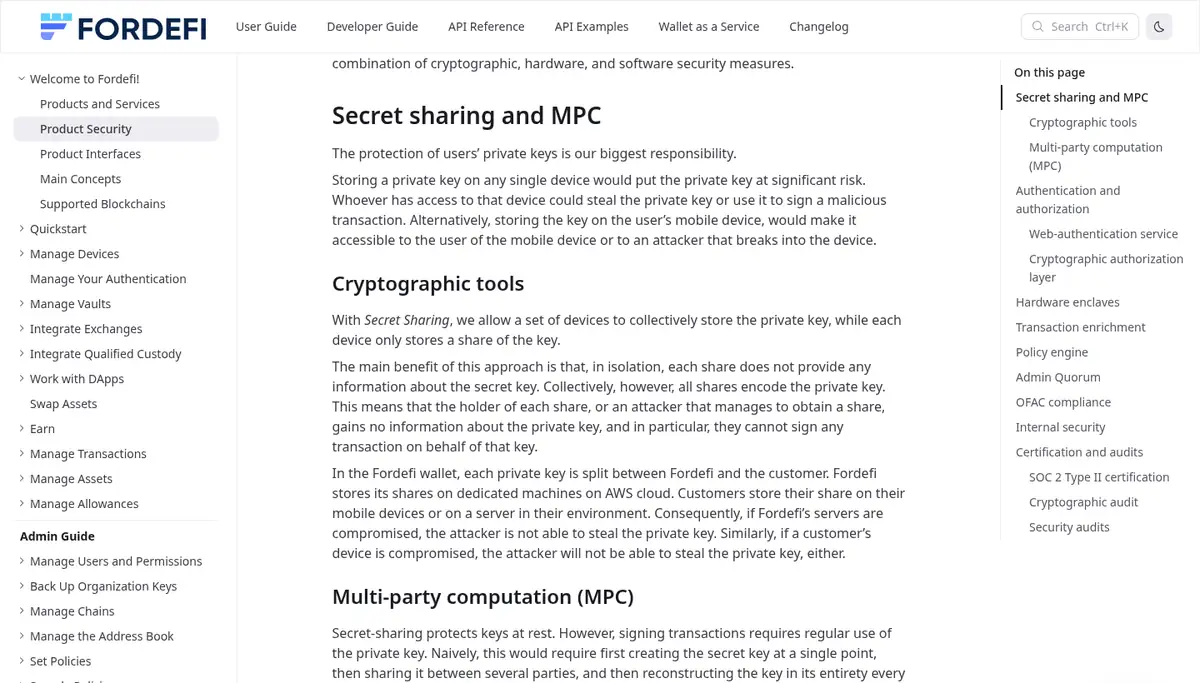
- Security: secret sharing, MPC signing, hardware enclaves and SOC 2 Type II audited by EY, per its product security docs.
- Chains: EVM, SVM, Cosmos, UTXO, Sui, Aptos, TON, Starknet, Stacks, TRON and Stellar, per its supported blockchains list.
- Weaknesses: no public price and no ISO 27001 or insurance named.
Verdict: Fordefi scores 7.1. Pick it when DeFi activity and transaction simulation matter more than a published price.
6. Utila
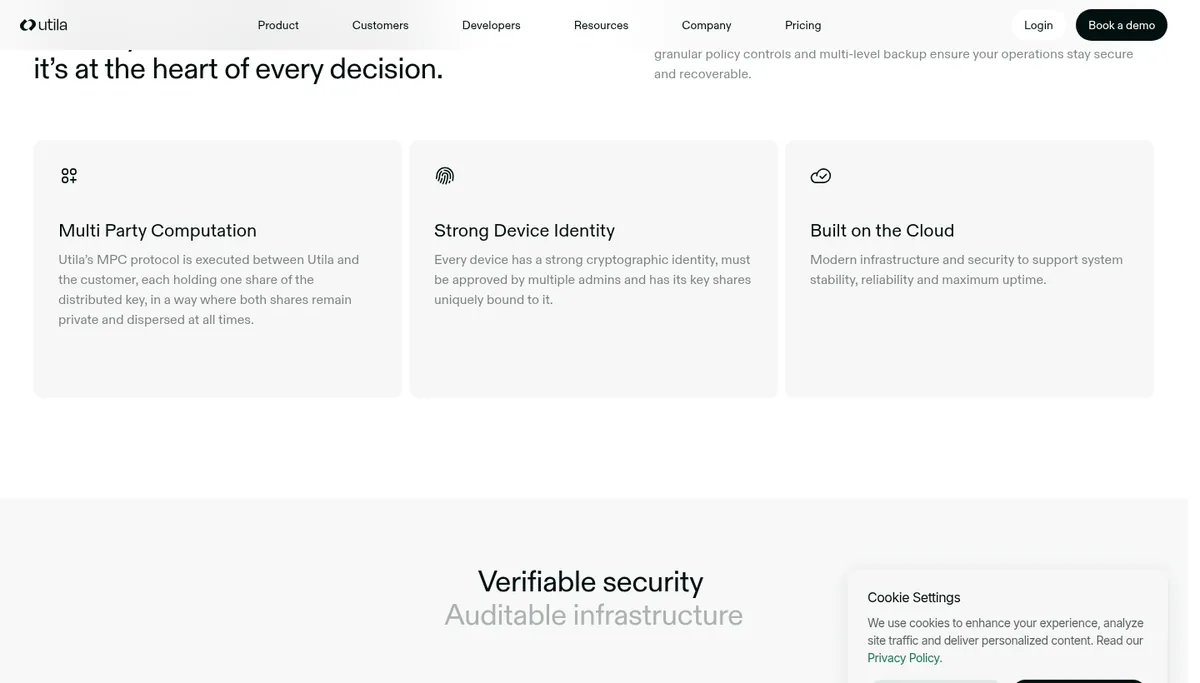
- Plan: Starter $799 a month billed quarterly, with $3M of outbound volume a quarter, 1,000 active wallets, 1 vault and 3 users, per its pricing page. Growth, Pro, Scale and Enterprise are custom.
- Access: biometrics and passkeys protect key shares on each device, per its security page.
- Audits: SOC 2 Type II.
- Weaknesses: no ISO 27001 or insurance named, and no public price above 1,000 wallets.
Verdict: Utila scores 6.7. Choose it for stablecoin payment and treasury teams under 1,000 wallets that want one flat monthly fee.
7. Safeheron
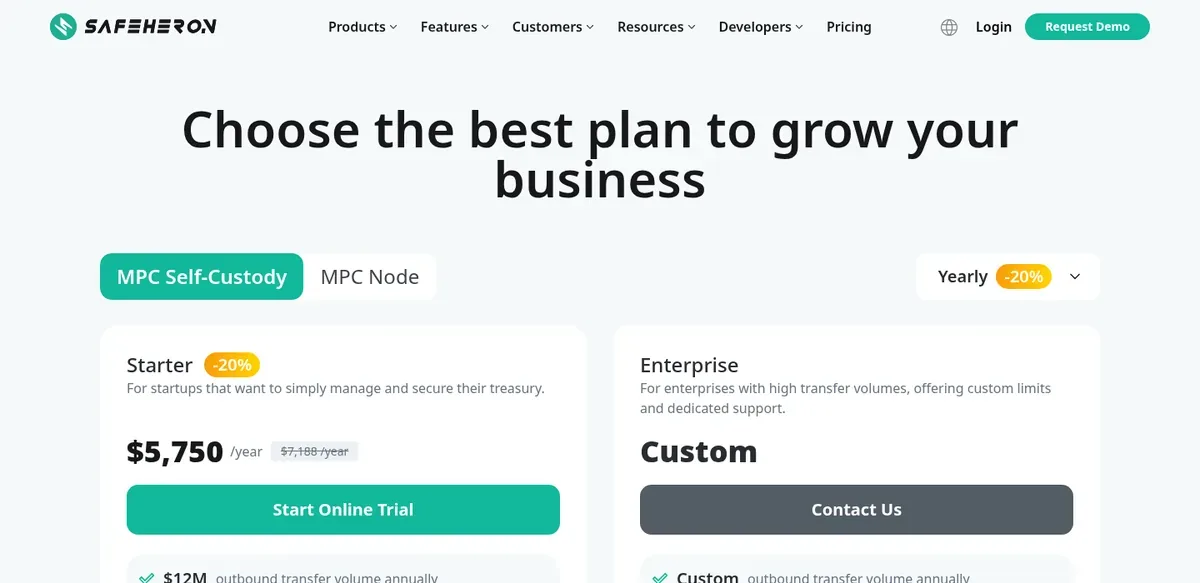
- Plan: Starter $5,750 a year billed yearly or $7,188 billed monthly, with $12M of outbound volume a year, 0.1% overage, 1,000 wallets, 2 teams and 3 users, per its pricing page.
- Audits: ISO/IEC 27001:2022 and SOC 2, with insurance through Lockton and no amount stated, per its home page.
- Weaknesses: no licence, no insurance limit and a less specific chain list than Cobo or Dfns.
Verdict: Safeheron scores 6.7. Choose it when you want auditable open-source MPC and a low annual price between 1,000 and about 5,000 wallets.
8. Liminal
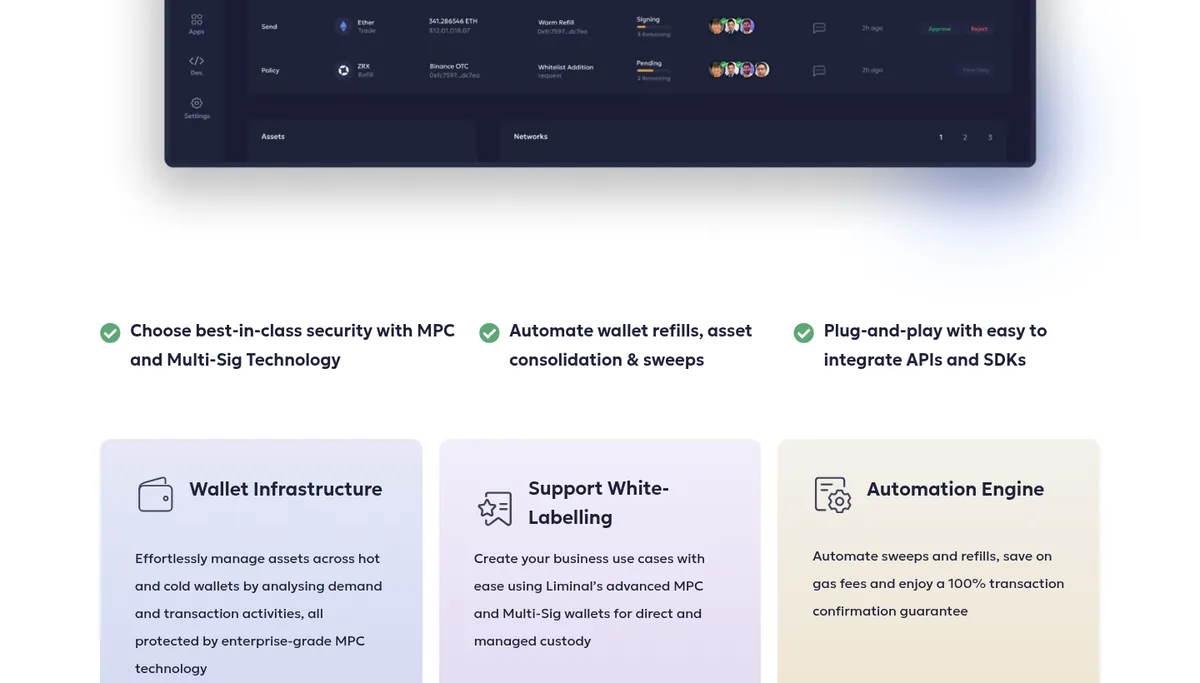
- Incident: WazirX blamed a mismatch between what Liminal’s interface displayed and what was signed, per TechCrunch. Liminal says the wallet was created outside its platform and its own infrastructure stayed secure, per its statement.
- Audits: ISO and SOC 2 Type 2 certifications, per its home page.
- Features: wallet-as-a-service APIs, Travel Rule tooling and staking through Figment-powered nodes.
- Weaknesses: no public price, no chain count and no insurance amount stated.
Verdict: Liminal scores 6.4. Consider it for exchange hot and cold wallet automation, and ask for its post-incident forensic reports during due diligence.
Which Providers We Left Out
We left out qualified custodians without a self-serve MPC wallet product, such as Anchorage Digital and Coinbase Prime, and Copper, whose MPC sits inside a custody service. Consumer MPC wallets and embedded wallet SDKs for retail apps are a different market and are out of scope.
Final Ranking
BitGo and Fireblocks lead on governance and audits, Cobo and Dfns on published pricing, and the remaining four each win a narrower use case.








Verdict: Shortlist BitGo or Fireblocks for governance, Dfns for self-hosting and scale, and Cobo for the lowest published price under 10,000 wallets.
Comparing custodians as well as wallet software? See our institutional custodians hub and the wider MPC wallets and key management hub.
Frequently Asked Questions
What is the best MPC wallet provider for institutions?
BitGo scores highest at 9.3 because it combines multisig and threshold signing with an OCC chartered trust bank and a free self-service tier. Fireblocks is close at 8.8 and has the widest audit set and network. Cobo (8.3) and Dfns (8.2) lead the software-only providers on published pricing.
How much does an MPC wallet cost for 10,000 wallets?
On list prices checked 25 October 2026, with 3 users and $250K of outbound volume a quarter, year one costs $8,000 on Dfns Basic, $11,150 on Safeheron Starter and $11,988 on Cobo. Fireblocks starts at its $36,000 Custom floor, because Essentials includes 5,000 wallets.
Which MPC wallet providers can run on-premises?
On the pages we read, Dfns offers hybrid deployment on Pro and full on-premises deployment on Enterprise, in Intel TDX, AWS Nitro or IBM HPVS enclaves. Safeheron sells an MPC Node suite as a privatized white-label deployment. Fordefi lets the customer hold its own share on a server.
Is an MPC wallet provider a qualified custodian?
No. MPC wallet software leaves signing control with your team and the vendor, and a software vendor is not a custodian. BitGo runs an OCC chartered trust bank and Fordefi is now owned by Paxos, but qualified custody is a separate contract from the wallet software, with its own terms.
What is the difference between two-party and multi-party MPC?
In two-party MPC, such as Utila and Fordefi, the vendor and the customer each hold one key share, and both must take part to sign. Multi-party designs, such as Cobo and Dfns, spread shares across more parties or isolated signers, so signing can continue when one share holder is offline.
Which MPC wallet providers have had security incidents?
Of the eight we ranked, Liminal is linked to a major loss: in July 2024 WazirX lost over $230M from a multisig wallet it operated through Liminal’s platform. Liminal says the wallet was created outside its platform and its infrastructure stayed secure. Ask every vendor for incident history and forensic reports.