
Last updated: 25 October 2026 · Plans, limits, audit reports, deployment options and key-share designs rechecked on Fireblocks, Utila and Dfns pages on 25 October 2026
Fireblocks vs Utila vs Dfns is a choice between three ways of splitting a private key. Fireblocks is the broadest platform, with a counterparty network, a trust company and three key shares across secure enclaves. Dfns is the developer pick, with flat public pricing, no volume fees and the only on-premises option of the three. Utila is the cheapest way for a stablecoin or treasury team to move up to $3M a quarter, using a simple two-share design.
We scored all three on the same six weighted criteria we use across our MPC wallets and key management hub, drew who holds each key share, and priced year one in three operating scenarios from public list prices checked on 25 October 2026. Two of the top results for this query are written by Fireblocks and Utila about each other, so we used each vendor’s own product pages for facts and treated their comparisons as claims. For the full field, see our ranking of the best MPC wallet providers and our list of Fireblocks alternatives.
TL;DR
- Scores out of 10: Fireblocks 8.8, Dfns 8.2, Utila 6.7. Fireblocks wins on network and regulation, Dfns on pricing transparency and deployment choice, Utila on entry price for payment volume.
- Key shares: Fireblocks uses three (yours plus two Fireblocks cloud co-signers), Utila uses two (yours plus Utila’s), and Dfns runs a threshold quorum of signers that you can host yourself on its Enterprise plan.
- Entry prices: Fireblocks Essentials $999 a month for up to 6 months, Utila Starter $799 a month on a 12-month term, Dfns Basic $8,000 a year. Only Fireblocks charges on volume: 0.20% over $1M a quarter.
- Year one for a treasury desk moving $2M a quarter on 3 chains: Dfns $8,000, Utila $9,588, Fireblocks $27,994. Add a fourth chain and Dfns jumps to Pro at $35,000.
- Audits: Fireblocks names SOC 2 Type 2, ISO 27001 and CCSS QSP Level 3. Dfns names SOC 2 Type II (Deloitte) and ISO 27001, 27017 and 27018 (KPMG). Utila names SOC 2 Type II and a Halborn audit.
- Only Fireblocks offers a regulated custodian (Fireblocks Trust Company, NYDFS). Dfns calls itself deliberately unlicensed, and Utila is a non-custodial technology provider. If you need a chartered custodian rather than software, our Fireblocks vs BitGo vs Anchorage Digital comparison covers that choice.
The Decision Kernel
Start with two questions: how many chains you need in year one, and whether your signing has to run inside your own infrastructure. Chain count decides the Dfns price, outbound volume decides the Fireblocks price, and Utila is flat until $3M a quarter or 1,000 wallets.
- Pick Fireblocks if you need many counterparties, 30+ exchange connections, off-exchange settlement or a path to a qualified custodian under the same vendor.
- Pick Dfns if developers are building wallets into a product, you want predictable per-plan pricing with no transaction fees, or a regulator expects signers on your own premises.
- Pick Utila if an operations team runs stablecoin payouts or treasury across a few thousand wallets at most, and you want 24/7 support on the entry plan.
- Shortlist two if you are unsure. Dfns offers a 30-day trial, and both Utila and Fireblocks publish self-serve entry plans, so a two-week pilot of each is cheap.
Verdict: Fireblocks for network reach and regulated custody, Dfns for developer teams and self-hosted signing, Utila for the lowest cost per dollar moved on a payments or treasury desk.
How We Compared the Three
We scored each platform from 1 to 5 on the six weighted criteria from our digital asset custody hub, using vendor pages read on 25 October 2026. Anything a vendor does not state on its own site scored as not disclosed, even when a competitor claims it. The full rules are on our methodology page and our editorial policy.
- Regulation and segregation, 25%: licences held by the vendor or its group companies, and whether a regulated custodian is available.
- Security and key control, 20%: MPC design, enclaves, who holds which share, recovery and approval policies.
- Audits and insurance disclosure, 15%: SOC 2 Type II, ISO certifications, CCSS, cryptography audits and stated insurance.
- Features, 15%: policy engine, API co-signers, exchange and counterparty connections, DeFi and staking.
- Coverage, 15%: supported chains, deployment models and regions served.
- Pricing transparency, 10%: 5 for a full public price list, 4 for a public entry price with overage terms, 3 for an entry price only, 1 for nothing.
| Platform | Regulation (25%) | Security (20%) | Audits (15%) | Features (15%) | Coverage (15%) | Pricing (10%) | Score |
|---|---|---|---|---|---|---|---|
 | 3 | 5 | 5 | 5 | 5 | 4 | 8.8 |
 | 2 | 5 | 5 | 5 | 4 | 5 | 8.2 |
 | 2 | 4 | 3 | 4 | 4 | 4 | 6.7 |
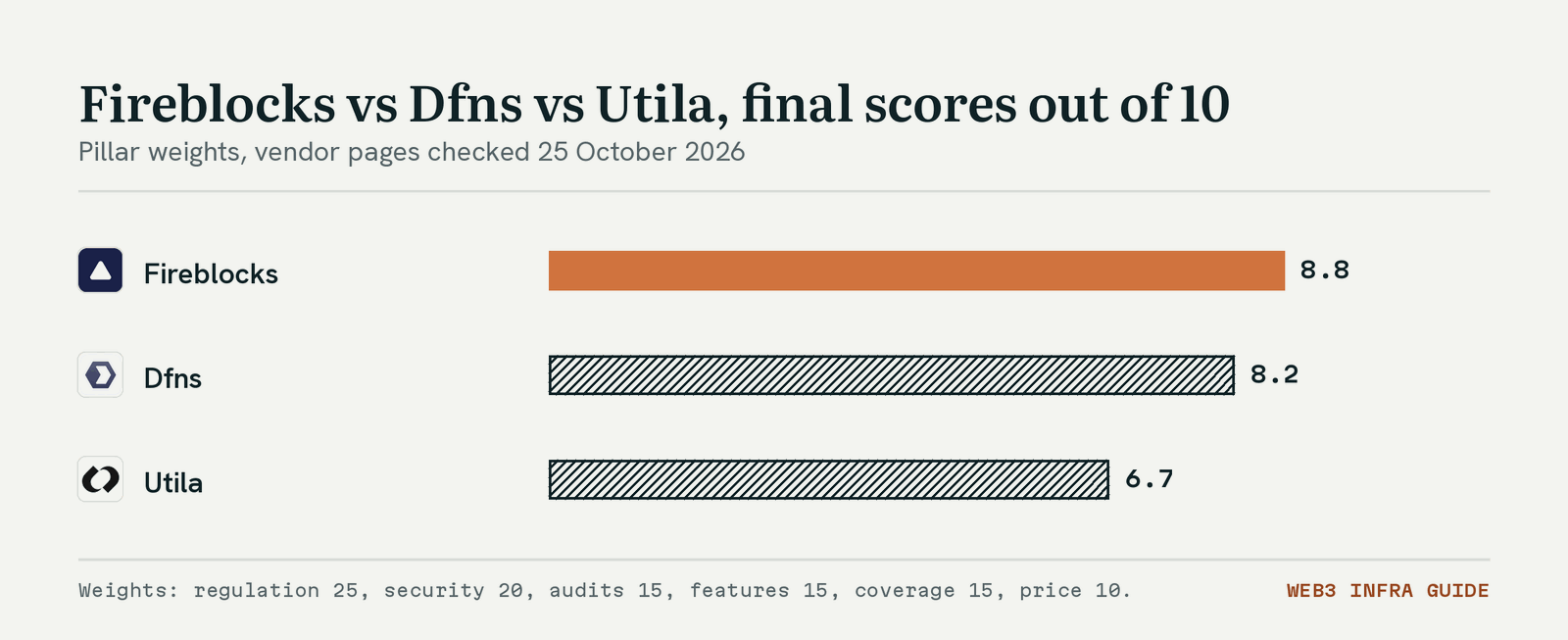
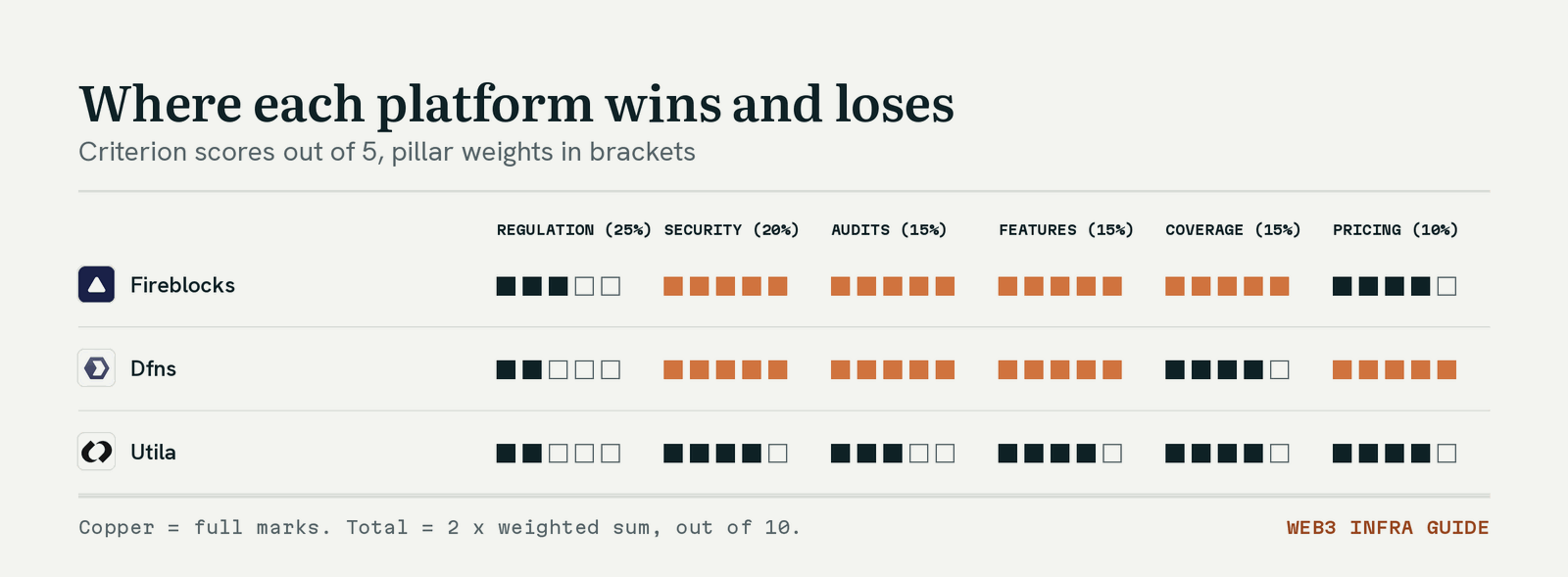
The grid explains the gap. Fireblocks and Dfns tie on security, audits and features. Fireblocks gains a point on regulation through its NYDFS trust company and a point on coverage, while Dfns gains a point on pricing because it publishes all four plans. Utila loses most on audits, where it names one SOC 2 report and one third-party audit, and on regulation, where it holds no licence we could find on its site.
Fireblocks vs Utila vs Dfns at a Glance
This table uses only what each vendor states on its own pricing, security and product pages, so it can be pasted into a vendor due diligence questionnaire as a starting point. The three differ most on deployment: Fireblocks and Utila run as SaaS, while Dfns sells SaaS, hybrid and fully on-premises signing.
| Fireblocks | Utila | Dfns | |
|---|---|---|---|
| Best for | Exchanges, banks, PSPs and fintechs that need a counterparty network | Stablecoin payments, treasury and fund operations teams | Developers embedding wallets, and institutions that self-host |
| MPC design | MPC-CMP, 3 shares: yours plus 2 Fireblocks cloud co-signers | 2-party MPC (DKLS23): yours plus Utila’s | Threshold signing (TSS) across a signer quorum |
| Secure enclaves | Intel SGX, AWS Nitro, Google Confidential Space | Not named; device-bound shares with biometrics or passkeys | Intel TDX, AWS Nitro, IBM HPVS |
| Deployment | SaaS; API Co-signer on cloud or on-prem SGX | SaaS; API co-signer | SaaS, hybrid (Pro) or on-premises (Enterprise) |
| Audits named | SOC 2 Type 2, ISO 27001, CCSS QSP Level 3, NCC library audit | SOC 2 Type II, Halborn audit | SOC 2 Type II (Deloitte), ISO 27001, 27017, 27018 (KPMG) |
| Regulated entity | Fireblocks Trust Company, LLC (NYDFS) | None stated | None; deliberately unlicensed |
| Chains (own pricing page) | 80+ blockchains | All supported chains on Starter | 1 to all, by plan; 100+ on its home page |
| Entry price | $999 a month, up to 6 months | $799 a month, 12-month term | $800 a year (Starter), $8,000 a year (Basic) |
| Volume fees | 0.20% over $1M a quarter on Essentials | None up to $3M a quarter | None at any tier |
| Support on entry plan | 8×5 | 24/7 chat | 48-hour response on Basic |
| Stated uptime | 99.97%+ monthly | 99.99% service uptime | 99.95% SLA; 99.997% historical |
Who Holds the Key Shares
All three platforms promise that no complete private key ever exists, but they split the key in very different ways. The question to ask is not whether a vendor uses MPC, but how many shares exist, who runs each one, and what happens if the vendor goes offline.
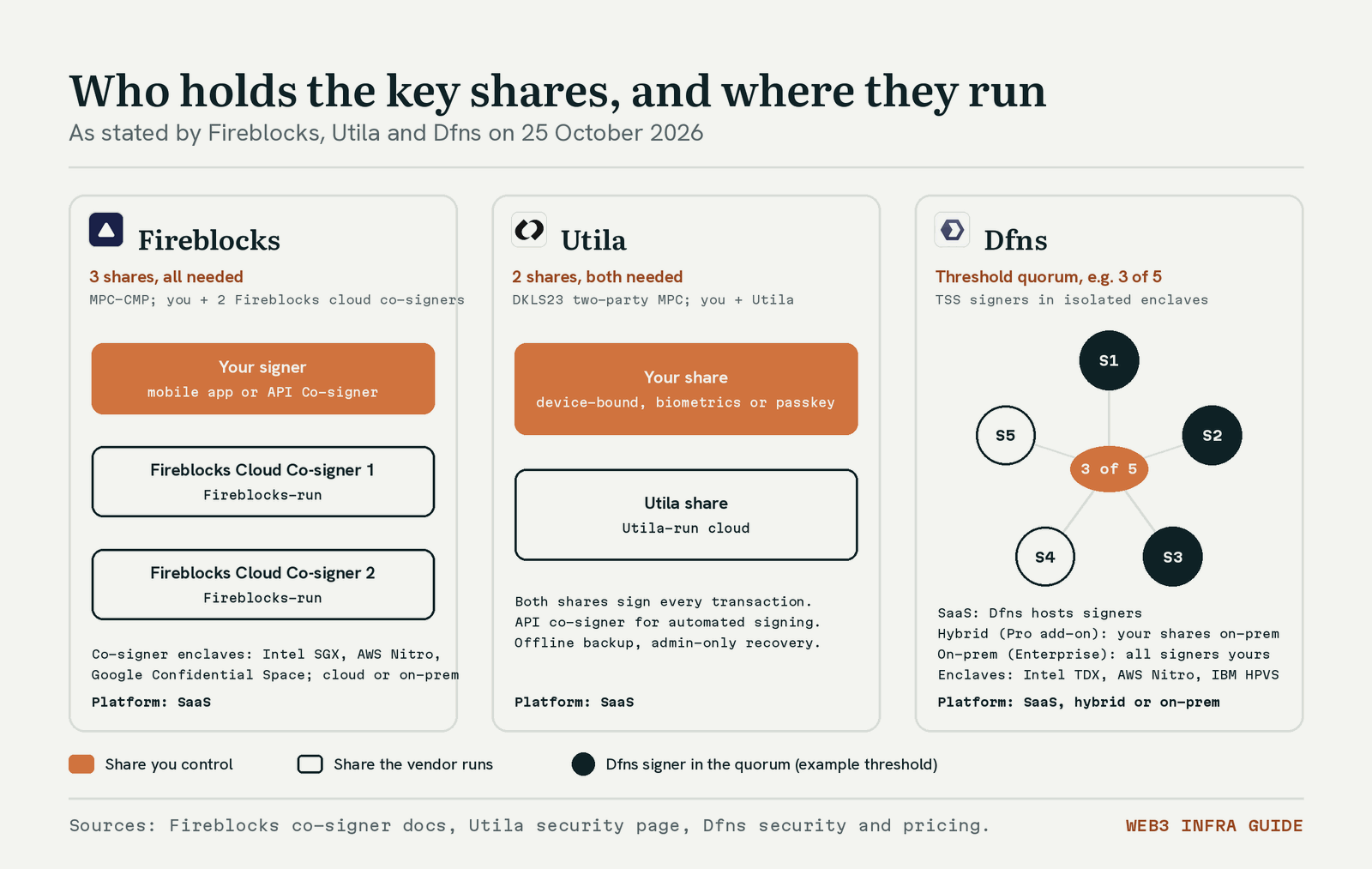
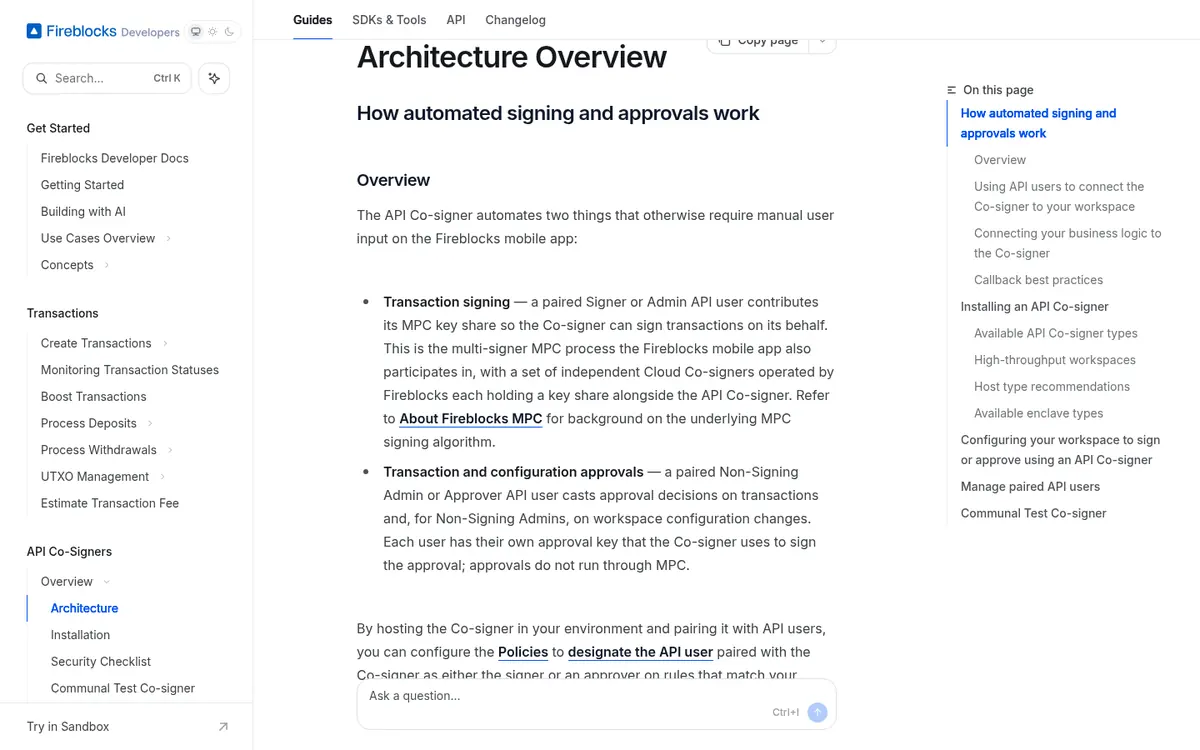
- Fireblocks: per its co-signer architecture docs, a workspace has three shares. You hold one in the mobile app or a self-hosted API Co-signer, and Fireblocks runs Cloud Co-signers 1 and 2 in Intel SGX, AWS Nitro or Google Confidential Space enclaves. The docs size API Co-signers at about one per 2.5 transactions per second.
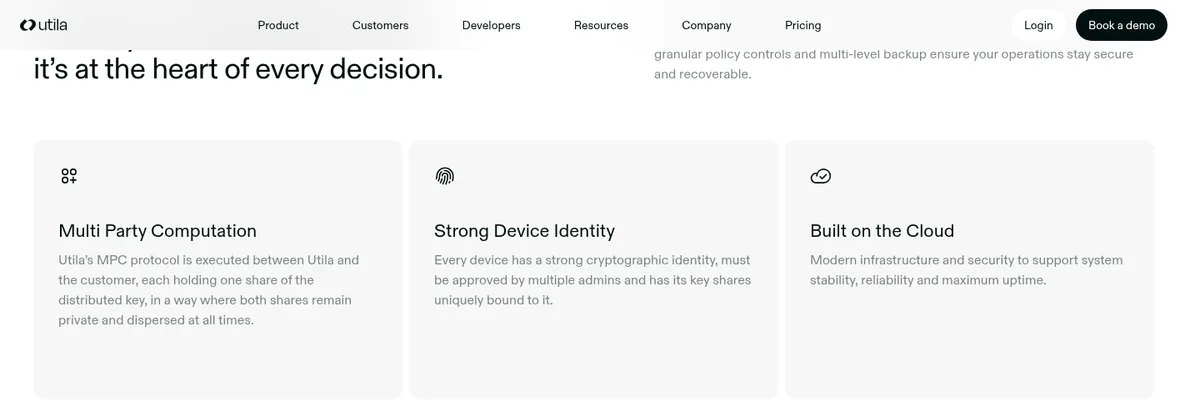
- Utila: per its security page, the key is split between Utila and you. Your share is bound to a device approved by multiple admins and unlocked with biometrics or passkeys, shares propagate end to end encrypted between devices, and an offline backup can be recovered only by admins.
- Dfns: per its security page, keys are generated and used through threshold signatures by signers running in Intel TDX, AWS Nitro or IBM HPVS enclaves. Pro adds hybrid deployments, and Enterprise lets you host all signers on premises.
Recovery follows from the layout. With two shares, Utila and you must both be available to sign, so its offline backup and admin-only recovery are what protect you if Utila is unreachable. Fireblocks holds two of three shares, so its documented backup and recovery tooling matters most. Dfns on premises removes the vendor from the signing path entirely, which is why regulated institutions with data residency rules shortlist it.
What Each Platform Costs in Year One
Each vendor prices on a different meter. Fireblocks meters outbound volume, Utila meters volume and active wallets with a hard plan cap, and Dfns meters chains, signatures, users and wallets but never volume. At $3M of outbound volume a quarter, Fireblocks Essentials costs $2,332 per $1M moved, Utila Starter $799 and Dfns Basic $667.
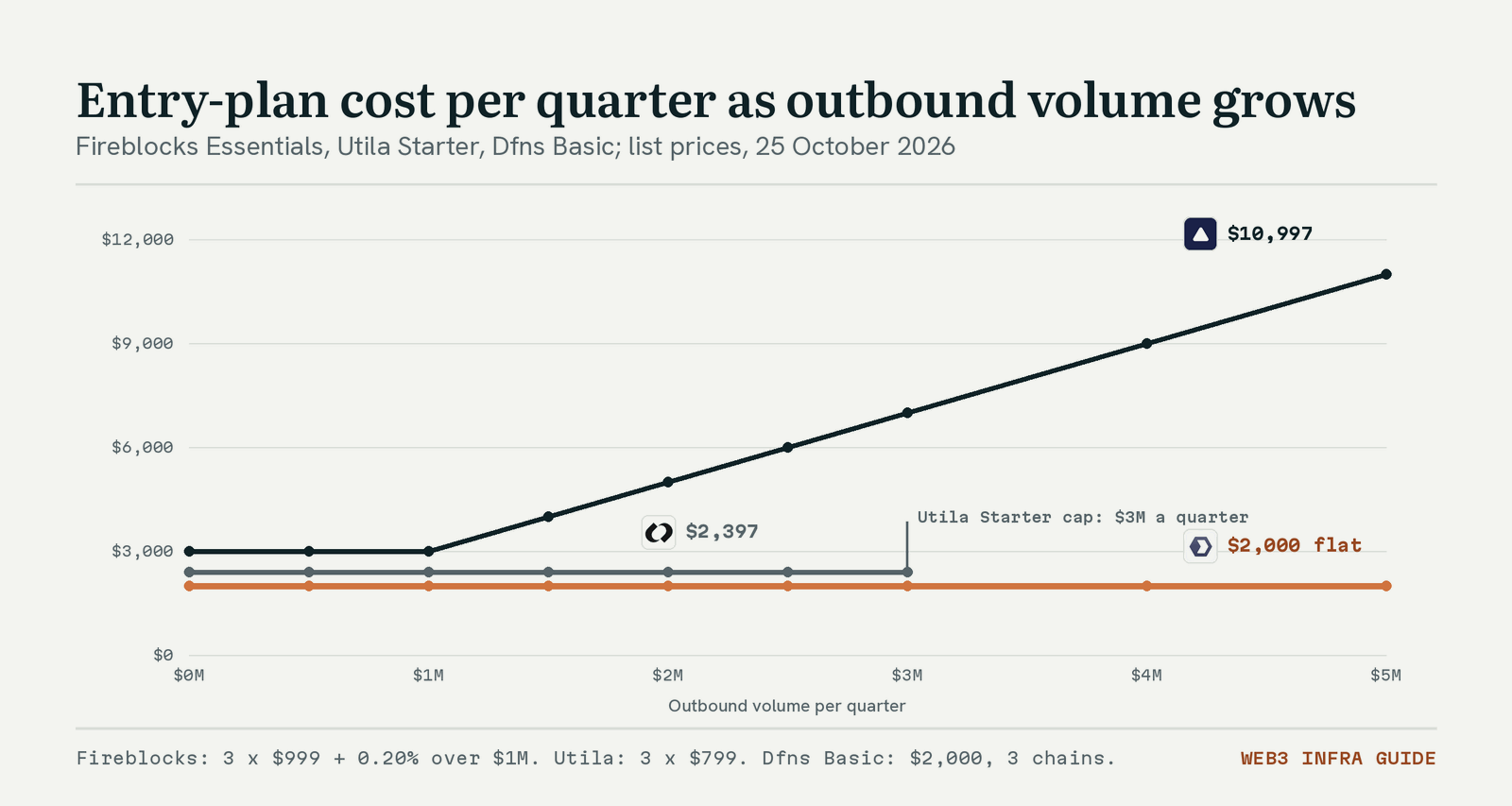
Every extra $1M a quarter above the first $1M adds $2,000 to a Fireblocks Essentials bill, so at $5M a quarter Essentials costs $10,997 against a flat $2,000 on Dfns Basic. Utila Starter stays at $2,397 a quarter until you pass $3M or 1,000 active wallets, and then you move to a custom plan.
# Quarterly list price, 25 October 2026
fireblocks_essentials = 3 * 999 + 0.002 * max(0, outbound-1_000_000)   # up to 6 months, 5,000 wallets
utila_starter         = 3 * 799                                         # outbound <= $3M, wallets <= 1,000
dfns_basic            = 8_000 / 4                                       # 3 chains, 1,000 signatures a month
dfns_pro              = 35_000 / 4                                      # all chains, 10,000 signatures a month
# Fireblocks after 6 months: Custom from 36_000 a year, so year one = 2 quarters Essentials + 18_000
The max(0, outbound-1_000_000) term is the only volume charge across the three entry plans. We then modelled three common teams for a full first year.
| Scenario | Fireblocks | Utila | Dfns |
|---|---|---|---|
| A: Treasury desk. 25 wallets, 3 users, 3 chains, $2M outbound a quarter, 200 signatures a month | $27,994 | $9,588 (Starter) | $8,000 (Basic) |
| B: Stablecoin payments. 1,000 wallets, 3 users, 6 chains, $3M a quarter, 900 signatures a month | $31,994 | $9,588 (Starter) | $35,000 (Pro, needs 4+ chains) |
| C: Wallet-as-a-service app. 20,000 wallets, 5 users, 6 chains, $10M a quarter, 8,000 signatures a month | From $36,000 (Custom floor) | Custom quote | $35,000 (Pro) |
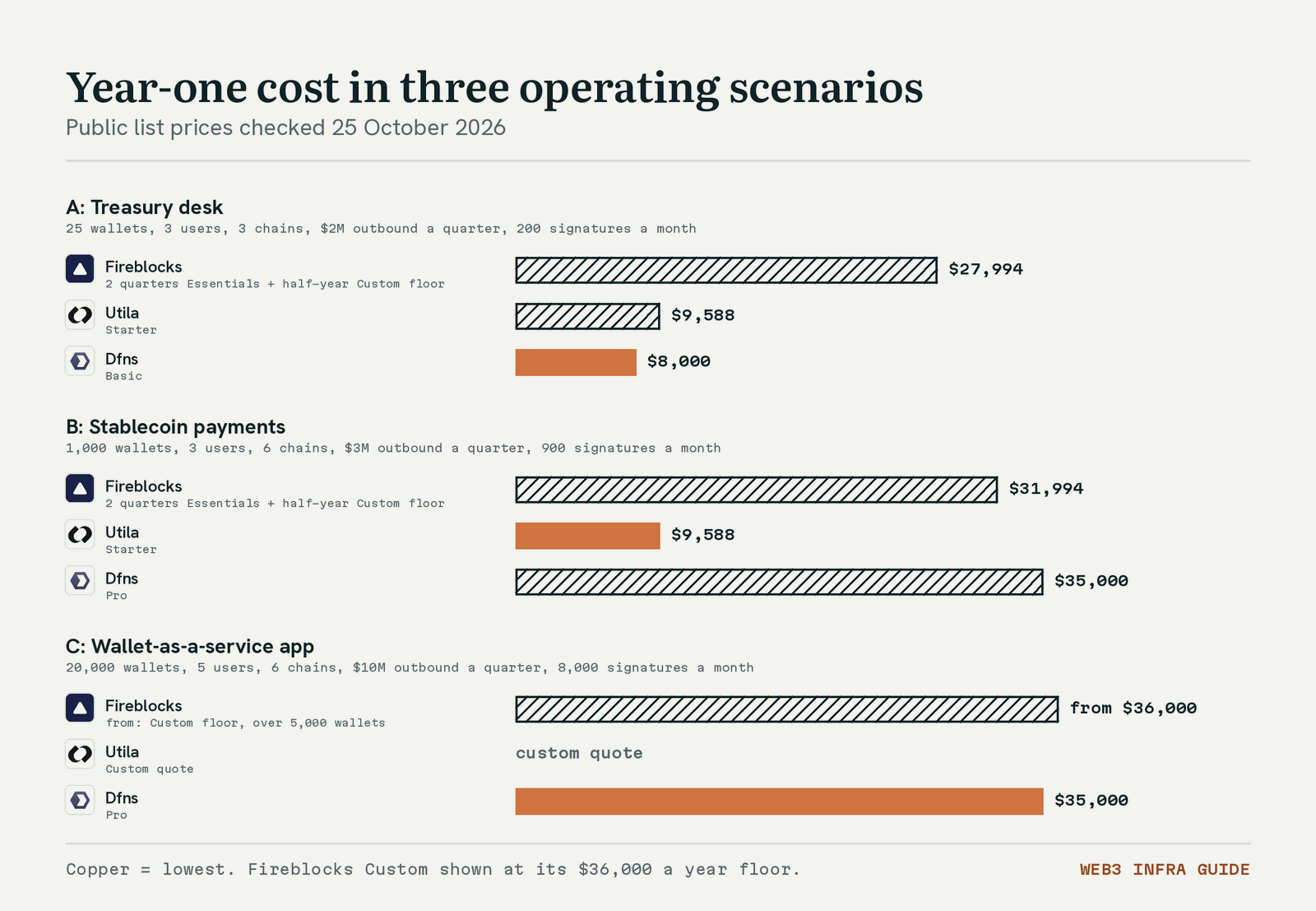
Two cliffs matter more than the headline prices. Dfns Basic covers 3 chains and 1,000 signatures a month, so a fourth chain or a busy payout run moves you to Pro at $35,000, which is $25,412 more than Utila Starter in scenario B. Fireblocks Essentials ends after 6 months, so year two on Fireblocks starts at $36,000 even if your volume stays small.
Per wallet at each plan’s cap, the order flips again: Dfns Pro works out to $0.058 per wallet a month, Dfns Basic $0.067, Fireblocks Essentials $0.20 and Utila Starter $0.80. Wallet-heavy consumer products favour Dfns, while volume-heavy treasury desks with few wallets favour Utila.
Verdict: Dfns is cheapest when you stay within 3 chains or need tens of thousands of wallets, Utila is cheapest for payment volume up to $3M a quarter, and Fireblocks costs the most at every point we modelled.
1. Fireblocks
- Security: SOC 2 Type 2 with zero material findings, ISO 27001, CCSS QSP Level 3, NCC-audited cryptography libraries and a 24/7 security operations centre, per its security page.
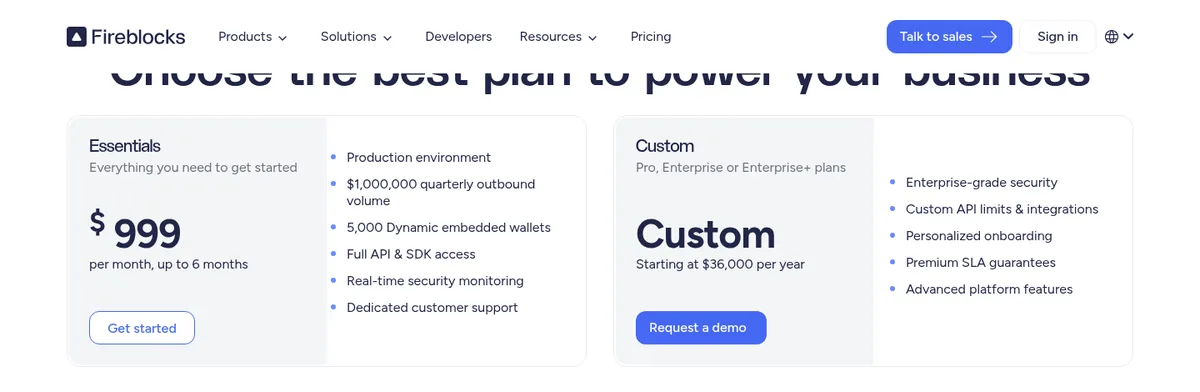
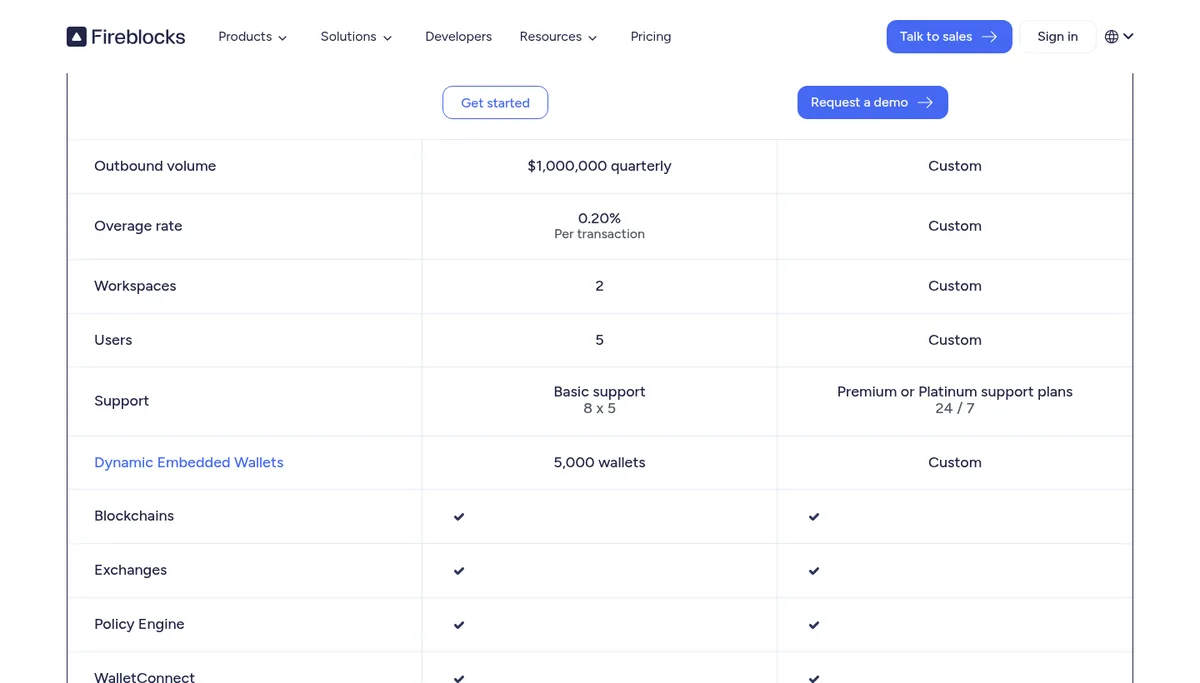
- Plans: Essentials includes $1M of outbound volume a quarter, 0.20% overage per transaction, 2 workspaces, 5 users, 8×5 support and 5,000 embedded wallets. Pro, Enterprise and Enterprise+ start at $36,000 a year, per its pricing page.
- Custody: Fireblocks Trust Company is an NYDFS limited purpose trust company, sold under a separate contract.
- Weaknesses: the highest cost at every volume we modelled, Essentials capped at 6 months, 8×5 support on the entry plan and no stated insurance amount.
Verdict: Fireblocks scores 8.8. Pick it when your business depends on moving assets between many counterparties and exchanges, or when you may need a qualified custodian later. Our custody models guide sets MPC against qualified custody and self-custody.
2. Dfns
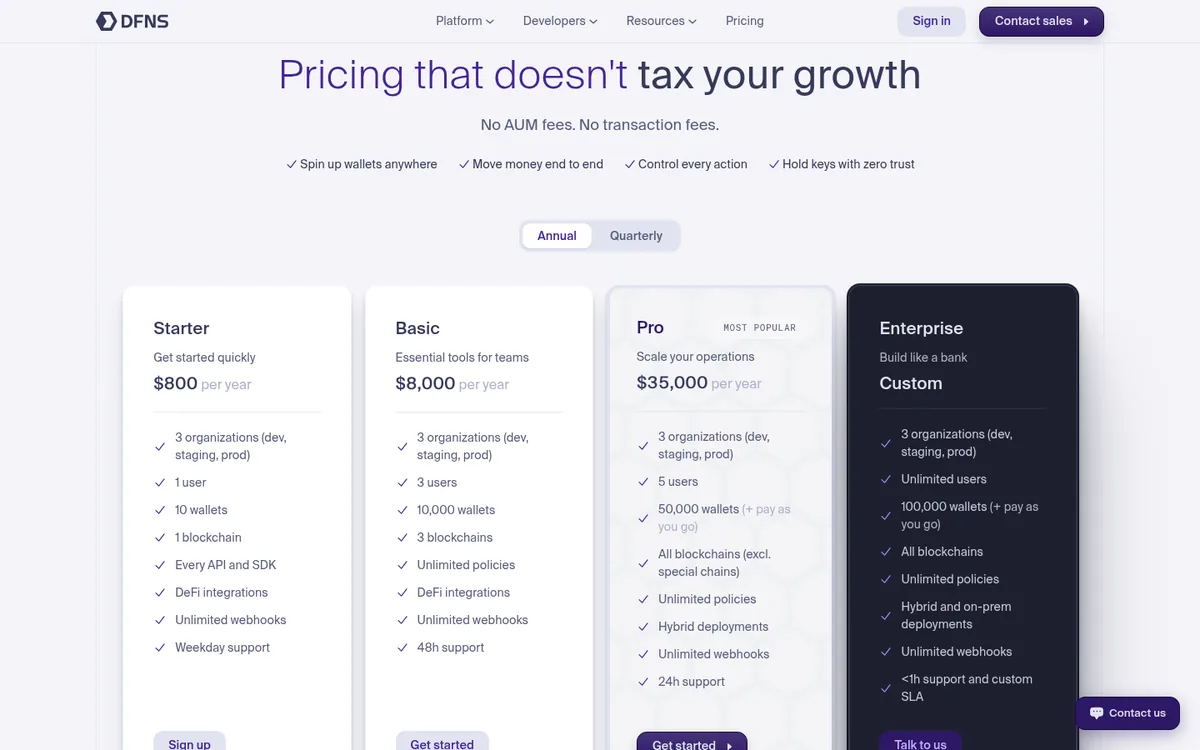
- Plans: Starter $800 a year (1 user, 10 wallets, 1 chain, 100 signatures a month), Basic $8,000 (3 users, 10,000 wallets, 3 chains, 1,000 signatures), Pro $35,000 (5 users, 50,000 wallets, all chains except special chains, 10,000 signatures, hybrid deployment), Enterprise custom, per its pricing page.
- Terms: no AUM or transaction fees, a 30-day free trial, a 99.95% uptime SLA, key import and export from Pro, and a bring-your-own-HSM add-on.
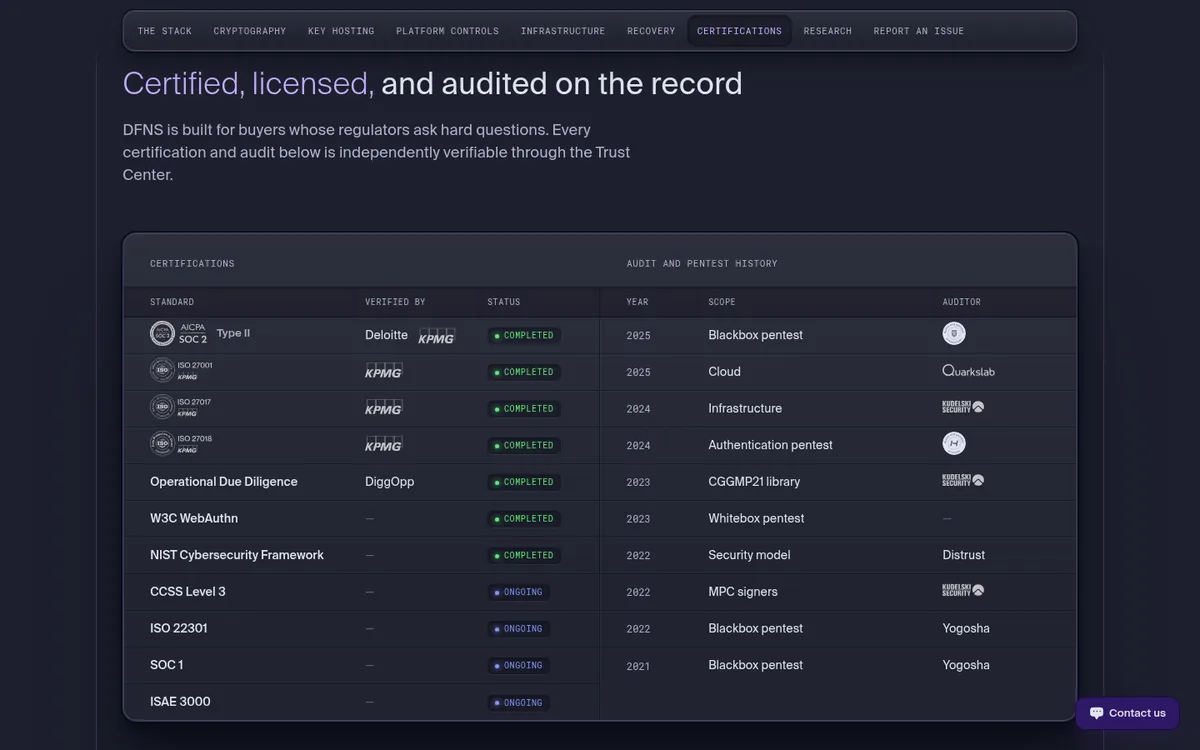
- Assurance: SOC 2 Type II by Deloitte and ISO 27001, 27017 and 27018 by KPMG, with CCSS Level 3, ISO 22301, SOC 1 and ISAE 3000 listed as in progress on its security page.
- Weaknesses: deliberately unlicensed, so no regulated custodian; the 3-chain limit on Basic; 48-hour support on Basic; insurance named (crime, E&O, cyber) without an amount.
Verdict: Dfns scores 8.2. Pick it when engineers are building wallets into a product, when you want no volume fees, or when signers must run inside your own data centre.
3. Utila
- Plan: Starter is $799 a month billed quarterly on a 12-month term, with $3M outbound a quarter, 1,000 active wallets, 1 vault, 3 users, all supported chains, limited DeFi access, one exchange connection and 24/7 chat, per its pricing page. Growth, Pro, Scale and Enterprise are custom.
- Operations: an API co-signer for automated signing, Bring Your Own EVM to add EVM networks yourself, and Utila Link for payment and liquidity partners.
- Security: SOC 2 Type II and a Halborn audit, device-bound shares, passkeys and third-party backup, per its security page.
- Weaknesses: fewer named audits, no regulated entity, only one exchange connection on Starter, and no published chain count or custom-plan prices.
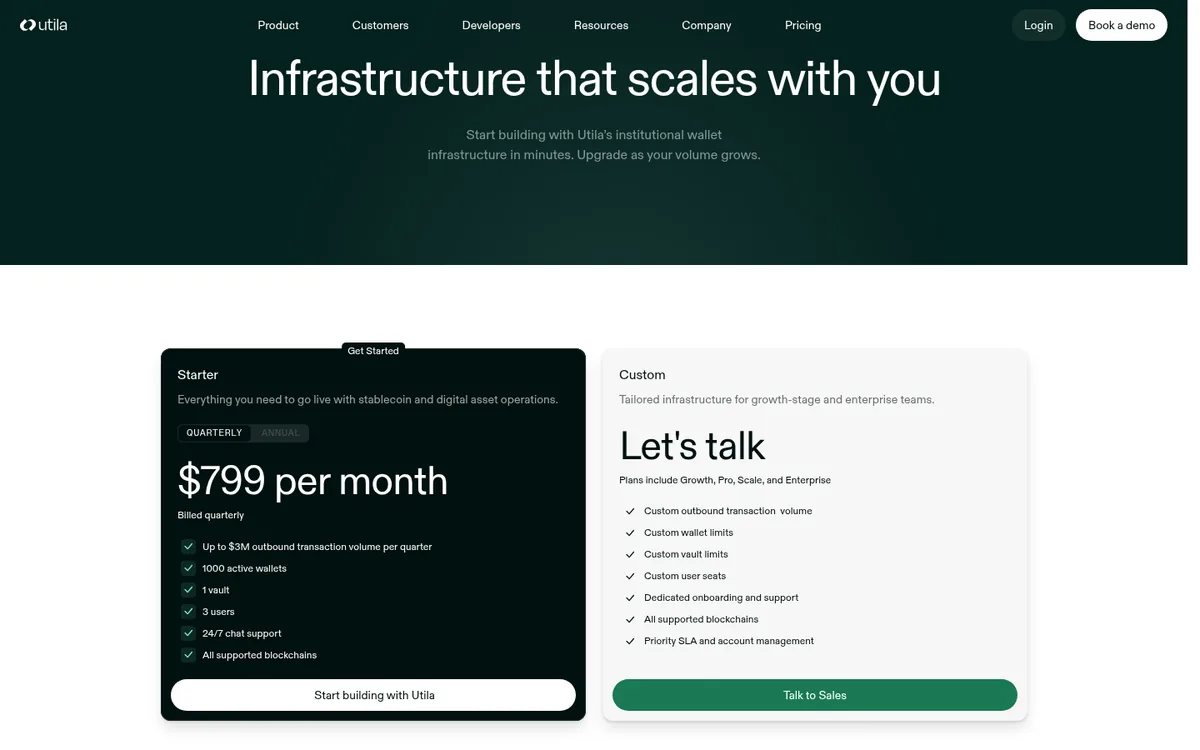
Verdict: Utila scores 6.7. Pick it when a payments or treasury team needs a low, flat price for real volume and round-the-clock support from day one. Our crypto treasury management platforms guide compares it with other tools built for finance teams.
Where the Vendor Comparisons Disagree
Much of what ranks for this query is written by the vendors themselves, and their numbers do not line up. Fireblocks gives at least three different chain counts for itself, so ask every vendor for a list of the exact chains your flows need, not a total.
- Fireblocks chain count: 80+ blockchains on its pricing page, 150+ in the body of its blockchain integrations page, which is headed 200+, and 200+ networks in its own comparison with Utila. Utila’s comparison blog puts Fireblocks at 125+.
- Counterparty network: 2,000+ counterparties on the Fireblocks pricing page, 2,400+ institutions on its security page and 2,500+ businesses in its wallet-as-a-service comparison.
- Dfns signing: the Fireblocks comparison says Dfns signing depends on Dfns-operated components. Dfns’ pricing page lists hybrid deployment on Pro and full on-premises deployment on Enterprise, so this is true for SaaS and Basic but not for every plan.
- Utila’s design: Fireblocks describes Utila as a 2-of-2 threshold with one share in Utila’s cloud, which matches Utila’s own security page. Utila’s blog describes its MPC as DKLS23 and Fireblocks’ as MPC-CMP.
None of these discrepancies changed a score, because we score from each vendor’s own product pages. They do show why a chain list, a counterparty list and a deployment diagram should be written into the contract.
Final Ranking
Fireblocks ranks first on our weights because it combines the deepest audit list, the largest network and a regulated trust company. Dfns is a close second and the better value for developer teams. Utila ranks third on disclosure, yet it is the cheapest of the three for payment volume.



Verdict: Shortlist Fireblocks when network reach matters most, Dfns when engineers own the integration or signers must run in house, and Utila when a payments team needs volume at a flat price.
Frequently Asked Questions
Is Fireblocks or Utila better for stablecoin payments?
Utila is cheaper for stablecoin payouts up to $3M a quarter: Starter costs $9,588 in year one against $31,994 on Fireblocks for a team moving $3M a quarter. Fireblocks is better when payments touch many exchanges, banks and payment providers through its 2,000+ counterparty network or need off-exchange settlement.
What is the difference between Fireblocks and Dfns?
Fireblocks splits each key into three shares, one yours and two run by Fireblocks in secure enclaves, and charges 0.20% on Essentials volume over $1M a quarter. Dfns uses threshold signing across a signer quorum, charges no volume fees, and lets Enterprise customers run every signer on their own premises.
How much do Fireblocks, Utila and Dfns cost?
Fireblocks Essentials is $999 a month for up to 6 months, then Custom from $36,000 a year. Utila Starter is $799 a month on a 12-month term. Dfns lists Starter at $800 a year, Basic at $8,000 and Pro at $35,000, with Enterprise on quote, as checked on 25 October 2026.
Is Dfns or Utila cheaper?
Dfns Basic is cheaper at $8,000 a year against $9,588 for Utila Starter, but only within 3 chains and 1,000 signatures a month. Above that, Dfns Pro costs $35,000. Utila Starter covers all supported chains up to $3M of outbound volume a quarter and 1,000 active wallets.
Are Fireblocks, Utila and Dfns custodians?
No. All three sell MPC technology, so your organisation keeps control of its assets. Fireblocks separately runs Fireblocks Trust Company, an NYDFS limited purpose trust company, for clients that need a qualified custodian. Dfns describes itself as deliberately unlicensed, and Utila does not state any licence on its site.
Which MPC wallet platform can run on premises?
Dfns is the only one of the three that sells fully on-premises signing, on its Enterprise plan, with hybrid deployment from Pro. Fireblocks lets you host its API Co-signer on your own SGX servers, but its two cloud co-signers stay with Fireblocks. Utila runs as a hosted service with an API co-signer.