
Last updated: 1 November 2026 · Plan prices, volume caps, audit reports and coverage claims rechecked on each vendor’s own pages on 1 November 2026
The best crypto treasury management platforms for businesses in 2026 are Fireblocks for companies that need custody, payments and policy controls at scale, Utila for a cheaper MPC platform with a public entry price, and BitGo for a treasury held with a federally chartered custodian. Safe, Den and Request Finance cover leaner setups, while Cryptio and Bitwave handle the accounting side that wallet tools leave out.
A crypto treasury is not one product. It is three layers: wallets and approval policies, payments in and out, and the books that reconcile it all. We scored eight platforms on six treasury-specific criteria, mapped which layer each one covers, and priced year one from the plans that vendors publish. The scoring rules are on our methodology page, and this guide sits in our crypto treasury management hub.
TL;DR
- Scores out of 10: Fireblocks 9.4, Utila 8.5, BitGo 7.8, Safe 7.3, Den 7.2, Request Finance 7.1, Cryptio 6.8, Bitwave 6.3.
- Four of the eight publish a price: Fireblocks Essentials at $999 a month, Utila Starter at $799 a month, Safe Pro from €189 a month and Request Finance from $50 a month. Den, BitGo, Cryptio and Bitwave are quote only.
- Volume caps decide the bill. Fireblocks Essentials includes $1M of outbound volume a quarter with a 0.20% overage. Utila Starter includes up to $3M a quarter.
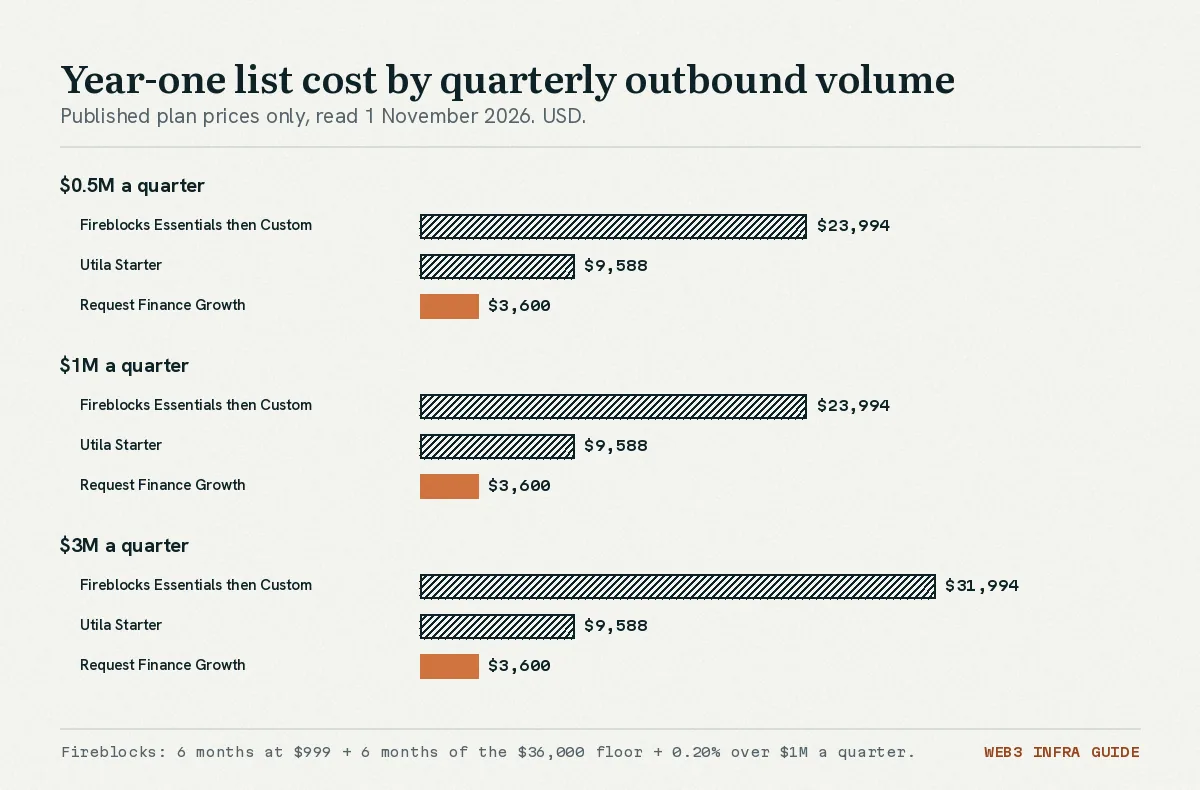
- At $3M of outbound volume a quarter, our year-one model puts Fireblocks at $31,994 and Utila Starter at $9,588, using list prices only.
- Cryptio and Bitwave do not hold your keys. They are accounting and reconciliation layers that sit on top of whichever wallet or custodian you pick.
- Every vendor here names a SOC 2 report except Safe, which leans on open-source contracts, audits and formal verification instead.
The Decision Kernel
Start with the layer that hurts most today: unsafe approvals, slow payouts or month-end reconciliation. Most finance teams end up with one wallet or custody platform plus one accounting tool, so pick the wallet layer first and the books second.
- Pick Fireblocks if you move serious volume across many chains and counterparties and want policy, payments and treasury system links in one vendor.
- Pick Utila if you want an MPC wallet platform with approval quorums and reconciliation exports at a published $799 a month.
- Pick BitGo if your board wants assets with a qualified custodian that runs an OCC chartered trust bank, with self-custody wallets alongside.
- Pick Safe or Den if your treasury lives on EVM chains and you want smart contract multisig with onchain enforced rules.
- Pick Request Finance if most of the job is paying vendors and contractors in stablecoins and syncing those bills to QuickBooks Online or Xero.
- Add Cryptio or Bitwave when auditors need GAAP or IFRS ready reports across wallets, exchanges and custodians.
Verdict: Fireblocks for scale, Utila for value, BitGo for regulated custody, Safe or Den for onchain multisig, and Request Finance for payables. Add Cryptio or Bitwave for the books. If you pay out to customers or other exchanges, our crypto compliance tools guide covers the screening and Travel Rule checks those transfers need.
How We Scored Treasury Platforms
Treasury buying differs from custody buying, so we built a separate rubric from the one in our digital asset custody hub. Scores here are not comparable with our custody scores, because finance operations and price disclosure carry more weight. Inputs come from vendor pages read on 1 November 2026.
Anything a vendor does not publish scored as not disclosed. See our editorial policy for how we handle vendors.
- Controls, 25%: approval quorums, spending limits, allowlists and role permissions.
- Security and audits, 20%: key design, SOC reports, ISO certificates and smart contract audits.
- Finance operations, 20%: payouts, invoicing, reconciliation, ERP or treasury system sync and reporting.
- Coverage, 15%: stated chains, assets and data sources.
- Pricing transparency, 10%: 5 for a full public price list, 4 for a public entry price with overage terms, 3 for a public price on a secondary product or a free tier, 2 for a billing method only, 1 for nothing.
- Proof of scale, 10%: stated volume, customers or assets secured.
| Platform | Controls (25%) | Security (20%) | Finance ops (20%) | Coverage (15%) | Pricing (10%) | Scale (10%) | Score |
|---|---|---|---|---|---|---|---|
| Fireblocks | 5 | 5 | 4 | 5 | 4 | 5 | 9.4 |
| Utila | 5 | 4 | 4 | 4 | 4 | 4 | 8.5 |
| BitGo | 4 | 5 | 3 | 4 | 2 | 5 | 7.8 |
| Safe | 4 | 4 | 2 | 3 | 5 | 5 | 7.3 |
| Den | 5 | 4 | 3 | 3 | 1 | 4 | 7.2 |
| Request Finance | 3 | 2 | 5 | 4 | 5 | 3 | 7.1 |
| Cryptio | 2 | 4 | 5 | 4 | 1 | 4 | 6.8 |
| Bitwave | 2 | 4 | 5 | 3 | 1 | 3 | 6.3 |
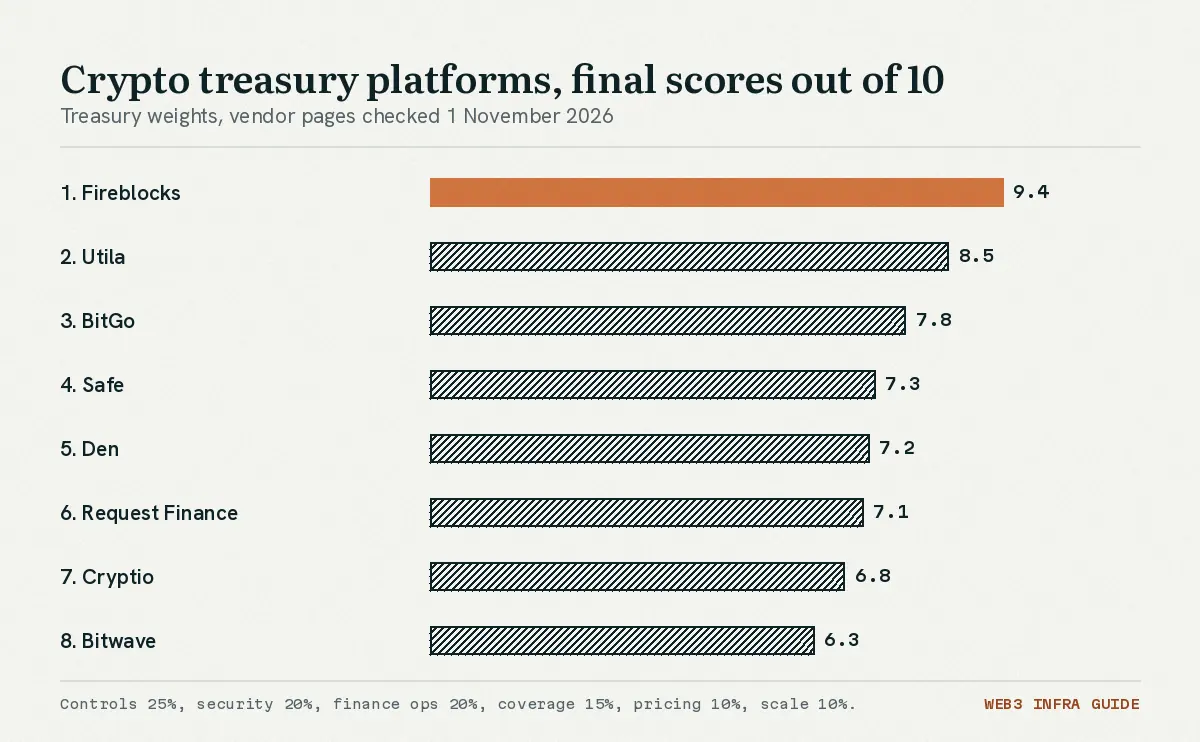
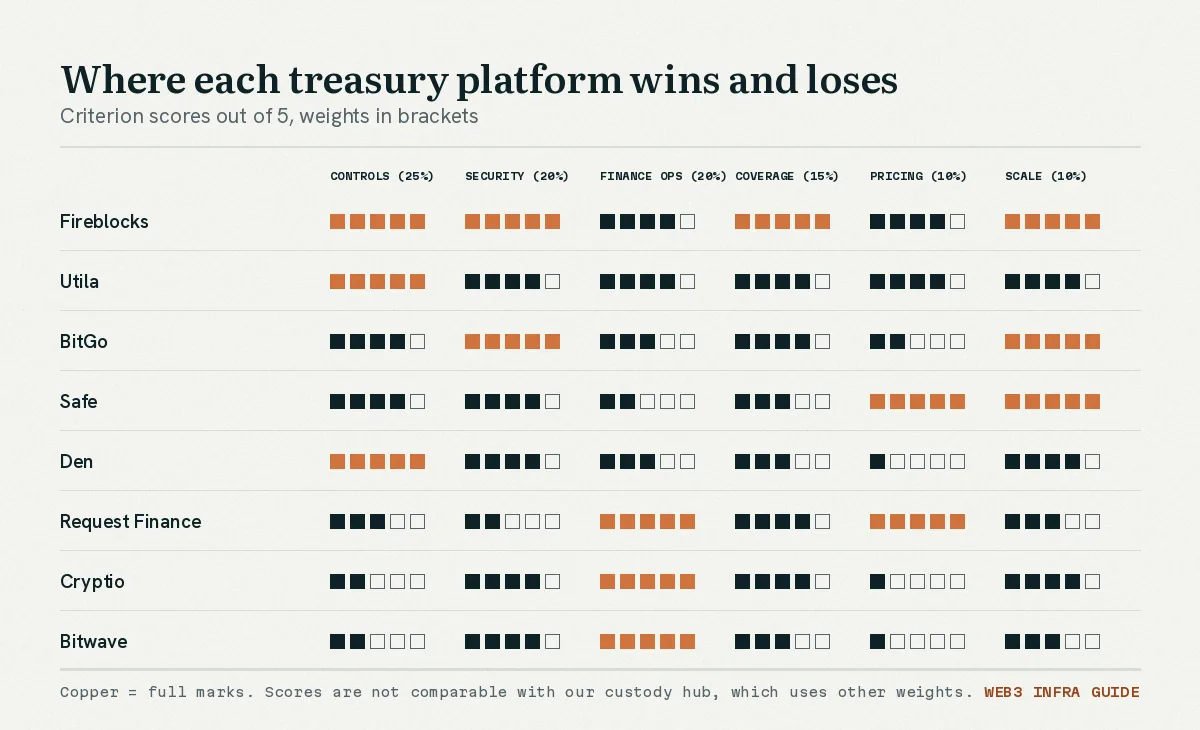
The grid shows two clusters. Wallet platforms (Fireblocks, Utila, BitGo, Safe, Den) win on controls and security and lose ground on finance operations. Accounting platforms (Cryptio, Bitwave) and Request Finance win on finance operations and lose on controls, because they do not sign transactions with your keys. That split is why a treasury stack usually needs one of each.
Crypto Treasury Platforms at a Glance
| Platform | What it is | Entry price | Security reports | Stated coverage |
|---|---|---|---|---|
| Fireblocks | MPC custody, payments and policy engine | $999 a month (Essentials) | SOC 2 Type 2, ISO 27001 | 80+ chains on pricing page, 150+ on treasury page |
| Utila | MPC wallet platform | $799 a month (Starter) | SOC 2 Type II | BTC, ETH, SOL, TRX, TON, EVM and Cosmos chains |
| BitGo | Qualified custody and self-custody wallets | Quote only | SOC attestations named | 1,700+ digital assets |
| Safe | Smart contract multisig | €189 a month (Safe Pro Starter) | Audits and formal verification | EVM networks Safe supports |
| Den | Policy controlled smart accounts | Quote only | SOC 2 Type II, Certora and yAudit audits | Any EVM network |
| Request Finance | Invoicing, payouts and business accounts | $0 invoicing, $50 a month for payouts | SOC 2 Type 1 | 25+ currencies, 190+ countries |
| Cryptio | Accounting and reconciliation | Quote only | SOC 1 and SOC 2 Type 1 and Type 2 (PwC) | 150+ chains, exchanges and other sources |
| Bitwave | Accounting, payments and reporting | Quote only | SOC 1 and SOC 2 Type II (EY) | 50+ blockchains |
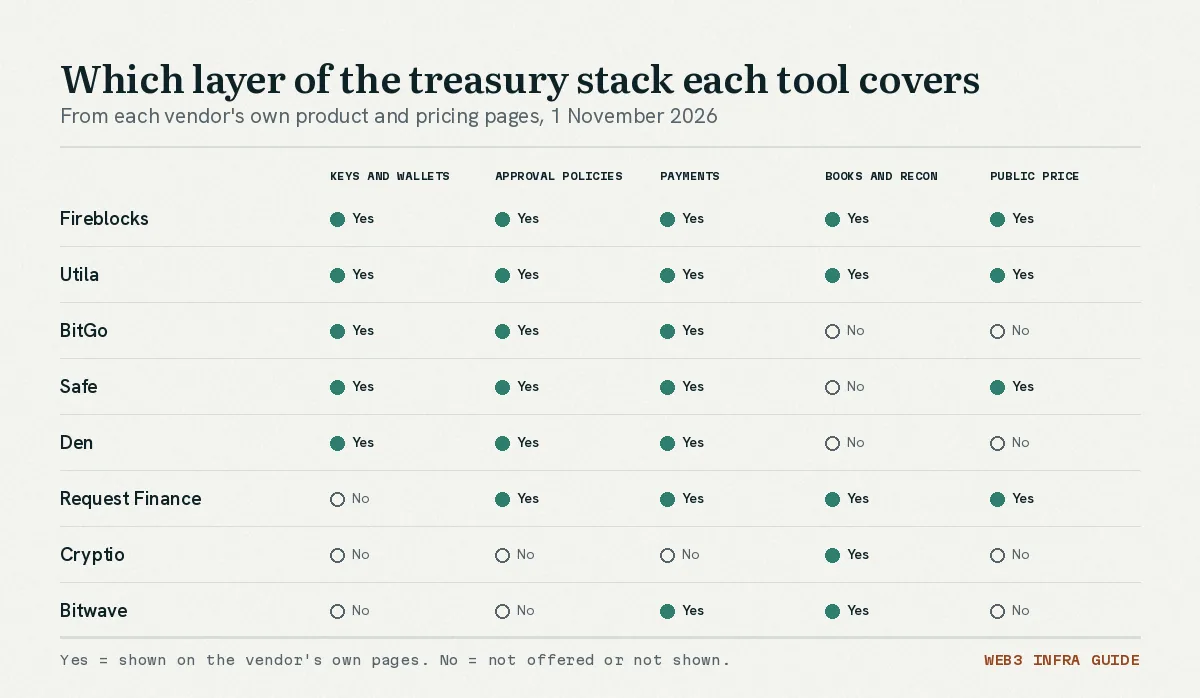
Only Fireblocks and Utila show all five columns on their own pages. If a tool shows No under keys and wallets, it cannot stop a bad transfer; it can only record one. That is fine for an accounting tool, as long as a wallet platform with approval policies sits in front of it.
What Year One Costs at Published Prices
Fireblocks Essentials costs $999 a month for up to 6 months, includes $1,000,000 of outbound volume a quarter and charges 0.20% above that, per its pricing page. At $3M of outbound volume a quarter, the Fireblocks overage alone adds $8,000 in the first six months, almost as much as a full year of Utila Starter.
Fireblocks Custom plans start at $36,000 a year. Utila Starter costs $799 a month for 12 months, billed quarterly, with up to $3M of outbound volume a quarter, per its pricing page.
| Outbound volume a quarter | Fireblocks (6 months Essentials, then Custom floor) | Utila Starter | Request Finance Growth | Safe Pro Starter |
|---|---|---|---|---|
| $0.5M | $23,994 | $9,588 | $3,600 | €2,268 |
| $1M | $23,994 | $9,588 | $3,600 | €2,268 |
| $3M | $31,994 | $9,588 | $3,600 | €2,268 |
The model is deliberately narrow. Fireblocks Essentials lasts up to 6 months, so we price the second half of the year at the $36,000 Custom floor.
Request Finance charges nothing on stablecoin payouts on any plan, but bank off-ramps cost 0.5% plus $10 per local transfer or $30 per SWIFT transfer on Growth. Safe Pro is a coordination layer priced per workspace, not by volume, so its cost stays flat. Rerun the math with your own numbers using the formula overage = max(0, volume-1_000_000) * 0.002 for Fireblocks Essentials.
# Year-one list cost, published prices read 1 Nov 2026
def fireblocks(q_volume):
    essentials = 999 * 6                       # up to 6 months
    overage = max(0, q_volume - 1_000_000) * 0.002 * 2   # two quarters
    custom_half_year = 36_000 / 2              # Custom floor, months 7-12
    return essentials + overage + custom_half_year

def utila_starter(q_volume):
    assert q_volume <= 3_000_000, 'above Starter cap: custom plan'
    return 799 * 12

def request_off_ramp(amount, transfers, swift=False):
    return amount * 0.005 + transfers * (30 if swift else 10)   # Growth plan

print(fireblocks(3_000_000))        # 31994.0
print(utila_starter(3_000_000))     # 9588
print(request_off_ramp(50_000, 1))  # 260.0, matches Request's own example
1. Fireblocks
Fireblocks combines MPC custody, a policy engine, payments and treasury automation. Its corporate treasury page cites $14T+ of transactions across 2,400+ institutions and links into the treasury and ERP systems a finance team already runs. Fireblocks is the only platform here that scores 5 on controls, security, coverage and scale at once.
- Controls: a Policy Engine and treasury automation on its treasury management page, which also lists Circle Gateway for USDC.
- Security: SOC 2 Type 2 with zero material findings, ISO 27001 and CCSS QSP Level 3, per its security page.
- Pricing: Essentials at $999 a month with 2 workspaces, 5 users and 5,000 embedded wallets; Custom plans from $36,000 a year; 99.97% monthly uptime stated.
- Weaknesses: the pricing page says 80+ blockchains while treasury pages say 150+, and the cheap plan only lasts 6 months.
Verdict: Fireblocks scores 9.4. It is the default for payment companies and large corporates that move stablecoins at volume. Compare it with others in our Fireblocks alternatives guide.
2. Utila
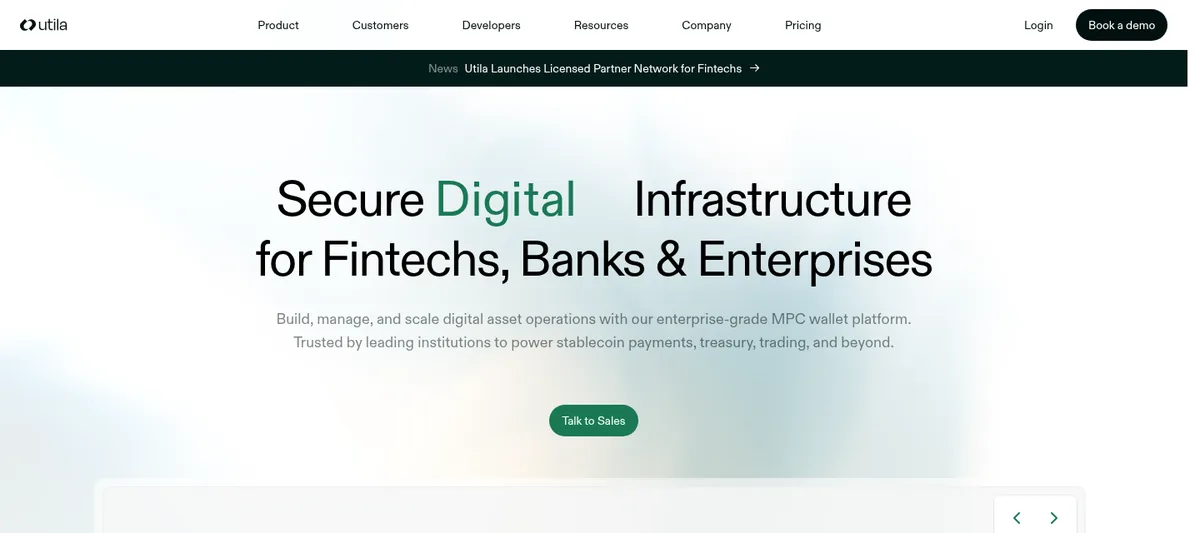
Utila is an MPC wallet platform for stablecoin payments, treasury and trading. Its home page states $30B+ of monthly volume and more than 400 companies. Utila Starter includes three times the outbound volume of Fireblocks Essentials for $200 less a month.
- Controls: MPC wallets, admin quorums and separate vaults, per its treasury management page.
- Security: SOC 2 Type II, listed on its security page.
- Plan limits: Starter covers 1,000 active wallets, 1 vault, 3 users, 24/7 chat support and one exchange connection, with all chains included.
- Weaknesses: Starter is a 12-month commitment, and anything above its caps moves to unpublished Growth, Pro, Scale or Enterprise plans.
Verdict: Utila scores 8.5. It is the value pick for fintechs and mid-size treasuries. See how it compares head to head in our Fireblocks vs Utila vs Dfns comparison.
3. BitGo
BitGo has run institutional custody since 2013 and is listed on the NYSE as BTGO. Its security page says it safeguards over 1,700 digital assets and offers M-of-N keys, role-based approvals and a policy engine. BitGo is the pick when treasury assets must sit with a qualified custodian rather than in a wallet you run yourself. Our BitGo vs Coinbase Prime vs Fidelity Digital Assets comparison covers that custodian choice in depth.
- Self-custody option: hot and cold wallets where you hold your keys and BitGo only countersigns transactions that meet your policies, per its self-custody page.
- Treasury assets: its crypto treasuries page covers BTC and ETH reserves, stablecoins such as USDC and USDT for payments, staked assets and DeFi positions.
- Insurance: a stated $250M policy for assets where BitGo Bank & Trust holds all keys.
- Weaknesses: no public price, only a billing method in basis points on assets, and no native invoicing or reconciliation.
Verdict: BitGo scores 7.8 on treasury weights. It is the conservative choice for corporate reserves. For other custodians, see our BitGo alternatives guide.
4. Safe
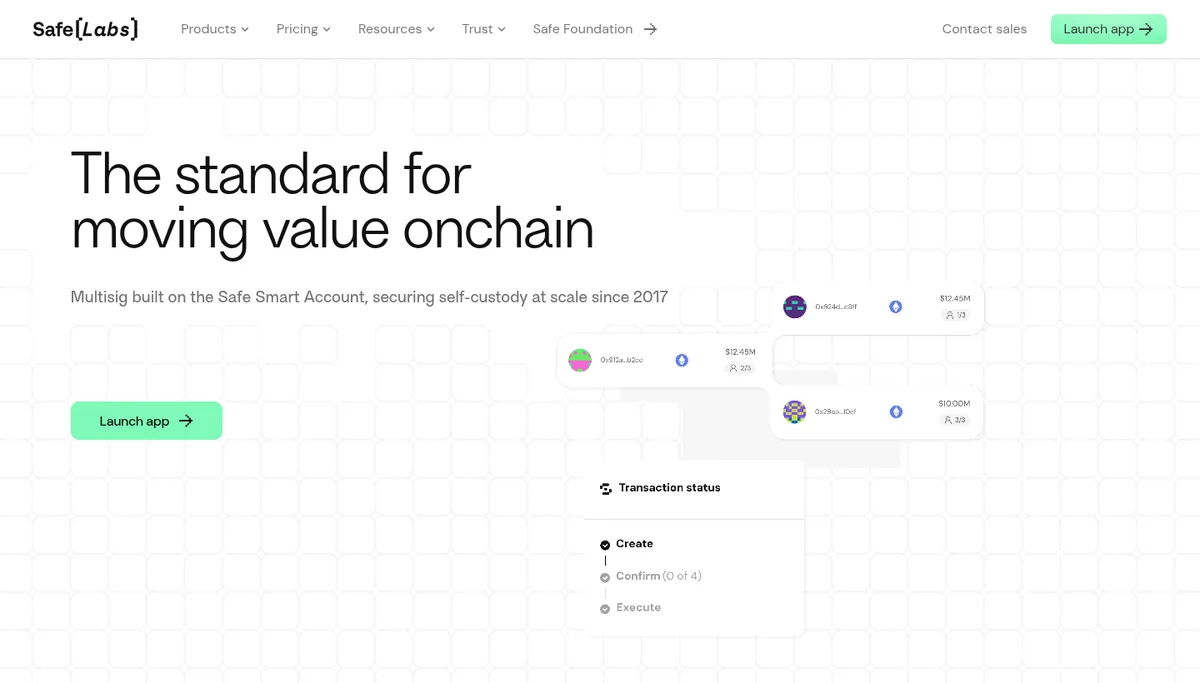
Safe is the smart contract multisig behind many DAO and company treasuries. Its home page states $1T+ of transaction volume, $60B+ of assets and 60M+ accounts since 2017. Safe has the most transparent price list here, and Safe Pro adds team workspaces on top of the free multisig.
- Controls: multiple signers with approval thresholds, a transaction builder for batches, and signing from web, mobile, hardware wallets or MPC, per its wallet page.
- Pricing: Safe Pro Starter at €189 a month for 2 Safe accounts and Business from €669 a month for 5 to 20, excluding VAT, per its pricing page.
- Security: open-source contracts with audits and formal verification listed in its audit documentation.
- Weaknesses: EVM only, no SOC report named, and no built-in invoicing or accounting sync.
Verdict: Safe scores 7.3. Choose it for EVM treasuries that want self-custody multisig with payroll and vendor payouts. For MPC options, read our MPC wallet providers guide.
5. Den
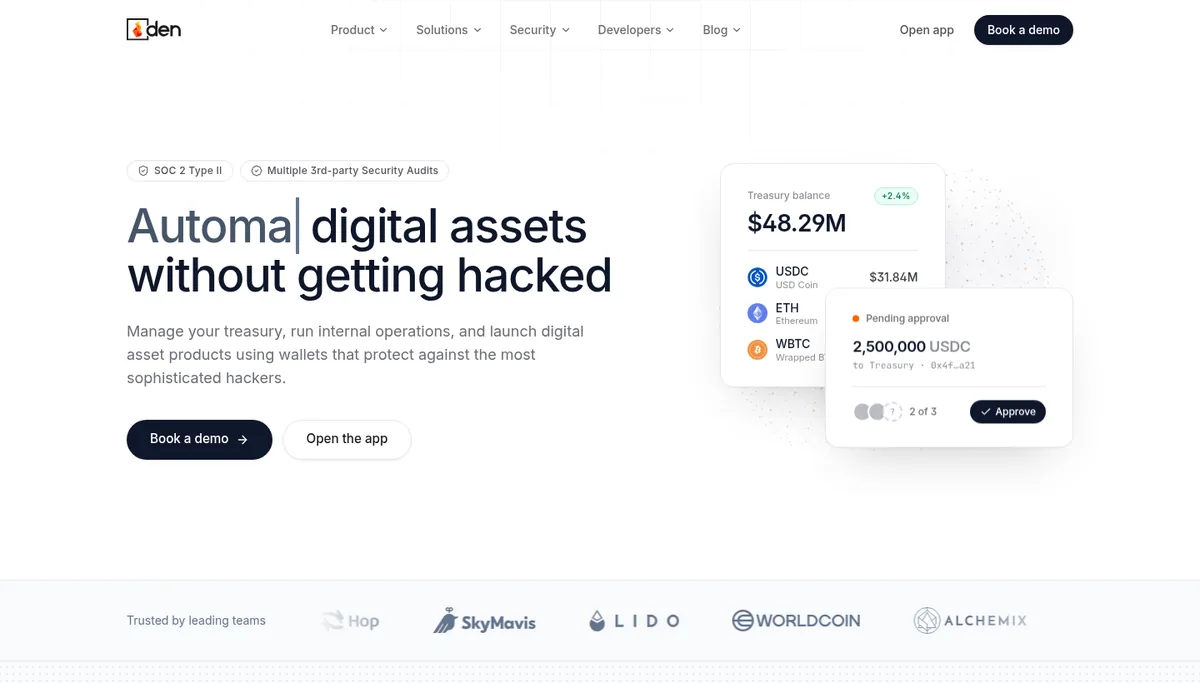
Den builds enterprise wallets for treasury, stablecoin payments and wallet-as-a-service on smart accounts. Its home page states $10B+ transacted, 400+ onchain teams and 99.9% availability. Den enforces spending rules onchain, so a compromised signer cannot move funds past the limits you set.
- Controls: approvals, allowlists and spending limits, auto-approval for routine low-risk transfers, and policy rechecked on the signing device, in a Guardian co-signer and in the smart contract, per its treasury page.
- Security: SOC 2 Type II on its SOC 2 page and Certora and yAudit reviews on its audits page.
- Coverage: any EVM network, with 24/7 support.
- Weaknesses: no public price and no non-EVM chains.
Verdict: Den scores 7.2. It suits EVM teams that want Safe-style self-custody with stricter policy controls and vendor support.
6. Request Finance
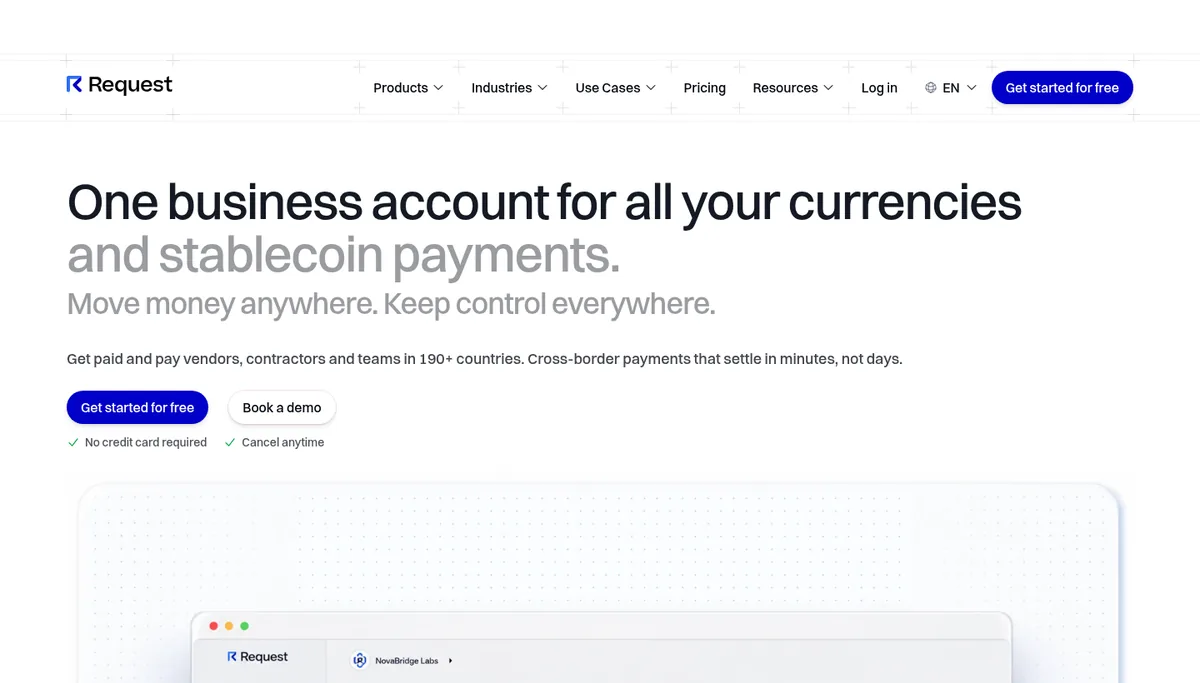
Request Finance is a finance operations tool for invoicing, payables and stablecoin payouts, with business accounts for 25+ currencies across 190+ countries. It states $1B+ processed. Request Finance is the cheapest way here to run approved stablecoin payables with accounting sync.
- Plans: Free invoicing at $0, Starter at $50, Growth at $300 and Pro at $600 a month, with annual billing giving 2 months free, per its pricing page.
- Finance ops: Growth adds approval workflows, QuickBooks Online and Xero sync and automated reconciliation. Enterprise adds NetSuite.
- Fees: stablecoin payouts are free; bank off-ramps cost 1% on Starter or 0.5% on Growth and Pro, plus $10 local or $30 SWIFT.
- Weaknesses: a SOC 2 Type 1 rather than Type II report, and it is not a custody platform for large reserves.
Verdict: Request Finance scores 7.1. It is the right first tool for startups and agencies that mainly pay people and vendors in stablecoins.
7. Cryptio
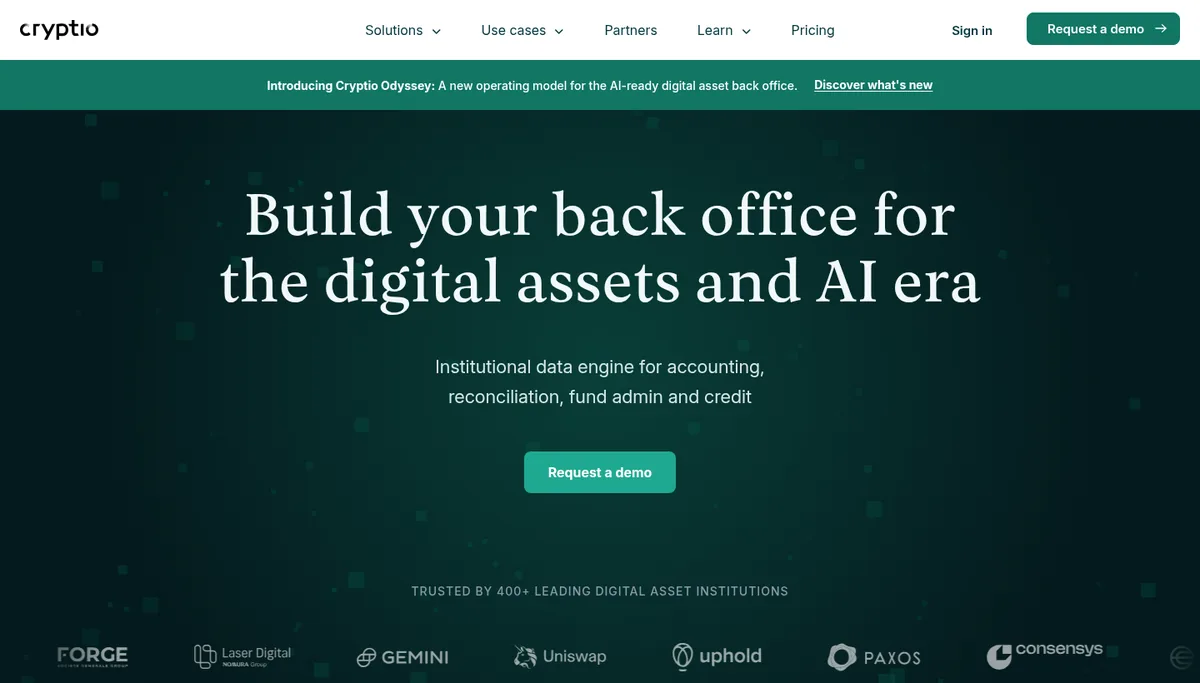
Cryptio is a data and accounting platform that turns onchain and exchange activity into GAAP and IFRS ready books. Its home page says it is trusted by 450+ institutions and connects 150+ blockchains, exchanges, custodians and DeFi protocols. Cryptio is the strongest pure accounting layer here for teams whose auditors are a Big Four firm.
- Audits: SOC 1 and SOC 2, Type 1 and Type 2, audited by PwC, per its pricing page.
- Finance ops: rules that tag counterparties and internal transfers, reconciliation against internal systems, and fund administration reports.
- Scale: 5K+ tokens and 50M+ transactions processed a year, per its home page.
- Weaknesses: quote-only pricing, and its pricing page says 120+ sources while its home page says 150+.
Verdict: Cryptio scores 6.8. Pair it with a wallet platform when audit-ready books matter more than payments.
8. Bitwave
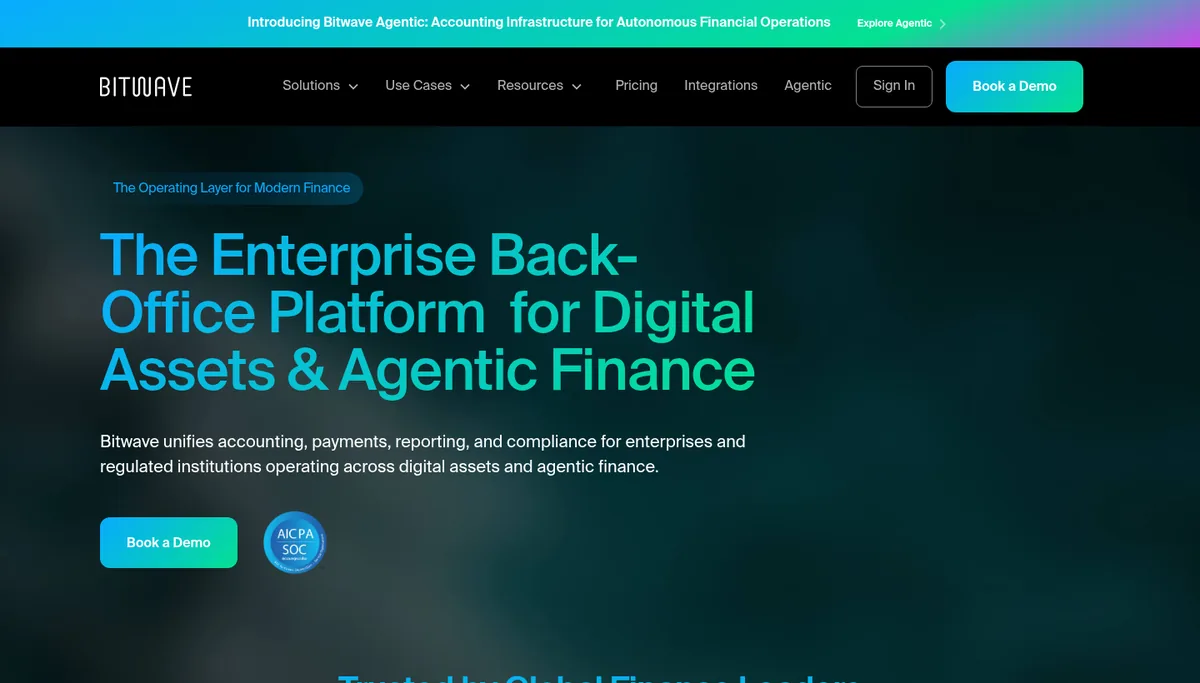
Bitwave unifies accounting, payments, reporting and compliance for enterprises and regulated institutions. Its pricing page says it brings onchain data from 50+ blockchains into your ERP. Bitwave holds no assets and never touches keys, which keeps it out of the custody chain entirely.
- Audits: SOC 1 Type II and SOC 2 Type II examined by EY for 1 January to 31 December 2025, per its SOC page.
- Plans: separate tracks for startups, enterprises and institutions, all priced through sales.
- Finance ops: ERP sync, payments and compliance reporting from one ledger.
- Weaknesses: no public price, no stated customer or volume figures on the pages we read, and no approval controls over transfers.
Verdict: Bitwave scores 6.3. It fits enterprises that already run an ERP and want digital asset subledgers flowing into it.
Building a Treasury Stack From Two Tools
Few finance teams get every layer of the stack from a single vendor. Pair one tool that can block a bad transfer with one tool that can explain every transfer to an auditor. These are the combinations that map cleanly onto the stack map above.
- Fireblocks plus Cryptio: high-volume payments and policy control, with Big Four ready books from 150+ data sources.
- Utila plus Bitwave: a priced MPC platform for wallets and approvals, with ERP sync from 50+ blockchains.
- Safe plus Request Finance: an EVM multisig holds reserves, and Request handles invoices, approvals and stablecoin payouts.
- BitGo plus an accounting tool: reserves with a qualified custodian, and operating wallets on a platform from our institutional custody comparison.
Treasury Platform Due Diligence Checklist
Send the same questions to every shortlisted vendor and compare the written answers side by side before you sign. Each item ties back to a criterion in our scoring table, so a gap in public disclosure becomes an explicit question for the sales call rather than an assumption.
- Ask for the latest SOC 2 Type II report and confirm its period covers the last 12 months.
- Get the outbound volume cap, user cap and wallet cap of the plan you will sign, plus the overage rate.
- Confirm support for every chain and stablecoin you use today, since headline chain counts can hide gaps.
- Test an approval policy: a transfer above your limit must stop and wait for a second approver.
- Export one month of transactions and check it imports into your ERP or accounting tool without manual edits.
- Ask who holds which key share or signer, and how you recover funds if the vendor disappears.
- Compare the answers against the head-to-head data in our Fireblocks vs BitGo vs Anchorage comparison.
Final Ranking
Fireblocks wins because it covers every layer and publishes enough to price a pilot. Utila is the value runner-up. BitGo ranks third on treasury weights because it is custody first. Safe, Den and Request Finance are close together and serve different jobs, while Cryptio and Bitwave rank lower only because they do not control transfers.
- Fireblocks, 9.4: policy engine, payments and treasury system links, $999 a month entry.
- Utila, 8.5: MPC platform at $799 a month with $3M of quarterly volume included.
- BitGo, 7.8: 1,700+ assets with a qualified custodian and countersigned self-custody.
- Safe, 7.3: smart contract multisig with a public €189 a month team plan.
- Den, 7.2: onchain enforced limits on any EVM network, SOC 2 Type II.
- Request Finance, 7.1: stablecoin payables from $50 a month, with free stablecoin payouts.
- Cryptio, 6.8: PwC audited accounting across 150+ sources.
- Bitwave, 6.3: EY audited subledger with ERP sync from 50+ blockchains.
Verdict: Shortlist Fireblocks and Utila for the wallet layer, add BitGo if you need a qualified custodian, and pair any of them with Cryptio or Bitwave for the books. Our custody models guide helps decide which wallet layer your treasury needs.
Frequently Asked Questions
What is the best crypto treasury management platform for businesses?
Fireblocks scores highest at 9.4 on our treasury weights because it combines a policy engine, payments, treasury system links and SOC 2 Type 2 security. Utila is the value pick at 8.5, with a $799 a month Starter plan that includes up to $3M of outbound volume a quarter.
How much does crypto treasury management software cost?
Published prices start at $0 for Request Finance invoicing and $50 a month for its payouts plan. Safe Pro starts at 189 euros a month, Utila Starter at $799 and Fireblocks Essentials at $999. Den, BitGo, Cryptio and Bitwave quote prices through sales, as checked on 1 November 2026.
Is Fireblocks or Utila cheaper?
Utila Starter costs $799 a month with up to $3M of outbound volume a quarter. Fireblocks Essentials costs $999 a month with $1M included and a 0.20% overage. At $3M a quarter, our year-one model gives $9,588 for Utila and $31,994 for Fireblocks at list prices.
Do I need a custodian or a wallet platform for a company treasury?
A qualified custodian such as BitGo holds assets under a trust charter, which some boards and auditors require. A wallet platform such as Fireblocks, Utila, Safe or Den lets your team control approvals directly. Many companies keep reserves with a custodian and operating funds in a wallet platform.
Can crypto treasury software sync with QuickBooks, Xero or NetSuite?
Yes. Request Finance syncs with QuickBooks Online and Xero on its Growth plan and offers NetSuite on Enterprise. Bitwave says it brings data from 50+ blockchains into your ERP, and Cryptio reconciles onchain activity with internal systems. Fireblocks links into existing treasury management systems.
Which treasury platforms have SOC 2 Type II reports?
Fireblocks, Utila, Den, Cryptio and Bitwave state SOC 2 Type II reports, with Cryptio naming PwC and Bitwave naming EY as auditors. Request Finance states SOC 2 Type 1. BitGo names SOC attestations without the type, and Safe relies on audits and formal verification instead.