
Last updated: 2 November 2026 · every coverage figure, certification and price below rechecked on the vendor’s own page on 2 November 2026
In the Chainalysis vs TRM Labs vs Elliptic decision, Chainalysis (9.2/10) is the safest default for a licensed exchange or bank that needs deep investigations, TRM Labs (8.9) is the best fit for multi-chain teams that want to tune their own risk rules, and Elliptic (8.7) wins on cross-chain screening, VASP due diligence and the only published price of the three. All three have the attribution data regulators expect; the right one depends on your chains, your case load and your budget.
We read every product page of all three vendors on 2 November 2026 and scored them on the same fixed rubric we use across our crypto compliance hub; the weights are on our methodology page. The articles ranking for this comparison quote chain counts that do not match the vendors’ own pages, so every figure below links to its source. Nothing here is legal advice.
TL;DR
- Chainalysis scores 9.2/10: KYT lists 400+ networks and 50M+ tokens, Reactor traces 27+ blockchains and 300+ bridges and DEXs, and the platform cites SOC 2 Type 2 and FedRAMP.
- TRM Labs scores 8.9: Wallet Screening covers 1.9B+ assets on 184+ blockchains with 155+ risk configurations and a response under 400 ms, backed by a 99.95% uptime SLA.
- Elliptic scores 8.7: Lens covers 60+ blockchains and 250+ bridges, Elliptic says it has labelled 1B+ addresses, and its trust page lists SOC 2 Type 2 plus four ISO certifications.
- Elliptic is the only one of the three with a public price: its AWS Marketplace listing shows 12-month contracts at $50,000 (Tier 1) and $100,000 (Tier 2) per unit of screening volume.
- Chainalysis and TRM publish no prices, so the price figures in other comparison articles are estimates, not list prices.
- Run a two-week bake-off on the same 50 past deposits before you sign: attribution rate on your own traffic is the number that decides it.
The Decision Kernel
Pick by the work your team does most, then check chains and price. Investigations-heavy teams lean Chainalysis, rule-tuning screening teams lean TRM Labs, and bridge-heavy or budget-capped teams lean Elliptic. The scores sit within half a point of each other, so your own data should break the tie.
- Law enforcement liaison, large case load, court evidence: Chainalysis Reactor, with KYT for monitoring.
- Many chains and long-tail tokens, own risk appetite: TRM Labs Wallet Screening and Forensics.
- Bridge and cross-chain exposure, counterparty VASP checks: Elliptic Lens plus Discovery.
- Need a price before the first sales call: Elliptic, the only one with a public listing.
Verdict: There is no wrong vendor here for a regulated firm. The wrong move is choosing on brand without testing attribution on your own deposits.
Chainalysis vs TRM Labs vs Elliptic at a Glance
| Chainalysis | TRM Labs | Elliptic | |
|---|---|---|---|
| Score | 9.2 | 8.9 | 8.7 |
| Best for | Investigations and regulator familiarity | Configurable multi-chain screening | Cross-chain screening and VASP due diligence |
| Screening product | KYT, Address Screening | Wallet Screening, Transaction Monitoring | Lens |
| Investigation product | Reactor | Forensics | Investigator |
| Screening coverage (stated) | 400+ networks, 50M+ tokens | 184+ blockchains, 1.9B+ assets | 60+ blockchains, 250+ bridges |
| Investigation coverage (stated) | 27+ blockchains, 300+ bridges and DEXs | 65+ blockchains | 65+ blockchains (company figure) |
| Security (stated) | SOC 2 Type 2, FedRAMP | Annual SOC 2 audit, 99.95% uptime SLA | SOC 2 Type 2, ISO 27001, ISO 22301 |
| Published price | None | None | $50,000 or $100,000 per unit a year (AWS) |
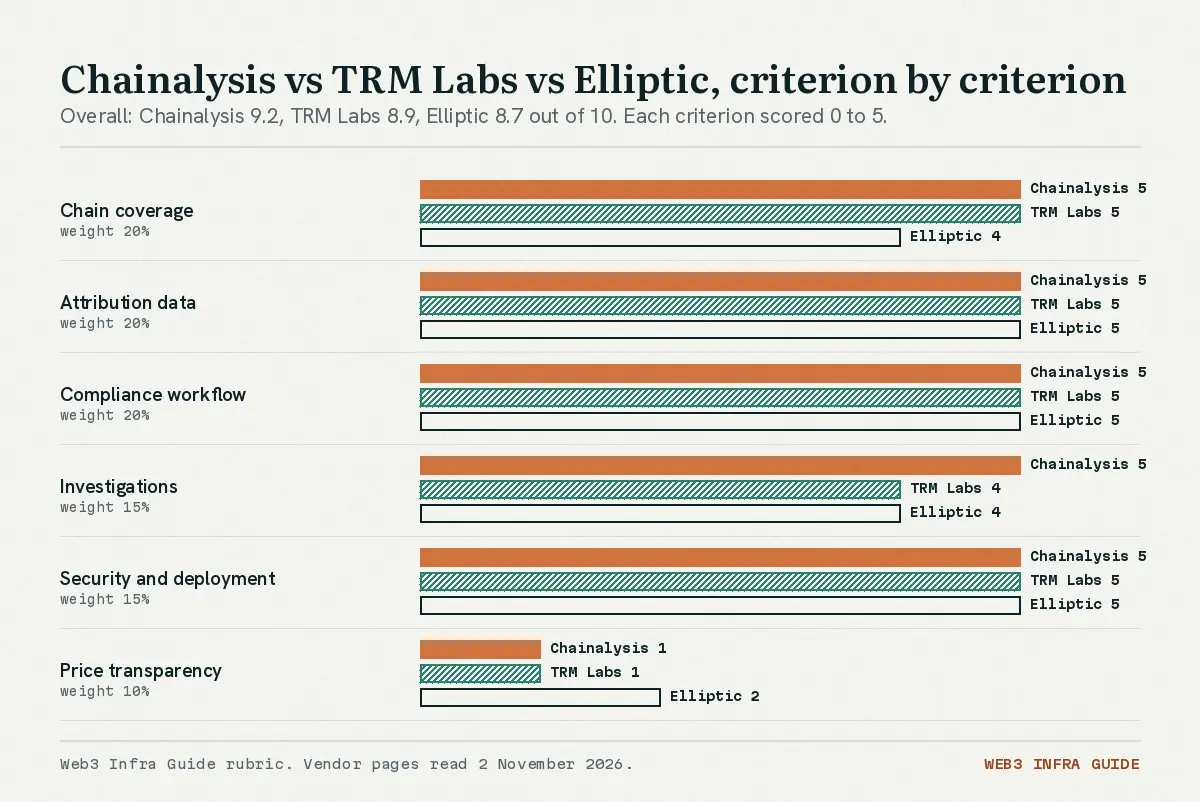
Each vendor gets 0 to 5 on six criteria: chain coverage (20%), attribution data (20%), compliance workflow (20%), investigations (15%), security and deployment (15%) and price transparency (10%). Elliptic loses a point on coverage but gains one on price, because it is the only vendor of the three that publishes any price at all. Chainalysis edges TRM on investigations because Reactor’s stated swap, bridge and integration depth is the widest we found.
1. Chainalysis: 9.2/10
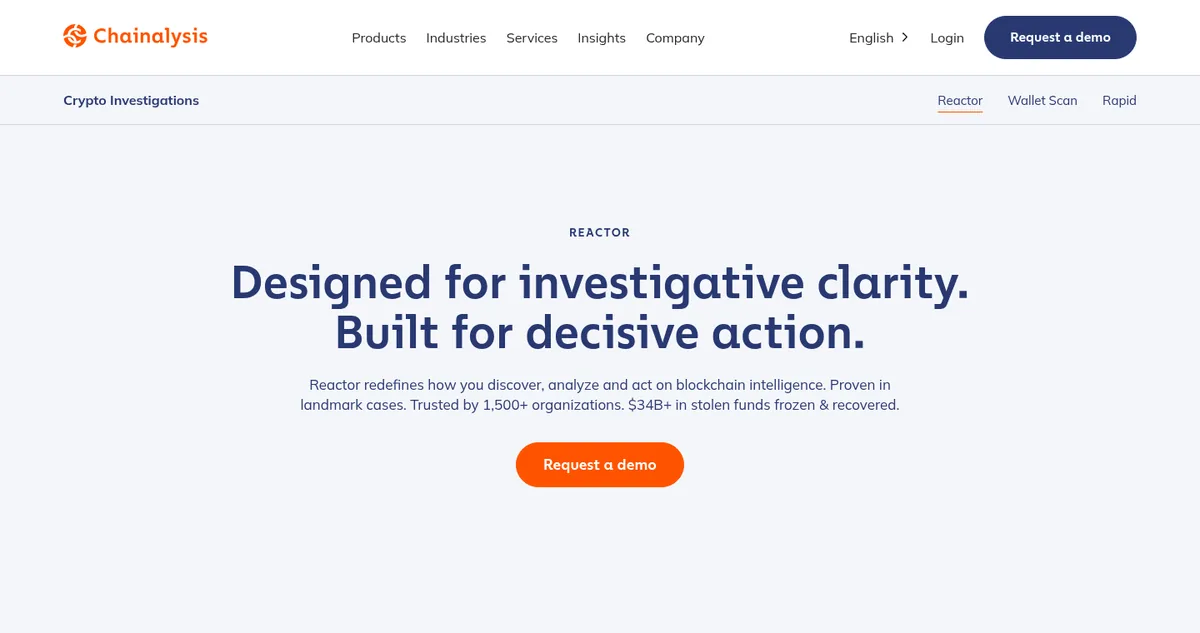
Chainalysis sells KYT for transaction monitoring, Address Screening for onboarding and withdrawals, and Reactor for investigations. Reactor says it is used by 1,500+ organizations and has helped freeze and recover $34B+ in stolen funds. Reactor states 27+ blockchains, 40M+ assets, 325M+ swaps, 300+ bridges and DEXs and 134K+ real-world counterparties.
- Monitoring breadth: the KYT FAQ lists 400+ networks and 50M+ tokens.
- Screening: Address Screening adds liquidity pool risk, continuous monitoring with alerts when a risk score changes, time-based and counterparty analysis.
- Integrations: Reactor connects to KYT, Cellebrite, Siren and i2, which matters for teams that already run those forensic tools.
- Security: the platform page cites SOC 2 Type 2 and FedRAMP.
- Free tier gone: the Chainalysis sanctions oracle is marked deprecated and no longer maintained, so do not build on it.
Verdict: The deepest investigation stack and the name examiners know best. Expect a quote-only, multi-product contract and ask for KYT and Reactor prices separately.
2. TRM Labs: 8.9/10
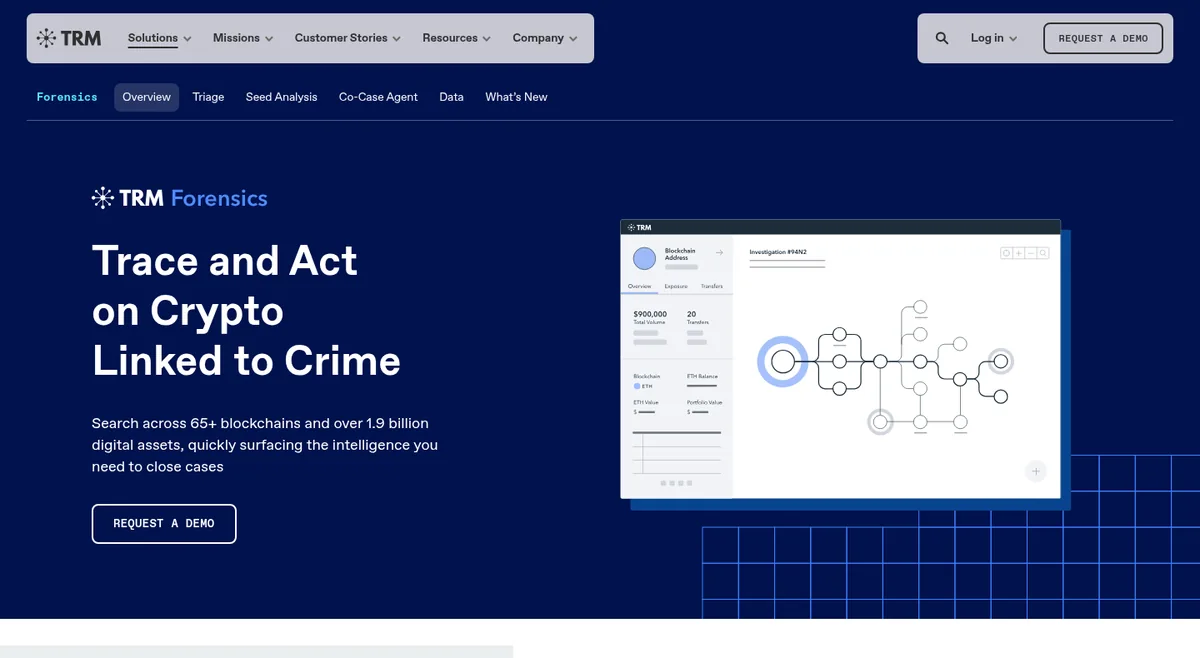
TRM Labs runs screening, monitoring and investigations on one attribution graph. Its Wallet Screening page covers 1.9B+ assets across 184+ blockchains, including all ERC-20 tokens, with responses under 400 ms. TRM is the most configurable of the three: over 155 settings for ownership, counterparty and indirect exposure risk.
- Glass-box attribution: TRM Forensics shows the source and a confidence score for each attribution, which helps when you must explain an alert to an examiner.
- Pattern detection: Signatures flags peel chains and layering across 65+ blockchains, and Seed Analysis and the Co-Case Agent speed up case work.
- Intel sharing: TRM’s investigator network lets verified investigators flag addresses and alerts exchanges in real time; TRM cites $1.5M frozen and $800K located in examples.
- Reliability: a 99.95% uptime SLA and an annual SOC 2 audit, both stated on the Forensics page.
- Public docs: its sanctions documentation says the Sanctions API and Chainabuse API docs need no login, handy for a quick technical review.
Verdict: The pick for teams that want to set their own risk appetite across many chains. Budget analyst time to tune the 155+ configurations.
3. Elliptic: 8.7/10
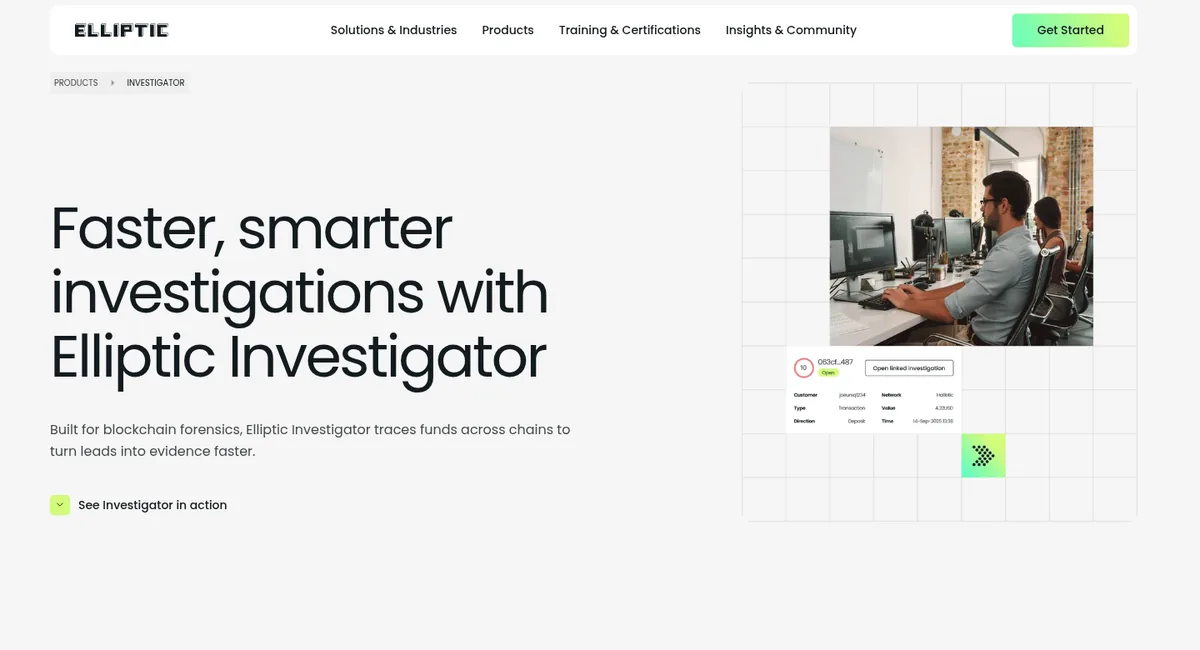
Elliptic splits its suite into Lens for wallet and transaction screening, Investigator for tracing and Discovery for VASP due diligence. Lens runs wallet and transaction screening in one workspace with one case queue, across 60+ blockchains and 250+ bridges. Elliptic says it has labelled 1B+ addresses and covers 99% of global trading volume.
- Investigator: Investigator builds graphs automatically, which Elliptic says cuts graph-building time by up to 60%, with one-click cross-chain tracing and exportable evidence.
- Discovery: Discovery scores VASPs against peers, tracks risk month over month and supports Travel Rule counterparty checks, drawing on 13 years of data.
- Security: the trust page lists SOC 2 Type 2, ISO 27001, ISO 22301, ISO 9001 and ISO 14001; the home page states 99.9% uptime.
- Published price: the AWS Marketplace listing shows 12-month contracts at $50,000 and $100,000 per unit.
Verdict: Best for bridge-heavy flows and for vetting counterparty VASPs, and the easiest of the three to budget. Confirm the 60+ chain list covers your assets.
Chain Coverage Compared
Coverage is where comparison articles disagree most, because each vendor states a different number for each product. Screening coverage and investigation coverage are separate figures, so compare the product you will actually buy. The chart and table show only what each vendor page says.
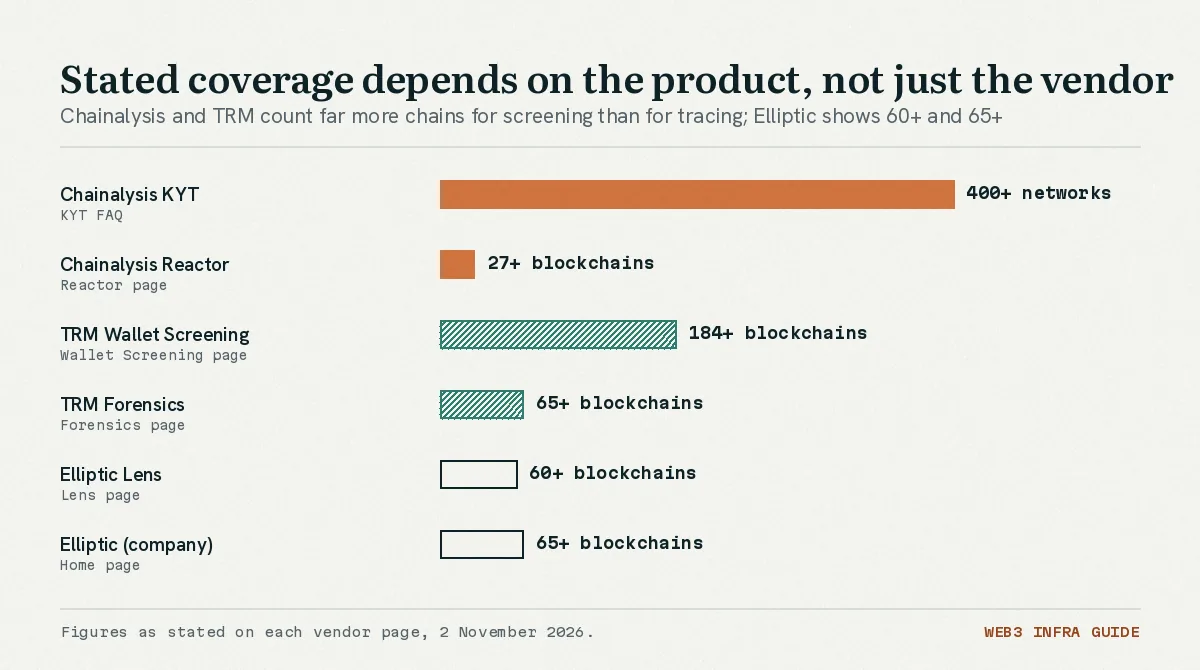
| Product | Stated coverage | Source |
|---|---|---|
| Chainalysis KYT | 400+ networks, 50M+ tokens | KYT FAQ |
| Chainalysis Reactor | 27+ blockchains, 40M+ assets, 300+ bridges and DEXs | Reactor page |
| TRM Wallet Screening | 184+ blockchains, 1.9B+ assets, all ERC-20s | Wallet Screening page |
| TRM Forensics | 65+ blockchains, 1.9B+ assets | Forensics page |
| Elliptic Lens | 60+ blockchains, 250+ bridges | Lens page |
| Elliptic (company) | 65+ blockchains, 1B+ addresses labelled | Home page |
Verdict: On paper Chainalysis KYT and TRM screening lead on breadth. In practice, check that your top ten assets by volume get full attribution, not just address lookup.
Screening and Monitoring Compared
All three screen wallets before onboarding and monitor transactions after they settle, and all three re-screen addresses as new risk data arrives, so the basic job is covered by any of them. The differences are in how much you can tune, how alerts reach a queue and how fast the API answers.
| Feature | Chainalysis | TRM Labs | Elliptic |
|---|---|---|---|
| Products | KYT, Address Screening | Wallet Screening, Transaction Monitoring | Lens |
| Risk tuning | Risk scores, alert on score change | 155+ configurations | Configurable risk rules |
| Continuous re-screening | Yes, continuous monitoring | Yes, pre and post transaction | Yes, continuous re-screening |
| Stated speed | Not stated | Under 400 ms | Not stated |
| DeFi coverage | Liquidity pool risk assessment | All ERC-20 tokens | 250+ bridges |
| Case handling | KYT alerts, Reactor cases | Case management in Forensics | One case queue for wallets and transactions |
Verdict: TRM gives the most knobs, Elliptic the simplest single queue, Chainalysis the widest monitoring coverage.
Investigations Compared
Reactor, Forensics and Investigator all trace funds across chains, attribute addresses to real-world entities and export evidence for a report or a court filing, so each can carry a full case. Reactor states the widest swap and bridge data, Forensics the clearest attribution sourcing and Investigator the most automation.
| Capability | Chainalysis Reactor | TRM Forensics | Elliptic Investigator |
|---|---|---|---|
| Stated chains | 27+ | 65+ | 65+ (company figure) |
| Cross-chain | 300+ bridges and DEXs, 325M+ swaps | Cross-chain tracing on one graph | One-click cross-chain tracing |
| Attribution detail | 134K+ real-world counterparties | Source and confidence score per label | 1B+ addresses labelled |
| Automation | Integrations with Cellebrite, Siren, i2 | Signatures, Seed Analysis, Co-Case Agent | Auto graphs, up to 60% faster graph building |
| Intel sharing | Not stated | Real-time investigator network | Not stated |
Verdict: If investigations are the core of the job, trial Reactor and Forensics side by side on a closed case you already know the answer to.
Security and Reliability
Your bank partner and examiner will ask for the vendor’s audit reports, so check what each one states publicly before the security review starts. All three publish a SOC 2 claim, but they differ on government authorisations, ISO certifications and whether an uptime figure appears on the public pages at all.
| Chainalysis | TRM Labs | Elliptic | |
|---|---|---|---|
| SOC 2 | Type 2 | Annual SOC 2 audit | Type 2 |
| Government | FedRAMP | Not stated | Not stated |
| ISO | Not stated on pages read | Not stated on pages read | 27001, 22301, 9001, 14001 |
| Uptime | Not stated on pages read | 99.95% SLA | 99.9% stated |
Verdict: Elliptic publishes the most certifications, Chainalysis the only FedRAMP, TRM the only contractual uptime figure we found.
Pricing: What Is Actually Published
Only Elliptic publishes a price. Its AWS Marketplace listing sells 12-month contracts at $50,000 per unit (Tier 1) or $100,000 per unit (Tier 2), where a unit is your expected screening volume. Chainalysis and TRM publish no price, so treat any figure for them in other comparisons as an estimate.
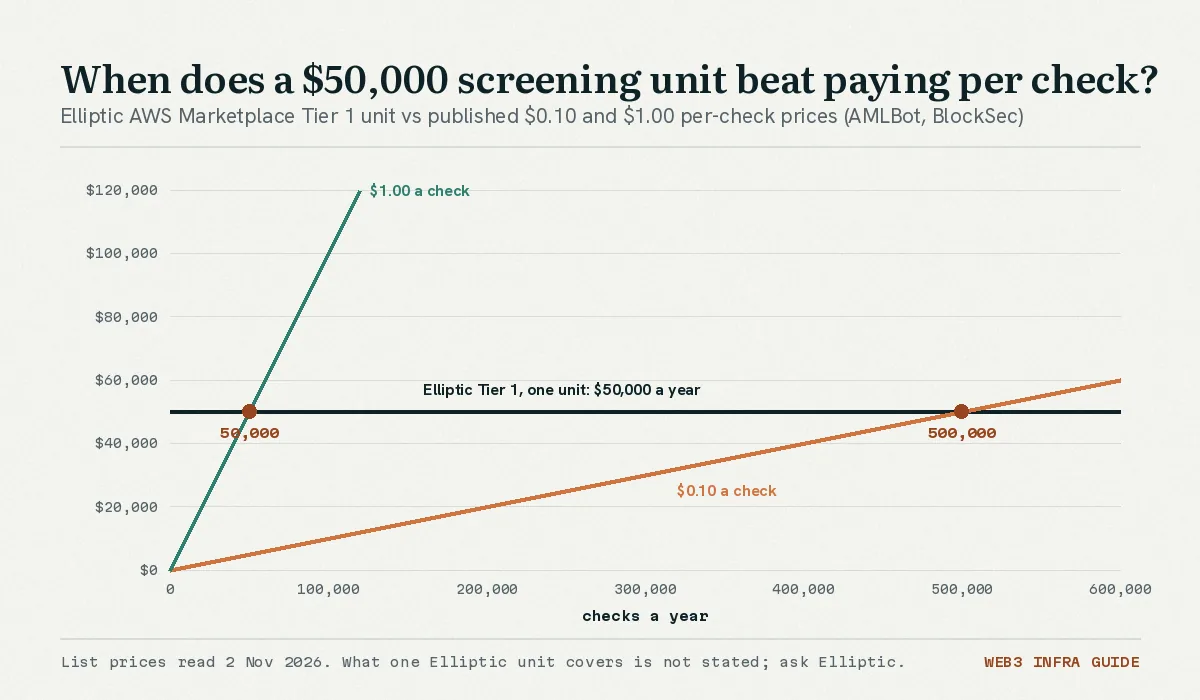
The listing does not say how many checks a unit covers or what overage costs, so ask Elliptic before you compare it with per-check tools.
To size a $50,000 unit, compare it with the published per-check prices from smaller tools: AMLBot credits run from $1 down to $0.10 a check, and BlockSec lists Phalcon from $0.10 a check. Our own arithmetic: $50,000 divided by $1.00 is 50,000 checks a year, and divided by $0.10 is 500,000 checks a year.
| Checks a year | At $1.00 a check | At $0.10 a check | Elliptic Tier 1 unit |
|---|---|---|---|
| 25,000 | $25,000 | $2,500 | $50,000 |
| 50,000 | $50,000 | $5,000 | $50,000 |
| 250,000 | $250,000 | $25,000 | $50,000 |
| 500,000 | $500,000 | $50,000 | $50,000 |
Verdict: Below about 50,000 checks a year a per-check tool is cheaper on list price; above 500,000, an enterprise unit wins even against $0.10 checks. Ask each vendor to quote against your real volume.
How to Run a Fair Bake-Off
Ask all three for a two-week trial on the same data, then compare attribution rates, not demos. The script below is an example of the scoring step: it reads each vendor’s export of the same 50 past deposits and counts how many got a named entity. Replace the file names with your own exports.
# example: compare attribution on the same 50 deposits
import csv
vendors = {"chainalysis": "chainalysis.csv", "trm": "trm.csv", "elliptic": "elliptic.csv"}
for name, path in vendors.items():
    rows = list(csv.DictReader(open(path)))
    named = sum(1 for r in rows if r["entity"].strip())
    high = sum(1 for r in rows if r["risk"] in ("high", "severe"))
    print(f"{name}: {named}/{len(rows)} attributed, {high} high-risk alerts")
Each export needs an entity column and a risk column; map each vendor’s field names to those two before you run it. Then review every high-risk alert by hand and record which ones were false positives.
- Pick 50 past deposits, including at least 10 you already know are risky.
- Send the same list to all three vendors and get exports from each.
- Compare attribution rate, high-risk alerts and false positives side by side.
- Trace one closed case end to end in Reactor, Forensics and Investigator.
- Ask each vendor for its SOC 2 report and a quote at your real check volume.
Verdict: A vendor that attributes far more of your own deposits is worth a higher price; a demo on someone else’s case proves little.
Which One Should You Choose?
| If you are | Choose | Why |
|---|---|---|
| A licensed exchange with a large investigations team | Chainalysis | Reactor depth, FedRAMP, KYT coverage |
| A multi-chain exchange that wants its own risk rules | TRM Labs | 155+ configurations, 184+ chains, glass-box attribution |
| A bridge-heavy or DeFi-facing platform | Elliptic | 250+ bridges in Lens, one-click cross-chain tracing |
| A custodian vetting counterparty VASPs | Elliptic | Discovery peer-relative VASP scores |
| A team that needs a budget figure now | Elliptic | Published AWS Marketplace tiers |
Custodians choosing a screening vendor alongside a custody provider can start with our institutional crypto custody guide, and treasury teams can compare tooling in our crypto treasury management guide.
Final Verdict
Chainalysis, TRM Labs and Elliptic are all credible primary engines for a regulated firm, and less than one point separates them on our rubric. The choice comes down to whether your team spends more time on investigations, on tuning screening rules or on cross-chain and counterparty checks, and on how much price certainty you need up front.
- Chainalysis (9.2): deepest investigations and the widest stated monitoring coverage.
- TRM Labs (8.9): the most configurable screening with clear attribution sourcing.
- Elliptic (8.7): cross-chain and VASP strength, plus the only published price.
Verdict: Shortlist two, run the 50-deposit bake-off and sign with the one that attributes more of your own traffic. If none of the three fits, our Chainalysis alternatives guide ranks eight alternatives to Chainalysis.
Frequently Asked Questions
Is Chainalysis better than TRM Labs?
Chainalysis scores 9.2 to TRM Labs 8.9 in our rubric, mainly on investigation depth: Reactor states 325M+ swaps and 300+ bridges and DEXs. TRM states wider screening coverage at 184+ blockchains and offers 155+ risk configurations. Test both on the same past deposits before you decide, because the gap is small.
Is Elliptic cheaper than Chainalysis?
Elliptic is the only one of the three with a public price: 12-month AWS Marketplace contracts at $50,000 or $100,000 per unit of screening volume. Chainalysis publishes no price and quotes privately, so a direct comparison needs a quote from each vendor at your real check volume and product mix.
How many blockchains do Chainalysis, TRM Labs and Elliptic support?
Each product has its own figure: Chainalysis KYT lists 400+ networks and Reactor 27+ blockchains, while TRM Wallet Screening lists 184+ blockchains and Forensics 65+. Elliptic Lens lists 60+ blockchains and 250+ bridges, and the company states 65+, so ask which chains get full attribution.
Which is best for cross-chain and bridge tracing?
Elliptic and Chainalysis both lead here. Elliptic Lens covers 250+ bridges and Investigator offers one-click cross-chain tracing, while Chainalysis Reactor states 300+ bridges and DEXs and 325M+ swaps. TRM traces across chains on one graph but publishes no bridge count on the pages we read.
Do these vendors have SOC 2 reports?
Yes. Chainalysis cites SOC 2 Type 2 and FedRAMP, TRM Labs states an annual SOC 2 audit, and Elliptic lists SOC 2 Type 2 plus ISO 27001, ISO 22301, ISO 9001 and ISO 14001. Ask for the actual report under NDA, and check which products it covers.
Can a firm use two blockchain analytics vendors?
Yes, and many large exchanges do. One vendor runs primary screening and monitoring, and a second covers chains the first misses or gives a second opinion on high-risk alerts. Smaller firms usually start with one vendor, then add another once volume or chain count grows enough to justify it.