
Last updated: 2 November 2026 · network counts, certifications, prices and the Sygna sale rechecked on each vendor’s own pages on 2 November 2026
In the Notabene vs Sumsub vs Sygna decision, Notabene (8.9/10) beats Sumsub (8.5) and Sygna (6.4) for most crypto firms in 2026: it has the largest stated network, the strongest published security record and the only free tier. Sumsub wins when you also want KYC and AML screening on one contract with a public price. Sygna is now owned by VerifyVASP, so it only makes sense if your counterparties are Sygna or VerifyVASP members in Japan, Taiwan or Korea.
We read the product, pricing, security and documentation pages of all three on 2 November 2026 and scored them on the same rubric we use across our crypto compliance hub; the weights are on our methodology page. The pages that rank for this comparison mostly compare one pair, skip the Sygna sale or quote prices no vendor publishes. Every figure below links to its source. This is not legal advice.
TL;DR
- Notabene scores 8.9/10: 2,300+ regulated institutions in its network, ISO 27001:2022 plus an annual SOC 2 Type II audit, and a free plan for firms sending up to $10k a month.
- Sumsub scores 8.5: five protocols behind one integration (CODE, GTR, Sygna, TRP and its own), 2,100+ VASPs claimed on its protocols page, and Travel Rule included from $1.35 per verification.
- Sygna scores 6.4: an ISO/IEC 27001 certified Bridge API, but no published price and an ownership change; VerifyVASP announced it bought Sygna on 30 April 2026.
- Sumsub reaches Sygna Bridge directly, so a Sumsub customer can still message Sygna members during the migration.
- Sumsub disclosed in February 2026 that a July 2024 intrusion exposed mostly names from a support environment; ask about it in due diligence.
- Run your own top 20 counterparties through each vendor before signing; reach to your real flow decides this more than scores.
The Short Answer by Use Case
All three move the same IVMS101 data between virtual asset service providers. They differ in who they reach, how much of the compliance workflow they cover and how open they are about price. Choose on reach to your own counterparties first; the overall score only breaks ties.
- Widest network and a free way to start: Notabene.
- KYC, AML screening and Travel Rule from one vendor: Sumsub.
- Most of your transfers go to Japanese or Taiwanese exchanges already on Sygna: Sygna, now via VerifyVASP.
- You need to budget before a sales call: Sumsub, the only one of the three with per-check prices on its site.
- You want to reach Sygna members without joining Sygna: Sumsub, which lists Sygna Bridge as a live protocol.
Verdict: Notabene for reach and security posture, Sumsub for one-contract compliance and price clarity, Sygna only for its existing Asian corridors.
Notabene vs Sumsub vs Sygna at a Glance
| Notabene | Sumsub | Sygna | |
|---|---|---|---|
| Our score | 8.9 | 8.5 | 6.4 |
| What it is | Travel Rule network and gateway | Identity and AML platform with Travel Rule | Travel Rule protocol and AML hub |
| Stated reach | 2,300+ regulated institutions, 110+ jurisdictions | 2,100+ VASPs on protocols page; 1,050+ in client directory | No current count; VerifyVASP states 150+ members |
| Protocols | Own network; says it integrates live protocols | CODE, GTR, Sygna, TRP (limited), Sumsub | Sygna Bridge; interop with TRISA and Veriscope |
| Security | ISO 27001:2022, SOC 2 Type II | SOC 2 Type 2, ISO/IEC 27001, PCI DSS and more | ISO/IEC 27001 |
| Published price | Free up to $10k sent a month; paid by demo | $1.35 or $1.85 per verification, $149 or $299 minimum | Not published |
| Owner in 2026 | Independent; Ripple investment | Independent | VerifyVASP (Upbit Global subsidiary) |
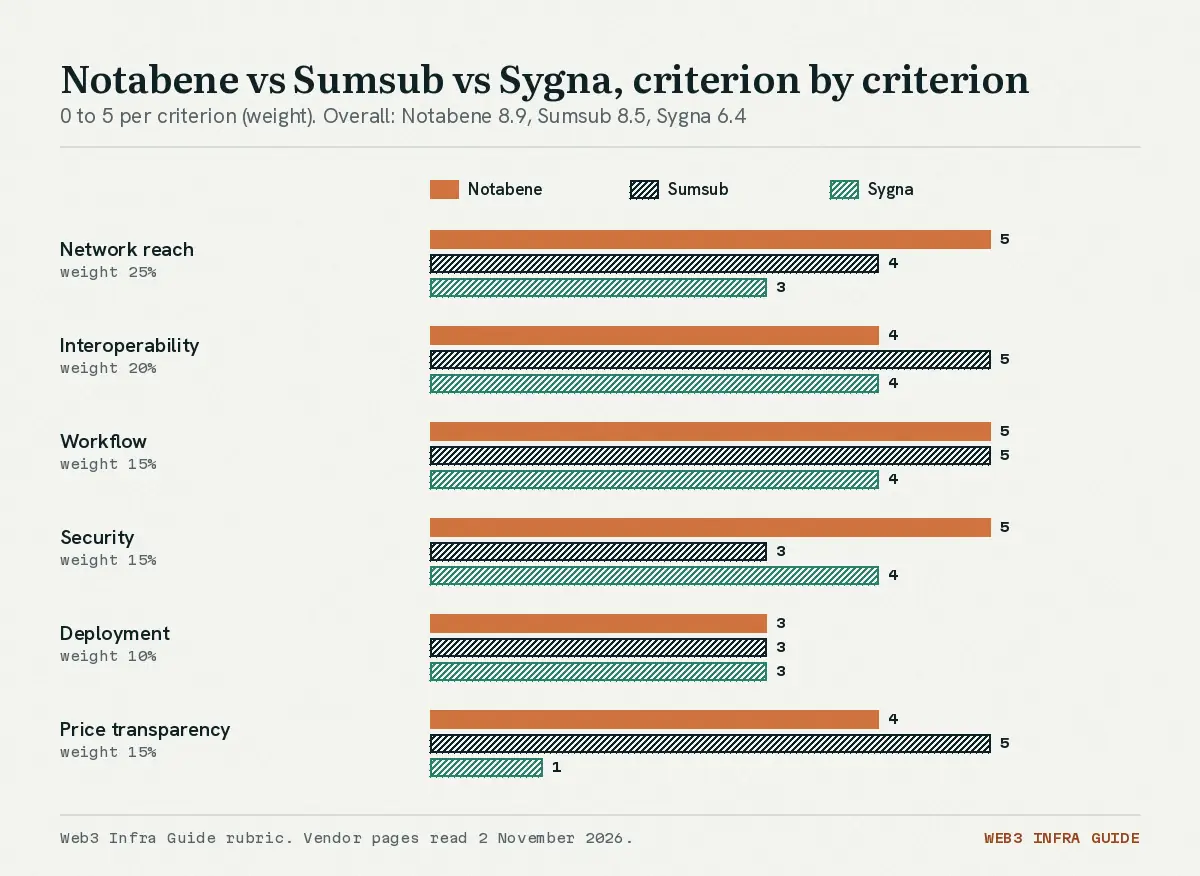
Each vendor gets 0 to 5 on network reach (25%), protocol interoperability (20%), workflow and unhosted wallet support (15%), security and data handling (15%), deployment options (10%) and price transparency (15%), and the weighted total is doubled to give a score out of 10. Sumsub loses most of its gap to Notabene on security, not on features. Sygna is held back by price transparency, where it scores 1, and by a network that is mid-migration.
Notabene: 8.9/10
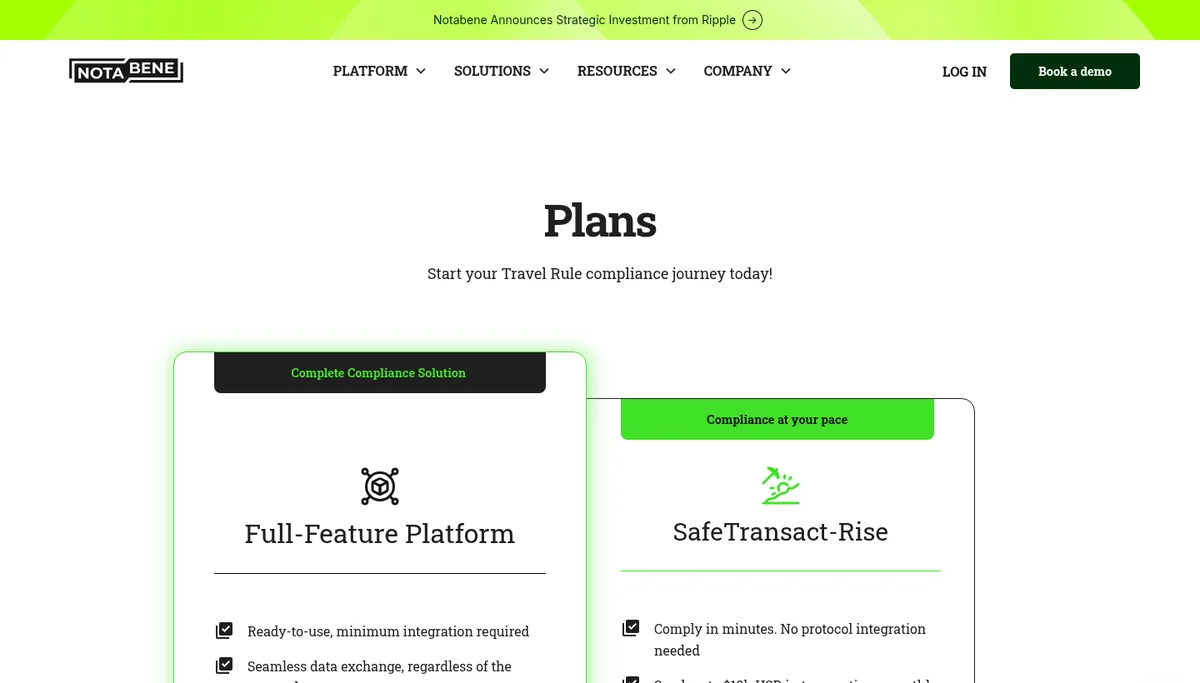
Notabene is the network most compliance teams shortlist first. Its home page states 2,300+ regulated institutions in the network, 280+ customers and more than $3 trillion in compliant volume, $1.7T+ of it in stablecoins. Notabene is the only one of the three with a free plan: SafeTransact-Rise lets a firm send up to $10k a month, receive without limit and use the full network.
- Products: the open Transaction Authorization Protocol (TAP), Notabene Transact for Travel Rule messaging and Notabene Flow for checks before a transfer is signed.
- Protocols: its protocols page calls Notabene protocol-agnostic and says it looks to integrate all live protocols, naming TRP, OpenVASP, TRUST, Sygna Bridge, TRISA, Shyft, Netki and VerifyVASP. It does not publish a list of which are live in its gateway today.
- Security: the security page lists ISO 27001:2022, an annual SOC 2 Type II audit, GDPR and DORA readiness, CREST-accredited penetration testers and optional customer-managed keys.
- Data handling: personal data can sit in an encrypted escrow until counterparty due diligence clears, with a choice of storage regions.
- Paid plans: the Full-Feature Platform on the pricing page is quoted by demo; we found no public figure.
Verdict: The strongest all-round pick. Use the free plan to test reach to your counterparties, then get the paid quote in writing before volume passes the $10k cap.
Sumsub: 8.5/10
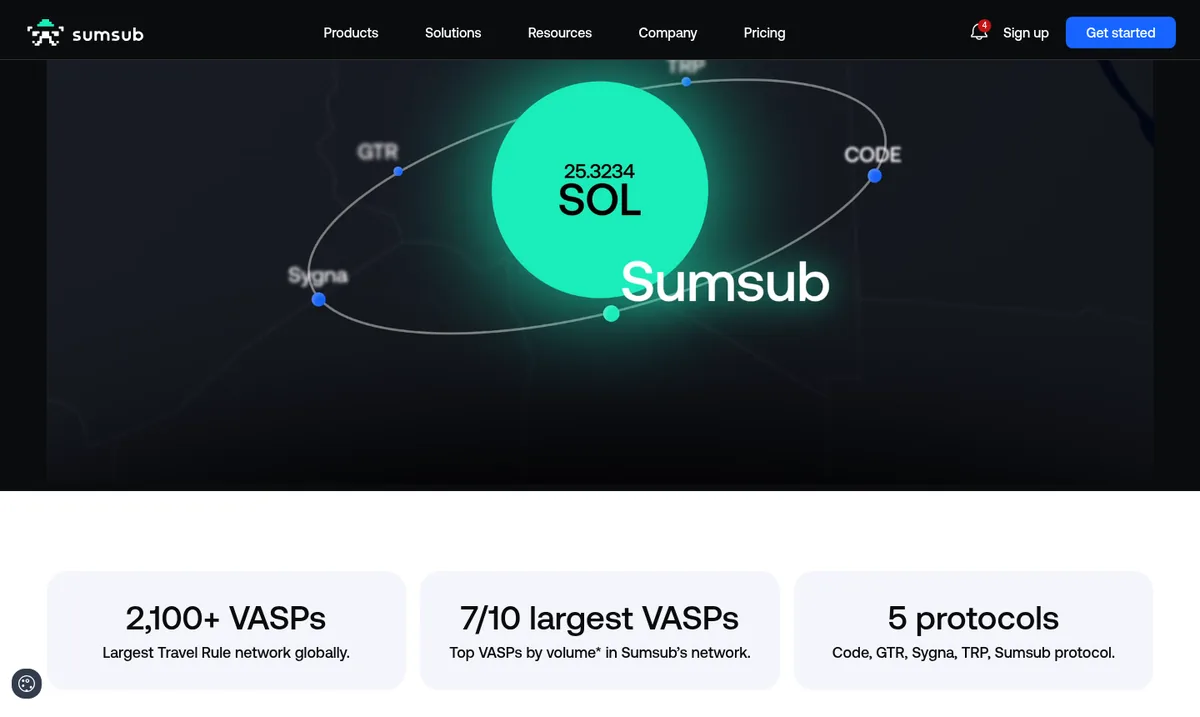
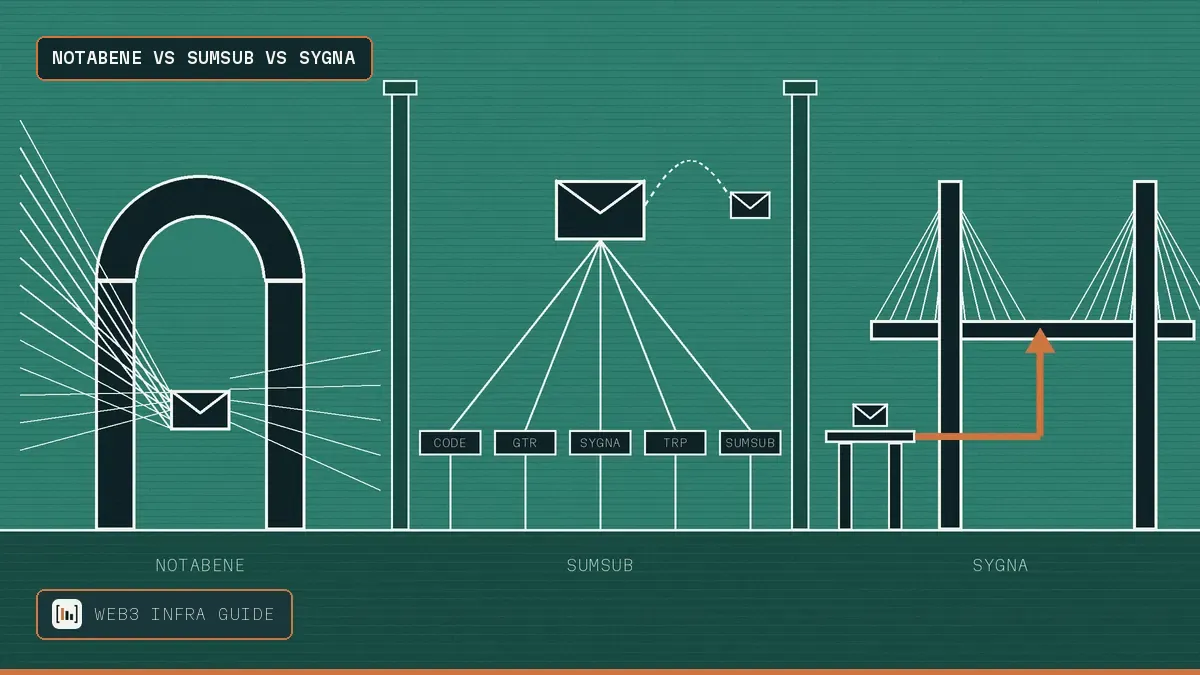
Sumsub sells Travel Rule inside a wider identity, KYC and transaction monitoring platform. Its protocols page claims 2,100+ VASPs, 7 of the 10 largest VASPs by volume and five protocols: CODE, GTR, Sygna, TRP and Sumsub’s own. Sumsub is a protocol router: you integrate once and it picks the protocol the counterparty speaks, with email as a fallback.
- Counting: the same company’s Travel Rule page states 1,050+ VASPs in its client directory. The 2,100+ figure is the protocols page claim for reachable VASPs, so the two measure different things.
- Protocol status: the protocols page marks TRP as limited, so confirm TRP flows before you rely on them.
- Unhosted wallets: its documentation lists digital signature, Satoshi test, self-declaration form and manual review as ownership methods.
- Price: the pricing page includes Travel Rule in Basic at $1.35 per verification with a $149 monthly minimum, and in Compliance at $1.85 with a $299 minimum.
- Certifications: the trust center lists SOC 1 Type 1, SOC 2 Type 2, PCI DSS, ISO/IEC 27001, 27017, 27018 and ISO 22301.
Verdict: Best when you also need KYC and screening and want one vendor and one invoice. Ask how Travel Rule transfers are metered against verifications before you sign.
Sygna: 6.4/10

Sygna, built by Taiwan’s CoolBitX, now presents itself as Sygna by VerifyVASP. Its home page sells three products: Bridge, a standalone Travel Rule API that supports over 3,000 virtual assets; Hub, a dashboard that bundles analytics and screening from Chainalysis, Elliptic, Merkle Science, Coinfirm, Dow Jones and ComplyAdvantage; and Gate, a browser-only version of Hub for firms that cannot integrate. Sygna Bridge encrypts personal data so that only the sending VASP holds the key, and Sygna says it never accesses that data.
- Assessment: the Bridge page says it was independently assessed by Singapore’s ACCESS association and was ISO/IEC 27001 certified.
- Timeline: the FAQ quotes 4 to 6 weeks to integrate with its API and alliance network.
- Interop: Hub and Gate list interoperability with TRISA and Veriscope; ask which links are live in 2026.
- Price and reach: no price and no current member count are published.
Verdict: Only worth a new contract if your main counterparties already use Sygna. Anyone else gets broader reach from Notabene or Sumsub, both of which can message Sygna members.
How Each One Routes a Transfer
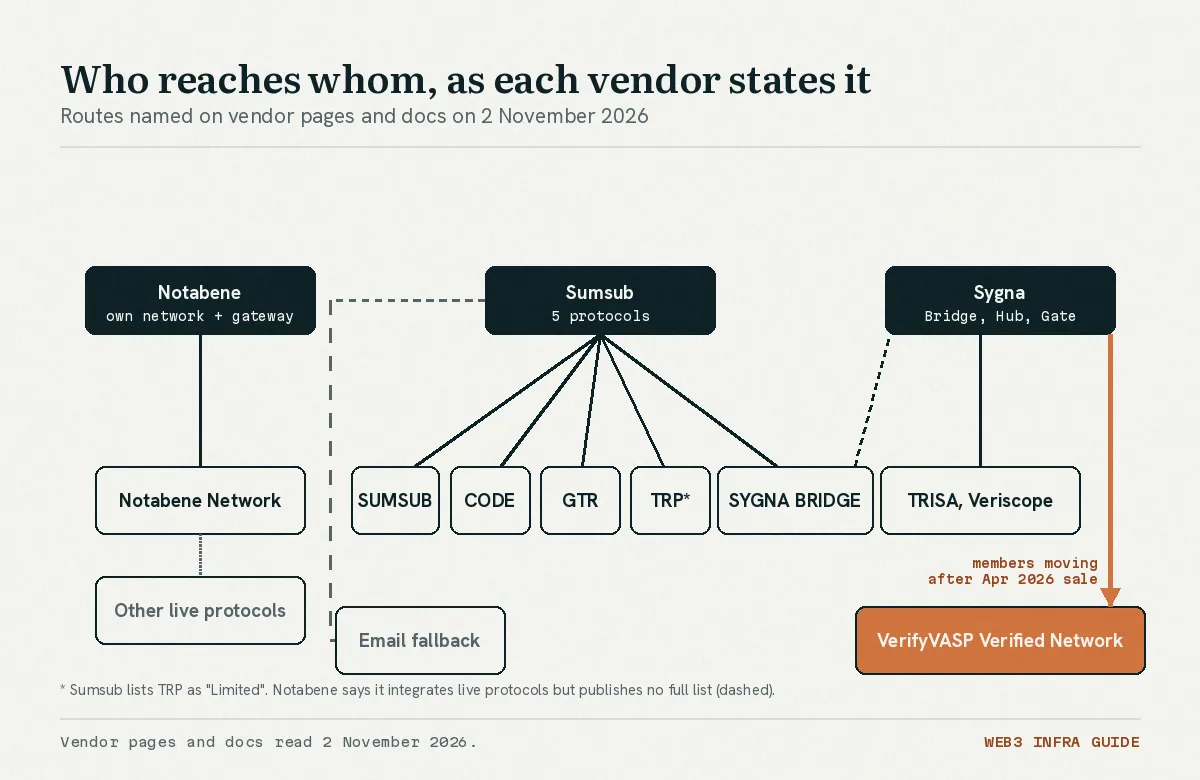
The three take opposite approaches: Notabene runs its own network and adds other protocols through its gateway. Sumsub owns no dominant network and instead routes to five. Sygna is a protocol that is now being folded into a bigger one. Because Sumsub lists Sygna Bridge as a protocol, the Sumsub route is the simplest way for a non-member to reach Sygna VASPs today.
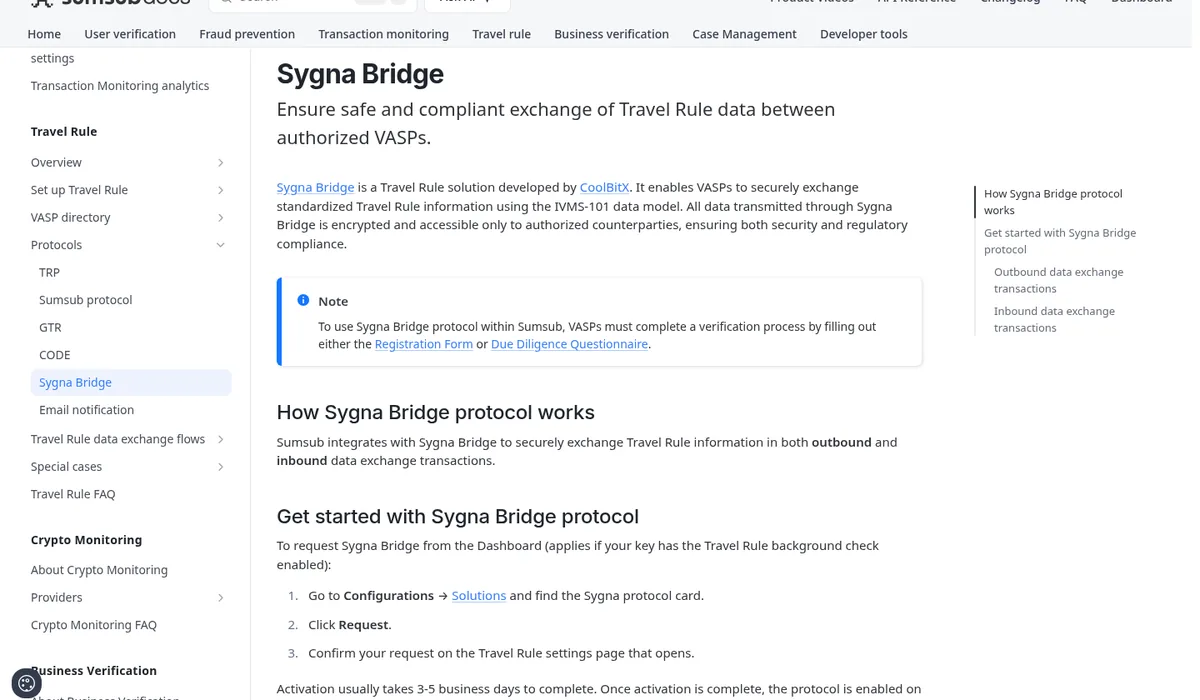
Turning on Sygna in Sumsub is not instant. Its Sygna Bridge documentation says you must complete a Registration Form or Due Diligence Questionnaire, and activation usually takes 3 to 5 business days. Sumsub first announced the Sygna integration in September 2024 for Japan and Taiwan.
| Question | Notabene | Sumsub | Sygna |
|---|---|---|---|
| Own network | Yes, the Notabene Network | Sumsub protocol, plus four others | Sygna Bridge, moving to VerifyVASP |
| Reaches Sygna members | Names Sygna Bridge among protocols it integrates | Yes, after a 3 to 5 day activation | Native |
| Fallback when no protocol matches | Not stated on the pages we read | Not stated | |
| Integration effort | Free plan, then demo | SDK, API or protocol connection | 4 to 6 weeks, per FAQ |
Verdict: If you need Sygna coverage without a Sygna contract, Sumsub is the documented path. Ask Notabene for written confirmation of which protocols are live in its gateway.
Price: What You Can Budget Before a Call
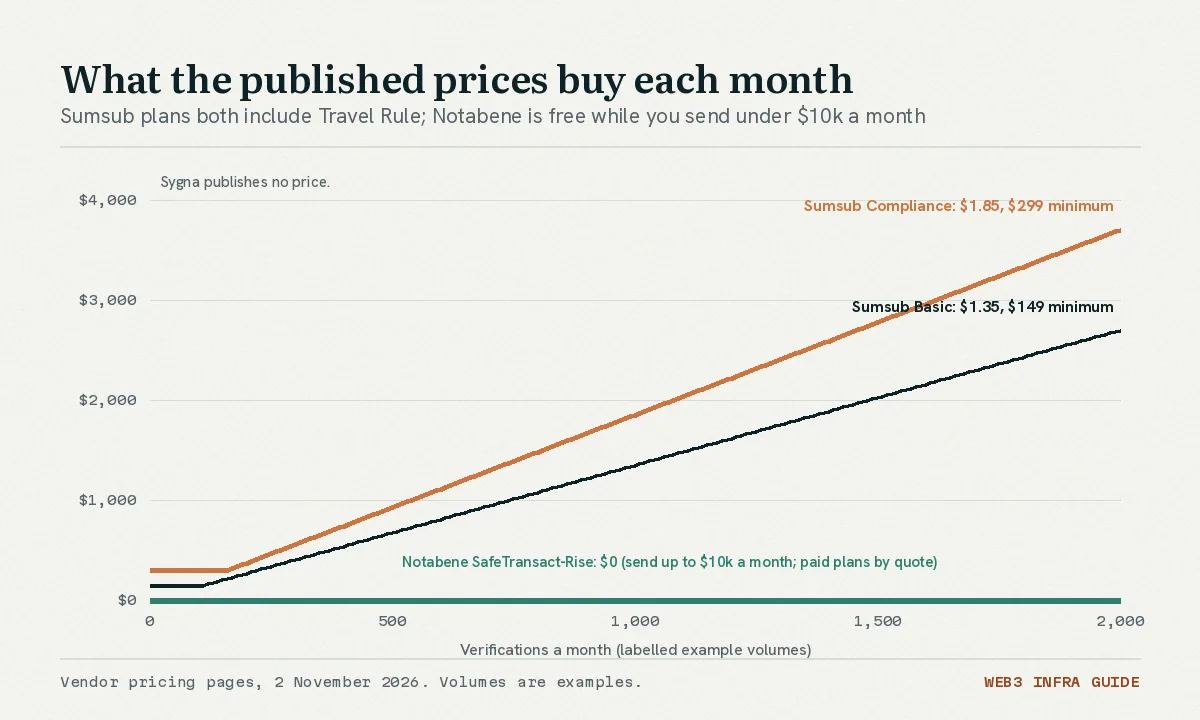
Only Sumsub publishes a usage price, and only Notabene publishes a free plan. Sumsub Basic costs the $149 minimum until about 110 verifications a month, and Compliance costs the $299 minimum until about 161. Above those points you pay per verification.
| Plan | Published price | Minimum per year | Labelled example: 1,000 verifications a month |
|---|---|---|---|
| Notabene SafeTransact-Rise | Free; send up to $10k a month | $0 | Free only if outgoing volume stays under $10k |
| Notabene Full-Feature Platform | By demo | Not published | Ask for a quote |
| Sumsub Basic | $1.35 per verification, $149 minimum | $1,788 | $1,350 a month |
| Sumsub Compliance | $1.85 per verification, $299 minimum | $3,588 | $1,850 a month |
| Sygna | Not published | Not published | Ask for a quote |
The example assumes one verification per Travel Rule check, which Sumsub does not spell out for Travel Rule transfers. A third-party page that ranks for this comparison quotes Notabene and Sygna in euro ranges; neither vendor publishes those figures, so treat them as estimates.
Verdict: Small CASPs with low outgoing volume should start free on Notabene. Firms already buying KYC should price Sumsub Basic first, since Travel Rule is included in that plan.
Security and Data Handling
All three hold ISO/IEC 27001. Notabene adds an annual SOC 2 Type II audit, and Sumsub lists the widest set of certifications. Sumsub is the only one of the three with a disclosed security incident in its recent history, so ask about it directly.
Sumsub’s incident notice says that in July 2024 an attacker sent a malicious attachment through a third-party support ticketing tool and reached a support environment. The exposed data was mostly names, with some email addresses or phone numbers; Sumsub says biometrics, ID document images and payment details were not accessed. It found the activity in a January 2026 review. Treat it as a due diligence question about detection time, not a reason to rule Sumsub out.
- Notabene: customer-managed keys, encrypted PII escrow until counterparty checks pass, and separate storage regions.
- Sumsub: SOC 2 Type 2 and ISO/IEC 27001, 27017 and 27018 on its trust center.
- Sygna: PII encrypted with a key only the sender holds; ISO/IEC 27001 certification announced for Bridge.
- All three: ask for the latest audit report under NDA before any personal data leaves your systems.
Verdict: Notabene has the cleanest published security record of the three. Sumsub’s certifications are broad, but its detection gap deserves a written answer.
If You Use Sygna Today: Migration Checklist
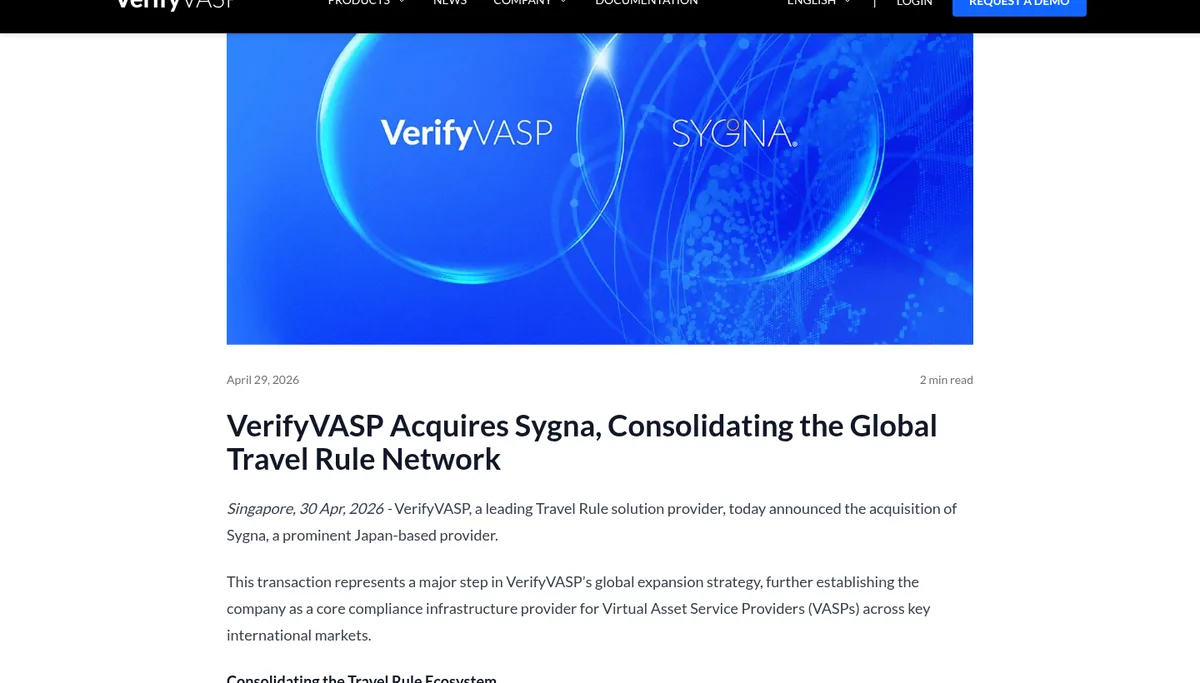
VerifyVASP’s acquisition notice calls Sygna a prominent Japan-based provider and says existing members will keep operating without disruption and be onboarded progressively onto its Verified Network. VerifyVASP states 150+ member VASPs across 30+ jurisdictions and SOC 2 Type II. No migration date is published, so the timeline is something you have to ask for.
- Ask VerifyVASP for your migration date and whether your Sygna contract carries over or is replaced.
- Confirm your API keys, endpoints and IVMS101 mapping still work after cutover; plan a test window.
- List your top counterparties on Sygna and check which are already VerifyVASP members.
- Check whether Hub and Gate screening integrations continue under the new owner.
- Keep a second route, such as Sumsub’s Sygna protocol or Notabene, for counterparties outside the Verified Network.
- Record the change in your Travel Rule policy and vendor risk register.
Verdict: Stay put for now if Sygna works, but get the migration plan in writing this quarter and line up a second route.
Thresholds Your Tool Must Handle
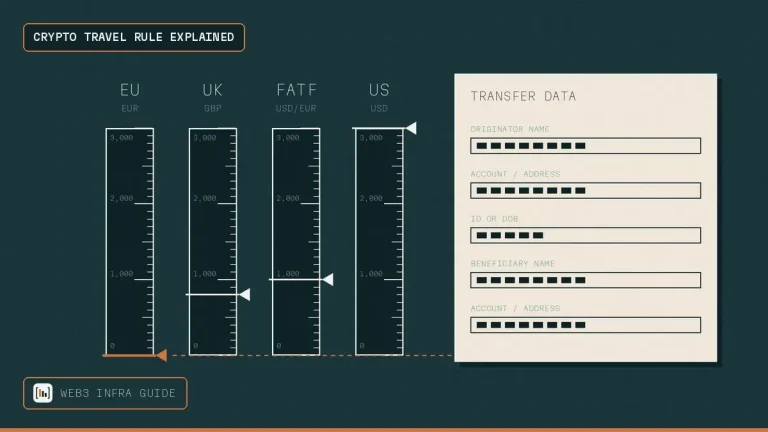
The vendor matters less than the rules you send under, because thresholds decide how many transfers need a Travel Rule message at all and therefore what each vendor will cost you. The EU applies the Travel Rule to every CASP-to-CASP transfer with no minimum, so price every vendor at your full transfer count. Our Travel Rule explainer lists the EU, UK, US and FATF requirements in one place.
| Region | Threshold | Source |
|---|---|---|
| FATF standard | Optional USD/EUR 1,000 | FATF Recommendation 16 |
| European Union | None for CASP-to-CASP; self-hosted wallet checks above EUR 1,000 | EBA Travel Rule Guidelines |
| United States | $3,000 or more | 31 CFR 1010.410 |
Unhosted wallet transfers need ownership checks rather than a counterparty message. Sumsub documents four methods; ask Notabene and Sygna to show their equivalent flow in a demo.
Test Coverage Before You Sign
Export 90 days of withdrawals to other VASPs, rank destinations by count and send the top 20 to each vendor. Ask which are reachable by API, which only by email and which are unknown. Save each reply as a CSV with vasp, status and count columns, then weight the answers by your own volume.
# example: weight vendor coverage by your own withdrawal counts
import csv
for vendor in ["notabene", "sumsub", "sygna"]:
    rows = list(csv.DictReader(open(f"{vendor}.csv")))
    total = sum(int(r["count"]) for r in rows)
    api = sum(int(r["count"]) for r in rows if r["status"] == "connected")
    print(f"{vendor}: {100 * api / total:.0f}% of withdrawals reachable by API")
Verdict: The vendor that covers the larger share of your weighted withdrawals by API is the better buy, whatever the headline network count says.
Which One Should You Choose?
| If you are | Choose | Why |
|---|---|---|
| A small CASP with low outgoing volume | Notabene | Free up to $10k sent a month, full network |
| An exchange that also needs KYC and AML screening | Sumsub | Travel Rule included in Basic and Compliance plans |
| A team that must budget before procurement | Sumsub | Only published per-check price of the three |
| A custodian or institution with strict security review | Notabene | ISO 27001:2022, SOC 2 Type II, customer-managed keys |
| An existing Sygna member in Japan or Taiwan | Sygna, migrating to VerifyVASP | Keeps current counterparties while you plan a second route |
For screening and monitoring tools that sit next to Travel Rule, see our crypto compliance tools guide and blockchain analytics tools comparison. Custodians should also read our crypto custody models guide, since the custody model decides who sends Travel Rule data.
Final Verdict
On Notabene vs Sumsub, Notabene is the safer default: the biggest stated network, the strongest published security record and a free way to prove coverage. Sumsub suits teams buying a KYC and AML stack and doubles as the easiest bridge to Sygna members. Sygna is a legacy route worth keeping only for the counterparties already on it.
- Notabene (8.9): reach, security and a free start.
- Sumsub (8.5): one contract, five protocols and a public price.
- Sygna (6.4): existing Asian corridors during the VerifyVASP move.
Frequently Asked Questions
Is Notabene better than Sumsub for the Travel Rule?
For most crypto firms, yes. Notabene scores 8.9 out of 10 against Sumsub’s 8.5 in our rubric, thanks to its 2,300+ institution network, ISO 27001:2022 and SOC 2 Type II, and a free plan. Sumsub is the better buy when you also need KYC and AML screening from one vendor with a published price.
Who owns Sygna now?
VerifyVASP, a Singapore Travel Rule provider and Upbit Global subsidiary, announced on 30 April 2026 that it had acquired Sygna. It says existing Sygna members keep operating without disruption and will be onboarded progressively onto its Verified Network. No migration date is published, so members should ask for one in writing.
Can Sumsub send Travel Rule data to Sygna members?
Yes. Sumsub lists Sygna as one of five protocols, alongside CODE, GTR, TRP and its own. Its documentation says you must complete a Registration Form or Due Diligence Questionnaire first, and activation of the Sygna protocol usually takes 3 to 5 business days after you request it in the dashboard.
How much do Notabene, Sumsub and Sygna cost?
Notabene’s SafeTransact-Rise plan is free for firms sending up to $10k a month, with paid plans by demo. Sumsub includes Travel Rule in Basic at $1.35 per verification with a $149 monthly minimum and in Compliance at $1.85 with a $299 minimum. Sygna does not publish a price.
Has Sumsub had a security incident?
Yes. Sumsub disclosed that in July 2024 an attacker used a third-party support ticketing tool to reach a support environment. Exposed data was mostly names, with some emails or phone numbers, and Sumsub says biometrics and ID documents were not accessed. It detected the activity during a January 2026 review.
Which is best for unhosted wallet checks?
Sumsub documents the most methods: digital signature, Satoshi test, self-declaration form and manual review. Notabene lists self-hosted wallet identification in its platform but publishes fewer details, and Sygna’s pages focus on VASP-to-VASP transfers. Ask each vendor to demo the exact flow your regulator expects above the EUR 1,000 EU threshold.