
Last updated: 3 November 2026 · every rule, threshold and date below rechecked against the FATF, EU, UK and US primary texts on 3 November 2026
The crypto Travel Rule requires crypto exchanges, custodians and other virtual asset service providers to send the sender’s and recipient’s identifying details along with a transfer, so the provider on the other end knows who is on both sides. It comes from FATF Recommendation 16, which the FATF applied to virtual assets in June 2019.
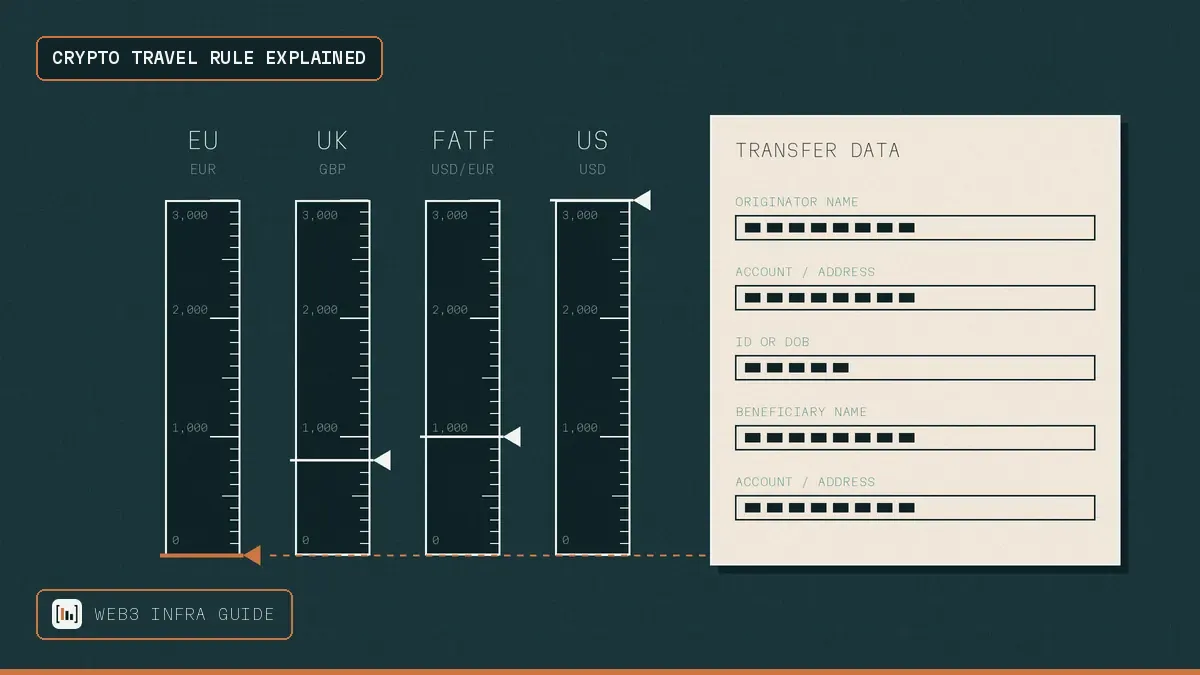
In the EU it is the Transfer of Funds Regulation (EU) 2023/1113, applying from 30 December 2024 with no minimum amount. The UK has applied it since 1 September 2023, with a £800 trigger for fuller data since 30 June 2026. In the US, the funds transfer rule at 31 CFR 1010.410(f) applies from $3,000.
This explainer puts the four regimes side by side: what data must travel, at which amount, what to do with self-hosted wallets, and what changes between now and 2030. Every rule is linked to its primary text. For the tools that do the messaging, see our crypto compliance tools guide; our sourcing rules are on the methodology page. Nothing here is legal advice.
TL;DR
- The Travel Rule is a data rule, not a ban: originator and beneficiary details must travel with, or before, a crypto transfer between providers.
- EU: no threshold for provider to provider transfers under the TFR since 30 December 2024; self-hosted wallet ownership checks above EUR 1,000.
- UK: basic data on every transfer; fuller originator data from £800 when a business outside the UK is in the chain, the trigger since 30 June 2026 (it was EUR 1,000).
- US: 31 CFR 1010.410(f) applies at $3,000 or more. The 2020 proposal to cut cross-border transfers to $250 was withdrawn on 16 April 2025.
- FATF’s July 2026 update found 91 of 109 responding jurisdictions (83%) with Travel Rule laws, but 60% of those had taken no supervisory or enforcement action.
- MiCA’s transitional period for existing crypto firms ended on 1 July 2026, so EU firms now need a CASP licence and full TFR compliance.
What the Crypto Travel Rule Requires
Every version answers three questions: who sent it, who receives it, and which account or address was used. The core data set is the same everywhere: originator name, originator account or wallet address, beneficiary name and beneficiary account or address; the regimes differ on extra identifiers and triggers.
The table shows the fields each regime asks the sending provider to pass on.
| Field | FATF minimum | EU TFR (Art. 14) | UK (reg 64C) | US (1010.410(f)) |
|---|---|---|---|---|
| Originator name | Always | Always | Always | At $3,000+ |
| Originator account or address | Always | Always (ledger address, plus account where used) | Always (or a transaction identifier) | At $3,000+ if ordered from an account |
| Originator address, ID number, customer ID or date and place of birth | Above USD/EUR 1,000 | Always: address with country, official document number and customer ID, or date and place of birth | One item, from £800 cross-border, or on request within three working days | Address at $3,000+ |
| LEI | Not required | If the message format has the field and the customer gave it | Not required | Not required |
| Beneficiary name | Always | Always | Always | As received with the order |
| Beneficiary account or address | Always | Always | Always | As received with the order |
| Amount and date | Not specified as fields | Not listed in Art. 14 | Not listed | Amount and execution date at $3,000+ |
Two details catch most teams out. In the EU the full originator set, including address or document number, is required on every transfer between providers, whatever the amount. In the US the rule is technology neutral: FinCEN’s 2019 guidance confirmed that money transmitters handling convertible virtual currency are covered by the same funds transfer rules as banks.
Verdict: If you build to the EU field list, you meet the data side of the UK, US and FATF minimum too. Thresholds then only decide when you can send less.
Thresholds by Regime
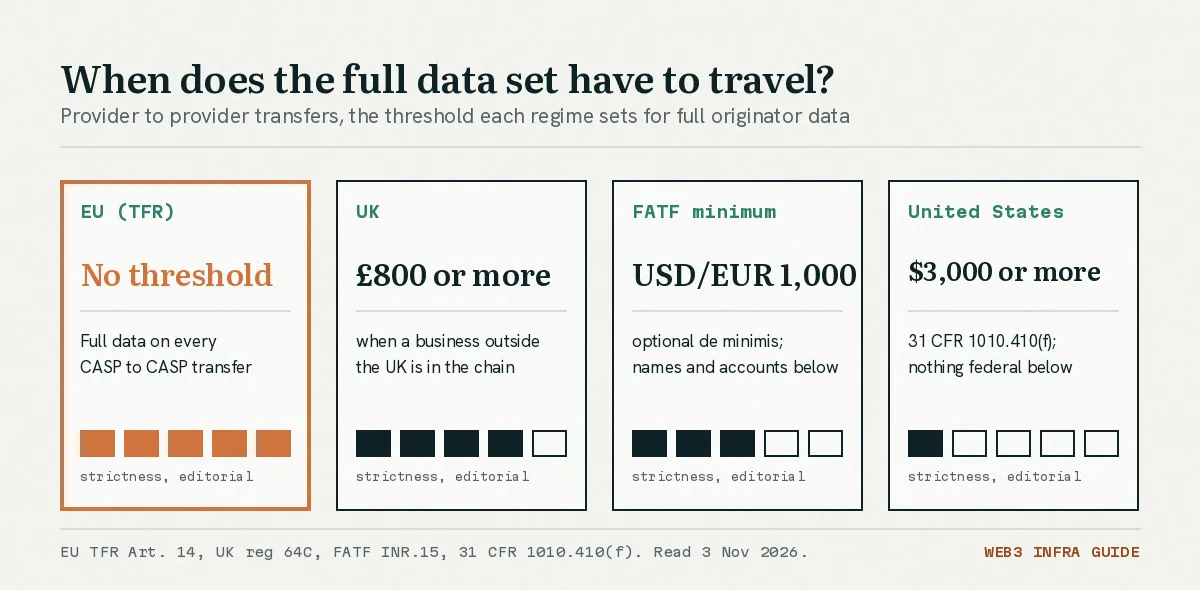
The FATF lets countries choose a de minimis threshold of up to USD/EUR 1,000, below which only names and account numbers need to travel and need not be verified unless there is suspicion. The EU chose no threshold at all, the UK chose £800 for cross-border chains, and the US kept the $3,000 it has used for bank wire transfers since the 1990s. So the same small transfer can be fully in scope in Paris and out of scope in New York.
| Transfer between providers | EU | UK, all businesses in the UK | UK, a business outside the UK | US | FATF minimum |
|---|---|---|---|---|---|
| Under £800 / EUR 1,000 / $3,000 | Full data | Basic data; fuller data on request | Basic data | No federal Travel Rule data | Names and accounts |
| £800 to just under EUR 1,000 | Full data | Basic data; fuller data on request | Full data | No federal Travel Rule data | Names and accounts |
| EUR 1,000 to under $3,000 | Full data | Basic data; fuller data on request | Full data | No federal Travel Rule data | Full data |
| $3,000 or more | Full data | Basic data; fuller data on request | Full data | Full data | Full data |
Note the UK split. Under regulation 64C, when every business in the chain is in the UK, the sender passes names and account numbers and must hand over the fuller originator data within three working days if the receiver asks. When any business is outside the UK, the fuller data must travel with transfers of £800 or more.
Verdict: Most cross-border firms simply send full data on every transfer. It removes threshold logic, FX conversion and the risk of splitting a payment under the line.
The FATF Standard: Recommendation 16 and R.15
The FATF wrote the rule for bank wires as Recommendation 16 and extended it to virtual assets through the interpretive note to Recommendation 15 in June 2019. FATF standards are not law; each country has to legislate them. The Seventh Targeted Update, published in Paris on 16 July 2026, measures how far that has gone.
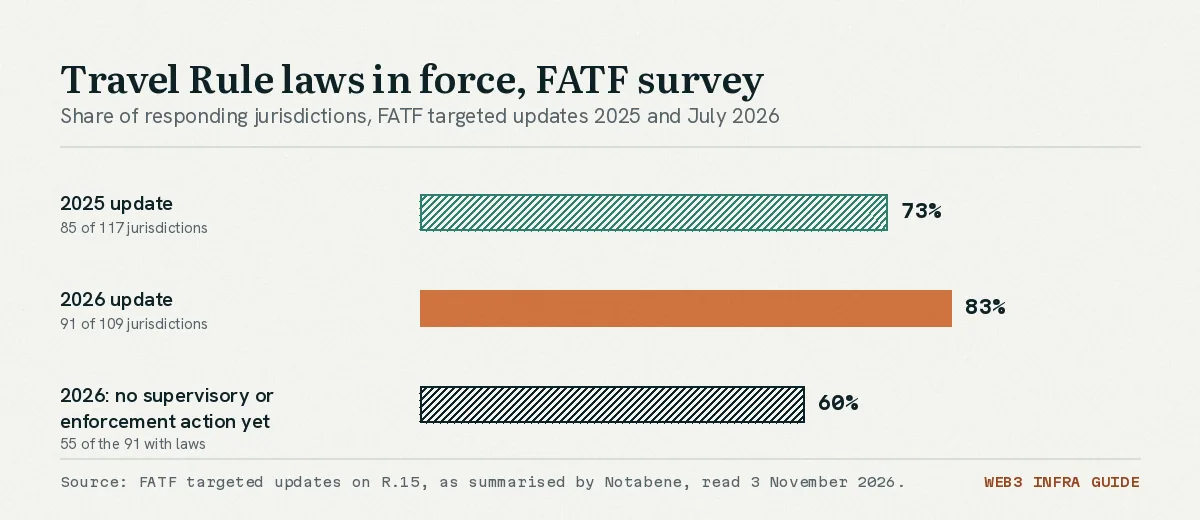
According to Notabene‘s summary of the report, 91 of 109 responding jurisdictions (83%) had passed Travel Rule legislation, up from 85 of 117 (73%) a year earlier. The weak spot is enforcement: 60% of the jurisdictions with a law had not taken a single supervisory or enforcement action on it. The FATF report also flags P2P transfers through unhosted wallets, stablecoin misuse and offshore VASPs as growing risks.
In June 2025 the FATF also revised Recommendation 16 to tighten payment transparency, with implementation expected by the end of 2030. It does not change crypto obligations overnight, but it is the next standard national laws will be measured against.
Verdict: FATF sets the floor and grades countries against it. Your obligations come from national law, which in most major markets is now stricter than the floor.
EU: The Transfer of Funds Regulation and MiCA
The EU applies the Travel Rule through the recast Transfer of Funds Regulation, which applies from 30 December 2024 in every member state without national transposition. Article 14 makes the crypto-asset service provider of the originator send the full originator and beneficiary data on every transfer, before or at the same time as the transfer, with no minimum amount. The data does not have to sit inside the on-chain transaction itself; it can travel through a separate secure channel.
- Article 14: the sending CASP collects and sends originator name, ledger address and account, address with country plus document number and customer ID (or date and place of birth), and the beneficiary’s name and ledger address or account, and verifies the originator data first.
- Article 16: the receiving CASP must detect missing data and verify the beneficiary data before releasing funds.
- Article 17: if data is missing, reject or return the transfer, or ask for the data before releasing it; repeat offenders can be restricted or cut off.
- Article 26: keep the data for five years, then delete it unless national law requires longer.
- Scope: person to person transfers with no CASP involved are outside the regulation.
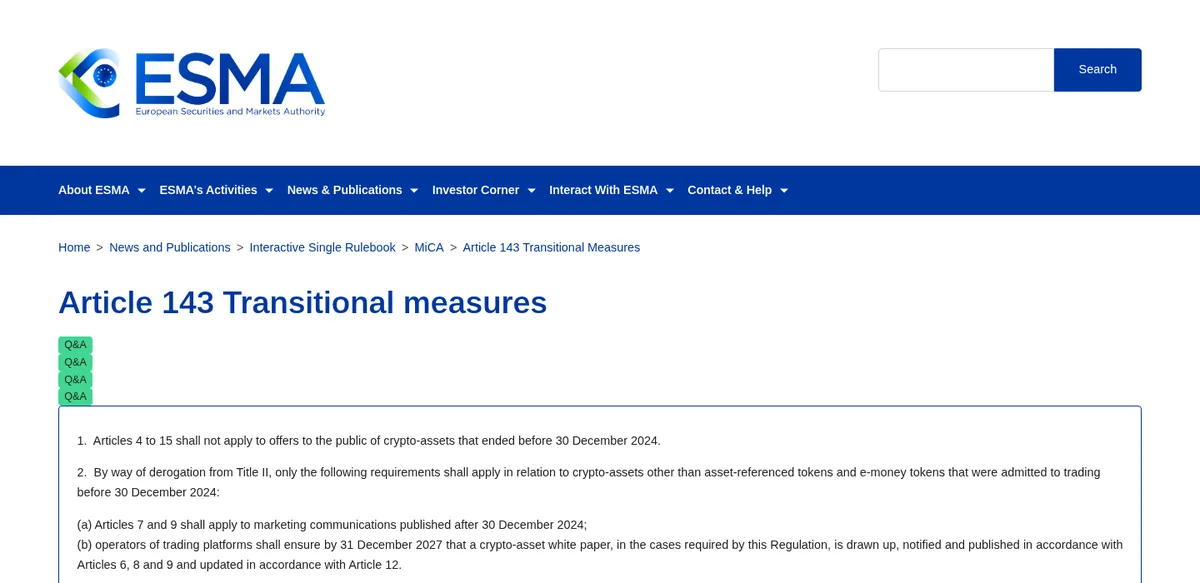
The TFR works alongside MiCA. Under MiCA Article 143, firms already serving clients before 30 December 2024 could continue under national rules until 1 July 2026 at the latest, and member states could shorten that window. That transition has now ended everywhere, so any firm still operating needs a CASP authorisation. The EBA Travel Rule guidelines set out how supervisors expect CASPs to detect missing data and handle self-hosted addresses.
Verdict: The EU is the strictest of the four regimes: every transfer, full data, verified first. Build here first if you have any EU customers.
UK: Part 7A of the Money Laundering Regulations
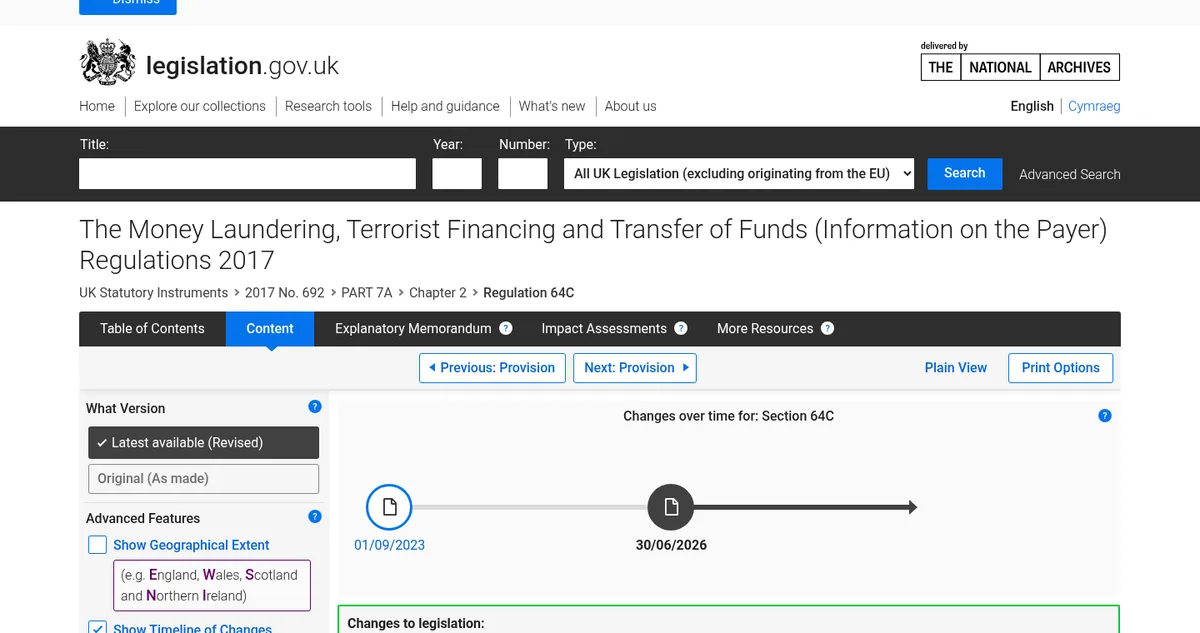
The UK added a Travel Rule in Part 7A of the Money Laundering Regulations 2017, in force since 1 September 2023. The Money Laundering and Terrorist Financing (Amendment) Regulations 2026 replaced the EUR 1,000 trigger with £800 in regulations 64C(4) and 64G(1)(b), effective 30 June 2026. Several guides still quote the euro figure.
- Every inter-business transfer: names of originator and beneficiary (registered name for firms) and account numbers, or a transaction identifier.
- All-UK chain: the fuller originator data on request, within three working days.
- Any business outside the UK and £800 or more: the fuller data travels with the transfer. For an individual that is one of customer ID number, address, ID document number, or date and place of birth.
- Verification and timing: originator data must be verified from an independent source, and the transfer must not go out before the business complies.
- Next: new regulation 34A, enhanced due diligence for crypto correspondent relationships, starts on 1 February 2027.
Verdict: The UK is lighter than the EU for all-UK chains but just as demanding once a foreign counterparty is involved. Many UK firms send full data on every transfer for that reason.
US: The $3,000 Funds Transfer Rule
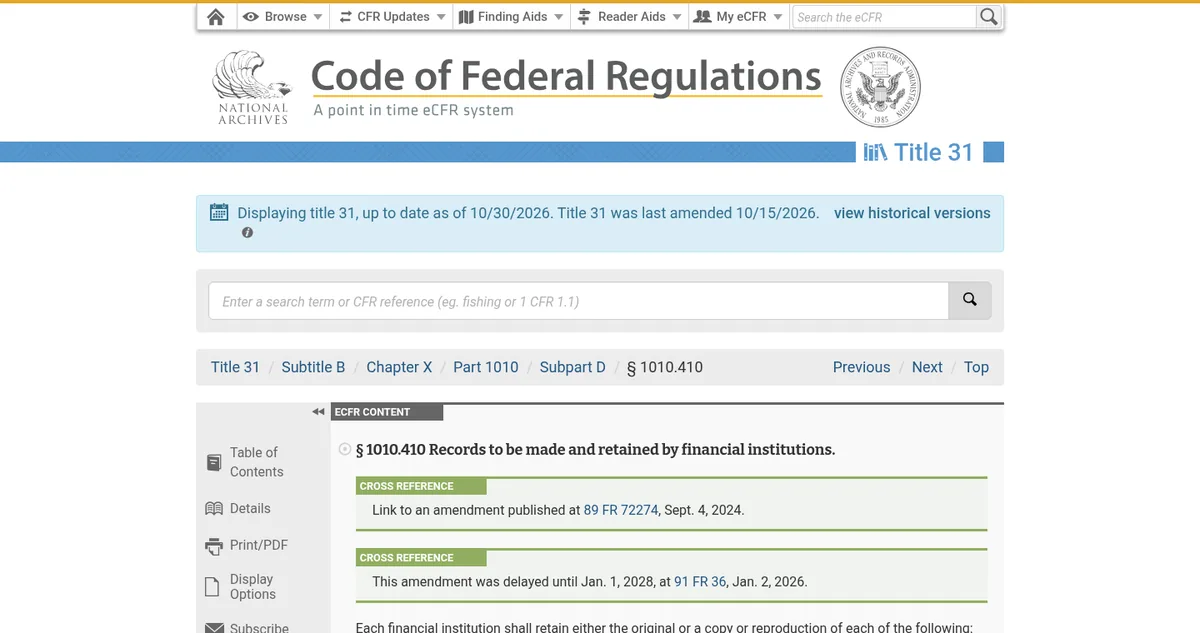
The US has no crypto-specific Travel Rule statute. FinCEN applies the Bank Secrecy Act funds transfer rules to crypto money transmitters, as its May 2019 guidance on convertible virtual currency spelled out. Paragraph (f) of 31 CFR 1010.410 makes the sender pass on the transmittor name, account number, address, amount, execution date and recipient institution for transmittals of $3,000 or more. Below $3,000 there is no federal Travel Rule data requirement, though state licensing and the customer’s own KYC still apply.
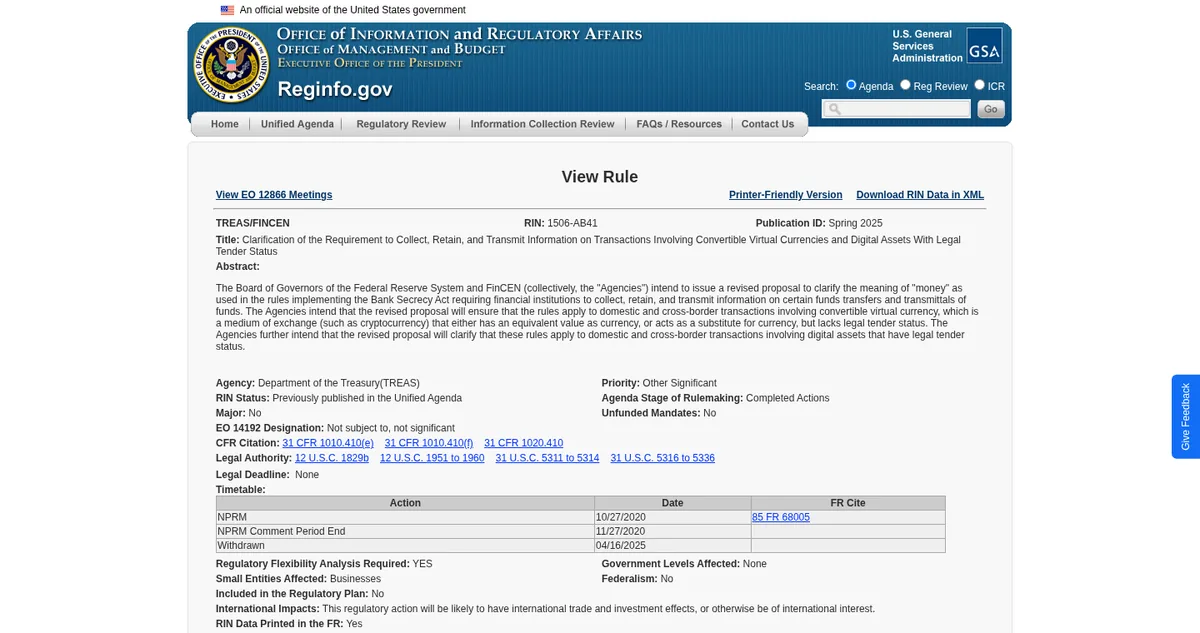
In October 2020 FinCEN and the Federal Reserve proposed lowering the threshold to $250 for transfers that start or end outside the US. The Spring 2025 regulatory agenda lists that rule, RIN 1506-AB41, as withdrawn on 16 April 2025. Some guides updated in 2026 still describe the $250 cut as pending; it is not.
Verdict: US firms work to $3,000, but any transfer to an EU or UK counterparty pulls in that side’s lower trigger. In practice US exchanges send data well below $3,000.
Self-Hosted Wallets: What Changes
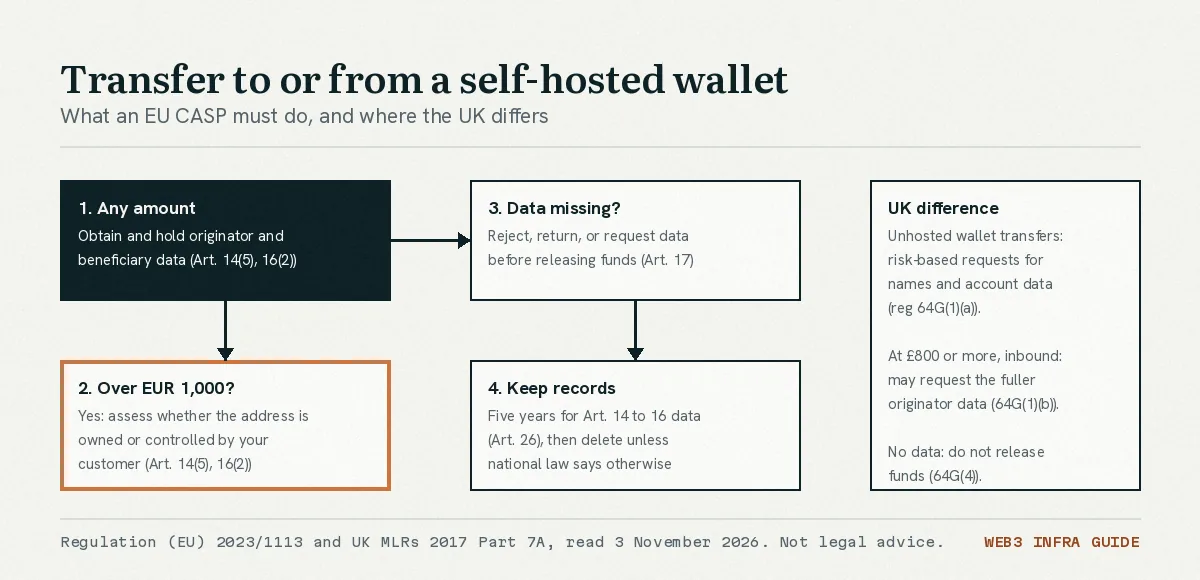
A self-hosted wallet has no provider on the other end to receive the data, so the rule shifts to collecting and checking it yourself. Above EUR 1,000, an EU CASP must also assess whether the self-hosted address is owned or controlled by its own customer, under Articles 14(5) and 16(2) of the TFR. Below that, it still has to obtain and hold the originator and beneficiary data.
| Duty | EU | UK |
|---|---|---|
| Collect counterparty data | Always obtain and hold originator and beneficiary data | Risk-based requests for names and account data (reg 64G(1)(a)) |
| Ownership or control check | Required over EUR 1,000 | No fixed trigger in reg 64G; risk-based |
| Fuller data on inbound transfers | Not separate | May request fuller originator data at £800 or more (64G(1)(b)) |
| If data is not provided | Reject, return or request (Art. 17) | Must not release the cryptoassets (64G(4)) |
| US | No federal Travel Rule duty for self-hosted transfers; the 2020 unhosted wallet proposal was withdrawn in August 2024 | n/a |
Common ways to prove control are a signed message from the address, a small test transfer, or a wallet connection that signs a challenge. Pick one that you can log and replay for an auditor.
Verdict: Treat self-hosted wallets as a separate flow with its own evidence trail. The data is yours to collect, so the failure is yours if it is missing.
Four Worked Transfers
Here is how the rules play out on four transfers. The amounts are example numbers we chose to sit either side of each trigger. The same EUR 900 transfer needs full data in the EU, full data when it leaves a UK firm for a foreign one, and no federal Travel Rule data inside the US.
| Example transfer | Amount (example) | Data that must travel | Why |
|---|---|---|---|
| EU exchange to EU exchange | EUR 200 | Full originator and beneficiary data, verified | TFR has no threshold |
| UK exchange to EU exchange | £900 | Basic data plus one fuller identifier; the EU receiver expects the full TFR set | £800 cross-border trigger; EU receiving duties under Art. 16 |
| US exchange to US exchange | $2,500 | No federal Travel Rule data | Below the $3,000 trigger in 1010.410(f) |
| EU exchange to customer’s self-hosted wallet | EUR 1,500 | Obtain and hold both parties’ data; assess ownership or control | Over EUR 1,000 under Art. 14(5) |
Verdict: Thresholds matter less than corridors. Map every corridor you serve to the stricter side and you rarely need per-transfer threshold logic.
How the Data Moves: IVMS 101
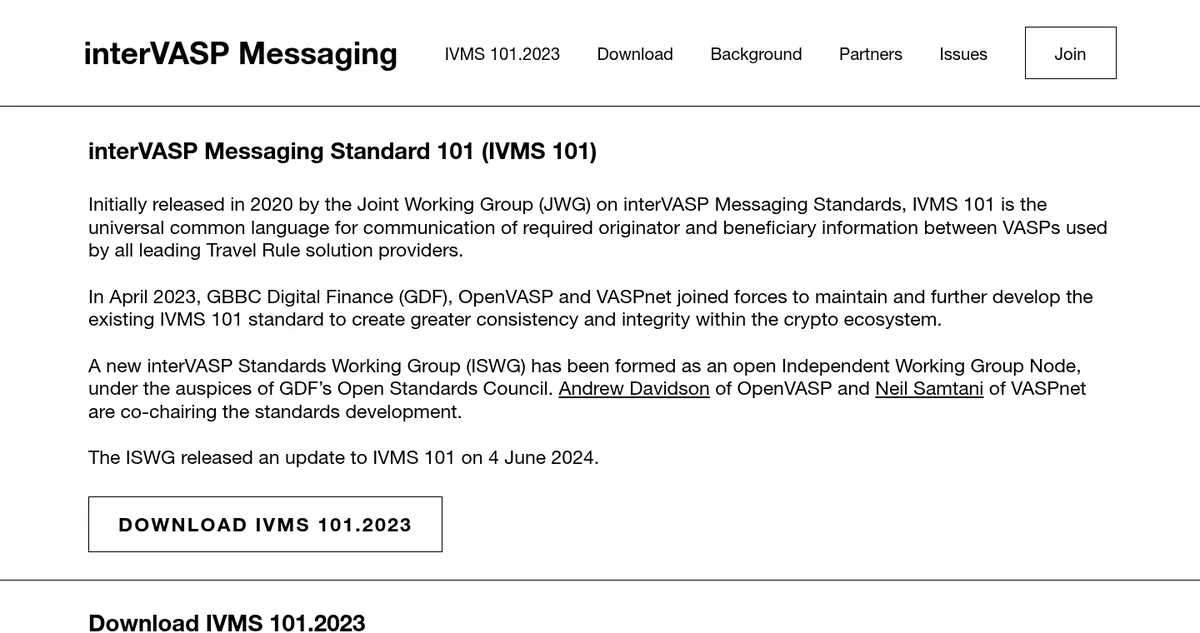
Regulators say what data must travel, not how. The industry answer is IVMS 101, the interVASP Messaging Standard first released in May 2020 and updated as IVMS 101.2023, which Travel Rule networks use as a common data model. IVMS 101 fixes the field names, so a TRISA, TRP or vendor network message can be mapped to the same originator and beneficiary objects. Here is a trimmed payload for the UK to EU example above, with made-up names and addresses.
{
  "originator": {
    "originatorPersons": [{
      "naturalPerson": {
        "name": {"nameIdentifier": [{"primaryIdentifier": "Example",
                 "secondaryIdentifier": "Alex", "nameIdentifierType": "LEGL"}]},
        "geographicAddress": [{"addressType": "HOME", "townName": "London",
                 "country": "GB"}],
        "customerIdentification": "CUST-0001"
      }
    }],
    "accountNumber": ["0xEXAMPLE0riginatorAddress"]
  },
  "beneficiary": {
    "beneficiaryPersons": [{
      "naturalPerson": {
        "name": {"nameIdentifier": [{"primaryIdentifier": "Sample",
                 "secondaryIdentifier": "Jo", "nameIdentifierType": "LEGL"}]}
      }
    }],
    "accountNumber": ["0xEXAMPLEBeneficiaryAddress"]
  }
}
Store the payload you sent, the counterparty’s acknowledgement and the on-chain transaction hash together. The accountNumber field carries the wallet address for on-chain transfers, so it is also the join key between your Travel Rule log and your blockchain analytics alerts.
Verdict: Use IVMS 101 internally even if your vendor hides it. It keeps you portable across Travel Rule networks and makes audits far easier.
What Changes Next
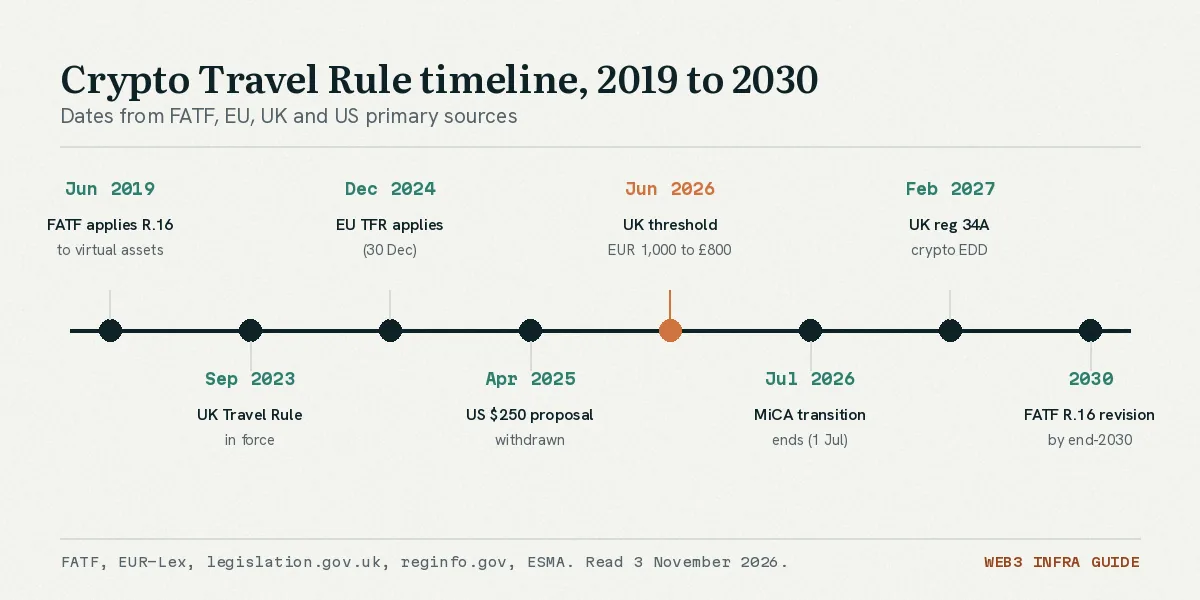
The rule keeps moving. The two dates to plan for now are 1 February 2027, when the UK adds enhanced due diligence for crypto correspondent relationships, and the end of 2030, when the revised FATF Recommendation 16 is expected to be in place. EU firms that relied on the MiCA transition are already past their deadline.
| Date | Change | Who it hits |
|---|---|---|
| 30 Dec 2024 | EU TFR applies to crypto transfers | All EU CASPs |
| 16 Apr 2025 | US $250 threshold proposal withdrawn | US money transmitters |
| 30 Jun 2026 | UK trigger moves from EUR 1,000 to £800 | UK cryptoasset businesses |
| 1 Jul 2026 | MiCA transitional period ends | EU firms without CASP authorisation |
| 16 Jul 2026 | FATF Seventh Targeted Update published | Supervisors, then firms |
| 1 Feb 2027 | UK reg 34A crypto correspondent EDD | UK exchanges and custodians |
| End of 2030 | Revised FATF R.16 expected in place | Every FATF jurisdiction |
Verdict: Nothing on this list loosens the rule. Budget for more data, more counterparty checks and more enforcement, not less.
Travel Rule Compliance Checklist
Use this list to test a program before a regulator or banking partner does. The most common failure is not missing software but missing counterparty due diligence: you must know the receiving provider is real and licensed before you send customer data to it.
- Map every corridor you serve and apply the stricter side’s rule.
- Collect and verify the full originator data set at onboarding so it is ready for any transfer.
- Identify the counterparty: provider or self-hosted wallet, and which provider.
- Run due diligence on counterparty providers before sharing personal data.
- Send the data before or at the same time as the transfer, through a secure channel.
- Detect missing inbound data and reject, return or hold funds until it arrives.
- Run ownership checks on self-hosted addresses above EUR 1,000 for EU flows.
- Keep Travel Rule records for five years in the EU and link them to analytics alerts.
For vendor choices, our blockchain analytics tools ranking covers the screening side, our Chainalysis vs TRM Labs vs Elliptic comparison goes deeper on the three largest analytics vendors, and our compliance hub collects every guide in this series.
Verdict: A Travel Rule program is a data pipeline with legal deadlines. Test it end to end with real counterparties, not just a vendor demo.
Final Verdict
The crypto Travel Rule is now law in most major markets, and the differences are mostly about thresholds. If you serve EU customers, build to the TFR: full, verified data on every transfer and ownership checks on self-hosted wallets above EUR 1,000; that design also covers the UK, US and FATF minimum.
- EU: no threshold, verified data on every provider transfer, five-year records.
- UK: basic data always, fuller data from £800 cross-border since 30 June 2026.
- US: $3,000 under 31 CFR 1010.410(f); the $250 proposal is withdrawn.
- FATF: 83% of responding jurisdictions have laws; enforcement is the next push.
Verdict: Send full data on every transfer, check every counterparty, and keep the records. That is cheaper than maintaining four sets of thresholds.
Frequently Asked Questions
What is the crypto Travel Rule?
The crypto Travel Rule requires exchanges, custodians and other virtual asset service providers to send the sender’s and recipient’s identifying details with a crypto transfer to another provider. It comes from FATF Recommendation 16, applied to virtual assets in June 2019, and is enforced through national laws such as the EU Transfer of Funds Regulation.
What is the Travel Rule threshold for crypto?
Each regime sets its own. The EU has no threshold for transfers between crypto-asset service providers. The UK requires fuller data from £800 when a business outside the UK is involved, and the US applies 31 CFR 1010.410(f) at $3,000 or more. The FATF allows an optional threshold of up to USD/EUR 1,000.
Does the Travel Rule apply to self-hosted wallets?
Partly. In the EU, a provider must obtain and hold originator and beneficiary data for transfers to or from a self-hosted wallet, and above EUR 1,000 assess whether the customer owns or controls it. UK firms request data on a risk basis. The US has no federal Travel Rule duty for self-hosted transfers.
Did the US lower the Travel Rule threshold to $250?
No. FinCEN and the Federal Reserve proposed a $250 threshold for cross-border transfers in October 2020, but the Spring 2025 regulatory agenda lists that rule, RIN 1506-AB41, as withdrawn on 16 April 2025. The threshold under 31 CFR 1010.410(f) remains $3,000 for US funds transfers, including convertible virtual currency.
What changed in the UK Travel Rule in 2026?
Regulations made in June 2026 replaced the EUR 1,000 trigger with £800 in regulations 64C(4) and 64G(1)(b) of the Money Laundering Regulations, effective 30 June 2026. Basic names and account data still travel on every transfer. A new regulation 34A on crypto correspondent due diligence starts on 1 February 2027.
How do MiCA and the Travel Rule fit together?
MiCA licenses crypto-asset service providers, while the Transfer of Funds Regulation sets the Travel Rule data they must send. Both apply across the EU. MiCA’s transitional period for firms already operating ended by 1 July 2026, so EU firms now need a CASP authorisation and must follow the TFR on every transfer.