
Last updated: 2 November 2026 · every coverage figure, certification and price below rechecked on the vendor’s own page on 2 November 2026
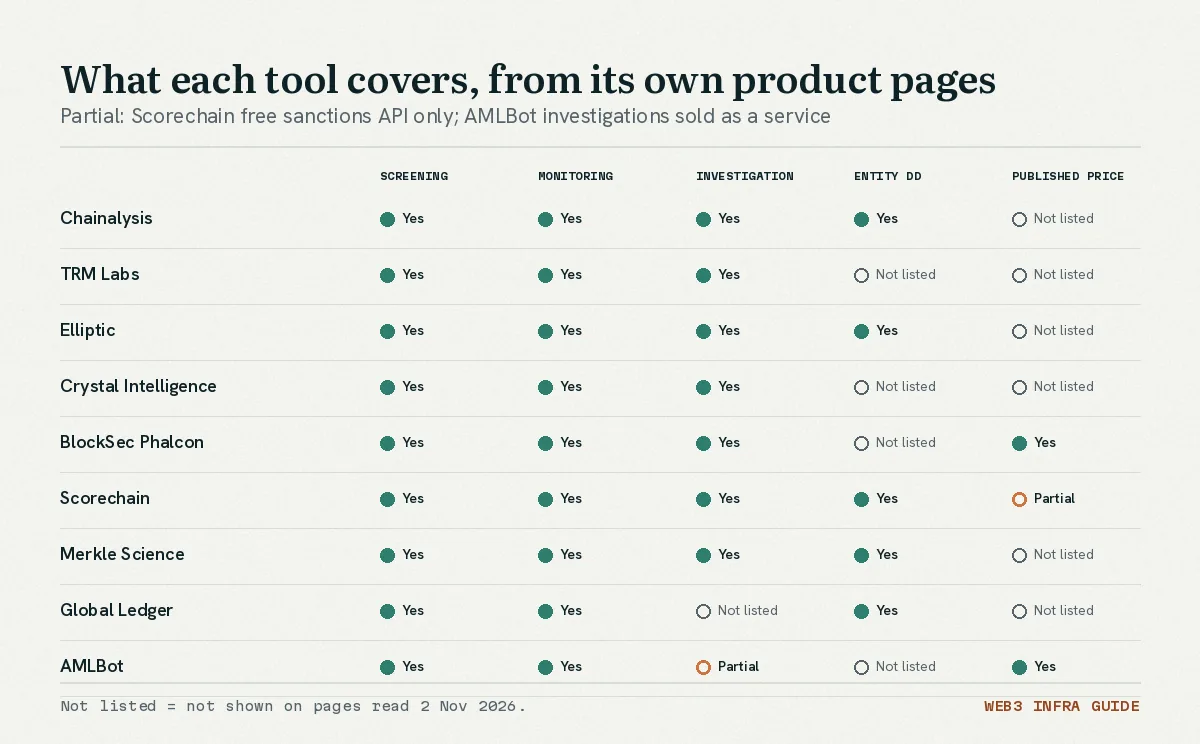
The best blockchain analytics tools for crypto compliance in 2026 are Chainalysis (9.2/10), TRM Labs (8.9), Elliptic (8.5) and Crystal Intelligence (8.4). They lead on chain coverage, attribution data and audited security. BlockSec Phalcon Compliance, Scorechain, Merkle Science, Global Ledger and AMLBot cost less or publish prices, but cover fewer chains or publish fewer attestations.
We scored all nine on one fixed rubric and took every number from the vendor’s own pages, because the ranking articles that lead this search quote chain counts from 15+ to 400+ for the same products. This guide sits in our crypto compliance hub, and the scoring rules are on our methodology page. Nothing here is legal advice. For how analytics fits with KYT, wallet screening and the Travel Rule, see our crypto compliance tools guide. Our KYT tools ranking and wallet screening API comparison cover the two real-time checks on their own.
TL;DR
- Chainalysis scores highest (9.2/10): KYT lists 400+ networks and 50M+ tokens, Reactor traces across 27+ blockchains and 300+ bridges and DEXs, and the platform cites SOC 2 Type 2 and FedRAMP.
- TRM Labs (8.9) screens 1.9B+ assets on 184+ blockchains with 155+ risk configurations, an annual SOC 2 audit and a 99.95% uptime SLA.
- Elliptic (8.5) labels 1B+ addresses and covers 60+ blockchains and 250+ bridges in Lens; Crystal (8.4) claims the widest coverage at 330+ blockchains.
- Only three of the nine publish prices: AMLBot credits run from $1 down to $0.10 a check, BlockSec lists Phalcon from $0.10 a check, and Scorechain offers a free sanctions API capped at 100 requests an hour.
- The free Chainalysis sanctions oracle that some guides still recommend is deprecated; Chainalysis says its last update was on 18 March 2026.
- Regulated exchanges and custodians usually license one of the top four, and many add a second vendor for coverage gaps or second opinions on high-risk alerts.
The Decision Kernel
Choose by what a regulator or bank will ask you to show, then by chains, then by budget. If you hold a licence and move customer funds, shortlist from the top four first; the cheaper tools fit lighter screening needs or a second-opinion role. Attribution data, not interface features, is what separates the groups.
- Licensed exchange, custodian or bank: Chainalysis, TRM Labs or Elliptic as the primary engine; Crystal if your chain list is long.
- EU CASP that wants EU hosting: Scorechain or Crystal, both of which state EU data hosting or residency.
- Payment company or startup screening addresses: BlockSec Phalcon Compliance or AMLBot, the only two with published per-check prices.
- Forensics-led team: Chainalysis Reactor, Crystal or TRM, then test Merkle Science Tracker on your own cases.
Verdict: Buy attribution depth for the licence and buy price transparency for the volume. Most regulated firms end up with one top-four vendor plus a cheaper tool for spot checks.
Blockchain Analytics Tools at a Glance
| Tool | Best for | Coverage (vendor stated) | Security (vendor stated) | Published price | Score |
|---|---|---|---|---|---|
| Chainalysis | Licensed exchanges and banks that need investigation depth | 400+ networks (KYT), 27+ blockchains (Reactor) | SOC 2 Type 2, FedRAMP | Quote only | 9.2 |
| TRM Labs | Multi-chain teams that want configurable risk rules | 184+ blockchains, 1.9B+ assets | Annual SOC 2 audit, 99.95% uptime SLA | Quote only | 8.9 |
| Elliptic | Cross-chain and bridge exposure, entity due diligence | 60+ blockchains, 250+ bridges (Lens) | SOC 2 Type 2, ISO 27001 | Quote only | 8.5 |
| Crystal Intelligence | Long chain lists and court-ready evidence | 330+ blockchains | SOC 2 Type II, EU data residency | Quote only | 8.4 |
| BlockSec Phalcon Compliance | Payment firms that want self-serve screening | 600M+ address labels | Not stated on pages read | From $0.10 a check | 7.2 |
| Scorechain | EU CASPs that want EU hosting | 21+ blockchains | EU-hosted private cloud | Free sanctions API; platform quote | 6.7 |
| Merkle Science | Behaviour-based monitoring and forensics | 10,000+ assets, 200 bridges | Not stated on pages read | Quote only | 6.0 |
| Global Ledger | Fast API scoring on major chains | 13 named chains, 700M+ attributed addresses | Private server deployment option | Quote only | 6.0 |
| AMLBot | Small teams and pay-per-check screening | 10 chains on Personal plan | ISO 27001 | $1 to $0.10 a check (Personal) | 5.9 |
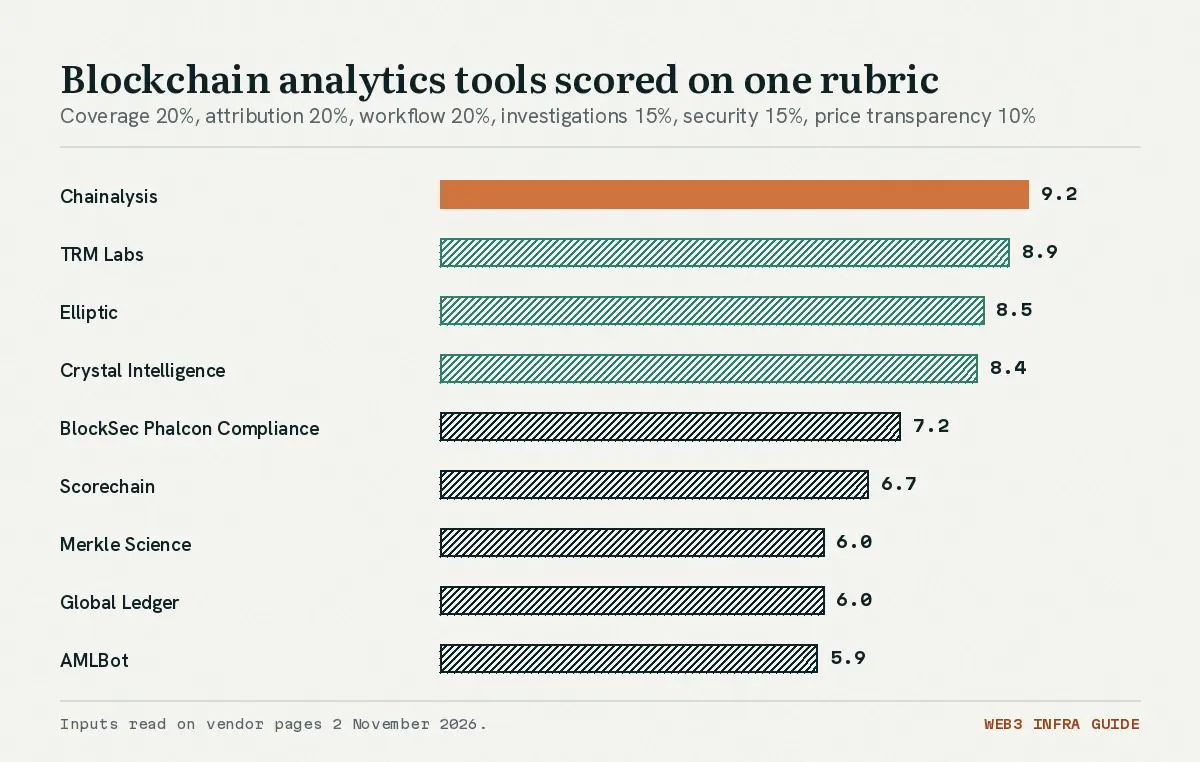
Each tool gets 0 to 5 on six criteria: chain coverage (20%), attribution data (20%), compliance workflow (20%), investigations (15%), security attestations and deployment (15%) and price transparency (10%). The top four are separated by less than one point, so your chain list and integration fit should break the tie. The rubric and weights stay fixed across our compliance guides.
1. Chainalysis: 9.2/10
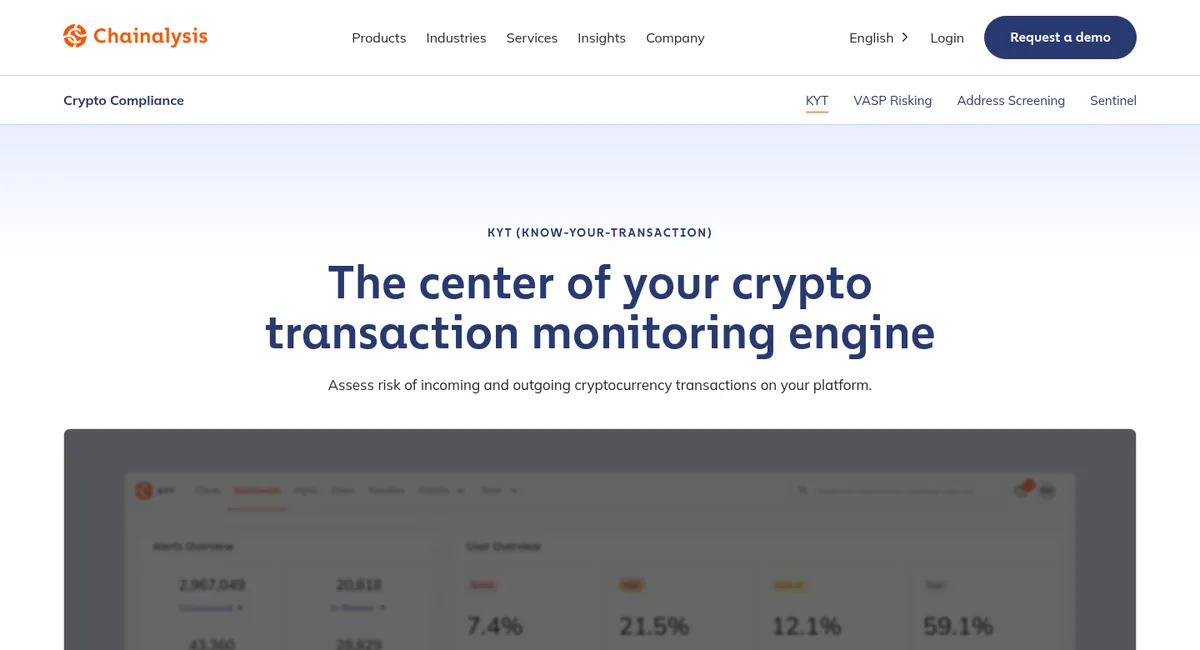
Chainalysis sells KYT for live monitoring, Address Screening, VASP Risking and Reactor for investigations. Its KYT FAQ lists 400+ networks and 50M+ tokens, and KYT can monitor exposure to sanctioned entities before and after a designation. Reactor is the deepest investigation tool in this list: 27+ blockchains, 40M+ assets, 325M+ swaps and 300+ bridges and DEXs, per its product page.
- Scale: Reactor says Chainalysis is relied on by 1,500+ organizations and has supported the recovery and seizure of over $34B in crypto.
- Security: the platform page cites SOC 2 Type 2 and FedRAMP.
- Two coverage numbers: 400+ networks on KYT and 27+ blockchains on Reactor measure different things, so ask which figure applies to the product you buy.
- Free tier gone: the Chainalysis sanctions oracle is marked deprecated and not recommended for new integrations.
Verdict: The safest primary engine for a licensed exchange or bank, if the budget allows. Price is quote only, so get the KYT and Reactor quotes separately.
2. TRM Labs: 8.9/10
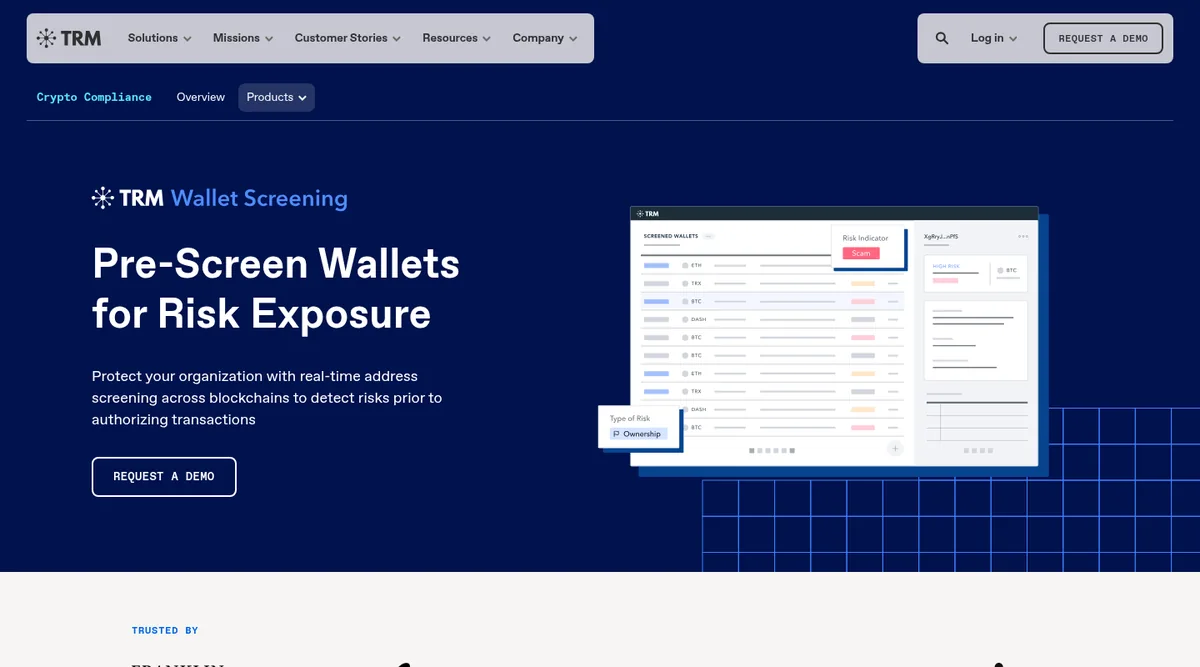
TRM Labs runs wallet screening, transaction monitoring and investigations on one attribution graph. Its Wallet Screening page covers 1.9B+ digital assets across 184+ blockchains, including all ERC-20 tokens. TRM lets you tune risk tolerance with over 155 configurations covering ownership, counterparty and indirect exposure.
- Data sources: TRM says it attributes entities with a dedicated threat team and over 300 million sources monitored monthly, including sanctions lists and the dark web.
- Reliability: it states a 99.95% uptime SLA and an annual SOC 2 audit.
- Monitoring: TRM Transaction Monitoring pairs with screening for pre- and post-transaction checks.
- Incident help: TRM’s investigations team supports customers after a hack or fraud.
Verdict: The strongest pick for multi-chain teams that want to set their own risk rules. Budget analyst time to tune the configurations.
3. Elliptic: 8.5/10
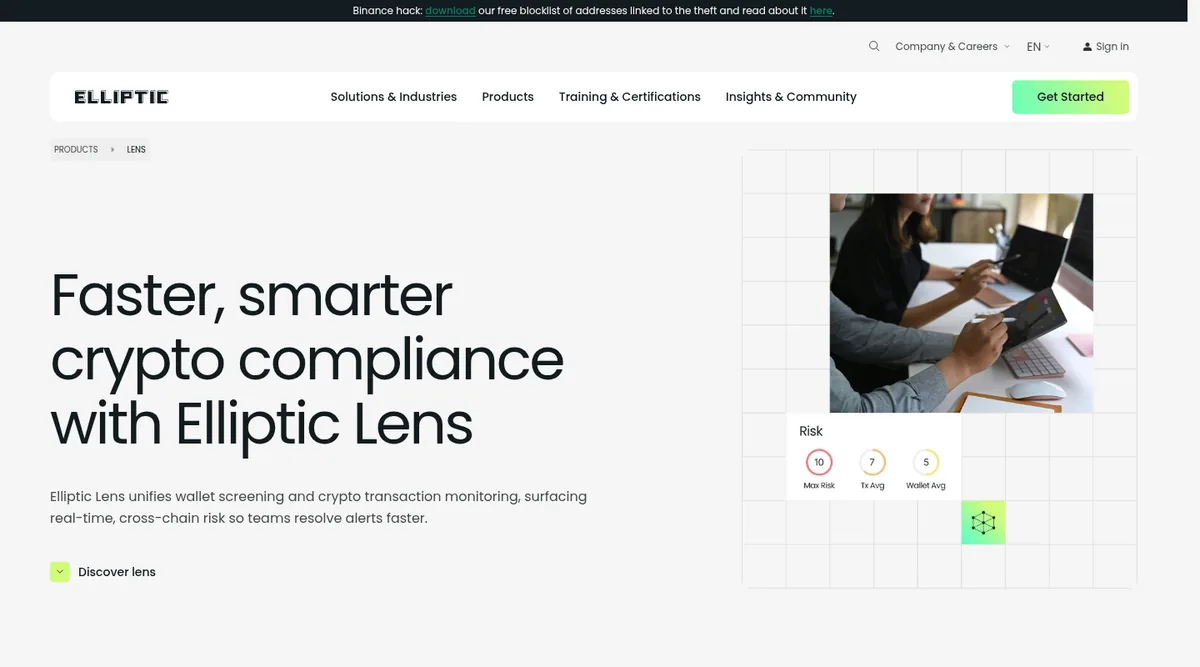
Elliptic splits its suite into Lens for wallet and transaction screening, Discovery for VASP due diligence and Investigator for cross-chain tracing. Lens covers 60+ blockchains and 250+ bridges. Elliptic says it has labelled 1B+ crypto addresses and covers 99% of global trading volume.
- Coverage figures differ: the home page says 65+ blockchains while Lens says 60+; ranking articles quote 100+, which we could not find on Elliptic’s pages.
- Security: the trust page lists SOC 2 Type 2 and ISO 27001.
- Uptime: Elliptic states 99.9% uptime.
- Entity due diligence: Discovery screens VASPs, useful before you open a Travel Rule or settlement relationship.
Verdict: A strong primary for cross-chain and bridge-heavy flows, and the best fit here for VASP due diligence. Confirm the chain list against your assets.
4. Crystal Intelligence: 8.4/10
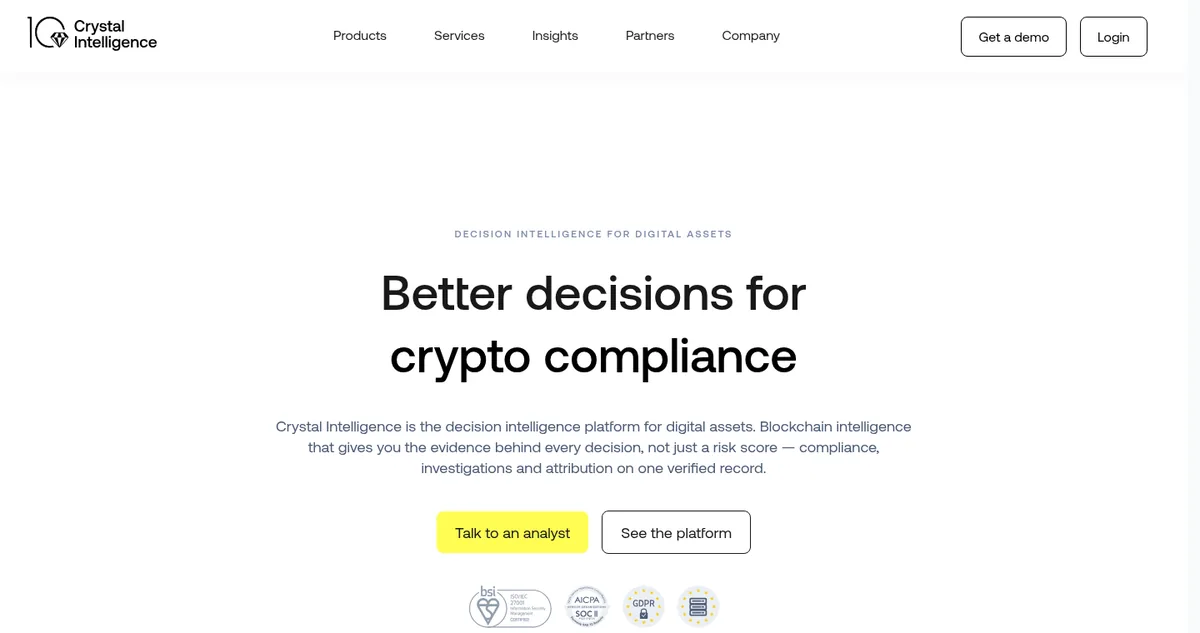
Crystal runs KYT, investigations and attribution on one record. Its home page claims 330+ blockchains, 210M+ verified transfers and 118,000+ entities attributed and verified off-chain. Crystal is the widest-coverage option here, and it states SOC 2 Type II, GDPR compliance and EU data residency.
- Evidence focus: Crystal markets court-level evidence and audit-ready case records for licence reviews.
- Access controls: it lists SSO and SAML support.
- Check depth per chain: on a list of 330+ chains, ask which ones get full attribution and risk scoring rather than address lookup only.
- Price: quote only.
Verdict: The pick when your asset list runs beyond the major chains or you need EU residency. Test attribution depth on the exact long-tail chains you support.
5. BlockSec Phalcon Compliance: 7.2/10
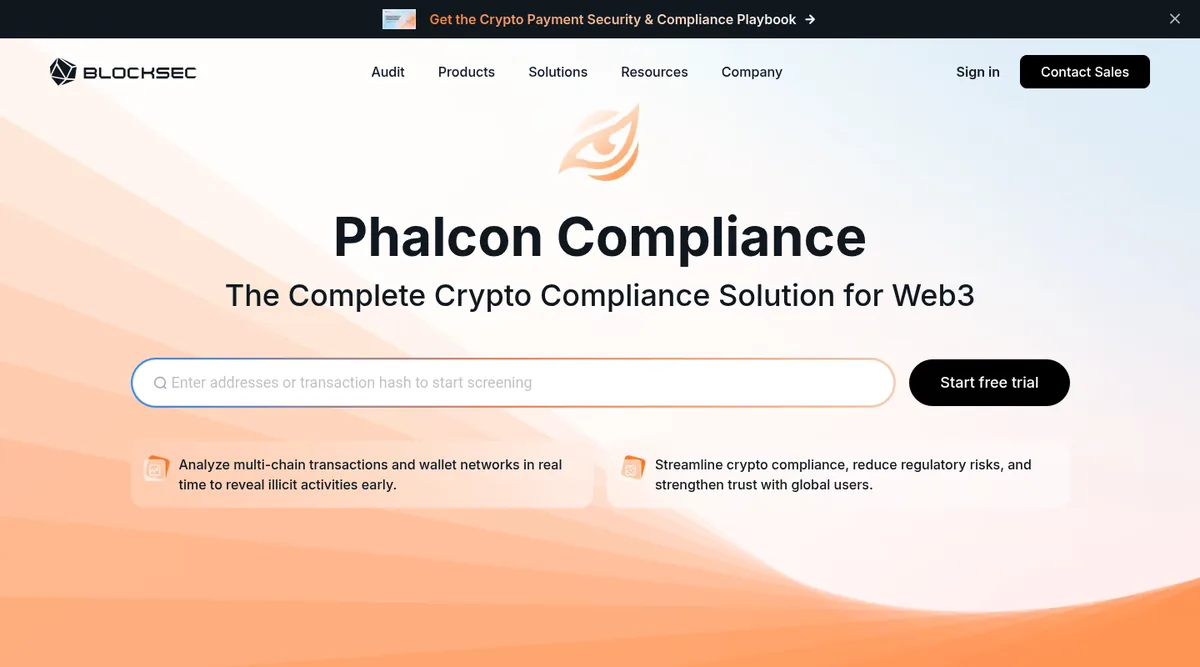
BlockSec’s Phalcon Compliance covers screening, monitoring, investigation and reporting in one workflow, with MetaSleuth for tracing. It cites 600M+ address labels and 200+ risk signals. Phalcon is one of only two tools here with a published per-check price: from $0.10 a check, with a free trial.
- Reach: BlockSec says the platform serves teams in 50+ countries and regions and aligns with FATF guidance across 27+ jurisdictions.
- Customers named: Interlace and Cobo are quoted on the product page.
- Self-serve: sign-up and trial do not need a sales call.
- Gap: no chain count or security attestation on the pages we read, so ask for both.
Verdict: The best self-serve option for payment companies and wallets that want a known price. Ask for the chain list and SOC report before production.
6. Scorechain: 6.7/10
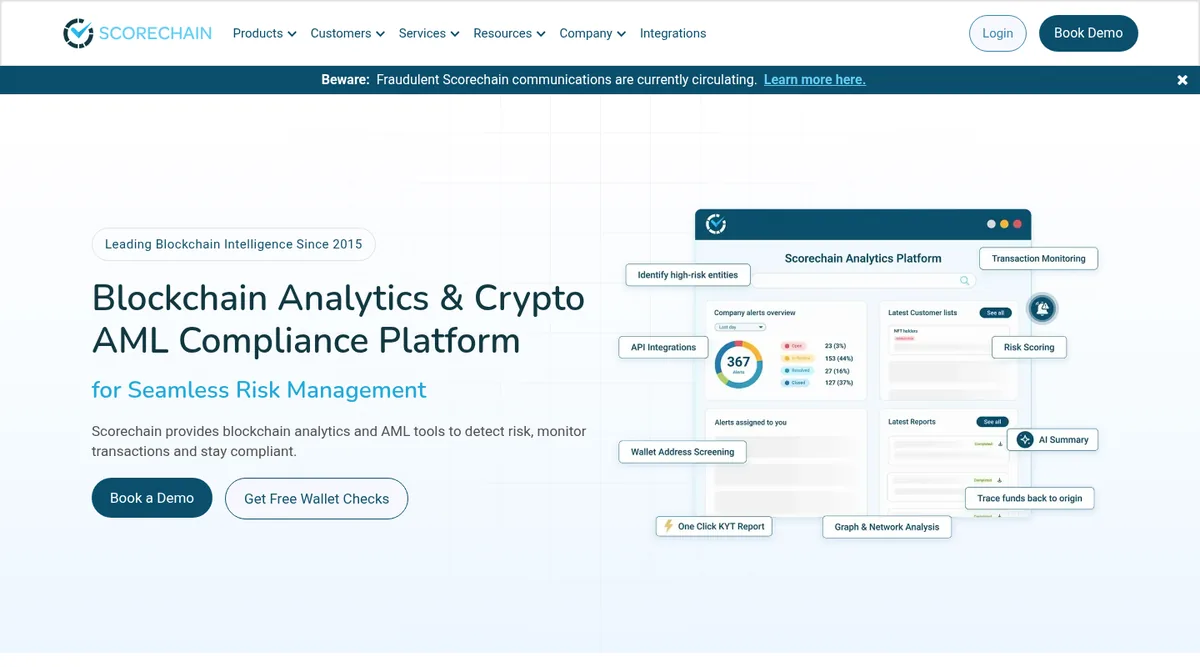
Scorechain is a Luxembourg-based analytics and AML platform with transaction monitoring, customisable alerts, Flux analysis graphs and token and stablecoin monitoring. Its home page cites 21+ blockchains, 350+ compliance and digital asset teams and an EU-hosted private cloud. Scorechain offers a free sanctions API, limited to non-commercial use at 100 requests an hour with no SLA.
- Free API terms: the free sanctions API page says it covers 21+ blockchains and is not a full compliance platform.
- Figures differ: the same page lists 25+ blockchains in its key numbers, plus 1B+ entities labelled and 2,800+ VASP due-diligence profiles.
- MiCA: Scorechain says it is designed to meet MiCA requirements and hosts data in the EU.
- AI assistant: an MCP-based assistant helps draft investigation narratives.
Verdict: A sensible primary for an EU CASP on major chains that wants EU hosting. The free API suits testing, not production screening.
7. Merkle Science: 6.0/10
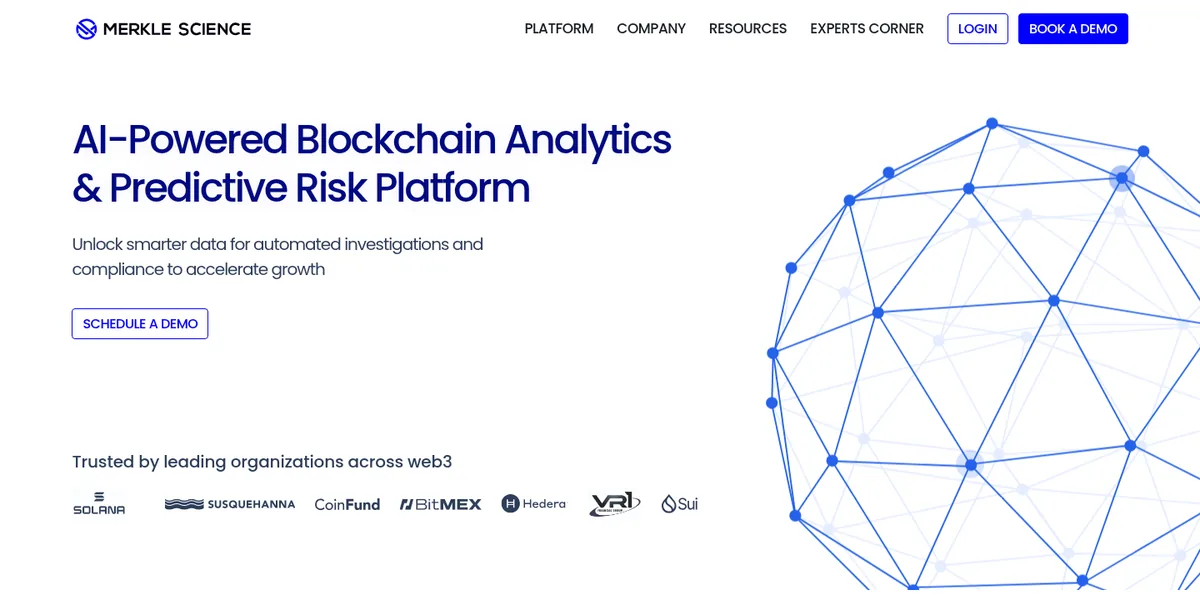
Merkle Science sells Compass for predictive risk monitoring, Tracker for forensics and KYBB for business due diligence. Its home page cites cross-chain coverage for 10,000+ assets and 200 bridges. Merkle Science leads with a behavioural rule engine that flags patterns, not just listed addresses.
- Sanctions claim: Merkle says it has the best sanctions attribution for Russian and Iranian exchanges, a vendor claim worth testing on your own data.
- Data platform: custom queries and transaction lists from major scams for research teams.
- No chain count: the home page lists assets and bridges, not blockchains.
- Price and security: quote only, with no attestation on the pages we read.
Verdict: Worth a trial for teams that want behaviour-based rules and forensics in one place. Ask for a chain list and a SOC report.
8. Global Ledger: 6.0/10
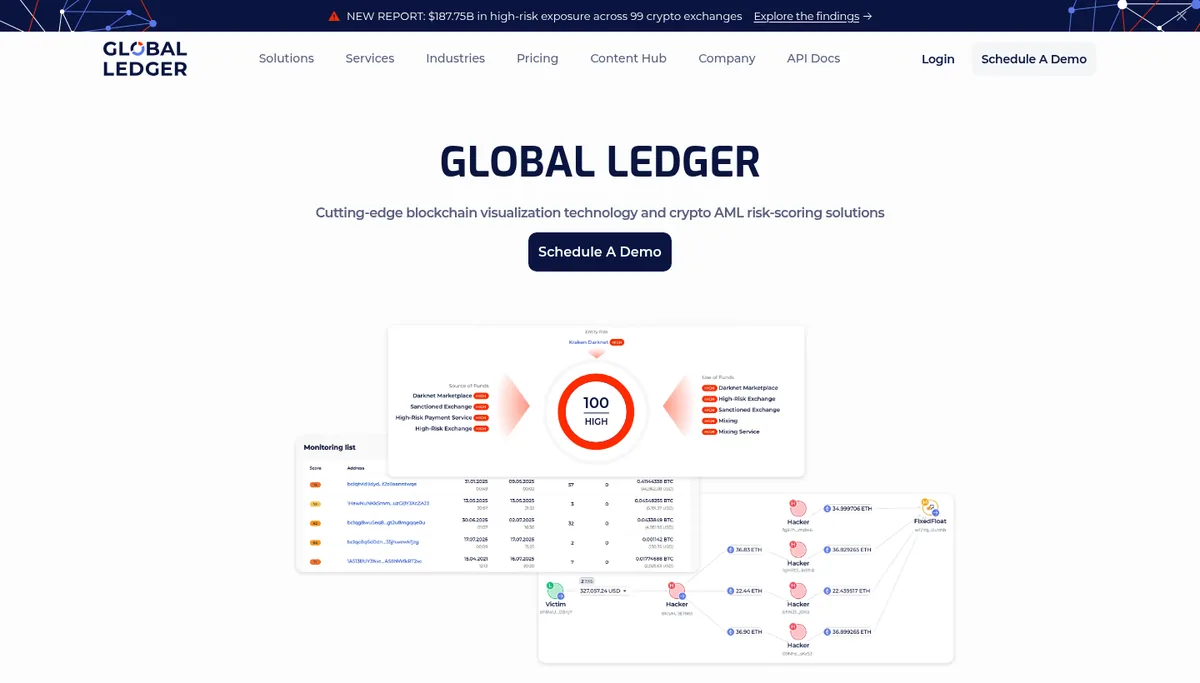
Global Ledger, founded in 2019, sells KYT and KYB toolsets with a 0 to 100 risk score. Its home page cites 700 million+ attributed addresses updated daily, 40K+ AML checks a day, 30 million monitored wallets and a 500 ms average response. Global Ledger names its chains: Bitcoin, Bitcoin SV, Litecoin, Ethereum, Tron, BNB, Polygon, Arbitrum, Base, Avalanche, Polkadot, Solana and TON.
- Deployment: private server deployment is offered for teams that cannot send data to a shared cloud.
- Research: the team publishes investigations into sanctioned exchanges and large hacks.
- Coverage limit: 13 named chains is narrow next to the top four.
- Price: quote only.
Verdict: A good fit if all your flows sit on its 13 named chains and you need on-premise deployment. Others cover more chains.
9. AMLBot: 5.9/10
AMLBot offers wallet screening, transaction monitoring and KYC, plus investigation and recovery services. Its plans page, updated 29 October 2026, splits into Personal and Business. On Personal, one standard check costs one credit, and credits run from $1 down to $0.10 depending on bundle size.
- Chains: Personal lists Bitcoin, Ethereum, BNB Chain, TRON, Polygon, Arbitrum, Base, Avalanche, Optimism and Solana; TON and Litecoin need Business. The page calls this nine chains but names ten.
- Business: adds API access, monitoring and fuller risk scoring, priced on request.
- Security: the home page states ISO 27001 certification.
- Reach: AMLBot says it has served 1,000+ crypto enterprises in 25 jurisdictions.
Verdict: The cheapest way to start screening, and useful as a second opinion. Licensed firms will usually need a deeper primary engine.
Why Chain Counts Disagree
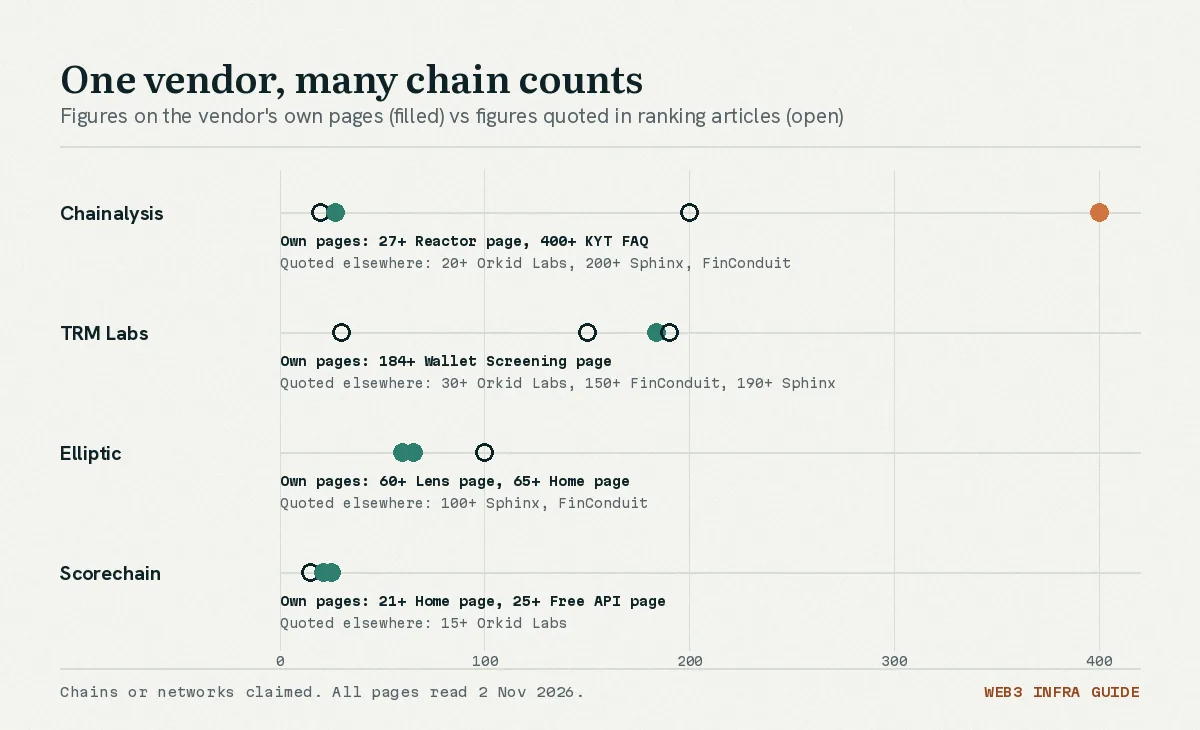
The same vendor can show two or three chain counts on its own site, and ranking articles add more. Ask every vendor for the chains where it provides full attribution and risk scoring, not just address lookups. The chart shows the spread we found on 2 November 2026.
| Vendor | Vendor pages | Quoted in ranking articles | Why they differ |
|---|---|---|---|
| Chainalysis | 400+ networks (KYT), 27+ blockchains (Reactor) | 20+, 200+ | KYT counts networks and tokens; Reactor counts blockchains with full tracing |
| TRM Labs | 184+ blockchains (screening) | 30+, 150+, 190+ | Screening coverage differs from deep tracing coverage; older pages linger |
| Elliptic | 60+ (Lens), 65+ (home) | 100+ | Product vs company figures; 100+ not found on Elliptic’s pages |
| Scorechain | 21+ (home), 25+ (free API key numbers) | about 15 | Two figures on one page; third-party figure looks out of date |
Verdict: Treat any single chain count as marketing. Send your own chain and token list and ask for a yes or no per chain at the depth you need.
Free and Low-Cost Screening Options
Free tools help with testing and spot checks, but none of them replaces a documented screening control. The Chainalysis sanctions oracle is deprecated, so new builds should not rely on it even though older guides still recommend it. The options that remain each come with limits.
- Chainalysis oracle: its documentation says Chainalysis will not add new sanctioned addresses and the last update was made on 18 March 2026.
- Scorechain free sanctions API: 100 requests an hour, non-commercial use, best effort with no SLA.
- AMLBot Personal: pay per check with no contract, from $1 down to $0.10 a credit.
- BlockSec Phalcon: free trial, then from $0.10 a check.
If you call a screening API in a withdrawal path, decide in code what happens when it fails. The sketch below blocks on a sanctions hit, holds on a time-out and asks a second vendor when the first returns a high score.
def screen_withdrawal(address, primary, secondary, timeout_s=2.0):
    try:
        r1 = primary.screen(address, timeout=timeout_s)
    except TimeoutError:
        return 'hold_for_review'            # never send unscreened
    if r1.sanctioned:
        return 'block_and_report'
    if r1.risk_score >= 75:                  # example threshold
        r2 = secondary.screen(address, timeout=timeout_s)
        return 'block_and_review' if r2.risk_score >= 75 else 'analyst_review'
    return 'allow'

# Store r1 (and r2) with the case so an examiner can see why it passed
The 75 threshold is an example; set yours from a trial on your own past alerts. Keep the vendor response, including the risk_score and the rules that fired, in the case record.
What Blockchain Analytics Costs
Six of the nine vendors publish no price. We leave out the annual price ranges some ranking articles print for Chainalysis, TRM Labs and Elliptic, because none of the three publishes a list price. Published per-check prices still give a floor for small teams.
| Option | Published price | Example volume | Example monthly bill |
|---|---|---|---|
| AMLBot Personal, smallest bundle | $1.00 a check | 1,000 checks | $1,000 |
| AMLBot Personal, largest bundle | $0.10 a check | 10,000 checks | $1,000 |
| BlockSec Phalcon Compliance | From $0.10 a check | 30,000 checks | From $3,000 |
| Scorechain free sanctions API | Free, non-commercial | Up to 100 requests an hour | $0 (not for production) |
| Chainalysis, TRM Labs, Elliptic, Crystal, Merkle Science, Global Ledger, Scorechain platform | Quote only | Any | Ask for a written quote |
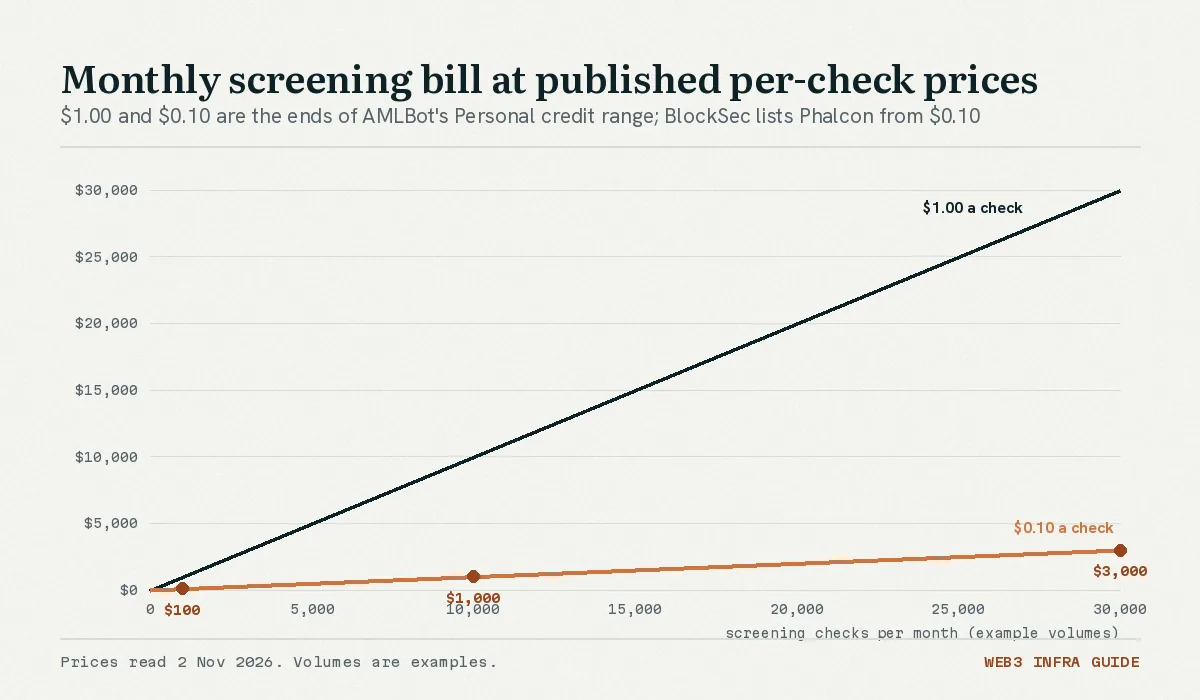
At $0.10 a check, 10,000 screens a month cost $1,000 and 30,000 cost $3,000. At $1.00 a check, the same $1,000 buys only 1,000 screens, so the bundle size changes the unit cost tenfold. Enterprise vendors price by chains, products and volume, so send them the same volume figures and compare written quotes.
Verdict: Use the published per-check prices as a floor and a fallback. For a licensed firm, the quoted enterprise contract is still the main cost line.
Which Tool Fits Your Business
Match the tool to the obligation and the chain list first. Many large regulated exchanges run two providers: one primary engine and a second for coverage gaps or a second opinion on high-risk alerts. The table gives a starting pair by business type.
| Business | Primary | Second tool | Why |
|---|---|---|---|
| Licensed exchange or broker | Chainalysis or TRM Labs | Elliptic or Crystal | Deep attribution plus a second view on high-risk alerts |
| Custodian or bank | Chainalysis or Elliptic | TRM Labs | Audited security and investigation depth for examiners |
| EU CASP on major chains | Scorechain or Crystal | Elliptic | EU hosting or residency stated by the vendor |
| Payment company or wallet | BlockSec Phalcon or TRM Labs | AMLBot | Published prices and API screening in the payment path |
| Treasury or DAO paying vendors | AMLBot or Phalcon | None | Low volume of counterparty checks |
Treasury teams can compare platforms in our crypto treasury management guide, and custody buyers in our institutional crypto custody guide.
Questions to Send Every Vendor
Send the same written questions to each finalist and score the answers side by side. Each one targets a gap we found on the public pages, so the answers fill in what the marketing pages leave out and become part of your vendor risk file.
- Which of our chains and tokens get full attribution and risk scoring, not just address lookup?
- What share of our last 50 deposits can you attribute to a named entity?
- What is the alert rate per 1,000 transfers on our traffic during the trial, and how many were false positives?
- How soon after a new OFAC SDN address listing does your data flag it?
- What is the p95 API response time, and what is the uptime commitment in the contract?
- Which security reports can we review (SOC 2 Type 2, ISO 27001), and for which products?
- Can we export every alert, decision and reason for an examiner?
Verdict: A vendor that cannot answer the chain-depth and attribution questions with your own data is not ready to be your primary engine.
Final Verdict
Chainalysis, TRM Labs, Elliptic and Crystal Intelligence form the top tier, and the gap between them is small enough that your chain list and integration fit should decide. Below them, BlockSec Phalcon and AMLBot win on published prices, Scorechain on EU hosting, Merkle Science on behavioural rules and Global Ledger on private deployment. For a closer look at the top three, see our Chainalysis vs TRM Labs vs Elliptic comparison, and if you are replacing Chainalysis, our Chainalysis alternatives guide.
- Chainalysis (9.2): deepest investigations and widest regulator familiarity.
- TRM Labs (8.9): broad screening with configurable risk rules.
- Elliptic (8.5): cross-chain screening plus VASP due diligence.
- Crystal Intelligence (8.4): widest stated chain coverage with EU residency.
Verdict: License one top-four vendor if you hold a licence, then add a published-price tool for second opinions and spot checks.
Frequently Asked Questions
What is the best blockchain analytics tool for crypto compliance?
Chainalysis scores highest in our rubric at 9.2 out of 10, thanks to KYT coverage of 400+ networks, Reactor investigations and SOC 2 Type 2 and FedRAMP security. TRM Labs and Elliptic are close behind. The right pick depends on your chains, budget and whether investigations are a core part of your work.
Is Chainalysis better than TRM Labs?
Chainalysis leads on investigation depth with Reactor and on regulator familiarity, while TRM Labs states wider screening coverage at 184+ blockchains and lets you tune risk with 155+ configurations. Both publish SOC 2 audits and quote prices privately. Run both on the same 50 past deposits before you decide.
Are there free blockchain analytics tools for AML?
Free options are limited. Scorechain offers a free sanctions API for non-commercial use at 100 requests an hour with no SLA. The Chainalysis sanctions oracle is deprecated and was last updated on 18 March 2026. AMLBot and BlockSec sell low-cost checks instead, from $1 down to $0.10 each.
How much does blockchain analytics software cost?
Most vendors, including Chainalysis, TRM Labs, Elliptic and Crystal, publish no price and quote annually by chains, products and volume. Published prices exist at the low end: AMLBot Personal credits cost $1 to $0.10 per check, and BlockSec lists Phalcon Compliance from $0.10 per check with a free trial.
How many blockchains does Chainalysis support?
The answer varies by product. Chainalysis says KYT supports 400+ networks and 50M+ tokens, while Reactor traces across 27+ blockchains, 40M+ assets and 300+ bridges and DEXs. Ranking articles quote other figures, so ask Chainalysis which chains get full attribution for the products you plan to buy.
Do regulated crypto firms need more than one analytics vendor?
Not by rule, but many large exchanges use two. One vendor acts as the primary screening and monitoring engine, and a second covers chains the first does not or gives a second opinion on high-risk alerts. Smaller firms usually start with one vendor and add another as volume grows.