
Last updated: 3 November 2026 · every coverage figure, response time and price below rechecked on the vendor’s own page on 3 November 2026
The best crypto wallet screening APIs in 2026 are Chainalysis Address Screening (9.2/10), TRM Labs Wallet Screening (8.9) and Elliptic Lens (8.7) for licensed exchanges and custodians. If you need a price you can see today, BlockSec Phalcon starts from $0.10 a check and Didit sells managed screening at $0.15 a check with 500 free verifications a month.
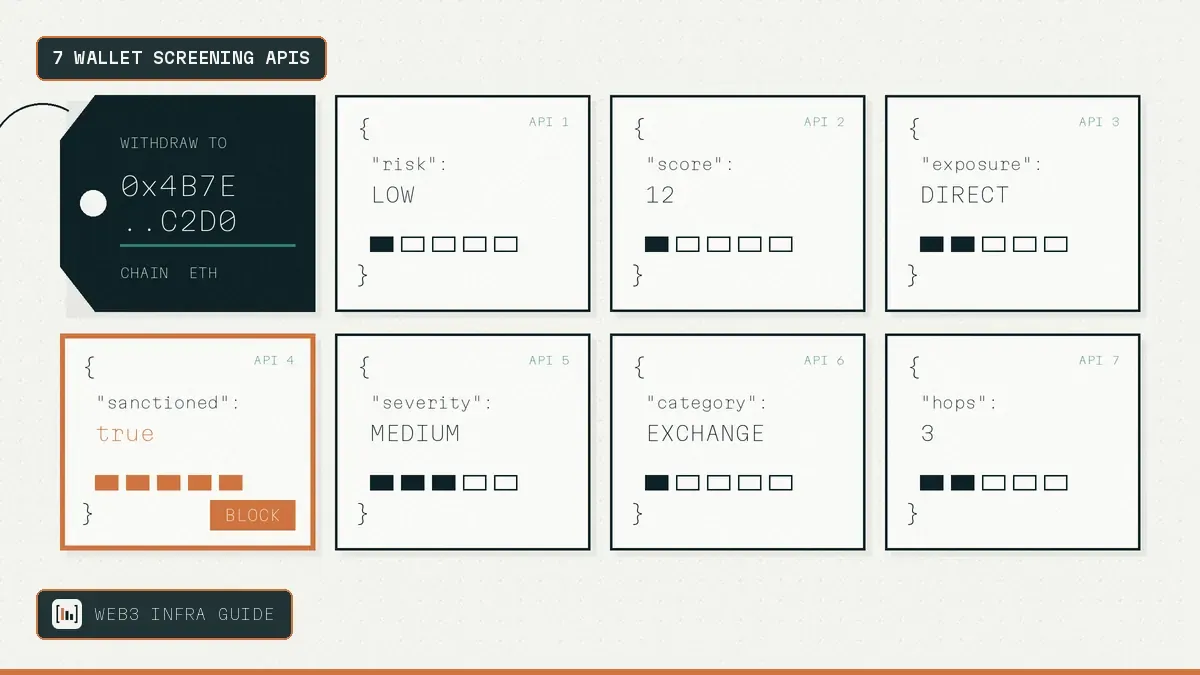
A wallet screening API takes one blockchain address and returns a risk answer before you act on it: before you send a withdrawal, onboard a user or accept a counterparty. Some APIs only check the address against sanctions lists. Others score its direct and indirect exposure to sanctioned, stolen or high-risk funds. That difference decides what you are actually buying.
This guide ranks seven screening APIs on the same rubric as our blockchain analytics tools ranking, separates list-only sanctions APIs from exposure-scoring APIs, shows what each one returns, and works out the monthly bill at three volumes. The scoring rules are on our methodology page. Nothing here is legal advice.
TL;DR
- Chainalysis Address Screening (9.2) sits on the widest data set here, 400+ networks and 50M+ tokens, and says it does not charge for API rescreens.
- TRM Labs (8.9) is the only top vendor with a published API speed: under 400 milliseconds, on 1.9B+ assets across 184+ blockchains.
- Elliptic Lens (8.7) is the only top-tier option with a list price: $50,000 per unit a year on AWS Marketplace.
- Published per-check prices: BlockSec Phalcon from $0.10, Didit $0.15 managed (or a $0.02 fee on your own Chainalysis, TRM, Elliptic or Crystal key), BlockchainAnalysis.io credits from $2.45 down to $1.25.
- List-only sanctions APIs such as CompliAPI and AnchorAPI are cheap but cannot see indirect exposure. Use them as a first gate, not as your whole control.
- The Chainalysis on-chain sanctions oracle is deprecated; its last update was 18 March 2026. Do not build new contracts on it.
The Decision Kernel
Pick a screening API by who reviews your controls and how many addresses you check. If a bank partner or regulator reads your logs, shortlist Chainalysis, TRM Labs or Elliptic; if you screen under about 10,000 addresses a month and pay as you go, start with BlockSec Phalcon or Didit. Then confirm every chain you support is covered.
- Licensed exchange, broker or custodian: Chainalysis Address Screening, TRM Labs Wallet Screening or Elliptic Lens.
- Payment company or wallet app, low to mid volume: BlockSec Phalcon per check, or Didit if you also need KYC in the same flow.
- EU team that wants a point-in-time check with reasons: Scorechain wallet screening.
- Developer prototype or AI agent paying per call: BlockchainAnalysis.io or BlockSec’s x402 Compliance API.
- Sanctions list gate only: CompliAPI, AnchorAPI or a free tier, never as your only control.
Verdict: Regulated and high-volume teams buy an enterprise screening API. Smaller teams should price Phalcon and Didit first and move up when chain coverage or an examiner demands it.
List-Only Sanctions APIs vs Exposure Scoring
Two very different products are sold as wallet screening. A list-only API tells you whether this exact address appears on OFAC, EU or UK lists; an exposure-scoring API tells you whether the address received funds from a sanctioned or illicit source, even several hops away. Only the second catches a fresh wallet funded from a sanctioned one.
List-only APIs are useful as a fast first gate and for small apps that are not regulated money transmitters. CompliAPI says on its own page that its OFAC change feed is polled every 15 minutes, which is a real speed advantage over daily refreshes. The table lists the list-only and free options we checked today, so you can see the limits before you build on one.
| API | What it checks | Free tier | Paid entry | Limit to know |
|---|---|---|---|---|
| CompliAPI | OFAC, EU, UK lists | 1,000 requests a month | Developer $149 a month billed annually, 10,000 requests | No indirect exposure |
| AnchorAPI | OFAC, EU, UK and community lists | 1,000 a month, public checker only, no API key | Starter $99 a month, 10,000 requests, 5 per second | Free tier has no API access |
| CoinForensics | Official sanctions lists | 100 checks a month | $299 for 5,000; $999 for 25,000; extra $0.04 | Early access; no risk score |
| ChainQuery | Sanctions lists, daily refresh | 30 requests an hour per IP, no key | No paid plan | Calls itself a research tool for education |
| Scorechain free API | Sanctions, 21+ chains | 100 requests an hour | Platform on quote | Non-commercial use, no SLA |
| PublicAML | Exposure score 0 to 100 | Free, no API key | No paid plan | No SLA or paid tier |
One warning for smart contract teams. Chainalysis marks its on-chain sanctions oracle as deprecated and no longer maintained, with the last update on 18 March 2026, per its own oracle documentation. A contract that still calls it is checking a list that has stopped changing.
Verdict: Use a list-only API as a cheap first gate. If you hold customer funds, add an exposure-scoring API behind it.
What Each API Returns
Field names differ by vendor, so map them once into your own shape. Didit is the only vendor here that documents one standard payload across several underlying data providers: a 0 to 100 risk score, a LOW to CRITICAL severity and a source-of-funds breakdown across 14+ categories. The table shows what each vendor says comes back.
| API | What the vendor says it returns | Speed stated |
|---|---|---|
| Chainalysis Address Screening | Risk score, direct and indirect exposure, counterparties, liquidity pool risk | Low latency, no figure |
| TRM Labs Wallet Screening | Trading volume, full list of risks, attribution | Under 400 milliseconds |
| Elliptic Lens | Configurable risk score and alerts; signed REST calls | Not stated |
| BlockSec Phalcon | Entity labels, risk scores, sanctions matches, behavioural flags | Not stated |
| Didit | risk_score 0 to 100, severity, source of funds | Sub-second |
| Scorechain | Explainable risk score, level and indicators, direct and indirect exposure | Not stated |
| BlockchainAnalysis.io | Risk score, entity labels, sanctions matches, behavioural signals | Under 500 milliseconds |
Here is the withdrawal pre-screen most teams wire around the call. It fails closed: if the API times out or errors, the withdrawal waits for a person instead of going out unchecked. Keep thresholds in config so compliance can change them without a release.
BLOCK_AT, HOLD_AT, TIMEOUT_S = 80, 50, 2.0   # 0-100 score; set by your compliance policy

def prescreen_withdrawal(address, chain, api):
    try:
        r = api.screen(address=address, chain=chain, timeout=TIMEOUT_S)
    except Exception:
        return "hold_for_analyst"          # fail closed, never send unchecked
    if r["sanctioned"]:
        return "block_and_report"
    if r["risk_score"] >= BLOCK_AT:
        return "block_and_review"
    if r["risk_score"] >= HOLD_AT:
        return "hold_for_analyst"
    return "sign_and_send"
Store the raw response, the address, the rule version and the decision for every call. When a bank asks why a payout went through, that log is your answer. Normalise each vendor into the same risk_score and sanctioned fields so you can swap or add a second provider later.
Verdict: A screening API only protects you if it runs before you sign. Fail closed on timeouts and keep the decision log.
Wallet Screening APIs at a Glance
| API | Coverage (vendor stated) | Security (vendor stated) | Published price | Score |
|---|---|---|---|---|
| Chainalysis Address Screening | 400+ networks, 50M+ tokens | SOC 2 Type 2, FedRAMP | Quote only | 9.2 |
| TRM Labs Wallet Screening | 184+ blockchains, 1.9B+ assets | Not on the page read today | Quote only | 8.9 |
| Elliptic Lens | 60+ blockchains, 250+ bridges | SOC 2 Type 2, ISO 27001 | $50,000 or $100,000 per unit a year (AWS) | 8.7 |
| BlockSec Phalcon | 20+ networks, 600M+ labelled addresses | Not stated on pages read | From $0.10 a check | 7.2 |
| Didit | 13 managed networks (docs say 17) | SOC 2 Type 1 and 2, ISO/IEC 27001 | $0.15 a check; $0.02 with your own key | 6.7 |
| Scorechain | 25+ blockchains, 1B+ entities | EU-hosted private cloud | Quote; free sanctions API | 6.7 |
| BlockchainAnalysis.io | 54 blockchains, 1B+ labels | Not stated on pages read | Credits $2.45 to $1.25 a call | 5.8 |
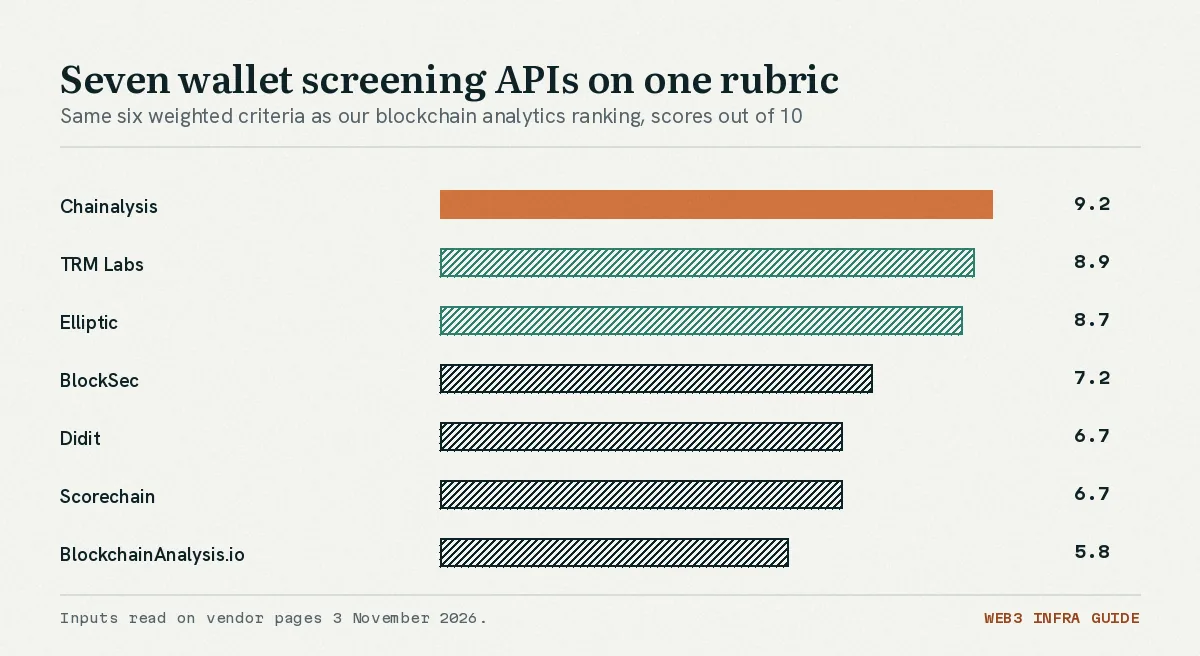
Each API gets 0 to 5 on six criteria: chain coverage (20%), attribution data (20%), compliance workflow (20%), investigations (15%), security attestations (15%) and price transparency (10%). These are the same weights and inputs as our analytics ranking, so Chainalysis, TRM Labs, Elliptic, BlockSec and Scorechain score the same here as there. Crystal Intelligence scores 8.4 on that ranking but is left out here because the pages we read give no screening API speed, spec or price.
Verdict: The top three are close on data and far apart on pricing transparency. Elliptic is the one you can budget before a sales call.
1. Chainalysis Address Screening
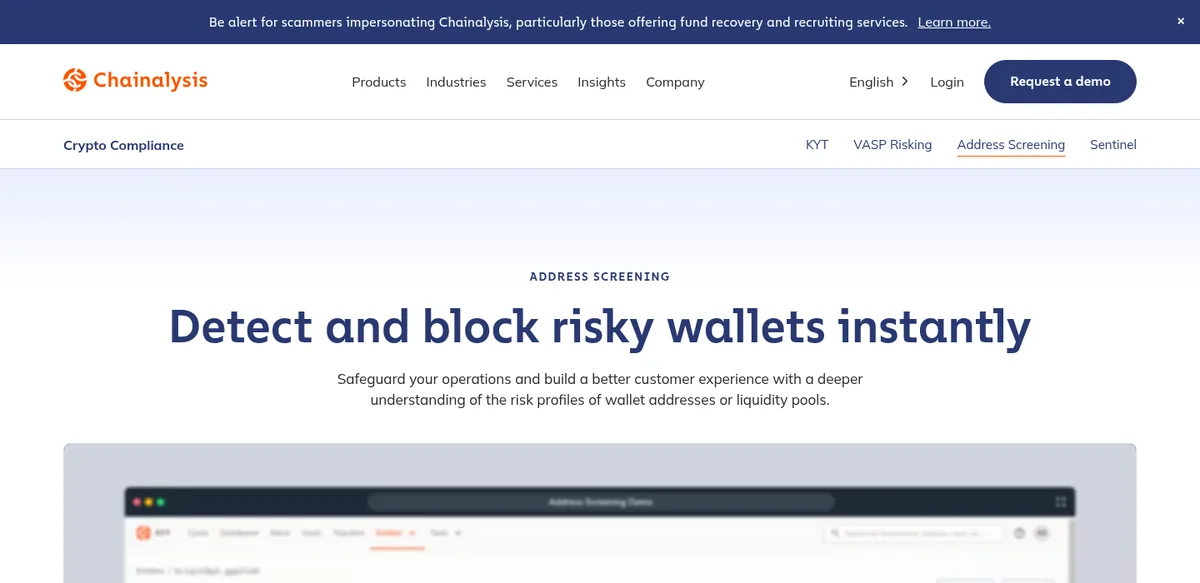
Address Screening is Chainalysis’s pre-transaction check, sold as a web app and as high-reliability, low-latency APIs. It scores wallets and liquidity pools for direct and indirect exposure, and you can tune category severities and exposure thresholds. Its FAQ says a rescreen through the API needs another call but does not incur additional costs, which matters when you re-check every address before each payout.
- Data: the same graph as Chainalysis KYT, which states 400+ networks and 50M+ tokens.
- Monitoring: continuous monitoring with alerts in the UI when a screened entity’s risk score changes.
- Security: SOC 2 Type 2 and FedRAMP on its platform page.
- Price: quote only; no public sandbox on the pages we read.
Verdict: The default when an examiner expects the market leader. Free rescreens make it a good fit for checking every withdrawal, not just the first.
2. TRM Labs Wallet Screening
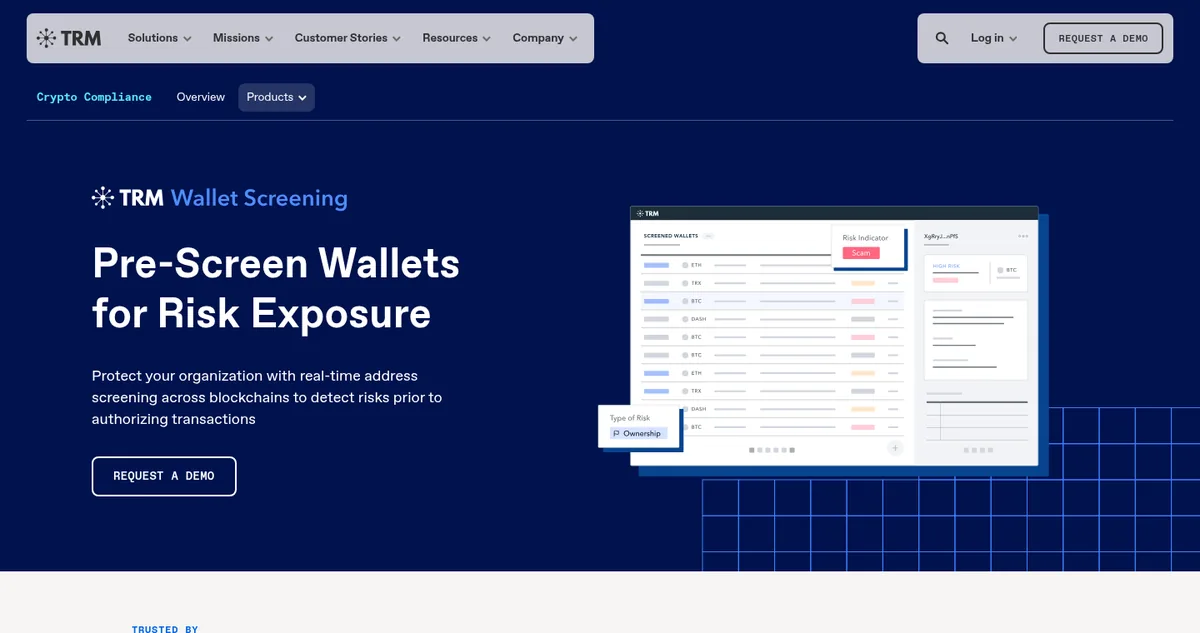
TRM Wallet Screening screens 1.9B+ digital assets across 184+ blockchains, including ERC-20 tokens, stablecoins and DeFi tokens. It is the only enterprise API here with a stated speed: submit an address and receive trading volume, a full list of risks and attribution in under 400 milliseconds.
- Rules: over 155 risk configurations covering ownership, counterparty and indirect risk.
- Use: screen wallets before authorising a transaction, then pair with TRM Transaction Monitoring for after-the-fact review.
- Sanctions docs: TRM publishes sanctions API documentation that its docs say needs no login to read.
- Price: quote only.
Verdict: The pick when withdrawal latency matters most. Test the 400 millisecond claim at your own peak traffic before you sign.
3. Elliptic Lens
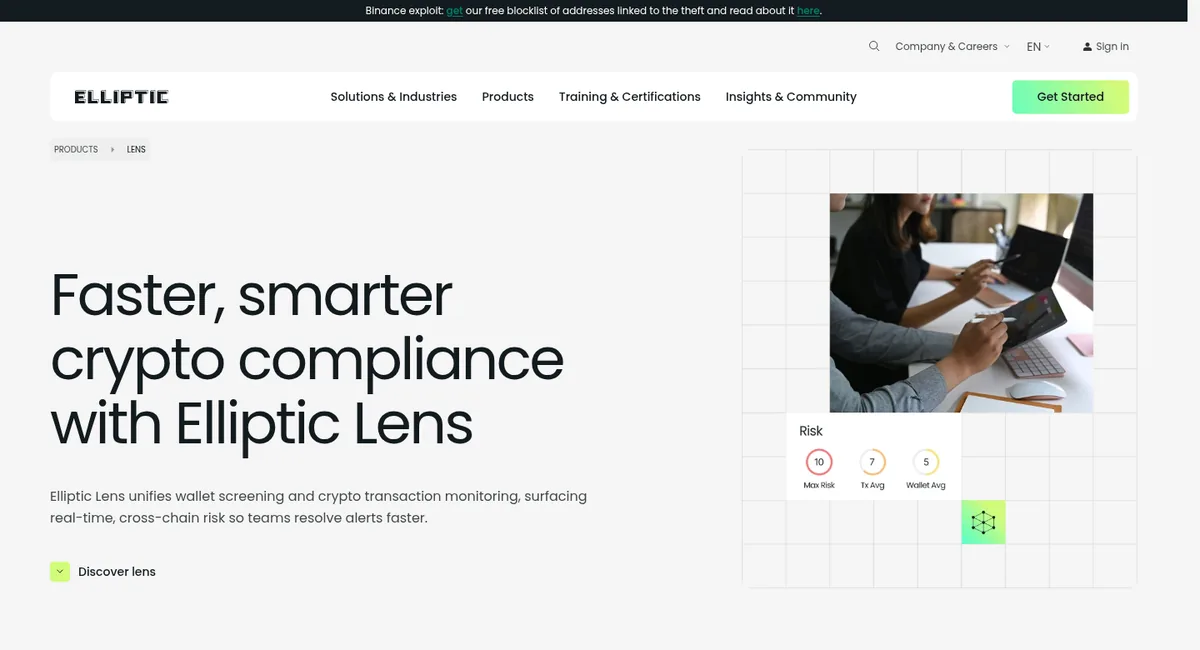
Elliptic Lens screens wallets across 60+ blockchains and 250+ bridges, before you onboard a customer or process a withdrawal, then re-screens them automatically when new risk appears. It is the only top-tier screening product with a list price: $50,000 per unit a year on Tier 1 or $100,000 on Tier 2, on AWS Marketplace.
- API: the developer docs require every request to be signed with an HMAC-SHA256 signature, so plan for that in your client.
- Security: the trust page lists a SOC 2 Type 2 report and ISO 27001.
- Units: the AWS listing prices per unit without saying how many screenings a unit covers.
- Budget line: one Tier 1 unit is about $4,167 a month.
Verdict: The pick for banks and custodians that need a known budget line. Get the screenings per unit in writing before you buy.
4. BlockSec Phalcon
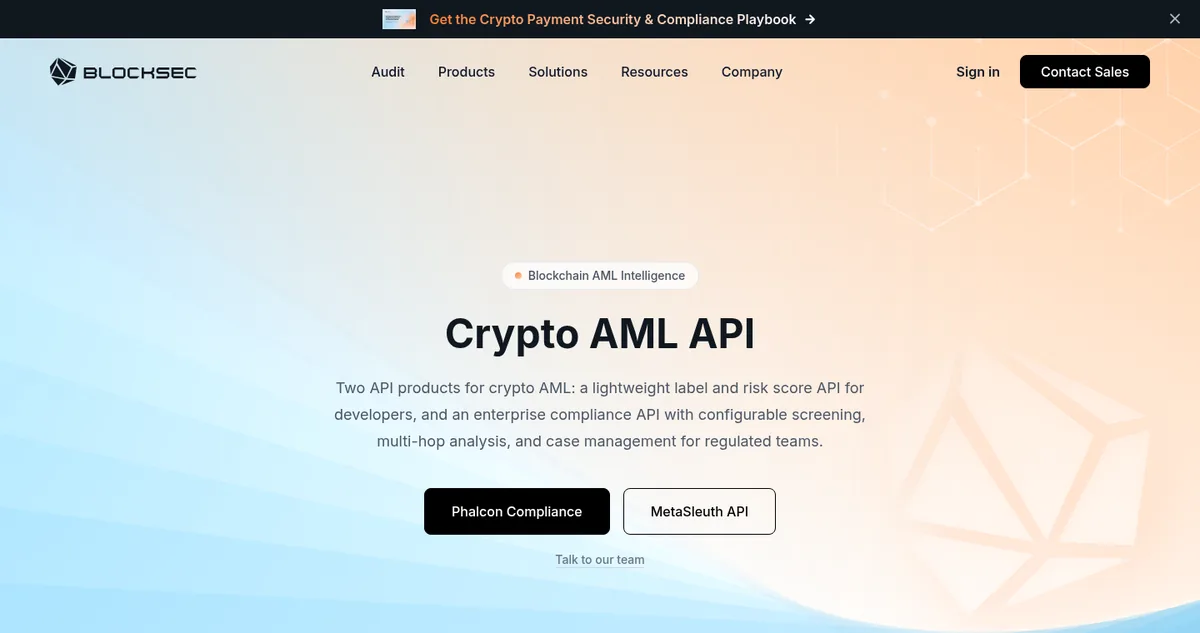
BlockSec sells two API families on its crypto AML API page: standalone MetaSleuth APIs for address labels and risk results across 20+ networks and 600M+ labelled addresses, and Phalcon Compliance APIs with multi-hop analysis, custom risk rules and sanctions checks. Phalcon has the lowest published per-check entry price among the seven, from $0.10 a check.
- Endpoints: Address Screening API for onboarding, counterparty checks, deposits and withdrawals; Transaction Screening API for incoming funds and ongoing monitoring.
- Agents: an x402 Compliance API sells AML intelligence pay-per-call.
- Pricing: Phalcon Compliance lists from $0.10 per check and a free trial.
- Security: no SOC 2 or ISO certificate stated on the pages read.
Verdict: The strongest self-serve choice for payment firms and wallets. Ask for security documents if a bank partner reviews your vendors.
5. Didit Wallet Screening
Didit is an identity platform that added wallet screening, so KYC and address checks run in one workflow. Managed screening uses Merkle Science data at $0.15 a check. Its docs let you connect your own Chainalysis, TRM Labs, Elliptic or Crystal key instead and pay Didit a $0.02 infrastructure fee per screening.
- Payload: risk score 0 to 100, severity LOW, MEDIUM, HIGH or CRITICAL, and source of funds across 14+ categories, sub-second.
- Free tier: 500 free verifications a month; volume discounts above 100,000 screenings a month.
- Security: SOC 2 Type 1 and Type 2 and ISO/IEC 27001:2022 stated.
- Watch: the product page lists 13 managed networks and the docs list 17, so check your chains.
Verdict: Best for teams already doing KYC who want one bill, or who want a cheap wrapper around an enterprise key they already own.
6. Scorechain
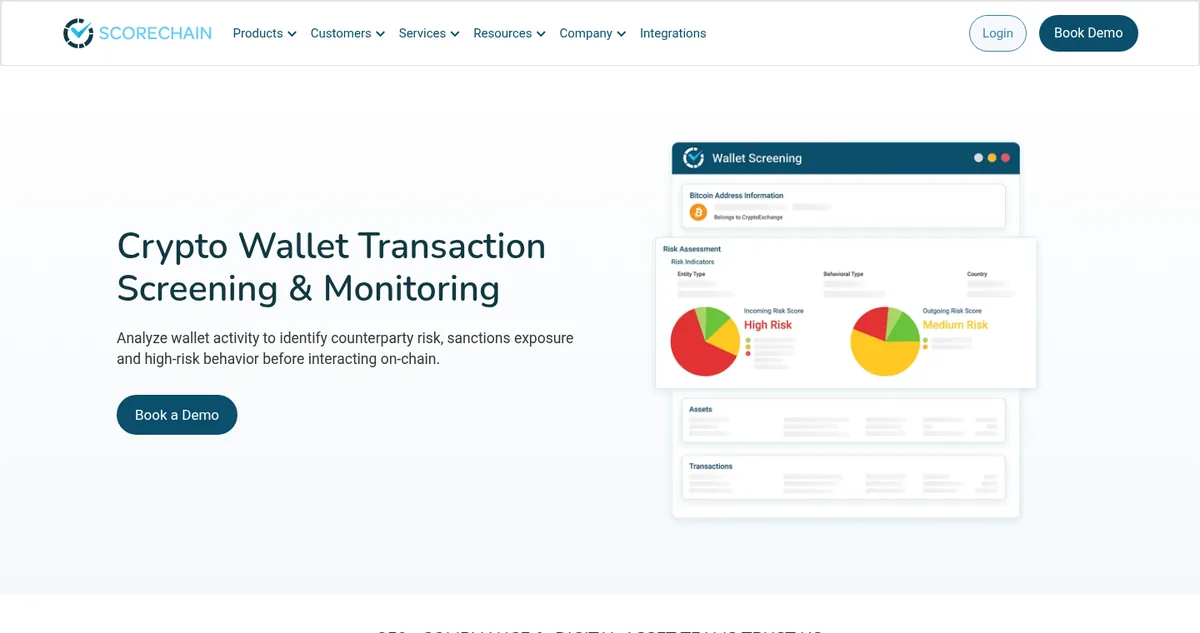
Scorechain wallet screening is a point-in-time snapshot: it scores a wallet now, with the risk level and indicators behind the score, without switching on ongoing monitoring. Scorechain is the one vendor that frames screening around explainability, showing the indicators behind each score so an analyst can justify the decision.
- Coverage: 25+ blockchains and 1B+ labelled entities on the screening page; 21+ blockchains on its free API page.
- Exposure: direct and indirect exposure, plus 2,800+ VASP due-diligence profiles.
- Free tier: a sanctions API for non-commercial use, 100 requests an hour, no SLA.
- Hosting: EU-hosted private cloud.
Verdict: The pick for EU teams that need to show why an address passed or failed. Confirm which coverage figure applies to scored screening.
7. BlockchainAnalysis.io
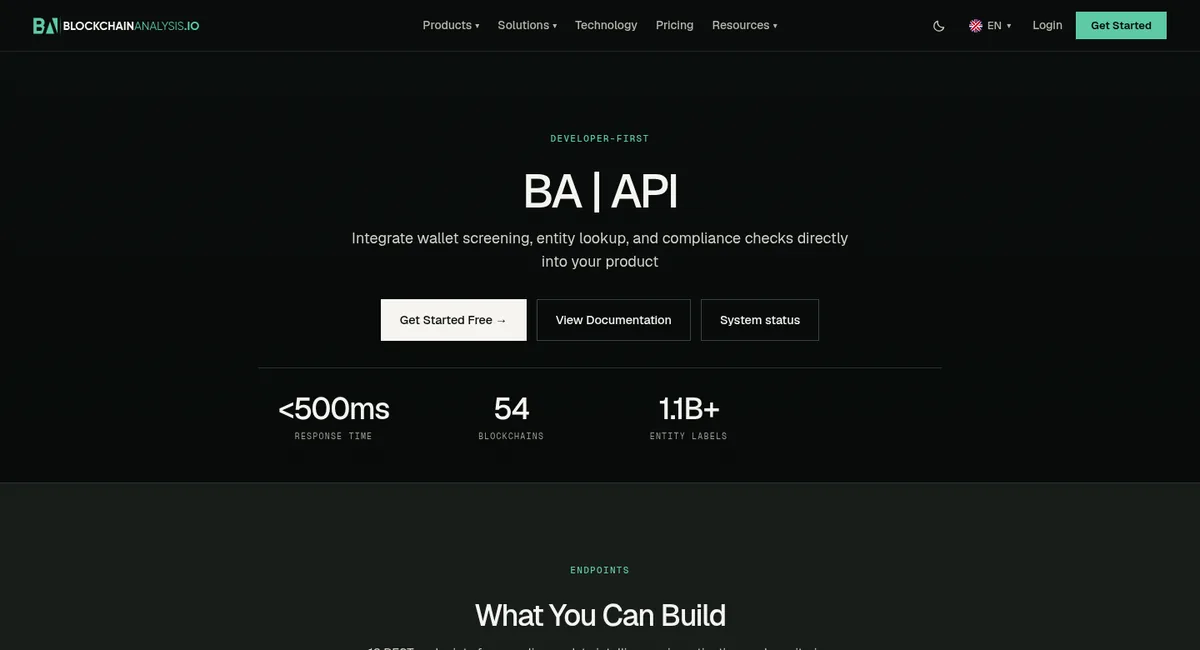
BlockchainAnalysis.io is a developer-first API that states under 500 millisecond responses, 54 blockchains and 1B+ entity labels. Its screening endpoint returns a risk score, entity labels, sanctions matches and behavioural signals for 1 credit. It has the most granular public price list of the seven, and also sells pay-per-call access in USDC on Base through x402.
- Credits: on the pricing page, 20 calls $49, 100 $199, 500 $799, 2,000 $2,499 ($1.25 each).
- Cheaper lanes: Oracle risk verdicts at 20,000 a month for $49, and Intel label lookups at 2,500 calls a month on 5 chains for $49.
- Free tier: 5 API credits, 10 KYT checks, 100 Oracle verdicts and 100 Intel calls a month, verified email, no card.
- Security: no certification stated on the pages read.
Verdict: Good for prototypes and AI agents that need a key in minutes. Regulated firms will want security documents first.
What Screening Costs at 1,000, 10,000 and 100,000 a Month
Most buyers ask what the bill looks like before they ask anything else. At 10,000 screenings a month, published list prices run from $49 for BlockchainAnalysis.io Oracle verdicts to $1,425 for Didit managed screening, and one Elliptic Tier 1 unit is about $4,167. Chainalysis, TRM Labs and Scorechain quote privately, so they are not in the math.
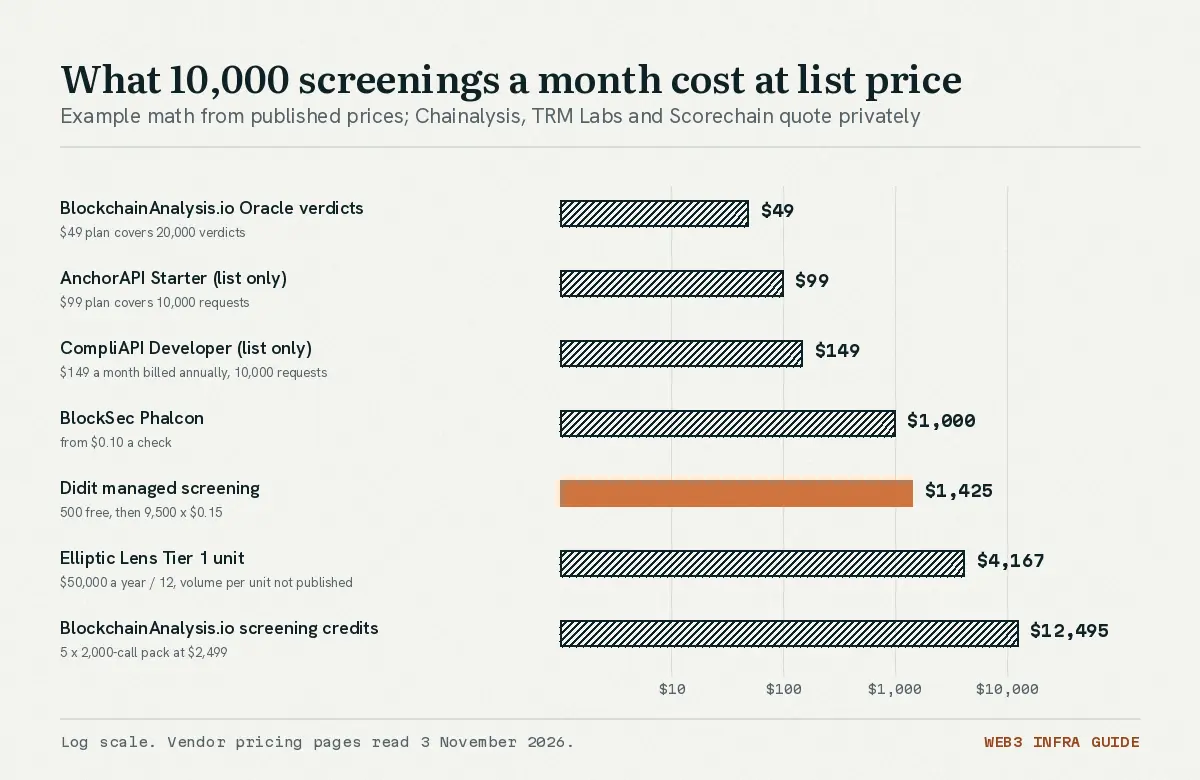
| Option | 1,000 a month | 10,000 a month | 100,000 a month | How we got it |
|---|---|---|---|---|
| Didit managed | $75 | $1,425 | $14,925 | 500 free, then $0.15 each; discounts above 100,000 |
| Didit with your own key | $20 + your vendor | $200 + your vendor | $2,000 + your vendor | $0.02 fee per screening, before free allowance |
| BlockSec Phalcon | $100 | $1,000 | $10,000 | From $0.10 a check |
| BlockchainAnalysis.io Oracle | $49 | $49 | $499 | 20,000 plan $49; 500,000 plan $499 |
| BlockchainAnalysis.io Intel (labels) | $49 | $299 | $999 | 2,500 calls (5 chains), 25,000 (10 chains), 150,000 (all chains) |
| BlockchainAnalysis.io credits | $1,598 | $12,495 | $124,950 | 500-call packs at $799; 2,000-call packs at $2,499 |
| Elliptic Lens Tier 1 | $4,167 | $4,167 | $4,167 | $50,000 a year per unit; screenings per unit not published |
| AnchorAPI (list only) | $99 | $99 | $299 | Starter 10,000; Growth 100,000 |
| CoinForensics (list only) | $299 | $999 | $3,999 | 25,000 plan plus $0.04 for each extra check |
Three break-even points fall out of this table. Didit managed and BlockSec Phalcon cost the same at 1,500 screenings a month; below that Didit’s free 500 wins, above it Phalcon’s $0.10 wins. One Elliptic Tier 1 unit beats Didit managed above about 28,278 screenings a month and beats Phalcon above about 41,667, if one unit covers that volume. BlockchainAnalysis.io Oracle verdicts are the cheapest line at every volume, but a verdict is a simpler answer than a full screening report, so compare the fields before you compare the price.
List price is only part of the cost. Analyst time on false positives often costs more than the API, so replay the same addresses through each trial and count the holds before you choose the cheapest line.
Verdict: Under 1,500 screenings a month, Didit’s free tier is cheapest. From there to the tens of thousands, Phalcon’s $0.10 leads on scored checks; above roughly 40,000, ask Elliptic how many screenings a unit covers.
How to Test a Screening API Before You Sign
Never pick a screening API from a demo. Replay addresses you already blocked, held and cleared through every trial, and pick the API that matches your past decisions with the fewest new false positives. The checklist below is what a bank partner will ask you to show anyway.
- Export 90 days of withdrawal and deposit addresses, including every one you held, blocked or reported.
- Send each vendor your chain and token list and get a yes or no per chain for scored screening.
- Replay the addresses through each trial and record scores, flags and response times.
- Measure the 95th percentile response time, not the average, at your peak hour.
- Check a newly designated sanctions address flags within the vendor’s stated window.
- Confirm every result exports with its reasons and a timestamp.
| Check | Pass if | Why it matters |
|---|---|---|
| Chain match | Every chain you support gets a scored result | A missing chain is a hole in your control |
| Known bad hits | Every address you blocked before also flags | Proves the data sees the same exposure |
| False positives | Holds per 1,000 addresses stay flat or fall | Staff time can cost more than the API |
| Latency | 95th percentile fits your payout queue | Slow checks stall users at the worst moment |
| Failure mode | Timeouts hold the payout | An API outage must not open the door |
Verdict: The API that matches your past blocks with the fewest false positives wins, even at a higher list price.
Which Wallet Screening API Fits Your Business
Match the API to your licence, volume and chains. Many regulated firms run one enterprise API and keep a cheaper one for second opinions or failover. For the wider stack, including Travel Rule messaging and VASP due diligence, see our crypto compliance tools guide.
| Business | First choice | Add | Why |
|---|---|---|---|
| Licensed exchange or broker | Chainalysis or TRM Labs | A list-only first gate | Market-default data and stated speed |
| Custodian or bank | Elliptic Lens | Chainalysis or TRM Labs | List price, SOC 2 Type 2 and ISO 27001 |
| Payment company or wallet | BlockSec Phalcon | Didit for KYC in the same flow | Published per-check prices |
| EU team needing explainable checks | Scorechain | Elliptic Lens | Indicators behind each score, EU hosting |
| Developer or AI agent | BlockchainAnalysis.io | BlockSec x402 API | Self-serve keys and pay-per-call |
Verdict: Licensed firms buy Chainalysis, TRM Labs or Elliptic. Everyone else should start with Phalcon, Didit or BlockchainAnalysis.io and move up when volume or examiners require it.
Final Verdict
Chainalysis Address Screening is the reference API, TRM Labs is the pick when speed matters, and Elliptic Lens is the only top-tier option you can budget before a sales call. Below about 40,000 screenings a month, BlockSec Phalcon and Didit make scored screening affordable on prices anyone can read today.
- Chainalysis (9.2): 400+ networks and free API rescreens.
- TRM Labs (8.9): under 400 milliseconds on 184+ blockchains.
- Elliptic Lens (8.7): $50,000 per unit a year on AWS, SOC 2 Type 2 and ISO 27001.
- BlockSec Phalcon (7.2): from $0.10 a check with multi-hop rules.
Verdict: Screen before you sign, fail closed on errors, and pay for exposure scoring as soon as you hold customer funds.
Frequently Asked Questions
What is a wallet screening API?
A wallet screening API checks one blockchain address and returns a risk answer before you send funds, onboard a user or accept a counterparty. Basic APIs only match sanctions lists. Exposure-scoring APIs from Chainalysis, TRM Labs, Elliptic and others also score direct and indirect links to sanctioned, stolen or high-risk funds.
What is the best crypto wallet screening API in 2026?
Chainalysis Address Screening scores highest in our ranking at 9.2 out of 10, with 400+ networks and free API rescreens. TRM Labs follows at 8.9 with under 400 millisecond responses on 184+ blockchains, and Elliptic Lens at 8.7 is the only top-tier option with a public list price.
How much does a wallet screening API cost?
Chainalysis, TRM Labs and Scorechain quote privately. Published prices on 3 November 2026 include BlockSec Phalcon from $0.10 a check, Didit at $0.15 a check after 500 free a month, BlockchainAnalysis.io credits from $2.45 to $1.25, and Elliptic Lens at $50,000 per unit a year on AWS.
Is there a free wallet screening API?
Yes, for testing and small apps. Scorechain’s free sanctions API allows 100 requests an hour for non-commercial use, CompliAPI gives 1,000 list-only requests a month, PublicAML needs no key, and Didit includes 500 free verifications a month. None of these replaces a paid, scored API for a regulated business.
Is sanctions list screening enough for compliance?
Usually not if you hold customer funds. A list check only flags the exact address on OFAC, EU or UK lists. A new wallet funded from a sanctioned one passes a list check but fails an exposure check. Most regulated firms run exposure scoring on every withdrawal and keep the decision log.
How fast should a wallet screening API respond?
Fast enough not to stall withdrawals at peak. TRM Labs states under 400 milliseconds, BlockchainAnalysis.io under 500 milliseconds and Didit sub-second. Measure the 95th percentile on your own traffic during a trial, and fail closed: if the call times out, hold the payout for review instead of sending it.