
Last updated: 25 October 2026 · Prices, credit costs, rate limits and benchmark figures rechecked on vendor pages on 25 October 2026
In the Helius vs QuickNode vs Triton comparison, Helius is the best Solana RPC for most teams, QuickNode is the best pick for NFT data, audits and multi-chain apps, and Triton One is the best pay-as-you-go option for heavy account scans and full history. We priced five real Solana workloads on all three meters.
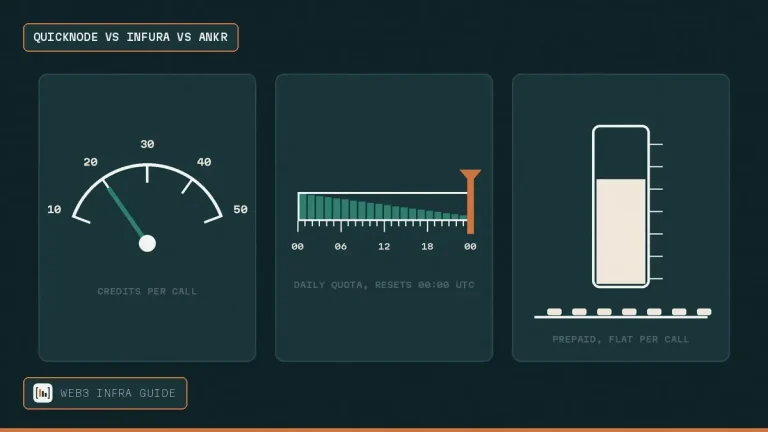
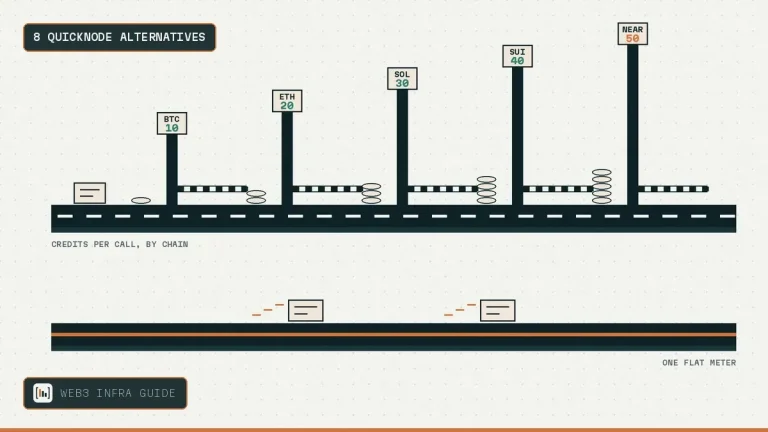
All three run Solana mainnet RPC endpoints, gRPC streaming and dedicated nodes. They bill in different units: Helius in credits per method, QuickNode in a flat 30 credits per Solana call, and Triton One in calls plus bandwidth. This head to head expands the Solana entries in our ranking of the 12 best RPC node providers, and our methodology page explains how we gather prices. Our RPC provider pricing breakdown converts these units to dollars per million calls.
TL;DR
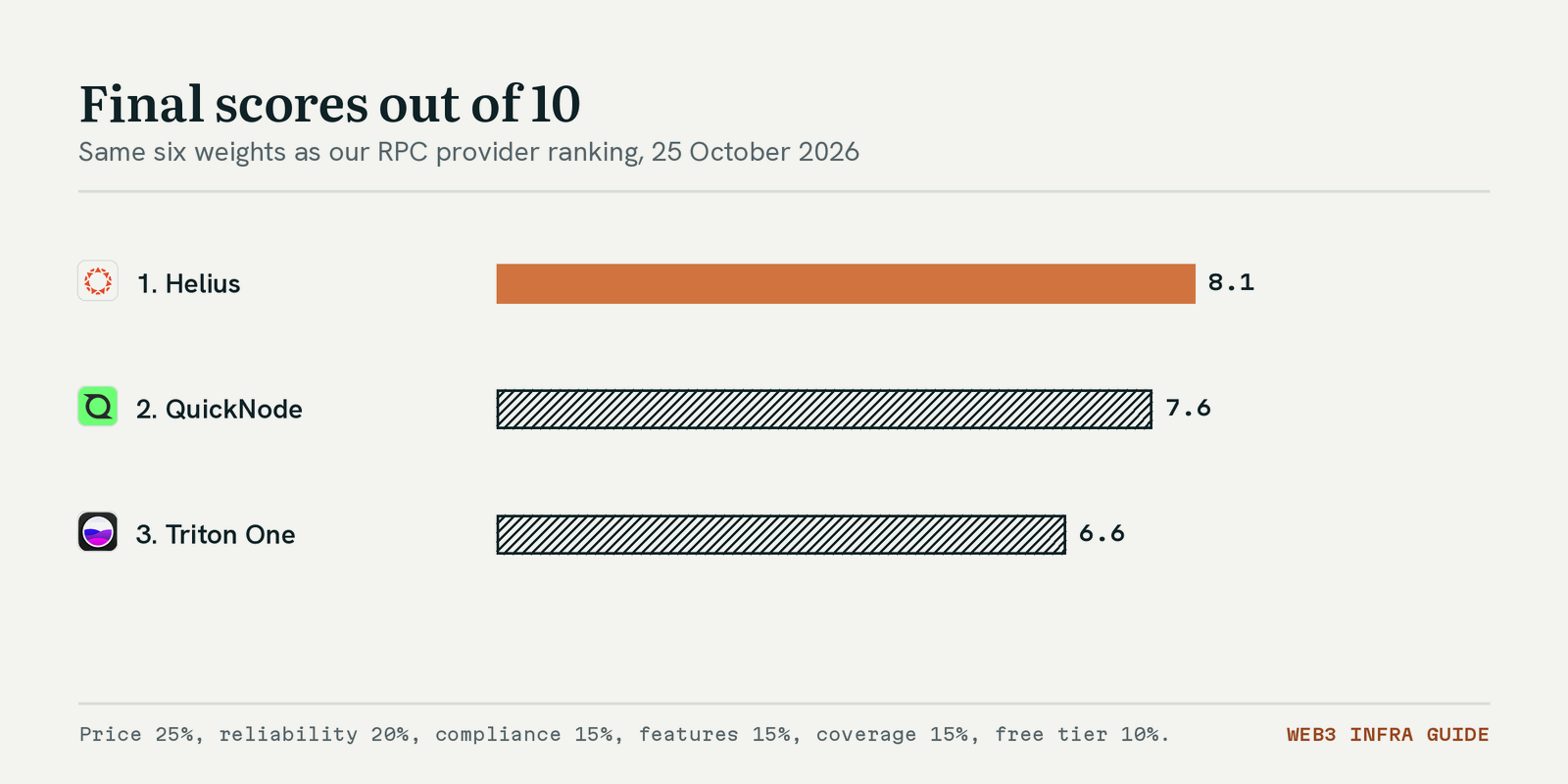
- Overall: 1. Helius (8.1), 2. QuickNode (7.6), 3. Triton One (6.6), on the same six weights as our 12-provider ranking.
- Helius produced the lowest bill in four of five workloads, from $49 for a 10M-request wallet backend to $499 for a 100M-request trading bot.
- QuickNode was cheapest for a DAS-heavy NFT and token app at $499, because Helius charges 10 credits per DAS call and caps DAS at 10 requests per second on Developer.
- Triton One charges $10 per million calls plus $0.08 per GB, so a history indexer pulling full blocks cost $2,677 there against $499 on Helius.
- Streaming costs about $0.08 per GB on all three. QuickNode includes Solana gRPC from Scale ($499) and sells it as an add-on below that. Helius includes mainnet LaserStream gRPC from Business ($499).
- QuickNode states SOC 1 Type 2, SOC 2 Type 2 and ISO 27001. Helius states SOC 2 Type II. Triton One publishes security practices with no audit report.
The Decision Kernel
Choose by the shape of your Solana traffic. Helius rewards plain reads and sends, QuickNode rewards expensive methods such as DAS, and Triton One rewards small responses and account scans. Log one day of requests by method and response size before you compare plans. The shortcuts below cover the common cases.
- Lowest bill for wallets, DeFi backends and bots: Helius, where standard calls cost 1 credit and Sender transactions cost none.
- NFT, token and compressed asset data: QuickNode Scale, which bills DAS at 60 credits with no extra DAS rate cap listed.
- Heavy
getProgramAccountsscans on pay as you go: Triton One at about $17.63 per million, or QuickNode at $18.38. - Security questionnaires and vendor reviews: QuickNode, with SOC 1, SOC 2 and ISO 27001 reports.
- Full ledger history from genesis and unmetered gRPC: Triton One, through Old Faithful and dedicated nodes from $2,900 a month.
- One vendor for Solana plus EVM chains: QuickNode, which covers 76+ chains on one key.
Verdict: Helius for most Solana teams, QuickNode for DAS-heavy apps and compliance reviews, Triton One for account scans, full history and dedicated streaming.
How We Compared Helius, QuickNode and Triton One
We scored each provider from 1 to 5 on six criteria, weighted them, and doubled the total for a score out of 10. The weights match our 12-provider ranking, with coverage judged on Solana depth. Every input links to a vendor page or a public benchmark checked on 25 October 2026. The full rules sit on our methodology page.
- Price per call, 25%: monthly bills for five method mixes, converted from credits or bandwidth.
- Reliability, 20%: uptime claims, support response targets and public latency benchmarks.
- Compliance, 15%: SOC 2, ISO 27001 and similar audits stated on the vendor’s own pages.
- Features, 15%: gRPC streaming, transaction sending, DAS, history and dedicated nodes.
- Coverage, 15%: Solana networks, regions, historical depth and other chains.
- Free tier, 10%: what a team can run before paying.
| Criterion (weight) |  |  |  |
|---|---|---|---|
| Price per call (25%) | 4 | 2 | 3 |
| Reliability (20%) | 4 | 5 | 4 |
| Compliance (15%) | 4 | 5 | 2 |
| Features (15%) | 5 | 4 | 5 |
| Coverage (15%) | 4 | 5 | 4 |
| Free tier (10%) | 3 | 2 | 1 |
| Score out of 10 | 8.1 | 7.6 | 6.6 |
Helius vs QuickNode vs Triton One at a Glance
The table lines up the billing unit, free option, entry plan, throughput and support target for each provider. Prices are monthly US dollar list prices from each pricing page on 25 October 2026. Annual billing gives two months free on Helius and lowers QuickNode by about 15% to 30%, and Triton One has no subscription to discount.
| | | |
|---|---|---|---|
| Billing unit | Credits, 1 to 10+ per method | API credits, 30 per Solana call | $10 per 1M calls plus $0.08 per GB |
| Free option | Free: 1M credits, 10 rps | One-month trial: 10M credits, 15 rps | None, $125 minimum deposit |
| Entry paid plan | Developer $49: 10M credits, 50 rps | Build $49: 80M credits, 50 rps | Pay as you go, 120 rps default |
| Higher tiers | $499 (100M), $999 (200M), Enterprise | $249 (450M), $499 (950M), from $999 (2B) | Custom limits, dedicated from $2,900 |
| Overage | $5 per 1M credits | $0.62 to $0.50 per 1M credits | Same metered rates |
| gRPC streaming | LaserStream, mainnet from Business | Solana gRPC included from Scale | Dragon’s Mouth, $0.08 per GB |
| Support target | 24h Developer to 4h Enterprise | 24h Build, 12h Accelerate, 8h Scale | 24/7 chat with engineers |
Pricing: Credits Against Bandwidth
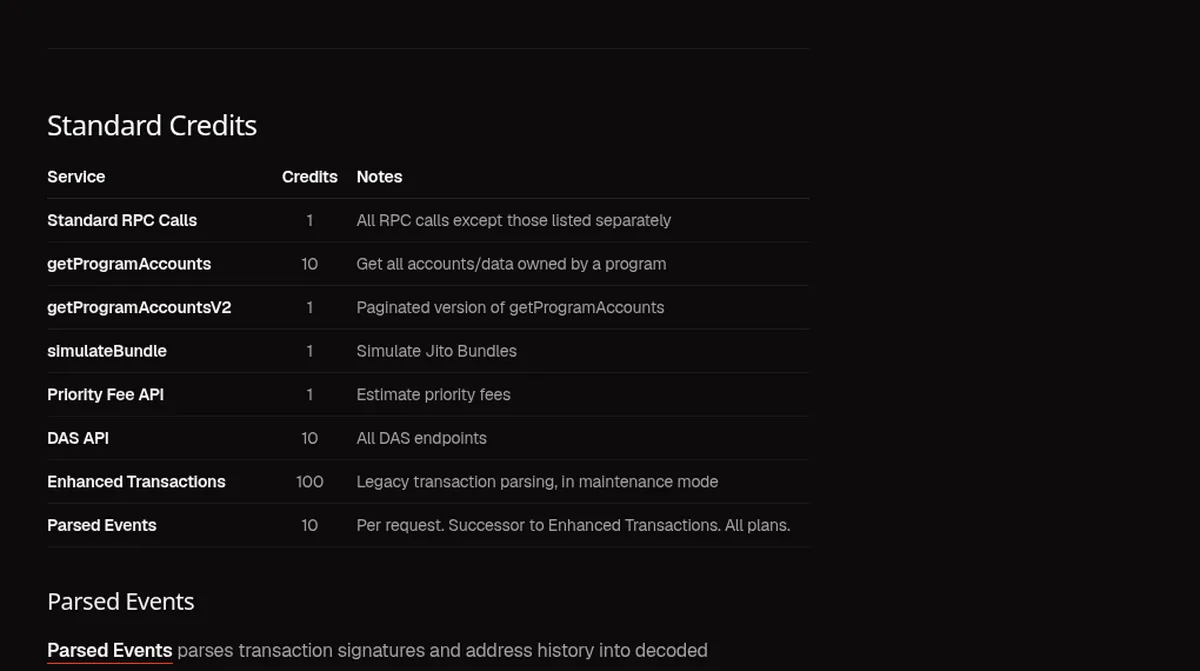
The three meters charge for the same Solana call in different ways. Helius charges 1 credit for standard and historical calls but 10 for getProgramAccounts and DAS. QuickNode charges 30 credits for any Solana method, with DAS at 60. Triton One charges $10 per million calls and then $0.08 for every GB the responses carry.
Converting each unit to dollars per million calls shows where each vendor wins. The figures use the entry paid plan fully used, which is the rate most small teams pay. Response sizes for Triton One come from our own calls to Solana mainnet on 25 October 2026, such as 0.49 KB for getAccountInfo and 1.82 MB for a full getBlock.
| Method, per 1M calls | | | |
|---|---|---|---|
getAccountInfo | $4.90 (1 credit) | $18.38 (30 credits) | $10.04 (0.49 KB each) |
getTransaction | $4.90 (1 credit) | $18.38 (30 credits) | $11.34 (17.5 KB each) |
getBlock, full transactions | $4.90 (1 credit) | $18.38 (30 credits) | $152.15 (1.82 MB each) |
getProgramAccounts | $49.00 (10 credits) | $18.38 (30 credits) | $17.63 (about 100 KB each) |
DAS getAsset | $49.00 (10 credits) | $36.75 (60 credits) | $50.00 (Metaplex API rate) |
sendTransaction | $0 through Sender, plus tip | $18.38 (30 credits) | $10.01 |
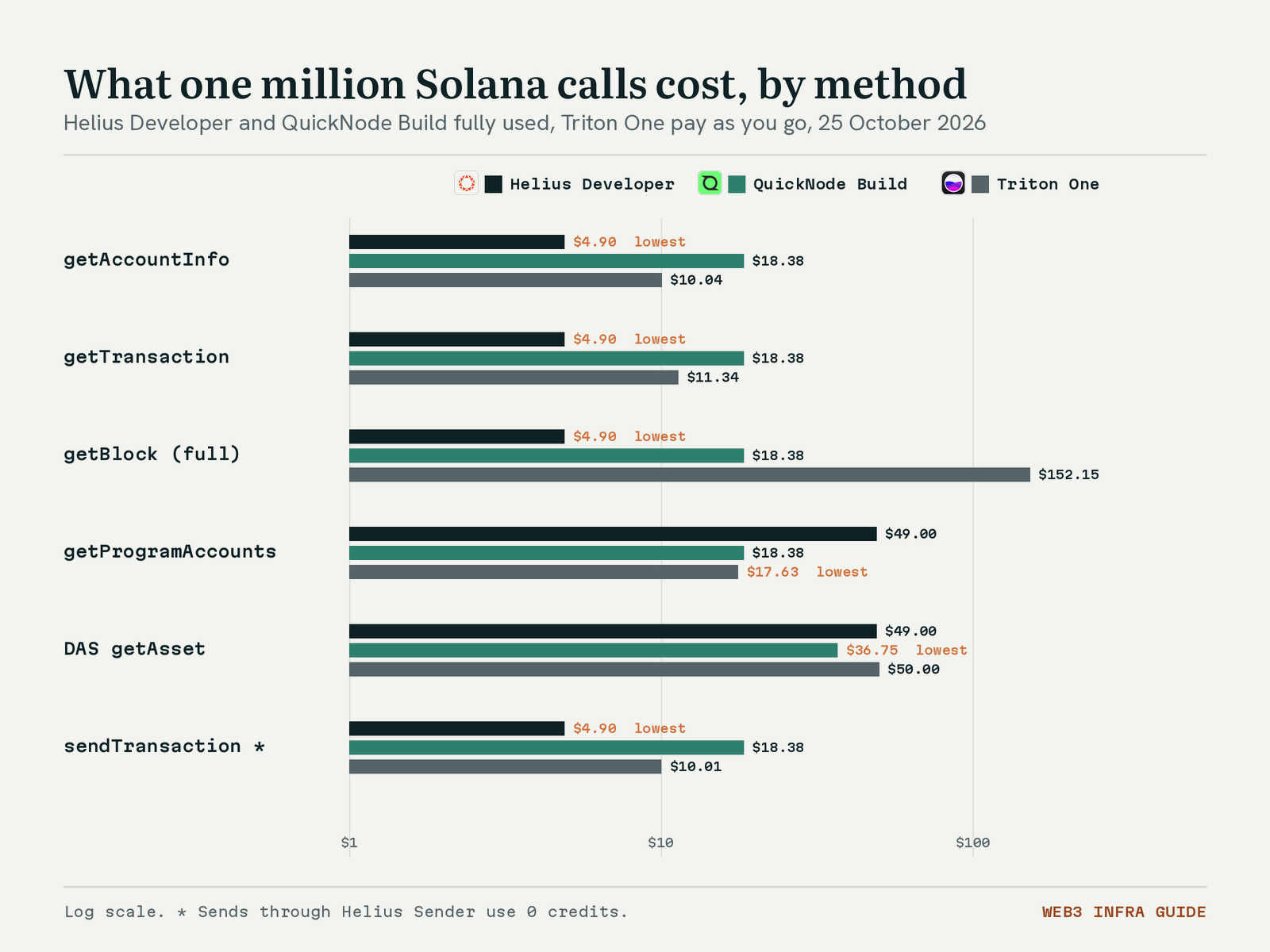
Two rows flip the ranking. Helius costs more than both rivals for account scans and DAS calls, and Triton One costs far more for full-block reads because bandwidth dominates the bill. Request getBlock with transactionDetails set to signatures and the response drops to about 27 KB, which brings Triton One back to about $12 per million.
Verdict: Helius is cheapest for standard reads and sends. QuickNode and Triton One are cheaper for getProgramAccounts and DAS, and Triton One is the most sensitive to response size.
What Five Real Workloads Cost
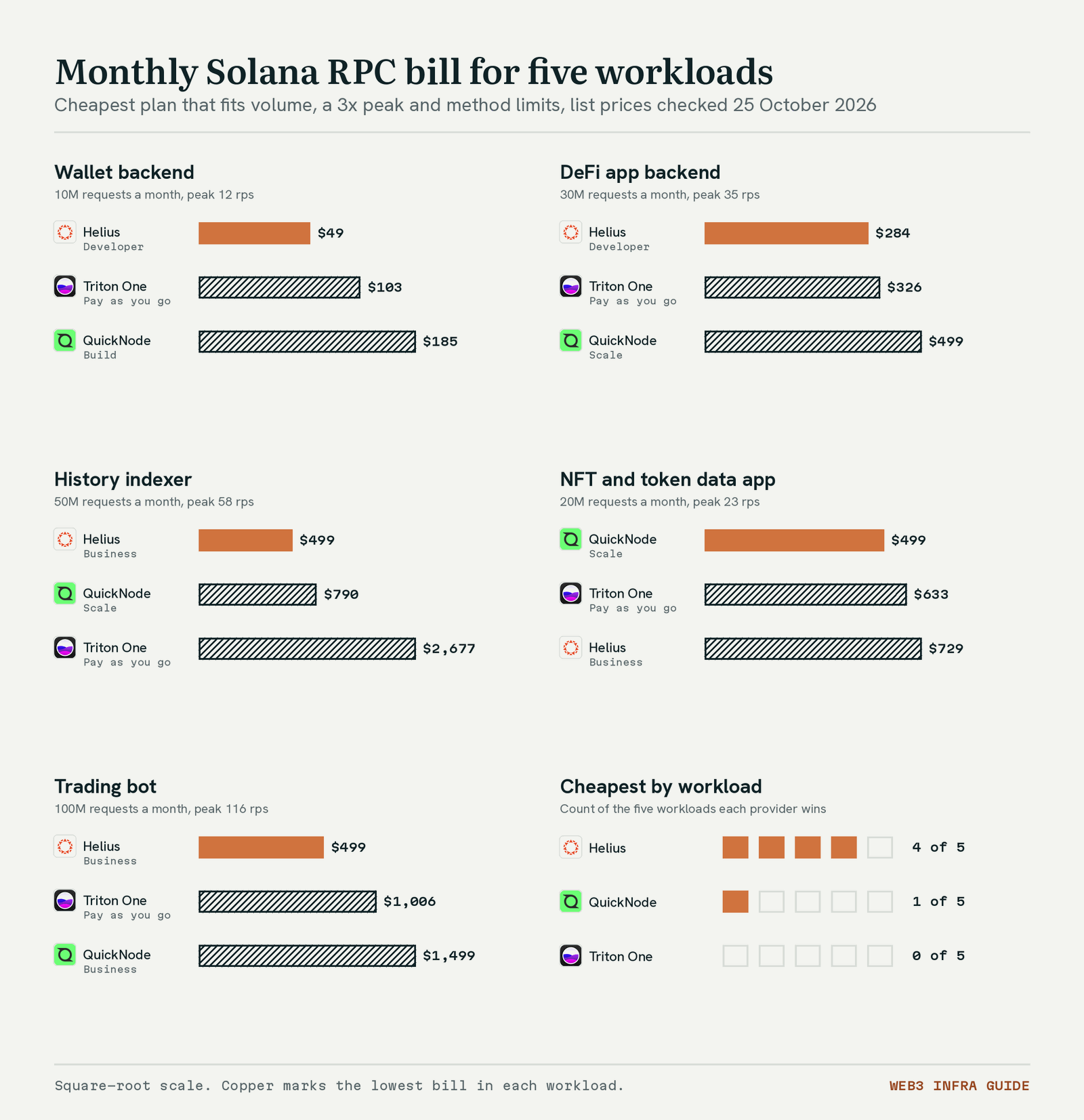
Plan tables only matter once you apply them to real traffic. We built five Solana method mixes, assumed a peak of three times the average rate, and picked the cheapest plan on each vendor that clears credits, requests per second and per-method limits. Helius came out cheapest in four of the five, and QuickNode won the DAS-heavy app.
| Workload (monthly) | | | |
|---|---|---|---|
| Wallet backend, 10M requests | $49 on Developer | $185.40 on Build | $102.95 (37 GB) |
| DeFi app backend, 30M requests | $284 on Developer plus overage | $499 on Scale | $326.27 (328 GB) |
| History indexer, 50M requests | $499 on Business | $790.50 on Scale plus overage | $2,677.11 (27.2 TB) |
| NFT and token data app, 20M requests | $729 on Business plus overage | $499 on Scale | $633.03 (413 GB) |
| Trading bot, 100M requests | $499 on Business | $1,499 on Business plus overage | $1,005.74 (72 GB) |
- Wallet backend: 35%
getAccountInfo, 20%getBalance, 15% token accounts, 10% blockhash, 10% signatures, 5%getTransaction, 5% sends. - DeFi app backend: 40%
getAccountInfo, 20%getMultipleAccounts, 10%getProgramAccounts, 10% simulations, 10% blockhash, 10% sends and status checks. - History indexer: 40%
getTransaction, 30% fullgetBlock, 20%getSignaturesForAddress, 10%getSlot. - NFT and token data app: 50% DAS
getAsset, 20%getProgramAccounts, 30%getAccountInfo. The DAS peak of 11.6 rps pushes Helius past Developer’s 10 rps DAS cap. - Trading bot: 50%
getAccountInfo, 20% blockhash, 15% simulations, 10% sends and 5% status checks, with sends peaking at 11.6 per second.
Rate limits decided two rows. The trading bot peaks at 116 requests per second, which fits Helius Business at 200 rps. On QuickNode its 3 billion credits make Business cheaper than Scale plus overage. The indexer fits Helius Business on credits alone, yet its full-block responses add 27.2 TB of bandwidth on Triton One.
Verdict: Helius is the cheapest fit for wallets, DeFi backends, indexers and bots. Pick QuickNode Scale when DAS calls make up a large share of traffic.
gRPC Streaming and Real-Time Data
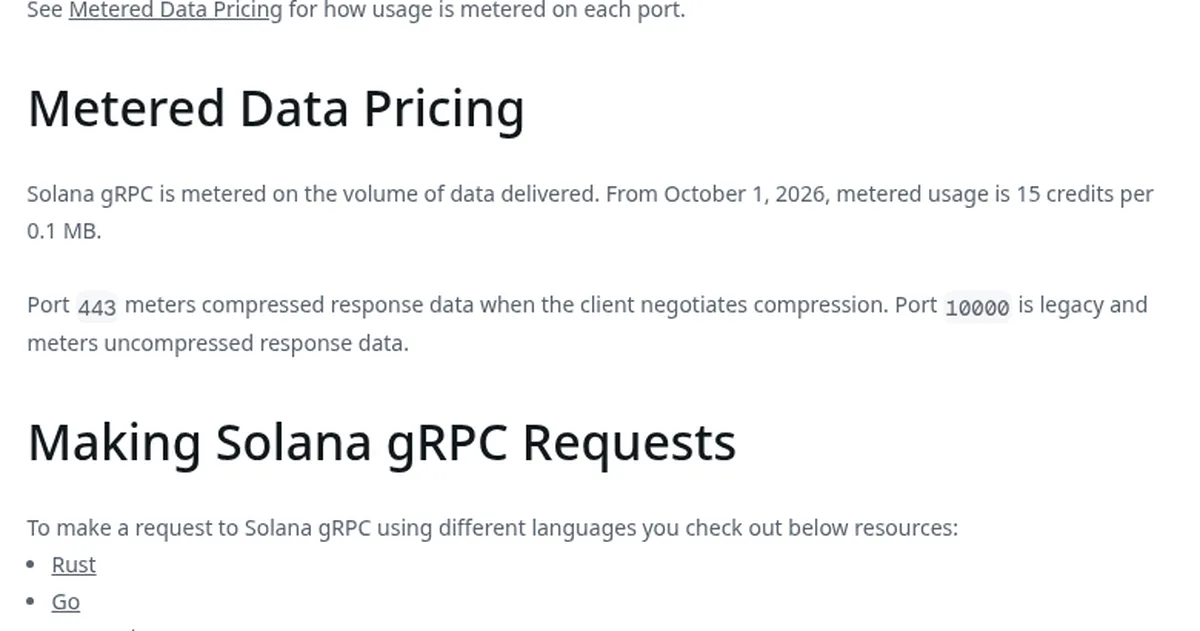
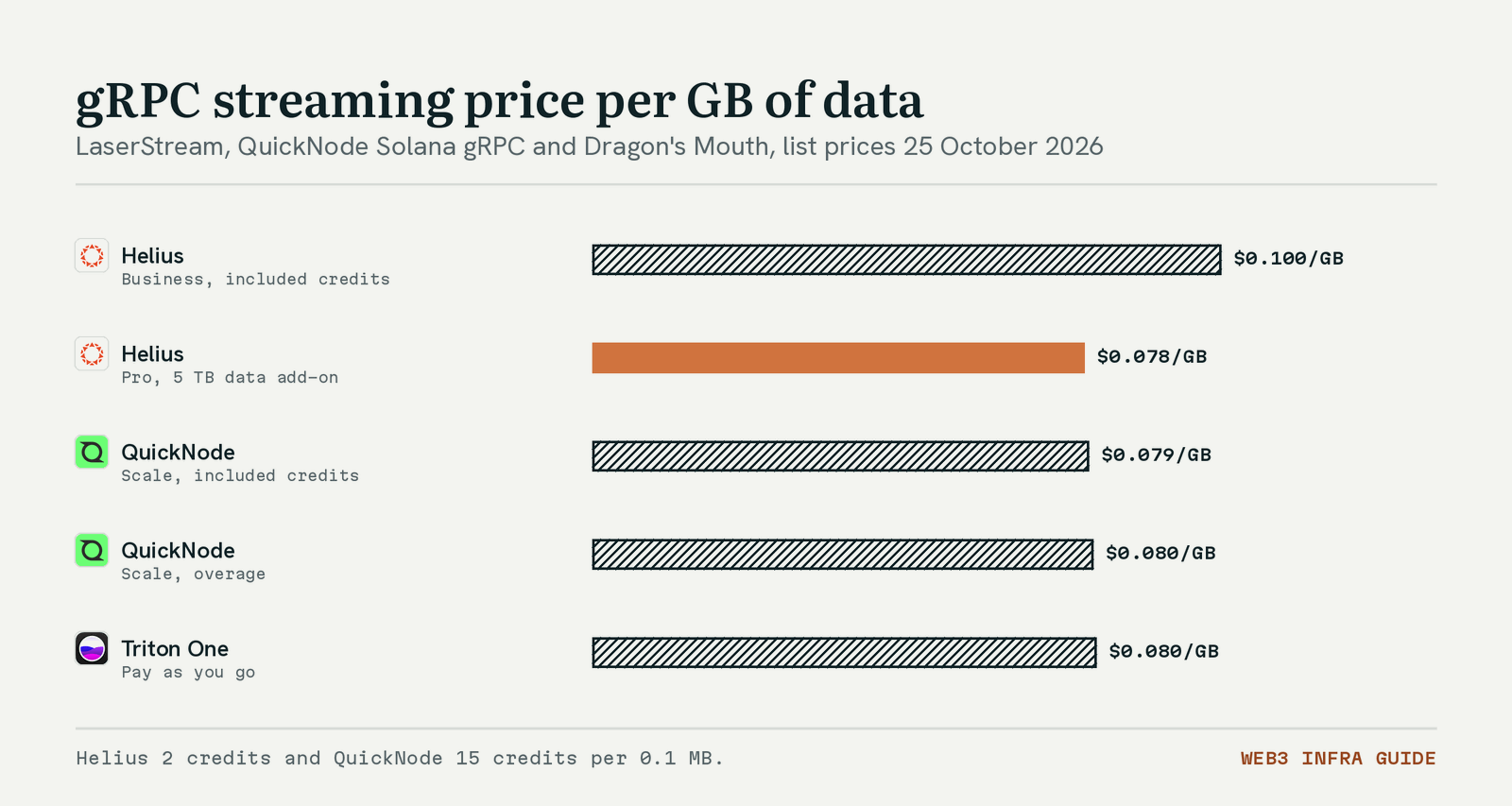
All three sell Yellowstone-compatible gRPC streams for accounts, transactions and slots, and they price them within a cent per GB. Helius LaserStream costs 2 credits per 0.1 MB and adds 48 hours of replay. QuickNode moved Solana gRPC to metered pricing on 1 October 2026, at 15 credits per 0.1 MB.
| Streaming | | | |
|---|---|---|---|
| Product | LaserStream gRPC and WebSocket | Solana gRPC | Dragon’s Mouth gRPC |
| Plan needed | Business $499 for mainnet, Developer on devnet | Included on Scale $499, paid add-on on Build and Accelerate | Any deposit |
| Price per GB | $0.100 on included credits, $0.078 with Pro data add-ons | $0.079 on Scale credits | $0.08 |
| Connection limits | 10 on Business, 100 on Professional | 10 concurrent on Scale, 25 on Business | Not capped on the pricing page |
| Extras | 48h historical replay, shreds from $800 a month | Compressed filters, port 443 compression | Shreds from $900 a month, unmetered on dedicated |
Verdict: Streaming price per GB is close to a tie. Triton One has the lowest entry point, Helius adds replay, and QuickNode bundles gRPC from the $499 Scale plan.
Sending Transactions
Landing transactions is where Solana RPC vendors differ most. Helius Sender uses no credits on any plan, including Free, and submits each transaction through several routes, including Jito. You pay a SOL tip instead, with a 0.001 SOL minimum for Sender and 0.000005 SOL for the SWQOS-only route. Helius plans also cap standard sendTransaction rates.
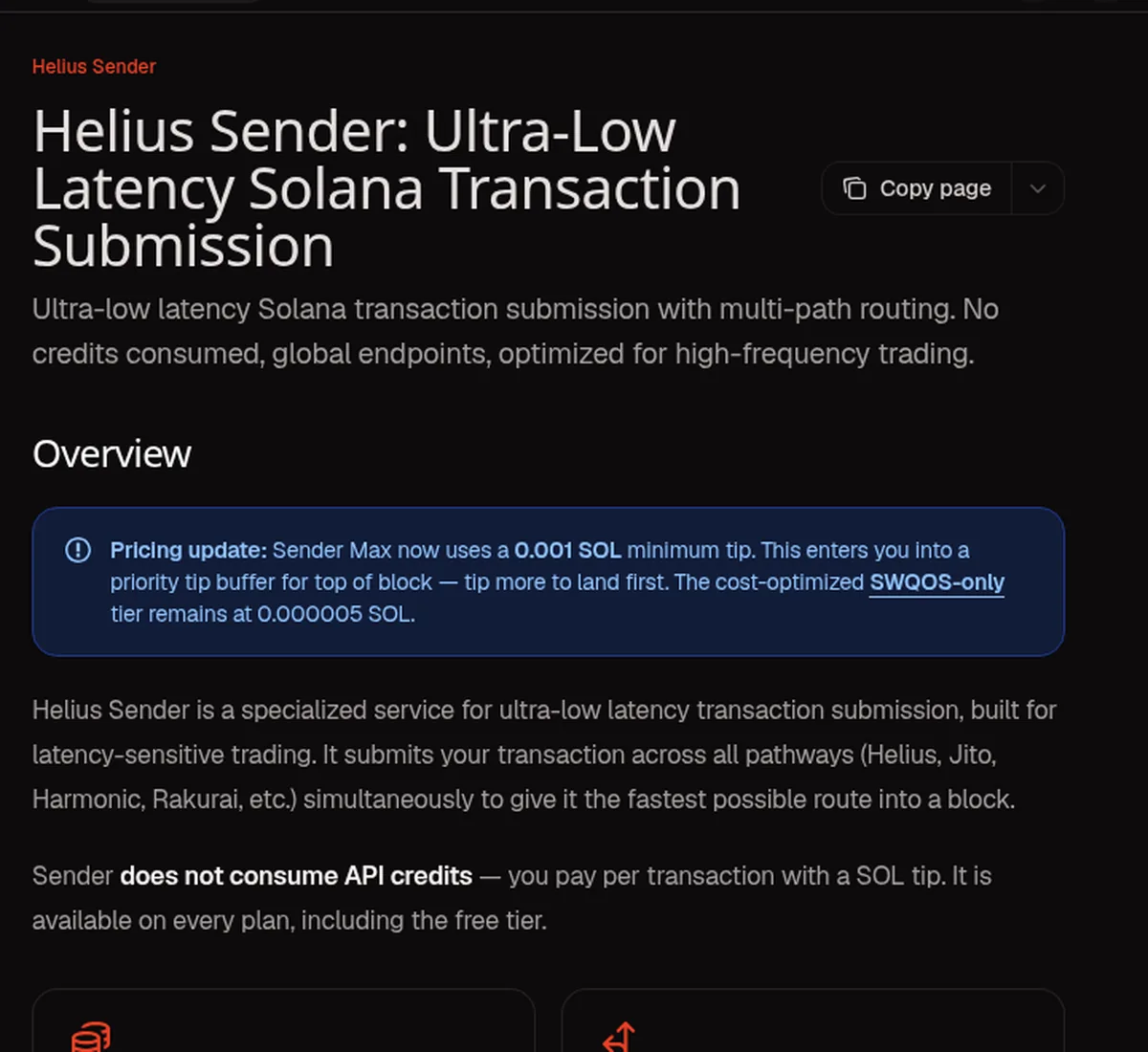
- Helius: Sender at 50 transactions per second on all plans, staked connections from Developer, standard sends capped from 1 to 100 per second by plan.
- QuickNode: sends cost 30 credits like any call, with Jito bundles, priority fee APIs and Lil’ JIT offered as marketplace add-ons.
- Triton One: sends cost $10 per million, and preconfirmations through Jito BAM and Harmonic cost $0.0015 per slot or $50 per million messages.
Landing data is patchy. The Helius sends benchmark showed submit errors for every QuickNode and Triton One transaction on 25 October, so its live board ranks only Helius (95.4% landed, 6-slot median) and Chainstack. Cached copies of the same board from earlier periods placed Triton One first on landing rate, so treat the live result as incomplete.
Verdict: Helius is the cheapest default for sending, since Sender uses no credits. Latency-critical bots should test Triton One landing rates side by side before choosing.
Free Tiers and Minimums
The free options differ more than the paid plans. Helius Free never expires and gives 1M credits and 10 requests per second, enough for a prototype. QuickNode offers a one-month trial with 10M credits. Triton One has no free tier and asks for a $125 prepaid deposit that is valid for 12 months and non-refundable.
| Free option | Allowance | Solana calls it covers | Limits |
|---|---|---|---|
| 1M credits a month | About 1M standard calls or 100,000 DAS calls | 10 rps, 1 send per second |
| 10M credits for one month | About 333,000 calls | 15 rps, ends after one month |
| $125 prepaid, 12 months | About 12M small reads | Spent like credit, no refunds |
Verdict: Helius has the only permanent free tier. Triton One’s $125 deposit buys the most calls but is a payment, so test it after a Helius or QuickNode prototype.
Latency and Reliability
Public Solana latency data is thin for this trio. The Helius benchmark is run by Helius, and its last complete ranking, ending 18 October 2026, scored Helius 94.5 and QuickNode 85.6. On 25 October that benchmark showed QuickNode and Triton One endpoints as down, so it fell back to older data.
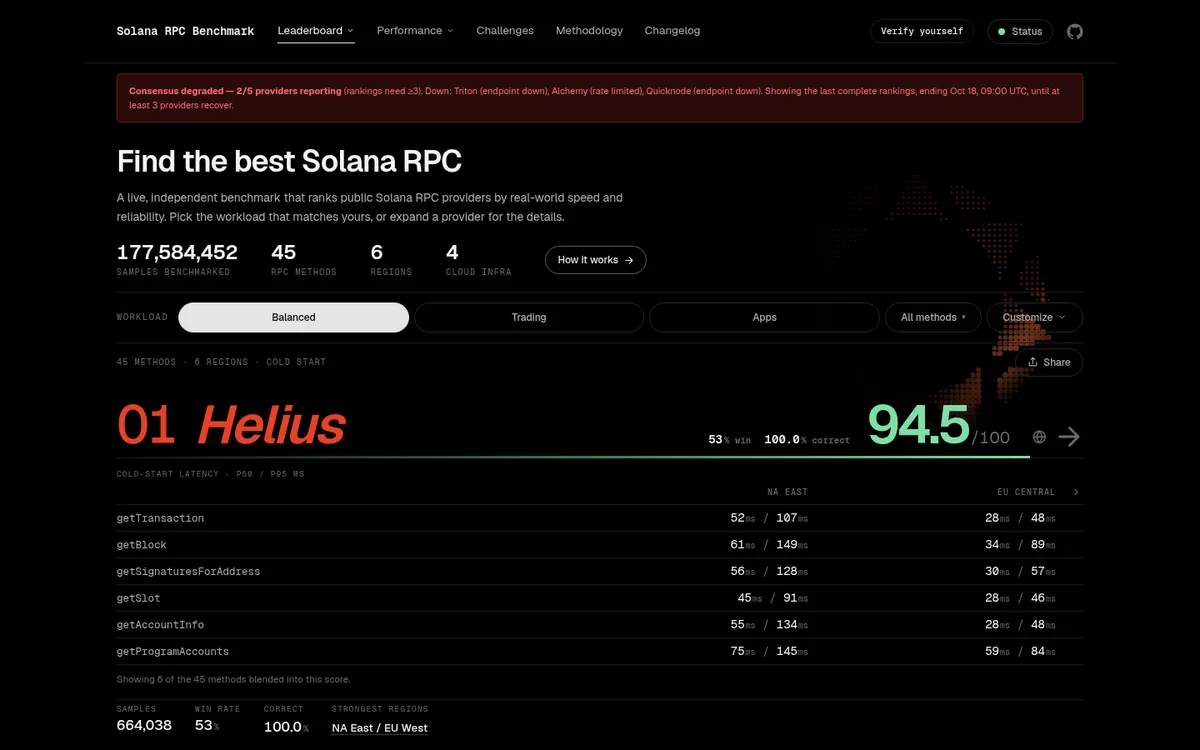
The independent OpenChainBench Solana run tracks keyed endpoints from Alchemy, Chainstack, GetBlock and QuickNode, and QuickNode leads that cohort at about 3 ms median. It does not test Helius or Triton One. QuickNode and Triton One claim 99.99% uptime, and Helius cites 99.99% from a February 2024 snapshot. None publishes a credit-backed SLA on its public pages.
Verdict: QuickNode has the best independent latency evidence. Helius leads its own benchmark, and Triton One needs your own testing.
Security, Compliance and SLAs
Procurement teams will see the widest gap here. QuickNode states SOC 1 Type 2, SOC 2 Type 2 and ISO 27001, and offers DORA reports on request. Helius states a SOC 2 Type II report with a clean opinion. Triton One publishes its security practices but no SOC 2 or ISO report.
| | | |
|---|---|---|---|
| Audits stated | SOC 2 Type II | SOC 1 Type 2, SOC 2 Type 2, ISO 27001 | Security practices page only |
| Uptime claim | 99.99% (February 2024 snapshot) | 99.99% | 99.99% |
| Support target | 24h, 12h, 8h, 4h by plan | 24h, 12h, 8h by plan | 24/7 chat with engineers |
| Dedicated option | Dedicated nodes from $2,900 | Dedicated clusters on Enterprise | Dedicated nodes from $2,900 |
Verdict: QuickNode is the safest pick for vendor reviews. Helius covers most SOC 2 requirements, and Triton One suits teams that do not need a report.
Historical Data and Dedicated Nodes
Archive depth matters for indexers and analytics. Helius bills historical calls such as getTransaction at 1 credit, and adds getTransactionsForAddress for filtered history. Triton One serves the complete ledger from genesis through Old Faithful at its standard rate. QuickNode serves archive calls at the same 30 credits.
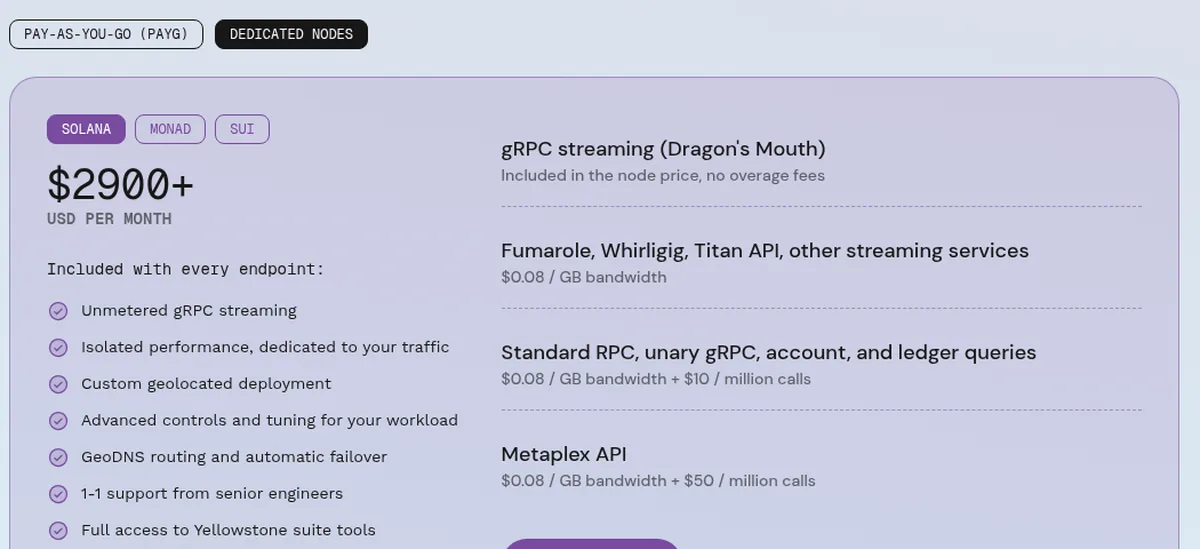
Dedicated nodes start at $2,900 a month on both Helius and Triton One, and QuickNode offers dedicated clusters on Enterprise plans. Triton One includes unmetered Dragon’s Mouth gRPC on dedicated nodes, which removes the bandwidth meter for streaming-heavy teams.
Verdict: Triton One is the strongest pick for full history and dedicated streaming. Helius matches it on dedicated node price and beats it on per-call history cost.
Helius
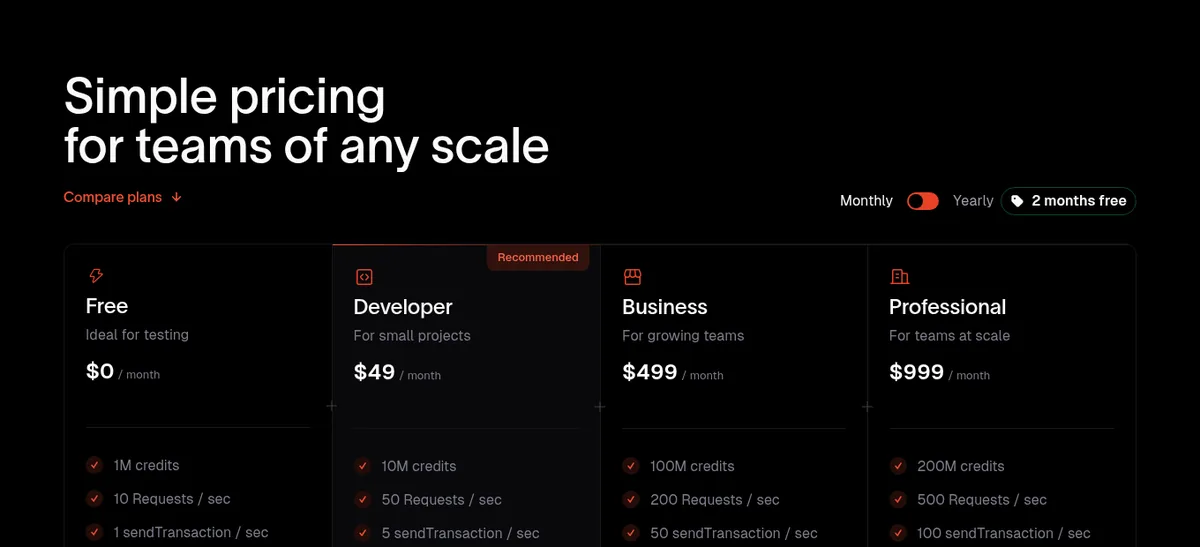
- Plans: Free (1M credits), Developer $49 (10M), Business $499 (100M), Professional $999 (200M), Enterprise custom.
- Rate limits: 10, 50, 200 and 500 rps by plan, with DAS at 2, 10, 50 and 100 rps and +100 rps for $100 a month on Professional.
- Strengths: lowest bill in four workloads, credit-free Sender, LaserStream replay, SOC 2 Type II.
- Weaknesses: 10 credits for DAS and
getProgramAccounts, a big jump from $49 to $499, Solana only.
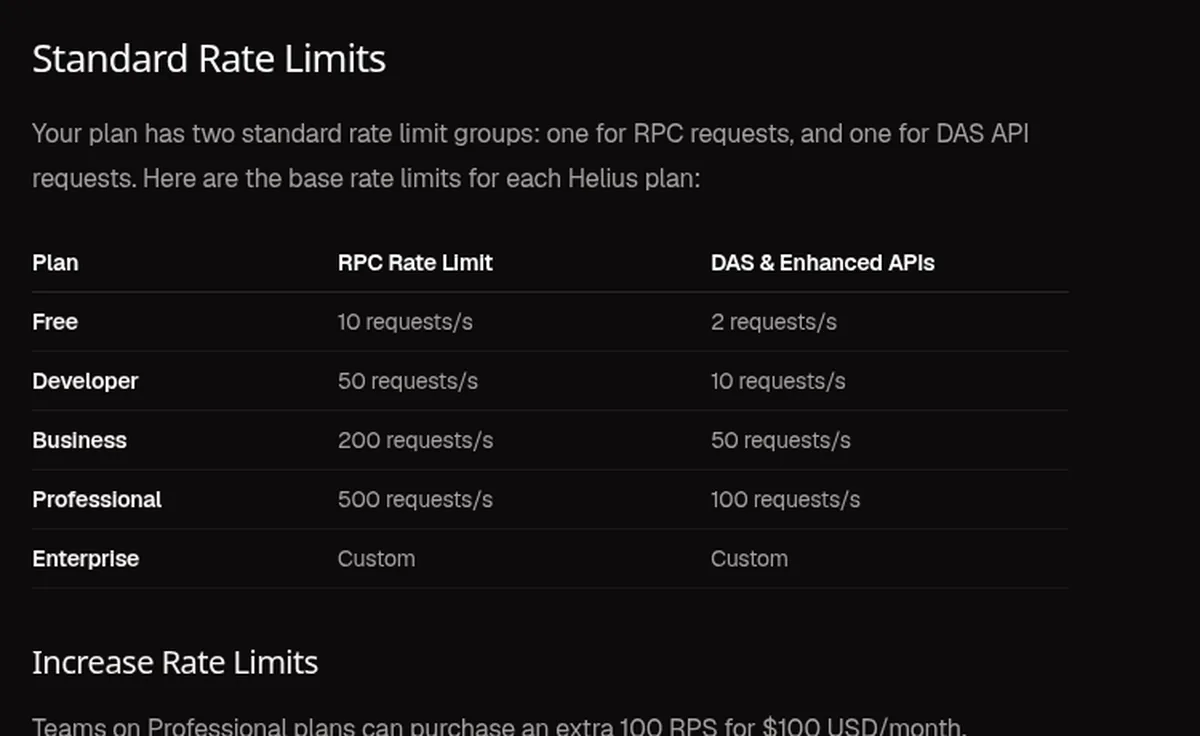
Verdict: Helius scores 8.1 and wins this comparison. Pick it for most Solana apps. See its entry in our full ranking.
QuickNode
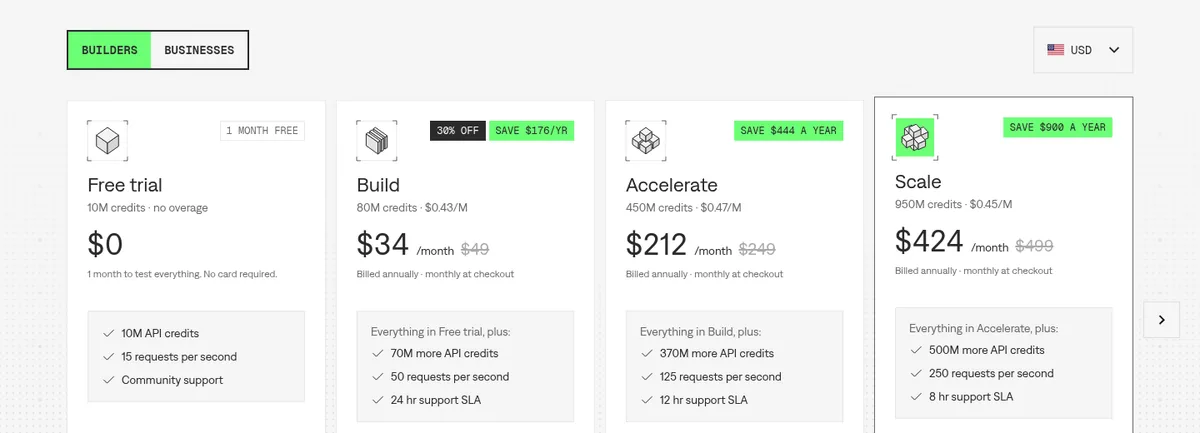
- Plans: trial (10M credits), Build $49 (80M), Accelerate $249 (450M), Scale $499 (950M), Business from $999 (2B).
- Overage: $0.62 per million credits on Build down to $0.50 on Business.
- Strengths: cheapest DAS workload, SOC 1, SOC 2 and ISO 27001, best independent latency, multi-chain.
- Weaknesses: $18.38 per million standard calls, gRPC bundled only from Scale, no permanent free tier.
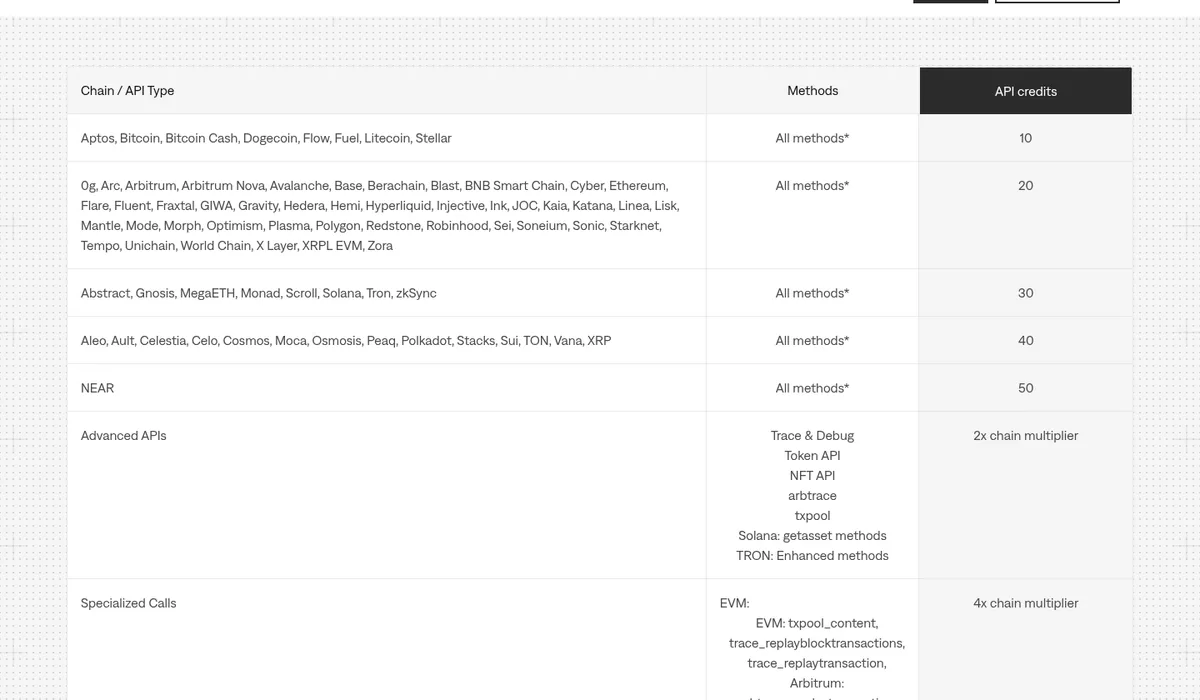
Verdict: QuickNode scores 7.6. Pick it for DAS-heavy apps, compliance reviews and teams on several chains. See its entry in our full ranking.
Triton One
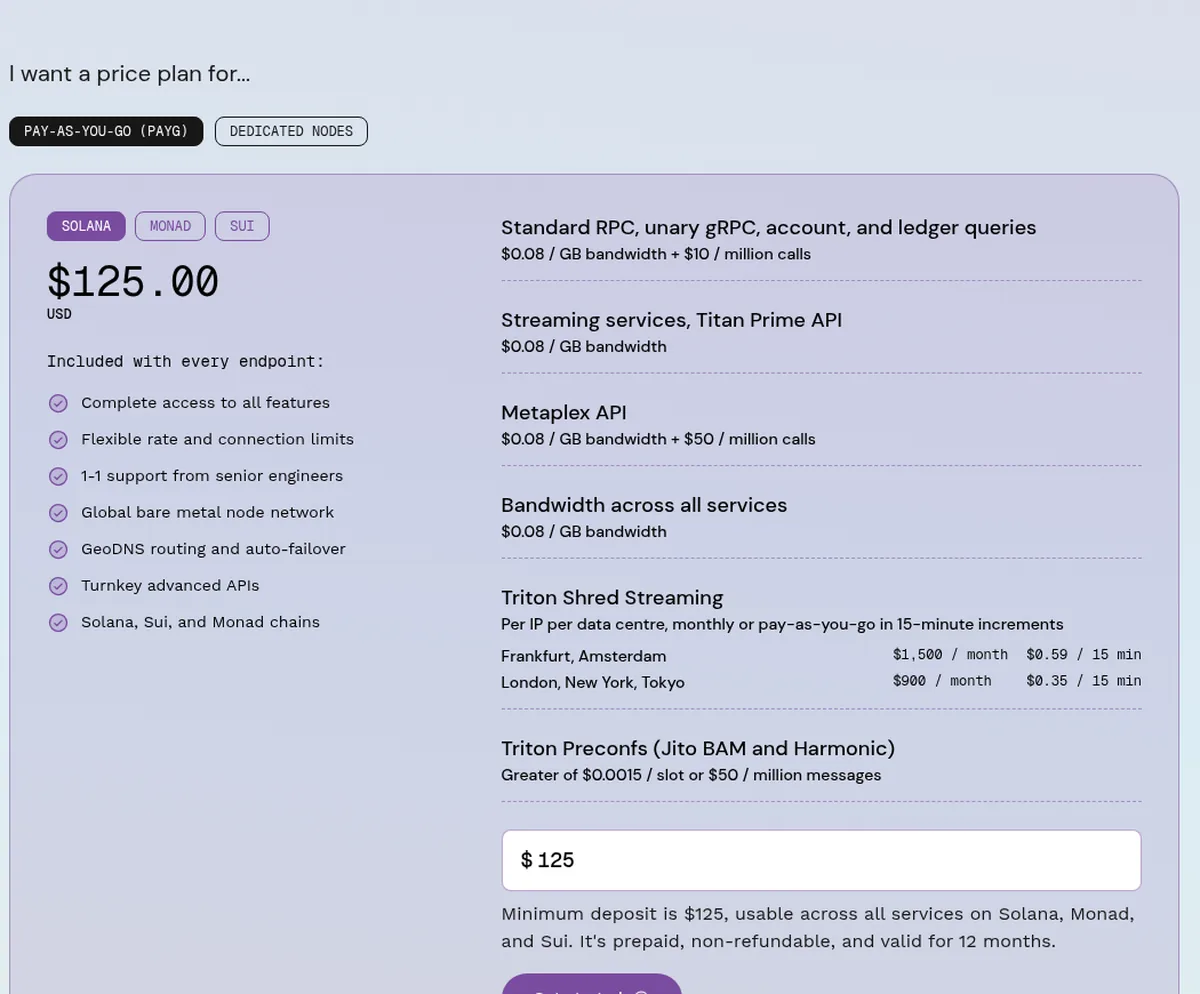
- Pricing: $125 minimum deposit, $10 per 1M calls plus $0.08 per GB, Metaplex API at $50 per 1M plus bandwidth.
- Extras: shred streaming from $900 a month, preconfirmations, dedicated nodes from $2,900 with unmetered gRPC.
- Strengths: cheapest
getProgramAccounts, full history from genesis, flexible rate limits, Yellowstone tooling. - Weaknesses: no free tier, no audit report, costly for large responses such as full blocks.
Verdict: Triton One scores 6.6. Pick it for account scans, full history and dedicated streaming. Compare it with other dedicated node options in our dedicated node providers guide.
Final Ranking
Helius takes first place on price for common workloads, Solana features and a permanent free tier. QuickNode is second on audits, latency evidence and DAS pricing, held back by its flat 30-credit meter. Triton One is third on our weights, mostly for its missing free tier and audit report, and it wins on history and scans.



Verdict: Start on Helius, keep QuickNode or Triton One as the second endpoint, and rerun the workload math each quarter.
How to Run a One-Week Bake-Off
A week of side-by-side traffic answers what a pricing page cannot. Send the same calls to all three endpoints from the region where your servers run. Log median and tail latency, error rates, slot lag and response sizes, then price that week’s mix on each meter.
for url in "$HELIUS_URL" "$QUICKNODE_URL" "$TRITON_URL"; do
  curl -s -o /dev/null -w "%{time_total} %{size_download}\n" \
    -H "Content-Type: application/json" \
    -d '{"jsonrpc":"2.0","id":1,"method":"getSlot","params":[{"commitment":"processed"}]}' \
    "$url"
done
The size_download column matters for Triton One, since bandwidth drives its bill. Use Helius Free, the QuickNode trial and the minimum Triton One deposit for the test. Read the full RPC providers hub for more comparisons.
Frequently Asked Questions
Is Helius better than QuickNode for Solana?
For most Solana teams, yes. Helius scored 8.1 to QuickNode’s 7.6 and produced the lowest bill in four of our five workloads, helped by 1-credit standard calls and credit-free Sender transactions. QuickNode is the better pick for DAS-heavy apps, SOC 1 and ISO 27001 requirements, and teams that also need EVM chains.
Is Triton One cheaper than Helius?
Only for some traffic. Triton One charges $10 per million calls plus $0.08 per GB, so small reads cost about $10 per million against $4.90 on Helius Developer. Triton One is cheaper for getProgramAccounts scans at about $17.63 per million, and far more expensive for full getBlock calls because of bandwidth.
Which Solana RPC is cheapest for NFT and DAS data?
QuickNode was cheapest in our 20M-request NFT and token model at $499 on Scale. Helius charges 10 credits per DAS call and caps DAS at 10 requests per second on Developer, which pushed the bill to $729. Triton One bills its Metaplex API at $50 per million plus bandwidth.
Which provider has the best Solana gRPC streaming?
Prices are close at about $0.08 per GB on all three. Triton One has the lowest entry point and unmetered gRPC on dedicated nodes. Helius LaserStream adds 48 hours of replay and needs Business for mainnet. QuickNode includes Solana gRPC from Scale at $499 a month and sells it as an add-on on lower plans.
Do Helius, QuickNode and Triton One have free tiers?
Helius has a permanent free tier with 1M credits and 10 requests per second. QuickNode offers a one-month trial with 10M credits and 15 requests per second. Triton One has no free tier and requires a $125 prepaid deposit that lasts 12 months and cannot be refunded.
Can I use Helius, QuickNode and Triton One together?
Yes, and production Solana teams often run two. All three expose standard Solana JSON-RPC and Yellowstone-compatible gRPC, so client code moves between them with a URL change. Put the cheapest fit for your method mix first, keep a second vendor as fallback, and recheck prices every quarter.