
Last updated: 3 November 2026 · Plans, credit costs, rate limits, chain lists and audit claims rechecked on vendor pages on 3 November 2026
QuickNode vs Infura vs Ankr comes down to how each one meters a call. QuickNode wins overall for most teams: it scores 7.7 on our RPC scorecard, has the cheapest heavy calls of the three and the widest audit list. Ankr (6.3) wins on rate limits and flat pricing, and Infura (6.1) has the cheapest light Ethereum reads if your traffic fits a daily quota.
We priced seven Ethereum methods on each meter, worked out how heavy methods shrink Infura’s real rate limit, costed WebSocket subscriptions and billed four workloads. The scores use the same weights as our ranking of the 12 best RPC node providers, and our methodology page explains how we collect prices.
TL;DR
- Scores: QuickNode 7.7, Ankr 6.3, Infura 6.1, on price 25%, reliability 20%, compliance 15%, features 15%, coverage 15% and free tier 10%.
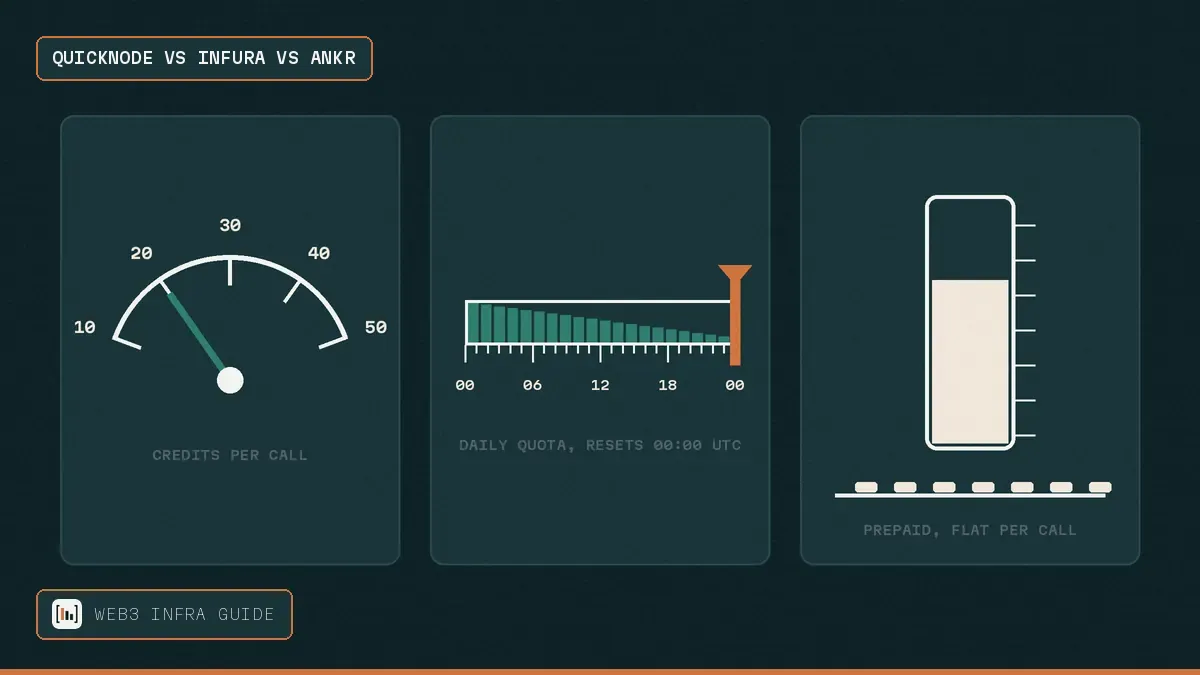
- Three different meters: QuickNode charges credits by chain (20 for every Ethereum method, 40 for trace and debug), Infura charges credits by method against a daily quota, and Ankr charges a flat $20 per million EVM calls from a prepaid balance.
- Per million Ethereum calls, Infura Developer is cheapest for
eth_callat $8.89 when you use the full quota, but charges $111.11 fordebug_traceTransaction. QuickNode Build costs $12.25 for standard calls and $24.50 for traces. Ankr costs $20 for any of them. - Infura caps credits per second, so its Developer plan allows 50
eth_callrequests a second but only 4 debug traces a second. QuickNode Build allows 50 of any call and Ankr pay as you go 1,500. - Across our four workloads QuickNode was cheapest every time: $49, $185.40, $49 and $383.40 a month. Infura cannot serve the workload with Solana, since it limits Solana to select customers.
- Paperwork: QuickNode states SOC 1 Type 2, SOC 2 Type 2 and ISO 27001, Ankr’s operator holds SOC 2 Type II, and we found no audit report on Infura’s pages.
Which One Should You Pick
Pick by the methods you call most and how spiky your traffic is. All three serve standard Ethereum JSON-RPC, so the bill and the rate limit decide it. Pull one week of request logs grouped by method before you compare prices, since the cheapest meter flips with the method. The shortcuts below cover most teams.
- Mixed traffic, audits and streaming: QuickNode, which bills every Ethereum method at the same 20 credits and adds Streams and Solana gRPC on larger plans.
- Bursty traffic or flat budgets: Ankr, with 1,500 requests per second on pay as you go and one price for every EVM method, including trace and debug.
- Read-heavy Ethereum and L2 apps with steady daily volume: Infura, whose
eth_callworks out cheapest per million if you use most of the daily quota. - Indexers and trace-heavy backends: QuickNode or Ankr. Infura’s 1,000-credit debug calls cost more than four times as much per call.
- Sui, NEAR or TRON next to EVM: QuickNode or Ankr. Infura does not list those chains.
Verdict: QuickNode for most production teams, Ankr when request bursts or method mix make a flat price simpler, Infura for EVM read traffic that stays inside a predictable daily quota.
How We Scored the Three
Each provider gets 1 to 5 on six weighted criteria, and the weighted sum is doubled to give a score out of 10. These are the same criterion scores the three providers hold in our 12-provider RPC ranking, so the numbers match across our site. Every input below links to a vendor page we checked on 3 November 2026.
| Provider | Price (25%) | Reliability (20%) | Compliance (15%) | Features (15%) | Coverage (15%) | Free tier (10%) | Score |
|---|---|---|---|---|---|---|---|
 | 3 | 4 | 5 | 5 | 4 | 2 | 7.7 |
 | 2 | 3 | 4 | 3 | 4 | 4 | 6.3 |
 | 4 | 3 | 1 | 3 | 3 | 4 | 6.1 |
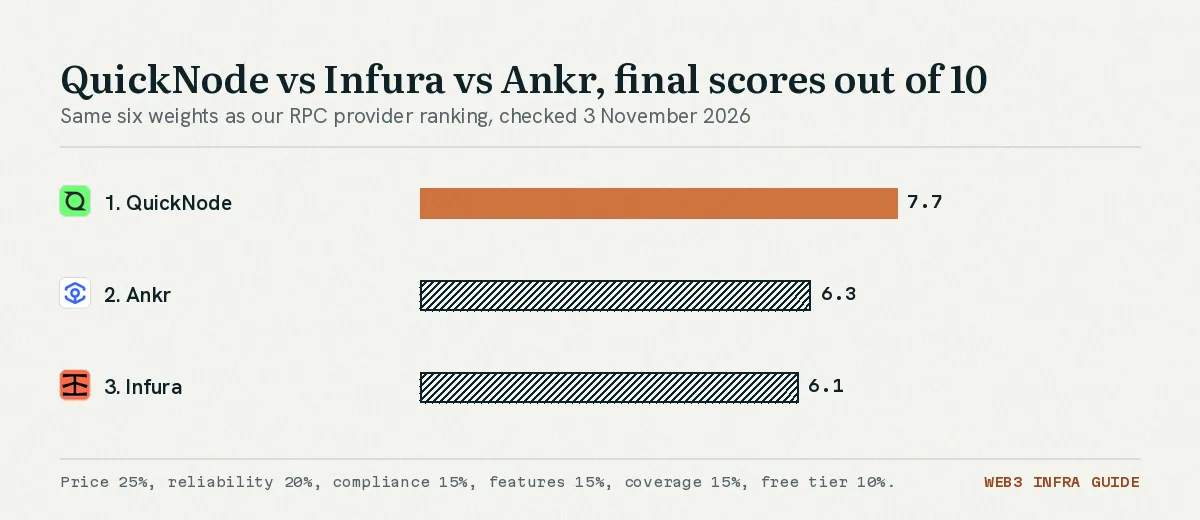
QuickNode leads on compliance and features. Infura has the best price score of the three for light reads and a usable free tier, but loses on compliance because we found no audit report. Ankr sits in the middle, with a strong free tier and wide chain list but the highest standard per-call rate.
QuickNode
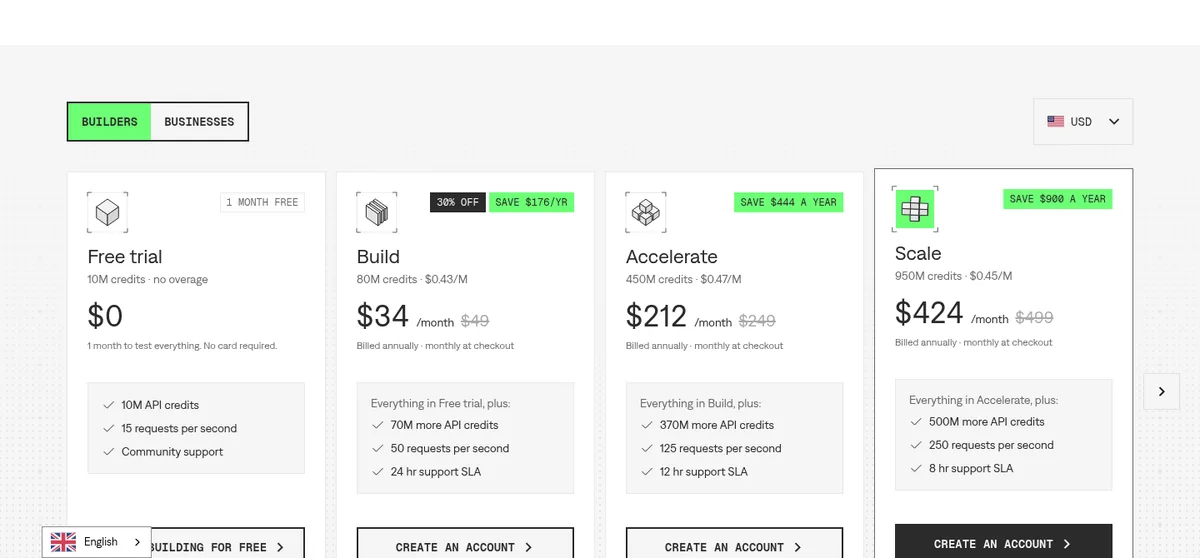
- Plans: Free trial (10M credits for one month, 15 rps), Build $49 (80M credits, 50 rps), Accelerate $249 (450M, 125 rps), Scale $499 (950M, 250 rps), Business from $999 (2B, 500 rps). Annual billing cuts these to $34, $212, $424 and $849.
- Overage: $0.62 per 1M credits on Build, then $0.56, $0.53 and $0.50 on larger plans, billed immediately once it passes $200.
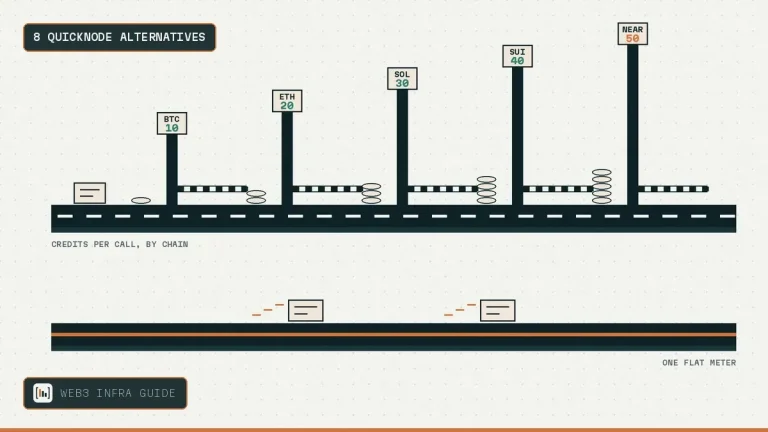
- Meter: 20 credits for all Ethereum methods, 40 for trace and debug, 80 for
txpool_content, and chain tiers from 10 (Bitcoin, Stellar) to 50 (NEAR), per its API credit table. - Support: 24-hour response target on Build, 12 hours on Accelerate and 8 hours on Scale.
- Coverage: its chains page lists 76 chains and 132 networks.
Verdict: QuickNode scores 7.7. It is the strongest all-round pick of the three, held back by a 50 requests per second cap on its $49 plan and a one-month free trial.
Infura
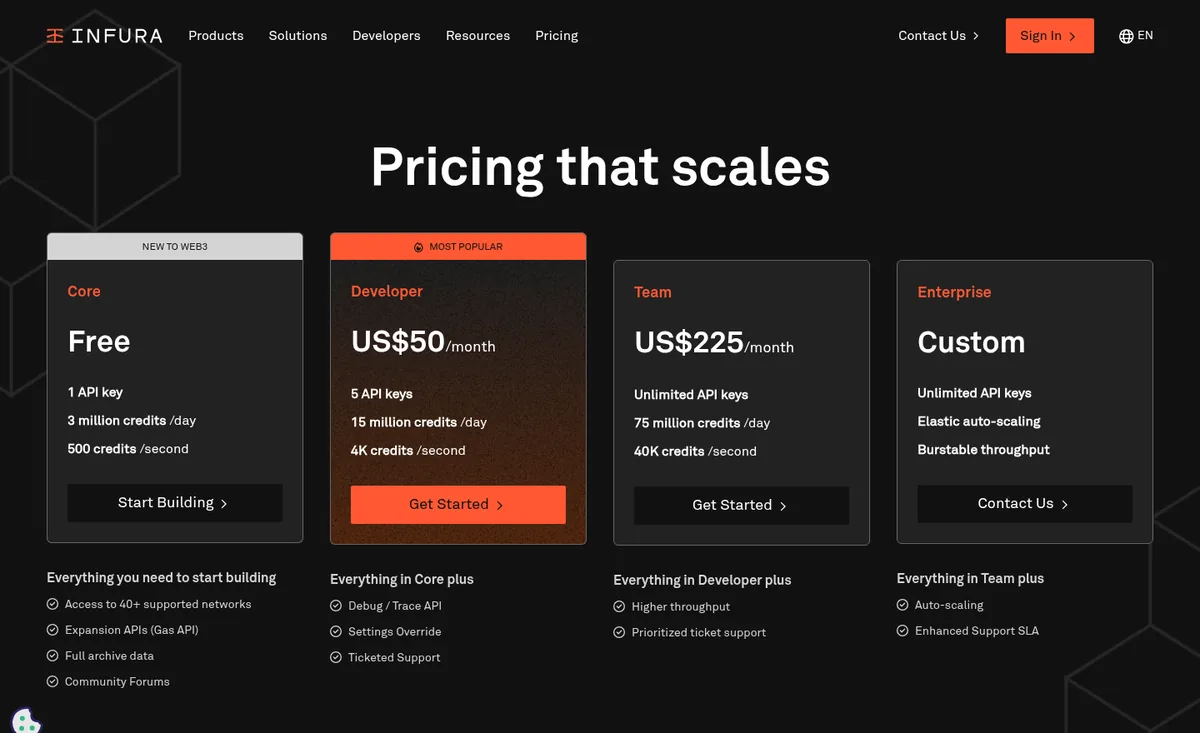
- Plans: Core free (3M credits a day, 500 credits per second, 1 API key), Developer $50 (15M a day, 4,000 credits per second, 5 keys), Team $225 (75M a day, 40,000 credits per second, unlimited keys), Enterprise custom. An add-on sells 55M more credits for $200 a month.
- Meter: 80 credits for
eth_call, balances, receipts and sends, 255 foreth_getLogs, 300 foreth_estimateGasandtrace_transaction, and 1,000 fordebug_traceTransactionandeth_getBlockReceipts. - Error billing: 429 and 402 responses cost nothing, other 4xx errors cost 5 credits and 5xx errors are free. Archive calls cost the same as recent ones today, which its docs say might change.
- Coverage: its endpoints page lists 27 networks, mostly EVM, plus Bitcoin, Starknet, Stellar and Solana for select customers.
- Failover: failover protection covers Arbitrum, Avalanche, Optimism and Polygon on Growth or custom plans.
Verdict: Infura scores 6.1. It suits EVM-only teams with steady read traffic, and it gets expensive fast for logs, gas estimates and traces.
Ankr
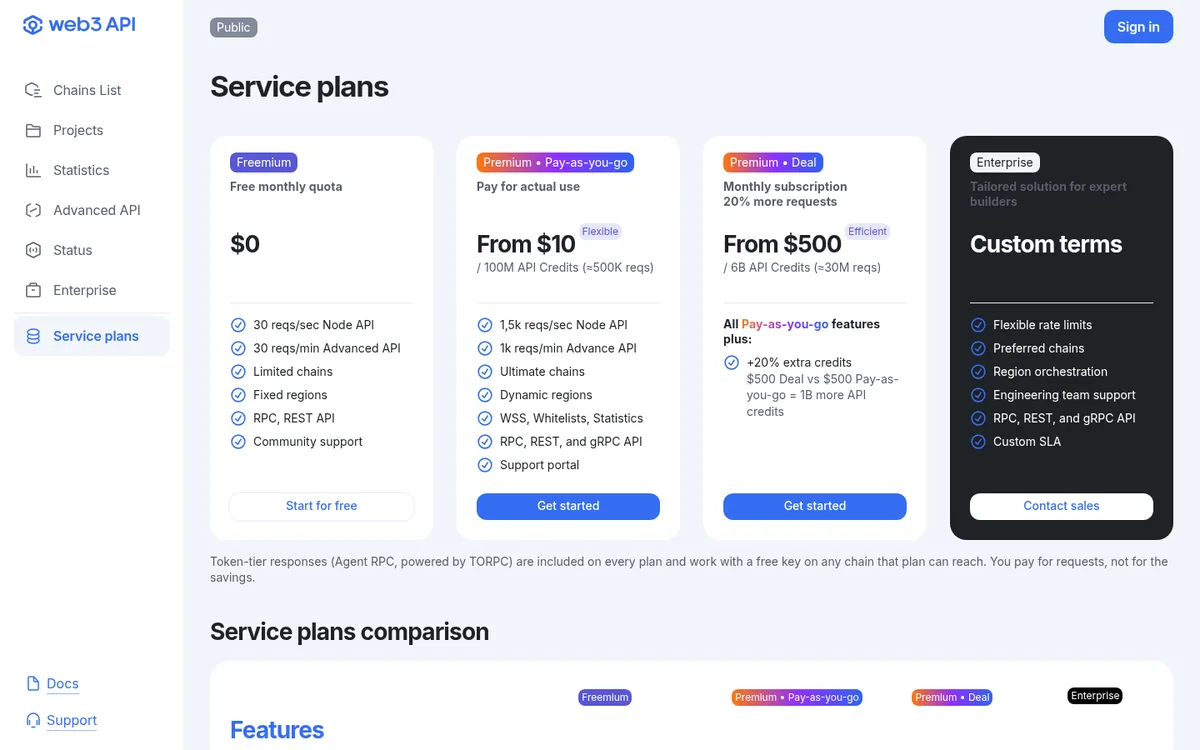
- Plans: Freemium (200M credits a month, 30 rps, HTTPS only, no trace or debug), Pay as you go from $10 per 100M credits, Deal from $500 for 6B credits plus 20% extra, Enterprise custom.
- Meter: $0.10 per 1M credits. An EVM request costs 200 credits ($20 per million), Solana 500 ($50 per million) and other non-EVM chains 200. Paid plans add WebSockets, gRPC and IP, domain and contract whitelists.
- Limits: block range of 3,000 on Freemium and 10,000 on paid plans, and batches of 100 and 1,000 calls.
- SLA: 99.9% uptime with a 10% service credit on Enterprise, per its SLA page. Pay as you go has no SLA.
- Coverage: 75+ chains on paid plans, including Solana, Sui, NEAR, TRON and Stellar, per its chains list.
Verdict: Ankr scores 6.3. Pick it for high request ceilings, flat trace pricing and prepaid billing. Standard calls cost more than on the other two.
Plans and Pricing Side by Side
The three use different billing units, so a credit on one vendor tells you nothing about a credit on another. Infura is the only one of the three with a daily quota, and the only one whose free plan renews every day. The table lines up each entry point. Our free RPC providers guide ranks seven free plans beyond this three-way set.
| QuickNode | Infura | Ankr | |
|---|---|---|---|
| Billing unit | API credits, set by chain | Credits, set by method | API credits, set by chain family |
| Free plan | 10M credits, one month, 15 rps | 3M credits a day, 500 credits per second | 200M credits a month, 30 rps |
| Entry paid plan | Build $49, 80M credits a month | Developer $50, 15M credits a day | Pay as you go from $10 per 100M credits |
| Rate limit on entry plan | 50 requests per second | 4,000 credits per second | 1,500 requests per second |
| Next step | Accelerate $249, 125 rps | Team $225, 40,000 credits per second | Deal from $500, 6B credits plus 20% |
| At the limit | Overage $0.62 per 1M credits | Requests fail until 00:00 UTC | Top up the balance |
| Trace and debug | 2x chain credits | 300 to 1,000 credits | Same 200 credits, paid plans |
Verdict: QuickNode and Infura cost about the same to start, at $49 and $50. Ankr is the only one with no monthly fee, which suits low or uneven volume.
What One Million Calls Cost by Method
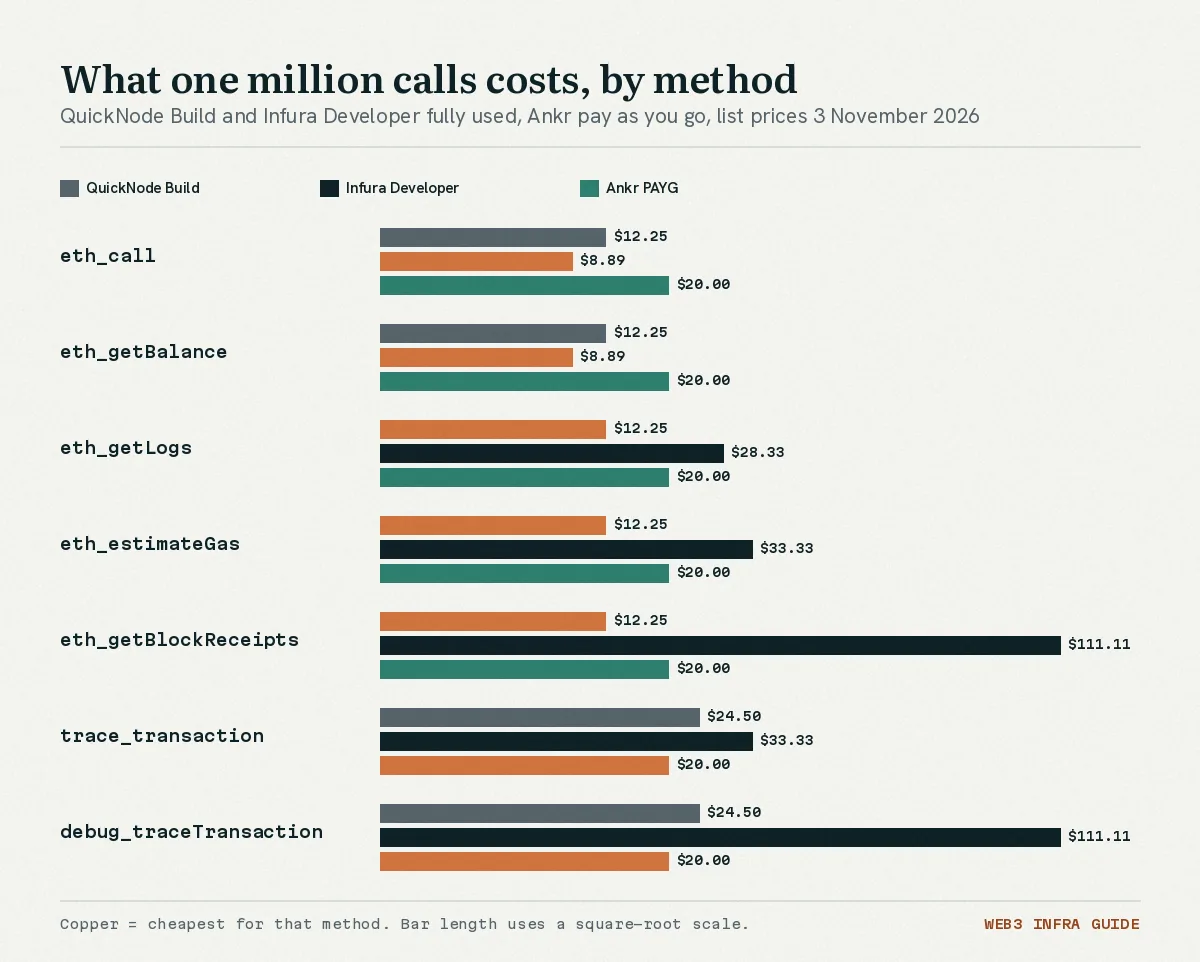
We converted each meter into dollars per million calls for seven Ethereum methods. QuickNode uses Build at $49 for 80M credits, Infura uses Developer at $50 with the full 15M daily quota used for 30 days, and Ankr uses pay as you go. Infura is cheapest for eth_call and balance reads, and the most expensive of the three for every other method we priced.
| Method | QuickNode credits | QuickNode Build, per 1M | Infura credits | Infura Developer, per 1M | Ankr, per 1M |
|---|---|---|---|---|---|
eth_call | 20 | $12.25 | 80 | $8.89 | $20.00 |
eth_getBalance | 20 | $12.25 | 80 | $8.89 | $20.00 |
eth_getLogs | 20 | $12.25 | 255 | $28.33 | $20.00 |
eth_estimateGas | 20 | $12.25 | 300 | $33.33 | $20.00 |
eth_getBlockReceipts | 20 | $12.25 | 1,000 | $111.11 | $20.00 |
trace_transaction | 40 | $24.50 | 300 | $33.33 | $20.00 |
debug_traceTransaction | 40 | $24.50 | 1,000 | $111.11 | $20.00 |
Infura’s rate looks lowest only when you use all 450M credits a month. A team that uses half its daily quota pays twice the per-call rate shown. QuickNode overage at $0.62 per 1M credits keeps its marginal price close to the table, and Ankr’s price never changes with volume below the Deal tier.
Verdict: Light Ethereum reads favor Infura. Logs, gas estimates, block receipts and traces favor QuickNode, and Ankr is the flat middle ground.
Rate Limits Shrink on Heavy Methods
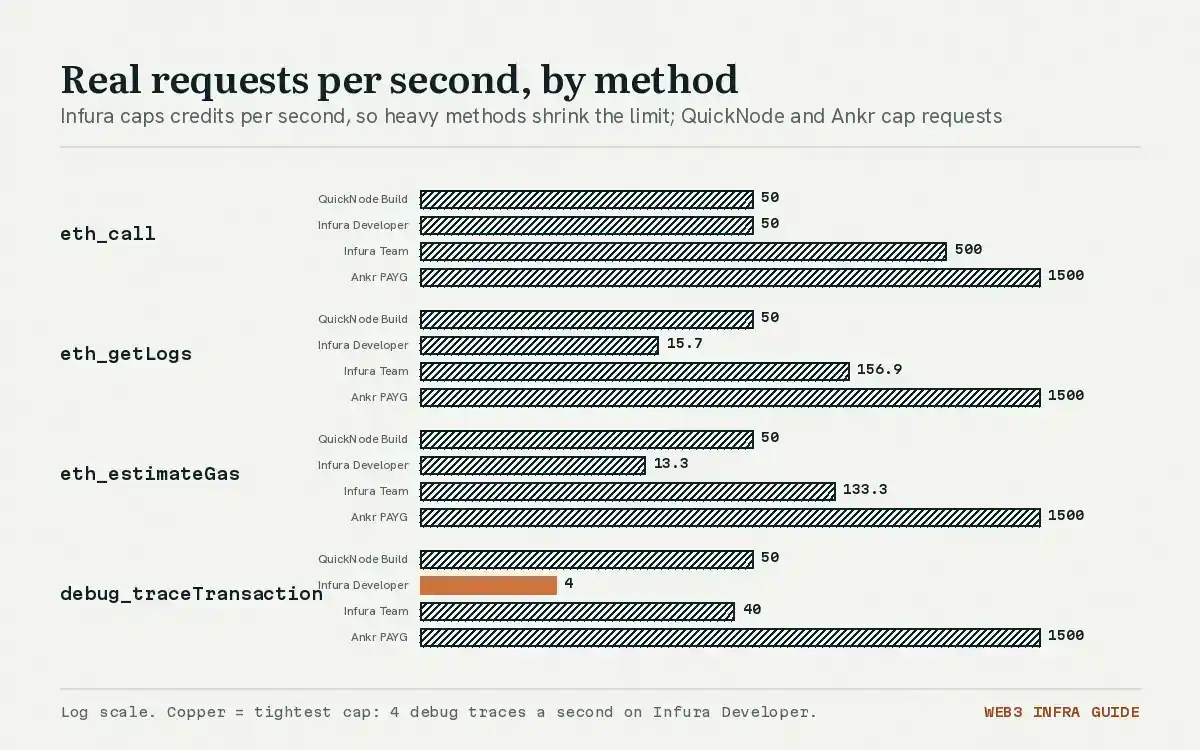
QuickNode and Ankr cap requests per second, but Infura caps credits per second. A heavy method uses up the cap faster, so the real request ceiling depends on what you call. Infura Developer allows 4 debug_traceTransaction calls a second, against 50 on QuickNode Build and 1,500 on Ankr.
| Method | Infura Developer, calls per second | Infura Developer, calls per day | Infura Team, calls per second |
|---|---|---|---|
eth_call | 50 | 187,500 | 500 |
eth_getLogs | 15.7 | 58,823 | 156.9 |
eth_estimateGas | 13.3 | 50,000 | 133.3 |
debug_traceTransaction | 4 | 15,000 | 40 |
The daily quota is a second ceiling. A Developer key can make 187,500 eth_call requests a day, or 15,000 debug traces, before it stops working until 00:00 UTC. A traffic spike on launch day can use up a whole day of quota by mid-afternoon.
Verdict: Apps with spiky or trace-heavy traffic should not run on Infura Developer alone. Ankr has the most headroom, and QuickNode’s caps are simple to plan for.
WebSocket Subscriptions and the Daily Quota
Subscriptions bill per event on Infura and Ankr, so chain speed changes the cost. Ethereum produces a block every 12 seconds, about 7,200 a day, per ethereum.org, and Base every 2 seconds, about 43,200 a day, per its docs. One newHeads subscription on Base uses 14.4% of an Infura Developer daily quota before your app makes a single call.
| Subscription, one per day | Ethereum | Base |
|---|---|---|
Infura newHeads, 50 credits per block | 360,000 credits (2.4% of Developer quota) | 2,160,000 credits (14.4%) |
Infura logs, 300 credits per block with matching events | 2,160,000 credits (14.4%) | 12,960,000 credits (86.4%) |
Ankr newHeads, 100 credits per notification, 30 days | $2.16 a month | $12.96 a month |
QuickNode eth_subscribe | 20 credits per call | 20 credits per call |
A log subscription that matches events in most Base blocks can use 86.4% of a Developer quota on its own. Infura also closes WebSocket connections when the daily quota runs out, so a busy subscription can cut off your HTTP traffic too.
Verdict: For real-time apps on fast L2s, budget subscriptions first on Infura. Ankr’s per-event cost is small, and QuickNode Streams is the alternative for heavy event feeds.
Chain Coverage and Price by Chain
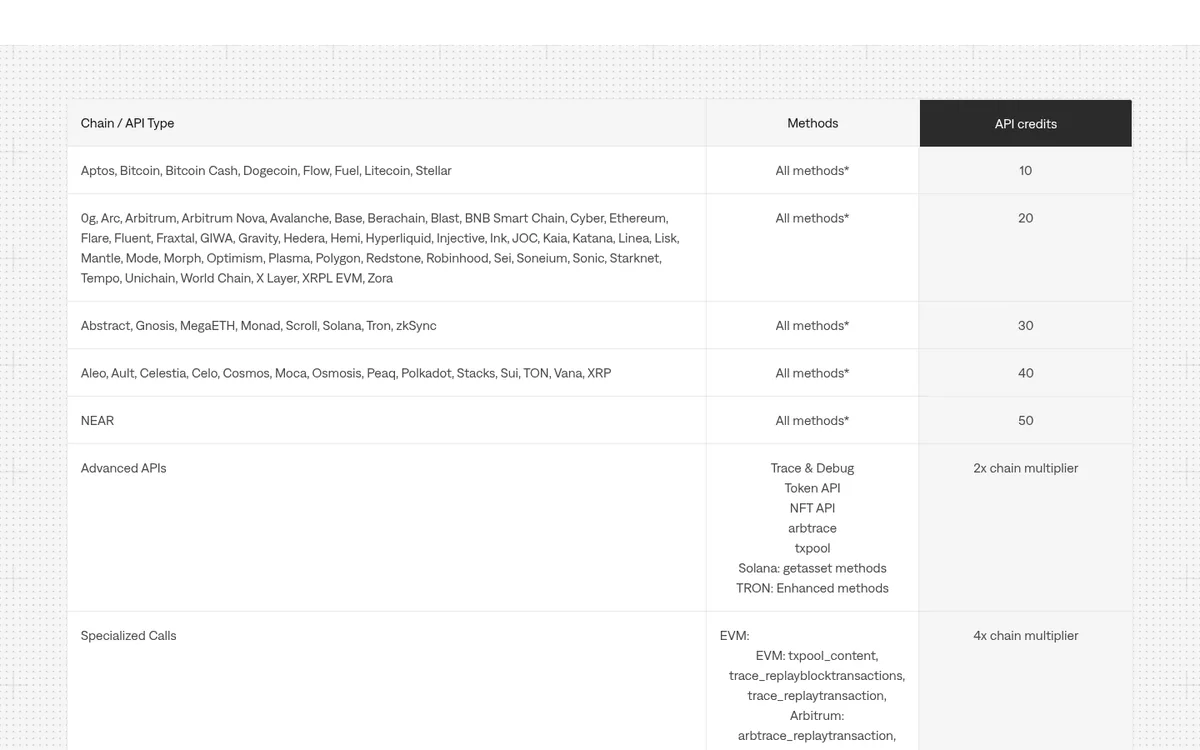
Chain choice moves the price on QuickNode, which bills chains in five credit tiers. Infura stays on EVM chains plus a few others, and Ankr charges one EVM rate and one Solana rate. Infura does not list TRON, Sui or NEAR, so a team adding any of them needs a second provider.
| Chain | QuickNode credits, Build per 1M | Infura eth_call class, Developer per 1M | Ankr per 1M |
|---|---|---|---|
| Ethereum | 20 credits, $12.25 | 80 credits, $8.89 | $20.00 |
| Base | 20 credits, $12.25 | 80 credits, $8.89 | $20.00 |
| Arbitrum | 20 credits, $12.25 | 80 credits, $8.89 | $20.00 |
| Polygon | 20 credits, $12.25 | 80 credits, $8.89 | $20.00 |
| BNB Smart Chain | 20 credits, $12.25 | 80 credits, $8.89 | $20.00 |
| Linea | 20 credits, $12.25 | 80 credits, $8.89 | $20.00 |
| Scroll | 30 credits, $18.38 | 80 credits, $8.89 | $20.00 |
| zkSync Era | 30 credits, $18.38 | 80 credits, $8.89 | $20.00 |
| Monad | 30 credits, $18.38 | 80 credits, $8.89 | $20.00 |
| Solana | 30 credits, $18.38 | Select customers only | $50.00 |
| Bitcoin | 10 credits, $6.12 | 80 credits, $8.89 | $20.00 |
| Stellar | 10 credits, $6.12 | 160 credits, $17.78 | $20.00 |
| TRON | 30 credits, $18.38 | Not offered | $20.00 |
| Sui | 40 credits, $24.50 | Not offered | $20.00 |
| NEAR | 50 credits, $30.63 | Not offered | $20.00 |
QuickNode is cheapest on Bitcoin and Stellar at 10 credits, while Ankr is cheapest on Sui and NEAR, where QuickNode charges 40 and 50 credits. On Solana, QuickNode costs $18.38 per million against $50 on Ankr.
Verdict: EVM-only teams can use any of the three. Teams with non-EVM chains on the roadmap should pick QuickNode or Ankr.
Four Workload Bills
We built four traffic patterns, converted each into every vendor’s unit and picked the cheapest public plan that covers the volume and a peak of three times the average rate. QuickNode had the lowest bill in all four workloads, and Infura could not serve the one with Solana traffic. The model uses list prices only.
| Workload | QuickNode | Infura | Ankr |
|---|---|---|---|
| Ethereum wallet backend, 4M requests | $49 (Build) | $50 (Developer, busy days over quota) | $80 (Pay as you go) |
| EVM L2 app (Ethereum, Base, Arbitrum), 15M requests | $185.40 (Build) | $225 (Team, busy days over quota) | $300 (Pay as you go) |
| Trace-heavy indexer (Ethereum), 3M requests | $49 (Build) | $225 (Team) | $60 (Pay as you go) |
| Multi-chain dApp (4 EVM chains + Solana), 30M requests | $383.40 (Accelerate) | No public Solana access | $625 (Deal ($500)) |
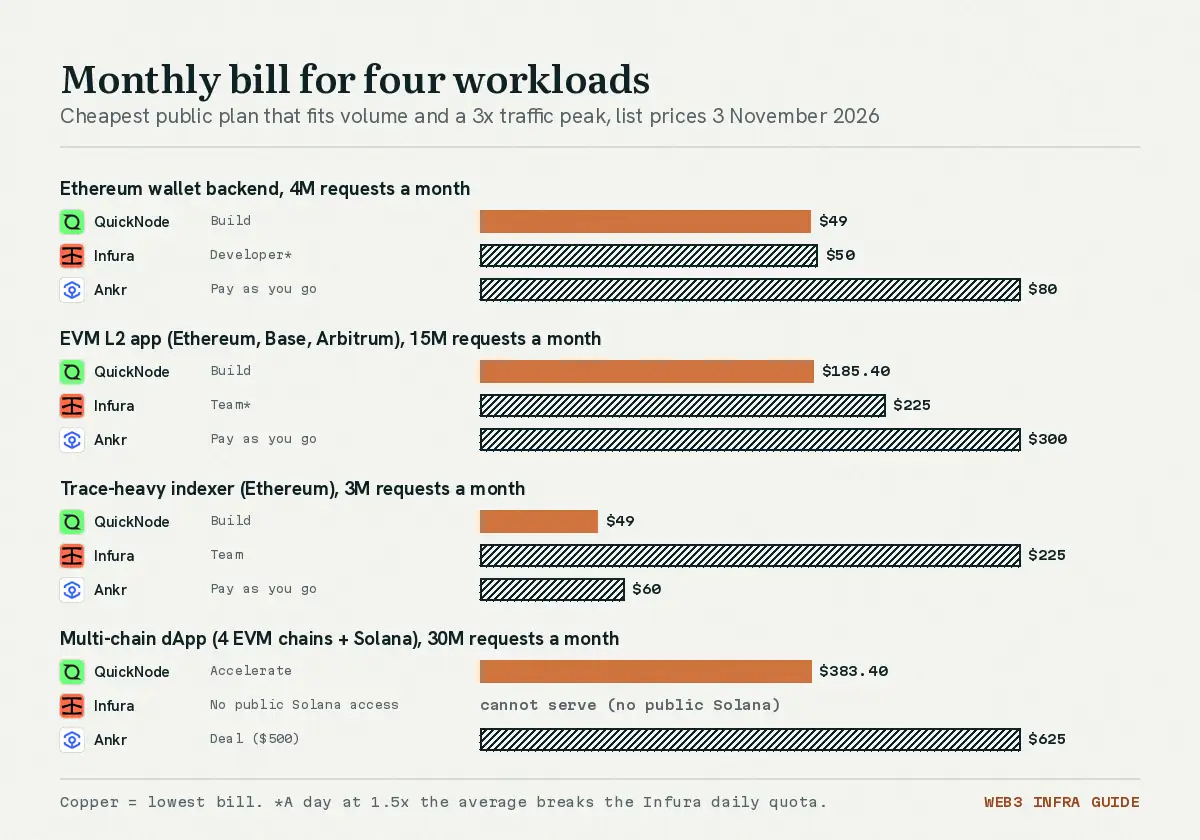
- Ethereum wallet backend, 4M requests: a dApp mix of 40%
eth_call, 15% balances, 15% block numbers, 10% receipts, 10% logs, 5% sends and 5% gas estimates. - EVM L2 app, 15M requests: the same mix across Ethereum, Base and Arbitrum.
- Trace-heavy indexer, 3M requests: 40%
eth_getLogs, 30%eth_getBlockByNumberand 30%debug_traceTransactionon Ethereum. - Multi-chain dApp, 30M requests: the dApp mix on four EVM chains, with 30% of traffic on Solana.
The wallet backend needs 80M QuickNode credits, exactly the Build allowance. On Infura it averages 14.47M credits a day against a 15M quota, so a busy day breaks it. The indexer shows the method effect most clearly: 78M credits on QuickNode, 600M on Ankr for $60, and an average of 42.6M Infura credits a day, which needs the $225 Team plan. Ankr’s $625 for the multi-chain dApp assumes the $500 Deal with extra usage at the same discounted rate.
Verdict: QuickNode is the cheapest of the three for every pattern we tested. Ankr is close for trace-heavy work, and Infura is close only for light EVM reads.
Security, SLAs and Support
Procurement teams usually ask for an audit report and an uptime commitment before signing. The three differ sharply here. QuickNode lists SOC 1 Type 2, SOC 2 Type 2 and ISO 27001 on its security page, the longest audit list of the three. The table shows what each vendor states publicly.
| QuickNode | Infura | Ankr | |
|---|---|---|---|
| Audits | SOC 1 Type 2, SOC 2 Type 2, ISO 27001 | None found on its public pages | SOC 2 Type II via operator Asphere, ISO 27001 in progress |
| Uptime | 99.99% uptime target on its security page | Enhanced Support SLA on Enterprise | 99.9% SLA with 10% service credit on Enterprise |
| Support target | 24 h Build, 12 h Accelerate, 8 h Scale | Ticket support from Developer | Support portal on paid plans |
Verdict: Teams that need audit reports for vendor reviews should start with QuickNode, then Ankr. Infura needs an Enterprise conversation for formal terms.
How to Run a Fair Test
A short side-by-side test beats any pricing page. Point a share of reads at each provider for a week, log latency, errors and block height, then price that week’s method mix on each meter. Our RPC provider pricing guide explains each billing unit in more depth.
for url in "$QUICKNODE_URL" "$INFURA_URL" "$ANKR_URL"; do
  curl -s -o /dev/null -w "%{http_code} %{time_total}\n" \
    -H "Content-Type: application/json" \
    -d '{"jsonrpc":"2.0","id":1,"method":"eth_blockNumber","params":[]}' \
    "$url"
done
Run the same loop with eth_getLogs over a 2,000-block range and with a trace call, since those are where the meters split. If you are leaving Infura, our Infura alternatives guide covers more options, and our Ethereum RPC provider ranking covers the wider field.
Final Verdict
QuickNode is the best of the three for most teams in 2026, with the lowest bill in all four of our workloads and the strongest audit list. Ankr is the pick for bursts and flat budgets, and Infura for light, steady EVM reads. For other head-to-heads, see our QuickNode vs Alchemy vs Chainstack comparison.


Verdict: Default to QuickNode, keep Ankr as the burst and fallback endpoint, and use Infura only where its daily quota fits. Browse the RPC providers hub for more comparisons. For a wider set of priced options, see our QuickNode alternatives guide. For lower-cost meters, see our GetBlock vs dRPC vs Tatum comparison.
Frequently Asked Questions
Is QuickNode better than Infura?
For most teams, yes. QuickNode scores 7.7 against Infura’s 6.1 on our weights, bills every Ethereum method at 20 credits and lists SOC 1, SOC 2 and ISO 27001 audits. Infura is cheaper only for light reads like eth_call when you use most of its daily quota, and it does not list TRON, Sui or NEAR.
Is Ankr cheaper than QuickNode?
Usually not for standard calls. Ankr charges $20 per million EVM requests, against $12.25 on a fully used QuickNode Build plan. Ankr is cheaper on Sui, NEAR and traces, at $20 against $24.50 for a trace, and has no monthly fee, so very small or uneven workloads can cost less on Ankr.
What happens when you hit the Infura daily limit?
Requests fail until the quota resets at 00:00 UTC, and Infura closes WebSocket connections at the same point. Its credit docs say 429 and 402 responses are not charged. Teams can buy an add-on of 55M extra credits for $200 a month or move up from Developer to the $225 Team plan.
Which has the highest rate limit?
Ankr pay as you go allows 1,500 requests per second per endpoint, or 4,000 on Solana. QuickNode Build allows 50 and Scale 250. Infura caps credits per second, so Developer allows 50 eth_call requests a second but only 4 debug_traceTransaction calls, because a debug trace costs 1,000 credits.
Do QuickNode, Infura and Ankr support Solana?
QuickNode supports Solana at 30 credits a call, about $18.38 per million on Build, and adds Yellowstone gRPC streams on Scale and Business. Ankr supports Solana at 500 credits, or $50 per million. Infura lists Solana access for select customers only, so most teams cannot use it there.
Which is best for archive and trace data?
QuickNode is the cheapest of the three for most trace-heavy work, at 40 credits per trace or debug call. Ankr includes archive data on every tier and charges the same 200 credits for traces on paid plans. Infura charges 300 credits for trace_transaction and 1,000 for debug_traceTransaction, about $111 per million.