
Last updated: 4 November 2026 · Free plan allowances, rate limits, unit costs and feature gates rechecked on each vendor’s pricing page and docs on 4 November 2026
The best free RPC provider in 2026 for most testing and small dApps is dRPC: its free plan gives about 10.5 million standard EVM calls every 30 days at 100 requests per second, with no card. Alchemy is the pick when you need archive data and WebSockets for free, Chainstack when you want a private endpoint with 3M requests, and Helius for Solana.
We checked seven free RPC providers with permanent free plans on 4 November 2026, turned each allowance into real calls for three workload mixes, and tested the limits that break a free plan before the quota does, such as log block ranges and per-second caps. The ranking uses a free-plan rubric explained below, and our methodology page covers how we collect prices.
TL;DR
- Ranking: dRPC 8.2, Alchemy 7.6, Chainstack 7.6, Ankr 7.0, Infura 6.0, Helius 5.8 (Solana only) and GetBlock 5.6, on allowance, rate limit, features, chains and upgrade path.
- For a typical dApp frontend mix, the free plans buy about 10,500,000 calls a month on dRPC, 3,000,000 on Chainstack, 1,158,301 on Alchemy, 1,000,000 on Ankr, 829,493 on Infura and 75,000 on GetBlock.
- Alchemy Free limits
eth_getLogsto a 10-block range on Ethereum and most chains, so scanning one day of Ethereum takes 720 calls. Chainstack Developer allows 100 blocks and Ankr Freemium 3,000. - dRPC Free runs on public nodes only, with no archive, no debug or trace and no WebSockets, a 2-second timeout and batches of 3. Alchemy and Infura include archive data free.
- Infura and GetBlock reset daily, at 3M credits and 50,000 compute units, so a busy afternoon can stop your app until the next reset.
- QuickNode is not on the list: its free option is a one-month trial with 10M credits, not a permanent plan.
Which Free RPC Provider Should You Pick
Pick by the one limit your project will hit first. For most hobby and test projects that is volume, for indexers it is the log block range, and for real-time apps it is WebSocket access. Before you pick, count how many eth_getLogs calls your app makes, since that one method splits these free plans more than any other. The shortcuts below cover most cases.
- Most calls for free: dRPC, with a 210M compute unit pool that covers about 10.5M standard EVM calls every 30 days.
- Archive data, WebSockets and webhooks: Alchemy, whose free plan includes full archive, all mainnets and testnets and 5 webhooks.
- A private endpoint with predictable limits: Chainstack, with 3M requests a month at 25 requests per second and WebSockets.
- Event scanning on a free plan: Ankr Freemium, which allows a 3,000-block range on
eth_getLogs. - Solana: Helius, with 1M credits a month at 1 credit per standard call and webhooks included.
- MEV-protected sends on a small budget: GetBlock, which lists MEV protection on its free plan.
Verdict: Start on dRPC for volume, add Alchemy as the archive and WebSocket endpoint, and move to a paid plan once either one throttles you.
How We Ranked the Free Plans
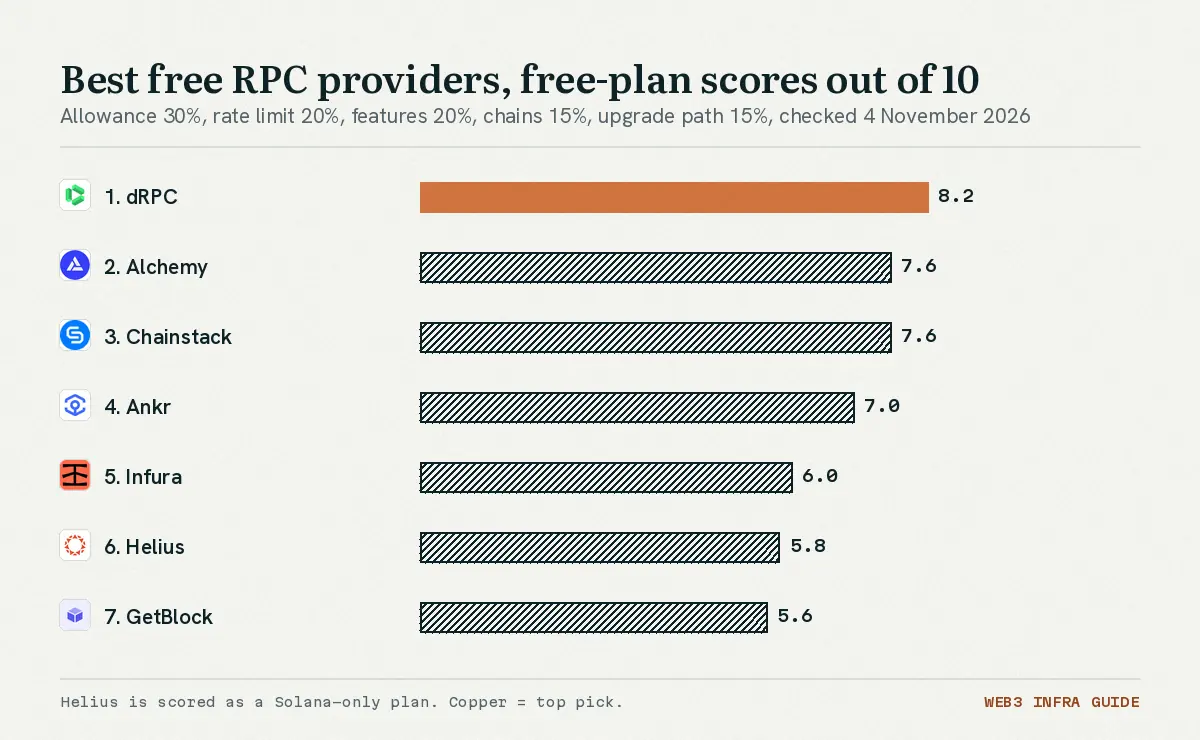
Our main RPC provider ranking weighs price and compliance for production buyers. This list only judges the free plans, so it uses a separate rubric. Each plan gets 1 to 5 on five criteria, and the weighted sum is doubled to give a score out of 10. All inputs come from vendor pages we checked on 4 November 2026.
| Provider | Allowance (30%) | Rate limit (20%) | Features (20%) | Chains and testnets (15%) | Upgrade path (15%) | Score |
|---|---|---|---|---|---|---|
 | 5 | 5 | 2 | 4 | 4 | 8.2 |
 | 3 | 3 | 4 | 5 | 5 | 7.6 |
 | 4 | 4 | 3 | 4 | 4 | 7.6 |
 | 3 | 4 | 3 | 4 | 4 | 7.0 |
 | 3 | 2 | 4 | 3 | 3 | 6.0 |
 | 2 | 3 | 4 | 2 | 4 | 5.8 |
 | 1 | 4 | 4 | 3 | 3 | 5.6 |
Allowance uses the dApp frontend mix described below. Features covers archive data, WebSockets, trace and debug access and log range limits. Upgrade path rewards a cheap first paid step, such as pay as you go billing, over a jump to a fixed monthly plan.
1. dRPC
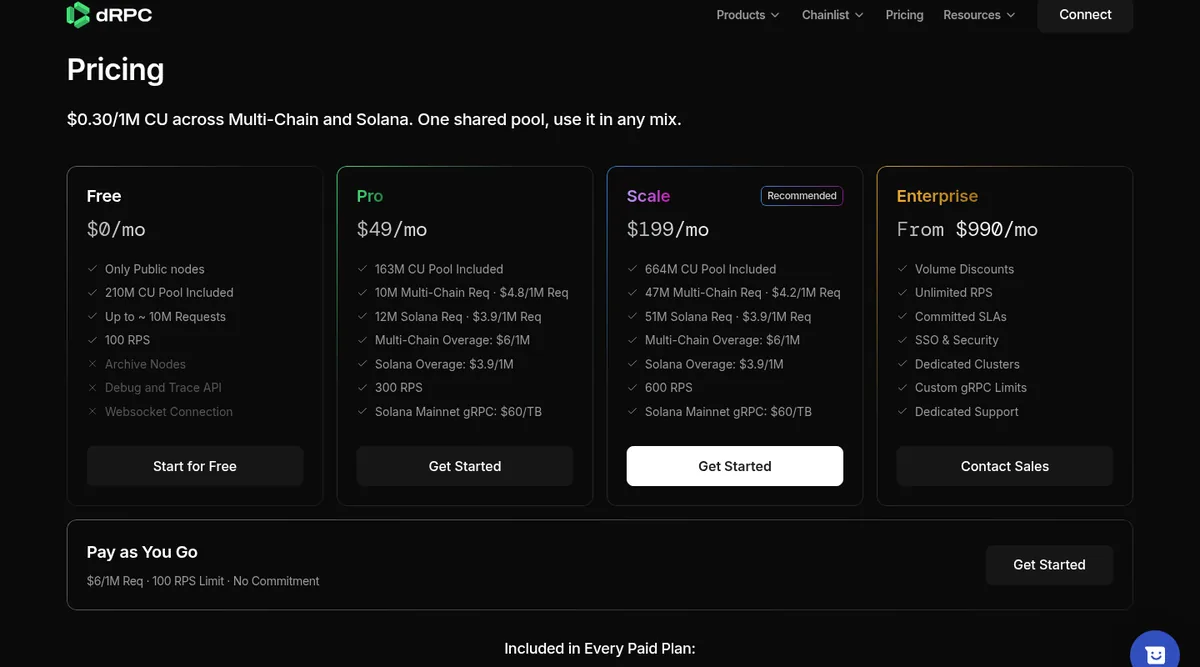
- Allowance: 210M CU, which dRPC describes as up to about 10M requests.
eth_call,eth_getLogsandeth_getBalanceall cost 20 CU. - Limits: 120,000 CU a minute per IP, about 100
eth_callrequests a second, a 2-second timeout, logs capped at 10,000 entries, batches of 3 and filter methods off by default, per its rate limiting docs. - Not included free: archive nodes, debug and trace methods and WebSocket connections.
- Upgrade: pay as you go at $6 per 1M requests, or Pro at $49 a month for 163M CU and 300 requests per second.
Public nodes are fast in third-party tests. OpenChainBench measured eth.drpc.org at 51 ms median latency with 100% success on 3 November 2026, the fastest keyless Ethereum endpoint in its board that day.
Verdict: dRPC scores 8.2. It is the best free plan for volume and request rate. Pair it with a second provider for archive reads and subscriptions.
2. Alchemy
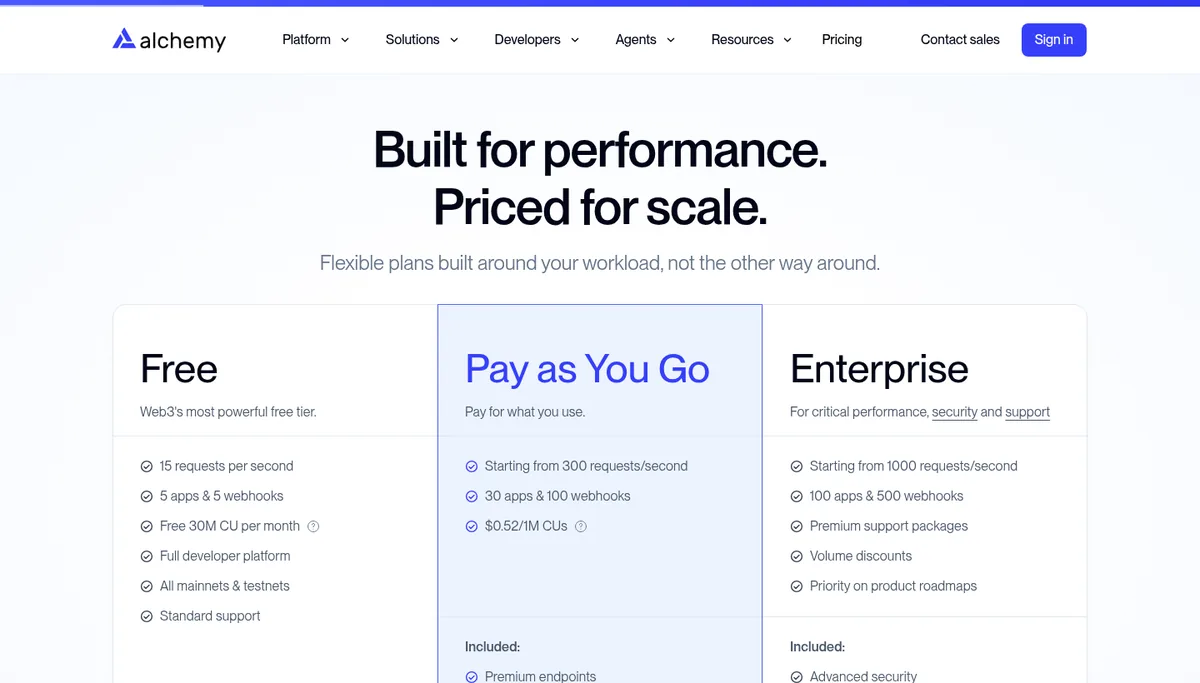
- Unit costs:
eth_blockNumber10 CU,eth_getBalance20,eth_call26,eth_sendRawTransaction40 andeth_getLogs60, per its compute unit table. - Real volume: about 1,158,301 calls a month on our dApp mix and 625,000 on our indexer mix.
- Throughput: the CU-per-second cap means our dApp mix tops out near 11.6 requests a second, per its throughput docs.
- Upgrade: pay as you go at $0.52 per 1M CU with 300 requests per second, so there is no fixed monthly jump.
Verdict: Alchemy scores 7.6. It is the best free plan for features, held back by the 10-block log range and a lower call count than dRPC or Chainstack.
3. Chainstack
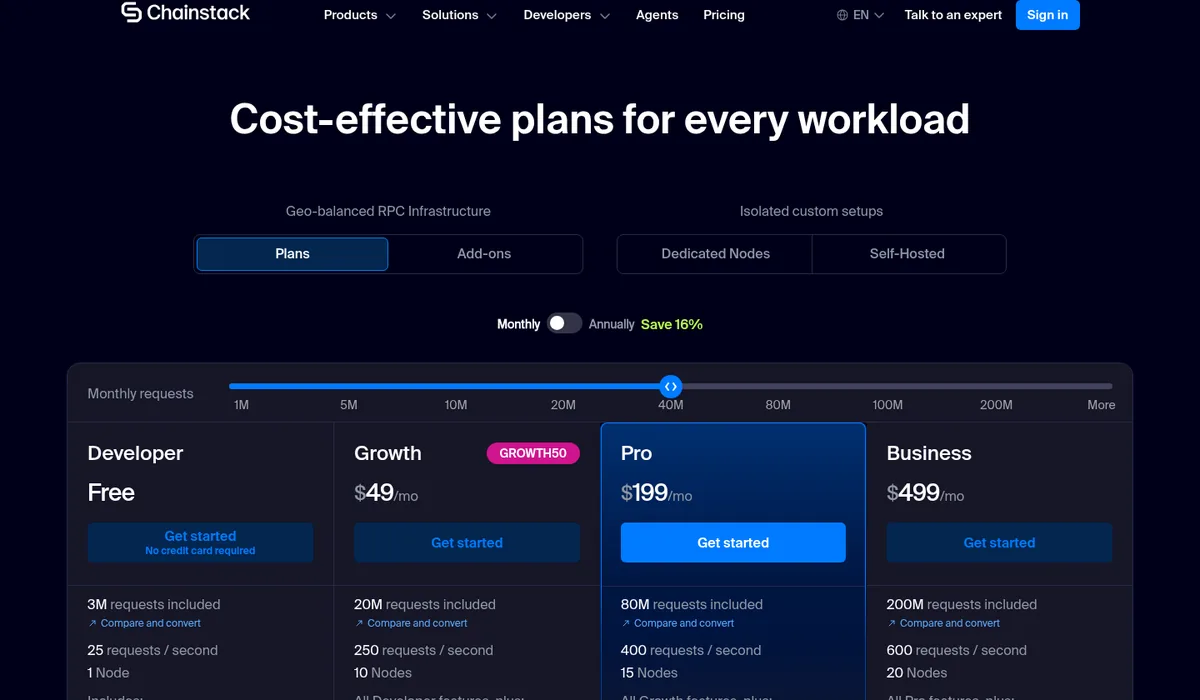
- Limits:
eth_getLogsis capped at 100 blocks on Developer and 10,000 on paid plans, and Solana mainnet is held to 5 requests a second on Developer, per its limits page. - Archive: listed from the Growth plan up, not on Developer.
- Upgrade: Growth at $49 a month for 20M requests and 250 requests per second.
- Trust: its pricing page shows SOC 2 Type II and ISO 27001 badges, useful if a test project later goes through vendor review.
Verdict: Chainstack scores 7.6. It is the most predictable free plan, since calls equal units. The 100-block log range and 5 rps Solana mainnet cap are the limits to watch.
4. Ankr
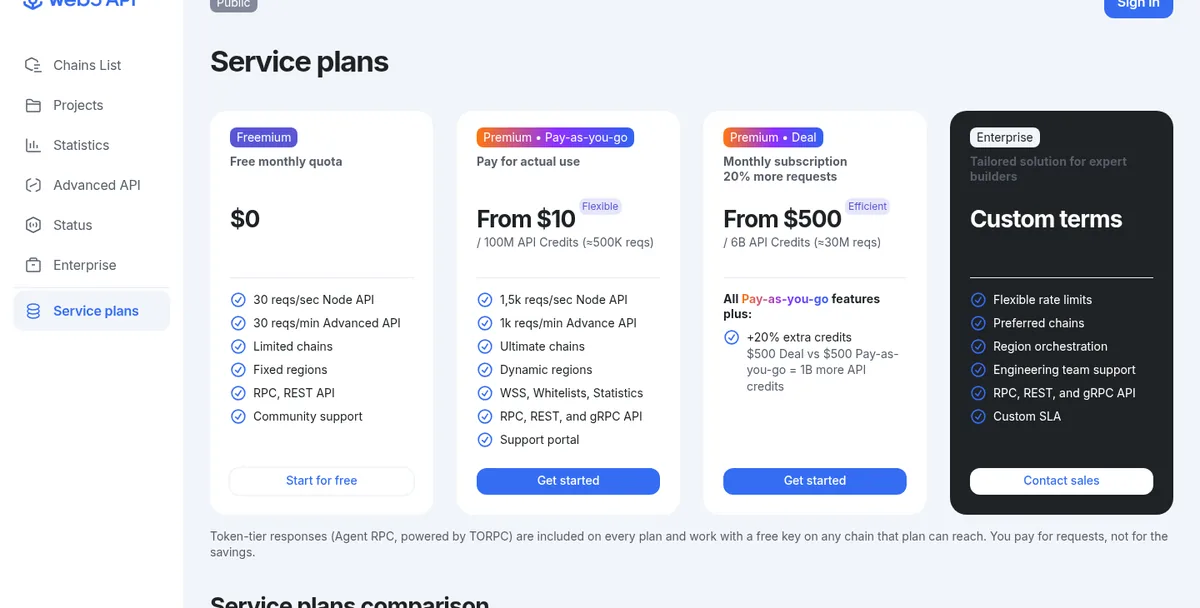
- Public tier: about 1,800 requests a minute guaranteed across endpoints, batches of 10 and a 1,000-block range.
- Freemium: 200M credits, 30 requests per second on the Node API, batches of 100, HTTPS only, one project token and no trace or debug.
- Solana: 500 credits a request, so 200M credits buys 400,000 Solana calls, per its pricing docs.
- Upgrade: pay as you go from $10 for 100M credits, with WebSockets and 1,500 requests per second.
Verdict: Ankr scores 7.0. It is the best free plan for event scanning and keyless testing, with fewer calls than dRPC and no WebSockets on Freemium.
5. Infura
eth_call, balances and receipts, 255 for eth_getLogs and 300 for eth_estimateGas, per its credit cost table. At 500 credits a second, Infura Core serves only about 6 eth_call requests a second, the lowest real rate of the seven. Plans are on its pricing page.
- Real volume: about 27,650 dApp-mix calls a day, or 829,493 over 30 days.
- Daily reset: the quota resets at 00:00 UTC, which is 5:30 AM in India. WebSocket subscriptions also bill per event, such as 50 credits per
newHeadsblock, per its WebSockets docs. - Not included free: debug and trace methods.
- Upgrade: Developer at $50 a month for 15M credits a day.
Verdict: Infura scores 6.0. It suits wallets and test scripts that need archive reads at low, steady rates, and it is the wrong pick for anything bursty.
6. Helius
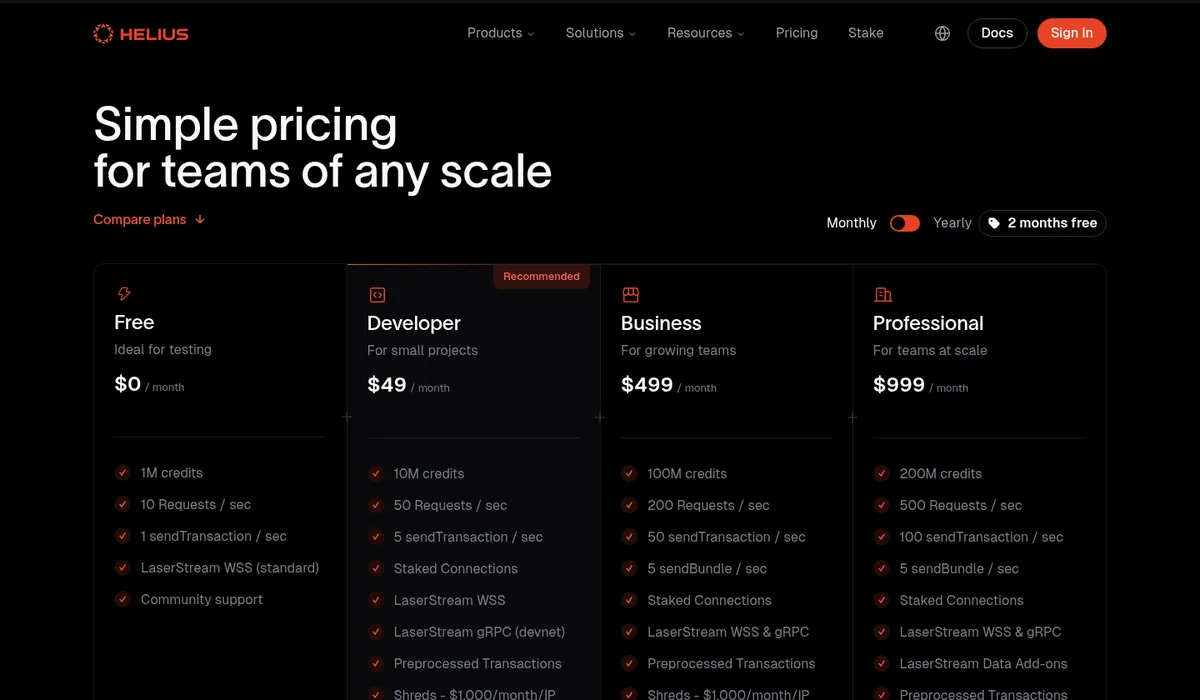
- Unit costs: standard RPC calls 1 credit and
getProgramAccounts10 credits, per its credit docs. - Other caps: 2 DAS API requests a second and 5
getProgramAccountscalls a second. - Not included free: staked connections and LaserStream gRPC.
- Upgrade: Developer at $49 a month for 10M credits and 50 requests per second. Our Helius vs QuickNode vs Triton comparison covers paid Solana options.
Verdict: Helius scores 5.8 as a Solana-only plan. It is the free Solana default for teams that want webhooks and indexed APIs from day one.
7. GetBlock
- Included free: WebSockets, MEV protection and limited archive access on major networks.
- Solana: a chain multiplier of 50, so about 1,000 Solana calls a day.
- Archive: archive-mode requests double the CU cost.
- Not included free: an SLA. Support is community only.
Verdict: GetBlock scores 5.6. It is fine for a quick test on a major chain, but the daily allowance is the smallest on this list. Our GetBlock vs dRPC vs Tatum comparison covers its paid plans once you outgrow the free tier.
How Many Calls Each Free Plan Buys
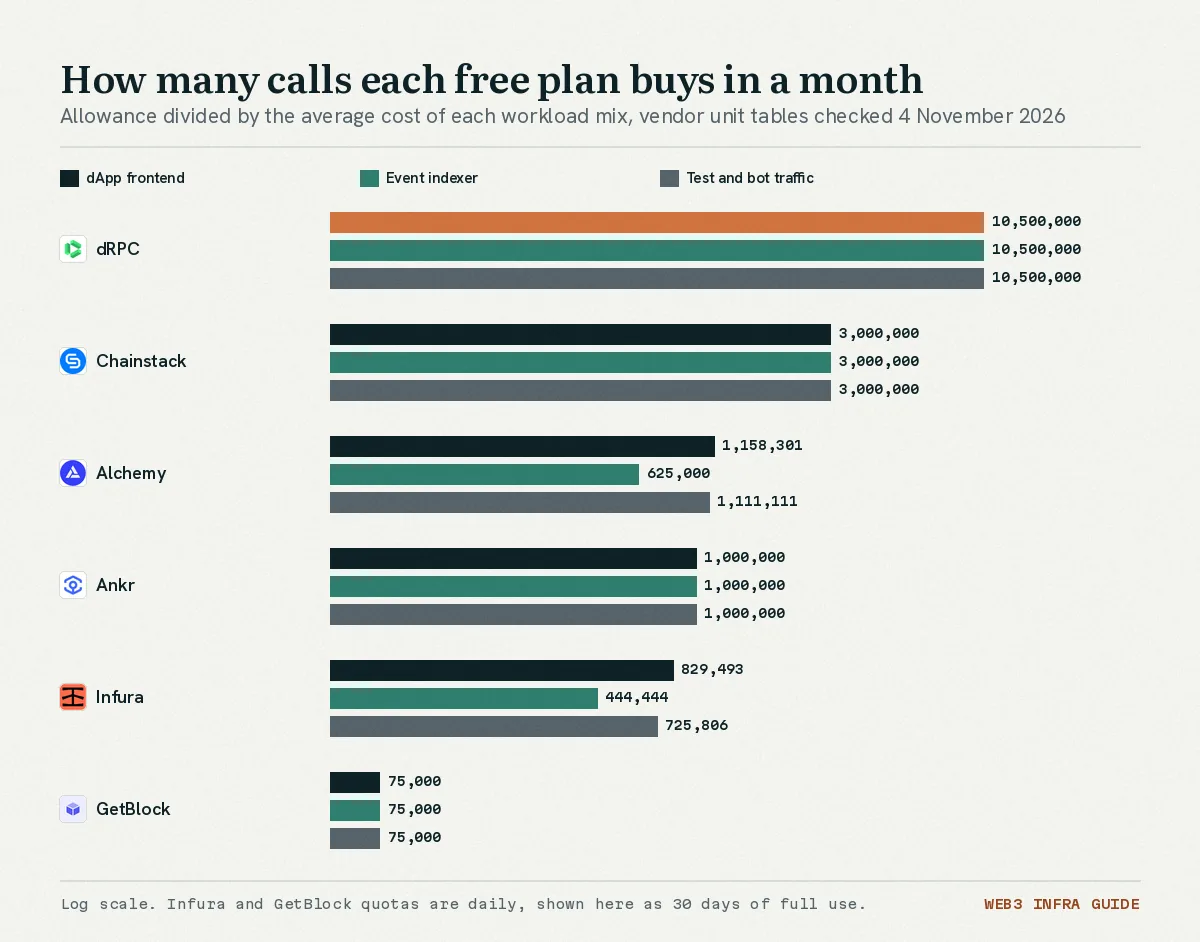
Free allowances use different units, so we converted each one into calls for three method mixes. Chainstack and dRPC give the same call count for every mix, while Alchemy and Infura shrink by roughly half for an indexer. Infura and GetBlock reset daily, so their figures assume full use on all 30 days.
| Plan | dApp frontend | Event indexer | Test and bot traffic | Rate limit |
|---|---|---|---|---|
| 10,500,000 | 10,500,000 | 10,500,000 | 100 req/s on dApp mix |
| 3,000,000 | 3,000,000 | 3,000,000 | 25 req/s on dApp mix |
| 1,158,301 | 625,000 | 1,111,111 | 11.6 req/s on dApp mix |
| 1,000,000 | 1,000,000 | 1,000,000 | 30 req/s on dApp mix |
| 829,493 | 444,444 | 725,806 | 4.6 req/s on dApp mix |
| 75,000 | 75,000 | 75,000 | 20 req/s on dApp mix |
- dApp frontend: 40%
eth_call, 15%eth_getBalance, 15%eth_blockNumber, 10% receipts, 10%eth_getLogs, 5% sends and 5% gas estimates. - Event indexer: 70%
eth_getLogs, 20%eth_getBlockByNumberand 10% receipts. - Test and bot traffic: 50%
eth_call, 20% gas estimates, 20% sends and 10% receipts.
Our numbers match the independent free-tier table on OpenChainBench closely for dRPC, Chainstack, Ankr and GetBlock. Its Alchemy figure of 1.26M uses a different method mix from ours. For paid pricing beyond the free tier, see our RPC provider pricing guide.
Verdict: For raw volume, dRPC buys 3.5 times Chainstack’s calls and roughly nine times Alchemy’s on our dApp mix. Infura and GetBlock run out first.
The Log Range Limit Breaks Free Plans First
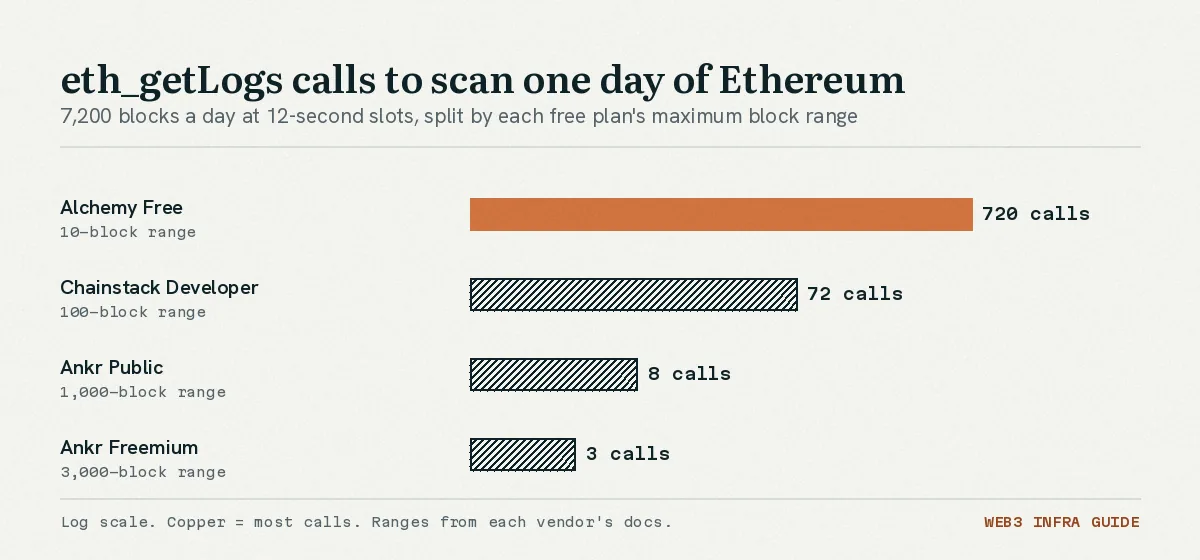
Ethereum adds a block every 12 seconds, about 7,200 a day, per ethereum.org. A free plan’s maximum block range sets how many eth_getLogs calls it takes to read one day of events. On Alchemy Free, scanning one day of Ethereum events takes 720 calls and 43,200 CU, against 3 calls on Ankr Freemium. That gap matters more than the headline allowance for any indexer.
| Free plan | Max block range | Calls for one day | Notes |
|---|---|---|---|
| 10 blocks | 720 | Same 10-block limit on Ethereum, Base, Arbitrum, Optimism and Polygon |
| 100 blocks | 72 | 10,000 blocks on paid plans |
| 1,000 blocks | 8 | Keyless endpoints |
| 3,000 blocks | 3 | 10,000 blocks on paid plans |
| Not stated as blocks | Depends on events | Responses capped at 10,000 log entries and a 2-second timeout |
Verdict: If your app reads events, test the log range before anything else. Ankr Freemium is the most forgiving free option, and Alchemy Free is the strictest.
Set Up a Free Fallback
Two free plans in a fallback beat one free plan. A fallback transport sends each call to the first healthy endpoint and moves on when one throttles or times out. The viem fallback transport does this in a few lines, and rank: true orders endpoints by measured latency.
import { createPublicClient, fallback, http } from "viem";
import { mainnet } from "viem/chains";

const client = createPublicClient({
  chain: mainnet,
  transport: fallback(
    [
      http(process.env.DRPC_URL),      // volume
      http(process.env.CHAINSTACK_URL), // private endpoint
      http(process.env.ALCHEMY_URL),   // archive reads
    ],
    { rank: true, retryCount: 2 }
  ),
});
Keep archive and trace calls on the provider that supports them, since dRPC Free does not include them. Keyless endpoints such as PublicNode, which lists 76 chains, make a good last resort in tests but carry no allowance or support commitment. For Ethereum-specific options, see our Ethereum RPC provider ranking, and for Base see our Base RPC provider guide.
Verdict: Run dRPC and Chainstack together for free volume, with Alchemy for archive reads and WebSockets. That covers most test projects for $0.
Why QuickNode Is Not on This List
QuickNode’s free option is a trial, not a plan: 10M API credits for one month at 15 requests per second with no card, then a paid plan from $49, per its pricing page. A one-month trial is useful for evaluation but cannot host a test project that runs for a year, so we left it out. Several ranking pages still list it as a free tier.
If you plan to move to a paid provider anyway, our QuickNode vs Alchemy vs Chainstack comparison covers the paid entry plans, and our Alchemy alternatives and Infura alternatives guides cover the wider field.
Final Verdict
dRPC is the best free RPC provider in 2026 for testing and small dApps, with the largest allowance and the highest free request rate. Alchemy is the best free plan for features, Chainstack the most predictable, and Helius the Solana default. For a full Solana list, see our Solana RPC provider ranking.


Verdict: Use dRPC for volume and keep Alchemy or Chainstack as a second endpoint. Browse the RPC providers hub for paid comparisons. For priced multi-vendor options, see our QuickNode alternatives guide and our QuickNode vs Infura vs Ankr comparison.
Frequently Asked Questions
What is the best free RPC provider in 2026?
For most testing and small dApps, dRPC. Its free plan gives a 210M compute unit pool every 30 days, about 10.5M standard EVM calls, at 100 requests per second with no card. It runs on public nodes only, so pair it with Alchemy or Chainstack if you need archive data or WebSockets.
Which free RPC plan includes archive data?
Alchemy Free and Infura Core both include full archive data. Ankr Freemium also serves archive reads on its network. dRPC Free and Chainstack Developer do not; Chainstack adds archive from its $49 Growth plan. GetBlock lists limited archive on its free plan, and archive calls cost double its normal compute units.
Is Alchemy free tier enough for a small dApp?
Often yes. Alchemy Free gives 30M compute units a month, about 1.16M calls on our dApp mix, at 15 requests per second, with archive data, WebSockets and 5 webhooks. The catch is eth_getLogs, which is limited to a 10-block range per call, so event-heavy apps hit limits fast.
Does QuickNode have a free plan?
Not a permanent one. QuickNode offers a free trial with 10M API credits for one month at 15 requests per second and no card. After the month you need a paid plan, starting with Build at $49 a month, so we did not include it in this list of free plans.
What is the best free Solana RPC?
Helius for most builders. Its free plan gives 1M credits a month at 10 requests per second, with standard calls at 1 credit, webhooks and standard LaserStream WebSockets. Sends are limited to 1 a second. Chainstack Developer also serves Solana but caps mainnet at 5 requests per second on the free plan.
What happens when a free RPC quota runs out?
The reset rule decides. Infura stops serving requests until its daily reset at 00:00 UTC, and GetBlock renews 50,000 compute units daily with no rollover. Monthly plans such as Alchemy, Chainstack and Ankr stop or throttle until the next cycle, and dRPC counts 30 days from registration.