
Last updated: 25 October 2026 · Prices, method weights, plan limits and Flashblocks support rechecked on vendor pages on 25 October 2026
The best Base RPC providers in 2026 are Chainstack for overall value, Alchemy for the strongest private free tier and tooling, and GetBlock and QuickNode for reliability and audits. We ranked seven providers on the weights from our main RPC ranking, priced three Base workloads on every meter, checked who documents Flashblocks and tested eight free public Base endpoints ourselves.
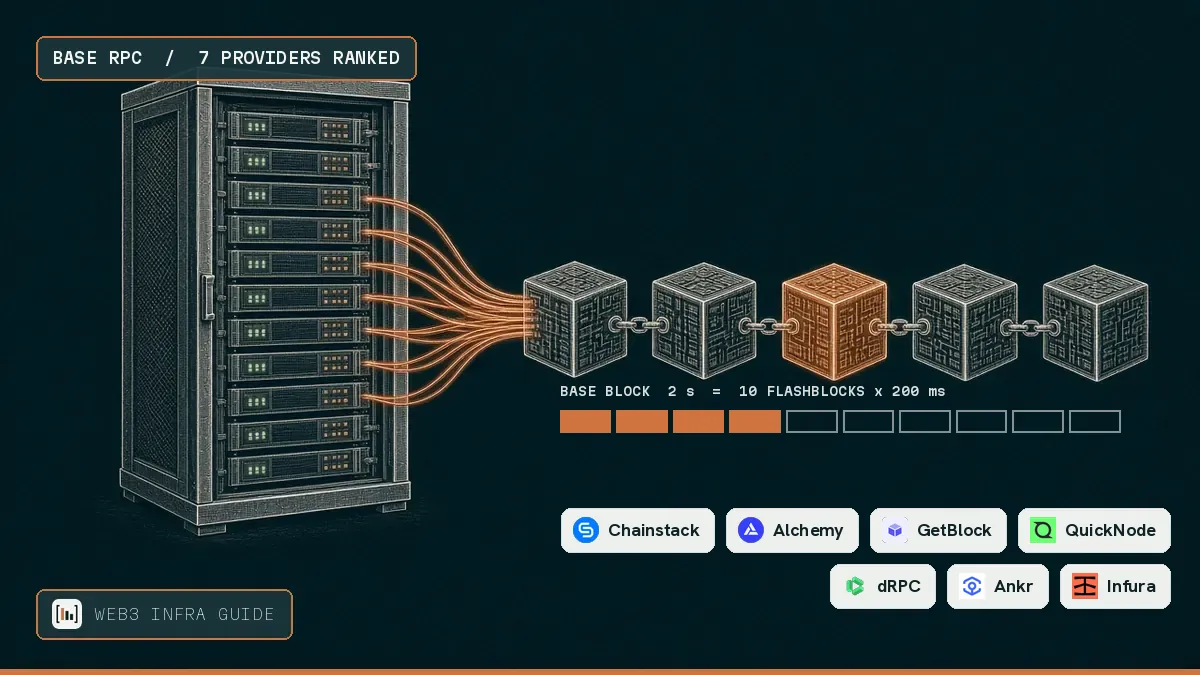
Base is not a generic EVM chain anymore. Blocks land every 2 seconds, but its Flashblocks feed exposes pre-confirmed state every 200ms, and only some providers document it. This guide is the Base cut of our ranking of the 12 best RPC node providers. Our methodology page explains how we collect prices and screenshots. For the L1 side, see our ranking of the best Ethereum RPC providers.
TL;DR
- Ranking: 1. Chainstack (9.2), 2. Alchemy (8.3), 3. GetBlock (8.0), 4. QuickNode (8.0), 5. dRPC (7.6), 6. Ankr (6.0), 7. Infura (5.9). Coinbase’s own CDP Node scores 4.0 and sits outside the list.
- One million Base calls in a typical app mix cost $2.45 on Chainstack Growth and $4.80 on dRPC Pro, against $13.60 on Alchemy pay as you go and $35.50 on CDP Node. If you are moving off Alchemy entirely, our Alchemy alternatives guide compares the options across chains.
- A 10M-request Base app costs $49 a month on Chainstack or dRPC. A 60M-request trading bot costs $199 on Chainstack Pro and $2,830 on CDP Node, where every send costs 500 billing units.
- Chainstack, Alchemy, QuickNode and GetBlock publish their own Flashblocks docs. Base’s own FAQ also names Infura and dRPC as Flashblocks providers.
- In our test, five of eight free public Base endpoints served Flashblocks state, but none suits production: Base’s endpoint returned HTTP 429 on log queries and 1RPC served a pending block 712 blocks behind tip.
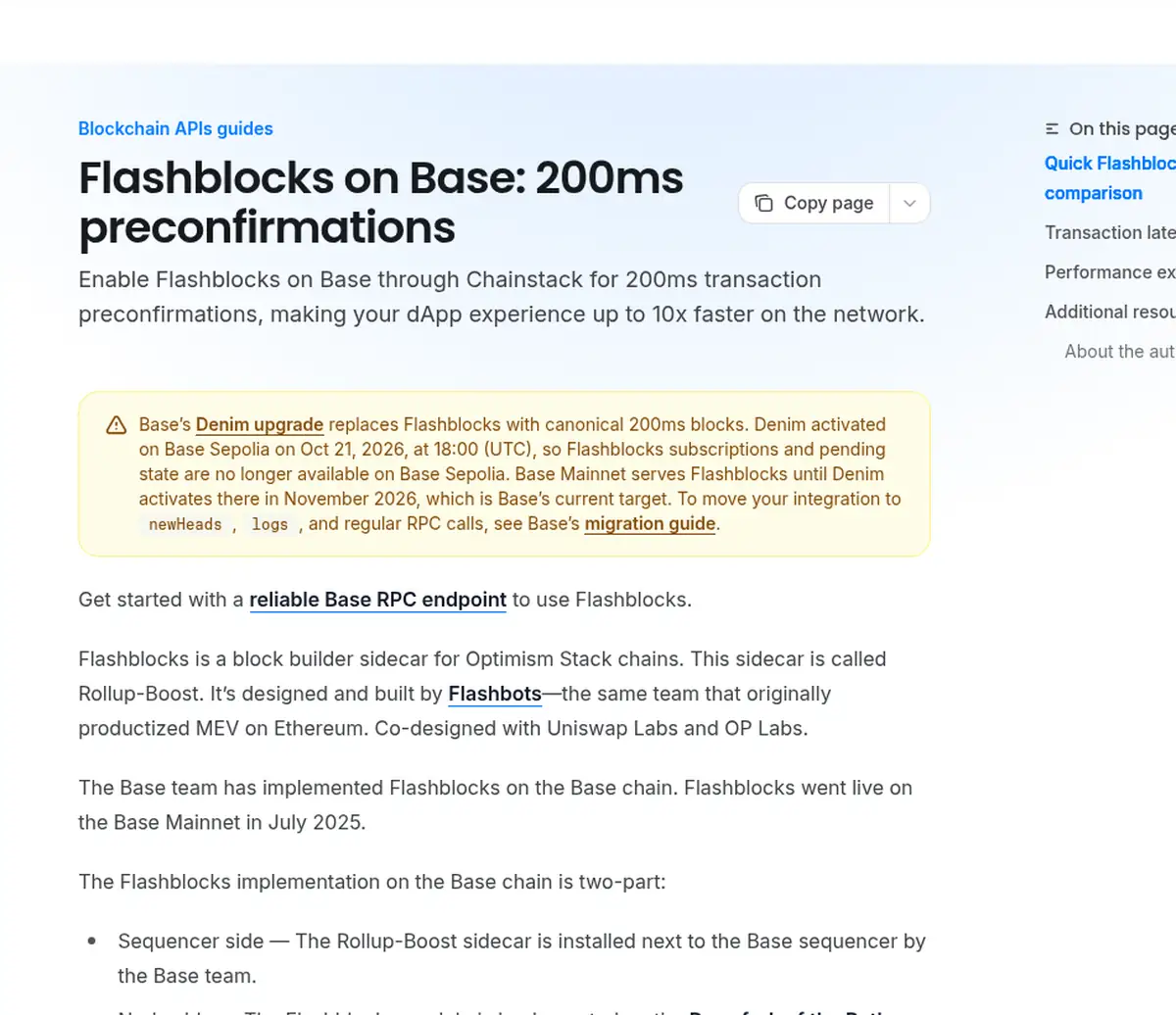
- Base plans to replace Flashblocks with 200ms canonical blocks in its Denim upgrade. Chainstack reports Denim went live on Base Sepolia on 21 October 2026, with Base Mainnet targeted for November 2026.
The Decision Kernel
Pick a Base provider by what your app does between blocks. Apps that act on pre-confirmed state need a documented Flashblocks endpoint, and indexers need cheap logs and archive. Price your real Base method mix first, because sends cost 1 unit on Chainstack and 500 on CDP Node. The shortcuts below cover the common cases.
- Lowest bill with audits and Flashblocks: Chainstack, at 1 request unit per call, Flashblocks on every Base endpoint and SOC 2 Type II plus ISO 27001.
- Free tier and app tooling: Alchemy, with 30M compute units a month free, Flashblocks on the existing endpoint and its wallet and data APIs.
- Top reliability: GetBlock, with the top reliability score in our main ranking and a documented Flashblocks endpoint.
- Audits, Streams and Base-specific methods: QuickNode, which documents
base_transactionStatusandbase_sendRawTransactionValidity. - Cheapest flat meter for logs: dRPC, at $4.80 per million calls whatever the method.
- Paymaster and Coinbase tooling: CDP Node, but only at low volume, because its send and log weights make it the most expensive meter here.
Verdict: Chainstack for most Base teams, Alchemy when the free tier and app tooling matter most, QuickNode or GetBlock when audits and uptime lead the brief. Add a second provider as a fallback either way.
How We Ranked the Base RPC Providers
We scored each provider from 1 to 5 on six weighted criteria, doubled. Weights, reliability, compliance and free tier scores come from our 12-provider RPC ranking. We rescored price, features and coverage for Base, since chain weights, Flashblocks and Base archive support differ by vendor. See our methodology page.
- Price per call, 25%: the price of one million Base calls in a typical app mix on each entry plan, from each vendor’s own Base weights.
- Reliability, 20%: public latency benchmarks, uptime claims, SLAs and support response targets.
- Compliance, 15%: SOC 2, ISO 27001 and other audits stated on the vendor’s own pages.
- Features, 15%: debug and trace APIs, dedicated nodes, streaming, Base-specific transaction methods and data APIs.
- Base access, 15%: mainnet and Sepolia, WebSocket, archive data and a vendor-documented Flashblocks endpoint.
- Free tier, 10%: how many real Base calls a team can make before paying.
| Provider | Price (25%) | Reliability (20%) | Compliance (15%) | Features (15%) | Base access (15%) | Free tier (10%) | Score |
|---|---|---|---|---|---|---|---|
 | 5 | 4 | 5 | 5 | 5 | 3 | 9.2 |
 | 3 | 4 | 4 | 5 | 5 | 5 | 8.3 |
 | 4 | 5 | 4 | 4 | 4 | 2 | 8.0 |
 | 3 | 4 | 5 | 5 | 5 | 2 | 8.0 |
 | 5 | 4 | 2 | 3 | 4 | 4 | 7.6 |
 | 2 | 3 | 4 | 3 | 3 | 4 | 6.0 |
 | 3 | 3 | 1 | 3 | 4 | 4 | 5.9 |
 | 1 | 2 | 1 | 3 | 3 | 3 | 4.0 |
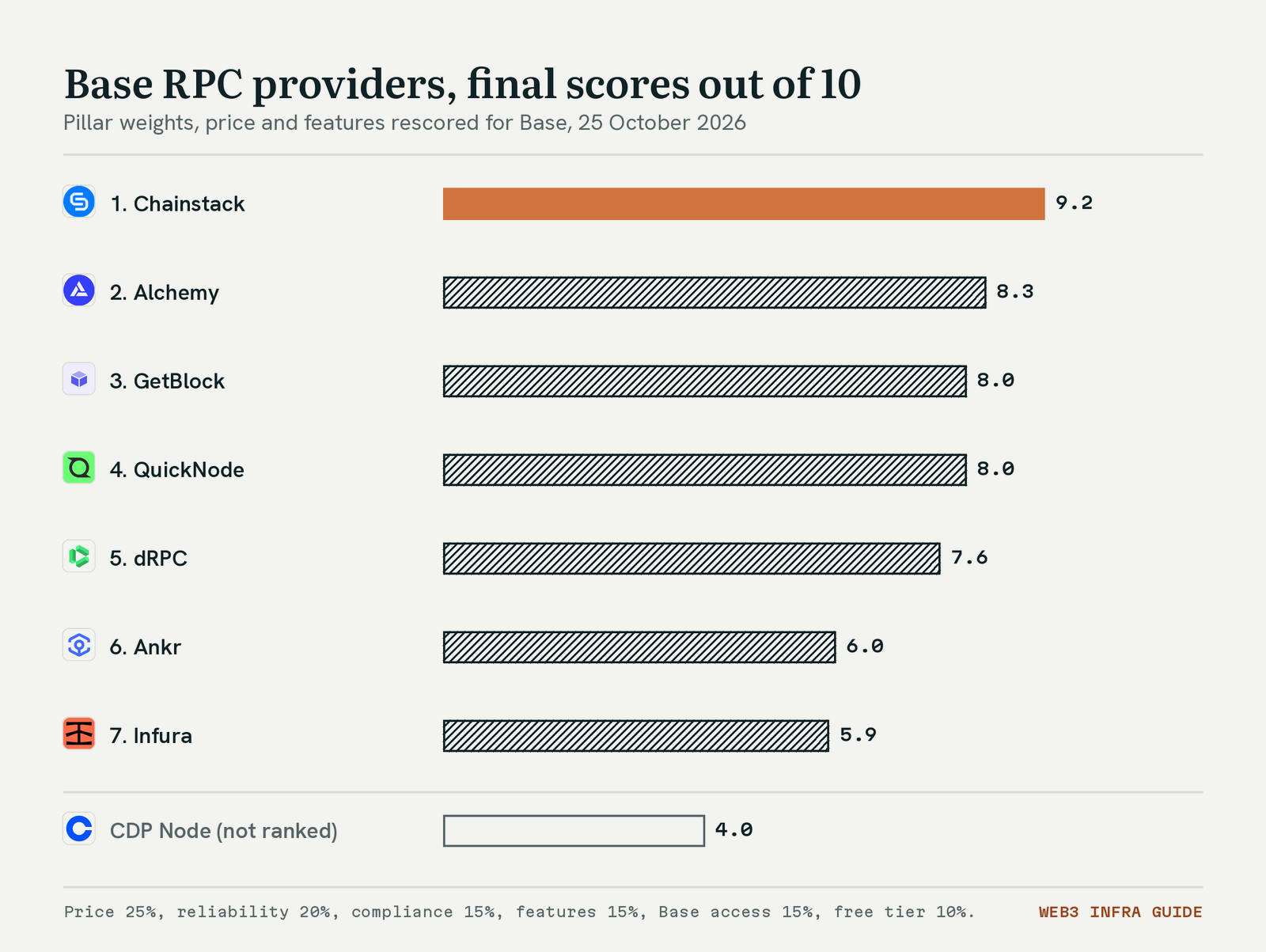
Chainstack gains on Base because its flat meter, archive support and Flashblocks docs all land in one plan. QuickNode and Alchemy hold their tooling scores, while dRPC loses a point on Base access because its own docs do not cover Flashblocks.
What Makes Base RPC Different
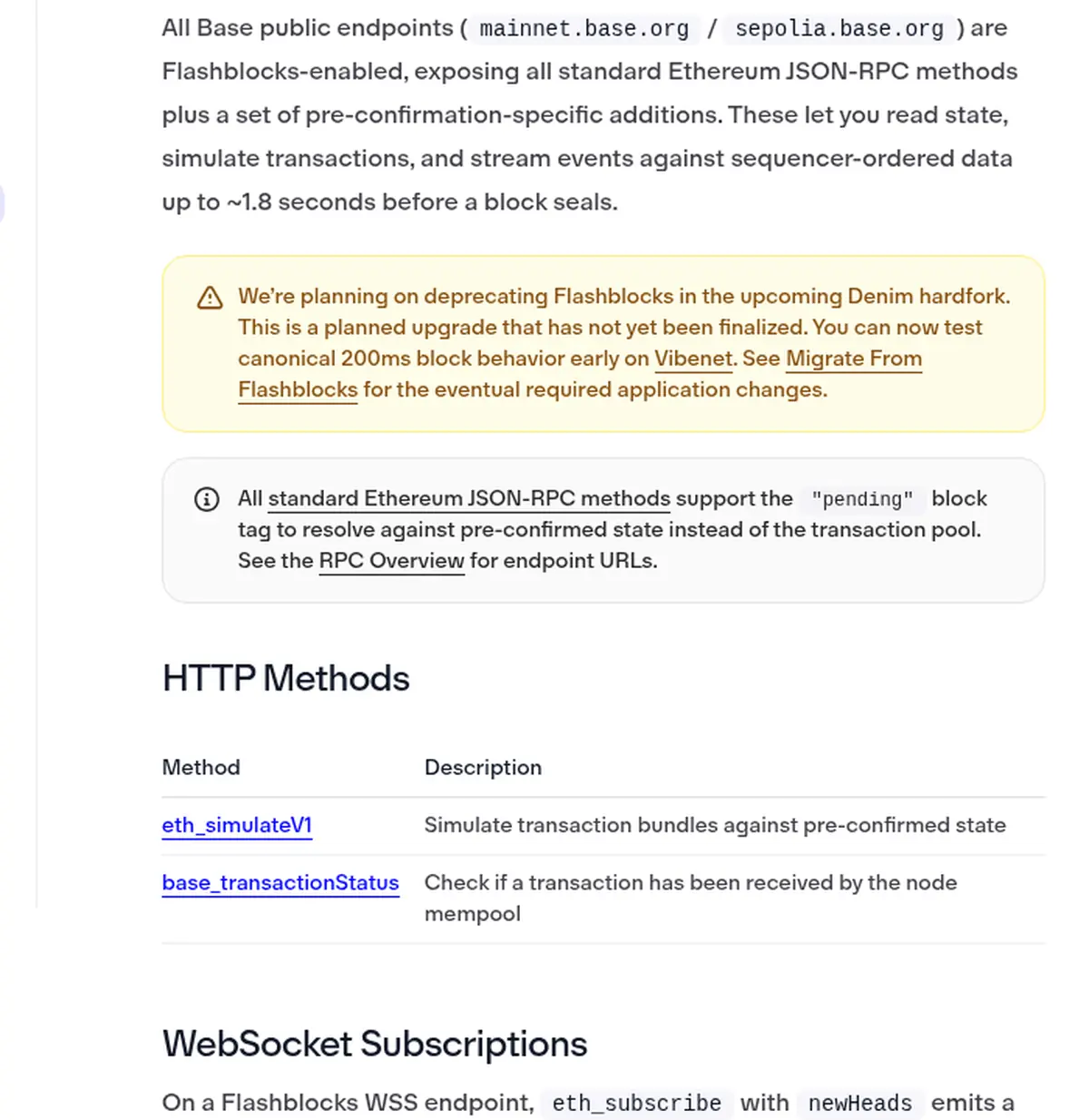
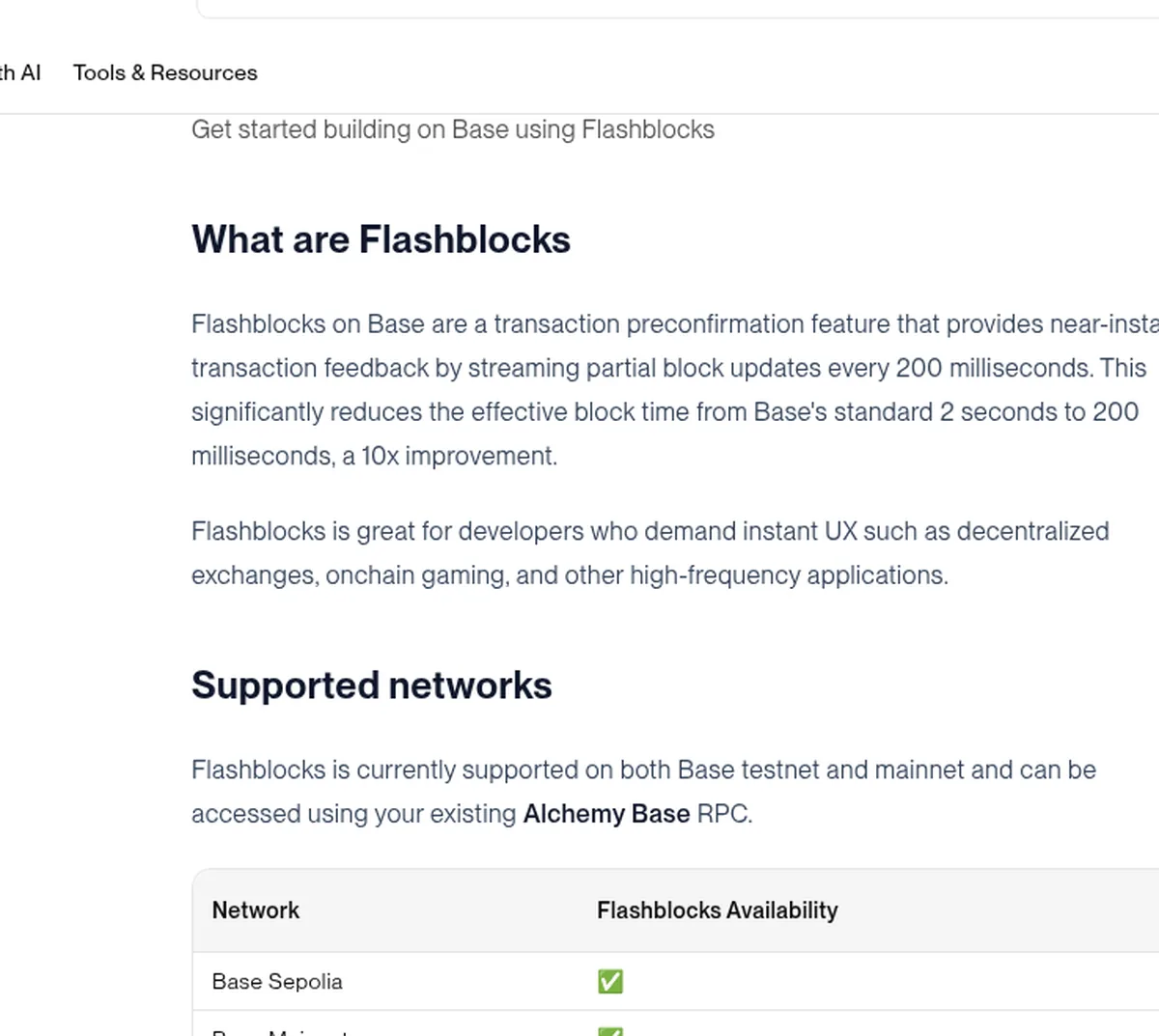
Base produces a full block every 2 seconds, built from ten 200ms sub-blocks called Flashblocks. A Flashblocks-aware node exposes that pre-confirmed state through the pending tag and three WebSocket subscriptions, per Base’s Flashblocks API overview. A standard node shows a transaction after about 2 seconds, while a Flashblocks-aware node can show it within about 200ms.
- Methods that read pre-confirmed state:
eth_call,eth_getBalance,eth_getTransactionCount,eth_estimateGas,eth_simulateV1,eth_getBlockByNumberandeth_getLogswith thependingtag, plus preconfirmed receipts. - WebSocket subscriptions:
newFlashblocks,newFlashblockTransactionsandpendingLogsthrougheth_subscribe. - No free public WebSocket: Base’s Flashblocks FAQ says it runs no free public WebSocket endpoint and that
mainnet.base.orgis explicitly rate limited, so production apps need a provider or their own node. - Reorg risk: Base targets a Flashblock reorg rate below 0.1%, so treat a preconfirmation as a strong signal, not finality.
Base also plans to retire Flashblocks. Its docs say the Denim hardfork will replace them with canonical 200ms blocks and that the plan is not final. Chainstack reports that Denim activated on Base Sepolia on 21 October 2026 and that Base Mainnet keeps Flashblocks until Denim activates there, with November 2026 as Base’s target. Code that reads pending state will need to move to newHeads, logs and regular calls after that.
Verdict: Pick a provider that documents Flashblocks today and has a stated Denim migration path. Fast blocks will raise call volume either way, which makes the per-call meter matter more.
Flashblocks Support by Provider
We checked each vendor’s own docs for a Base Flashblocks endpoint on 25 October 2026. Four of the seven ranked providers publish their own Flashblocks guide, and none charges an add-on fee for it. Base’s FAQ names QuickNode, Alchemy, Infura and dRPC as Flashblocks providers.
| Provider | Own Flashblocks docs | Endpoint | Extra methods documented |
|---|---|---|---|
| Yes | Every Base Mainnet endpoint | eth_sendRawTransactionSync, pending reads, subscriptions |
| Yes | Existing Base Mainnet endpoint | eth_simulateV1, pending reads, subscriptions |
| Yes | Shared Frankfurt (eu-central-1) endpoint | base_transactionStatus, eth_simulateV1, subscriptions |
| Yes | Existing Base endpoint, no add-on | base_transactionStatus, base_sendRawTransactionValidity |
| Named by Base, no vendor guide found | Public node served Flashblocks state in our test | Not documented |
| Named by Base, no vendor guide found | Base Mainnet and Sepolia, HTTPS and WebSocket | Not documented |
| No | Base on paid plans | Not documented |
| No | Base Mainnet and Sepolia only | eth_simulateV1 priced as a standard method |
Verdict: Chainstack, Alchemy, GetBlock and QuickNode are the safe Flashblocks picks. Test dRPC and Infura on your own pending-state calls before you rely on them.
Base RPC Providers at a Glance
The table lines up each provider’s Base billing unit, free tier and entry plan. Fixed plans include a monthly allowance with overage above it, while Alchemy, Ankr and CDP Node bill pure usage. A credit on one vendor is not a credit on another, so check the unit first.
| Provider | Base billing unit | Free tier | Entry paid plan |
|---|---|---|---|
| 1 request unit per call, 2 for archive and debug | 3M RU a month, 25 rps | Growth $49, 20M RU, 250 rps |
| Compute units per method, 10 to 60 for common calls | 30M CU a month, 15 rps | Pay as you go, $0.525 per 1M CU |
| 20 CU per Base call, x2 for archive and debug | 50K CU | Starter $49, 90M CU, 250 rps |
| 20 credits per Base call, any method | 10M credits, one-month trial | Build $49, 80M credits, 50 rps |
| Flat price per request | 210M CU on public nodes, 100 rps | Pro $49, about 10M requests, 300 rps |
| 200 API credits per EVM call | 200M credits a month, 30 rps | Pay as you go from $10 per 100M credits |
| 80 credits for most reads, daily quota | 3M credits a day | Developer $50, 15M credits a day |
| 30, 100 or 500 billing units per method | 10M BU a month | $0.50 per 1M BU, card required |
Verdict: Chainstack and dRPC give the most Base calls for $49. Alchemy has the strongest free tier on a private endpoint, and CDP Node’s 500-unit sends make it the costliest meter for write-heavy apps.
What One Million Base Calls Cost
We converted each entry plan into the price of one million Base calls for three method mixes, using each vendor’s own weights. QuickNode and dRPC charge the same for every mix, while Alchemy, GetBlock, Infura and CDP Node get pricier as logs and sends grow.
- App mix: 40%
eth_call, 15% balances, 15% block numbers, 10% receipts, 10% logs, 5% sends and 5% gas estimates. - Trading bot mix: 45%
eth_call, 15% receipts, 10% nonces, 10% balances, 10% sends, 5% gas estimates and 5% blocks. - Indexer mix: 45%
eth_getLogs, 25% blocks, 20% receipts and 10%eth_callover history, at archive rates where vendors charge them.
| Entry plan | App mix, per 1M | Trading bot mix, per 1M | Indexer mix, per 1M |
|---|---|---|---|
| $2.45 | $2.45 | $4.90 |
| $4.80 | $4.80 | $4.80 |
| $10.89 | $10.89 | $21.78 |
| $12.06 | $10.11 | $17.64 |
| $12.25 | $12.25 | $12.25 |
| $13.60 | $12.97 | $20.27 |
| $20.00 | $20.00 | $20.00 |
| $35.50 | $47.25 | $46.50 |
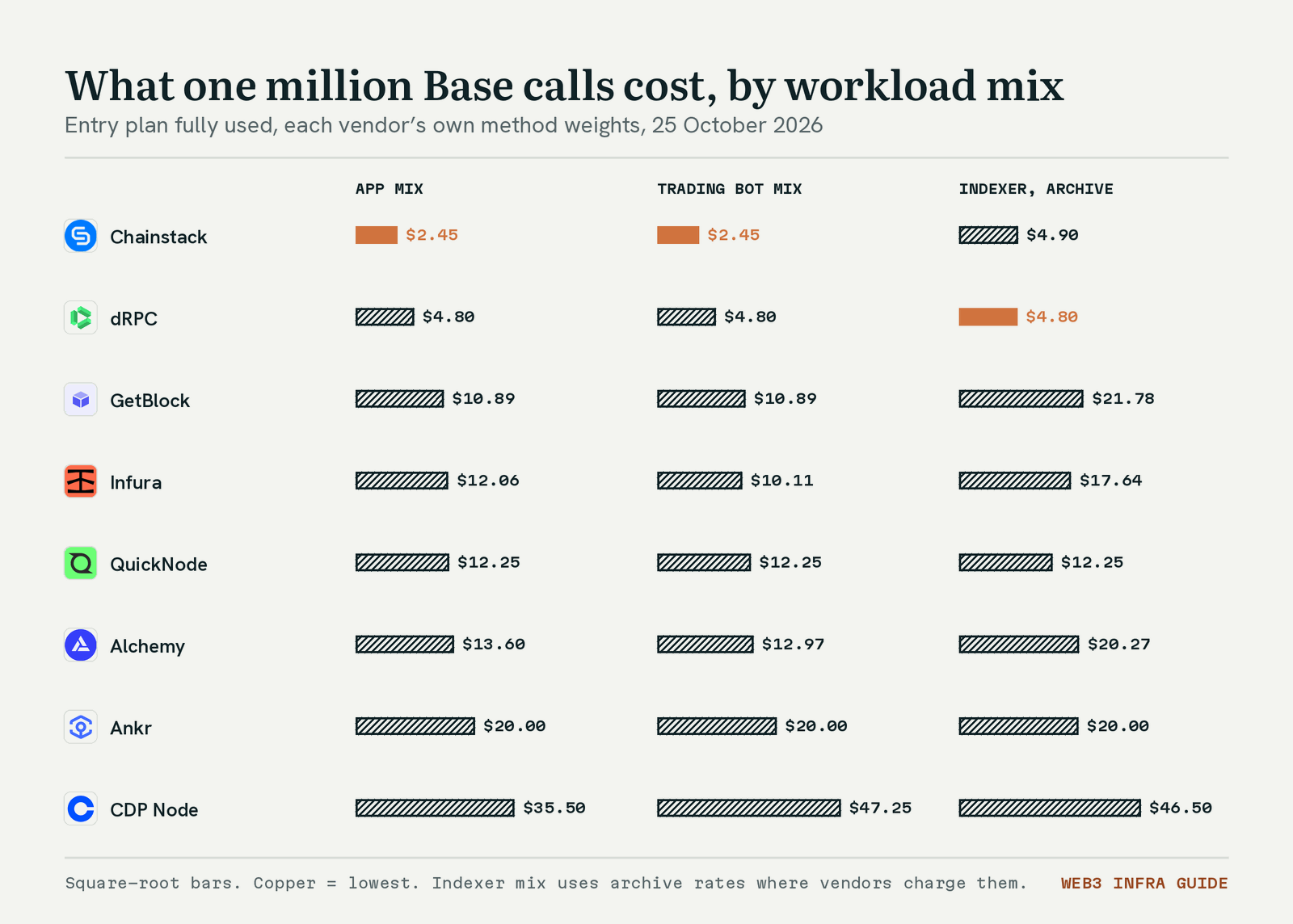
CDP Node is the outlier. Its trading bot mix averages 94.5 billing units per call because each eth_sendRawTransaction costs 500 units, which works out to $47.25 per million calls. Fixed plans only reach these rates when you use the whole allowance.
Verdict: Chainstack is the cheapest meter on every mix, and dRPC is the cheapest flat meter. Alchemy is mid-priced for app traffic but costly for log-heavy indexing.
What Three Base Workloads Cost
We built three Base traffic patterns, converted each into every vendor’s unit and picked the cheapest public plan that covers the volume and a peak of three times the average rate. Chainstack had the lowest bill in all three workloads, from $49 for the app to $499 for the indexer.
| Provider | Base consumer app, 10M | Base trading bot, 60M | Base indexer backfill, 100M |
|---|---|---|---|
| $49 (Growth) | $199 (Pro) | $499 (Business) |
| $136 (Pay as you go) | $778 (Pay as you go) | $2,026 (Pay as you go) |
| $199 (Advanced) | $579 (Pro) | $1,539 (Premium) |
| $123 (Build) | $632 (Scale) | $999 (Business) |
| $49 (Pro) | $277 (Scale) | $517 (Scale) |
| $200 (Pay as you go) | $900 (Deal ($500)) | $1,567 (Deal ($500)) |
| $225 (Team) | Enterprise quote | Enterprise quote |
| $350 (Pay as you go) | $2,830 (Pay as you go, rate raise needed) | $4,645 (Pay as you go, rate raise needed) |
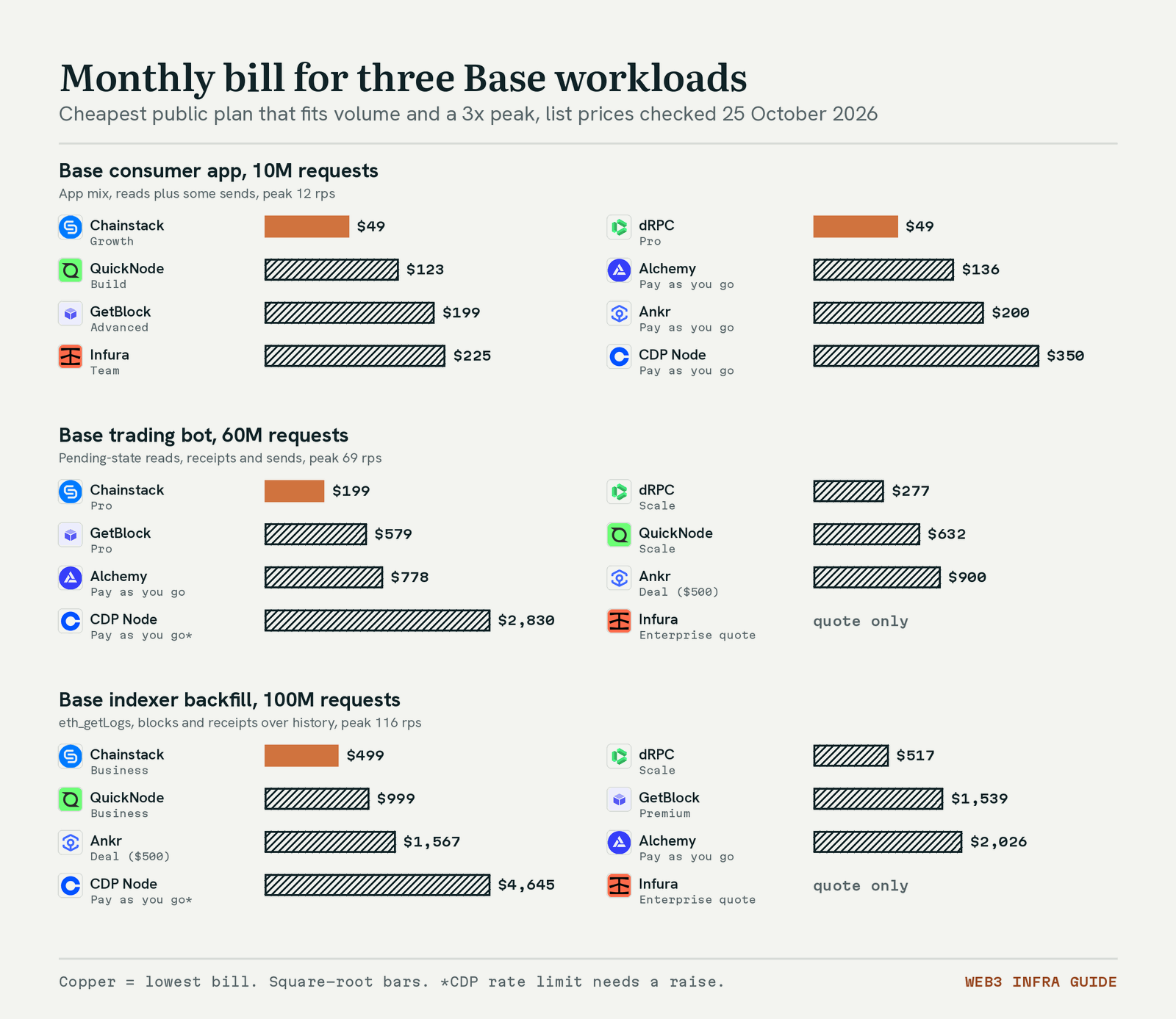
- Base consumer app, 10M requests: the app mix above with a peak of 12 requests per second.
- Base trading bot, 60M requests: the bot mix with a peak of 69 requests per second.
- Base indexer backfill, 100M requests: the indexer mix with a peak of 116 requests per second.
Plan limits moved several answers. The trading bot needs 1.2B GetBlock CU, which lands on Pro at $499 plus $80 of overage. Infura’s daily quota rules out its public plans for the bot and the indexer, so both need an Enterprise quote. CDP Node’s 7,500 billing units per 5 seconds, about 1,500 per second, cannot carry the bot or the indexer at peak without a rate raise.
Verdict: For Base apps of any size, Chainstack and dRPC cost the least. QuickNode’s flat 20 credits make it the predictable mid-priced pick for log-heavy indexers.
Free Public Base Endpoints, Tested
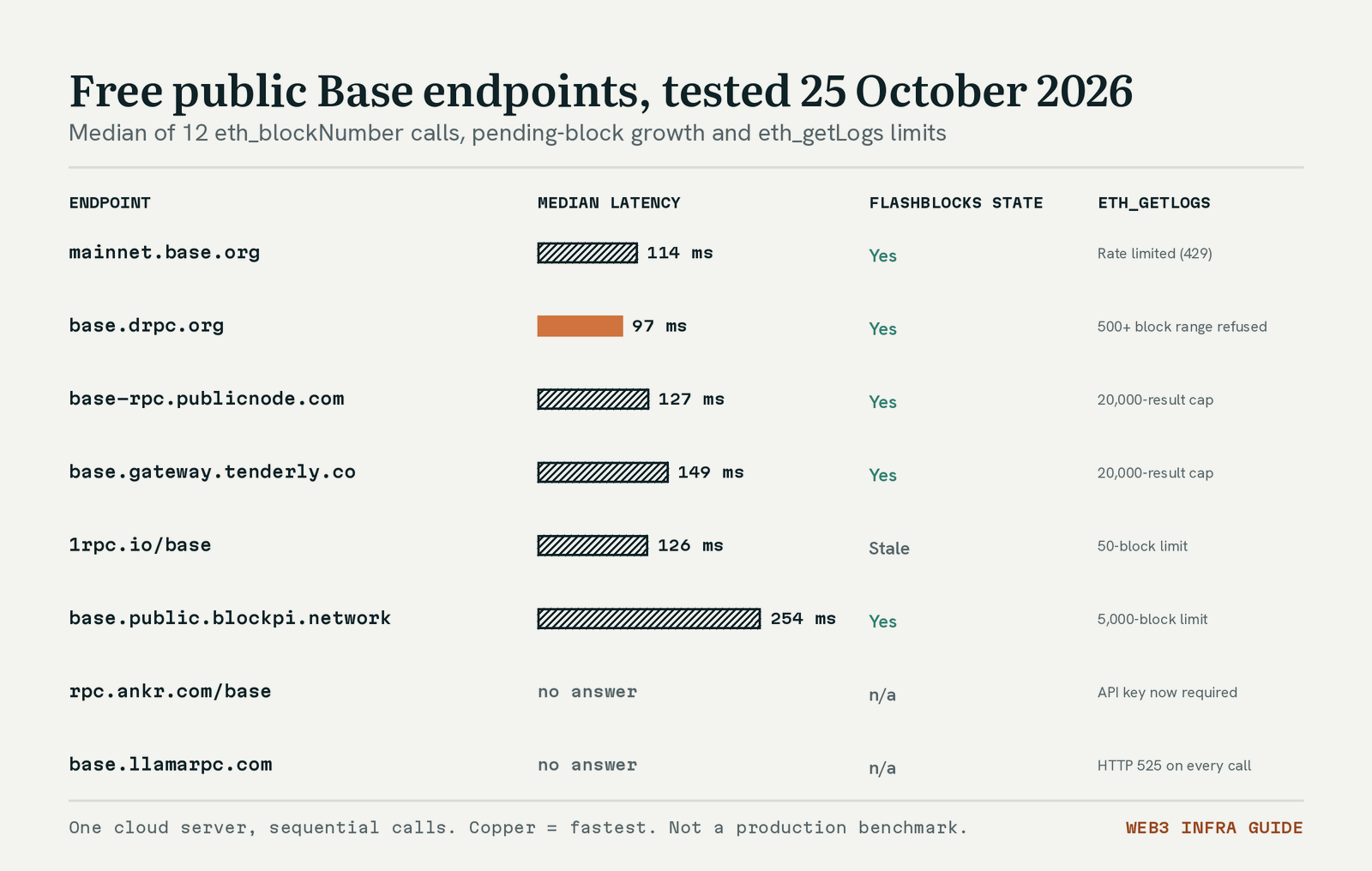
We tested eight free public Base endpoints on 25 October 2026 from one cloud server. We timed 12 eth_blockNumber calls each, polled the pending block every 150ms for Flashblocks growth, and probed eth_getLogs limits. Five endpoints served live Flashblocks state, with up to seven distinct transaction counts inside one pending block.
| Endpoint | Median, p90 | Flashblocks state | eth_getLogs | Archive at block 1M |
|---|---|---|---|---|
| mainnet.base.org | 114 ms, 123 ms | Yes | HTTP 429 even at 100 blocks | Yes |
| base.drpc.org | 97 ms, 108 ms | Yes | 100 blocks ok, 500 refused | Yes |
| base-rpc.publicnode.com | 127 ms, 131 ms | Yes | 20,000-result cap | No (403) |
| base.gateway.tenderly.co | 149 ms, 168 ms | Yes | 20,000-result cap | Yes |
| base.public.blockpi.network | 254 ms, 268 ms | Yes | 5,000-block cap | No (pruned) |
| 1rpc.io/base | 126 ms, 165 ms | No, pending 712 blocks behind | 50-block cap | Not tested |
| rpc.ankr.com/base | No answer | n/a | API key now required | n/a |
| base.llamarpc.com | No answer | n/a | HTTP 525 on every call | n/a |
Two findings matter for production. Base’s own endpoint is fast but throttled, which matches its FAQ, and Ankr’s public Base endpoint now requires an API key. Latency from one server says little about your users’ regions, so repeat the test from where your backend runs.
Verdict: Use public endpoints for prototypes and as a last fallback only. Put production reads, logs and WebSocket subscriptions on a paid provider.
1. Chainstack
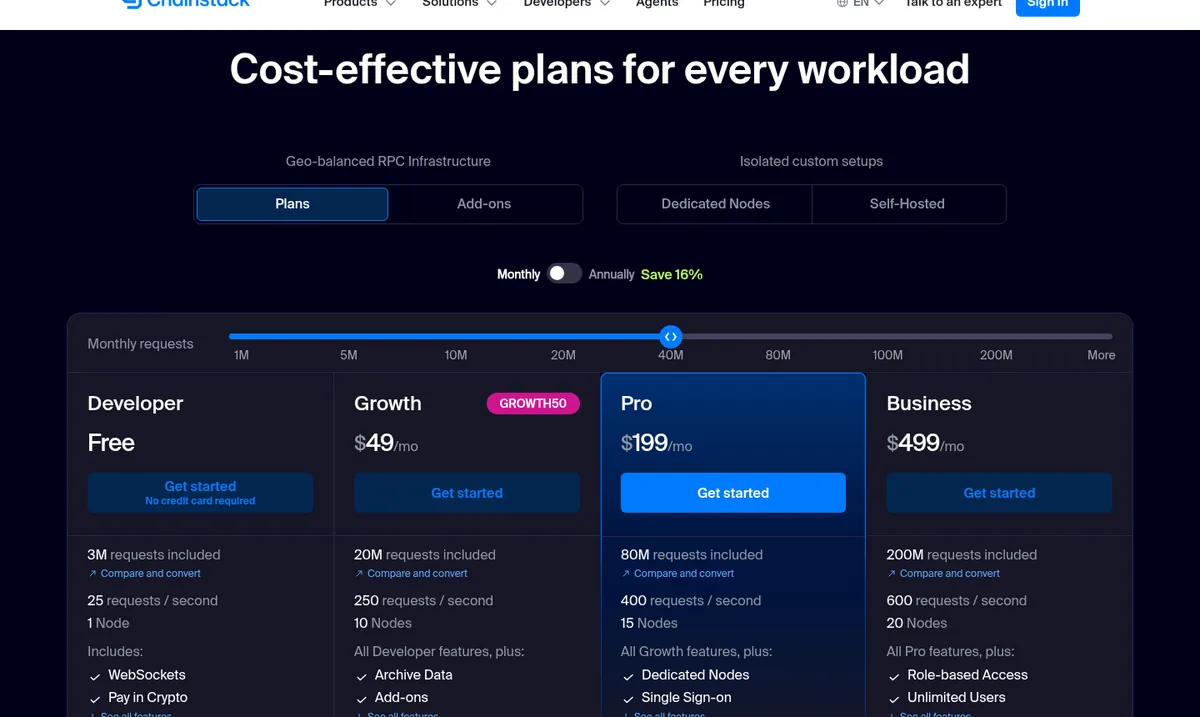
- Plans: Developer free (3M RU, 25 rps), Growth $49 (20M, 250 rps), Pro $199 (80M, 400 rps), Business $499 (200M, 600 rps), Enterprise $990 (400M). Overage runs $15, $12.50, $10 and $5 per 1M RU.
- Meter: 1 RU per full-node call and 2 RU for archive and
debug_*ortrace_*calls, per its request unit rules. - Base depth: archive data, Debug and Trace APIs, dedicated nodes and a private transaction submission path, per its Base page. Its Flashblocks guide expects 300 to 500ms confirmations against about 2,000ms and supports
eth_sendRawTransactionSync. - Weaknesses: the free tier is smaller than Alchemy’s, and Growth overage costs six times the included rate.
Verdict: Chainstack scores 9.2. It had the lowest bill in all three Base workloads and pairs that with SOC 2 Type II and ISO 27001. See its entry in our full RPC ranking.
2. Alchemy
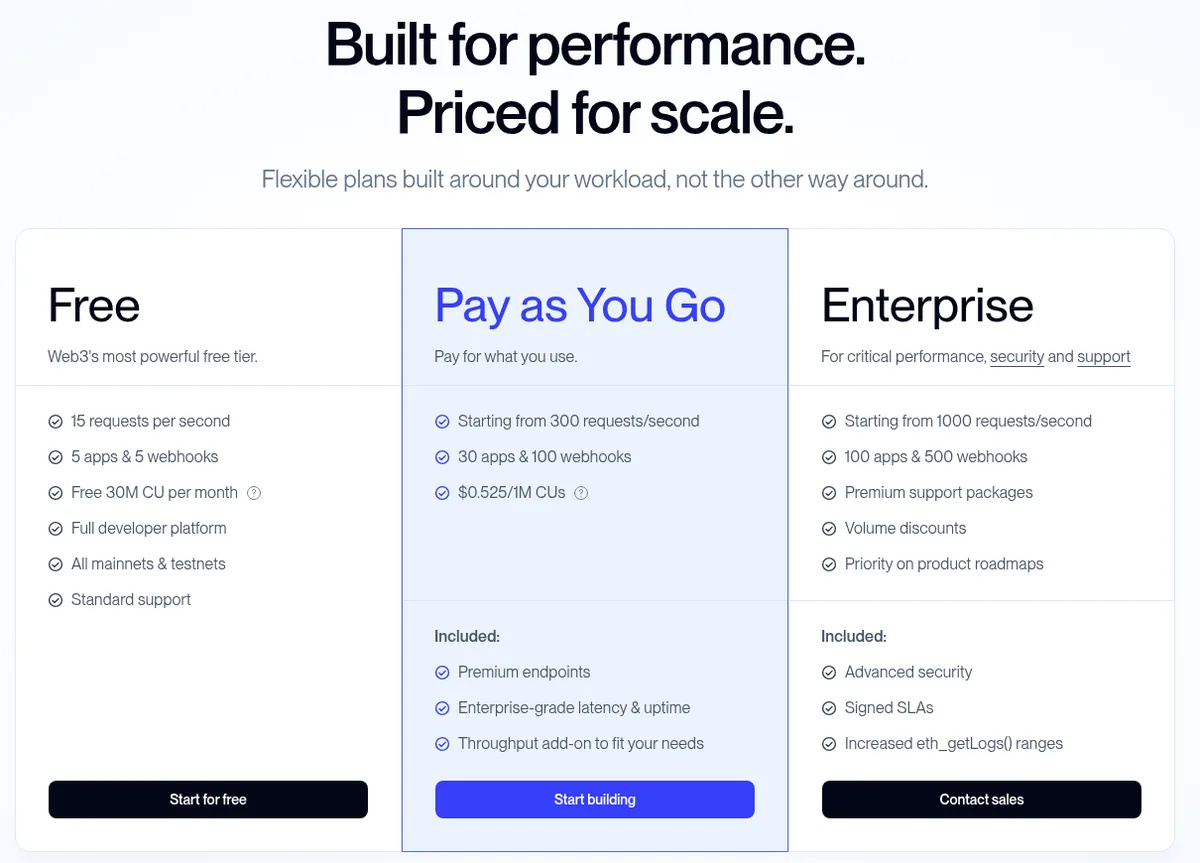
- Plans: Free (30M CU, 15 rps) and Pay as you go at $0.525 per 1M CU, with Enterprise for higher throughput and SLAs, per its pricing page.
- Meter: 10 CU for
eth_blockNumber, 20 for balances and receipts, 26 foreth_call, 40 for sends and 60 foreth_getLogs, per its compute unit table. - Flashblocks: supported on Base Mainnet and Sepolia with the existing endpoint, including
eth_simulateV1, per its Flashblocks quickstart. - Weaknesses: $13.60 per million app calls and $20.27 per million indexer calls on pay as you go, and throughput is capped per account.
Verdict: Alchemy scores 8.3. Pick it to launch on the free tier or when its app tooling saves engineering time. See its entry in our full RPC ranking.
3. GetBlock
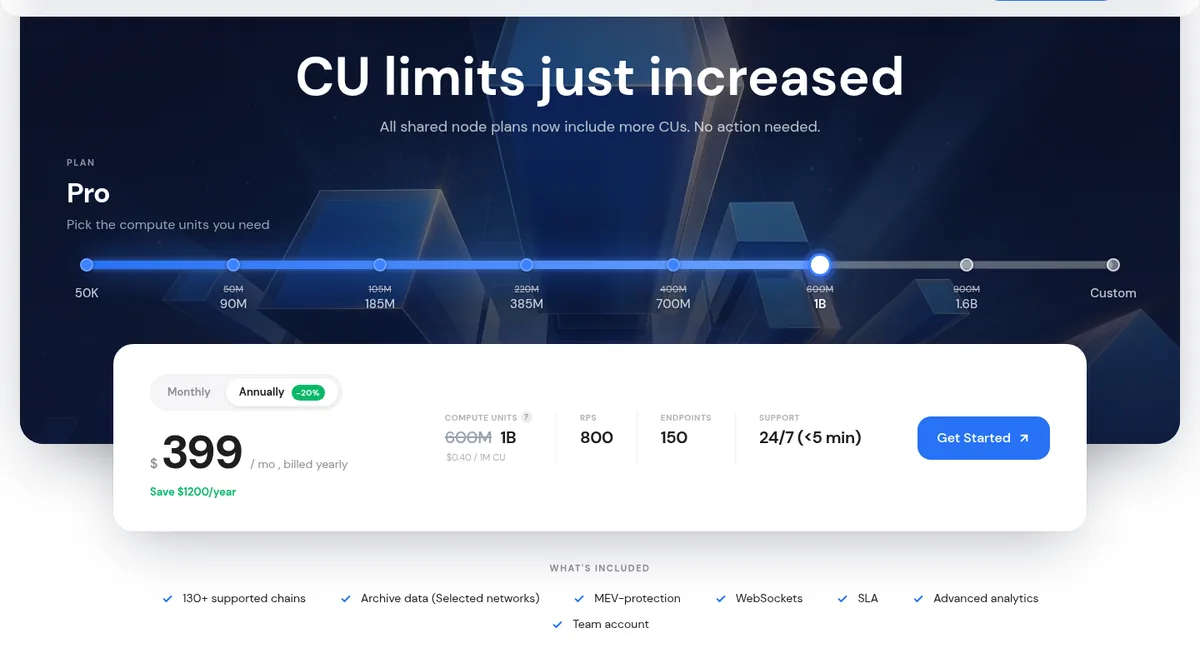
- Plans: Starter $49 (90M CU, 250 rps), Growth $99 (185M), Advanced $199 (385M), Scale $349 (700M), Pro $499 (1B CU, 800 rps, $0.40 per 1M overage) and Premium $699 (1.6B, $0.35). The free tier has 50K CU.
- Meter: chain multiplier 20 for Base, method multiplier 2 for debug and trace, and x2 for archive, per its CU rules.
- Flashblocks: documented on a shared Frankfurt (eu-central-1) endpoint, per its Base Flashblocks guide.
- Weaknesses: archive doubling put our indexer at $1,539, and lower plans have no overage, so you must size the plan up front.
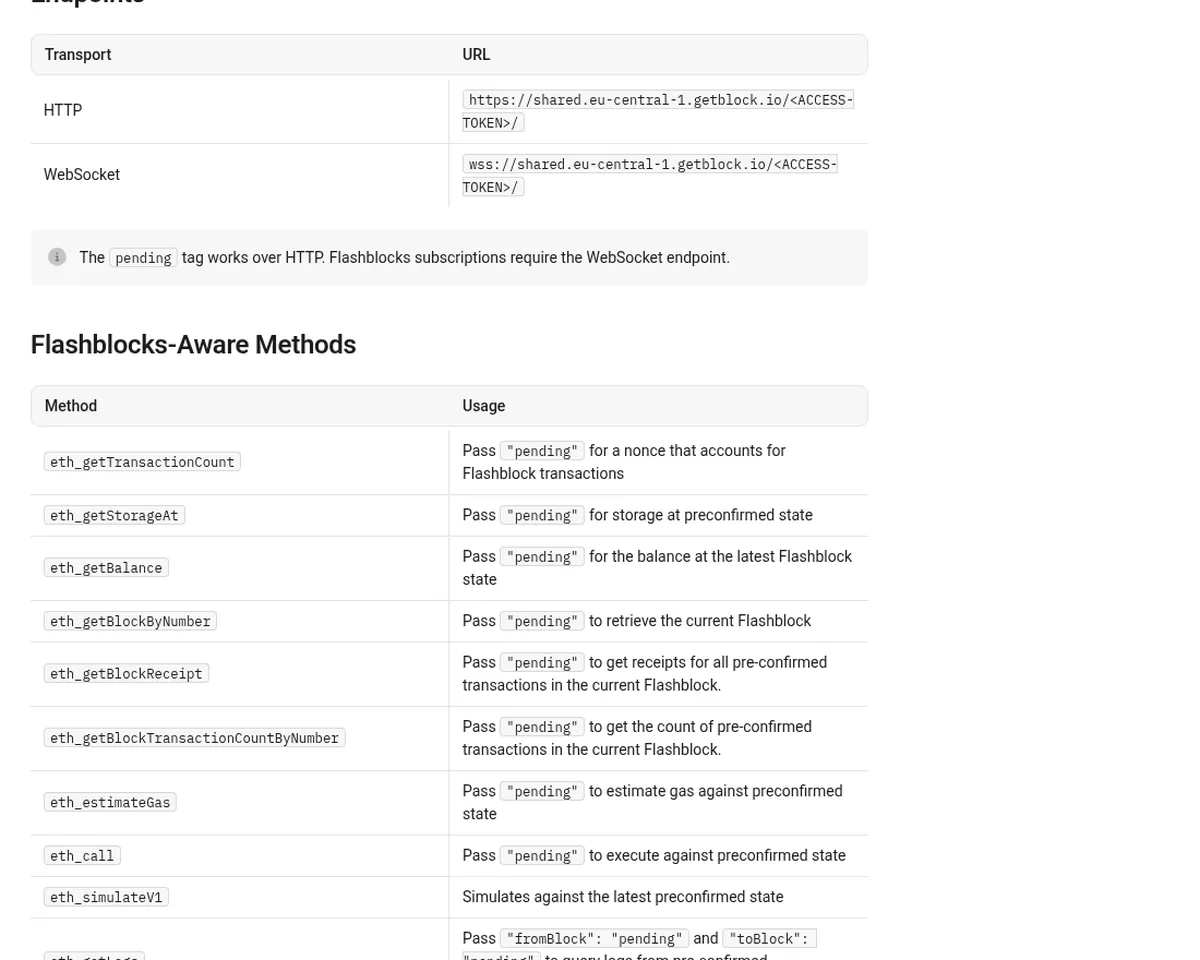
Verdict: GetBlock scores 8.0, tied with QuickNode and ahead on price. Pick it when uptime matters most. See its entry in our full RPC ranking.
4. QuickNode
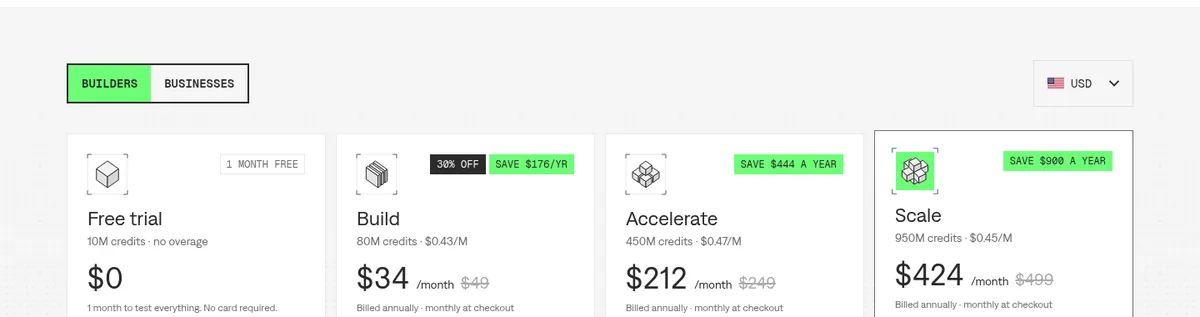
- Plans: Build $49 (80M credits, 50 rps), Accelerate $249 (450M, 125 rps), Scale $499 (950M, 250 rps) and Business $999 (2B, 500 rps). Overage runs $0.62 to $0.50 per 1M credits. The free trial gives 10M credits for one month.
- Meter: 20 credits for every Base method, per its Base credit page, or $12.25 per million calls on Build.
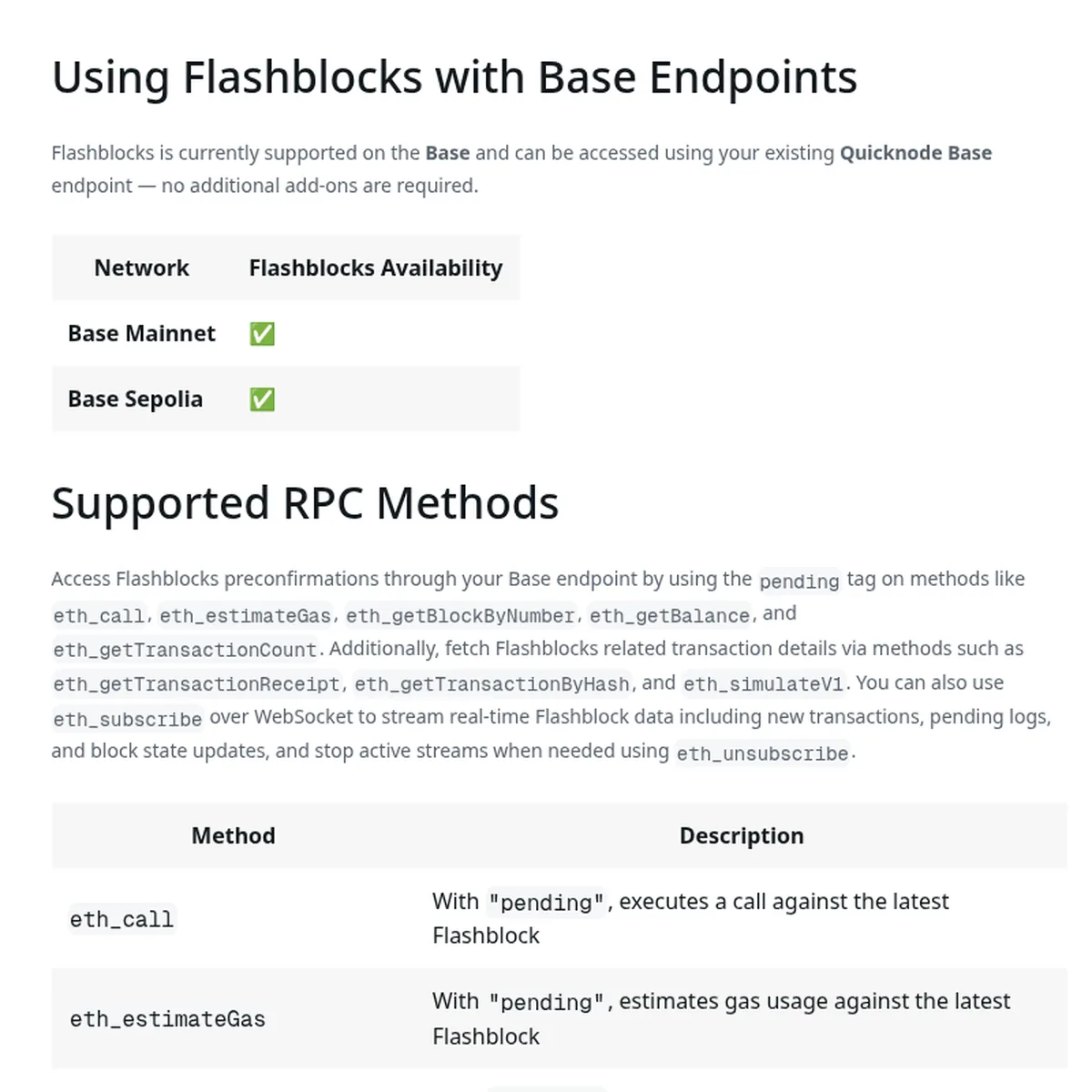
- Flashblocks: on the existing endpoint with no add-on, plus
base_transactionStatusandbase_sendRawTransactionValidity, per its Flashblocks docs. - Weaknesses: Build caps throughput at 50 requests per second, and our trading bot needed Scale at $632.
Verdict: QuickNode scores 8.0. Pick it when audits, Streams and Base-specific transaction methods matter more than price. See its entry in our full RPC ranking.
5. dRPC
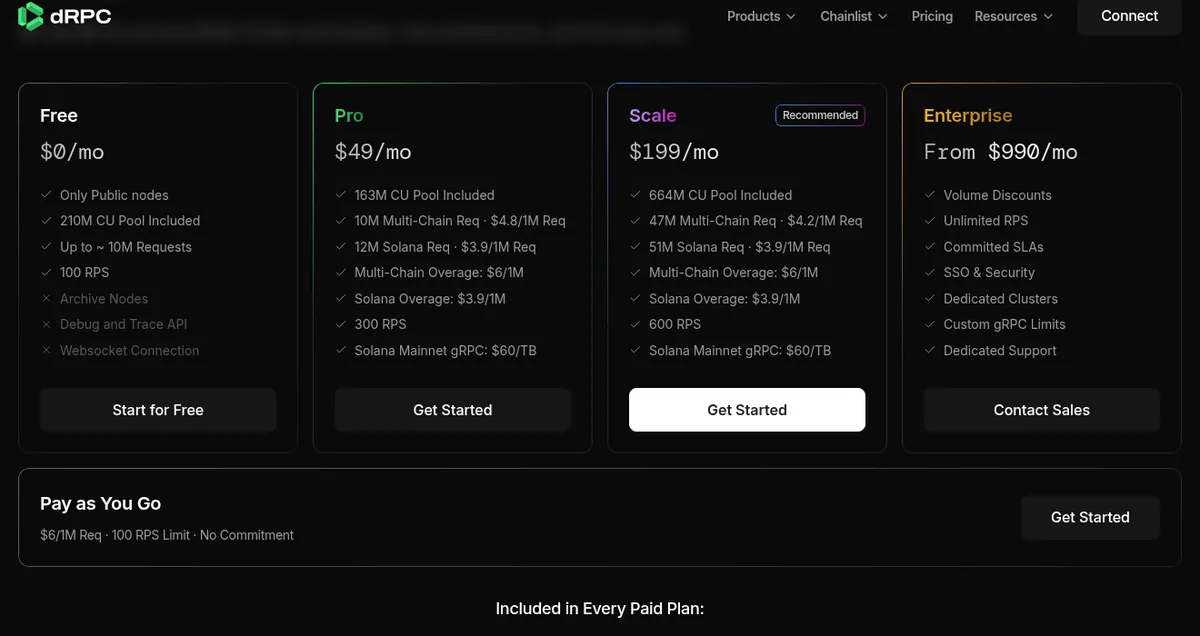
- Plans: Free on public nodes (210M CU, 100 rps), Pro $49 (about 10M requests, 300 rps), Scale $199 (about 47M requests, 600 rps), Enterprise from $990. Overage and pay as you go cost $6 per 1M requests.
- Meter: $0.30 per 1M CU, flat across methods, per its compute unit page, or $4.80 per million calls on Pro.
- Base access: Mainnet and Sepolia over HTTPS and WebSocket with archive, per its Base chain page. Base’s FAQ names dRPC as a Flashblocks provider.
- Weaknesses: no audit report on its own pages, no vendor Flashblocks guide, and its public node refused a 500-block log query.
Verdict: dRPC scores 7.6. Pick it for the cheapest flat meter when audit paperwork is not required. See its entry in our full RPC ranking.
6. Ankr
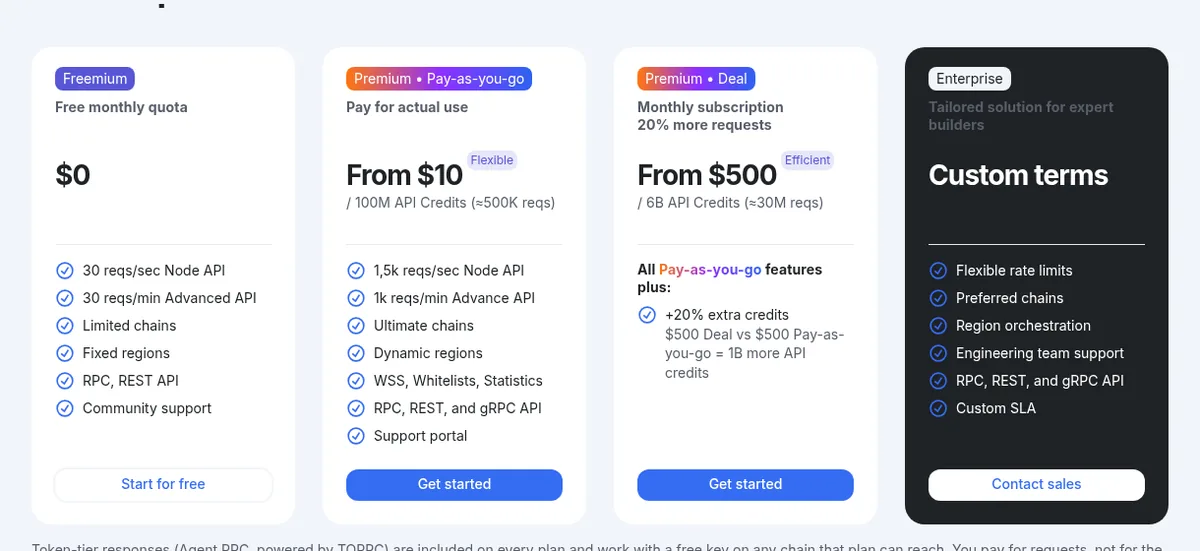
- Plans: Freemium (200M credits a month, 30 rps), Pay as you go from $10 per 100M credits at 1,500 rps, Deal from $500 for 6B credits plus 20% extra, and Enterprise, per its service plans.
- Strengths: one price for all methods, the highest pay as you go rate limit here, and SOC 2 Type II through its operator Asphere on its trust page.
- Weaknesses: the highest flat rate in this list, no Flashblocks docs, and a $900 bill for our trading bot.
Verdict: Ankr scores 6.0. It fits bursty, low-volume Base apps that need a high rate ceiling on prepaid credits. See its entry in our full RPC ranking.
7. Infura
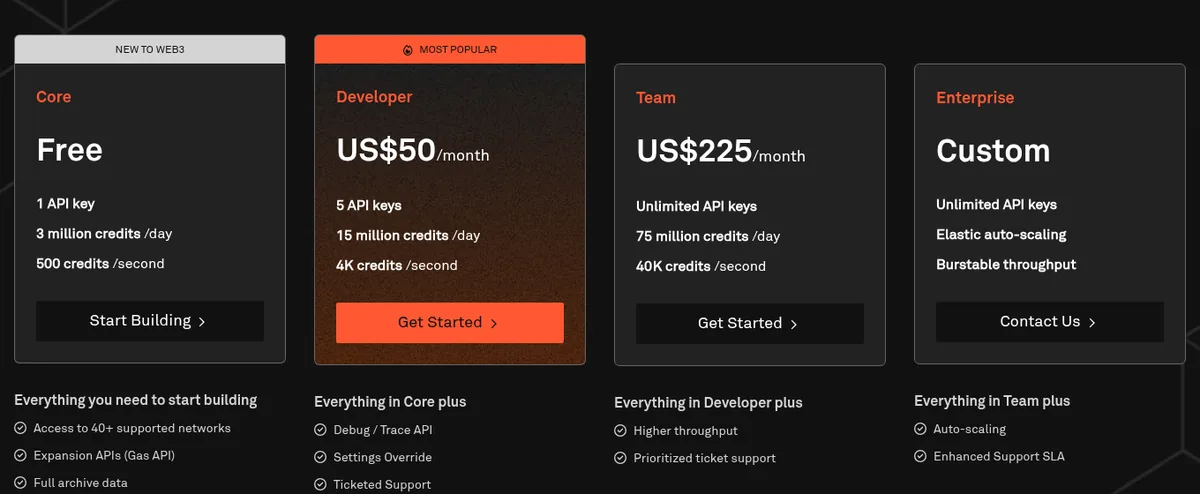
- Plans: Core free (3M credits a day), Developer $50 (15M a day) and Team $225 (75M a day), with Enterprise above.
- Meter: 80 credits for
eth_calland most reads, 255 foreth_getLogs, 300 for gas estimates and 1,000 fordebug_traceTransaction, per its credit cost table. - Base access: Mainnet and Sepolia endpoints on its Base reference.
- Weaknesses: requests fail once the daily quota is used, no vendor Flashblocks guide, and no SOC 2 or ISO 27001 report on its pages.
Verdict: Infura scores 5.9. It suits teams already on Consensys and MetaMask tooling with steady daily Base traffic. See its entry in our full RPC ranking.
Why CDP Node Is Not in the Ranking
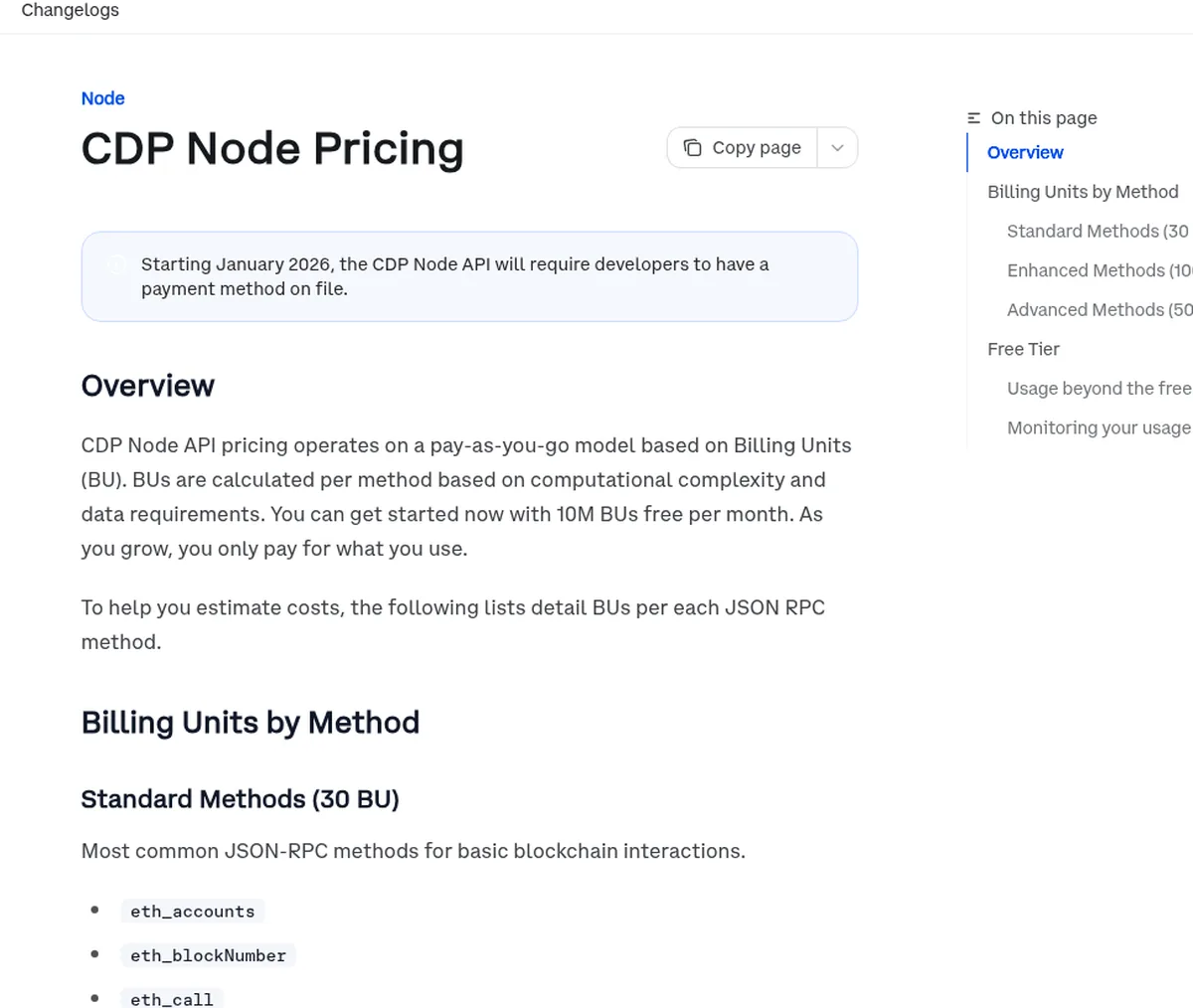
- Tiers: 30 BU for standard reads such as
eth_calland balances, 100 BU for receipts, logs, blocks and gas estimates, and 500 BU for debug, trace and sends. - Price: 10M BU free each month, then $0.50 per 1M BU, and a card has been required since January 2026.
- Limits: 7,500 BU per 5 seconds per project, about 50 standard calls per second, on Base Mainnet and Sepolia only.
- Our math: $35.50 per million app calls, $47.25 per million bot calls and $2,830 for our 60M-request trading bot.
Verdict: Use CDP Node for low-volume apps that lean on Coinbase’s Paymaster and wallet tools, with a cheaper provider for bulk reads. It scores 4.0.
Providers We Left Out
Dwellir, BlockPI and Tenderly serve Base, but they are not in our main ranking yet, so we have no comparable scores. Helius, Tatum, NOWNodes and Lava appear in our RPC node provider ranking, but Helius is Solana only and the rest scored too low or could not be priced on 25 October 2026.
Running your own Base node is the other route. Base publishes a Flashblocks-aware Reth build, but you then own storage, upgrades and the Denim migration. Our dedicated nodes hub covers when that starts to pay off.
Final Ranking
Chainstack wins on Base because it pairs the lowest meter with Flashblocks, archive, trace and audits on one plan, with no add-on fees for any of them. Alchemy and QuickNode trade price for tooling, GetBlock for uptime, and dRPC for a flat price without audits.


Verdict: Run production Base traffic on Chainstack, or Alchemy while you fit its free tier, and keep QuickNode or dRPC as the fallback. Recheck Flashblocks code before Denim reaches Base Mainnet.
How to Set Up a Base RPC Fallback
Two providers behind one client cover outages, rate limits and the odd lagging node. In ethers v6, a FallbackProvider sends each call to the highest-priority healthy endpoint and fails over when it stalls. Put your cheapest Flashblocks-aware provider first and a second vendor behind it.
import { FallbackProvider, JsonRpcProvider } from "ethers";

const base = { chainId: 8453, name: "base" };
const provider = new FallbackProvider([
  { provider: new JsonRpcProvider(process.env.PRIMARY_BASE_URL, base, { staticNetwork: true }), priority: 1, weight: 2, stallTimeout: 400 },
  { provider: new JsonRpcProvider(process.env.BACKUP_BASE_URL, base, { staticNetwork: true }), priority: 2, weight: 1, stallTimeout: 800 },
], base, { quorum: 1 });

const pendingNonce = await provider.getTransactionCount(wallet, "pending");
To check that an endpoint serves Flashblocks state, poll the pending block a few times inside 2 seconds. If the transaction count grows while the block number stays the same, the node is Flashblocks-aware.
curl -s -H "Content-Type: application/json" \
  -d '{"jsonrpc":"2.0","id":1,"method":"eth_getBlockByNumber","params":["pending",false]}' \
  "$BASE_RPC_URL" | jq '.result.number, (.result.transactions | length)'
For streaming, open a WebSocket to your provider and subscribe to pre-confirmed blocks. Keep a newHeads subscription alongside it, because that is the path that survives Denim.
{"jsonrpc":"2.0","id":1,"method":"eth_subscribe","params":["newFlashblocks"]}Frequently Asked Questions
What is the best Base RPC provider in 2026?
On our weighted scorecard, Chainstack is the best Base RPC provider at 9.2 out of 10. It bills 1 request unit per Base call, serves Flashblocks on every Base endpoint, offers archive, debug and trace, and states SOC 2 Type II and ISO 27001. Alchemy is second at 8.3.
What is the cheapest Base RPC provider?
Chainstack had the lowest bill in all three of our Base workloads: $49 for a 10M-request app, $199 for a 60M-request trading bot and $499 for a 100M-request indexer. dRPC matched it at $49 for the app and is the cheapest flat meter at $4.80 per million calls.
Which RPC providers support Base Flashblocks?
Chainstack, Alchemy, QuickNode and GetBlock publish their own Base Flashblocks guides, and Base’s FAQ also names Infura and dRPC. Flashblocks-aware endpoints expose 200ms pre-confirmed state through the pending tag and WebSocket subscriptions such as newFlashblocks. None of the four charges an add-on fee for it.
Is the public Base RPC endpoint good enough for production?
No. Base says mainnet.base.org is explicitly rate limited and recommends a provider or your own node for production. In our test it answered eth_blockNumber in 114ms but returned HTTP 429 on log queries. Base also runs no free public WebSocket endpoint, so subscriptions need a provider.
What happens to Flashblocks after the Denim upgrade?
Base plans to replace Flashblocks with canonical 200ms blocks in the Denim hardfork. Chainstack reports Denim went live on Base Sepolia on 21 October 2026, with Base Mainnet targeted for November 2026. Apps should move from pending-state reads and Flashblocks subscriptions to newHeads, logs and regular calls.
How much does CDP Node cost for Base?
CDP Node gives 10M billing units free each month, then charges $0.50 per million. Reads cost 30 units, logs and receipts 100, and sends, debug and trace 500. That is $35.50 per million calls in our app mix and $2,830 a month for our 60M-request trading bot.