
Last updated: 25 October 2026 · Prices, method weights, plan limits and chain lists rechecked on vendor pages on 25 October 2026
The best Alchemy alternatives in 2026 for multi-chain teams are Chainstack for overall value, dRPC for the cheapest bill when Solana is in the mix, and GetBlock and QuickNode for latency and audits across many chains. We ranked eight providers on the same six weighted criteria as our main RPC ranking, priced three multi-chain workloads on every meter and checked 13 chains against each vendor’s own list.
Alchemy is a strong default: it scores 8.3 in our ranking of the 12 best RPC node providers and has the most useful free tier we found. Teams usually look elsewhere when its per-method compute units, account-wide throughput cap or single-vendor dependence start to hurt. Our methodology page explains how we collect prices and screenshots. Teams leaving Infura face a similar choice, covered in our Infura alternatives guide.
TL;DR
- Overall: 1. Chainstack (8.6), 2. dRPC (7.9), 3. GetBlock (7.8), 4. QuickNode (7.7), 5. Helius (7.0, Solana only), 6. Ankr (6.3), 7. Infura (6.1), 8. NOWNodes (5.8). Alchemy scores 8.3 on the same weights.
- One million blended EVM dApp calls cost $13.60 on Alchemy pay as you go, against $2.45 on Chainstack Growth and $4.80 on dRPC Pro. On Solana, Alchemy is cheaper at $8.40, but Chainstack ($2.70) and dRPC ($3.90) still undercut it.
- Our 30M-request multi-chain dApp, 70% EVM and 30% Solana, costs $361 a month on Alchemy, $154 on dRPC and $199 on Chainstack. Infura cannot serve it without Solana access, and Helius cannot serve the EVM side.
- Chainstack, dRPC, GetBlock, QuickNode and NOWNodes list all 13 chains in our set, as does Alchemy. Ankr lists 12, Infura 8 with limited Solana access, and Helius 1.
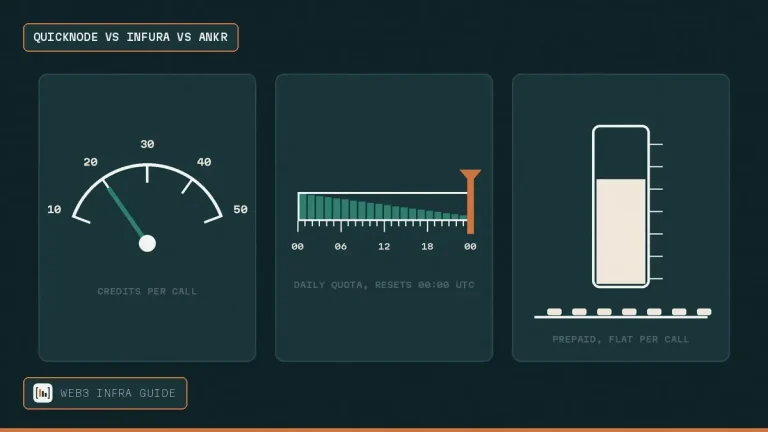
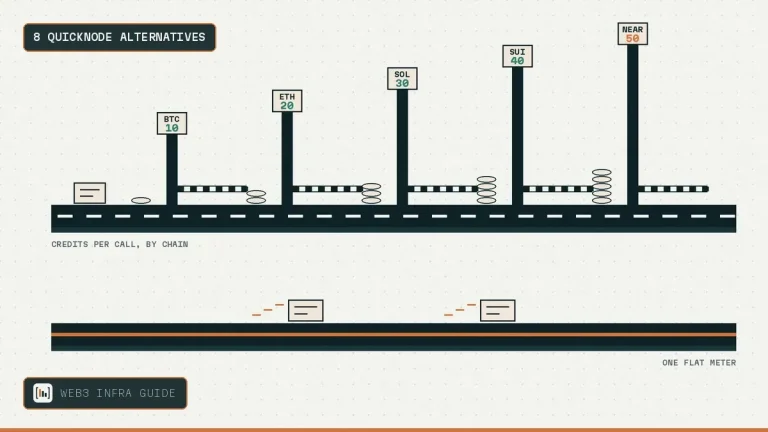
- Chain matters on two meters: GetBlock charges 50 CU for a Solana call and 100 for Sui against 20 for Ethereum, and QuickNode 30 and 40 credits against 20.
- Alchemy caps throughput in compute units per second across the whole account, so one busy app can push every other app into HTTP 429 errors.
The Decision Kernel
Pick the replacement by the reason you are leaving Alchemy and by the chains you run. Log-heavy apps need a flat meter, and throttled apps need a higher request ceiling. Export one month of Alchemy usage by chain and method before you price any alternative. The shortcuts below cover the common cases.
- Lowest bill across EVM chains, with audits: Chainstack, at 1 request unit per call on every chain and SOC 2 Type II plus ISO 27001.
- EVM plus Solana on one cheap pool: dRPC, which draws Ethereum and Solana calls from one compute unit pool at $4.80 and $3.90 per million on Pro.
- Top reliability across many chains: GetBlock, with 130+ chains, the top reliability score and SOC 2 Type II, as long as you avoid its heavy chain multipliers.
- Widest audit set and add-on marketplace: QuickNode, which lists SOC 1 Type 2, SOC 2 Type 2 and ISO 27001.
- Solana-heavy products: Helius for the Solana leg, paired with an EVM provider from this list.
- Simple per-request billing in euros: NOWNodes, where any call on any chain counts as one request.
Verdict: Chainstack for most multi-chain EVM teams, dRPC when Solana is a big share of traffic, QuickNode when audits and add-ons matter more than price. Keep Alchemy or a second provider as a fallback endpoint either way. Our QuickNode vs Alchemy vs Chainstack comparison goes deeper on the top three, and our Base RPC providers ranking covers Base specifically.
How We Ranked the Alchemy Alternatives
We scored each provider from 1 to 5 on six weighted criteria, doubled. The weights and criterion scores are the same as in our 12-provider RPC ranking, so Alchemy sits on the same scale as its rivals. Every price, weight, limit and chain claim links to a vendor page checked on 25 October 2026. See our methodology page.
- Price per call, 25%: monthly bills for common method mixes, converted from each vendor’s billing unit.
- Reliability, 20%: public latency benchmarks, uptime claims, SLAs and support response targets.
- Compliance, 15%: SOC 2, ISO 27001 and other audits stated on the vendor’s own pages.
- Features, 15%: debug and trace APIs, archive data, WebSockets, streaming, dedicated nodes and data APIs.
- Coverage, 15%: how many chains one account reaches, including non-EVM chains.
- Free tier, 10%: how many real calls a team can make before paying.
| Provider | Price (25%) | Reliability (20%) | Compliance (15%) | Features (15%) | Coverage (15%) | Free tier (10%) | Score |
|---|---|---|---|---|---|---|---|
 | 5 | 4 | 5 | 4 | 4 | 3 | 8.6 |
 | 5 | 4 | 2 | 3 | 5 | 4 | 7.9 |
 | 3 | 5 | 4 | 4 | 5 | 2 | 7.8 |
 | 3 | 4 | 5 | 5 | 4 | 2 | 7.7 |
 | 5 | 3 | 3 | 5 | 1 | 3 | 7.0 |
 | 2 | 3 | 4 | 3 | 4 | 4 | 6.3 |
 | 4 | 3 | 1 | 3 | 3 | 4 | 6.1 |
 | 4 | 3 | 1 | 2 | 5 | 1 | 5.8 |
 | 3 | 4 | 4 | 5 | 5 | 5 | 8.3 |
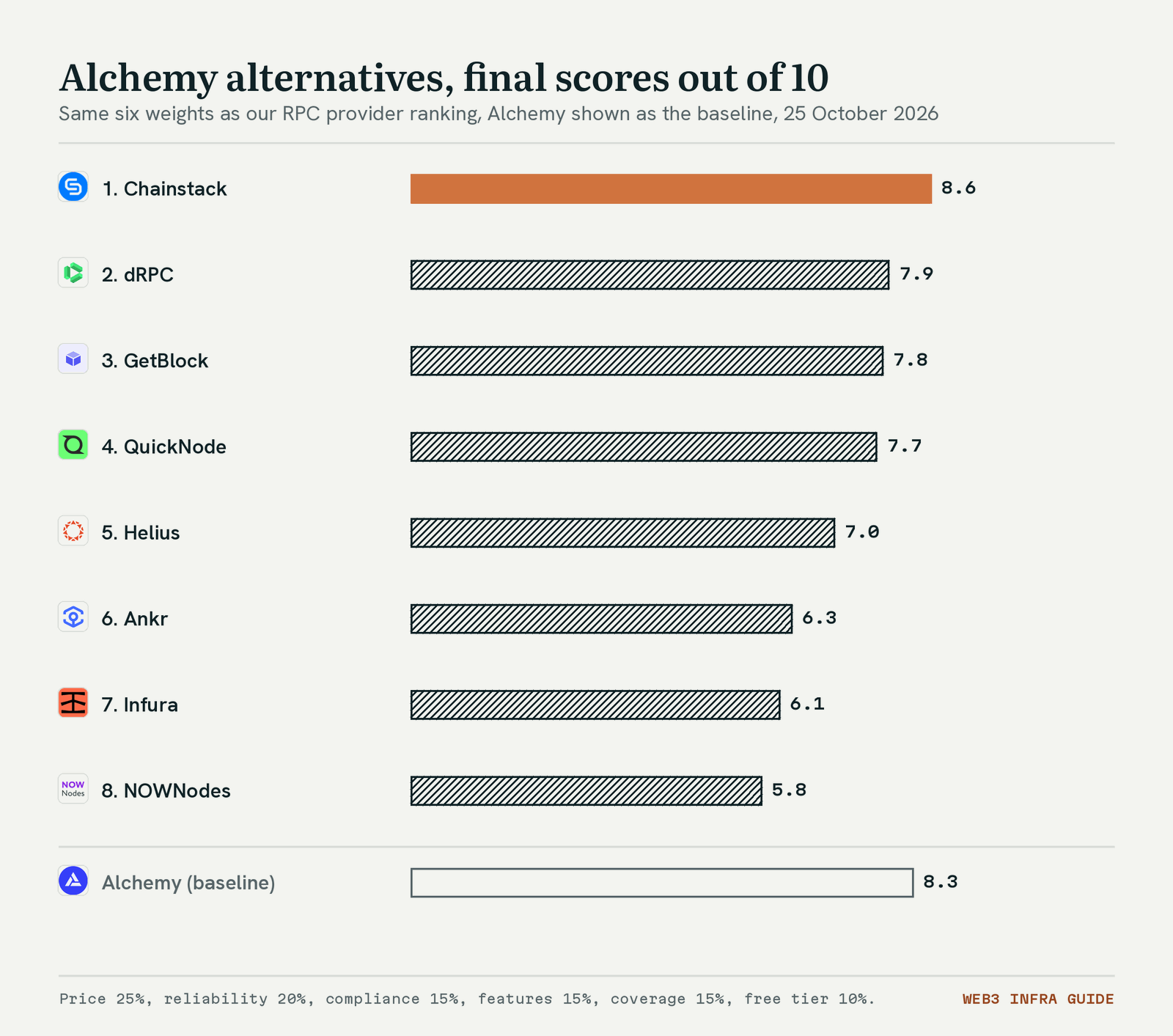
Only Chainstack outscores Alchemy overall. The others win on one axis, such as price, latency, audits or Solana depth, and lose on another, which is why the right pick depends on your traffic.
Why Multi-Chain Teams Move Off Alchemy
Alchemy pairs node access with data APIs, webhooks, wallets and account abstraction tooling, and it lists all 13 chains in our set on its supported chains page. Three traits push growing multi-chain teams to price alternatives. A single eth_getLogs call costs 60 compute units, so one million log queries cost $31.50 on pay as you go.
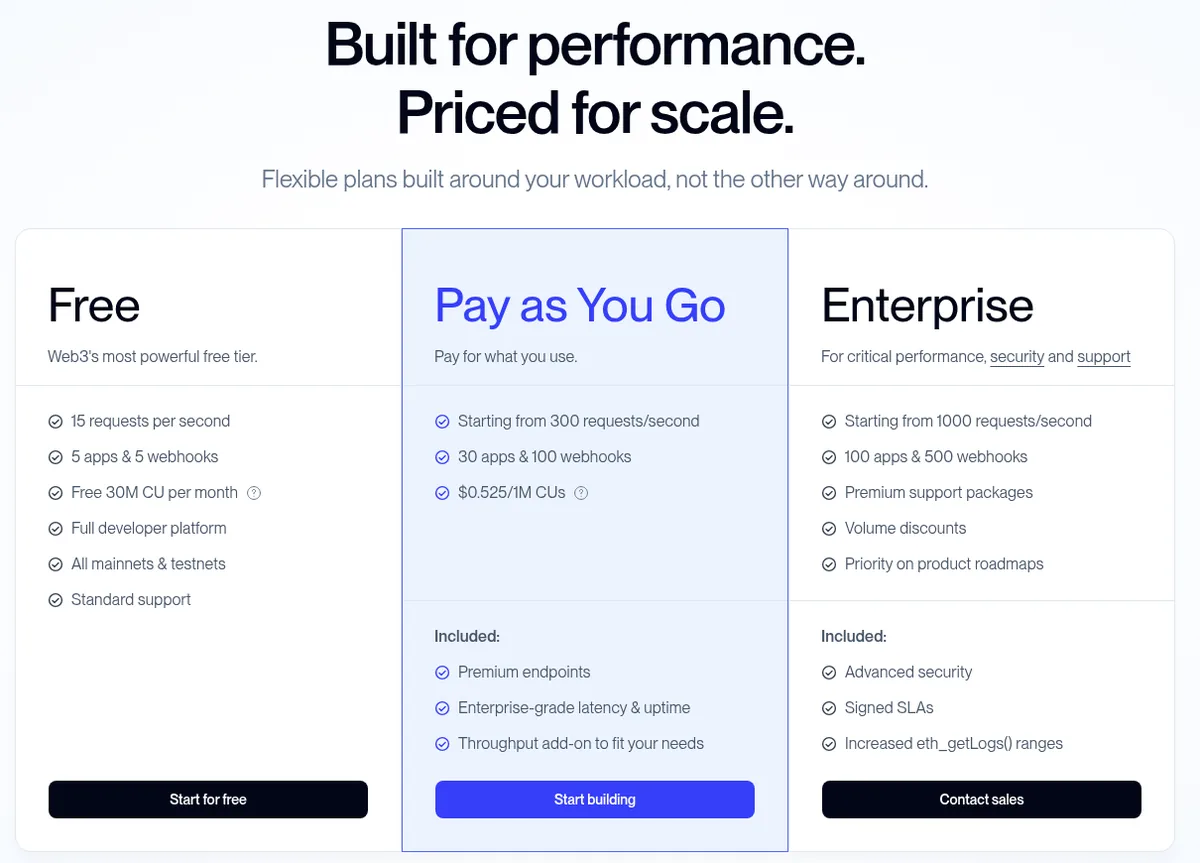
- Plans: Free (30M compute units a month, 15 requests per second, 5 apps), Pay as you go at $0.525 per 1M CU from 300 requests per second with 30 apps, and Enterprise from 1,000 requests per second with signed SLAs and larger
eth_getLogsranges. - Method weights: 10 CU for
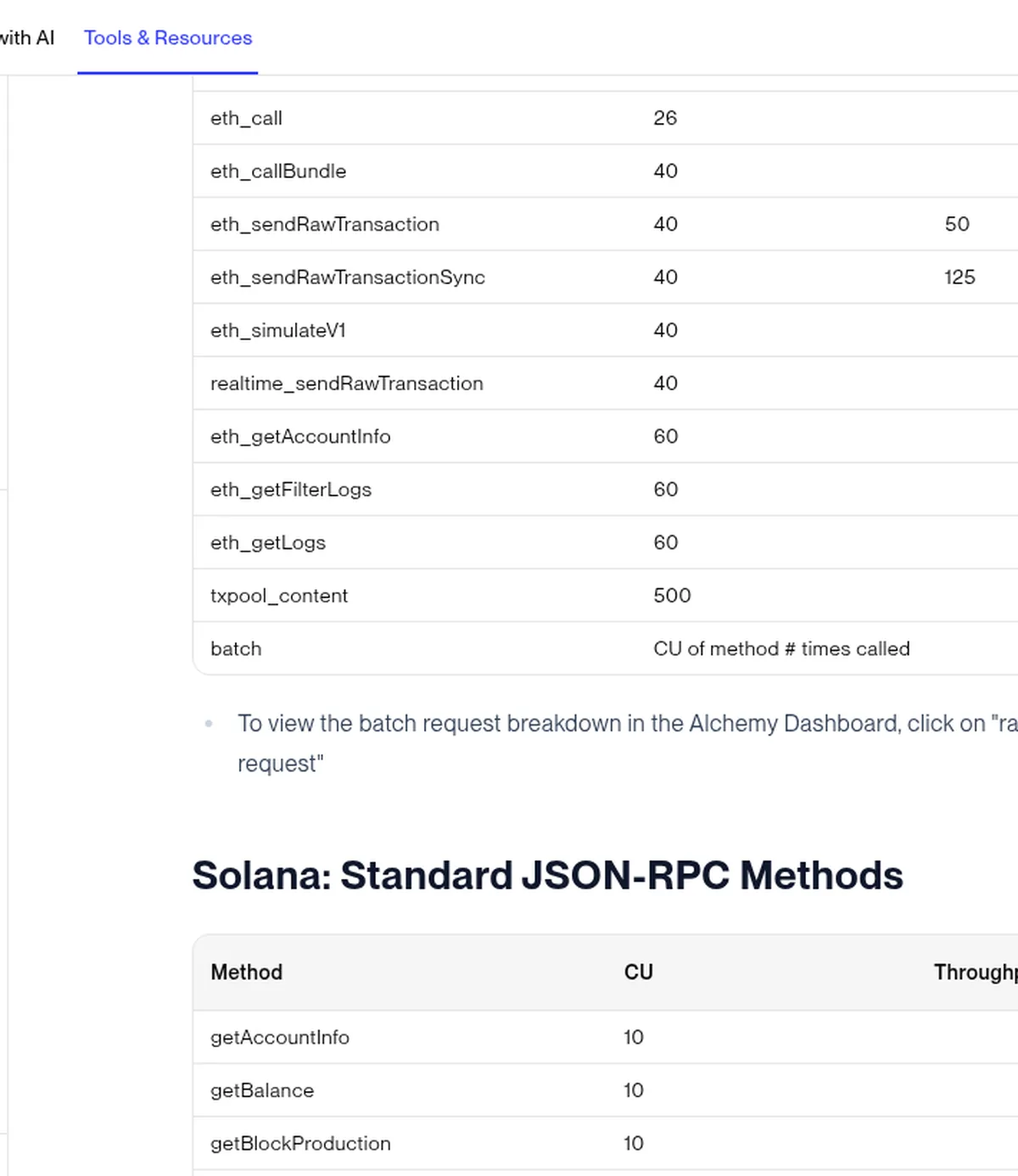
eth_blockNumber, 20 for balances and receipts, 26 foreth_call, 40 for sends and 60 foreth_getLogs. Solana reads such asgetAccountInfocost 10 CU, per its compute unit table. - Throughput: limits are set in compute units per second at the account level over a 10-second window, so every app shares one budget and excess calls return HTTP 429, per its throughput docs. Pay as you go sells more in blocks of 5,000 CU per second for $160 a month.
- Gaps: Debug and Trace APIs and private transactions are not on Free, request-log history is one hour on Free, and there is no fixed monthly plan to cap spend.
Verdict: Alchemy still suits teams that lean on its data APIs and free tier. Teams whose bills are mostly logs, sends and Solana history, or whose apps fight over one throughput budget, pay less on the providers below.
Alchemy Alternatives at a Glance
The table lines up each alternative’s billing unit, entry plan, free tier and chain reach. Fixed plans include a monthly allowance with overage above it, while Alchemy and Ankr bill pure usage with no monthly fee. Check the billing unit first, since a credit on one vendor is not a credit on another.
| Provider | Billing unit | Free tier | Entry paid plan | Chains in our 13 |
|---|---|---|---|---|
| Request units, 1 per call | 3M RU a month, 25 rps | Growth $49, 20M RU, 250 rps | 13 |
| Compute units, flat per request | 210M CU on public nodes, 100 rps | Pro $49, 163M CU, 300 rps | 13 |
| Compute units x chain multiplier | 50K CU free tier | Starter $49, 90M CU, 250 rps | 13 |
| API credits by chain | 10M credits, one-month trial | Build $49, 80M credits, 50 rps | 13 |
| Credits, Solana only | 1M credits, 10 rps | Developer $49, 10M credits, 50 rps | 1 |
| API credits, 200 EVM, 500 Solana | 200M credits a month, 30 rps | Pay as you go from $10 per 100M credits | 12 |
| Credits per method, daily quota | 3M credits a day | Developer $50, 15M credits a day | 8 |
| Requests | 100,000 requests for one month | Pro Plus €90, 10M requests | 13 |
| Compute units per method | 30M CU a month, 15 rps | Pay as you go, $0.525 per 1M CU | 13 |
Verdict: Chainstack and dRPC give the most calls for $49. QuickNode and GetBlock price by chain, so check where your traffic runs before you compare them.
What One Million Calls Cost on Each Chain Family
We converted each entry plan into the price of one million calls, using a typical dApp mix on EVM chains and a typical wallet mix on Solana. Alchemy is the fourth-cheapest meter for Solana wallet traffic at $8.40 per million, but the second most expensive for EVM traffic at $13.60.
The EVM mix is 40% eth_call, 15% balances, 15% block numbers, 10% receipts, 10% logs, 5% sends and 5% gas estimates.
| Entry plan | EVM dApp mix, per 1M | Solana wallet mix, per 1M |
|---|---|---|
| $2.45 | $2.70 |
| $4.80 | $3.90 |
| $10.07 | $10.07 |
| $10.89 | $27.22 |
| $12.06 | Select customers only |
| $12.25 | $18.38 |
| Not offered | $4.90 |
| $20.00 | $50.00 |
| $13.60 | $8.40 |
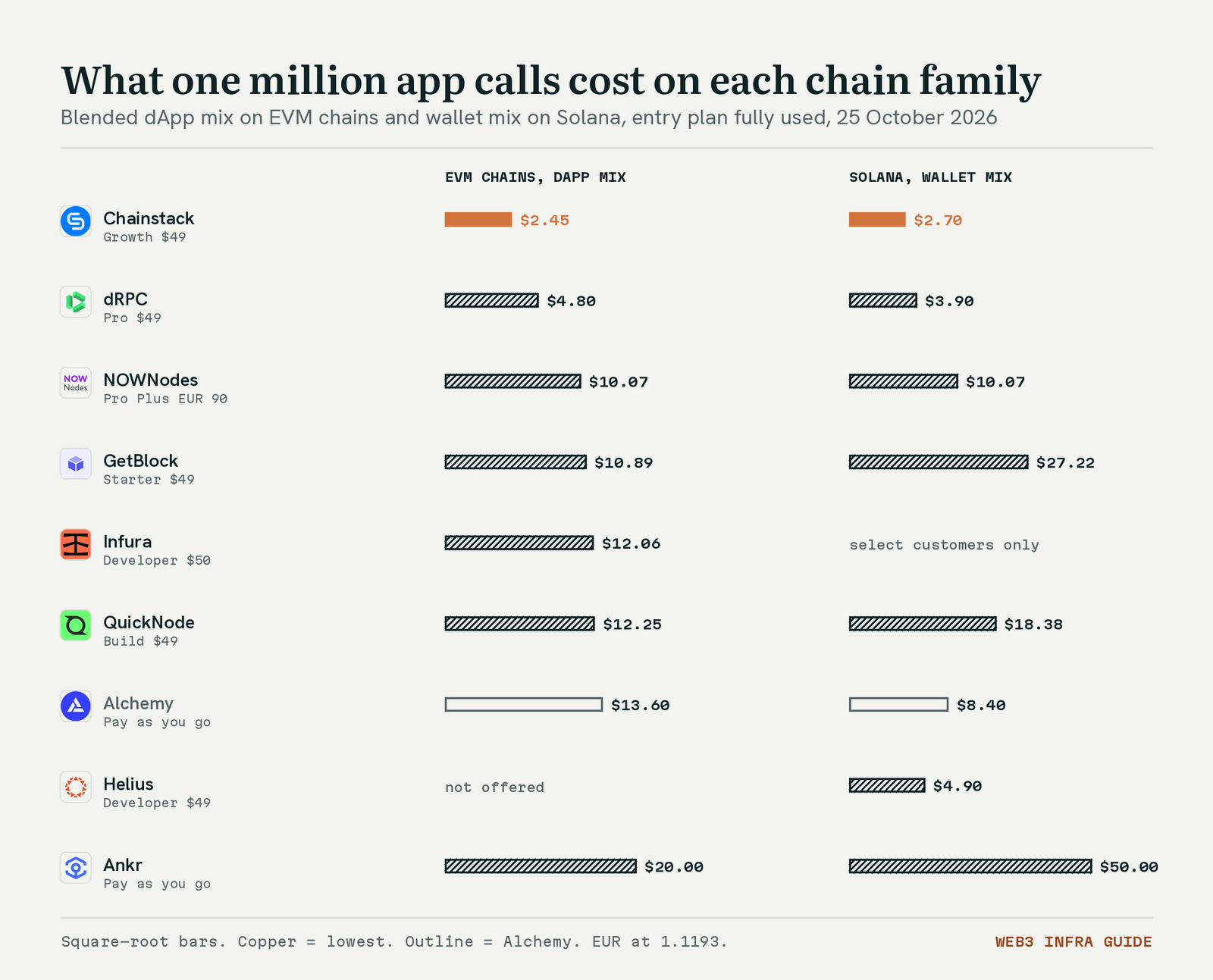
The Solana mix is 35% getAccountInfo, 20% balances, 15% token accounts, 10% blockhash, 10% signatures, 5% transactions and 5% sends. Chainstack charges 2 RU for signature lookups, which is why its Solana price is a little above its EVM price. Fixed plans only reach these rates when you use the whole allowance.
Verdict: On both chain families, Chainstack and dRPC are the two cheapest meters. Alchemy’s weights favor Solana reads, so a Solana-heavy team loses less by staying.
What Three Multi-Chain Workloads Cost
We built three traffic patterns, converted each into every vendor’s unit and picked the cheapest public plan that covers the volume and a peak of three times the average rate. dRPC had the lowest bill for both workloads that include Solana, and Chainstack the lowest for the EVM-only app at $49.
| Provider | EVM L2 app (Ethereum, Base, Arbitrum), 15M | Multi-chain dApp (4 EVM chains + Solana), 30M | Solana-first wallet with EVM support, 40M |
|---|---|---|---|
| $204 (Pay as you go) | $361 (Pay as you go) | $398 (Pay as you go) |
| $49 (Growth) | $199 (Pro) | $199 (Pro) |
| $79 (Pro) | $154 (Pro) | $179 (Pro) |
| $199 (Advanced) | $499 (Pro) | $713 (Premium) |
| $185 (Build) | $383 (Accelerate) | $568 (Scale) |
| Solana only | Solana only | Solana only |
| $300 (Pay as you go) | $625 (Deal ($500)) | $1,267 (Deal ($500)) |
| $225 (Team (busy days over quota)) | No public Solana access | No public Solana access |
| $224 (Business) | $224 (Business) | $336 (Business Plus) |
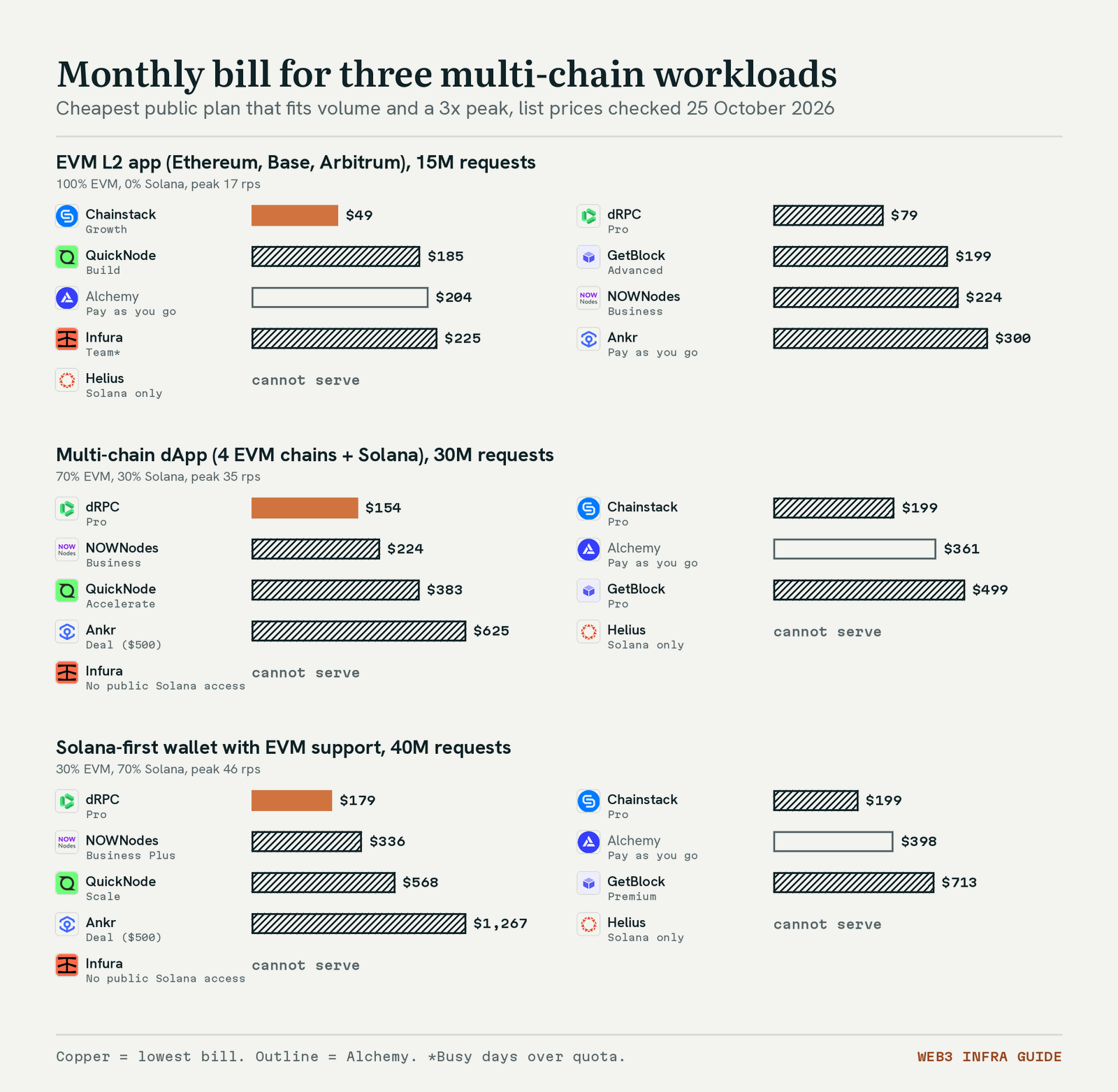
- EVM L2 app, 15M requests: Ethereum, Base and Arbitrum traffic with the dApp mix above. Peak of 17 requests per second.
- Multi-chain dApp, 30M requests: 70% EVM across Ethereum, Base, Arbitrum and Polygon, and 30% Solana with the wallet mix. Peak of 35 requests per second.
- Solana-first wallet, 40M requests: 70% Solana and 30% EVM. Peak of 46 requests per second.
Plan limits moved several answers. The multi-chain dApp needs 31M request units on Chainstack, so Pro at $199 beats Growth plus $15 per million overage. dRPC fits it on Pro with about 302M CU of overage, billed at $6 per million EVM requests and $3.90 per million Solana requests. GetBlock needs 870M CU because Solana weighs 50 CU, which lands on Pro at $499.
Verdict: For mixed EVM and Solana traffic, dRPC and Chainstack cost roughly half of Alchemy. For EVM-only apps, Chainstack is the clear low-cost pick.
Chain Coverage and Chain Multipliers
Multi-chain teams need two answers from each vendor: is the chain listed, and does a call on it cost more than a call on Ethereum. On GetBlock, one million Sui or Starknet calls cost five times as much as one million Ethereum calls. We checked 13 chains against each vendor’s own chain list.
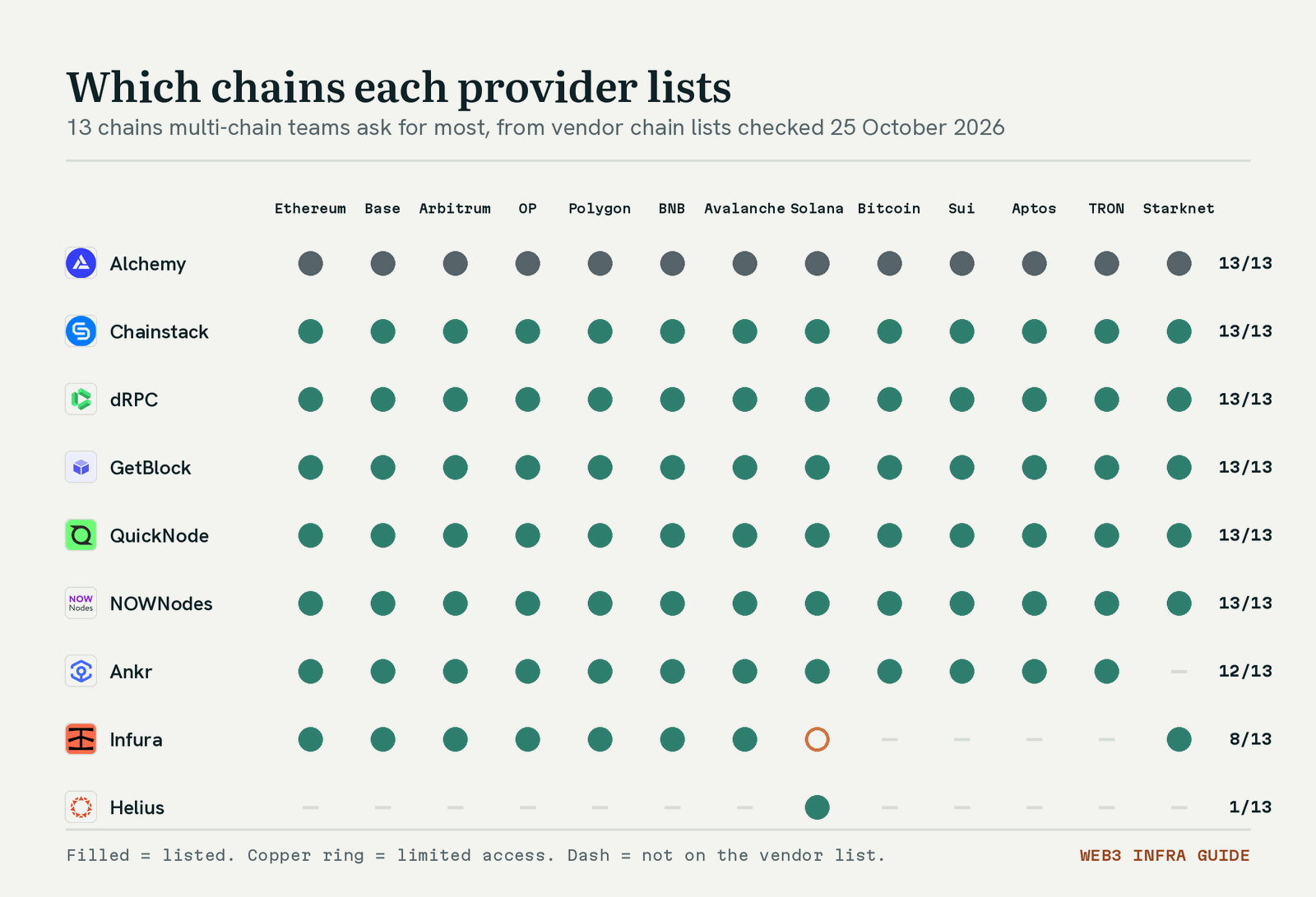
Infura lists Solana for select customers only on its endpoints page and does not list Bitcoin, Sui, Aptos or TRON. Ankr does not list Starknet on its chain list. Everyone else in our set lists all 13, though archive, trace and WebSocket support still varies by chain.
| Chain | QuickNode credits | GetBlock CU | QuickNode Build, per 1M | GetBlock Starter, per 1M | Ankr, per 1M |
|---|---|---|---|---|---|
| Bitcoin | 10 | 10 | $6.13 | $5.44 | $20.00 |
| Ethereum, Base, Arbitrum, OP, Polygon, BNB, Avalanche | 20 | 20 | $12.25 | $10.89 | $20.00 |
| Aptos | 10 | 20 | $6.13 | $10.89 | $20.00 |
| TRON | 30 | 20 | $18.38 | $10.89 | $20.00 |
| Solana | 30 | 50 | $18.38 | $27.22 | $50.00 |
| Sui | 40 | 100 | $24.50 | $54.44 | $20.00 |
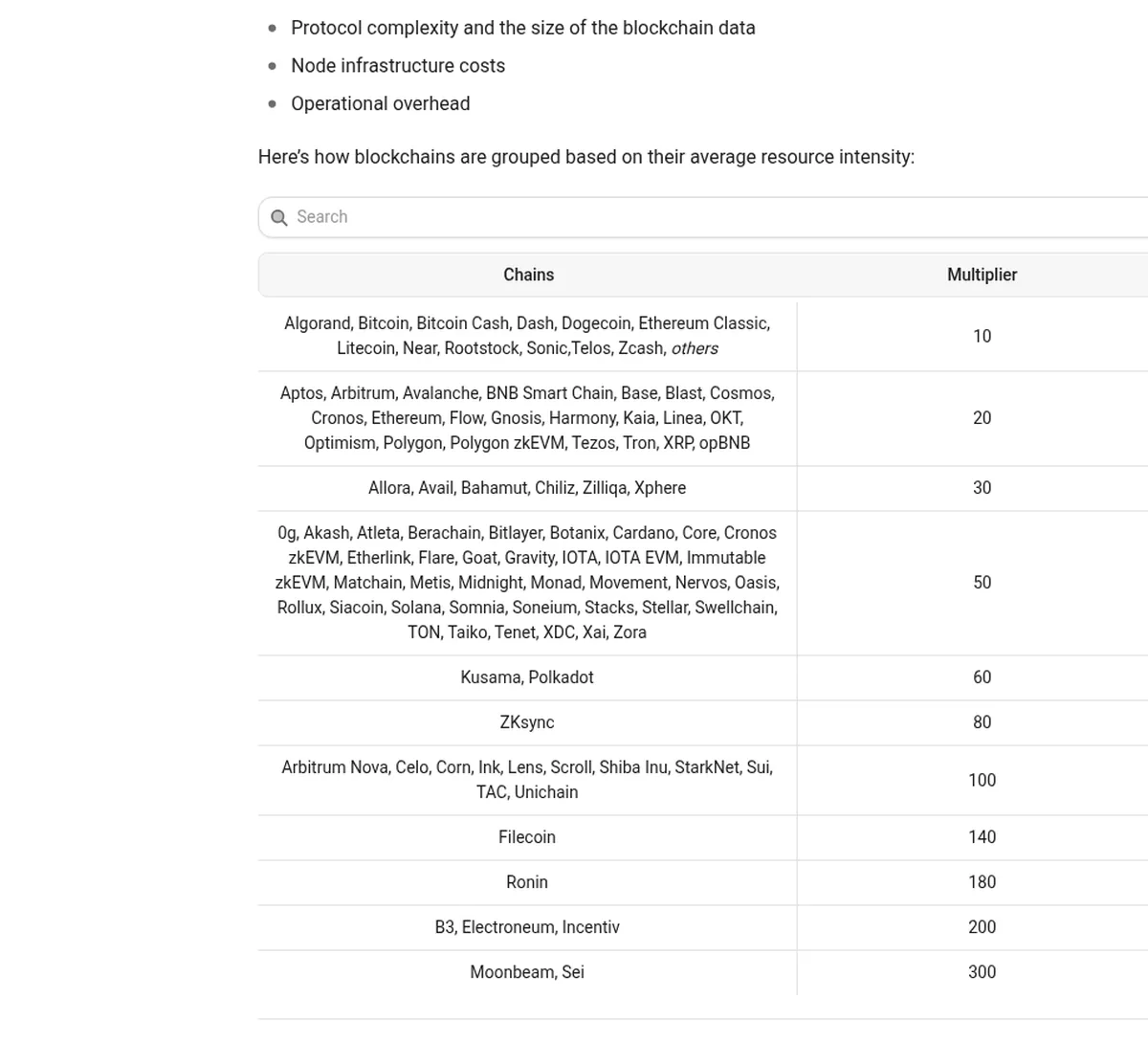
Chainstack bills 1 RU per full-node call on every chain, dRPC uses one pool for 120+ chains, and NOWNodes counts one request per call. Those three keep the same price wherever your traffic moves.
Verdict: If your roadmap adds Solana, Sui or Starknet, prefer flat meters like Chainstack, dRPC or NOWNodes. QuickNode and GetBlock suit teams that stay on 20-credit EVM chains.
Migration Effort From Alchemy
Moving standard JSON-RPC traffic off Alchemy is mostly an endpoint swap, since every provider here serves the same methods. The work sits in Alchemy-only APIs and in limits. Calls to Alchemy Token, NFT, Transfers and Portfolio APIs have no drop-in equivalent and need a data API or your own indexer. The table rates the effort for a typical multi-chain app.
| Provider | Quota model | At the limit | Debug and trace | Gaps vs Alchemy | Effort |
|---|---|---|---|---|---|
| Monthly RU | Overage from $15 down to $5 per 1M RU | 2 RU per call | No token or NFT data APIs | Low |
| Monthly CU pool | $6 per 1M EVM, $3.90 per 1M Solana | Flat price | No data APIs, no audit report | Low |
| Monthly CU | Top up below Pro, $0.40 per 1M CU on Pro | 2x CU | Chain multipliers up to 100 on our set | Medium |
| Monthly credits | $0.62 down to $0.50 per 1M credits | 2x credits | Data via marketplace add-ons | Low |
| Monthly credits | $5 per 1M credits | Solana only | No EVM chains | Medium |
| Prepaid credits | Top up the balance | Same credit price | No Starknet | Low |
| Daily credits | Requests fail until the daily reset | 300 to 1,000 credits | Solana limited, no Bitcoin, Sui, Aptos or TRON | High |
| Monthly requests | €5 down to €0.50 per 100,000 | 1 request per call | No audit report found | Medium |
Alchemy endpoints follow a pattern such as https://eth-mainnet.g.alchemy.com/v2/KEY, one hostname per chain. Keep one environment variable per chain, swap them one chain at a time, and keep Alchemy as the fallback until error rates match.
// ethers v6: new provider first, Alchemy as fallback
import { FallbackProvider, JsonRpcProvider } from "ethers";
const primary = new JsonRpcProvider(process.env.BASE_RPC_URL);
const alchemy = new JsonRpcProvider(process.env.ALCHEMY_BASE_URL);
export const provider = new FallbackProvider([
  { provider: primary, priority: 1, weight: 2 },
  { provider: alchemy, priority: 2, weight: 1 },
]);
Check eth_getLogs block-range limits on the new plan, since each vendor caps ranges differently, and move WebSocket subscriptions last because reconnect behavior differs. Alchemy’s account abstraction bundler and gas manager need their own replacement if you use them.
Verdict: Chainstack, dRPC, QuickNode and Ankr are drop-in swaps for standard RPC. Budget extra work for Alchemy data APIs, Helius on the EVM side and Infura’s missing chains.
1. Chainstack
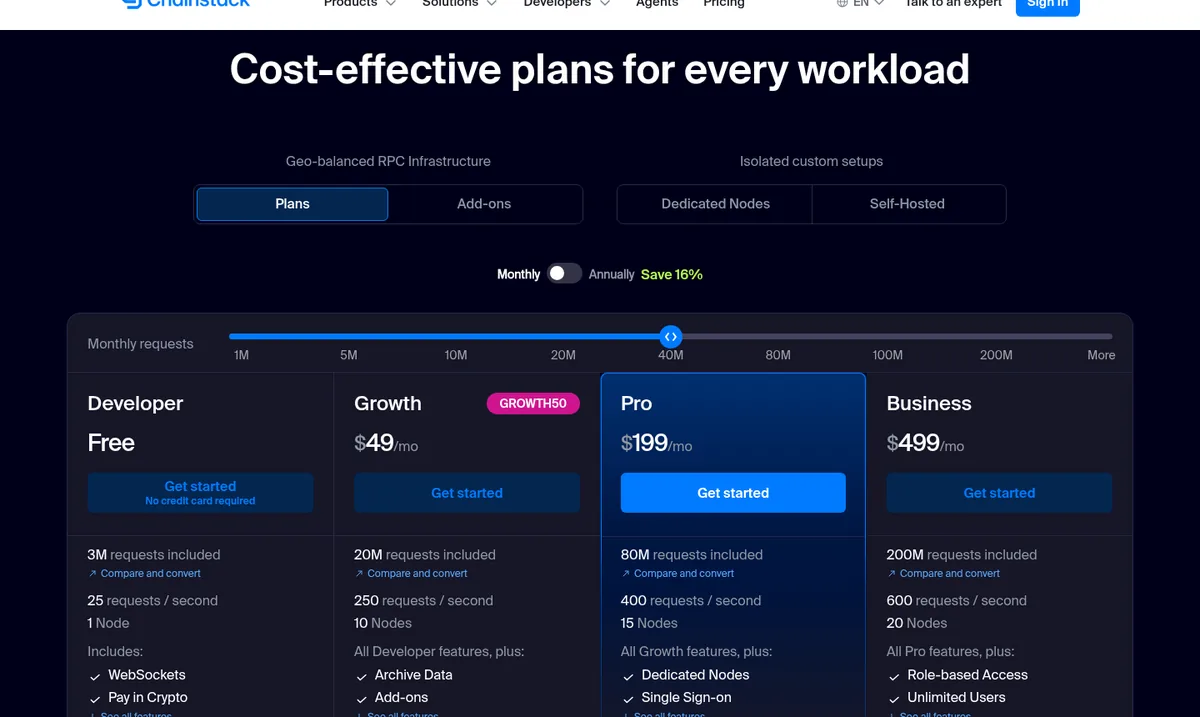
- Plans: Developer free (3M RU, 25 rps), Growth $49 (20M, 250 rps), Pro $199 (80M, 400 rps), Business $499 (200M, 600 rps), Enterprise from $990 (400M). Annual billing saves 16%.
- Meter: 1 RU for full requests, 2 RU for archive calls and for
debug_*andtrace_*methods, and 2 RU for SolanagetSignaturesForAddress, per its request unit rules. - Strengths: $2.45 per million EVM calls and $2.70 per million Solana wallet calls, SOC 2 Type II and ISO 27001, and all 13 chains in our set on its network list.
- Weaknesses: Growth overage costs $15 per 1M RU, six times the included rate, and there are no token or NFT data APIs like Alchemy’s.
Verdict: Chainstack scores 8.6, the only alternative above Alchemy. Pick it as the default replacement for cost control with audits. See its entry in our full RPC ranking.
2. dRPC
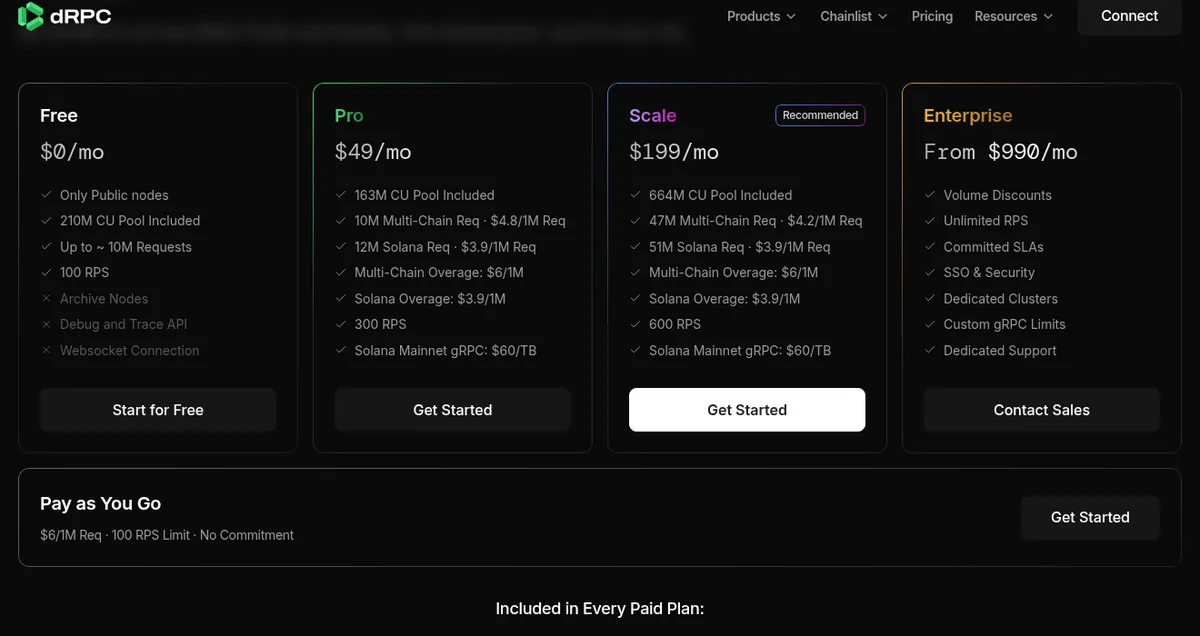
- Plans: Free on public nodes (210M CU, 100 rps), Pro $49 (163M CU, 300 rps), Scale $199 (664M CU, about 47M multi-chain or 51M Solana requests, 600 rps), Enterprise from $990. Pay as you go costs $6 per 1M requests.
- Meter: $0.30 per 1M CU, flat across methods, per its compute unit page. Overage is $6 per 1M multi-chain requests and $3.90 per 1M Solana requests.
- Strengths: the lowest bill for both workloads with Solana, at $154 and $179, a 99.96% uptime claim and 120+ chains.
- Weaknesses: no audit report on its own pages, and the free tier uses public nodes only.
Verdict: dRPC scores 7.9. Pick it when a mixed EVM and Solana bill matters more than audit paperwork. See its entry in our full RPC ranking.
3. GetBlock
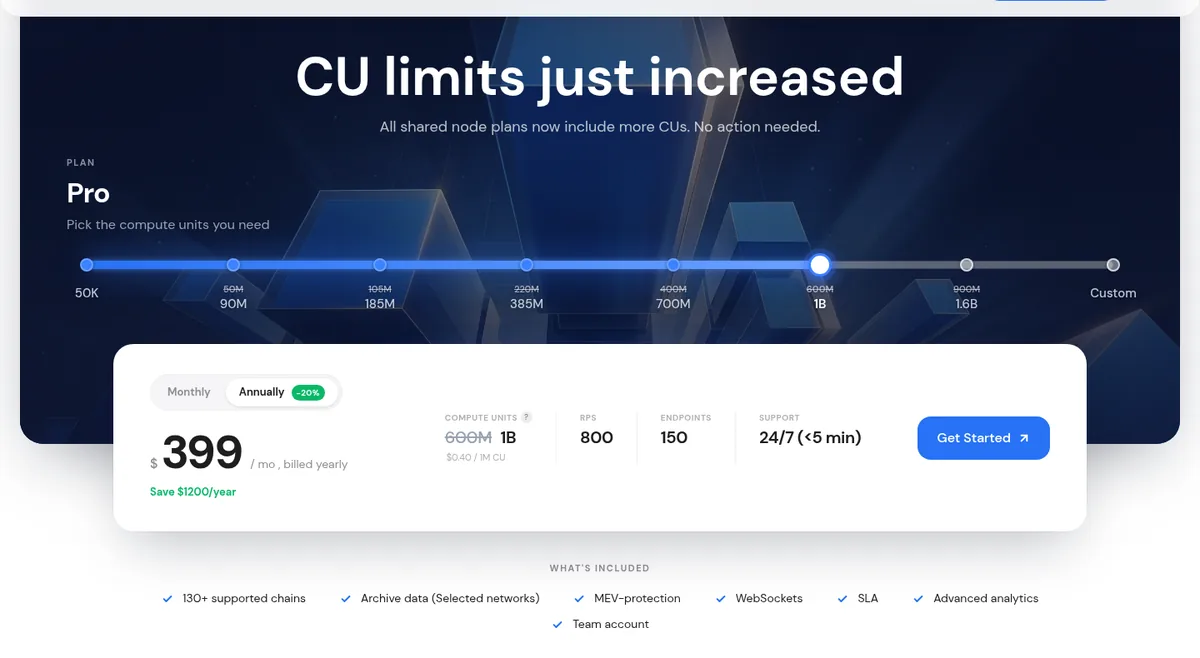
- Plans: Free (50K CU), Starter $49 (90M CU, 250 rps), Growth $99 (185M), Advanced $199 (385M), Scale $349 (700M), Pro $499 (1B CU, 800 rps), Premium $699 (1.6B).
- Meter: chain multiplier times method multiplier, with debug and trace at 2x and archive doubling again, per its CU rules.
- Strengths: the top reliability score in our ranking, SOC 2 Type II, a 99.9%+ uptime SLA on dedicated nodes and all 13 chains in our set.
- Weaknesses: steep multipliers on Solana, Sui and Starknet, no overage below Pro, and a 50K CU free tier, about 2,500 Ethereum calls.
Verdict: GetBlock scores 7.8. It suits latency-sensitive EVM teams that stay on 20x chains. See its entry in our full RPC ranking.
4. QuickNode
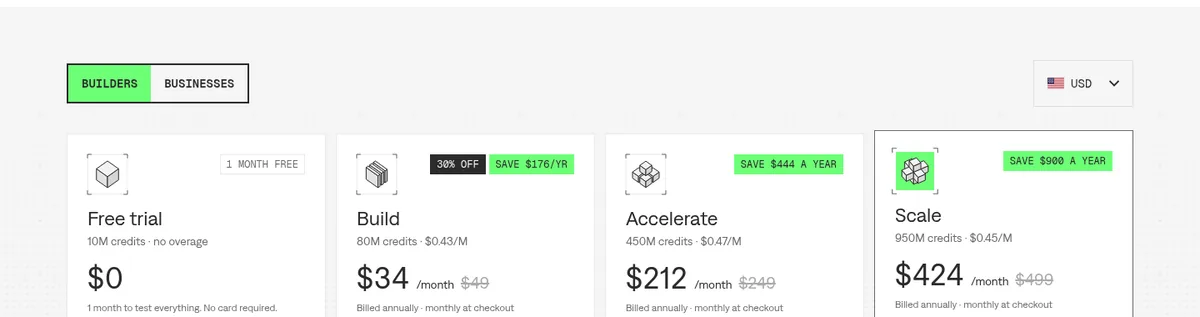
- Plans: Free trial (10M credits for one month, 15 rps), Build $49 (80M, 50 rps), Accelerate $249 (450M, 125 rps), Scale $499 (950M, 250 rps), Business from $999 (2B, 500 rps). Annual billing cuts these to $34, $212 and $424.
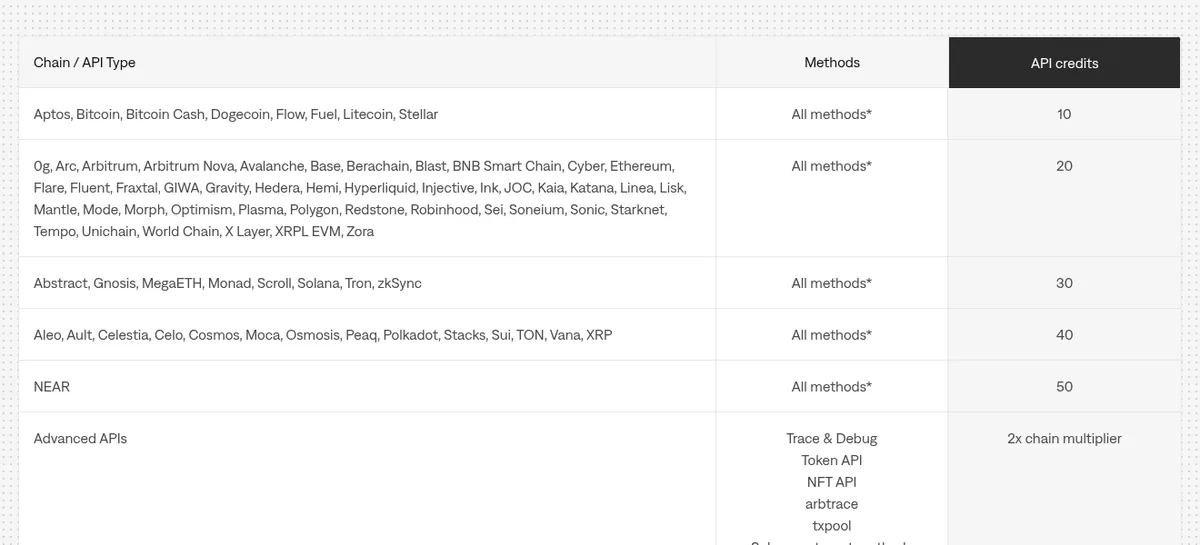
- Meter: 10 credits for Bitcoin and Aptos, 20 for Ethereum and most EVM chains, 30 for Solana, TRON and ZKsync and 40 for Sui, per its API credit page. Trace and debug calls cost double.
- Strengths: SOC 1 Type 2, SOC 2 Type 2 and ISO 27001 on its security page, overage from $0.62 down to $0.50 per 1M credits, and all 13 chains in our set.
- Weaknesses: Build allows only 50 rps, Solana costs 1.5 times EVM, and the free tier is a one-month trial.
Verdict: QuickNode scores 7.7. Pick it when audits, Streams and add-ons outweigh the per-call price. See its entry in our full RPC ranking. Our QuickNode alternatives guide ranks eight other multi-chain options.
5. Helius
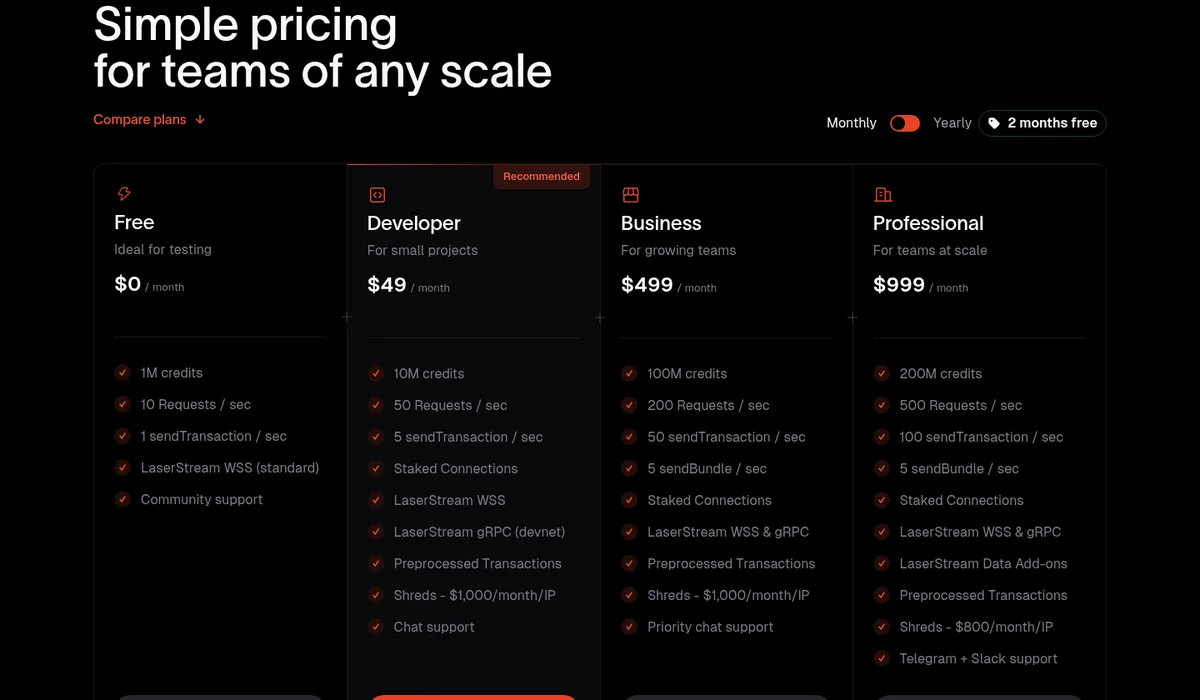
- Plans: Free (1M credits, 10 rps), Developer $49 (10M credits, 50 rps, 5 sends per second), Business $499 (100M, 200 rps), Professional $999 (200M, 500 rps). Yearly billing gives two months free.
- Meter: 1 credit for standard RPC calls, 10 for
getProgramAccountsand more for DAS and enhanced APIs, per its credit table. Overage is $5 per 1M credits. - Strengths: the deepest Solana feature set in this list, staked connections on all paid plans and SOC 2 Type II, audited by Sensiba.
- Weaknesses: one chain only, so it scores 1 of 5 on coverage, and Developer caps sends at 5 per second.
Verdict: Helius scores 7.0. Pair it with Chainstack or dRPC when Solana is your main chain. See its entry in our full RPC ranking.
6. Ankr
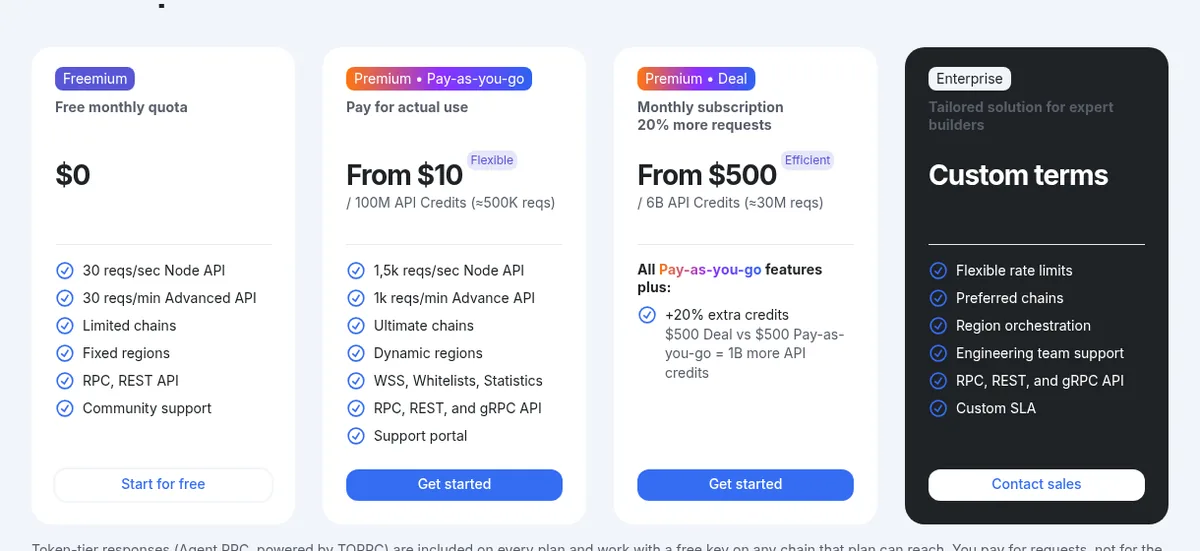
- Plans: Freemium (200M credits a month, 30 rps), Pay as you go from $10 per 100M credits at 1,500 rps, Deal from $500 for 6B credits plus 20% extra, and Enterprise, per its service plans.
- Coverage: 75+ chains on paid plans, with 12 of our 13 listed. Starknet is missing.
- Strengths: the highest public rate limit here, one price for all methods, and SOC 2 Type II through its operator Asphere on its trust page.
- Weaknesses: the highest per-call rates in this list, which put our Solana-first wallet at $1,267 a month.
Verdict: Ankr scores 6.3. It fits bursty, low-volume apps that need a high rate ceiling on prepaid credits. See its entry in our full RPC ranking.
7. Infura
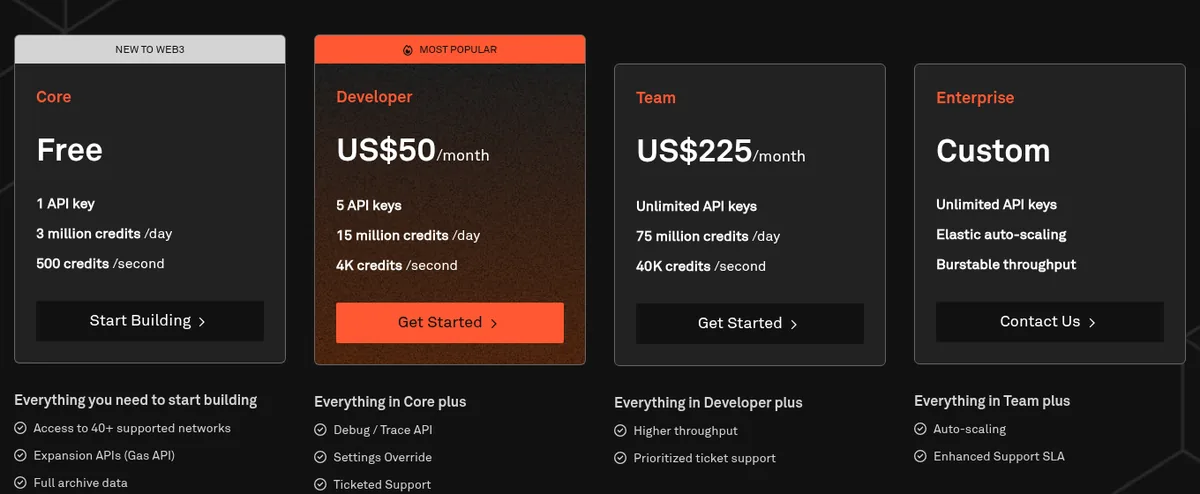
- Plans: Core free (3M credits a day, 500 credits per second), Developer $50 (15M a day), Team $225 (75M a day), Enterprise custom. An add-on sells 55M more credits for $200 a month.
- Meter: 80 credits for
eth_calland most reads, 255 foreth_getLogs, 300 for gas estimates and 1,000 fordebug_*, per its credit cost table. - Strengths: $12.06 per million blended EVM calls on Developer, Starknet support and a daily free allowance with archive data.
- Weaknesses: requests fail once the daily quota is used, 8 of our 13 chains, and no SOC 2 or ISO 27001 report found on its pages.
Verdict: Infura scores 6.1. It suits EVM-only teams with steady daily traffic. See its entry in our full RPC ranking.
8. NOWNodes
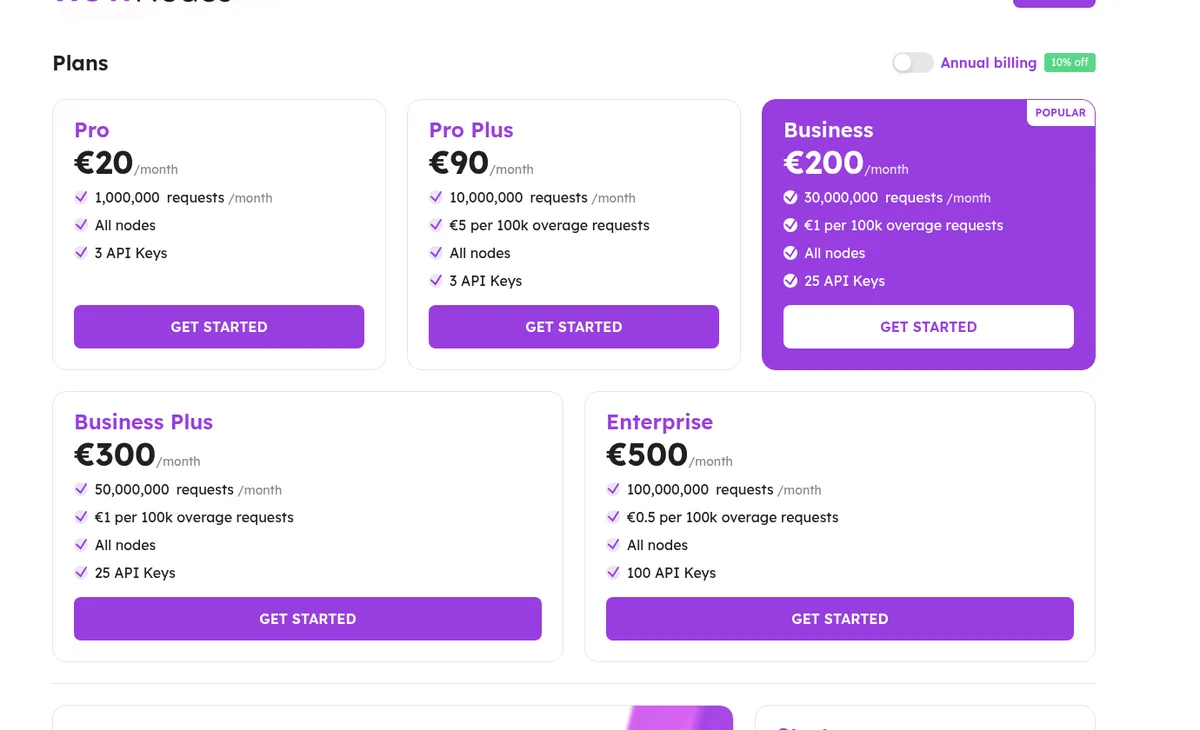
- Plans: Start free (100,000 requests for one month), Pro €20 (1M), Pro Plus €90 (10M), Business €200 (30M), Business Plus €300 (50M), Enterprise €500 (100M). Annual billing saves 10%.
- Overage: €5 per 100,000 requests on Pro Plus, €1 on Business and Business Plus, €0.50 on Enterprise.
- Strengths: one price on every chain, all 13 chains in our set on its nodes list, and second place in two of our workloads.
- Weaknesses: no audit report found, a one-month free trial only, and fewer developer tools than Alchemy.
Verdict: NOWNodes scores 5.8. Pick it for simple euro billing across many chains. See its entry in our full RPC ranking.
Providers We Left Out
Tatum scores 6.1 in our main ranking, level with Infura, but its pricing slider did not render on 25 October 2026, so we could not verify its current plan prices and left it out. CDP Node and Lava scored 4.4 and 4.3, and CDP Node serves Base only. Their entries sit in our RPC node provider ranking.
Running your own nodes is the other route off Alchemy, but a multi-chain stack multiplies the work: each chain needs its own clients, storage and upgrades. Our RPC providers hub covers when shared plans stop paying off.
Final Ranking
Chainstack wins on our weights because it pairs the lowest included rate with audits and full chain coverage. dRPC leads on raw price for mixed traffic, GetBlock and QuickNode trade price for reliability and audits, and Helius is the Solana specialist.


Verdict: Move EVM traffic to Chainstack or dRPC, put Solana on dRPC or Helius, and keep Alchemy or QuickNode as the fallback endpoint. Reprice your chain mix every quarter.
How to Test Alchemy Alternatives in One Week
A week of side-by-side traffic answers what a pricing page cannot. Keep Alchemy live and mirror a share of reads on each chain to two candidates from the region where your servers run. Log median and tail latency, error rates and returned block heights, then price that week’s chain and method mix on each meter.
for url in "$ALCHEMY_BASE_URL" "$CHAINSTACK_BASE_URL" "$DRPC_BASE_URL"; do
  curl -s -o /dev/null -w "%{time_total}\n" \
    -H "Content-Type: application/json" \
    -d '{"jsonrpc":"2.0","id":1,"method":"eth_blockNumber","params":[]}' \
    "$url"
done
Repeat the loop for Solana with getSlot and for every other chain you run. Compare returned heights to spot lagging nodes, and watch for HTTP 429 responses during your own traffic peaks before you cut over.
Frequently Asked Questions
What is the best Alchemy alternative in 2026?
On our weighted scorecard, Chainstack is the best Alchemy alternative at 8.6 out of 10, the only provider that outscores Alchemy’s 8.3. It bills 1 request unit per call on every chain, lists all 13 chains in our set and states SOC 2 Type II and ISO 27001. dRPC is second at 7.9.
What is the cheapest Alchemy alternative for multi-chain apps?
dRPC had the lowest bill in both of our workloads that mix EVM and Solana traffic, at $154 and $179 a month against $361 and $398 on Alchemy. Chainstack was cheapest for EVM-only traffic at $49 a month, and it has the lowest per-call rate on every chain we priced.
Is Alchemy more expensive than QuickNode?
The answer changes by chain. For our blended EVM dApp mix, Alchemy pay as you go costs $13.60 per million calls against $12.25 on QuickNode Build. For Solana wallet traffic, Alchemy costs $8.40 per million against $18.38, because QuickNode bills Solana at 30 credits.
Why does Alchemy return 429 errors?
Alchemy returns HTTP 429 when your account exceeds its compute units per second limit, measured over a 10-second rolling window. The limit is shared by every app on the account. Retrying with backoff, buying a throughput add-on or moving heavy traffic to a second provider all reduce the errors.
Which Alchemy alternatives support Solana and EVM chains together?
Chainstack, dRPC, GetBlock, QuickNode, Ankr and NOWNodes all list Solana alongside Ethereum, Base, Arbitrum, Polygon and other EVM chains. Infura limits Solana to select customers, and Helius serves Solana only. GetBlock, QuickNode and Ankr charge more per Solana call than per EVM call.
How hard is it to migrate from Alchemy?
For standard JSON-RPC traffic, migration is mostly an endpoint swap per chain, and a fallback provider makes it low risk. Plan extra work for Alchemy Token, NFT, Transfers and Portfolio APIs, its bundler and gas manager, and different eth_getLogs range limits on the new provider.