
Last updated: 25 October 2026 · Prices, method costs, limits and benchmark figures rechecked on vendor pages on 25 October 2026
In the QuickNode vs Alchemy vs Chainstack comparison, Chainstack is the best value for most teams, Alchemy is the best developer platform, and QuickNode is the strongest pick for latency on Base, Solana and Arbitrum and for procurement-heavy buyers. We priced four real workloads on each meter to show where every vendor wins.
All three sell the same core product: a remote procedure call (RPC) endpoint backed by synced blockchain nodes. They bill it in three different units, which is why sticker prices mislead. This head to head expands three entries from our ranking of the 12 best RPC node providers, and our methodology page explains how we collect prices and screenshots. For archive-heavy Ethereum work, see our ranking of the best Ethereum RPC providers.
TL;DR
- Overall: 1. Chainstack (8.6), 2. Alchemy (8.3), 3. QuickNode (7.7), using the same weighted scorecard as our 12-provider ranking.
- Chainstack produced the lowest bill in all four workloads we modeled, from $49 for a 10M-request wallet backend to $199 for a 50M-request indexer.
- Alchemy beats QuickNode on light reads and Solana. QuickNode beats Alchemy on log-heavy and trace-heavy Ethereum traffic, by up to 55%.
- On the 25 October OpenChainBench keyed run, QuickNode led on Base, Solana and Arbitrum, and Chainstack led on Ethereum. Alchemy was absent from that day’s keyed ranking.
- QuickNode states SOC 1 Type 2, SOC 2 Type 2 and ISO 27001. Chainstack states SOC 2 Type II and ISO 27001. Alchemy publishes SOC 2 Type II through its trust center.
- Chainstack overage costs $15 per 1M request units on Growth, six times its included rate, so pick the tier that covers your peak month.
The Decision Kernel
Pick on the shape of your traffic first and the brand second. The three meters reward different method mixes, so the cheapest vendor for a wallet can be the most expensive for an indexer. Count one day of requests by method before you compare any plan. The shortcuts below cover the common cases.
- Lowest bill at almost any volume: Chainstack, sized to a tier that covers your busiest month.
- Token, NFT and transfer APIs on the same key: Alchemy, with its 30M compute unit free tier for prototypes.
- Base, Solana or Arbitrum latency matters most: QuickNode, which led the keyed latency runs on all three chains on 25 October 2026.
- Security questionnaires and DORA reporting: QuickNode states SOC 1, SOC 2 and ISO 27001 and offers DORA reports to enterprise buyers.
- Log-heavy indexing on Ethereum: Chainstack first, QuickNode second. Alchemy charges 60 CU per
eth_getLogscall. - Production with failover: pair any two. Chainstack as primary with Alchemy or QuickNode as backup covers most outages. If you are replacing a single vendor, our guides to Alchemy alternatives and Infura alternatives rank the wider field on the same scorecard.
Verdict: Chainstack for cost, Alchemy for developer tooling, QuickNode for latency on Base, Solana and Arbitrum. Most production teams should run two of the three.
How We Compared QuickNode, Alchemy and Chainstack
We scored each provider from 1 to 5 on six criteria, weighted them, and doubled the total to get a score out of 10. The weights match our 12-provider ranking, so the scores line up across the site. Every input links to a vendor page or a public benchmark checked on 25 October 2026. Details sit on our methodology page.
- Price per call, 25%: monthly cost for real method mixes, converted from each vendor’s billing unit.
- Reliability, 20%: published uptime terms, support response targets and public latency benchmarks.
- Compliance, 15%: SOC 2, ISO 27001 and other audits stated on the vendor’s own pages.
- Features, 15%: archive data, Trace and Debug methods, streaming, data APIs and dedicated nodes.
- Chain coverage, 15%: chains and networks listed in each vendor’s documentation.
- Free tier, 10%: what a team can run before paying, and for how long.
| Criterion (weight) |  |  |  |
|---|---|---|---|
| Price per call (25%) | 5 | 3 | 3 |
| Reliability (20%) | 4 | 4 | 4 |
| Compliance (15%) | 5 | 4 | 5 |
| Features (15%) | 4 | 5 | 5 |
| Chain coverage (15%) | 4 | 5 | 4 |
| Free tier (10%) | 3 | 5 | 2 |
| Score out of 10 | 8.6 | 8.3 | 7.7 |
QuickNode vs Alchemy vs Chainstack at a Glance
The table lines up the billing unit, free option, entry paid plan, throughput and support target for each provider. Prices are monthly US dollar list prices from each pricing page on 25 October 2026. Annual billing lowers QuickNode by about 30% and Chainstack by 16%, while Alchemy pay as you go has no annual option on its public page.
| | | |
|---|---|---|---|
| Billing unit | API credits, flat per chain | Compute units (CU) per method | Request units (RU), 1 or 2 per call |
| Free option | One-month trial: 10M credits, 15 rps | Free forever: 30M CU a month, 15 rps | Developer: 3M RU a month, 25 rps |
| Entry paid plan | Build $49: 80M credits, 50 rps | Pay as you go: $0.525 per 1M CU, 300 rps | Growth $49: 20M RU, 250 rps |
| Next tiers | $249 (450M), $499 (950M), $999 (2B) | Enterprise, custom | $199 (80M), $499 (200M), from $990 (400M) |
| Overage per 1M units | $0.62 to $0.50 | $0.525 on all usage | $15 to $5 |
| Support target | 24h on Build, 12h Accelerate, 8h Scale | 48h free, 24h pay as you go | Under 24h on paid plans, 24/5 |
| Chains (vendor figure) | 76+ chains, 137 networks | 100+ claimed, 89 in API docs | 70+ |
Pricing: Three Different Meters
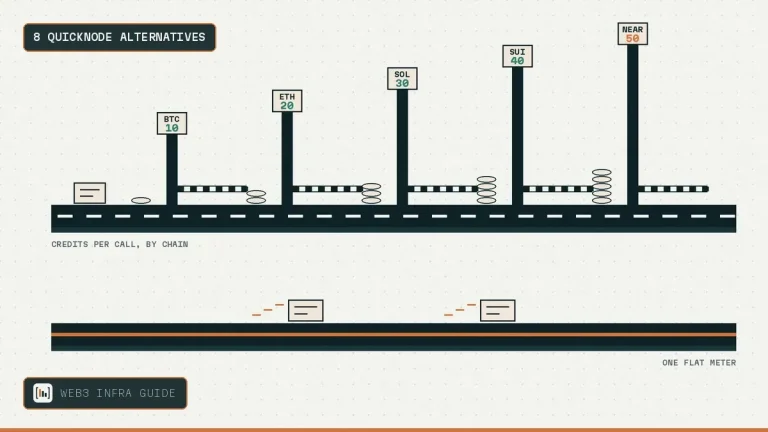
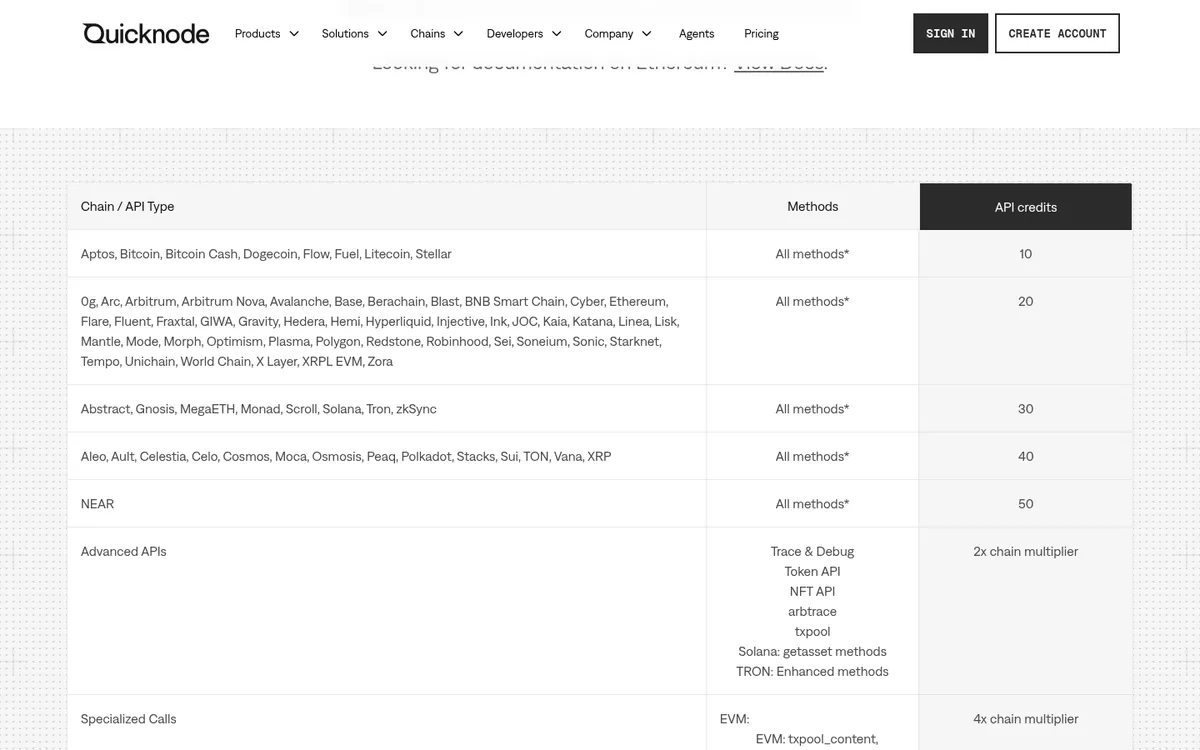
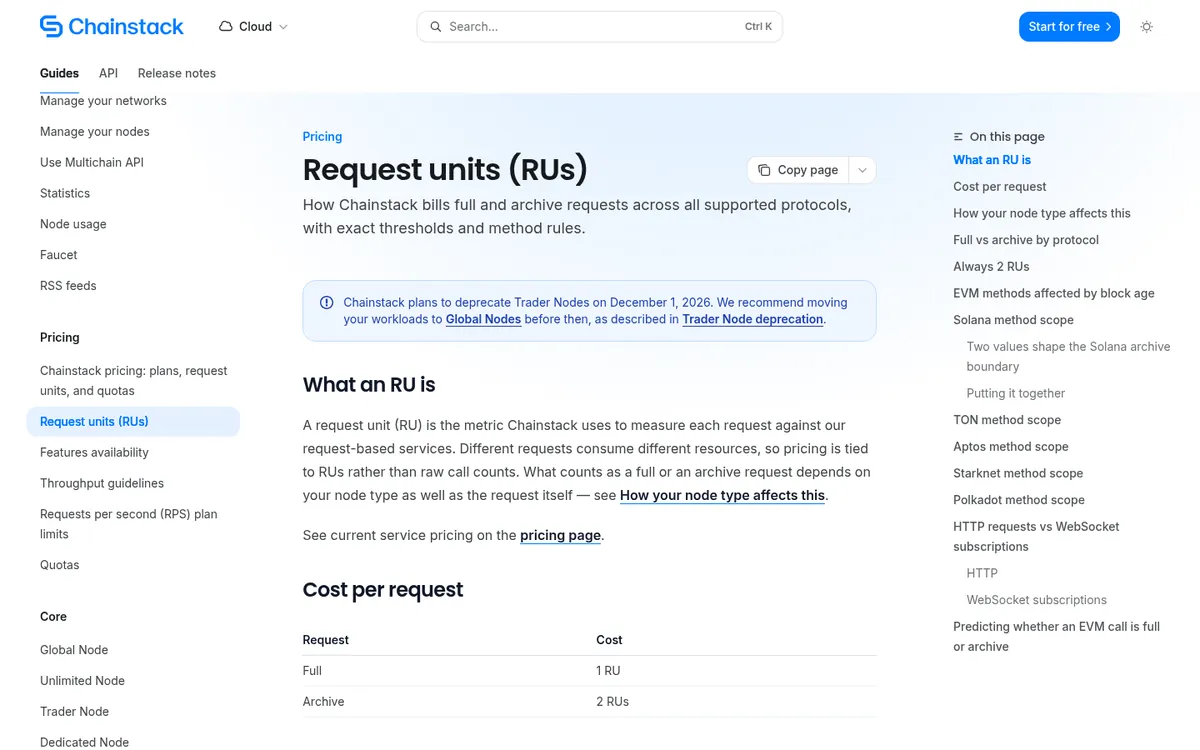
Each vendor charges for the same eth_call in a different unit. Alchemy weights every method separately, from 10 CU for eth_blockNumber to 60 CU for eth_getLogs. QuickNode charges 20 credits for any standard Ethereum call and 30 on Solana. Chainstack charges 1 request unit for a recent-block call and 2 for archive, Debug or Trace.
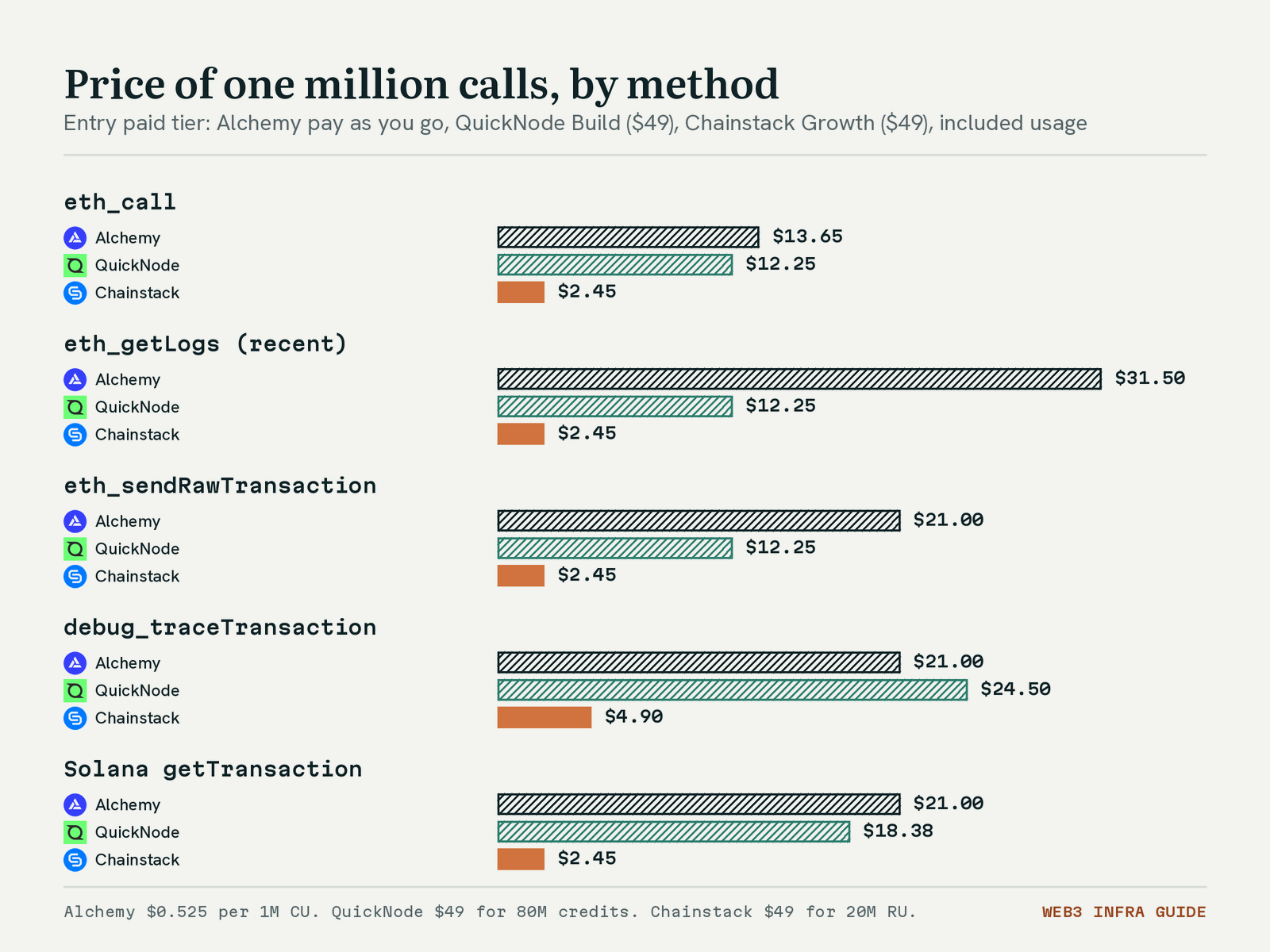
Converting each unit to dollars per million calls shows how far apart the three are. The figures below use the entry paid tier with included usage, which is the rate most small teams pay. Chainstack Growth works out to $2.45 per million recent-block calls, about five times cheaper than either rival for a plain eth_call.
| Method, per 1M calls | | | |
|---|---|---|---|
eth_blockNumber | $5.25 (10 CU) | $12.25 (20 credits) | $2.45 (1 RU) |
eth_call | $13.65 (26 CU) | $12.25 (20 credits) | $2.45 (1 RU) |
eth_getLogs, recent blocks | $31.50 (60 CU) | $12.25 (20 credits) | $2.45 (1 RU) |
eth_sendRawTransaction | $21.00 (40 CU) | $12.25 (20 credits) | $2.45 (1 RU) |
debug_traceTransaction | $21.00 (40 CU) | $24.50 (40 credits) | $4.90 (2 RU) |
Solana getTransaction | $21.00 (40 CU) | $18.38 (30 credits) | $2.45 (1 RU) |
| Rate above the plan allowance | Same $0.525 per 1M CU | $12.40 per 1M eth_call | $15.00 per 1M recent calls |
The last row is the trap. Chainstack’s overage on Growth is $15 per million request units, six times its included rate and higher than QuickNode’s $12.40 per million eth_call. A team that runs 30M recent calls on Growth pays $199, the same as moving up to Pro, which includes 80M.
Verdict: Chainstack has the lowest included rate on every method we priced. Size the plan to your peak month, since its overage rate is the highest of the three.
What Four Real Workloads Cost
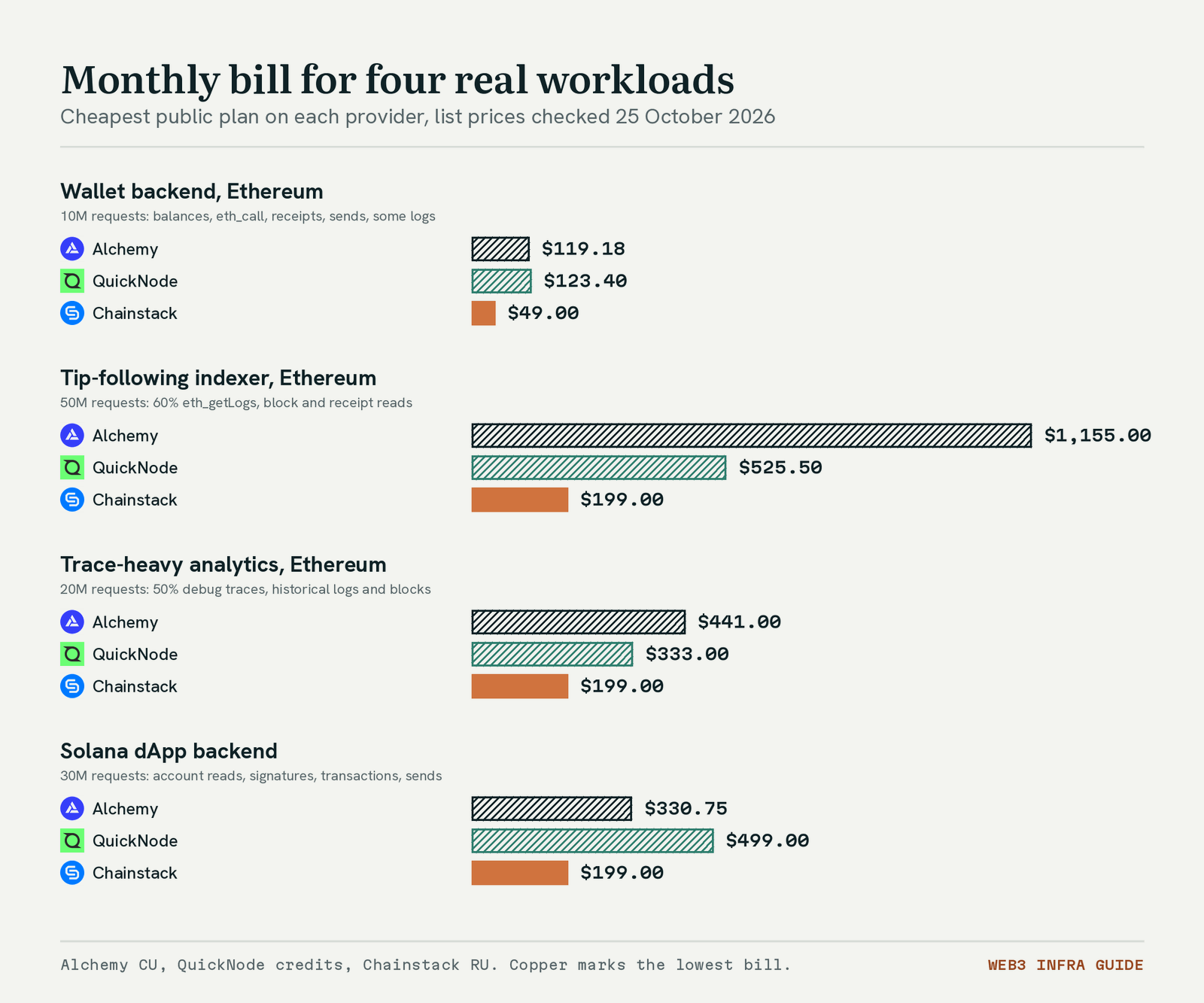
Plan tables only matter once you apply them to real traffic. We built four common method mixes, converted each into Alchemy CU, QuickNode credits and Chainstack request units, and picked the cheapest public plan on each vendor. Chainstack came out cheapest in all four, and the gap widens as traffic shifts toward logs and traces.
| Workload (monthly) | | | |
|---|---|---|---|
| Wallet backend, Ethereum, 10M requests | $119.18 (227M CU) | $123.40 on Build (200M credits) | $49 on Growth (10M RU) |
| Tip-following indexer, Ethereum, 50M requests | $1,155.00 (2.2B CU) | $525.50 on Scale (1B credits) | $199 on Pro (50M RU) |
| Trace-heavy analytics, Ethereum, 20M requests | $441.00 (840M CU) | $333.00 on Accelerate (600M credits) | $199 on Pro (40M RU) |
| Solana dApp backend, 30M requests | $330.75 (630M CU) | $499 on Scale (900M credits) | $199 on Pro (34.5M RU) |
- Wallet backend: 40%
eth_getBalance, 20%eth_call, 15% receipts, 15%eth_blockNumber, 5% sends and 5%eth_getLogs. Alchemy averages 22.7 CU per request. - Indexer: 60%
eth_getLogs, 25%eth_getBlockByNumberand 15% receipts, all within 127 blocks of the tip. Alchemy averages 44 CU per request. - Trace-heavy analytics: 50%
debug_traceTransaction, 30% historicaleth_getLogsand 20% historical blocks. Every call counts as 2 RU on Chainstack, and traces are 2x credits on QuickNode. - Solana backend: 50%
getAccountInfo, 15%getSignaturesForAddress, 15%getTransaction, 10%sendTransactionand 10%getProgramAccounts, recent slots only. Chainstack bills everygetSignaturesForAddresscall as archive at 2 RU, even on recent slots, so this mix uses 34.5M RU.
Alchemy and QuickNode trade places by workload. Alchemy wins light reads and Solana, because cheap methods such as getAccountInfo cost 10 CU against QuickNode’s flat 30 credits. QuickNode wins log and trace traffic, where Alchemy’s 60 CU eth_getLogs weight makes the indexer bill 2.2 times larger.
Verdict: Chainstack is the cheapest in every workload we modeled. Between the other two, choose Alchemy for read-light apps and Solana, and QuickNode for indexers and trace jobs.
How the Bill Grows at Scale
The cost curve shows what happens as a single Ethereum app grows from 1M to 500M eth_call requests a month. Alchemy and QuickNode rise almost in a straight line because both bill every unit. At 200M calls a month, Chainstack Business costs $499, QuickNode $1,999 and Alchemy $2,730. Chainstack climbs in steps as you move between flat tiers.
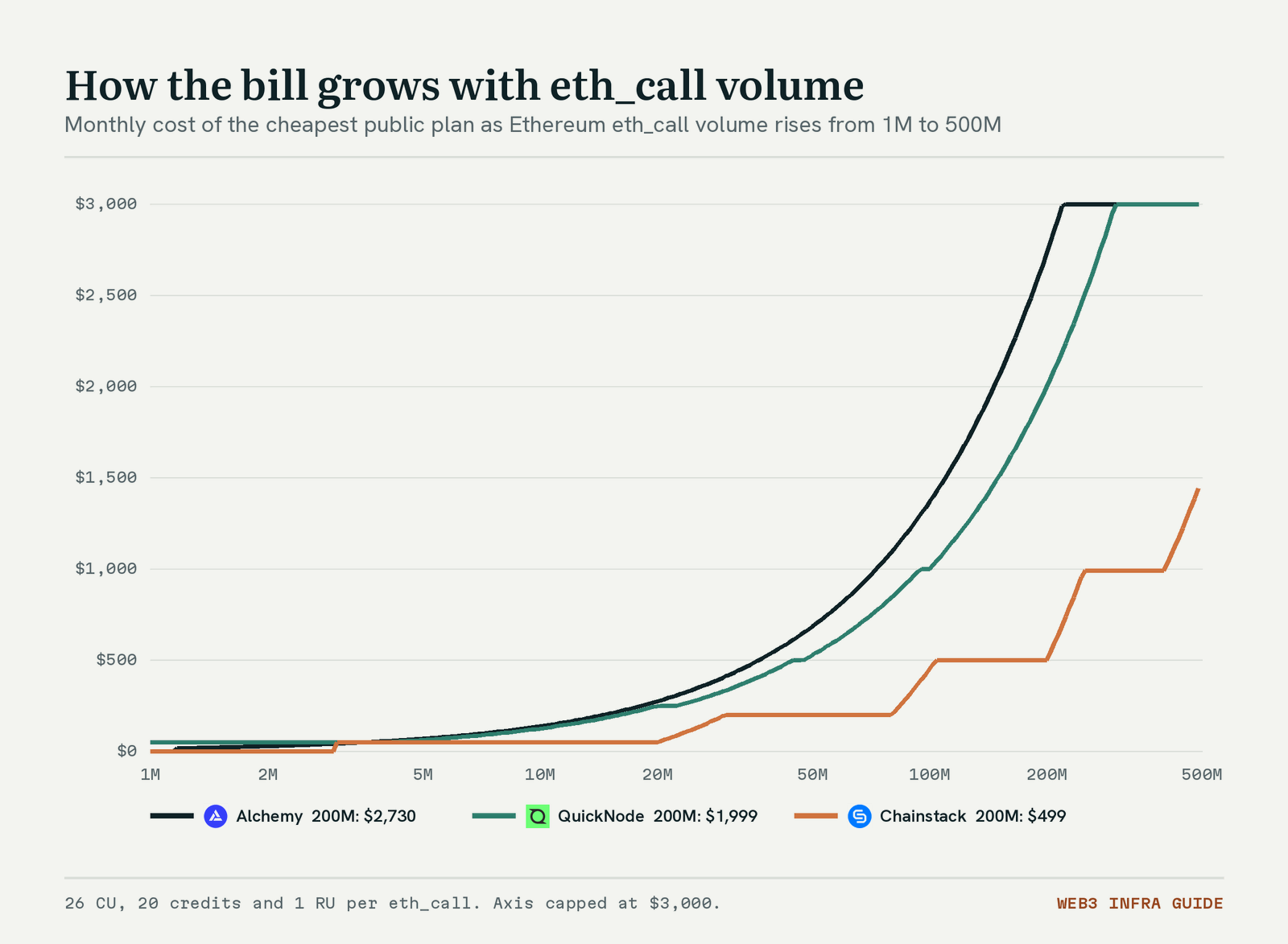
Rate limits matter at the top of the curve. 200M calls a month averages 77 requests per second, which fits Chainstack Business at 600 rps and QuickNode Business at 500 rps. Alchemy pay as you go includes 300 rps, which is 10,000 CU per second, and sells extra blocks of 5,000 CU per second for $160 a month each.
Verdict: Above about 20M calls a month, Chainstack’s flat tiers pull far ahead. Teams that expect to pass 400M should ask all three for enterprise quotes, since Chainstack Enterprise drops overage to $5 per 1M RU.
Free Tiers and Trials
The free options differ more than the paid ones. Alchemy’s free tier never expires and includes its data APIs. Chainstack’s Developer plan is also free forever and buys the most raw calls, as the table shows. QuickNode offers a one-month trial only, so it cannot host a permanent side project.
| Free option | Allowance | Ethereum calls it covers | Limits |
|---|---|---|---|
| 30M CU a month | About 1.15M eth_call, or 3M eth_blockNumber | 15 rps, 5 apps, no Debug or Trace |
| 3M RU a month | 3M recent-block calls | 25 rps, 1 node, archive from Growth |
| 10M credits for one month | 500,000 calls | 15 rps, ends after the first month |
Verdict: Alchemy has the most useful free tier for building, and Chainstack has the most free calls. QuickNode’s trial suits a time-boxed evaluation only.
Latency: Why the Benchmarks Disagree
OpenChainBench probes the API-key endpoints of all three vendors every 120 seconds from three regions, and reports two cohorts. Warm runs reuse an open connection, and cold-start runs open a new one for every probe. The two cohorts rank the vendors in opposite order on Ethereum, so the right benchmark depends on how your app connects.
| Chain, median (p99) | | | Leader |
|---|---|---|---|
| Ethereum, warm | 55.8 ms (65.2) | 7.7 ms (39.3) | Chainstack |
| Ethereum, cold start | 29.7 ms (343.6) | 68.1 ms (217.2) | QuickNode |
| Base, warm | 5.3 ms (8.3) | 5.7 ms (47.6) | QuickNode |
| Base, cold start | 29.1 ms (123.4) | 28.4 ms (130.9) | Chainstack, by 0.7 ms |
| Solana, warm | 3.4 ms (7.6) | 6.5 ms (63.7) | QuickNode |
| Solana, cold start | 23.1 ms (322.1) | 32.0 ms (242.8) | QuickNode |
| Arbitrum, warm | 5.6 ms (9.4) | 6.6 ms (21.6) | QuickNode |
| Arbitrum, cold start | 30.0 ms (367.6) | 66.8 ms (154.8) | QuickNode |
Long-lived backends with connection pooling see the warm numbers. Serverless functions, edge workers and browser wallets open fresh connections and see the cold-start numbers. QuickNode’s warm tail on Base and Solana stays under 10 ms at p99, the tightest result in the table.
Alchemy did not appear in either keyed cohort on 25 October 2026, so we have no same-day figure to compare. Our 12-provider ranking recorded 9 ms for Alchemy on the Ethereum keyed run a day earlier. These figures move daily, so treat them as a shortlist filter and run your own test.
Verdict: QuickNode is the latency pick for Base, Solana and Arbitrum and for cold-start traffic. Chainstack leads on warm Ethereum connections.
Security, Compliance and SLAs
All three vendors state a SOC 2 Type II report, so the differences sit in the extra audits and in who gets a contractual SLA. QuickNode states the widest audit set, with SOC 1 Type 2, SOC 2 Type 2 and ISO 27001. At all three vendors, contractual uptime SLAs come with enterprise contracts.
| | | |
|---|---|---|---|
| Audits stated | SOC 1 Type 2, SOC 2 Type 2, ISO 27001 | SOC 2 Type II | SOC 2 Type II, ISO 27001 |
| Uptime language | 99.99% uptime on the security page | Signed SLAs on Enterprise | 99.99%+ claim, SLA on Enterprise |
| Paid support response | 24h Build, 12h Accelerate, 8h Scale | 24h pay as you go, premium 12h, 4h or 2h | Under 24h standard, under 6h for $1,000 a year, under 1h for $10,000 a year |
| Regulatory extras | DORA reports for enterprise | Not stated | Not stated |
Verdict: QuickNode is the easiest pass through a bank or fintech security review. Chainstack is close behind, and it publishes prices for its faster support tiers.
Features and Chain Coverage
Alchemy is the broadest developer platform, with token, NFT, transfer and webhook APIs on the same key. QuickNode sells a similar add-on catalog and includes archive data on every plan. Chainstack is the only one of the three that publishes self-serve dedicated node pricing. Chain counts below come from each vendor’s own documentation.
| Feature | | | |
|---|---|---|---|
| Archive data | All plans | All plans, including Free | Growth and above |
| Debug and Trace | Build and above, 2x credits | Paid plans, 40 CU per trace | Paid plans, 2 RU per call |
| Data APIs | Token, NFT and add-on marketplace | Token, NFT, transfers, webhooks | Few data APIs, add-ons such as MEV protection and Warp transactions |
| Dedicated nodes | Enterprise | Enterprise | Pro and above: $199 plus from $0.50 an hour compute |
| Solana extras | Solana gRPC add-on and Streams | Solana gRPC from $75 per TB | Yellowstone Geyser gRPC add-on, Trader Nodes until 1 December 2026 |
| Chains | 76+ chains, 137 networks | 100+ claimed, 89 in API docs | 70+ |
Alchemy’s marketing says 100+ chains, while its chain API overview listed 89 when we checked. Chainstack’s documentation states that it plans to deprecate Trader Nodes on 1 December 2026, so Solana trading teams on that product should plan a move to Global Nodes. Our dedicated nodes coverage explains when a private node pays off.
Verdict: Alchemy wins on data APIs and chain count. Chainstack wins for teams that expect to need a dedicated node, since its price is public.
QuickNode
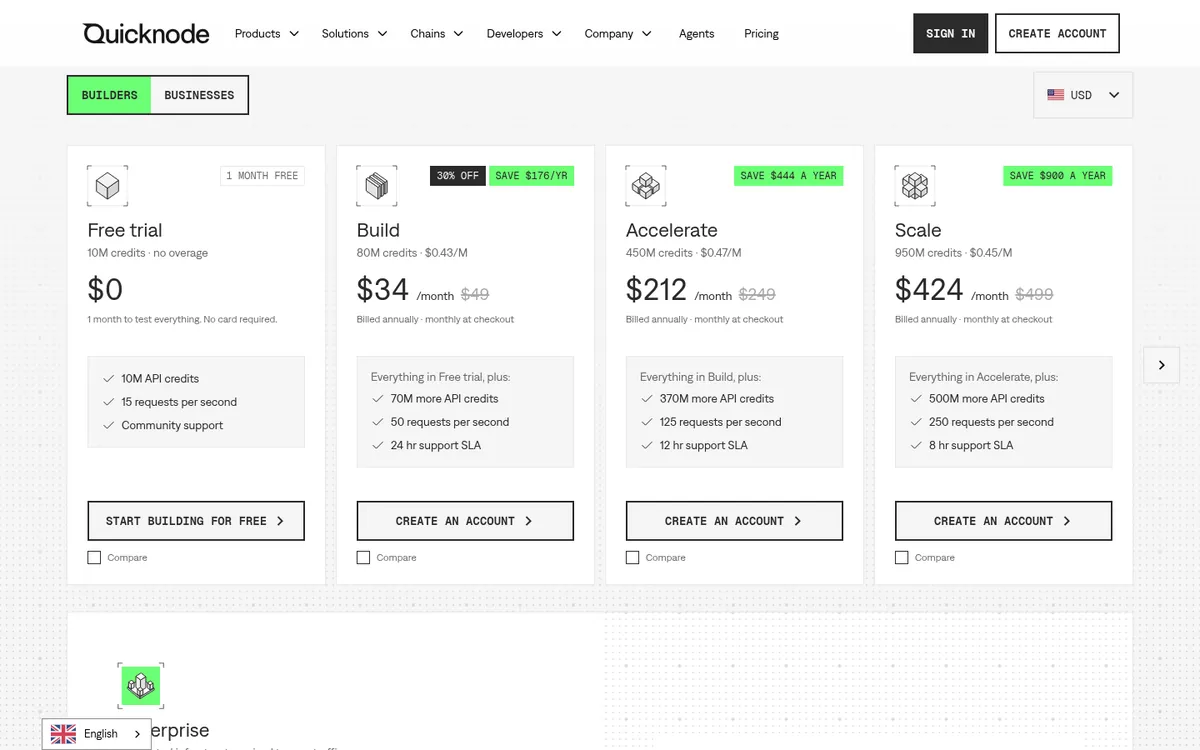
- Plans: Build $49 (80M credits), Accelerate $249 (450M), Scale $499 (950M), Business $999 (2B). Annual billing saves about 30%.
- Overage: $0.62 per 1M credits on Build, falling to $0.50 on Business.
- Strengths: lowest warm latency on Base, Solana and Arbitrum on 25 October 2026, SOC 1 and SOC 2 Type 2, ISO 27001, archive data on every plan.
- Weaknesses: no free-forever tier, and Solana calls cost 30 credits, which lifts Solana bills above Alchemy’s.
Verdict: QuickNode scores 7.7. Pick it for latency-sensitive apps on Base, Solana or Arbitrum and for regulated buyers. See its entry in our full ranking.
Alchemy
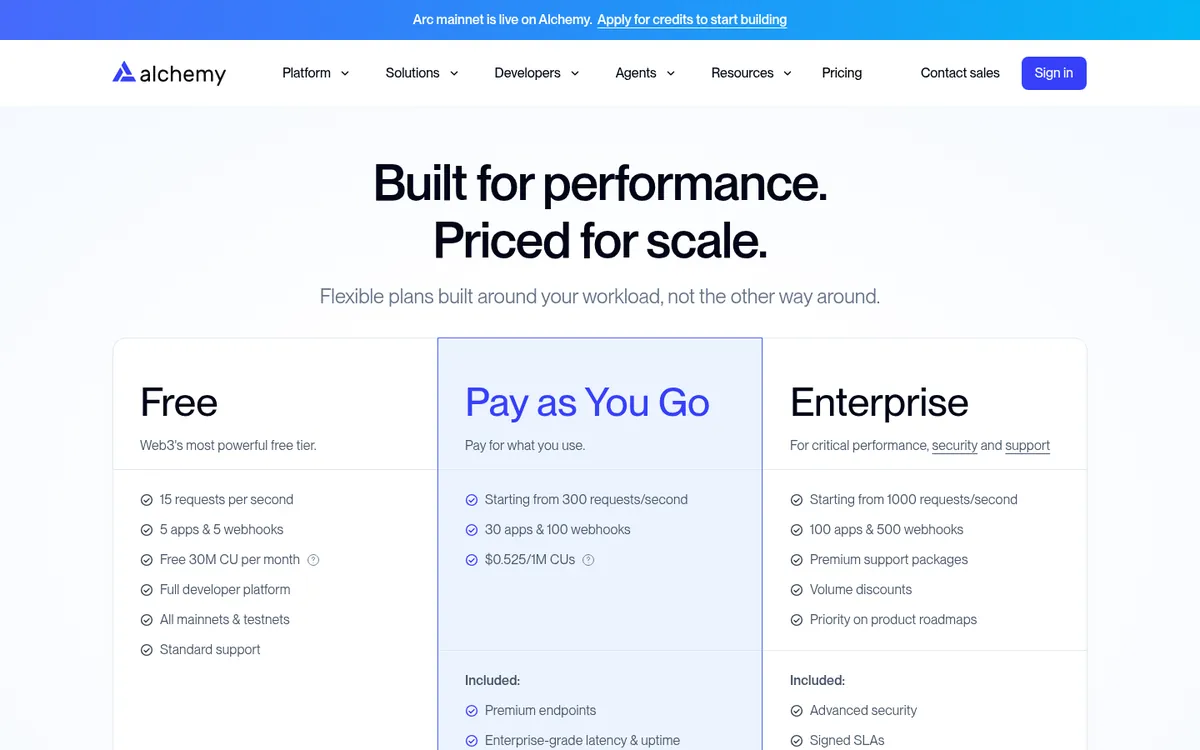
- Plans: Free (30M CU, 15 rps, 5 apps), Pay as you go ($0.525 per 1M CU, 300 rps, 30 apps), Enterprise (custom).
- Method weights: 10 CU for
eth_blockNumber, 26 foreth_call, 40 for sends and traces, 60 foreth_getLogs. - Strengths: most useful free tier, data APIs and webhooks, widest chain list, cheap light reads on Solana.
- Weaknesses: log-heavy and trace-heavy workloads cost the most of the three, and contractual SLAs need Enterprise.
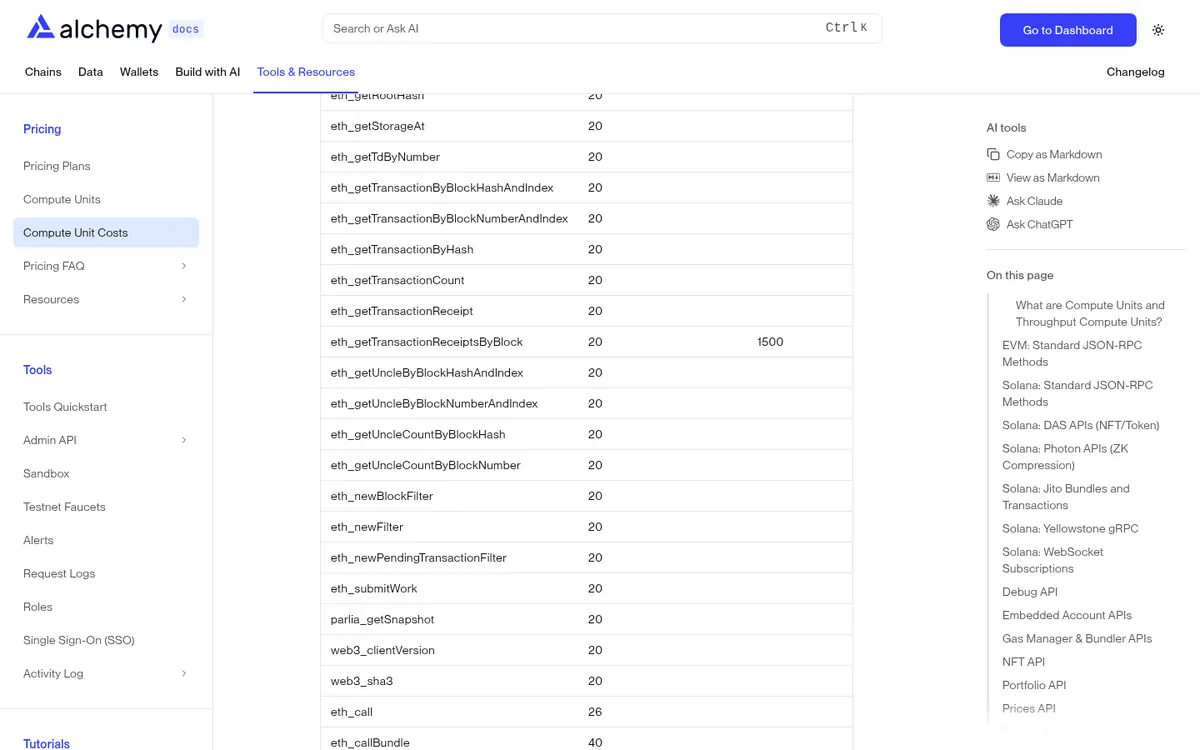
Verdict: Alchemy scores 8.3. Pick it for prototypes, wallets and apps that lean on token and NFT data. See its entry in our full ranking.
Chainstack
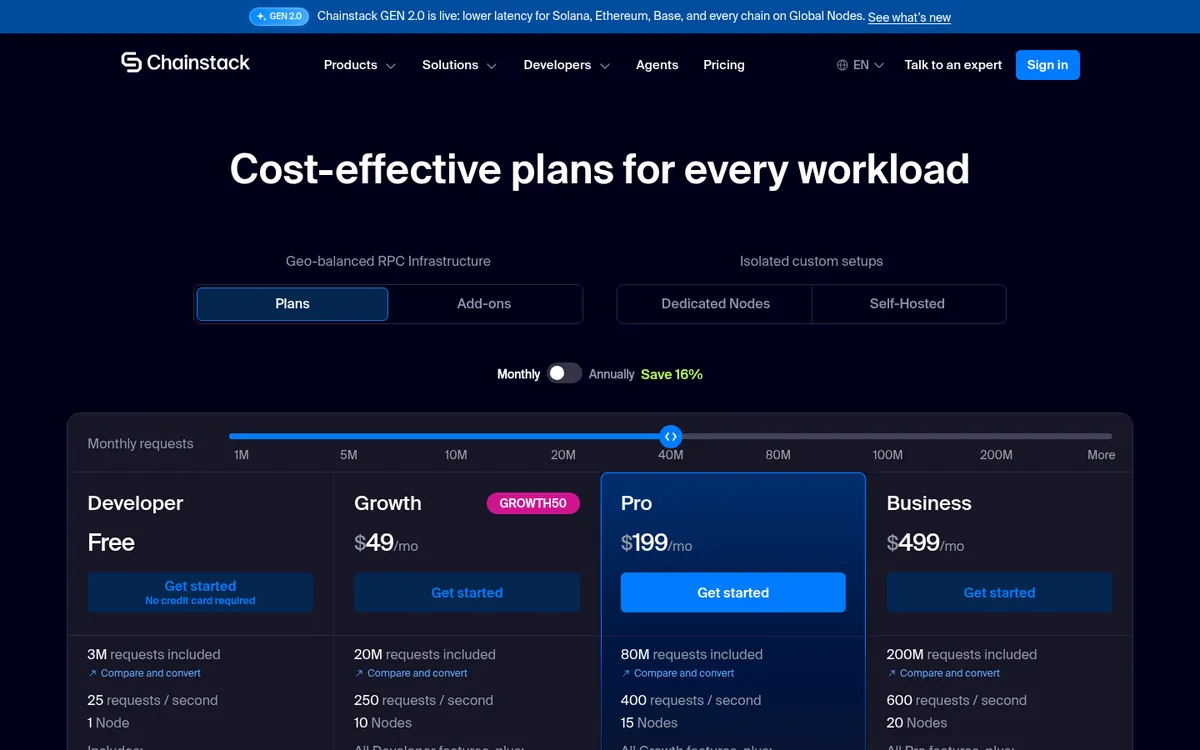
- Plans: Developer free (3M RU), Growth $49 (20M), Pro $199 (80M), Business $499 (200M), Enterprise from $990 (400M). Annual billing saves 16%.
- Overage: $20 per 1M RU on Developer, $15 on Growth, $12.50 on Pro, $10 on Business and $5 on Enterprise.
- Strengths: lowest bill in all four workloads, flat meter for logs, SOC 2 Type II and ISO 27001, published dedicated node pricing.
- Weaknesses: high overage on lower tiers, slower cold-start latency on Ethereum and Arbitrum, fewer data APIs.
Verdict: Chainstack scores 8.6 and wins this comparison. Pick it for cost control at any volume. See its entry in our full ranking.
Final Ranking
Chainstack takes first place on price, audits and a flat meter that suits logs and traces. Alchemy is second on the strength of its free tier, data APIs and chain coverage. QuickNode is third on our weights, mostly because it has no free tier and costs more per call, and it still wins on latency for three of four chains.


Verdict: Start on Chainstack for cost, keep Alchemy or QuickNode as the second endpoint, and rerun the workload math each quarter as prices change. For a wider set of options, see our QuickNode alternatives guide. See also our QuickNode vs Infura vs Ankr comparison.
How to Run a One-Week Bake-Off
A week of side-by-side traffic answers the questions a pricing page cannot. Send the same requests to all three endpoints from the region where your servers run. Log median and tail latency, error rates and the block number each endpoint returns, then price that week’s method mix on each meter.
for url in "$QN_URL" "$ALCHEMY_URL" "$CHAINSTACK_URL"; do
  curl -s -o /dev/null -w "%{time_total}\n" \
    -H "Content-Type: application/json" \
    -d '{"jsonrpc":"2.0","id":1,"method":"eth_blockNumber","params":[]}' \
    "$url"
done
Run the loop from a long-lived server and from a serverless function to see both warm and cold behavior. Use each vendor’s free tier or trial for the test. Read the full RPC providers hub for more head to head comparisons.
Frequently Asked Questions
Is QuickNode better than Alchemy?
QuickNode is better for latency on Base, Solana and Arbitrum, for log-heavy and trace-heavy Ethereum traffic, and for buyers who need SOC 1 and ISO 27001. Alchemy is better for prototypes, wallets and Solana reads, thanks to its free tier, data APIs and cheap light methods. Alchemy scores 8.3 and QuickNode 7.7 on our weights.
Is Chainstack cheaper than Alchemy and QuickNode?
Yes, in every workload we modeled on 25 October 2026. A 10M-request wallet backend costs $49 on Chainstack, $119.18 on Alchemy and $123.40 on QuickNode. A 50M-request indexer costs $199, $1,155 and $525.50. Chainstack overage is expensive on lower tiers, so pick a plan that covers your busiest month.
How do Alchemy compute units compare to QuickNode credits?
Alchemy weights each method, from 10 CU for eth_blockNumber to 60 CU for eth_getLogs. QuickNode charges 20 credits for any standard Ethereum call. At entry pricing, one million eth_call requests cost $13.65 on Alchemy and $12.25 on QuickNode Build, while one million eth_getLogs calls cost $31.50 and $12.25.
Which is fastest: QuickNode, Alchemy or Chainstack?
On the OpenChainBench keyed run for 25 October 2026, QuickNode led on Base, Solana and Arbitrum, and Chainstack led on warm Ethereum at 7.7 ms. On cold-start connections QuickNode beat Chainstack on Ethereum, Solana and Arbitrum. Alchemy was not listed that day, so test it from your own region.
Which has the best free tier?
Alchemy has the most useful free tier: 30M compute units a month, with archive data and data APIs, and no expiry. Chainstack Developer gives 3M request units a month, which buys more raw calls. QuickNode offers a one-month trial with 10M credits, which suits a short evaluation but cannot host a permanent project.
Can I use QuickNode, Alchemy and Chainstack together?
Yes, and most production teams should run at least two. All three expose standard JSON-RPC endpoints, so the same client code works against each. Put the cheapest fit for your traffic first in a fallback list, keep a second vendor behind it, and compare bills each quarter as prices and benchmarks change.