
Last updated: 25 October 2026 · Every plan price, allowance, overage rate and method weight rechecked on vendor pages on 25 October 2026
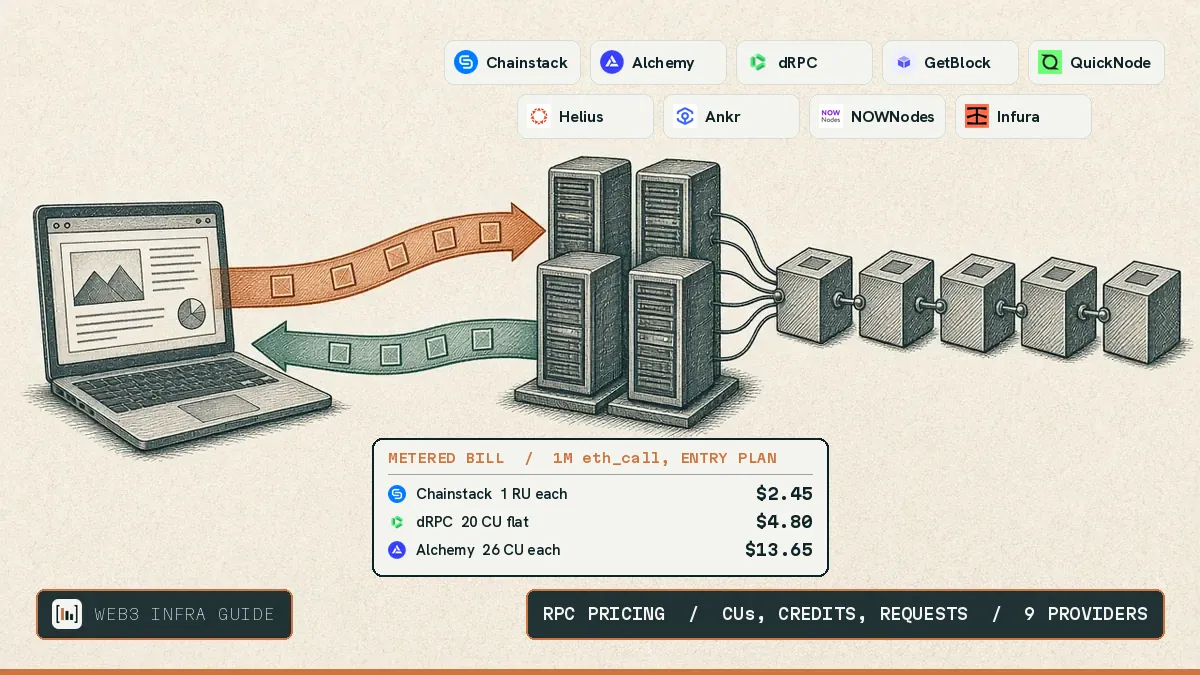
RPC provider pricing comes down to one question: what does a million of your calls cost once each vendor’s unit is converted to dollars? On entry plans used in full, an Ethereum eth_call costs $2.45 per million on Chainstack, $4.80 on dRPC, $12.25 on QuickNode and $13.65 on Alchemy. The spread on log and trace calls is wider still.
Vendors sell compute units, credits, request units or plain requests, and each one weights methods differently. We converted nine providers’ meters into dollars per million calls, priced four real workloads on every plan, and scored the results with the same weights as our ranking of the 12 best RPC node providers. Our methodology page explains how prices and screenshots are collected.
TL;DR
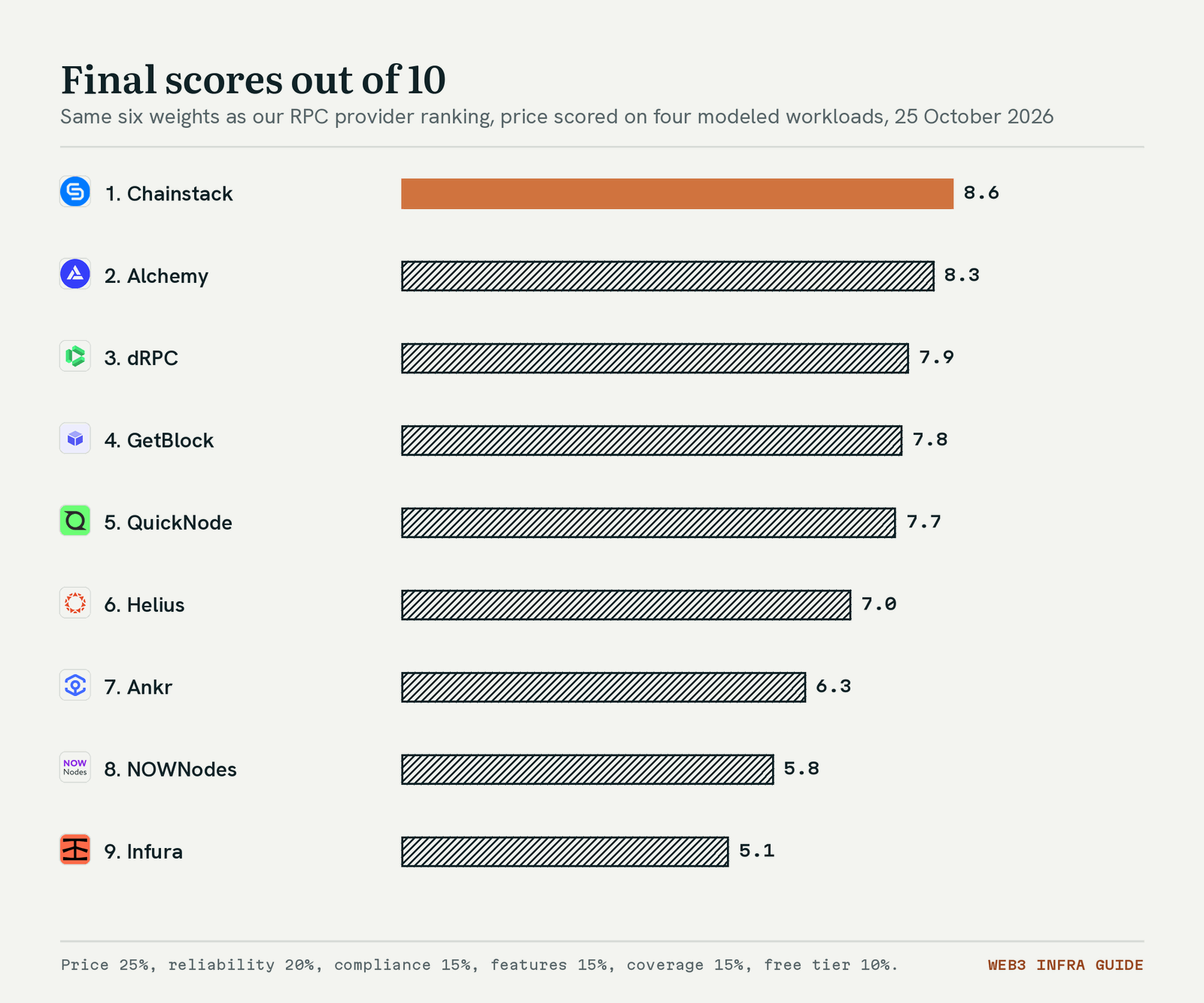
- Best value overall: 1. Chainstack (8.6), 2. Alchemy (8.3), 3. dRPC (7.9), 4. GetBlock (7.8), 5. QuickNode (7.7), 6. Helius (7.0), 7. Ankr (6.3), 8. NOWNodes (5.8), 9. Infura (5.1).
- Cheapest meter per call: Chainstack Growth at $2.45 per million for most Ethereum and Solana methods, then dRPC at $4.80 per million EVM requests and $3.90 per million Solana requests.
- Method weights decide log-heavy bills. A million
eth_getLogscalls cost $2.45 on Chainstack, $12.25 on QuickNode, $28.33 on Infura and $31.50 on Alchemy. Our QuickNode vs Alchemy vs Chainstack comparison runs the same calls through three providers in more detail. - Across our four workloads, Chainstack had the lowest or tied-lowest bill three times and dRPC once. Alchemy’s 50M-request log indexer came to $1,155 a month against $199 on Chainstack Pro.
- Overage is where plans get expensive: $15 per million request units on Chainstack Growth, about $56 per million requests on NOWNodes Pro Plus, and no overage at all below Pro on GetBlock.
- Pay as you go still wins at low volume. Alchemy is free up to 30M compute units, and $49 of Alchemy usage buys about 93M compute units, or about 3.6M dApp-style requests. When usage outgrows that tier, our Alchemy alternatives guide prices the switch.
The Decision Kernel
Do not compare plans by headline allowance. 80M credits and 20M request units can buy similar or very different call counts, depending on your methods. Export one week of request logs grouped by method, then price that mix on each meter before you look at plan names. These shortcuts cover the common cases.
- Lowest bill for most mixes: Chainstack, where most methods cost 1 request unit and Growth buys 20M of them for $49.
- Flat price with no method math: dRPC, which charges the same for every method, including
eth_getLogsand traces. - Spiky or small traffic: Alchemy pay as you go at $0.525 per million compute units, with no plan to outgrow.
- Solana-only stack: Helius Developer at $49 for 10M credits, where most calls cost 1 credit. Our Helius vs QuickNode vs Triton comparison prices Solana workloads in more detail.
- Predictable invoices in euros: NOWNodes request plans, as long as you stay inside the allowance.
- Largest step-up plans: GetBlock and QuickNode, with published tiers up to 1.6B and 2B units.
Verdict: Chainstack for the lowest per-call price across chains, dRPC when you want one flat rate, and Alchemy pay as you go while volume is small or unknown. For chain-specific shortlists, see our rankings of the best Ethereum RPC providers and the best Solana RPC providers.
How We Ranked RPC Provider Pricing
We scored each provider from 1 to 5 on six criteria with the same weights as our main RPC provider ranking, and doubled the weighted total. The price score comes from our four-workload model, and only Infura moved, from 4 to 2. Its daily quota forces Team at 10M requests and Enterprise above that. Our methodology covers the rest.
Reliability, compliance, features, coverage and free tier scores carry over unchanged from that ranking, so the two lists stay comparable.
- Price, 25%: monthly bills for four method mixes on Ethereum and Solana, on the cheapest public plan that fits.
- Reliability, 20%: public latency benchmarks, uptime claims and support response targets.
- Compliance, 15%: SOC 2, ISO 27001 and other audits stated on the vendor’s own pages.
- Features, 15%: archive, trace, streaming, WebSockets and dedicated node options.
- Coverage, 15%: chains on one account.
- Free tier, 10%: how much traffic a team can run before paying.
| Provider | Price (25%) | Reliability (20%) | Compliance (15%) | Features (15%) | Coverage (15%) | Free tier (10%) | Score |
|---|---|---|---|---|---|---|---|
 | 5 | 4 | 5 | 4 | 4 | 3 | 8.6 |
 | 3 | 4 | 4 | 5 | 5 | 5 | 8.3 |
 | 5 | 4 | 2 | 3 | 5 | 4 | 7.9 |
 | 3 | 5 | 4 | 4 | 5 | 2 | 7.8 |
 | 3 | 4 | 5 | 5 | 4 | 2 | 7.7 |
 | 5 | 3 | 3 | 5 | 1 | 3 | 7.0 |
 | 2 | 3 | 4 | 3 | 4 | 4 | 6.3 |
 | 4 | 3 | 1 | 2 | 5 | 1 | 5.8 |
 | 2 | 3 | 1 | 3 | 3 | 4 | 5.1 |
Three Ways RPC Providers Bill
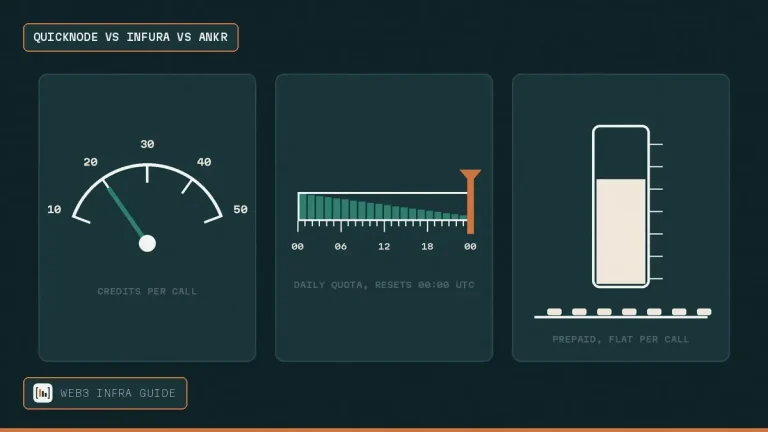
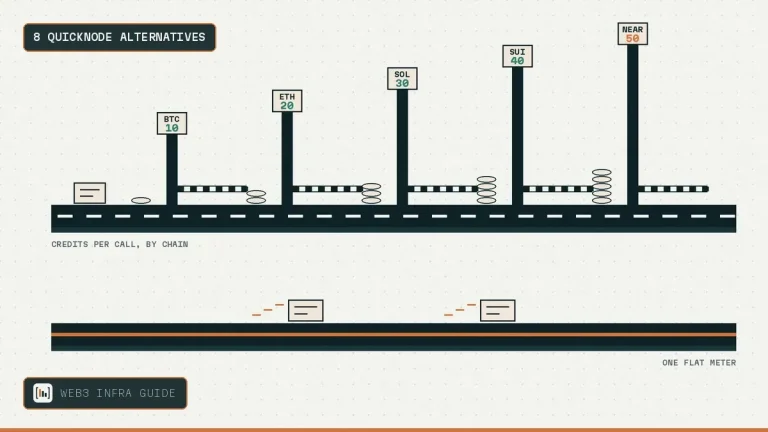
Every provider in this guide uses one of three meters. The label on the plan matters less than how the meter treats your heaviest method. A per-method meter can charge 12.5 times more for one block receipts call than for a standard read.
| Meter | Providers | How a call is priced | What to watch |
|---|---|---|---|
| Weighted per method | Alchemy (CU), Infura (credits), Helius (credits), Chainstack (RU) | Each method has its own weight | Log, trace and program-account calls cost more |
| Weighted per chain | QuickNode (credits), GetBlock (CU) | A chain multiplier, then a method multiplier for traces | Solana costs 1.5 to 2.5 times Ethereum |
| Flat per request | dRPC, Ankr, NOWNodes | Every method costs the same | You pay full price for cheap calls too |
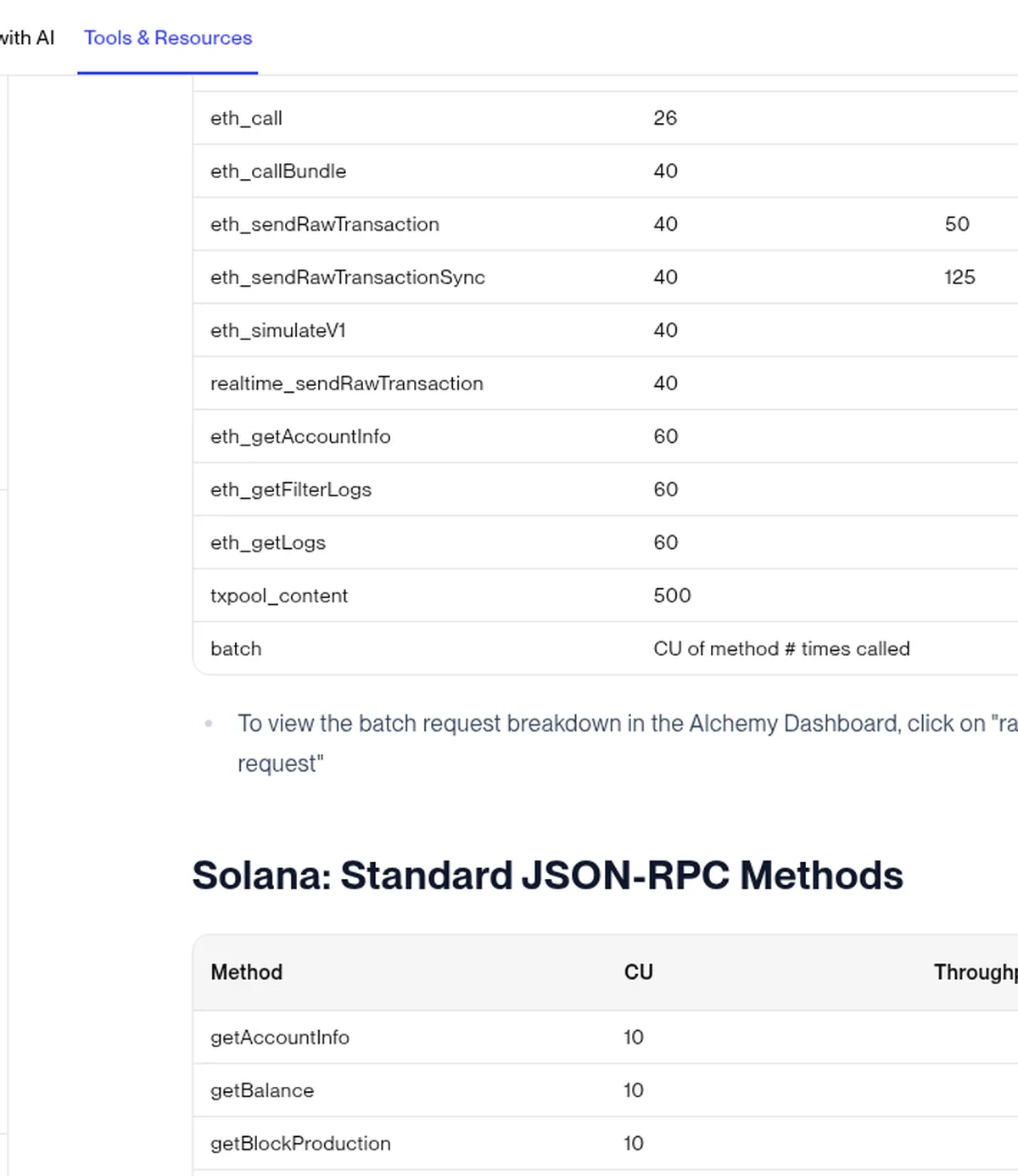
- Alchemy: 10 CU for
eth_blockNumber, 20 foreth_getBalance, 26 foreth_call, 40 fordebug_traceTransactionand 60 foreth_getLogs, per its CU cost table. - Infura: 80 credits for most reads, 255 for
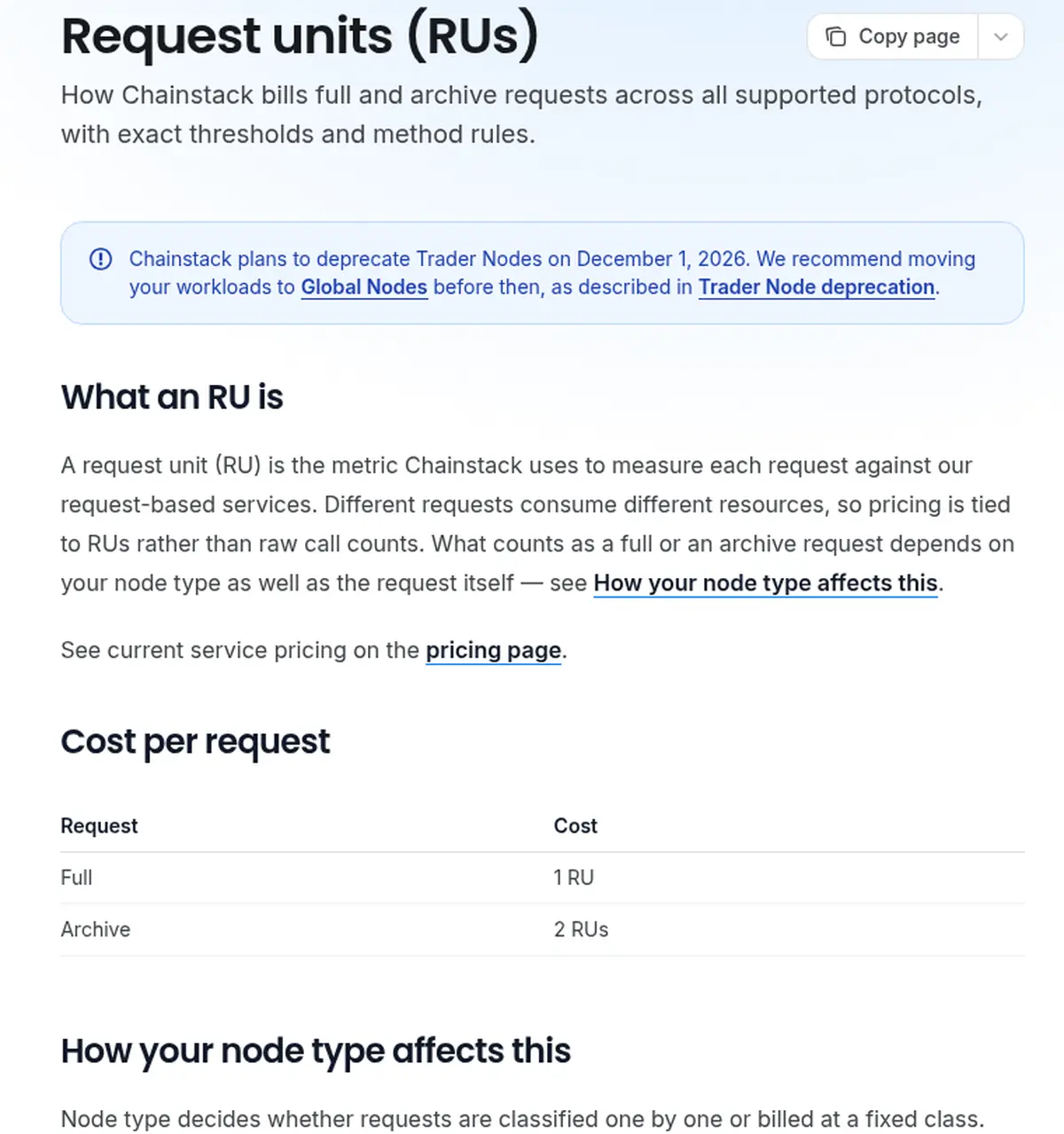
eth_getLogs, 300 foreth_estimateGasand 1,000 foreth_getBlockReceiptsand debug calls, and 160 for every Solana method, per its credit cost page. - Chainstack: 1 RU for a full-node call and 2 RU for archive, debug and trace calls, per its request unit rules.
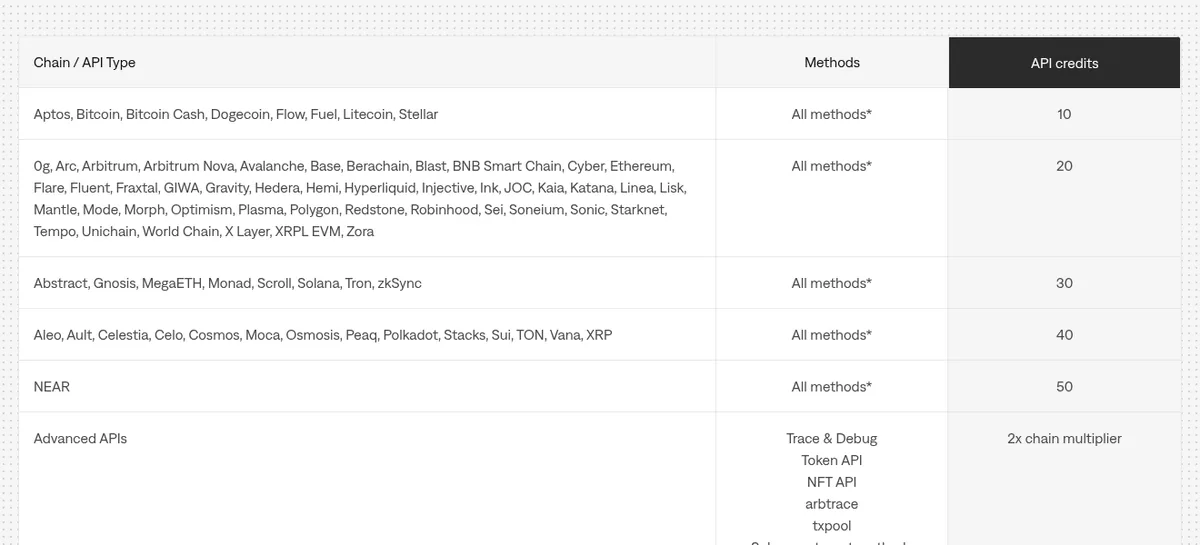
- QuickNode: 20 credits per Ethereum or Base call and 30 per Solana call, doubled for trace and debug, per its API credit tables.
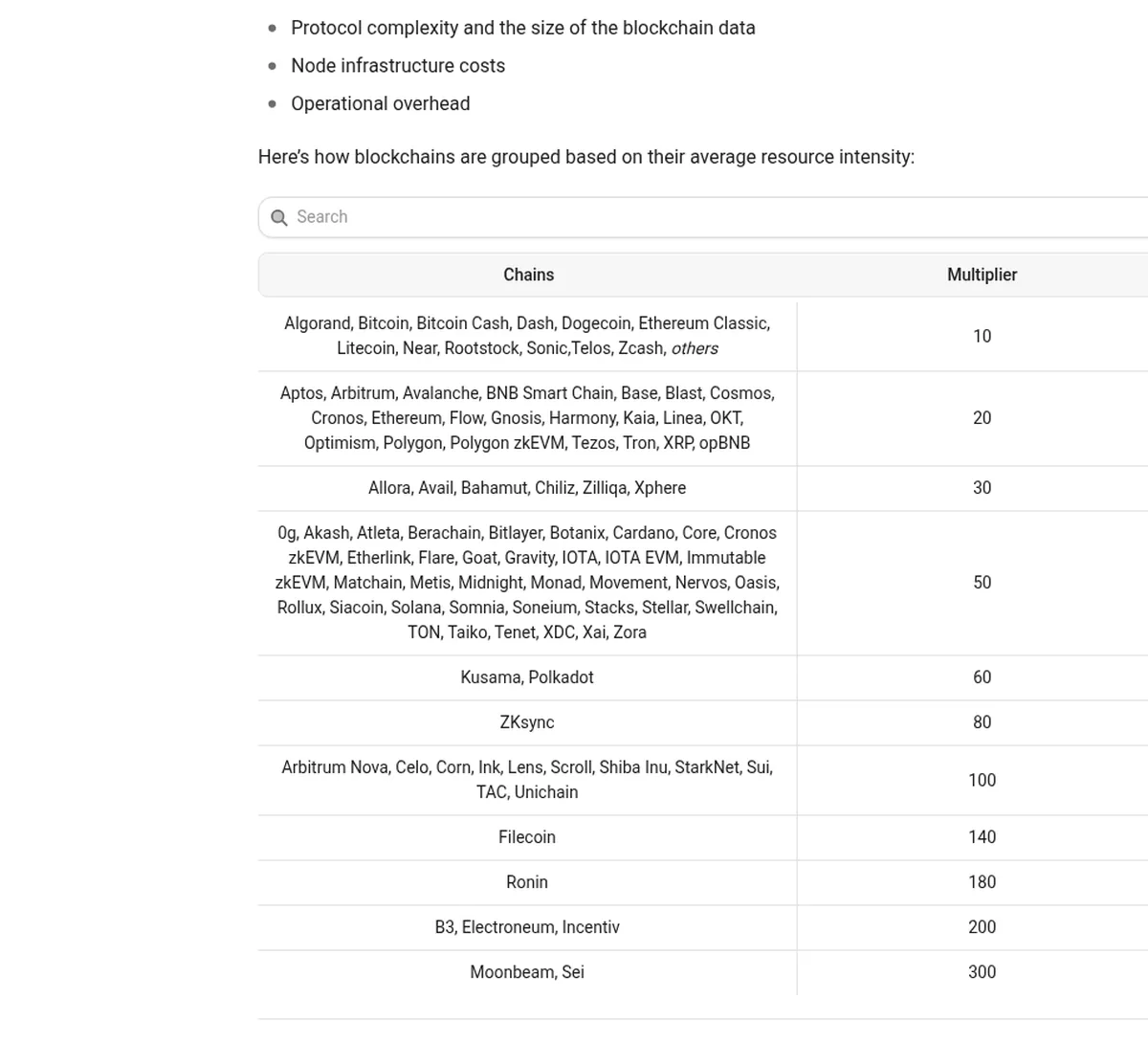
- GetBlock: a chain multiplier of 20 for Ethereum and Base and 50 for Solana, times 2 for debug and trace and 2 again for archive, per its CU formula.
Verdict: Flat meters are simple and punish light calls. Weighted meters reward balance and block reads and punish logs, traces and program scans. Know which side your traffic sits on.
What One Million Ethereum Calls Cost
We converted each vendor’s Ethereum weights into dollars per million calls on its entry paid plan, assuming the allowance is fully used. Chainstack’s $2.45 is $49 divided by 20M request units. Alchemy’s $13.65 is 26 CU at $0.525 per million CU. One million debug traces cost $4.80 on dRPC, $4.90 on Chainstack and $111.11 on Infura Developer.
| Entry plan | eth_call | eth_getBalance | eth_getLogs | eth_getBlockReceipts | debug_traceTransaction |
|---|---|---|---|---|---|
| $2.45 | $2.45 | $2.45 | $2.45 | $4.90 |
| $4.80 | $4.80 | $4.80 | $4.80 | $4.80 |
| $8.89 | $8.89 | $28.33 | $111.11 | $111.11 |
| $10.07 | $10.07 | $10.07 | $10.07 | $10.07 |
| $10.89 | $10.89 | $10.89 | $10.89 | $21.78 |
| $12.25 | $12.25 | $12.25 | $12.25 | $24.50 |
| $13.65 | $10.50 | $31.50 | $10.50 | $21.00 |
| $20.00 | $20.00 | $20.00 | $20.00 | $20.00 |
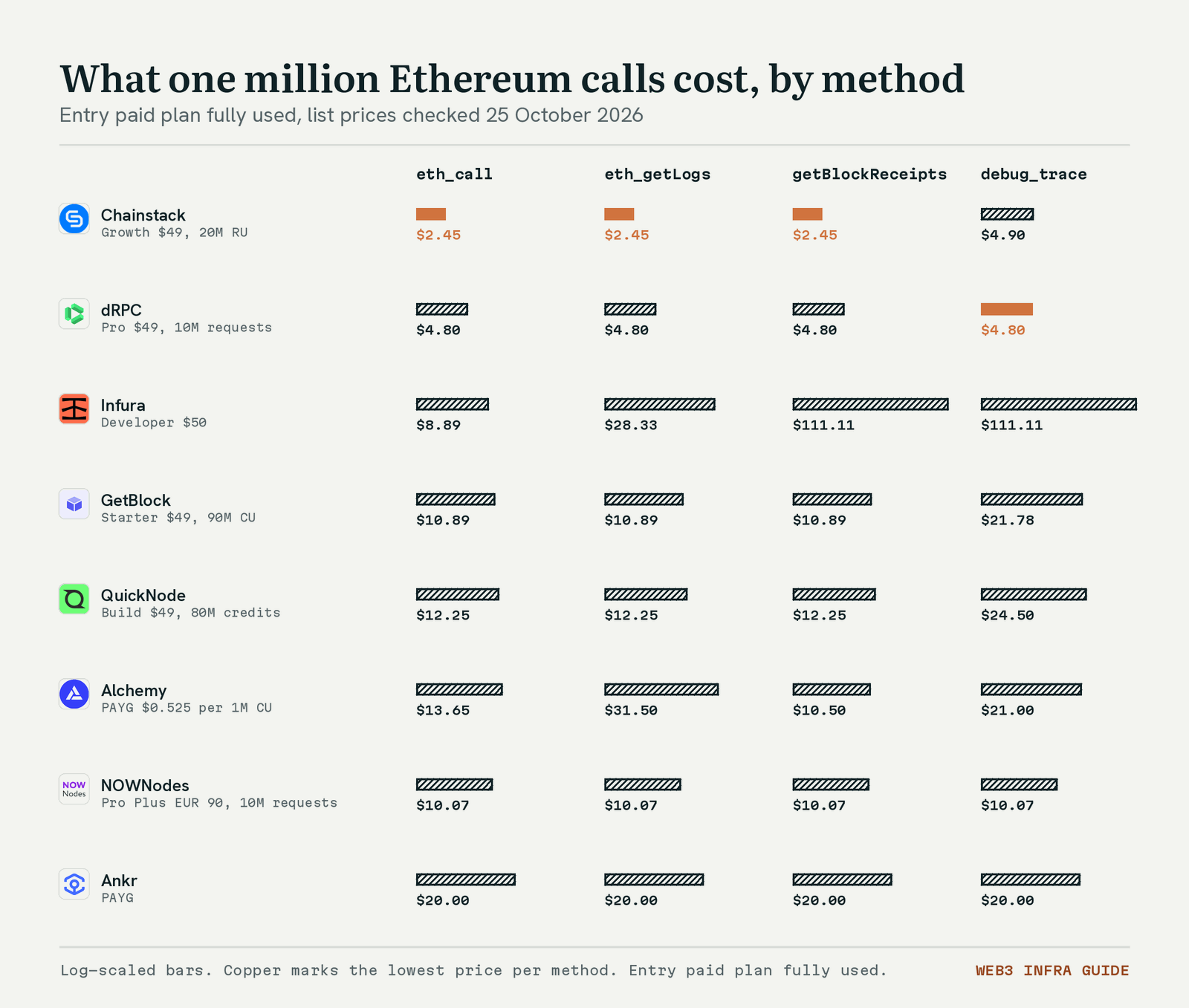
The ranking flips by method. Infura is the third-cheapest option for eth_call at $8.89 per million, yet the most expensive for block receipts and traces, because those methods weigh 1,000 credits. Alchemy is mid-priced for balances and the most expensive mainstream meter for logs. Flat meters like dRPC and NOWNodes sit in the middle for every method.
Verdict: For Ethereum, Chainstack and dRPC are the two cheapest meters on every method we priced. Weighted meters only compete when your traffic is mostly cheap reads.
What One Million Solana Calls Cost
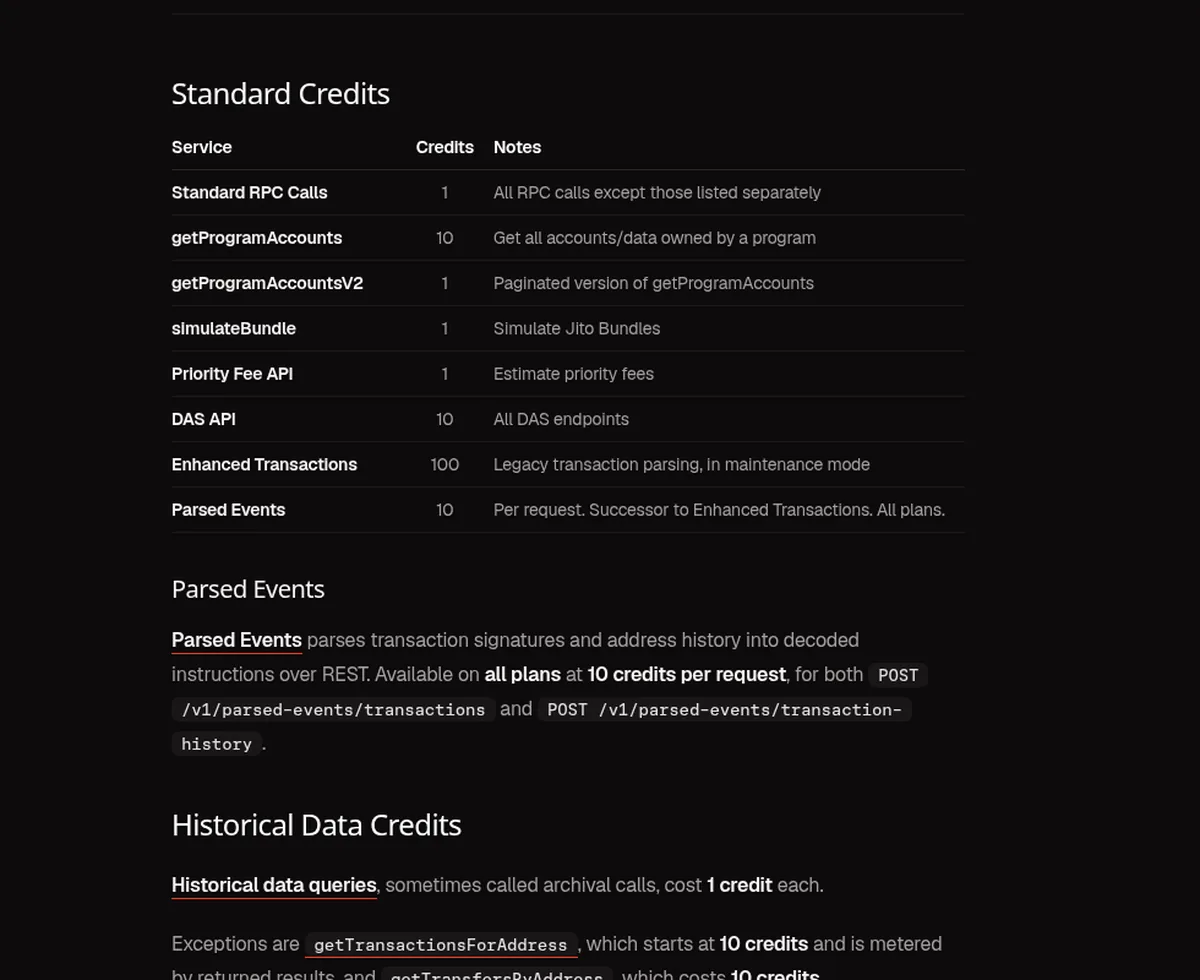
Solana changes the order. QuickNode and GetBlock charge more per Solana call than per Ethereum call, while Alchemy weights Solana account reads at only 10 CU. Helius charges 10 credits for getProgramAccounts, which makes it $49 per million on Developer against $4.90 for a normal call. Its newer getProgramAccountsV2 costs 1 credit, per its credit table.
| Entry plan | getAccountInfo | getProgramAccounts | getTransaction | getSignaturesForAddress |
|---|---|---|---|---|
| $2.45 | $2.45 | $2.45 | $4.90 |
| $3.90 | $3.90 | $3.90 | $3.90 |
| $4.90 | $49.00 | $4.90 | $4.90 |
| $5.25 | $10.50 | $21.00 | $21.00 |
| $10.07 | $10.07 | $10.07 | $10.07 |
| $17.78 | $17.78 | $17.78 | $17.78 |
| $18.38 | $18.38 | $18.38 | $18.38 |
| $27.22 | $27.22 | $27.22 | $27.22 |
| $50.00 | $50.00 | $50.00 | $50.00 |
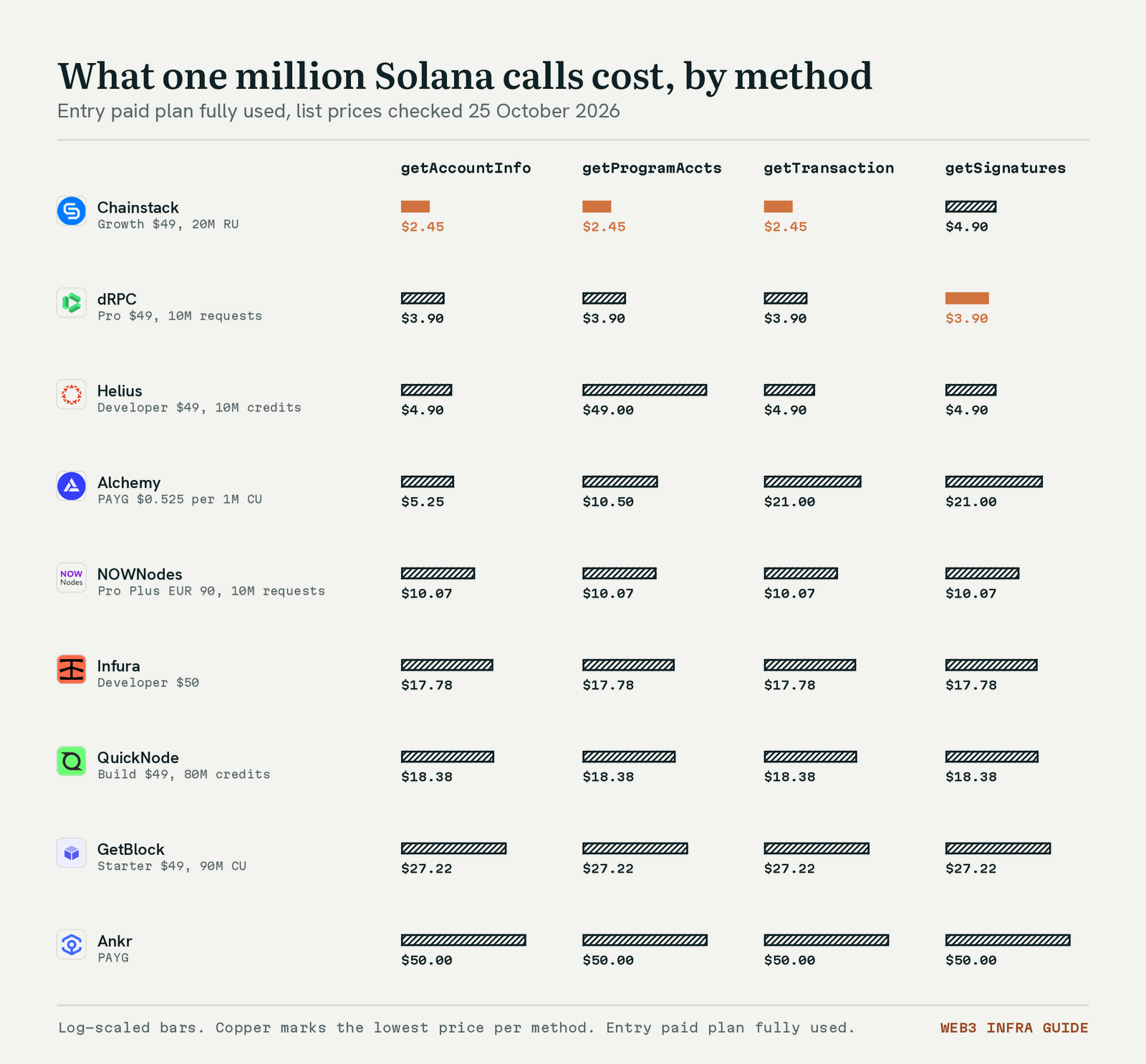
Two caveats apply. Chainstack charges 2 RU for getSignaturesForAddress and for calls that reach old slots, so history-heavy Solana apps pay $4.90 per million there. GetBlock’s 50x Solana multiplier is published, but we did not find per-method Solana multipliers on its docs, so heavier methods may cost more than shown.
Verdict: Chainstack and dRPC are again cheapest per call on Solana. Helius is close on standard calls and expensive on program scans unless you move to getProgramAccountsV2.
Entry Plans When You Do Not Use Them Fully
A fixed plan only reaches its per-call price when you use the whole allowance. At a quarter of the allowance, every fixed plan costs four times as much per call, while pay-as-you-go meters stay put. At 25% use, Chainstack Growth works out to $9.80 per million eth_call requests, still cheaper than Alchemy pay as you go at $13.65.
| Entry plan | Monthly price | eth_call requests included | Per 1M at 100% use | Per 1M at 25% use |
|---|---|---|---|---|
| $49 | 20M | $2.45 | $9.80 |
| $49 | 10M | $4.80 | $19.60 |
| EUR 90 ($100.74) | 10M | $10.07 | $40.28 |
| $49 | 4.5M | $10.89 | $43.56 |
| $49 | 4M | $12.25 | $49.00 |
| $50 | 5.6M (187,500 a day) | $8.89 | $35.56 |
| $49 | 10M | $4.90 | $19.60 |
| Usage | No minimum | $13.65 | $13.65 |
| From $10 top-up | Prepaid | $20.00 | $20.00 |
Infura’s daily quota adds a twist. Developer gives 15M credits a day, or about 187,500 eth_call requests, and unused credits from a quiet day do not help on a busy one. Plan for your busiest day, not your monthly average.
Verdict: If you will use less than about a quarter of a $49 plan, start on Alchemy pay as you go or a free tier and move to a fixed plan once usage is steady. Our free RPC providers guide compares seven free plans side by side.
Overage and Plan Jumps
The second number on every pricing page is what happens past the allowance. Some vendors bill overage at close to the plan rate, some charge a premium, and some stop service until you upgrade. Chainstack Growth overage costs $15 per million request units, six times its in-plan rate, so moving to Pro at $199 is cheaper from about 30M requests.
| Provider | Overage on the entry plan | Overage on bigger plans | At the limit |
|---|---|---|---|
| $15 per 1M RU on Growth | $12.50 Pro, $10 Business, $5 Enterprise | Billed per extra 1M RU |
| $6 per 1M multi-chain, $3.90 per 1M Solana | Same rates on Scale | Billed as pay as you go |
| $0.62 per 1M credits on Build | $0.56, $0.53 and $0.50 per 1M | Billed per extra credit |
| No overage below Pro, CU top-ups | $0.40 per 1M CU on Pro, $0.35 on Premium | Top up or upgrade |
| $5 per 1M credits | $5 per 1M credits | Billed per extra credit |
| EUR 5 per 100,000 requests on Pro Plus | EUR 1 per 100,000 on Business, EUR 0.50 on Enterprise | Billed per extra request |
| Add-on: 55M credits for $200 a month | Custom on Enterprise | Requests fail once the daily quota is used |
| Same $0.525 per 1M CU | Throughput add-on, $160 per 5,000 CU/s | No allowance to exceed |
| Same prepaid rate | Deal from $500 for 6B credits | Top up credits |
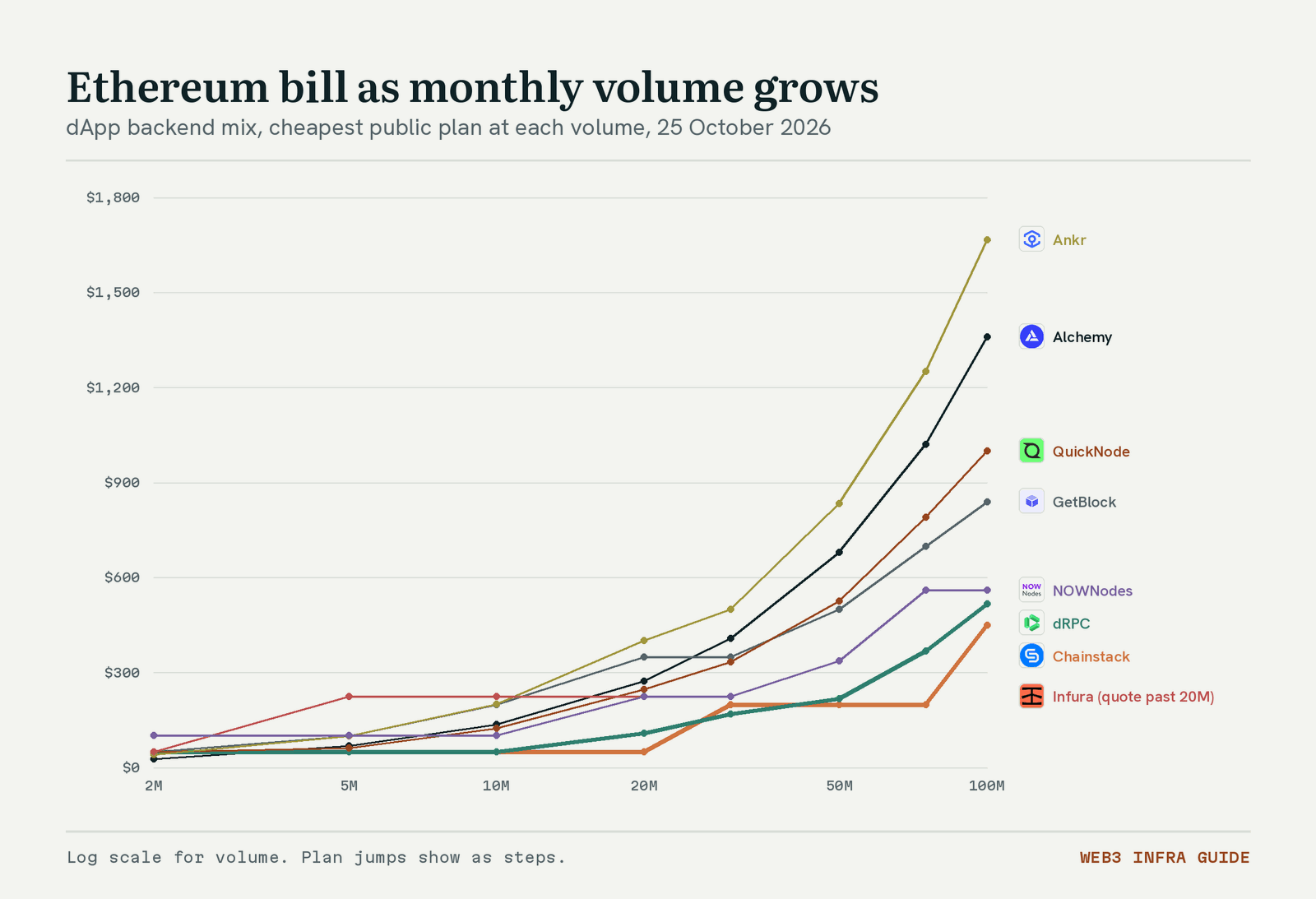
The chart shows the steps. Chainstack stays at $49 up to 20M dApp requests and jumps to $199 Pro at 30M. dRPC climbs in a straight line at $6 per million past Pro, then steps to Scale. Alchemy rises smoothly with no plan to outgrow and passes $1,000 a month near 75M requests.
Verdict: Model your next six months of growth, not this month. The cheapest plan today can be the most expensive one after a single traffic spike.
What Four Workloads Cost
We built four method mixes from common app patterns, converted each into every vendor’s unit and picked the cheapest public plan that covers the volume and a peak of three times the average rate. Chainstack had the lowest or tied-lowest bill in three of the four workloads, and dRPC won the Solana wallet backend at $119.
| Provider | Ethereum dApp backend, 10M | Ethereum log indexer, 50M | Solana wallet backend, 30M | Solana DeFi backend, 20M |
|---|---|---|---|---|
| $49 (Growth) | $199 (Pro) | $199 (Pro) | $49 (Growth) |
| $136 (Pay as you go) | $1,155 (Pay as you go) | $252 (Pay as you go) | $168 (Pay as you go) |
| $49 (Pro) | $217 (Scale) | $119 (Pro) | $80 (Pro) |
| $199 (Advanced) | $499 (Pro) | $699 (Premium) | $499 (Pro) |
| $123 (Build) | $526 (Scale) | $499 (Scale) | $333 (Accelerate) |
| Solana only | Solana only | $149 (Developer) | $189 (Developer) |
| $200 (Pay as you go) | $833 (Deal ($500)) | $1,250 (Deal ($500)) | $833 (Deal ($500)) |
| $101 (Pro Plus) | $336 (Business Plus) | $224 (Business) | $224 (Business) |
| $225 (Team) | Enterprise quote | Enterprise quote | Enterprise quote |
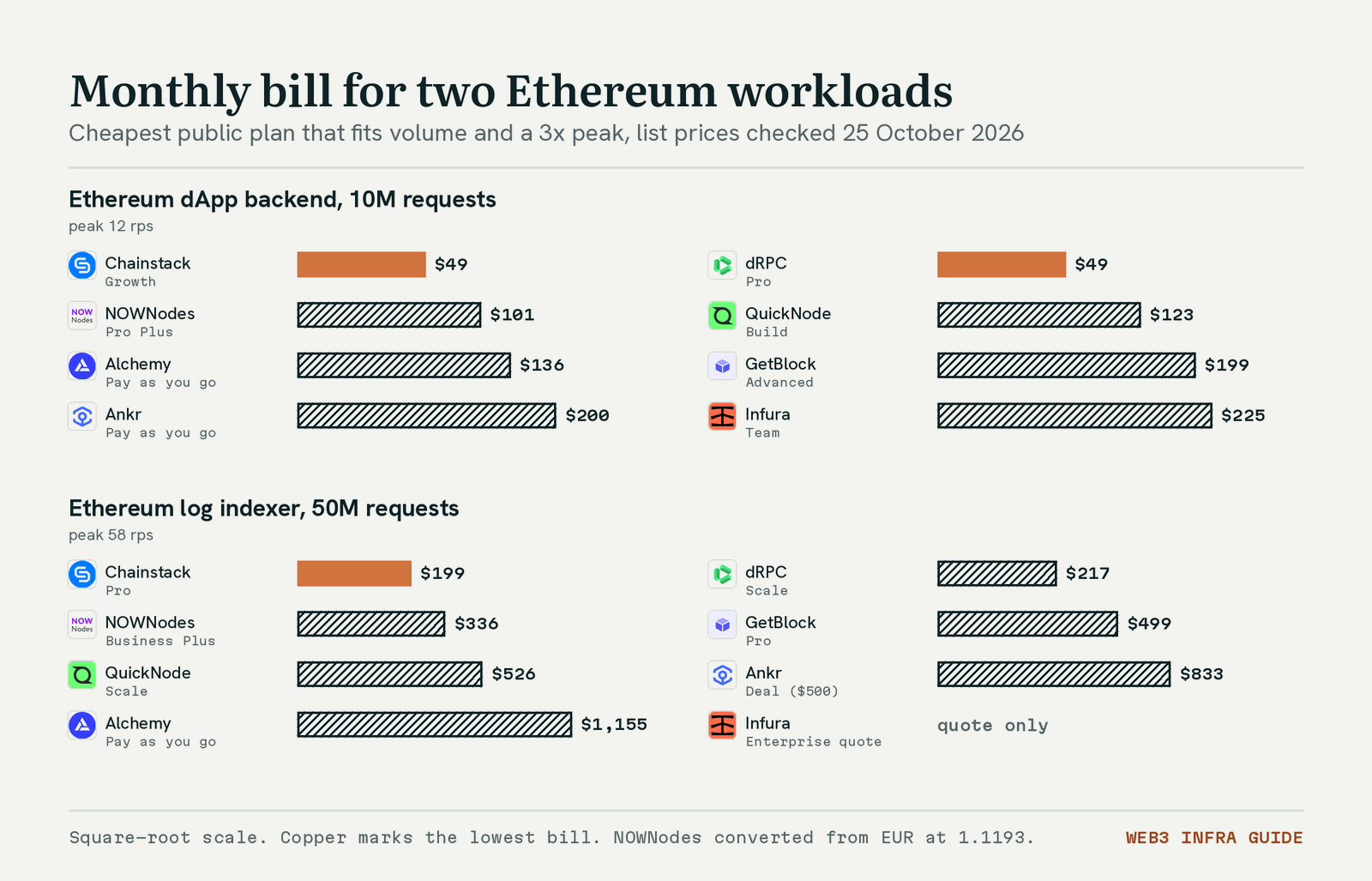
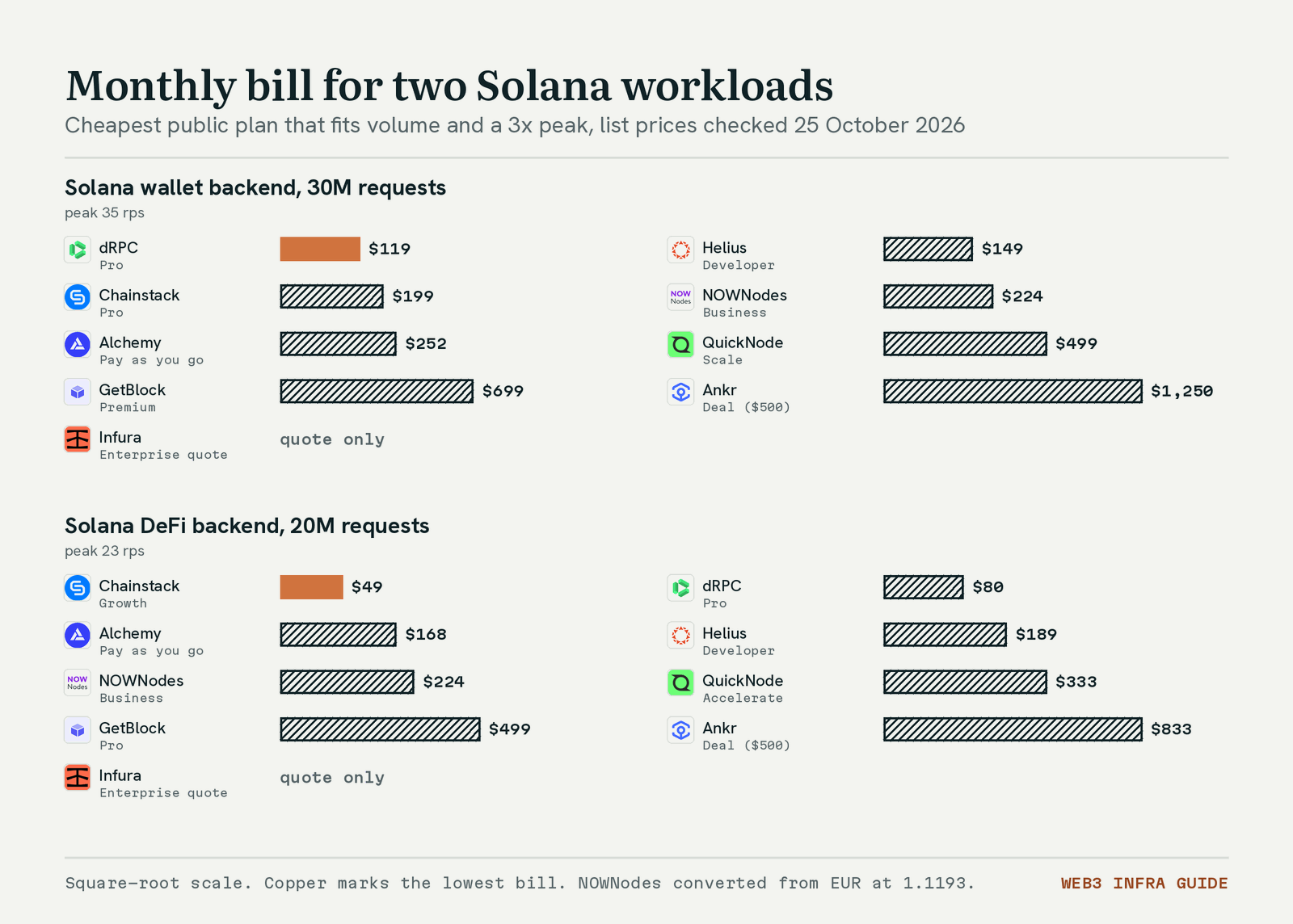
- Ethereum dApp backend, 10M requests: 40%
eth_call, 15%eth_getBalance, 15%eth_blockNumber, 10% receipts, 10%eth_getLogs, 5% sends and 5% gas estimates. - Ethereum log indexer, 50M requests: 60%
eth_getLogs, 25%eth_getBlockByNumberand 15%eth_getBlockReceipts, recent blocks. - Solana wallet backend, 30M requests: 35%
getAccountInfo, 20%getBalance, 15% token accounts, 10% blockhash, 10% signatures, 5% transactions and 5% sends. - Solana DeFi backend, 20M requests: 40%
getAccountInfo, 20%getMultipleAccounts, 10%getProgramAccounts, 10% blockhash, 10% simulations, 5% sends and 5% status checks.
Plan limits moved several answers. The Solana wallet mix needs 33M request units on Chainstack because signature lookups cost 2 RU, so Pro at $199 beats Growth plus overage. QuickNode’s indexer needs 1B credits and 58 requests per second at peak, which lands on Scale at $526. Infura’s Solana calls weigh 160 credits each, so both Solana mixes need an Enterprise deal.
Verdict: On list prices, Chainstack and dRPC are the two cheapest places to run all four workloads. Alchemy is competitive for Solana reads and expensive for log indexing.
Costs Outside the Request Meter
The request meter is not the whole bill. Streaming, bandwidth and support are priced separately at most vendors, and annual billing changes the math. Solana gRPC streaming is billed by data volume: $60 per TB on dRPC, from $75 per TB on Alchemy and 2 credits per 0.1 MB on Helius LaserStream.
- Streaming and gRPC: Ankr charges $0.001 per 1,000 gRPC calls plus $0.50 per GB, and QuickNode meters gRPC and sells its Solana gRPC add-on separately below Scale.
- Annual discounts: 30% on QuickNode (Build drops to $34), 20% on GetBlock, 16% on Chainstack, two months free on Helius and 10% on NOWNodes.
- Support: Chainstack sells Professional support at $1,000 a year and Premium at $10,000 a year. QuickNode targets 24, 12 and 8 hours on Build, Accelerate and Scale.
- Throughput: Alchemy pay as you go starts at 300 requests per second and sells more capacity at $160 per 5,000 CU per second.
- Dedicated nodes: GetBlock lists them from $1,000 a month and Helius from $2,900. Our dedicated nodes hub covers when they beat shared plans, and our dedicated node providers guide compares eight published options.
Verdict: Add streaming, support and throughput to your estimate before you compare totals. On Solana, a gRPC stream can cost more than the RPC calls themselves.
1. Chainstack
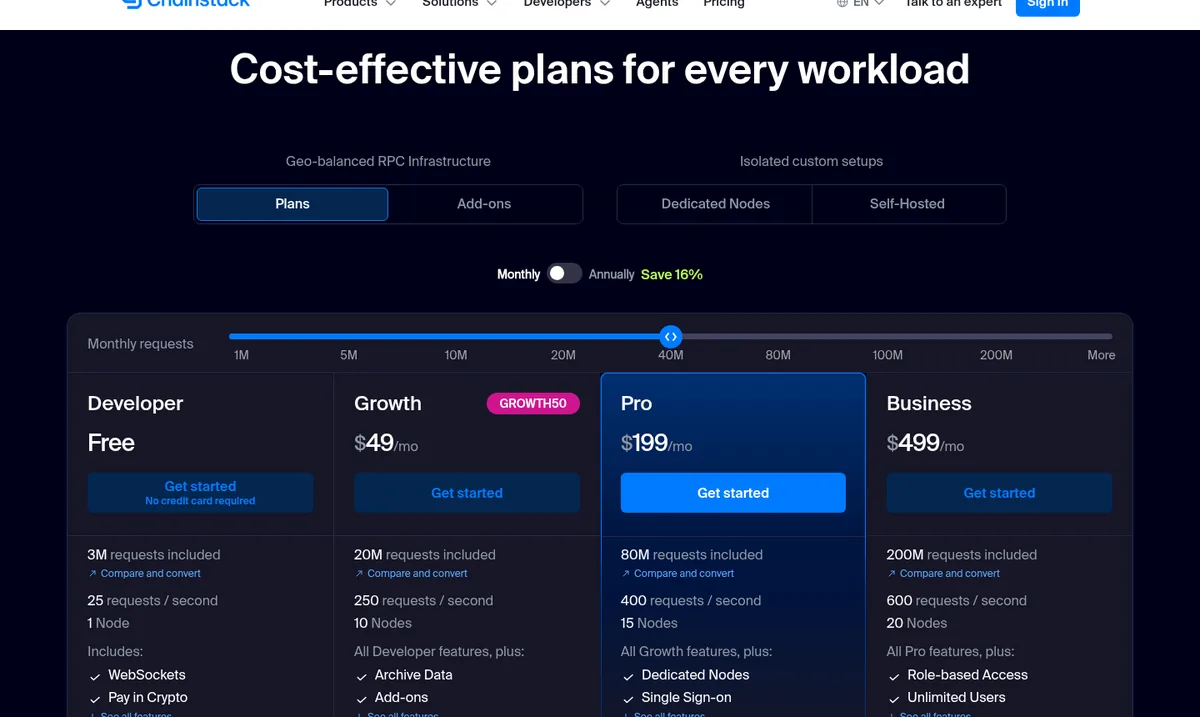
- Plans: Developer free (3M RU, 25 rps, no archive), Growth $49 (20M RU, 250 rps), Pro $199 (80M, 400 rps), Business $499 (200M, 600 rps), Enterprise from $990 (400M). Annual billing saves 16%.
- Meter: 1 RU per full-node call and 2 RU for archive, debug and trace. On Solana,
getSignaturesForAddressandgetFirstAvailableBlockalways cost 2 RU, per its RU docs. - Strengths: lowest or tied-lowest bill in three of four workloads, SOC 2 Type II and ISO 27001 on its security page, and a 99.99%+ uptime claim.
- Weaknesses: overage of $15 per million RU on Growth, and no archive data on the free plan. Its Trader Nodes product is deprecated on 1 December 2026.
Verdict: Chainstack scores 8.6 and ranks first. It is the cheapest meter across Ethereum and Solana for most method mixes. See its full entry in our RPC provider ranking.
2. Alchemy
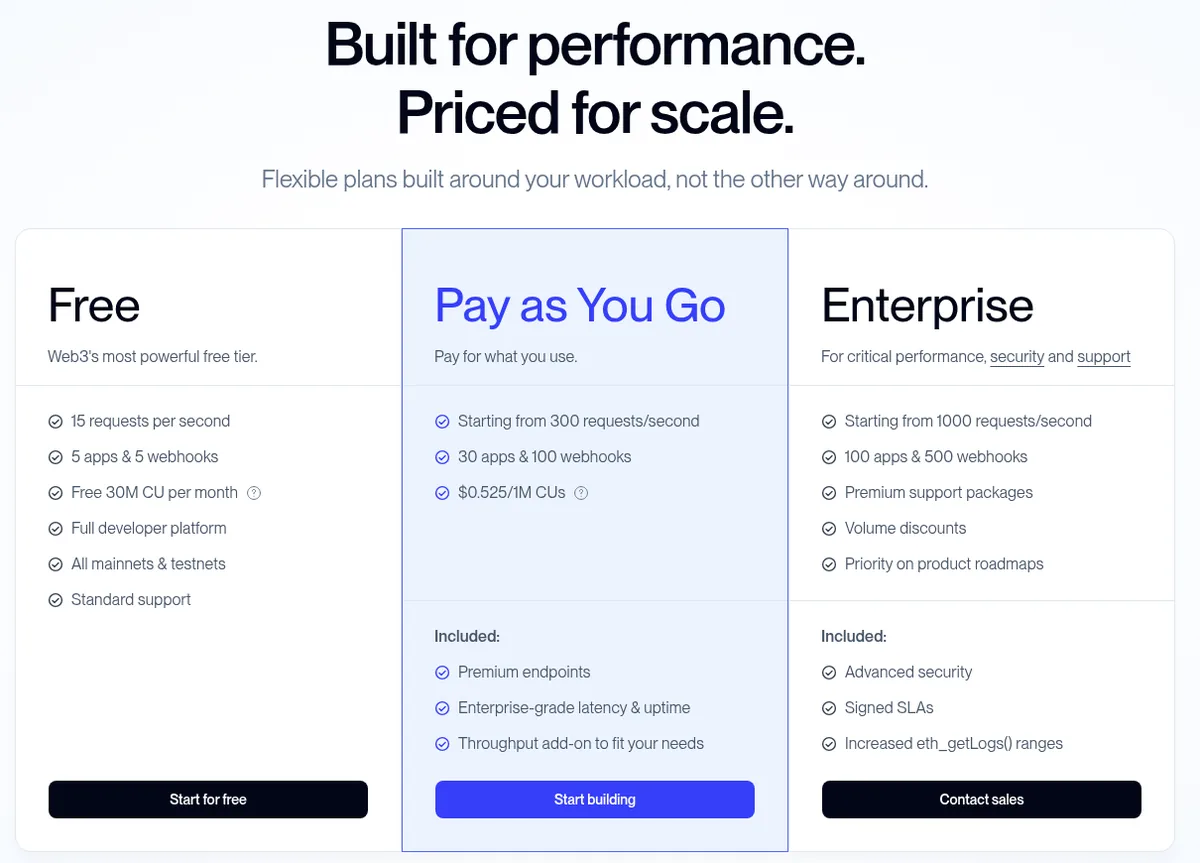
- Plans: Free (30M CU, 15 rps), Pay as you go at $0.525 per million CU from 300 rps, and Enterprise with custom terms. Extra throughput costs $160 per 5,000 CU per second.
- Meter: Alchemy’s own estimate is 27 CU per average request. Solana
getAccountInfoandgetBalancecost 10 CU, andgetTransactionandgetSignaturesForAddress40. - Strengths: no commitment, Solana account reads at $5.25 per million, cheaper than QuickNode and GetBlock, and Solana gRPC from $75 per TB.
- Weaknesses: $31.50 per million log queries, which put our log indexer at $1,155 a month, and support targets of 48 hours on Free and 24 on pay as you go.
Verdict: Alchemy scores 8.3. It is the best starting meter for small or unpredictable traffic, and a costly one for log indexing. See its full entry in our RPC provider ranking.
3. dRPC
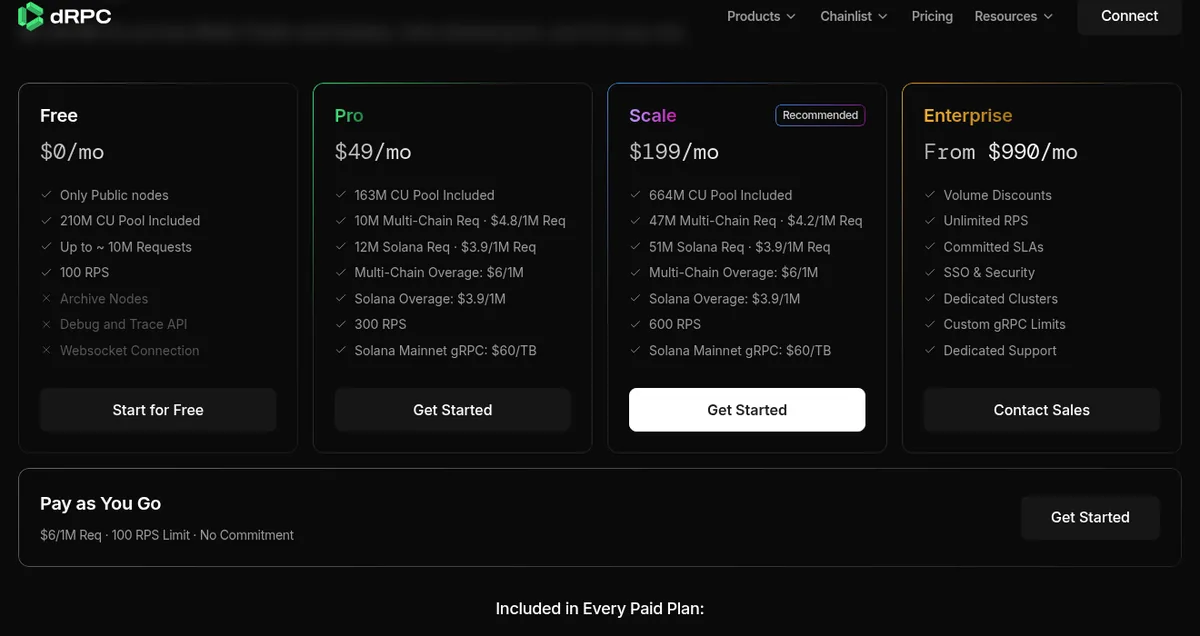
- Plans: Free on public nodes (210M CU, about 10M requests, 100 rps), Pro $49 (300 rps), Scale $199 (47M multi-chain or 51M Solana requests, 600 rps), Enterprise from $990. Pay as you go costs $6 per million at 100 rps.
- Meter: a flat 20 CU per method, per its compute unit docs, with overage at $6 per million multi-chain requests and $3.90 per million on Solana.
- Strengths: the cheapest trace price here, the lowest Solana wallet bill at $119, Solana gRPC at $60 per TB, 120+ chains and a 99.96% uptime claim.
- Weaknesses: no SOC 2 or ISO report on its own pages, and the free tier runs on public nodes only.
Verdict: dRPC scores 7.9. Pick it when log and trace calls drive your bill and audit paperwork is not a gate. See its full entry in our RPC provider ranking.
4. GetBlock
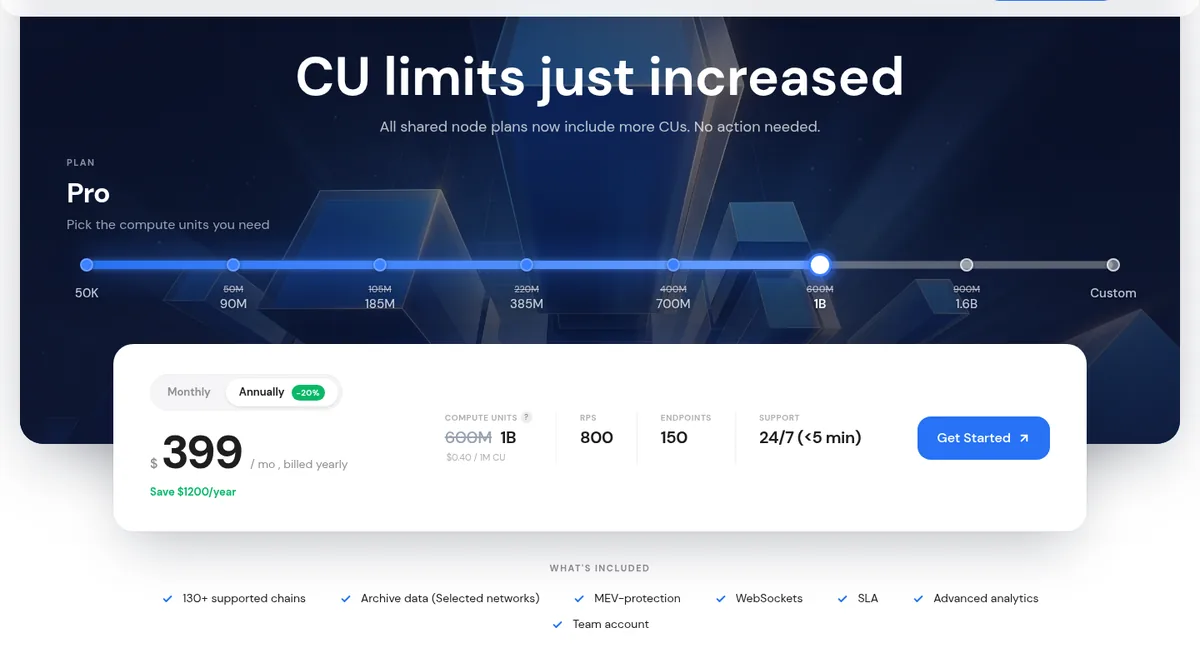
- Plans: Free (50,000 CU a day, 20 rps), Starter $49 (90M CU, 250 rps), Growth $99 (185M), Advanced $199 (385M), Scale $349 (700M), Pro $499 (1B, 800 rps), Premium $699 (1.6B). Annual billing saves 20%.
- Meter: chain multiplier times method multiplier times archive modifier, per its CU formula. Debug and trace double the method multiplier.
- Strengths: many small steps between plans, SOC 2 Type II attested in Q2 2026, and dedicated nodes from $1,000 a month.
- Weaknesses: no overage below Pro, so Starter through Scale need top-ups or an upgrade, and the highest Solana price among plan-based vendors.
Verdict: GetBlock scores 7.8. It suits Ethereum and EVM teams who want fine-grained plan steps. See its full entry in our RPC provider ranking. Our GetBlock vs dRPC vs Tatum comparison works out its cost per 1M calls against dRPC on every plan.
5. QuickNode
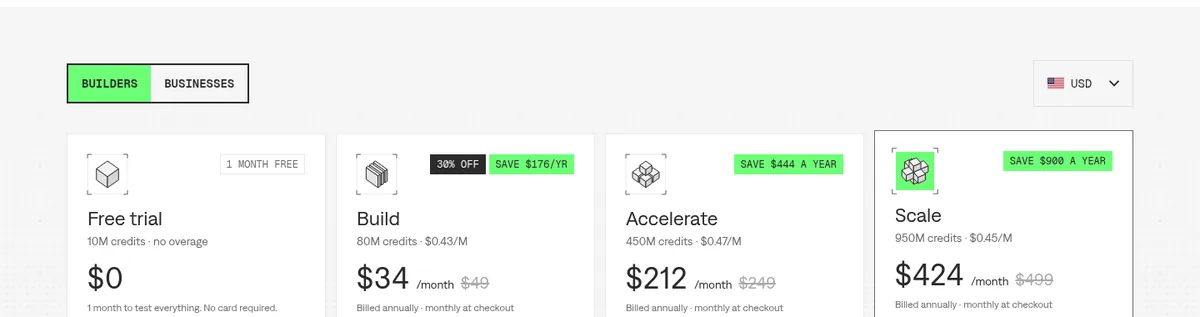
- Plans: Free trial (10M credits for one month, 15 rps), Build $49 (80M, 50 rps), Accelerate $249 (450M, 125 rps), Scale $499 (950M, 250 rps), Business from $999 (2B, 500 rps). Annual billing saves 30%.
- Meter: 20 credits per Ethereum or Base call, 30 per Solana call, twice that for trace and debug and four times for replay, per its Ethereum credit table.
- Strengths: overage from $0.62 down to $0.50 per million credits, and SOC 1 Type 2, SOC 2 Type 2, ISO 27001 and DORA reports on its security page.
- Weaknesses: Build’s 50 rps cap pushes busier apps to Accelerate, and $12.25 per million Ethereum calls is five times Chainstack.
Verdict: QuickNode scores 7.7. Pick it when audit coverage and published overage matter more than the lowest per-call price. See its full entry in our RPC provider ranking.
6. Helius
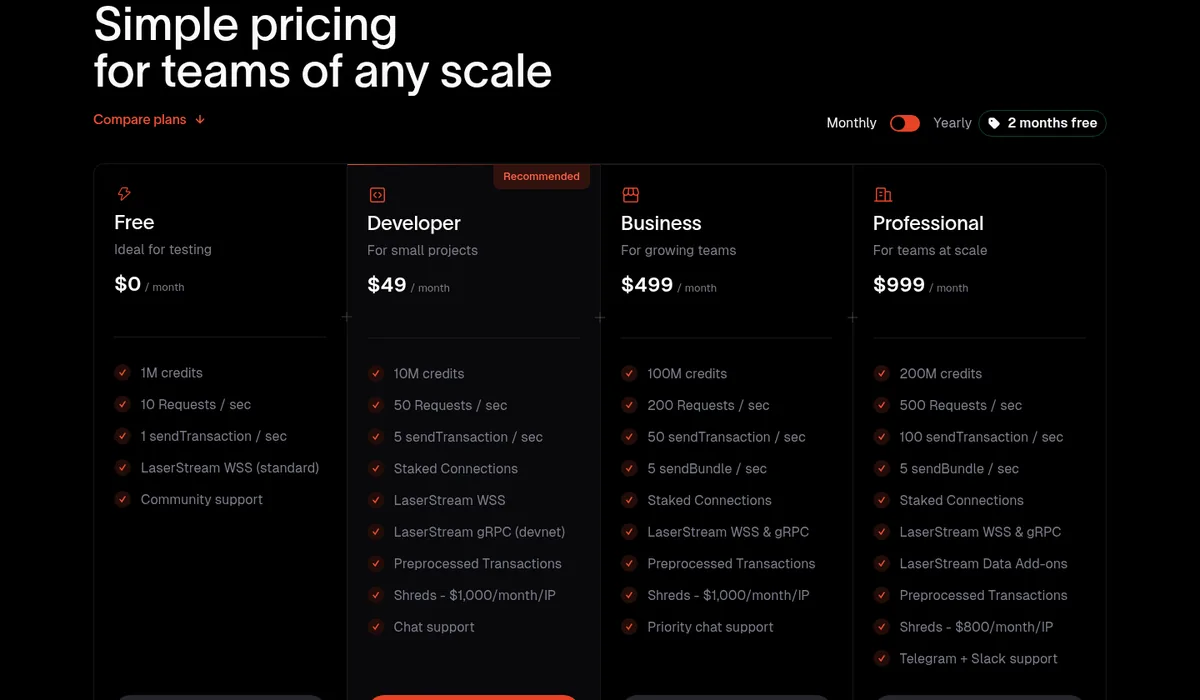
- Plans: Free (1M credits, 10 rps), Developer $49 (10M credits, 50 rps, 5 sends per second), Business $499 (100M, 200 rps), Professional $999 (200M, 500 rps). Extra credits cost $5 per million.
- Meter: 1 credit for standard calls, 10 for
getProgramAccountsand DAS calls, 100 for Enhanced Transactions, and 1 forgetProgramAccountsV2. - Strengths: $4.90 per million standard Solana calls, LaserStream at 2 credits per 0.1 MB, two free months on annual plans and dedicated nodes from $2,900.
- Weaknesses: Solana only, a big jump from $49 Developer to $499 Business, and $49 per million legacy program-account scans.
Verdict: Helius scores 7.0. It is the Solana specialist pick when you also want its data APIs and streaming. See its full entry in our RPC provider ranking.
7. Ankr
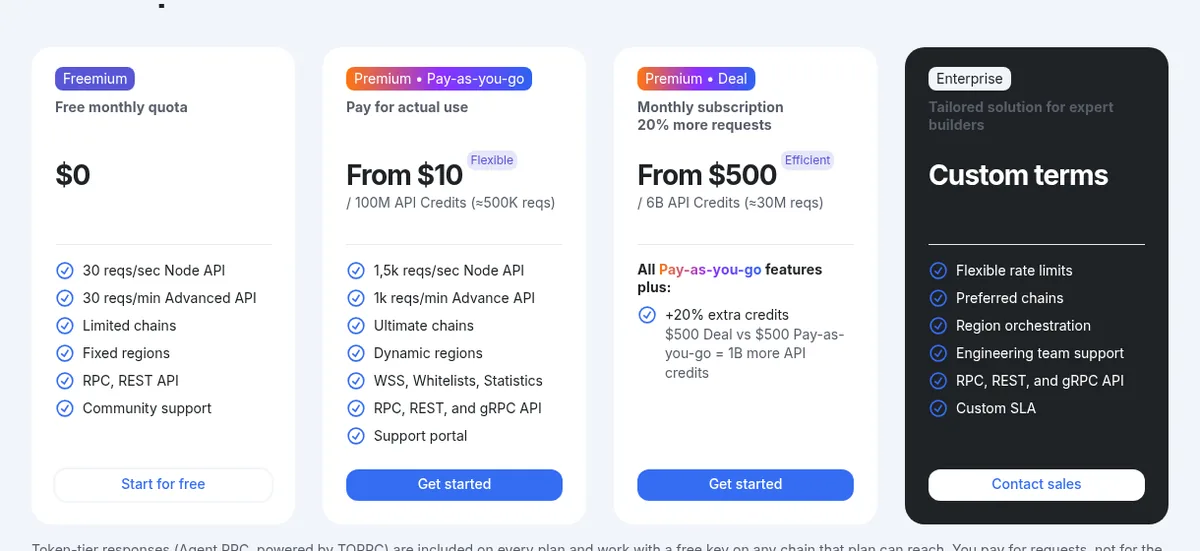
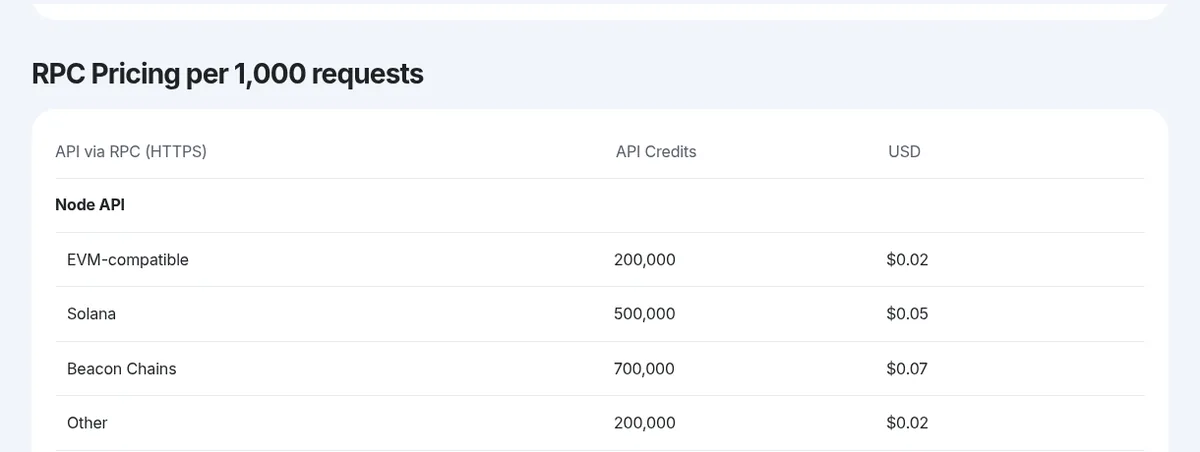
- Plans: Freemium (200M credits a month, 30 rps), Pay as you go from $10 per 100M credits (about 500,000 EVM requests), and Deal from $500 for 6B credits, about 30M requests, with 20% extra.
- Limits: 1,500 rps on EVM and about 4,000 on Solana on pay as you go, and
eth_getLogsranges of 1,000, 3,000 and 10,000 blocks, per its service plans page. - Strengths: no plan to outgrow, high burst capacity and a large free allowance of about 1M EVM requests.
- Weaknesses: the highest flat rate in this guide, and $1,250 for our Solana wallet mix.
Verdict: Ankr scores 6.3. It fits bursty jobs that need a high rate ceiling on prepaid credits. See its full entry in our RPC provider ranking.
8. NOWNodes
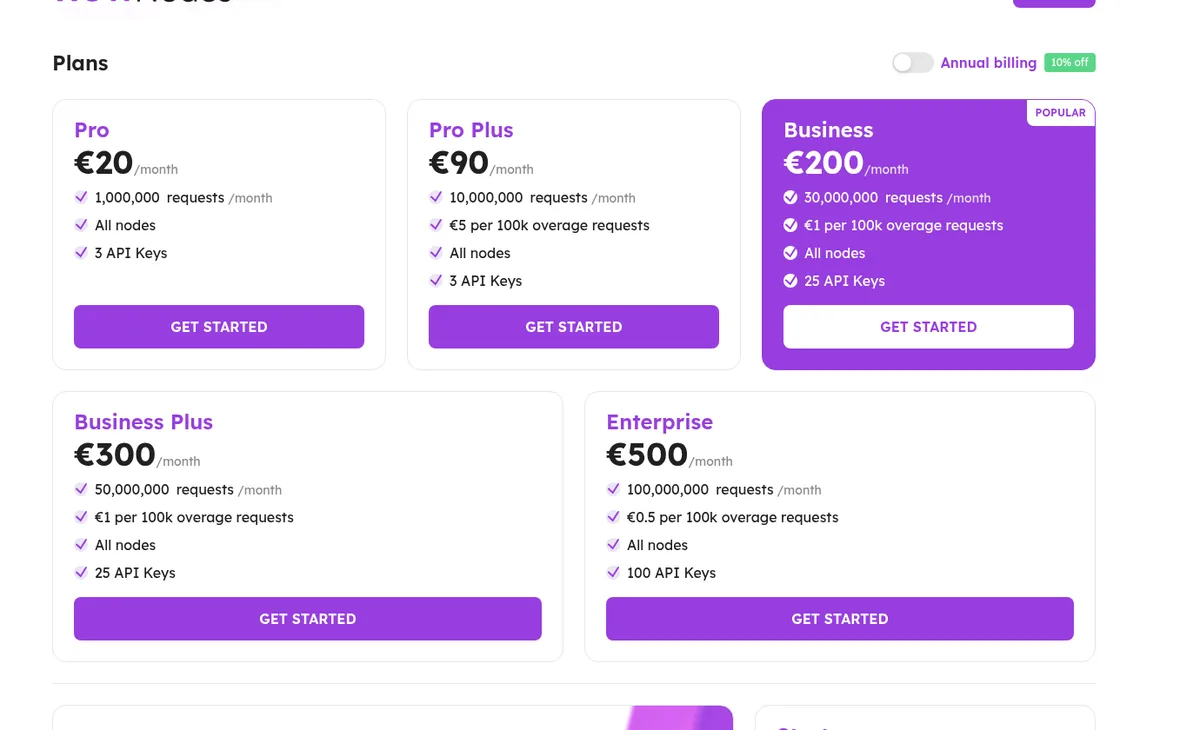
- Plans: Start free (100,000 requests, 15 rps, 5 networks, one month), Pro EUR 20 (1M), Pro Plus EUR 90 (10M), Business EUR 200 (30M), Business Plus EUR 300 (50M), Enterprise EUR 500 (100M). Annual billing saves 10%.
- Meter: one request is one request on every chain. We converted euros at the ECB reference rate of 1.1193 on 23 October 2026.
- Strengths: simple invoices, $10.07 per million on Pro Plus for any method, and overage that falls to EUR 0.50 per 100,000 on Enterprise.
- Weaknesses: steep overage on Pro Plus, no rate limits shown for paid plans on its pricing page, and no audits stated.
Verdict: NOWNodes scores 5.8. It suits teams that want a fixed euro invoice and stay inside the allowance. See its full entry in our RPC provider ranking.
9. Infura
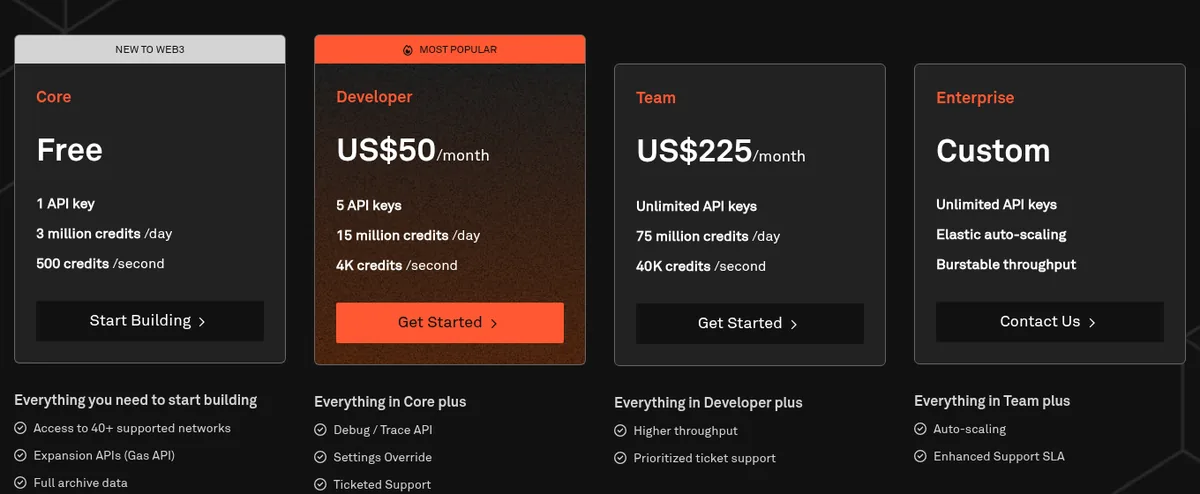
- Plans: Core free (3M credits a day, 500 per second), Developer $50 (15M a day, 4,000 per second, debug and trace), Team $225 (75M a day, 40,000 per second), Enterprise custom. An add-on sells 55M extra credits for $200 a month.
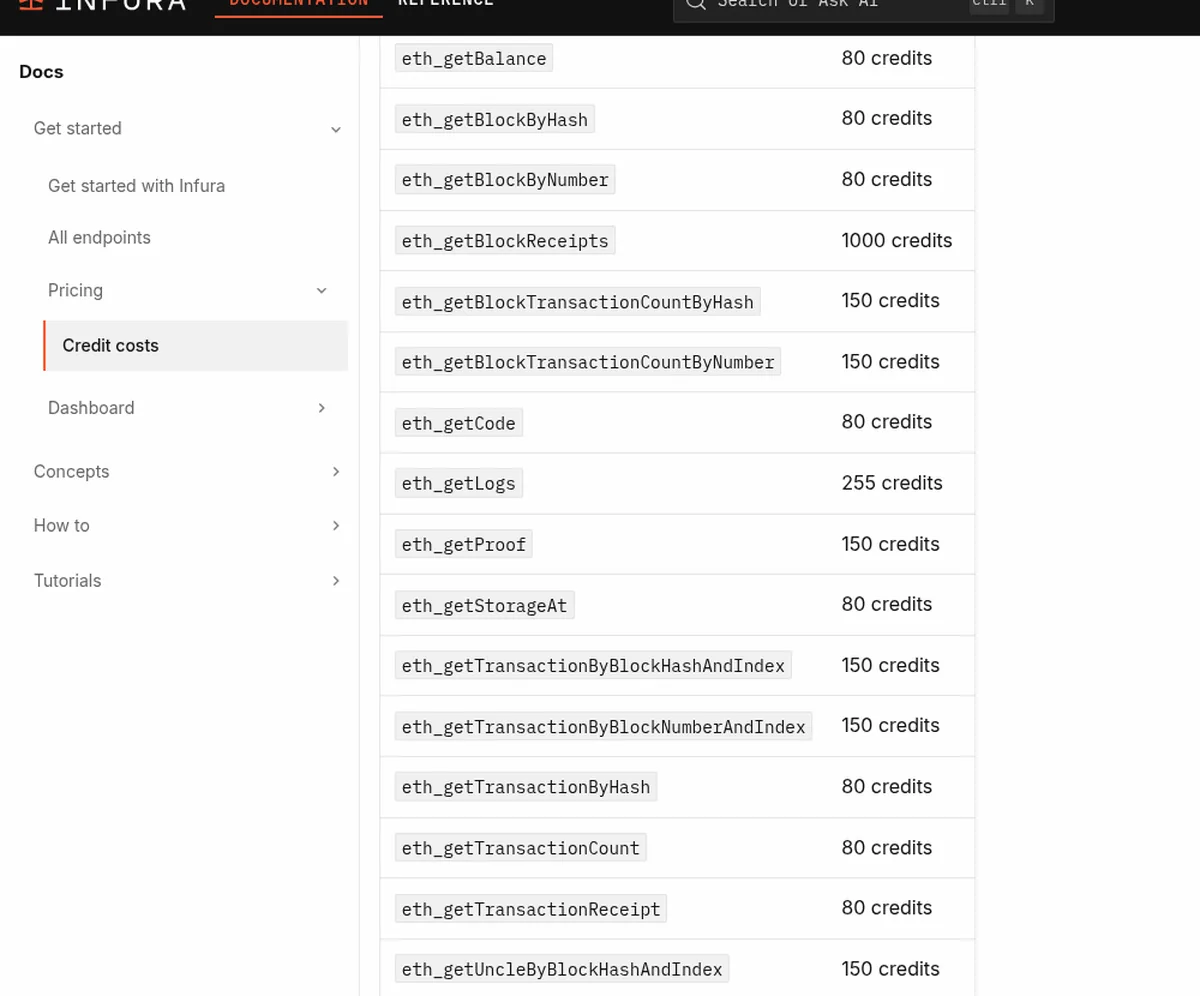
- Meter: 80 credits for most reads, 255 for
eth_getLogs, 300 foreth_estimateGasand trace calls, and 160 for every Solana method, per its credit cost page. - Strengths: $8.89 per million
eth_callrequests on Developer, and a free tier that resets every day. - Weaknesses: the daily quota forces Team at 10M dApp requests a month and Enterprise for our other three workloads.
Verdict: Infura scores 5.1. It still fits light Ethereum reads that stay under the daily quota. See its full entry in our RPC provider ranking.
Providers We Left Out
Tatum’s docs list 2 credits for standard calls, 5 for eth_call and 50 for debug and trace, per its RPC docs, but its plan slider did not load for our capture on 25 October 2026, so we could not verify current plan prices.
Triton One, CDP Node and Lava sit in our main ranking, and we did not reprice them for this guide. Pricing comparisons published by RPC vendors themselves are useful, but check their numbers against each vendor’s own page.
For the wider shortlist, including reliability and compliance detail, see our RPC providers hub and the node infrastructure section.
Final Ranking
Chainstack wins on our weights because it pairs the lowest per-call price with audits. Alchemy places second on its free tier, chain coverage and pay-as-you-go flexibility, and dRPC third on its flat meter. Infura drops to last on price because of its daily quota.


Verdict: Price your own method mix on Chainstack, dRPC and Alchemy first. Those three cover the cheapest fixed plan, the cheapest flat meter and the best usage-based start.
How to Estimate Your Own RPC Bill
Count calls by method for one week, multiply to a month, then apply each vendor’s weight and plan price. The script below does that for three meters with the weights in this guide. Replace the counts with your own logs.
mix = {"eth_call": 4_000_000, "eth_getLogs": 1_000_000, "eth_getBalance": 1_500_000}
weights = {
  "alchemy_cu":   {"eth_call": 26, "eth_getLogs": 60, "eth_getBalance": 20},
  "chainstack_ru":{"eth_call": 1,  "eth_getLogs": 1,  "eth_getBalance": 1},
  "infura_cr":    {"eth_call": 80, "eth_getLogs": 255,"eth_getBalance": 80},
}
for meter, w in weights.items():
    units = sum(n * w[m] for m, n in mix.items())
    print(meter, f"{units/1e6:,.1f}M units")
# Alchemy: units x $0.525 per 1M. Chainstack: fits Growth if under 20M RU.
# Infura: divide by 30 and compare with the daily quota.
Run the numbers at your busiest day as well as your average. Daily quotas, per-second caps and plan jumps all bite at the peak, and that is where most surprise invoices come from.
Frequently Asked Questions
Which RPC provider is cheapest in 2026?
On list prices checked 25 October 2026, Chainstack Growth is the cheapest meter for most methods at $2.45 per million calls when fully used. dRPC is next at $4.80 per million EVM requests and $3.90 per million Solana requests. In our four workloads, Chainstack had the lowest or tied-lowest bill three times.
What is the difference between compute units and credits?
Both are weighted units that make expensive methods cost more. Alchemy compute units weight each method, from 10 CU for a block number to 60 for eth_getLogs. QuickNode credits weight by chain, 20 for Ethereum and 30 for Solana. Infura credits weight by method and reset against a daily quota instead of a monthly one.
How much do one million RPC requests cost?
The meter and the method decide it. On entry plans used in full, one million eth_call requests cost $2.45 on Chainstack, $4.80 on dRPC, $8.89 on Infura, $12.25 on QuickNode, $13.65 on Alchemy and $20 on Ankr. Log queries cost up to $31.50 per million on Alchemy.
Is pay as you go cheaper than a monthly RPC plan?
At low or uneven volume, yes. A fixed plan reaches its listed per-call price only when you use the whole allowance. At 25% use, Chainstack Growth costs $9.80 per million calls and QuickNode Build $49. Alchemy pay as you go stays at $13.65 per million eth_call requests whatever your volume.
What happens when I exceed my RPC plan allowance?
Most vendors bill overage. Chainstack charges $15 per million request units on Growth, QuickNode $0.62 per million credits on Build and dRPC $6 per million requests. GetBlock has no overage below Pro and asks you to top up, and Infura requests fail once its daily credit quota is used.
Why is Solana RPC more expensive on some providers?
Some vendors apply a higher chain multiplier to Solana. GetBlock charges 50 CU per Solana call against 20 for Ethereum, QuickNode 30 credits against 20, and Infura 160 credits for every Solana method. Chainstack, dRPC and Helius keep standard Solana calls cheap, from $2.45 to $4.90 per million.