
Last updated: 25 October 2026 · Prices, method costs, rate limits and benchmark figures rechecked on vendor pages on 25 October 2026
The best Solana RPC providers in 2026 are Chainstack for overall value, Helius for Solana-native features such as LaserStream and staked sends, and Alchemy for its free tier and data APIs. We ranked nine providers on the same six weighted criteria as our main RPC ranking and priced four real Solana workloads on every vendor’s meter. For a closer look at the Solana specialists, see our Helius vs QuickNode vs Triton comparison.
Solana traffic is unusual. It is read-heavy, bursty and full of methods that some vendors weight at 10 to 50 times others, so the plan table on a pricing page tells you little. This list expands the Solana picks in our ranking of the 12 best RPC node providers, and our methodology page explains how we collect prices, screenshots and benchmark data.
TL;DR
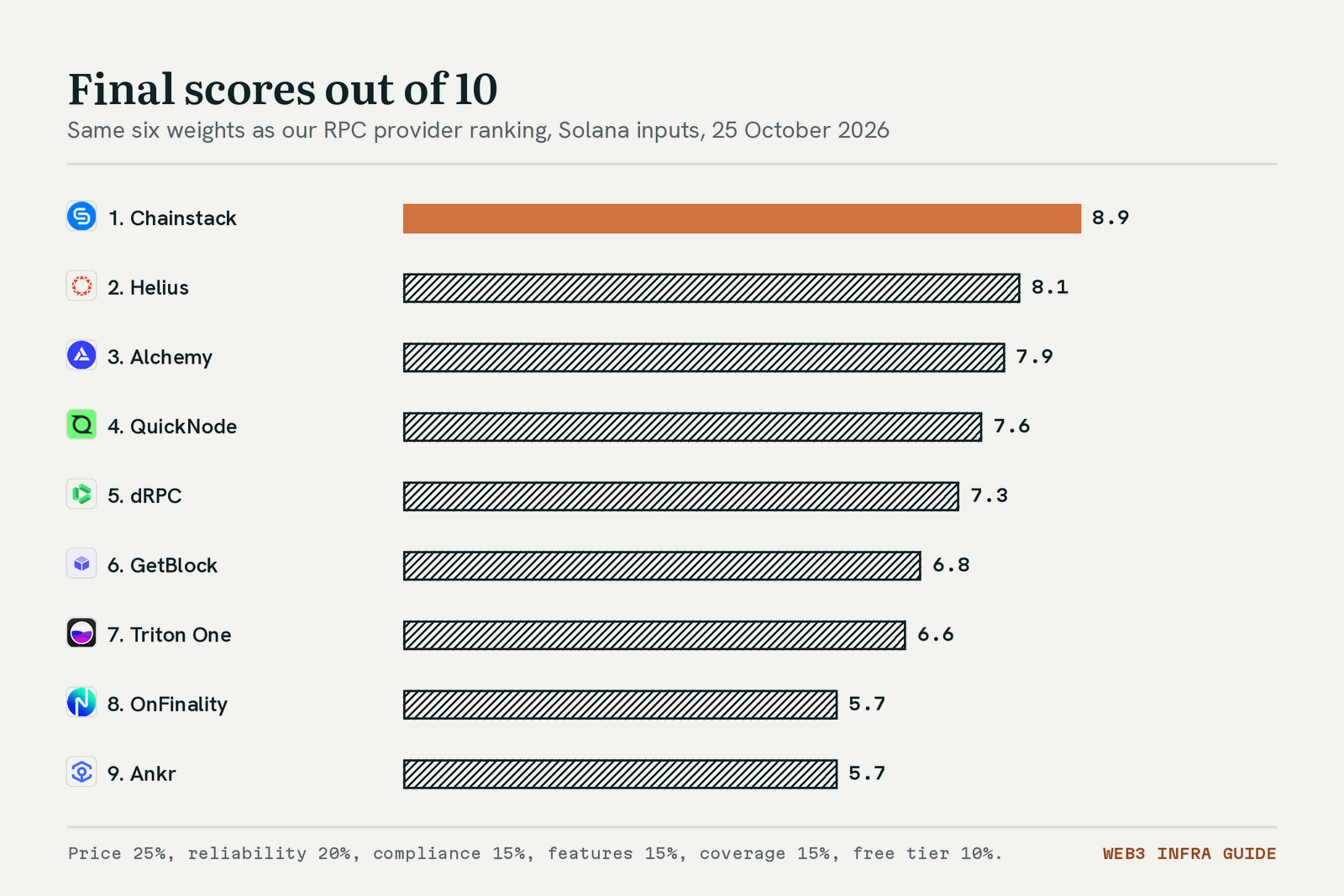
- Overall: 1. Chainstack (8.9), 2. Helius (8.1), 3. Alchemy (7.9), 4. QuickNode (7.6), 5. dRPC (7.3), 6. GetBlock (6.8), 7. Triton One (6.6), 8. OnFinality (5.7), 9. Ankr (5.7).
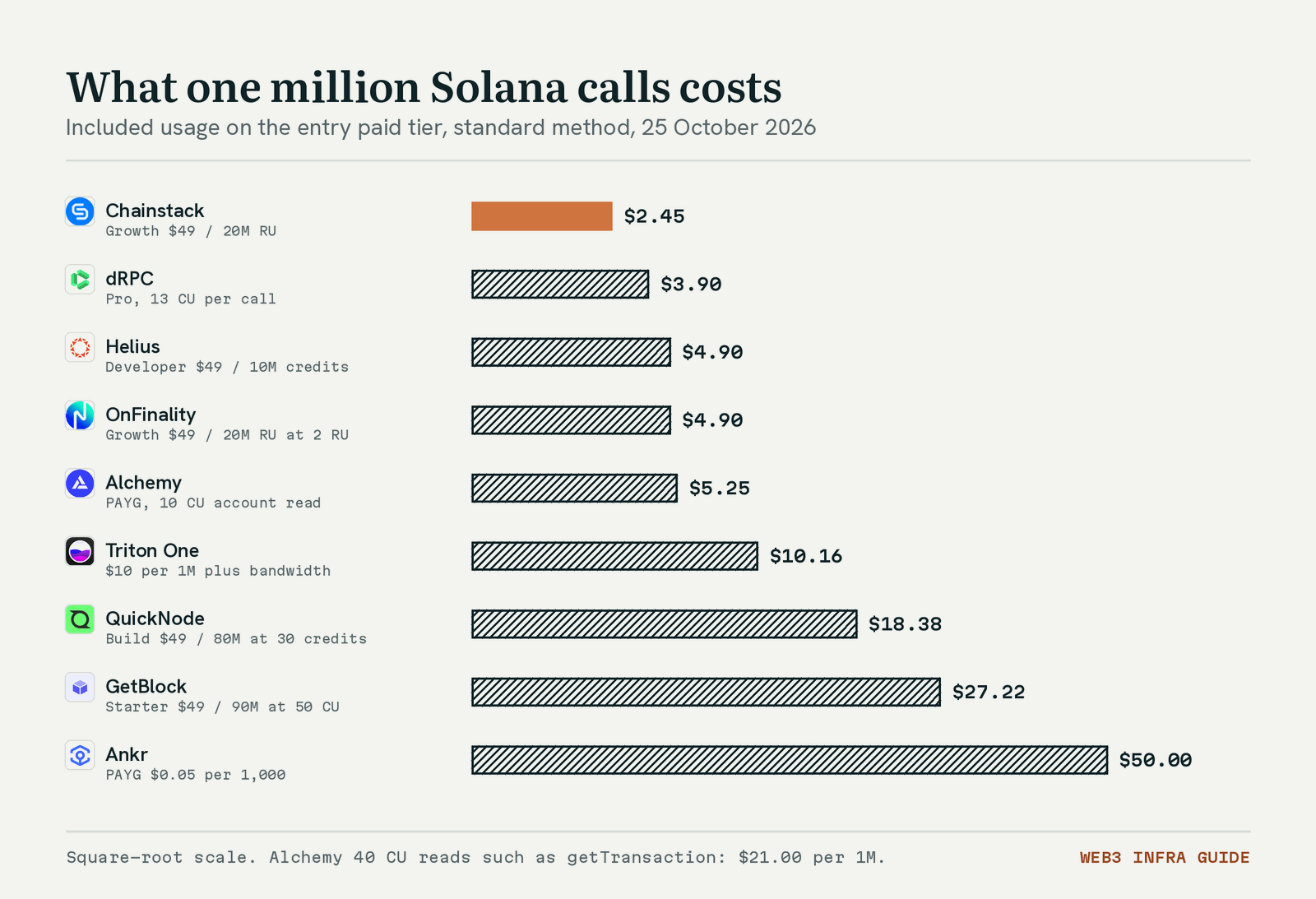
- One million standard Solana calls cost $2.45 on Chainstack Growth, $3.90 on dRPC, $4.90 on Helius Developer, $18.38 on QuickNode Build and $50 on Ankr pay as you go.
- dRPC produced the lowest bill in three of our four workloads, with Chainstack within $82 in each. Helius tied for cheapest on the 10M-request wallet backend at $49.
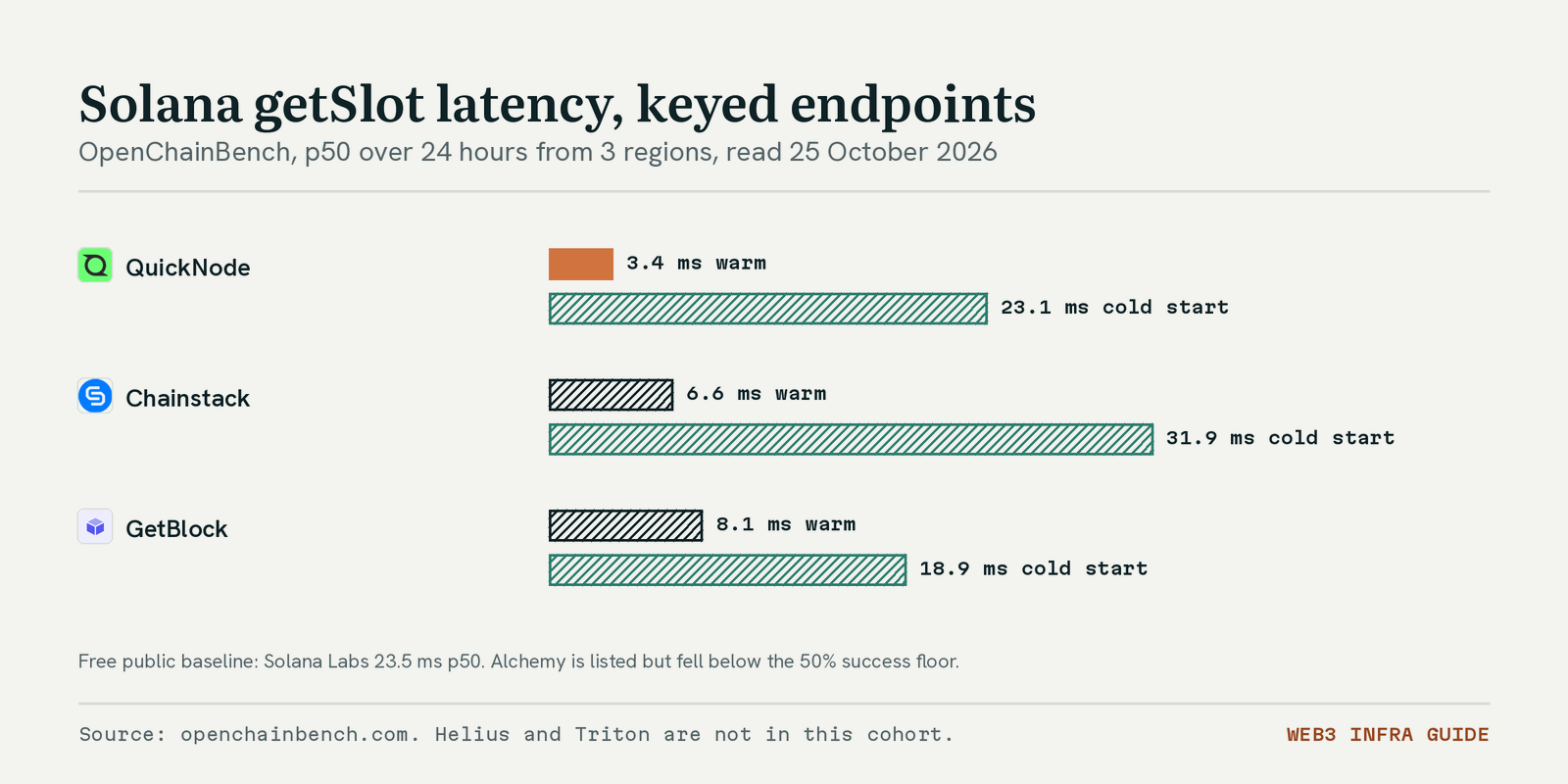
- On OpenChainBench’s keyed Solana run, QuickNode had the lowest warm median at 3.4 ms and GetBlock the lowest cold-start median at 18.9 ms.
- Chainstack and QuickNode state both SOC 2 Type II and ISO 27001. Triton One and dRPC do not publish an audit report on their own pages.
- Syndica retired its self-serve Solana RPC on 14 February 2026, so it is no longer on this list.
The Decision Kernel
Start from how your app talks to Solana. A wallet that polls balances, a DeFi backend that scans program accounts and a trading bot that sends transactions every slot each favor a different meter. Log one day of requests by method before you compare any plan. The shortcuts below cover the common cases.
- Lowest bill with audits: Chainstack, which charges 1 request unit for almost every Solana call and states SOC 2 Type II and ISO 27001.
- Cheapest raw calls at volume: dRPC, at a flat $3.90 per million Solana requests on paid plans.
- Solana-native tooling: Helius, for LaserStream gRPC, staked connections, the DAS API and webhooks on one key.
- Free prototyping: Alchemy, whose 30M compute unit free tier never expires.
- Lowest measured latency: QuickNode on warm connections, GetBlock on cold starts, per OpenChainBench on 25 October 2026.
- Validator-grade streaming and full history: Triton One, the team behind Yellowstone gRPC, billed per call and per gigabyte.
Verdict: Chainstack for most teams, Helius when you need Solana-specific features, dRPC when the raw call count is all that matters. Run two providers in production.
How We Ranked the Solana RPC Providers
We scored each provider from 1 to 5 on six criteria, weighted them and doubled the total. The weights match our 12-provider RPC ranking, with Solana-specific inputs. Every price, limit and audit claim links to a vendor page checked on 25 October 2026. The full process is on our methodology page.
- Price per call, 25%: the monthly bill for four Solana method mixes, converted from each vendor’s billing unit.
- Reliability, 20%: public Solana latency benchmarks, uptime claims and support response targets.
- Compliance, 15%: SOC 2, ISO 27001 and other audits stated on the vendor’s own pages.
- Features, 15%: gRPC streaming, staked or priority sends, DAS and other data APIs, archive and dedicated nodes.
- Coverage, 15%: Solana history depth, devnet, regions, plus other chains for multi-chain teams.
- Free tier, 10%: how many Solana calls a team can make before paying.
| Provider | Price (25%) | Reliability (20%) | Compliance (15%) | Features (15%) | Coverage (15%) | Free tier (10%) | Score |
|---|---|---|---|---|---|---|---|
 | 5 | 4 | 5 | 4 | 5 | 3 | 8.9 |
 | 4 | 4 | 4 | 5 | 4 | 3 | 8.1 |
 | 3 | 3 | 4 | 5 | 5 | 5 | 7.9 |
 | 2 | 5 | 5 | 4 | 5 | 2 | 7.6 |
 | 5 | 3 | 2 | 3 | 5 | 3 | 7.3 |
 | 1 | 5 | 4 | 4 | 5 | 2 | 6.8 |
 | 3 | 4 | 2 | 5 | 4 | 1 | 6.6 |
 | 4 | 2 | 1 | 2 | 4 | 4 | 5.7 |
 | 1 | 3 | 4 | 3 | 5 | 2 | 5.7 |
Solana RPC Providers at a Glance
The table lines up each provider’s billing unit, what one standard Solana call costs in that unit, the entry paid plan and its throughput. Prices are monthly US dollar list prices from each pricing page on 25 October 2026, before annual discounts.
| Provider | Billing unit | One Solana call | Entry paid plan | Rate limit |
|---|---|---|---|---|
| Request units (RU) | 1 RU, 2 for archive and getSignaturesForAddress | Growth $49: 20M RU | 250 rps |
| Credits | 1 credit, 10 for getProgramAccounts and DAS | Developer $49: 10M credits | 50 rps |
| Compute units (CU) | 10 to 40 CU, 100 for getTransactionsForAddress | Pay as you go: $0.525 per 1M CU | 300 rps |
| API credits | 30 credits | Build $49: 80M credits | 50 rps |
| Compute units | 13 CU on paid plans | Pro $49: about 12M Solana requests | 300 rps |
| Compute units | 50 CU, doubled for archive | Starter $49: 90M CU | 250 rps |
| Calls plus bandwidth | $10 per 1M calls plus $0.08 per GB | $125 prepaid deposit | Not published |
| Response units (RU) | 2 RU | Growth $49: 20M RU | 200 RU per second |
| API credits | $0.05 per 1,000 requests | Pay as you go from $10 | 1,500 rps |
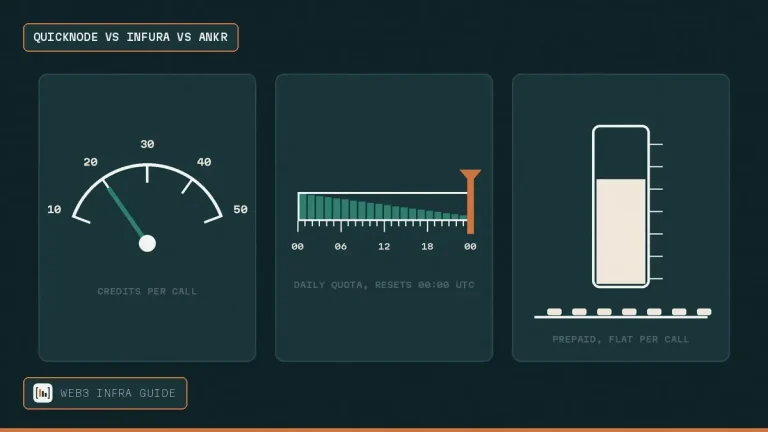
Verdict: Five of the nine providers price a standard Solana call at 1 to 2 units. QuickNode, GetBlock and Ankr charge 30 to 50 times a base unit, which shows up in every bill below.
What One Million Solana Calls Cost
Converting each unit to dollars shows how far apart the meters are. We used included usage on the entry paid tier, which is what most small teams pay. Chainstack Growth works out to $2.45 per million standard calls, and Ankr pay as you go to $50. Method weights move some vendors a long way from their headline rate.
| Method, per 1M calls | | | | |
|---|---|---|---|---|
getAccountInfo | $2.45 (1 RU) | $4.90 (1 credit) | $5.25 (10 CU) | $18.38 (30 credits) |
getLatestBlockhash | $2.45 (1 RU) | $4.90 (1 credit) | $10.50 (20 CU) | $18.38 (30 credits) |
getProgramAccounts | $2.45 (1 RU) | $49.00 (10 credits) | $10.50 (20 CU) | $18.38 (30 credits) |
getSignaturesForAddress | $4.90 (2 RU) | $4.90 (1 credit) | $21.00 (40 CU) | $18.38 (30 credits) |
getTransaction, recent slot | $2.45 (1 RU) | $4.90 (1 credit) | $21.00 (40 CU) | $18.38 (30 credits) |
sendTransaction | $2.45 (1 RU) | $4.90 (1 credit) | $10.50 (20 CU) | $18.38 (30 credits) |
| Rate above the allowance | $15.00 per 1M RU | $5.00 per 1M credits | Same $0.525 per 1M CU | $0.62 per 1M credits ($18.60 per 1M calls) |
Helius charges 10 credits for getProgramAccounts, which makes it the most expensive of the four on that one method. Helius also lists a V2 version of the call at 1 credit, so teams that can switch to it remove most of the gap. Chainstack’s overage of $15 per million request units is six times its included rate, so size the plan to your busiest month.
Verdict: Chainstack has the lowest included rate on every method we priced, and Helius is the second cheapest except on getProgramAccounts. Alchemy is cheap for account reads and expensive for history.
What Four Real Solana Workloads Cost
We built four common Solana method mixes, converted each into every vendor’s unit and picked the cheapest public plan that covers the volume and a peak of three times the average rate. dRPC was cheapest in three of four workloads, and Chainstack stayed within $82 of it in every case.
| Provider | Wallet backend, 10M | DeFi app backend, 30M | History indexer, 50M | Trading bot, 100M |
|---|---|---|---|---|
| $49 (Growth) | $199 (Pro) | $199 (Pro) | $449 (Pro) |
| $49 (Developer) | $284 (Developer) | $499 (Business) | $499 (Business) |
| $84 (Pay as you go) | $252 (Pay as you go) | $998 (Pay as you go) | $788 (Pay as you go) |
| $185 (Build) | $499 (Scale) | $790 (Scale) | $1,499 (Business) |
| $49 (Pro) | $117 (Pro) | $195 (Pro) | $390 (Scale) |
| $349 (Scale) | $699 (Premium) | Enterprise quote | Enterprise quote |
| $102 (Pay as you go) | $305 (Pay as you go) | $508 (Pay as you go) | $1,016 (Pay as you go) |
| $49 (Growth) | $249 (Accelerate) | $249 (Accelerate) | $624 (Accelerate) |
| $500 (Pay as you go) | $1,500 (Pay as you go) | $2,500 (Pay as you go) | $5,000 (Pay as you go) |
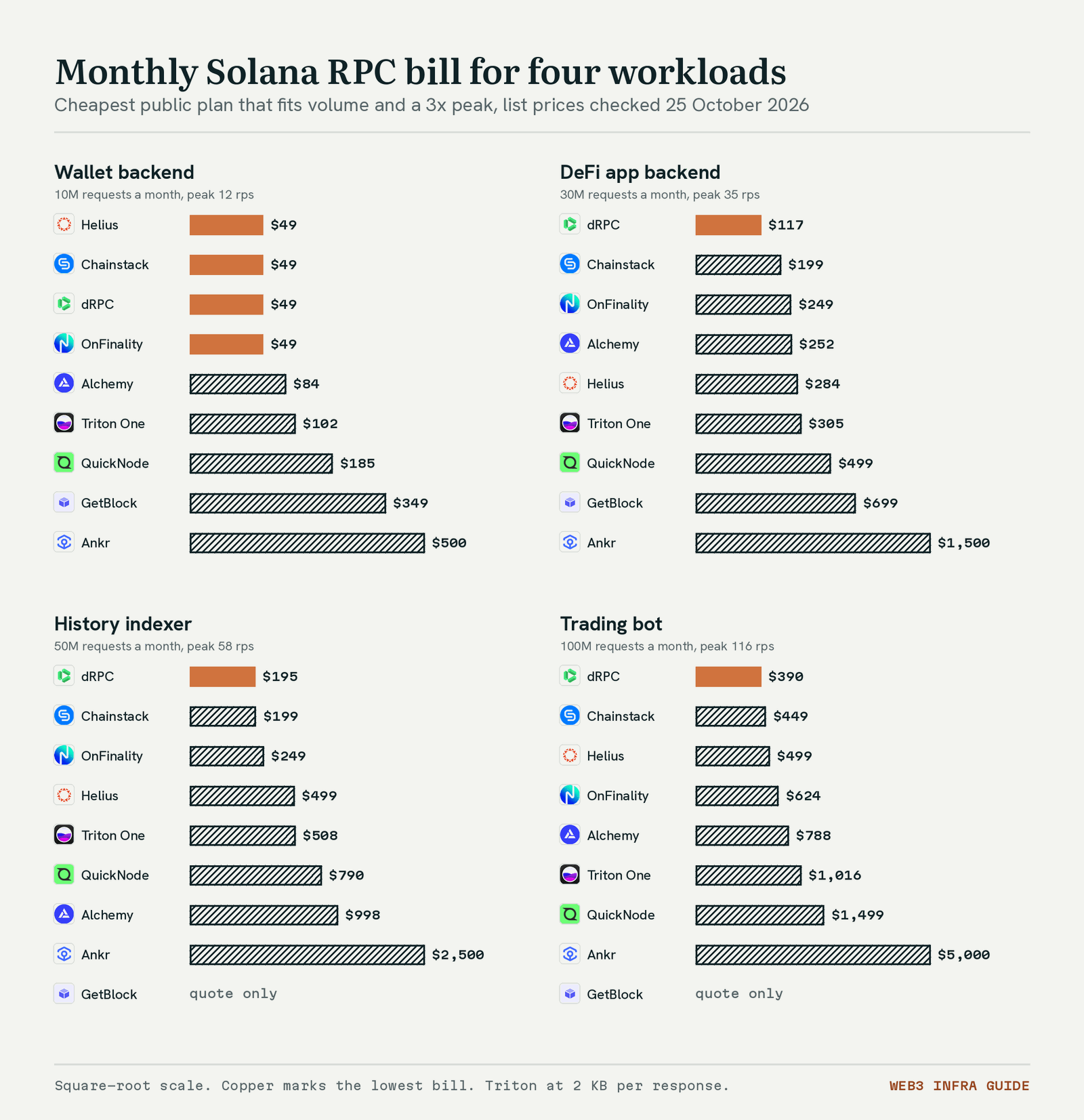
- Wallet backend, 10M requests: 35%
getAccountInfo, 20%getBalance, 15%getTokenAccountsByOwner, 10%getLatestBlockhash, 10%getSignaturesForAddress, 5%getTransactionand 5% sends. - DeFi app backend, 30M requests: 40%
getAccountInfo, 20%getMultipleAccounts, 10%getProgramAccounts, 10% blockhash, 10% simulations, 5% sends and 5% status checks. - History indexer, 50M requests: 40%
getTransaction, 30%getBlock, 20%getSignaturesForAddressand 10%getSlot, all on recent slots. - Trading bot, 100M requests: 50%
getAccountInfo, 20% blockhash, 15% simulations, 10% sends and 5% status checks.
Rate limits changed several answers. The indexer peaks at 58 requests per second, above Helius Developer’s 50, so Helius moves to Business at $499. GetBlock needs 2.5B compute units for the indexer and 5B for the trading bot, above its largest public plan of 1.6B, so both require a quote. A backfilling indexer that reads old slots pays 2 RU per call on Chainstack, which would lift its bill from $199 to $449.
Verdict: dRPC and Chainstack are the cheapest meters for every Solana workload we modeled. Helius competes at low volume and for send-heavy bots once you account for its included features.
Latency: What the Public Benchmarks Show
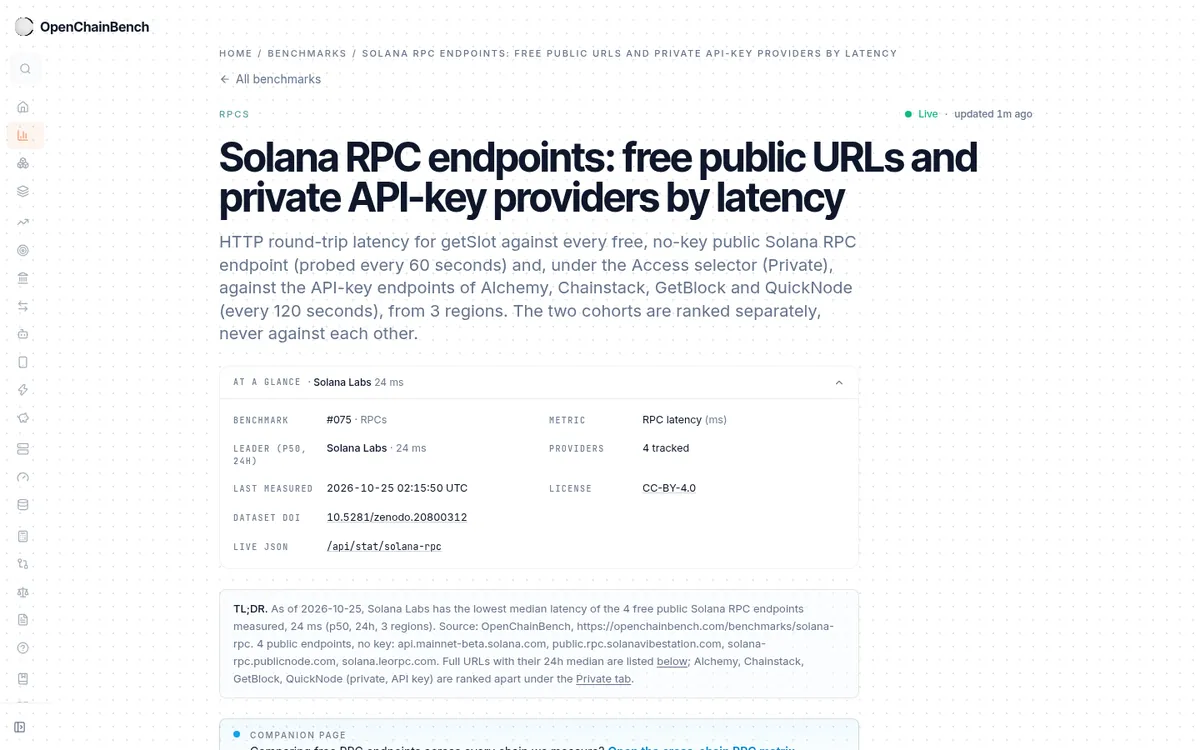
Two public dashboards measure Solana RPC latency, and neither covers all nine providers. OpenChainBench probes API-key endpoints for Alchemy, Chainstack, GetBlock and QuickNode every 120 seconds from three regions. Warm and cold-start results rank the vendors differently, so match the benchmark to how your app connects.
| Provider | Warm p50 (p99) | Cold-start p50 (p99) | Success rate |
|---|---|---|---|
| 3.4 ms (7.8) | 23.1 ms (322.1) | 100% |
| 6.6 ms (63.7) | 31.9 ms (242.8) | 100% |
| 8.1 ms (27.2) | 18.9 ms (49.9) | 100% |
| Below 50% success floor | Below 50% success floor | Not ranked |
The second dashboard is the Helius Solana RPC benchmark, which Helius runs and which ranks Helius first. It blends 45 methods across six regions. Its last complete ranking, to 18 October 2026, scored Helius 94.5, QuickNode 85.6 and Chainstack 73.9, and it showed Triton and Alchemy with insufficient method coverage. On 25 October the page reported degraded consensus, with Triton and QuickNode endpoints down and Alchemy rate limited.
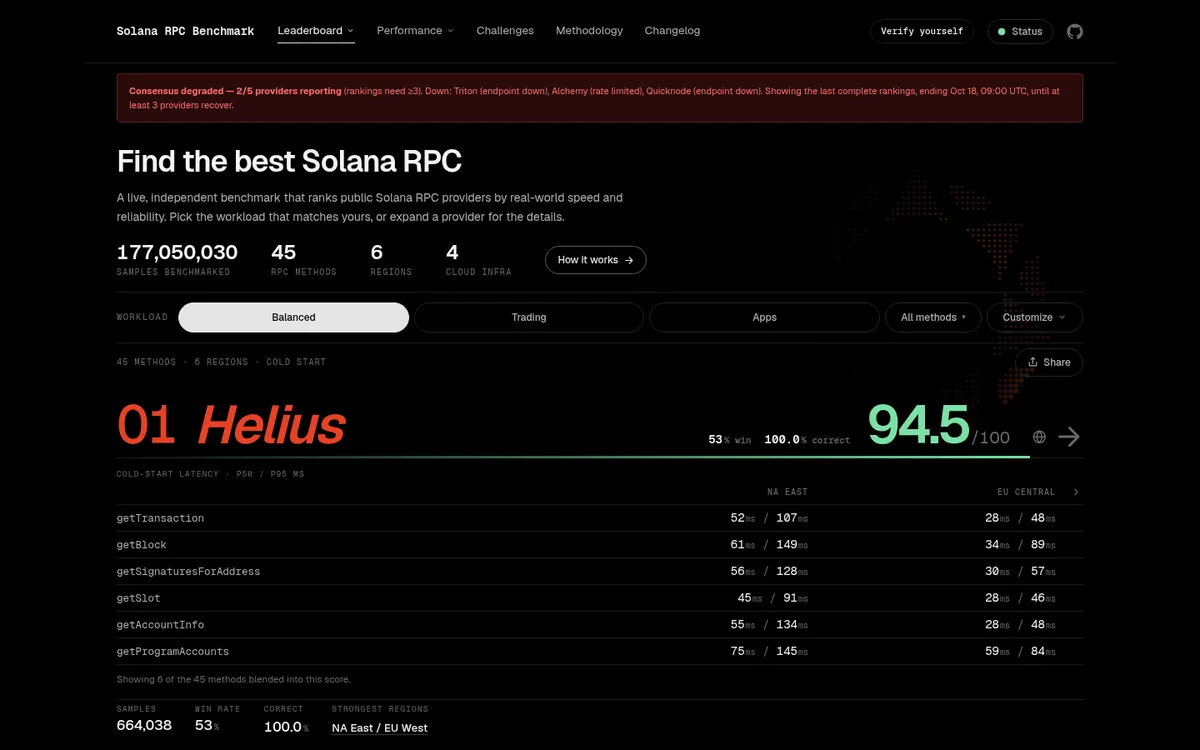
Verdict: QuickNode is the warm-latency pick and GetBlock the cold-start pick on independent data. Treat Helius’s own benchmark as a useful but vendor-run signal, and run your own test.
Streaming, Sends and Data APIs
Solana apps rarely live on JSON-RPC alone. Trading systems want Yellowstone-compatible gRPC streams and priority sends, and NFT or token apps want the Digital Asset Standard (DAS) API. Pricing for these extras varies far more than base RPC pricing. The table lists what each vendor states on its own pages.
| Provider | gRPC streaming | Sends and landing | Data APIs and history |
|---|---|---|---|
| Yellowstone gRPC from $49 a month for 2 streams, from Growth | Warp transactions at $0.15 per transaction | Archive from Growth, Unlimited Node from $149 a month |
| LaserStream gRPC, devnet on Developer, mainnet from Business | Staked connections on paid plans, Sender at 0 credits | DAS API at 10 credits, webhooks, enhanced transactions |
| Yellowstone gRPC at $75 per TB | Jito bundles at 40 CU, paid plans | DAS API (getAsset 80 CU), full archive |
| Paid add-on on Build and Accelerate, 10 streams on Scale, 25 on Business | Standard sendTransaction | DAS methods at 2x credits, archive on all plans |
| Solana gRPC at $60 per TB on Pro | Standard sendTransaction | Standard JSON-RPC |
| Yellowstone gRPC and shred add-ons | SWQoS validator connections and MEV-aware routing, per GetBlock | Bare-metal clusters in six regions, dedicated nodes from $3,200 a month |
| Created Yellowstone gRPC, streaming at $0.08 per GB | Shred streaming from $900 a month | Complete ledger from genesis, Metaplex API at $50 per 1M calls |
| Not listed, WebSocket subscriptions only | Standard sendTransaction | Archive access, dedicated nodes |
| gRPC on paid plans at $0.50 per GB received | Standard sendTransaction | Standard JSON-RPC, archive |
Verdict: Helius and Triton One have the deepest Solana feature sets. Chainstack and Alchemy are the best multi-chain vendors for teams that also need gRPC on Solana.
Free Tiers Compared
Free allowances on Solana are smaller than they look, because several vendors charge many units per call. On private endpoints, OnFinality and Alchemy give the most free Solana calls, about 6M and up to 3M a month. QuickNode’s offer is a one-month trial, and Triton One has no free tier.
| Provider | Free allowance | Standard Solana calls it covers | Limits |
|---|---|---|---|
| 400,000 RU a day | About 200,000 a day, roughly 6M a month | Up to 40 RU per second |
| 30M CU a month | 3M getAccountInfo or 750,000 getTransaction | 15 rps, 5 apps |
| 3M RU a month | About 3M | 25 rps |
| 1M credits a month | About 1M | 10 rps, 1 send per second |
| 210M CU on public nodes | About 10M requests, per dRPC | Public nodes only, 100 rps |
| 200M credits a month | About 400,000 | 30 rps |
| 10M credits, one month | About 333,000 | 15 rps, trial only |
| 50,000 CU a day | About 1,000 a day | 20 rps |
| None | None | $125 minimum prepaid deposit |
Verdict: Alchemy has the most useful free tier for building, OnFinality the most raw free calls. dRPC’s free tier routes only to public nodes, so do not test production latency on it.
Security, Compliance and SLAs
Institutional teams usually need a SOC 2 Type II report before they sign, so we recorded only audits stated on each vendor’s own pages. Chainstack and QuickNode state both SOC 2 Type II and ISO 27001. Contractual uptime SLAs sit on enterprise contracts at every vendor that offers them.
| Provider | Audits stated on vendor pages | Uptime and support |
|---|---|---|
| SOC 2 Type II, ISO 27001 | 99.99%+ claim, SLA on Enterprise |
| SOC 1 Type 2, SOC 2 Type 2, ISO 27001, DORA reports on request | 24h support on Build, 12h Accelerate, 8h Scale |
| SOC 2 Type II | Signed SLAs on Enterprise, 24h support on pay as you go |
| SOC 2 Type II | Latency and uptime SLAs on Enterprise, support from 24h on Developer to 4h on Enterprise |
| SOC 2 Type II | 99.99% uptime SLA claim on shared Solana nodes |
| SOC 2 Type II, ISO 27001 in progress | 99.9% uptime SLA on Enterprise |
| Security practices page, no SOC 2 or ISO report published | 99.99% uptime claim, 1-1 support from engineers |
| No audit report on its own pages | 99.96% uptime claim |
| No audit report found on its pages | Enterprise support on Ultimate |
Verdict: Chainstack and QuickNode are the easiest passes through a security review. Helius states SOC 2 Type II and shares the report on request through its Trust Center. Expect extra diligence for Triton One, dRPC and OnFinality.
1. Chainstack
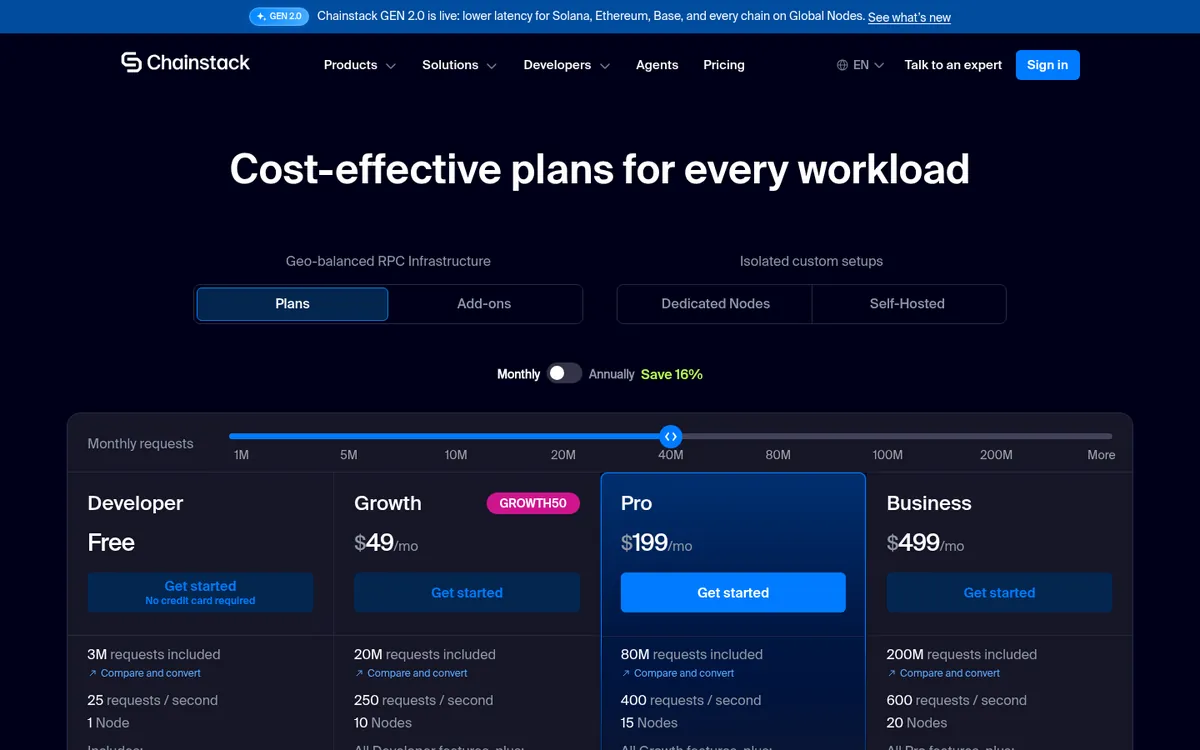
- Plans: Developer free (3M RU, 25 rps), Growth $49 (20M, 250 rps), Pro $199 (80M, 400 rps), Business $499 (200M, 600 rps), Enterprise from $990 (400M). Annual billing saves 16%.
- Solana meter: 1 RU per call.
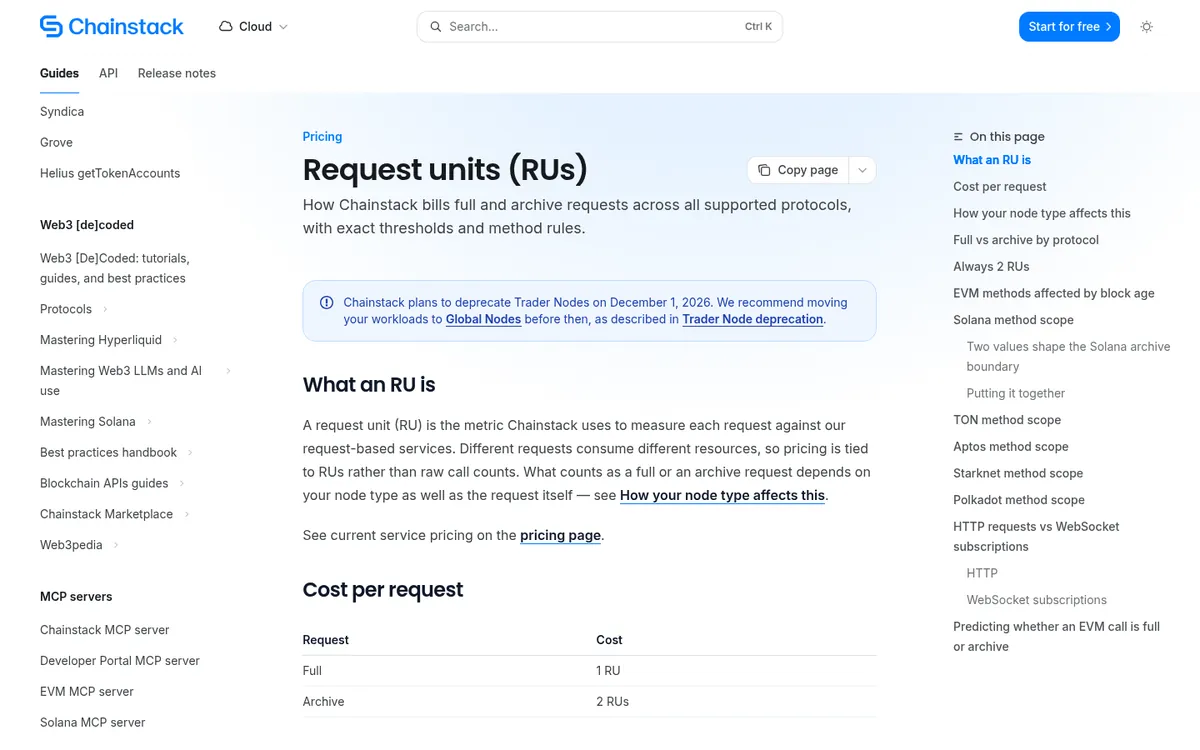
getSignaturesForAddressis always 2 RU, and history calls such asgetTransactionandgetBlockcost 2 RU for slots older than the first available block plus 5,000. - Strengths: lowest included rate, SOC 2 Type II and ISO 27001, Yellowstone gRPC from $49 a month, flat Unlimited Node from $149 a month at 25 rps.
- Weaknesses: overage of $15 per 1M RU on Growth, and Trader Nodes are deprecated on 1 December 2026, so trading teams should plan a move.
Verdict: Chainstack scores 8.9 and takes first place. Pick it as the default Solana endpoint for cost control with audits. See its entry in our full RPC ranking.
2. Helius
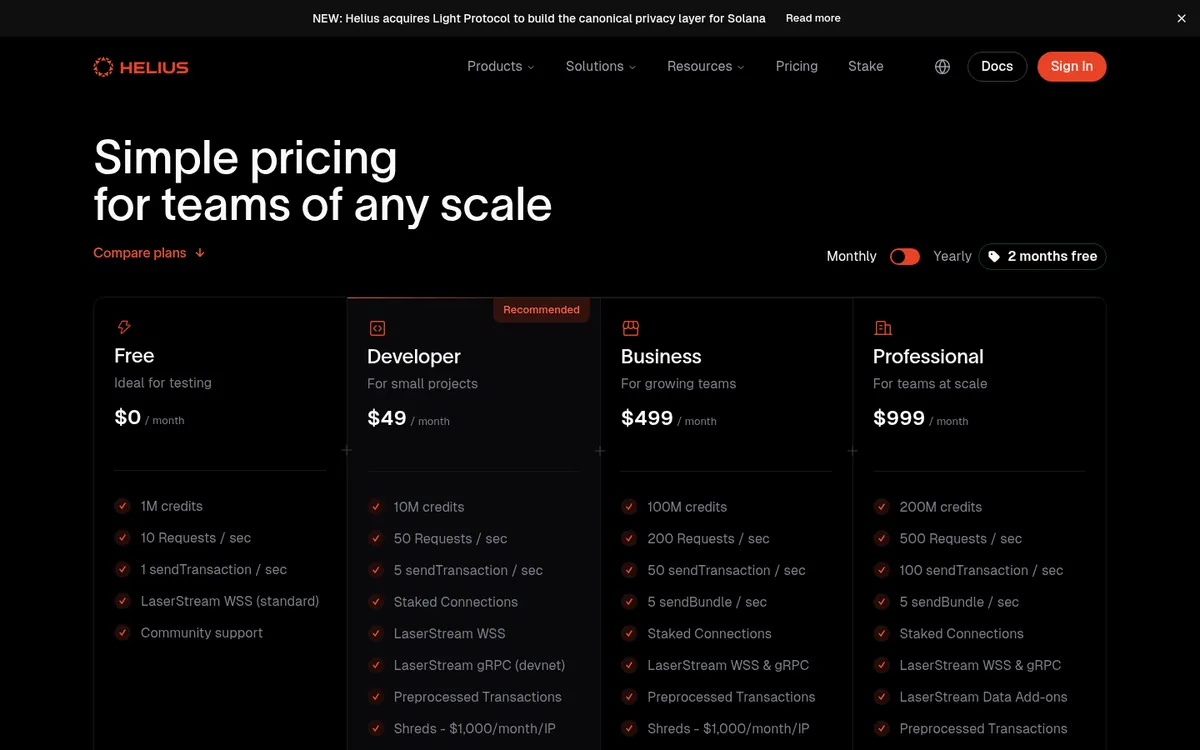
- Plans: Free (1M credits, 10 rps), Developer $49 (10M, 50 rps), Business $499 (100M, 200 rps), Professional $999 (200M, 500 rps). Extra credits cost $5 per 1M.
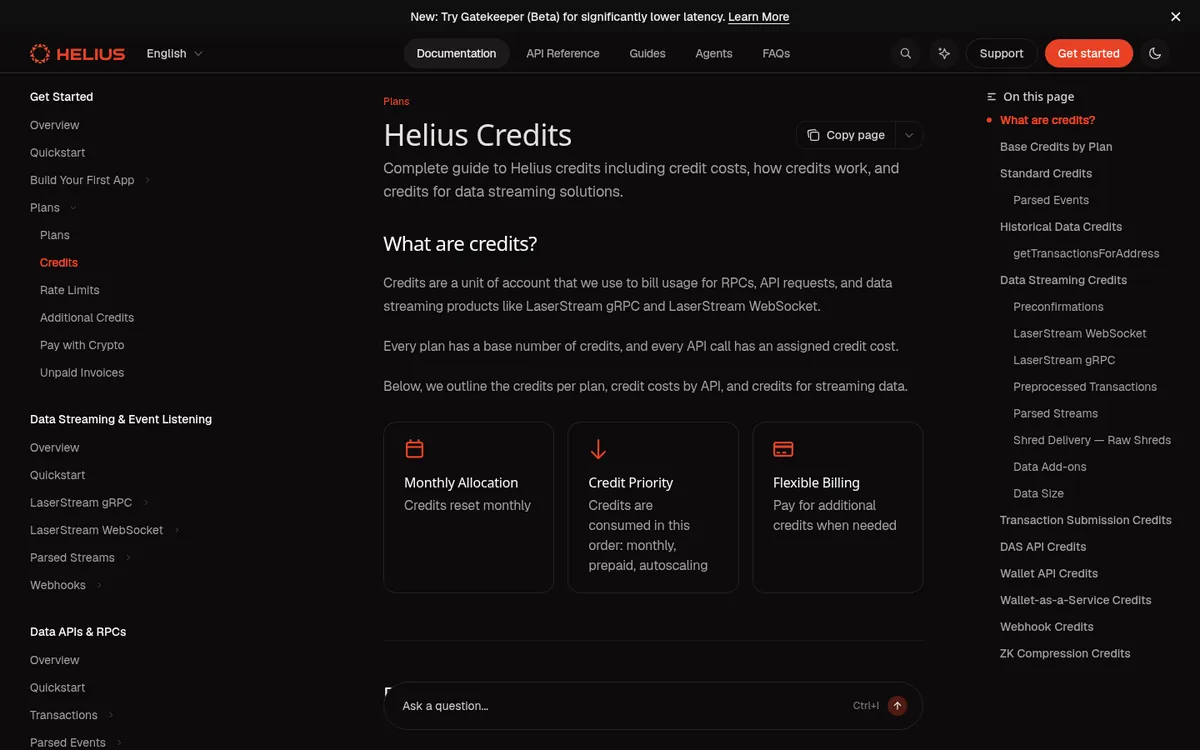
- Credit costs: 1 for standard RPC, 10 for
getProgramAccounts(1 for the V2 version) and DAS calls, 0 for Sender. - Strengths: LaserStream, staked connections, DAS and webhooks, dedicated nodes from $2,900 a month, SOC 2 Type II, top of its own 45-method benchmark.
- Weaknesses: Solana only, and rate limits of 50 rps and 5 sends per second on Developer.
Verdict: Helius scores 8.1. Pick it when Solana is your main chain and you want streaming, sends and data APIs from one vendor. See its entry in our full RPC ranking. Our free RPC providers guide covers the Helius Free plan alongside other no-cost options.
3. Alchemy
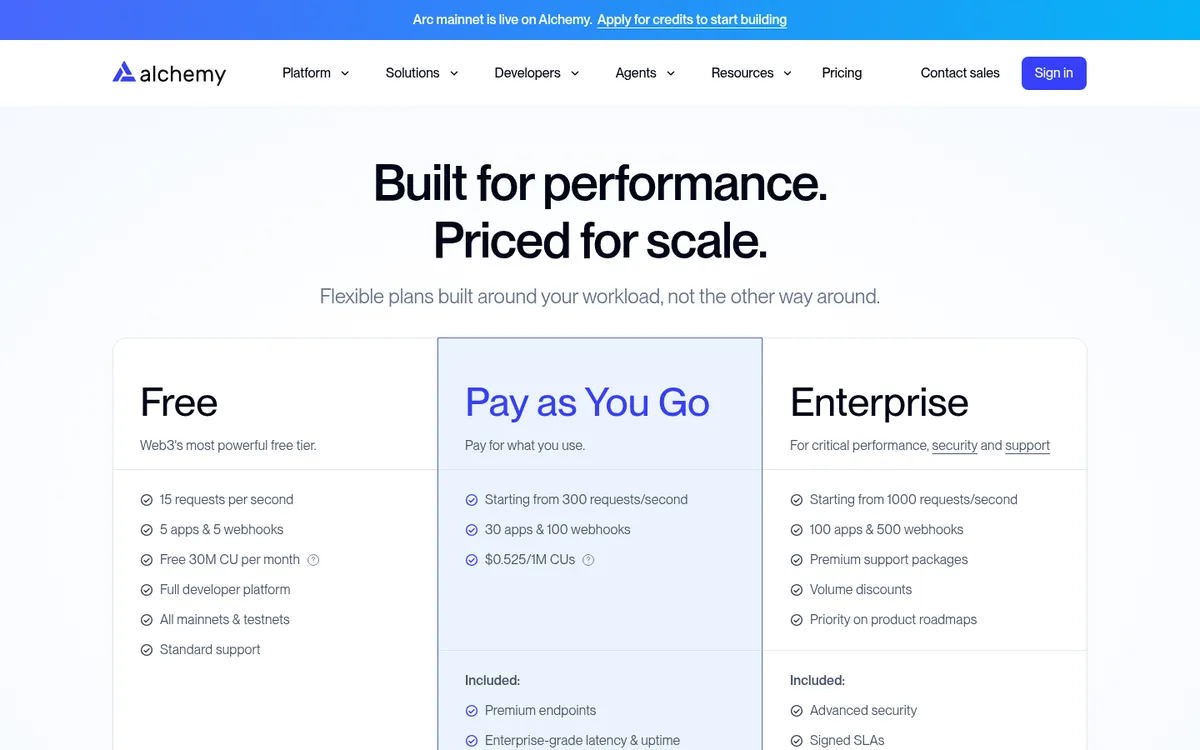
- Plans: Free (30M CU, 15 rps, 5 apps), Pay as you go ($0.525 per 1M CU, 300 rps), Enterprise from 1,000 rps with signed SLAs.
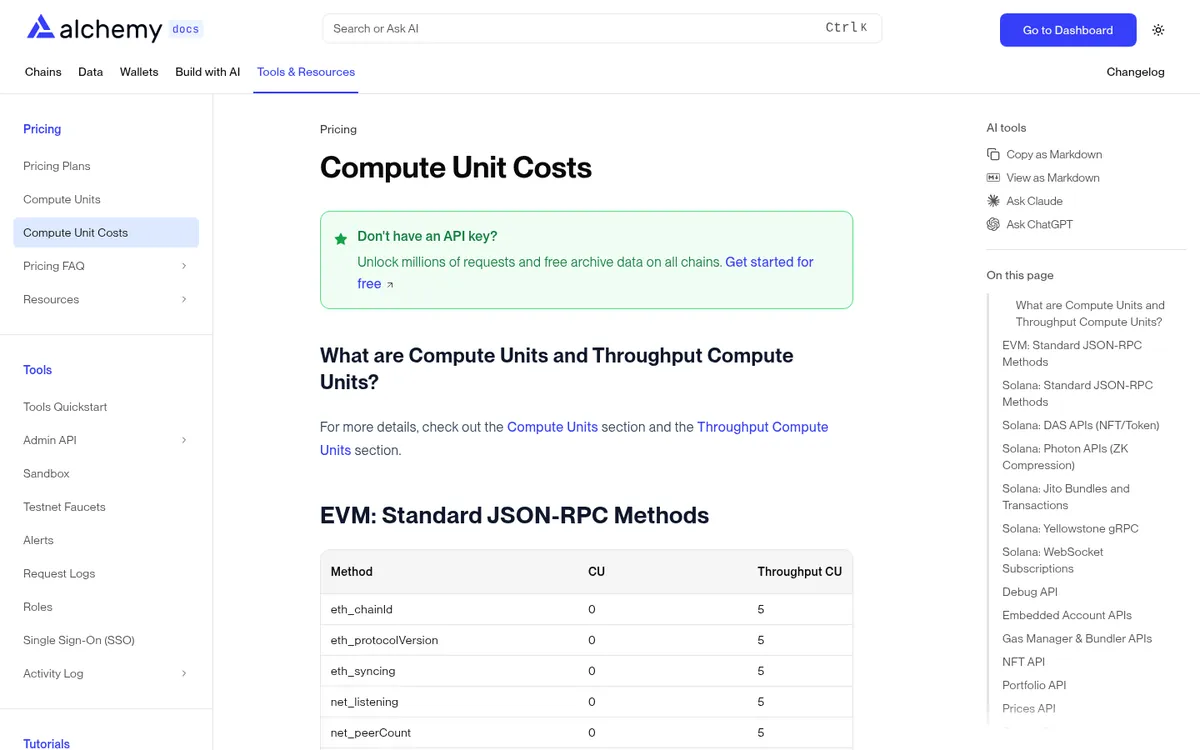
- Solana weights: 10 CU for
getAccountInfoandgetBalance, 20 forgetProgramAccountsandsendTransaction, 40 forgetTransaction,getBlockandgetSignaturesForAddress. - Strengths: best free tier, DAS API, Yellowstone gRPC at $75 per TB, SOC 2 Type II, wide chain list.
- Weaknesses: history-heavy work is expensive, with our indexer at $998 a month, and Alchemy fell below OpenChainBench’s success floor on 25 October.
Verdict: Alchemy scores 7.9. Pick it for prototypes, wallets and token or NFT apps that lean on data APIs. See its entry in our full RPC ranking.
4. QuickNode
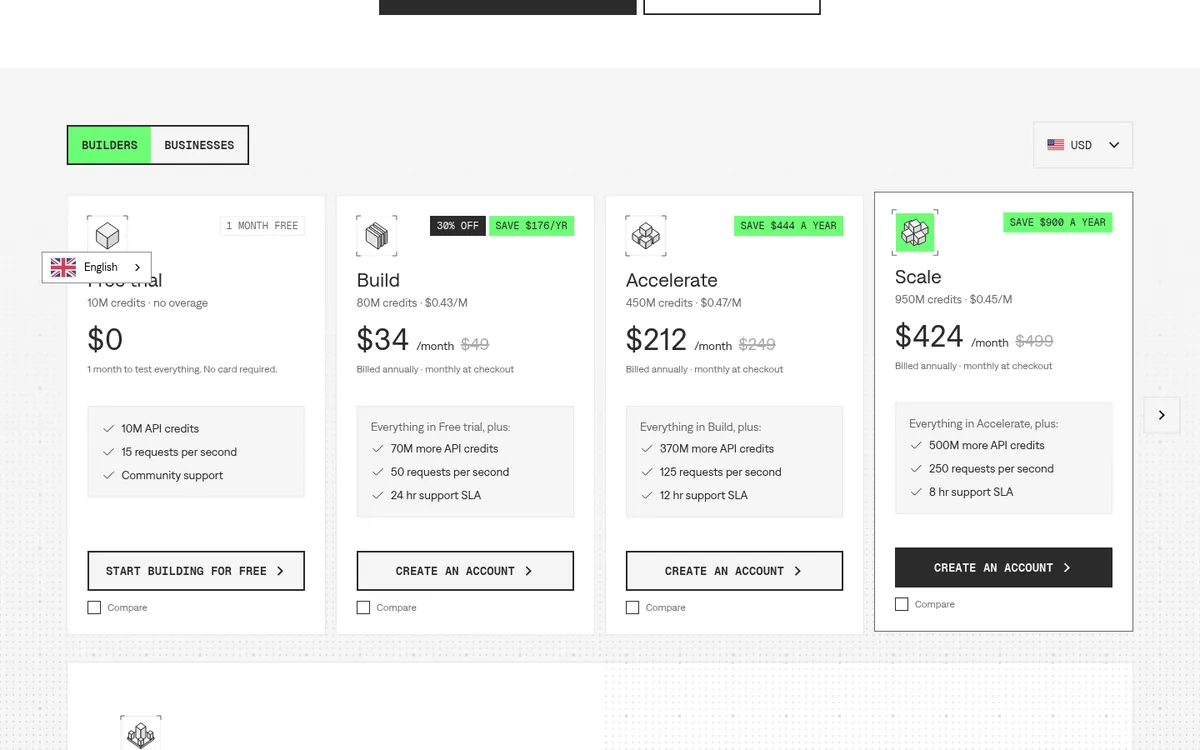
- Plans: Build $49 (80M credits, 50 rps), Accelerate $249 (450M, 125 rps), Scale $499 (950M, 250 rps), Business from $999 (2B, 500 rps). Annual billing lowers Build to $34.
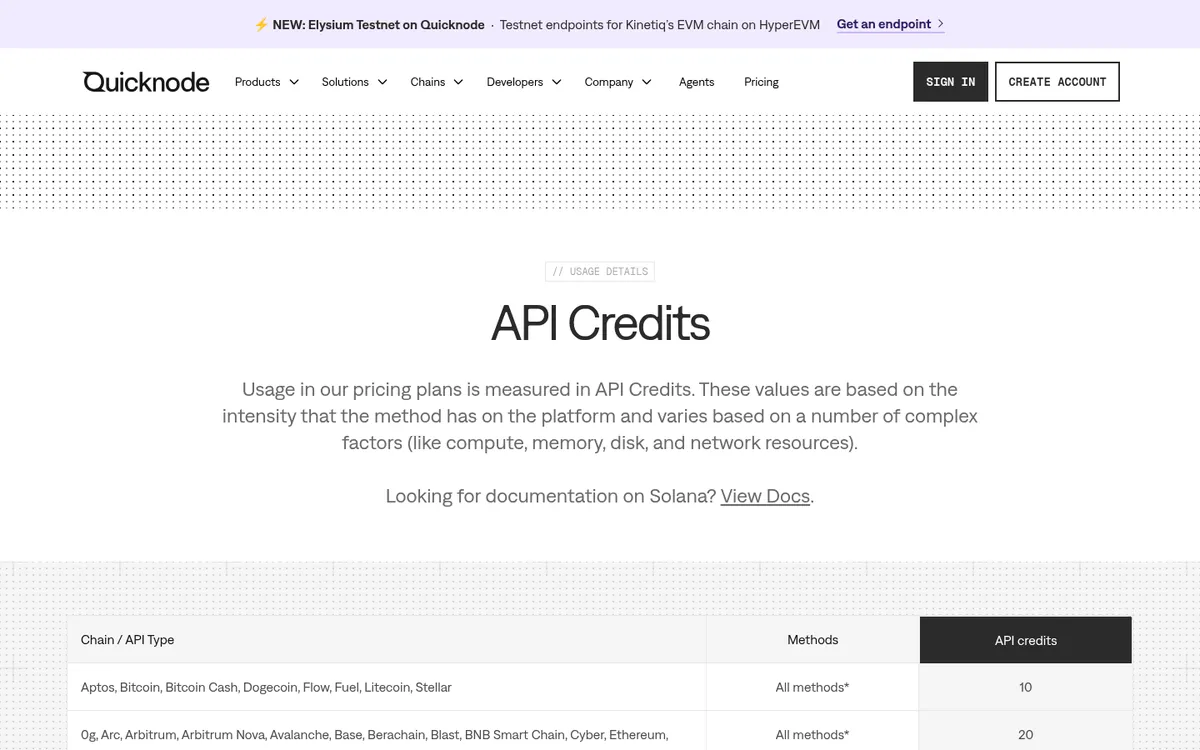
- Solana meter: 30 credits per call, so Build covers about 2.67M calls. Some DAS methods cost 2x and
getLargestAccounts4x. - Strengths: best warm latency, SOC 1 and SOC 2 Type 2 plus ISO 27001, archive on all plans, gRPC streams included from Scale.
- Weaknesses: $18.38 per million calls on Build, and a one-month trial instead of a free tier.
Verdict: QuickNode scores 7.6. Pick it for latency-sensitive apps and regulated buyers that can absorb a higher per-call rate. See its entry in our full RPC ranking.
5. dRPC
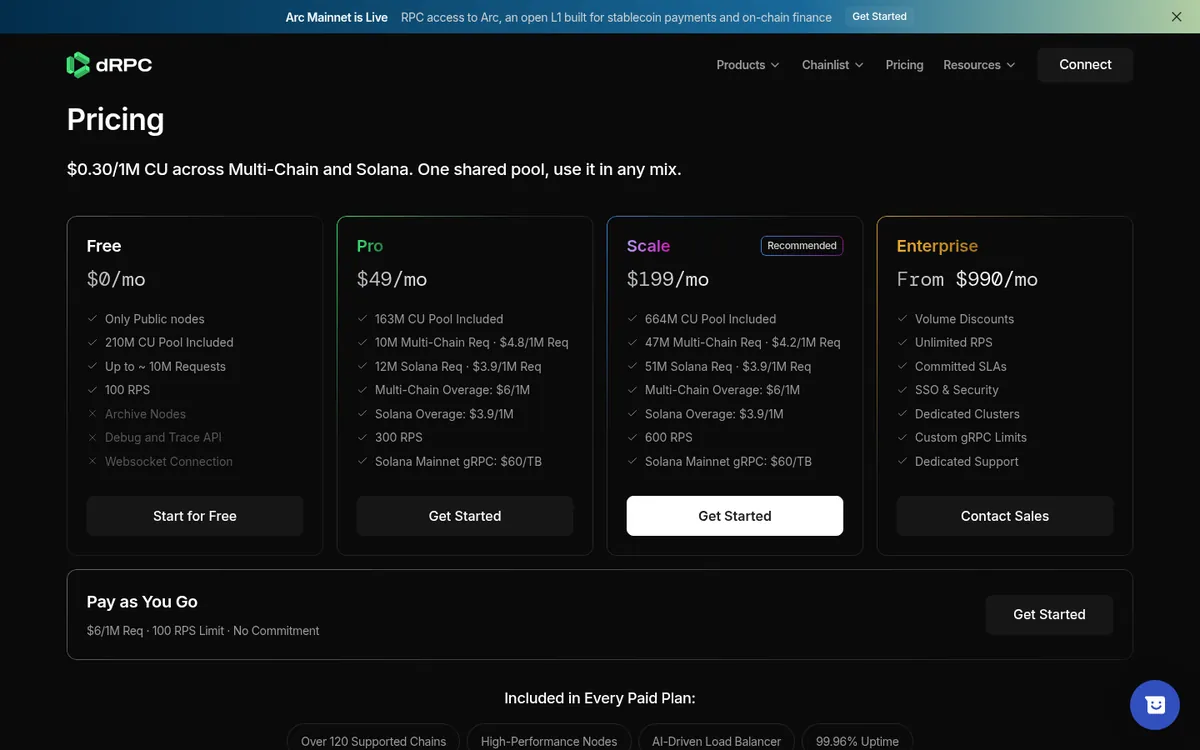
- Plans: Free (public nodes, 210M CU, 100 rps), Pro $49 (about 12M Solana requests, 300 rps), Scale $199 (about 51M, 600 rps), Enterprise from $990. Pay as you go is $6 per 1M requests.
- Strengths: lowest bills at volume, Solana gRPC at $60 per TB, more than 120 chains.
- Weaknesses: no audit report on its own pages, no independent Solana latency data, and the free tier uses public nodes only.
- Uptime: dRPC claims 99.96%.
Verdict: dRPC scores 7.3. Pick it for high-volume, cost-first workloads, ideally behind an audited primary. See its entry in our full RPC ranking.
6. GetBlock
- Plans: Free (50,000 CU a day), Starter $49 (90M CU), Growth $99 (185M), Advanced $199 (385M), Scale $349 (700M), Pro $499 (1B), Premium $699 (1.6B), Enterprise from $999.
- Solana meter: chain multiplier of 50, so Starter buys about 1.8M calls, or $27.22 per million.
- Strengths: best cold-start latency, Limitless Node from $150 a month, Yellowstone gRPC and shred add-ons, SOC 2 Type II.
- Weaknesses: the highest per-call price among subscription plans, and our two largest workloads exceed its biggest public plan.
Verdict: GetBlock scores 6.8. Pick a Limitless or dedicated node for steady, latency-sensitive traffic rather than metered shared access. See its entry in our full RPC ranking. Our dedicated node providers guide prices dedicated Solana nodes across vendors.
7. Triton One
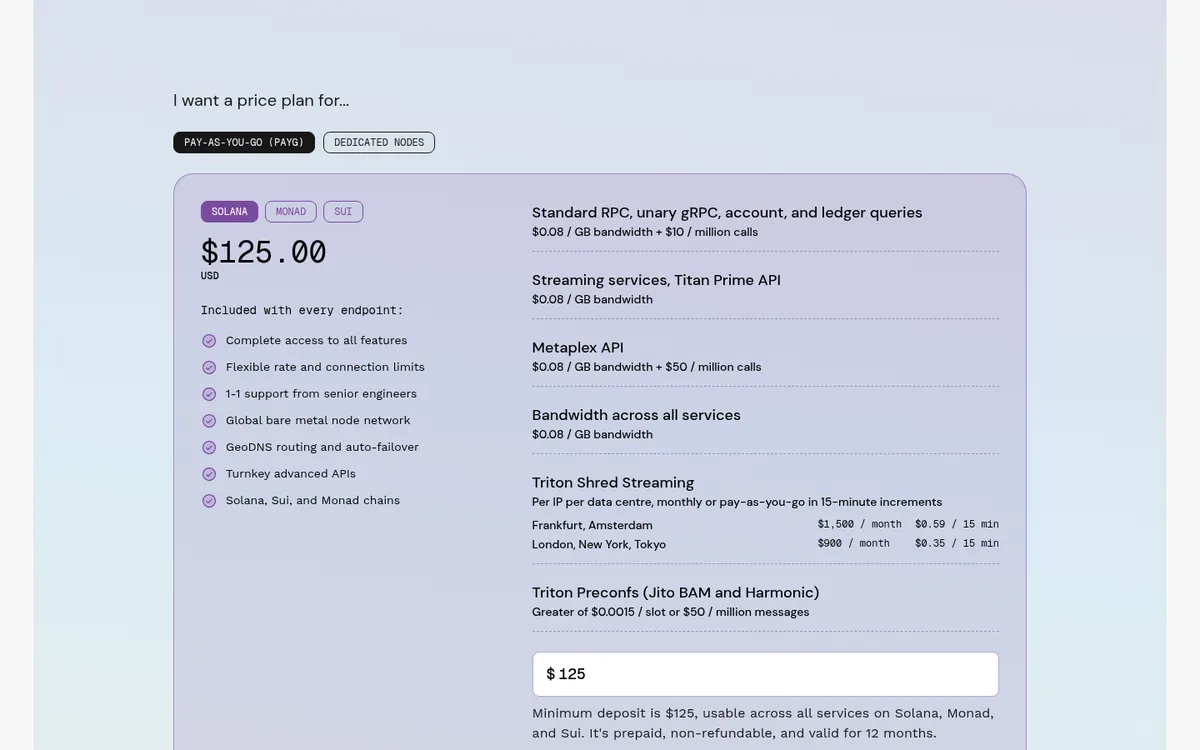
- Pricing: $125 minimum deposit in stablecoins, valid 12 months and non-refundable. Streaming $0.08 per GB, Metaplex API $0.08 per GB plus $50 per 1M calls.
- Shreds: $1,500 a month in Frankfurt and Amsterdam, $900 in London, New York and Tokyo.
- Strengths: complete ledger from genesis, bare-metal clusters in 10+ data centres, 99.99% uptime claim, also serves Sui and Monad.
- Weaknesses: no free tier, no published SOC 2 or ISO report, and its endpoint showed as down on the Helius benchmark on 25 October.
Verdict: Triton One scores 6.6 on our weights, which favor audits and free tiers. Trading and data teams that need raw Solana depth should still test it.
8. OnFinality
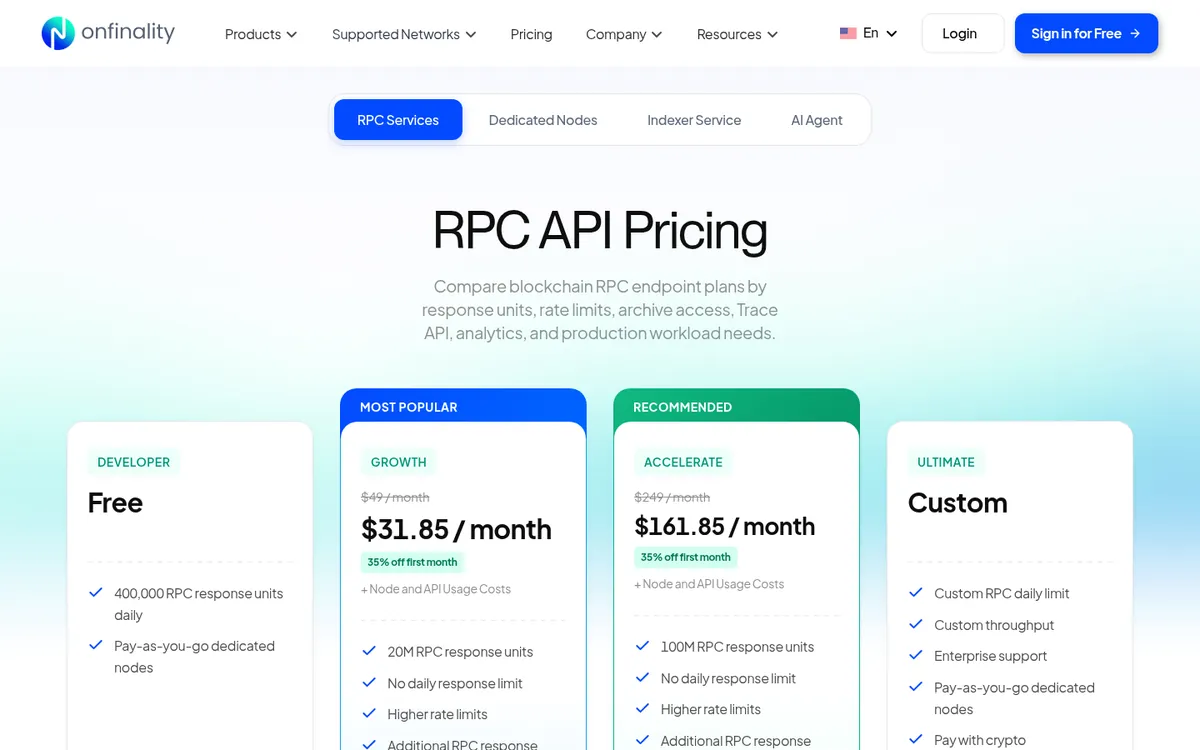
- Plans: Developer free (400,000 RU a day), Growth $49 (20M RU, 200 RU per second), Accelerate $249 (100M RU, 500 RU per second), Ultimate custom. New users get 35% off the first month.
- Overage: $6 per 1M RU on Growth and $3.75 on Accelerate, or $12 and $7.50 per million Solana calls.
- Strengths: generous free tier, flat method weights, archive access, dedicated nodes.
- Weaknesses: Solana regions listed as N. Virginia and Hong Kong only, no gRPC streaming listed, and no audit report found.
Verdict: OnFinality scores 5.7. Pick it for prototypes and low-traffic apps that want a large free Solana allowance.
9. Ankr
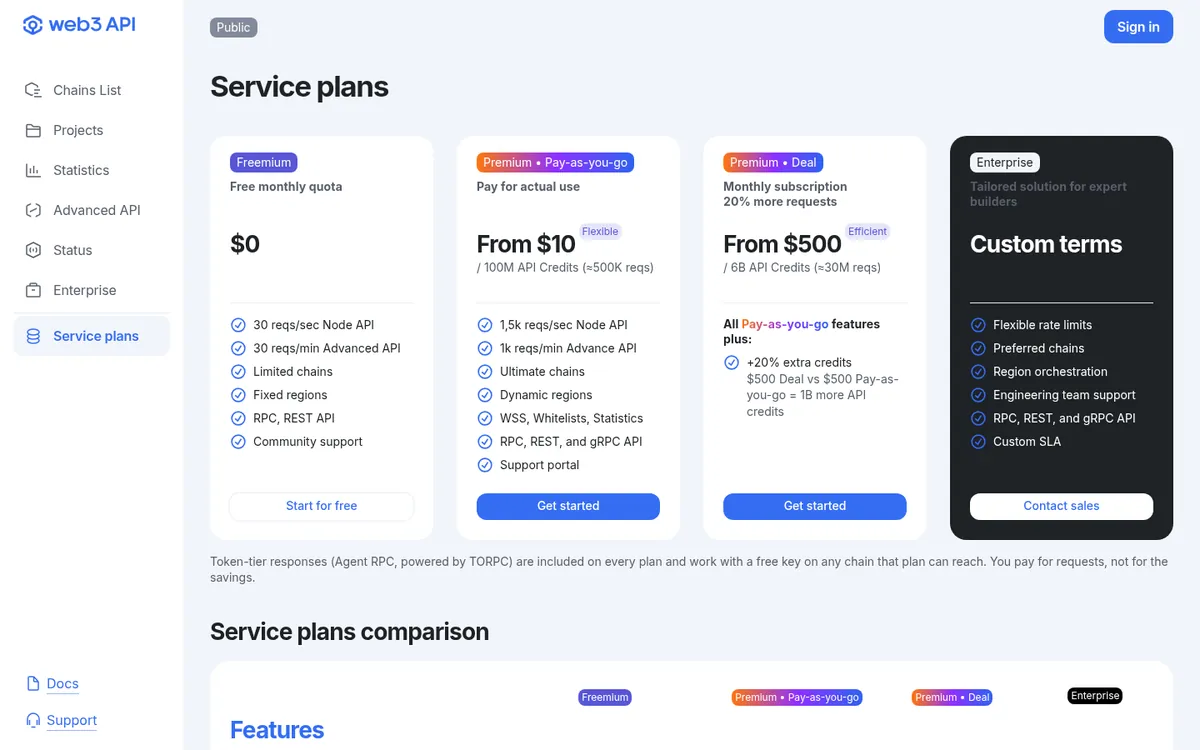
- Plans: Freemium (200M credits a month, 30 rps), Pay as you go from $10 per 100M credits, Deal from $500 for 6B credits including 20% extra.
- Solana meter: about 200,000 Solana requests per $10, or 12M per $500 Deal, which is $41.67 per million.
- Strengths: high rate limit, SOC 2 Type II, gRPC at $0.50 per GB, 100+ chains per Ankr.
- Weaknesses: the most expensive Solana meter we found, with our trading bot at $5,000 a month, and no independent Solana latency data.
Verdict: Ankr scores 5.7. It suits teams already on Ankr for EVM chains that need light Solana access. See its entry in our full RPC ranking.
Providers We Left Out
Syndica retired its self-serve Solana RPC and ChainStream products on 14 February 2026, and its pricing page returned a 404, so it is out despite appearing in some rival lists. Shyft and ERPC pricing pages also returned 404 on 25 October 2026, so we could not verify them. The Solana documentation keeps a longer directory of RPC providers.
Self-hosting is the other option. A Solana RPC node needs high-end hardware and constant upkeep, which is why the dedicated plans above start at $2,900 to $3,200 a month. Our dedicated nodes coverage explains when a private node pays off.
Final Ranking
Chainstack wins on our weights because it combines the lowest included rate with audits and broad coverage. Helius and Alchemy are close behind for different reasons: Helius for Solana depth, Alchemy for its free tier and data APIs. QuickNode trails on price and leads on latency.





Verdict: Start on Chainstack, add Helius or QuickNode as a second endpoint for features or latency, and reprice your method mix every quarter.
How to Test Solana RPC Providers in One Week
A week of side-by-side traffic answers what a pricing page cannot. Send the same requests to two or three endpoints from the region where your servers run. Log median and tail latency, error rates and the slot each endpoint returns, then price that week’s method mix on each meter.
for url in "$CHAINSTACK_URL" "$HELIUS_URL" "$QUICKNODE_URL"; do
  curl -s -o /dev/null -w "%{time_total}\n" \
    -H "Content-Type: application/json" \
    -d '{"jsonrpc":"2.0","id":1,"method":"getSlot"}' \
    "$url"
done
Run the loop from a long-lived server and from a serverless function to see warm and cold behavior, and compare the returned slots to spot lagging nodes. Read the RPC providers hub for more comparisons.
Frequently Asked Questions
What is the best Solana RPC provider in 2026?
On our weighted scorecard, Chainstack is the best Solana RPC provider overall at 8.9 out of 10, thanks to its 1 request unit meter, SOC 2 Type II and ISO 27001. Helius is second and the strongest Solana-native option for streaming and sends, and Alchemy is third for its free tier and data APIs.
What is the cheapest Solana RPC provider?
Chainstack Growth has the lowest included rate at $2.45 per million standard calls. dRPC is cheapest once you exceed a plan allowance, at a flat $3.90 per million, and it produced the lowest bill in three of our four workloads. Ankr pay as you go was the most expensive at $50 per million.
Which Solana RPC provider is fastest?
On OpenChainBench’s keyed Solana run read on 25 October 2026, QuickNode had the lowest warm median at 3.4 ms and GetBlock the lowest cold-start median at 18.9 ms. Helius ranks first on its own 45-method benchmark. Helius and Triton One are not in the OpenChainBench cohort, so test them yourself.
Is Helius better than QuickNode for Solana?
Helius is cheaper for most Solana traffic at 1 credit per call against QuickNode’s 30, and it offers LaserStream, staked sends and DAS on one key. QuickNode posts better independent latency and states SOC 1, SOC 2 Type 2 and ISO 27001. Helius scores 8.1 and QuickNode 7.6 on our weights.
Is there a free Solana RPC endpoint?
Yes. Solana Labs runs free public endpoints, which OpenChainBench measured at about 24 ms median latency, but they are rate limited and not meant for production. For a free private key, Alchemy offers 30M compute units a month, OnFinality about 200,000 calls a day and Chainstack 3M request units a month.
Do I need gRPC streaming for Solana?
You need gRPC streaming when your app reacts to account or transaction changes within milliseconds, such as trading bots, indexers and liquidators. Most wallets and dApps work fine with JSON-RPC and WebSocket subscriptions. Triton One, Helius, Chainstack, Alchemy, QuickNode, GetBlock and dRPC all sell Yellowstone-compatible gRPC streams.