
Last updated: 25 October 2026 · Charters, audit reports, insurance statements, asset counts and public prices rechecked on BitGo, Fireblocks and Anchorage Digital pages on 25 October 2026
Fireblocks vs BitGo vs Anchorage Digital comes down to who should hold the keys. BitGo is the strongest all-round qualified custodian, Anchorage Digital is the pick when you want a federally chartered crypto bank with staking and settlement attached, and Fireblocks is the platform for teams that want to hold their own MPC key shares. We scored all three on the same six weighted criteria, mapped which legal entity would hold your assets, and priced year one of self-custody software from public list prices.
All three sell more than one product, which is why head-to-head tables online often compare the wrong things. BitGo and Anchorage Digital each run a bank-level custodian and a self-custody wallet, and Fireblocks runs MPC software plus a separate trust company. We compare like with like, and the scoring rules are on our methodology page. If you are still choosing between those models, start with our crypto custody models guide.
TL;DR
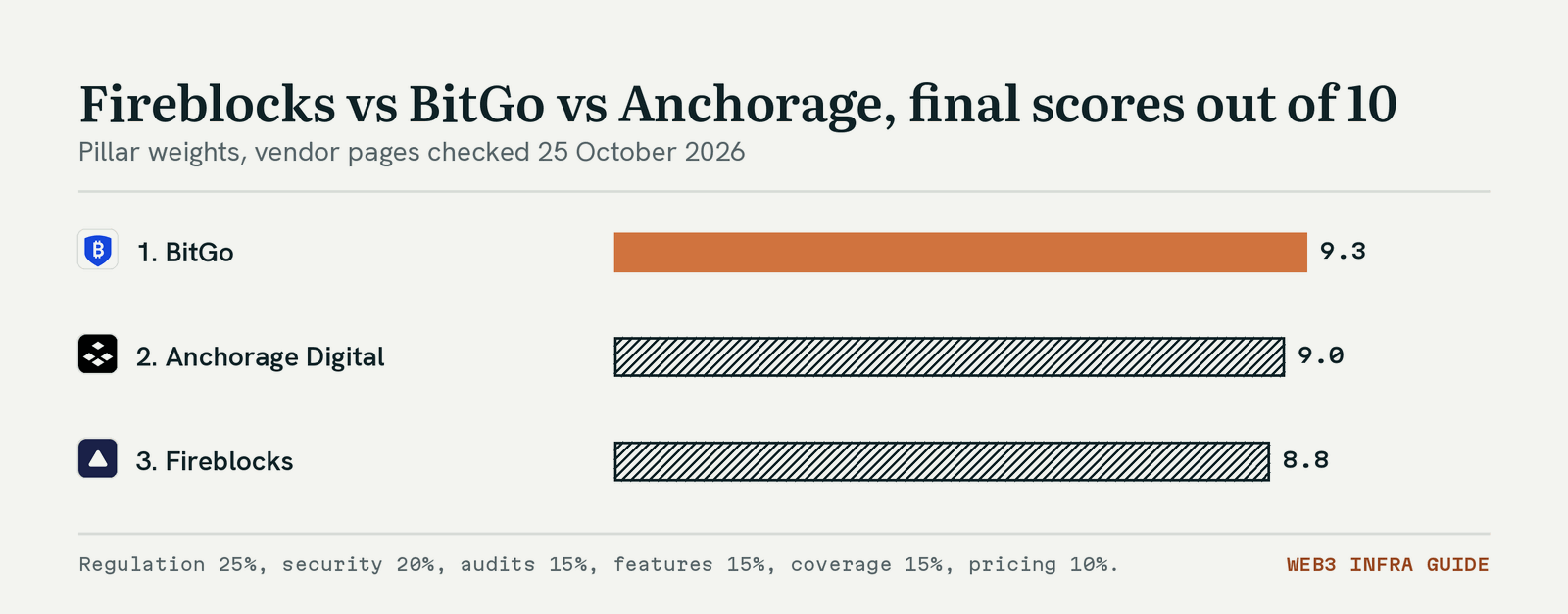
- Scores out of 10: BitGo 9.3, Anchorage Digital 9.0, Fireblocks 8.8. The gap is small, and the right answer depends on your custody model more than the total.
- BitGo Bank & Trust is an OCC national trust bank and Anchorage Digital Bank is an OCC chartered bank. Fireblocks Trust Company is an NYDFS limited purpose trust company, sold separately from the Fireblocks software platform.
- Only BitGo states an insurance figure: up to $250M through a Lloyd’s of London and European syndicate for assets where BitGo Bank & Trust holds all keys. Anchorage Digital says custody assets are not FDIC insured.
- Fireblocks publishes the most audit detail: SOC 2 Type 2 with zero material findings, ISO 27001 and CCSS QSP Level 3. Anchorage Digital names SOC 1 and SOC 2 Type II. BitGo names SOC attestations without the type.
- Year-one self-custody software for a team holding $800K and moving $1M a quarter: $23,994 on Fireblocks, $7,650 on Porto by Anchorage Digital Starter, and $0 on BitGo’s free self-service tier.
- Coverage: BitGo lists 1,700+ assets, Fireblocks 80+ chains and a 1,022-entry asset list, and Anchorage Digital about 780 assets on its supported list.
The Decision Kernel
Answer one question first: does a regulation, an auditor or your board require a qualified custodian to hold the assets? If yes, compare BitGo Bank & Trust, Anchorage Digital Bank and Fireblocks Trust Company. If no, you are choosing self-custody software, and Fireblocks, Porto and BitGo self-custody wallets compete on a very different basis. If you are choosing self-custody software, our Fireblocks alternatives guide and our Fireblocks vs Utila vs Dfns comparison cover the MPC platforms in depth.
- Pick BitGo if you need a qualified custodian across many assets and regions, stated insurance and a published billing method. It holds licences in the US, New York, Singapore, Dubai, the EU and Switzerland.
- Pick Anchorage Digital if federal bank supervision matters most and you want custody tied to staking on 20+ networks, Atlas settlement and trading through Anchorage Digital Prime.
- Pick Fireblocks if your team wants to sign its own transactions under a policy engine, connect to 2,000+ counterparties and keep the option of a trust company later.
- Use two of them if you run a cold reserve and an active trading or payments book. A custodian for the reserve and MPC software for operations is a common pattern.
Verdict: BitGo for most regulated buyers, Anchorage Digital when a federal bank charter and staking come first, and Fireblocks when your own team should control signing.
How We Compared the Three
We used the six weighted criteria from our digital asset custody hub, scored each from 1 to 5 and doubled the weighted sum. Inputs come from provider pages read on 25 October 2026. Facts missing from the provider site scored as not disclosed. The full rules are on our methodology page and our editorial policy.
- Regulation and segregation, 25%: the charter or licence of the entity that holds assets, bankruptcy-remote segregation and qualified custodian status.
- Security and key control, 20%: cold storage, MPC or multisig design, HSMs, approval policies and recovery.
- Audits and insurance disclosure, 15%: SOC 1 and SOC 2 Type II reports, ISO 27001, other certifications and any stated insurance amount.
- Features, 15%: staking, trading, off-exchange settlement, DeFi access and APIs.
- Coverage, 15%: supported assets and chains, plus the number of regulated regions.
- Pricing transparency, 10%: 5 for a full public price list, 4 for a public entry price with overage terms, 3 for a public price on a secondary product or a free tier, 2 for a billing method only, 1 for nothing.
| Provider | Regulation (25%) | Security (20%) | Audits (15%) | Features (15%) | Coverage (15%) | Pricing (10%) | Score |
|---|---|---|---|---|---|---|---|
 | 5 | 5 | 4 | 5 | 5 | 3 | 9.3 |
 | 5 | 5 | 4 | 5 | 4 | 3 | 9.0 |
 | 3 | 5 | 5 | 5 | 5 | 4 | 8.8 |
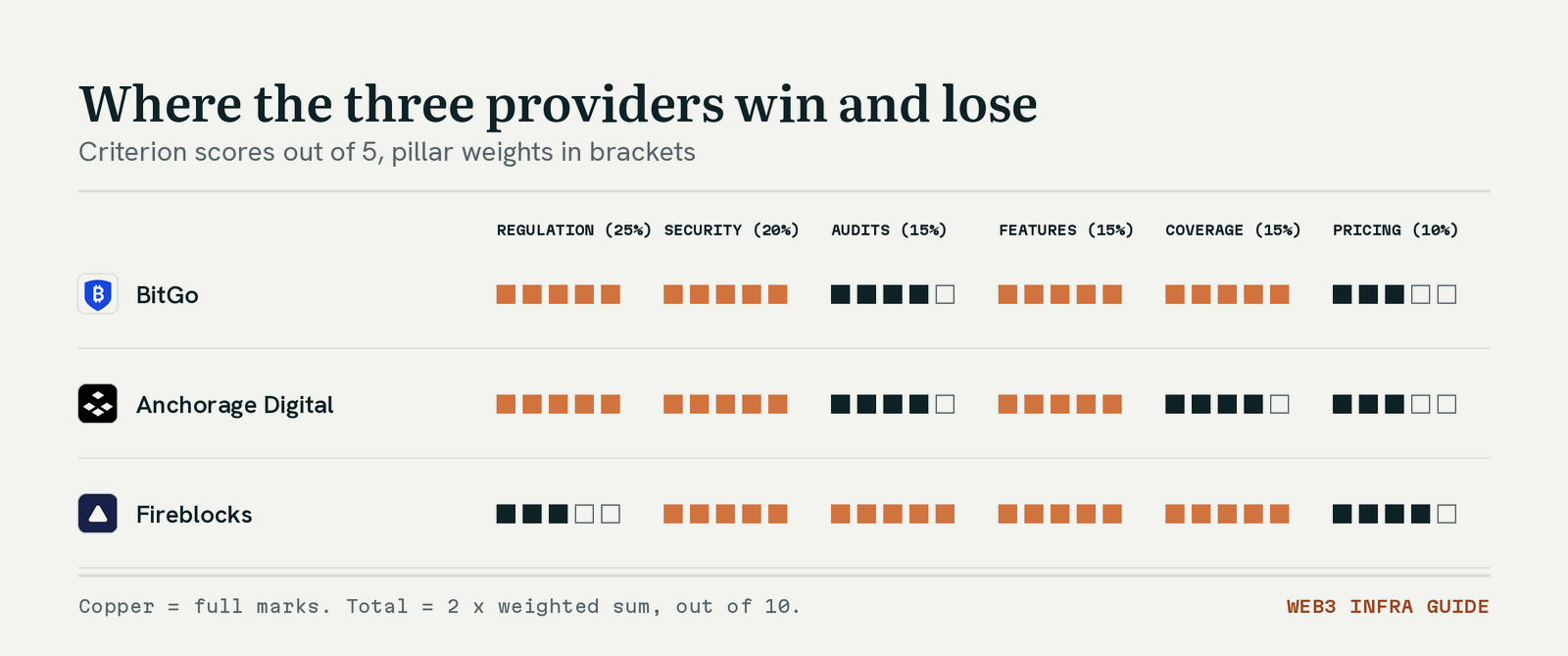
The criterion grid explains the ranking better than the totals. BitGo and Anchorage Digital tie on regulation, security, audits and features. BitGo pulls ahead on coverage. Fireblocks wins audits, coverage and pricing transparency, but loses 2 points on regulation because most clients use its software to self-custody, and its trust company is a separate entity with its own contract.
Fireblocks vs BitGo vs Anchorage at a Glance
This table puts the facts a due diligence questionnaire asks for in one place, using only what each provider states on its own site. The biggest structural difference is that BitGo and Anchorage Digital lead with bank custody, while Fireblocks leads with software you operate yourself.
| BitGo | Anchorage Digital | Fireblocks | |
|---|---|---|---|
| Core product | Qualified custody plus self-custody wallets | Bank custody plus Porto self-custody | MPC wallet platform plus Fireblocks Trust |
| US custody entity | BitGo Bank & Trust, N.A. (OCC national trust bank) | Anchorage Digital Bank N.A. (OCC chartered bank) | Fireblocks Trust Company, LLC (NYDFS limited purpose trust) |
| Key model | Multisig and MPC (TSS), 100% cold storage for qualified custody | HSM-based keys with biometric approvals | MPC key shares in secure enclaves, air-gapped cold wallet option |
| Audit reports named | SOC attestations, type not stated | SOC 1 and SOC 2 Type II | SOC 2 Type 2, ISO 27001, CCSS QSP Level 3 |
| Stated insurance | Up to $250M (Lloyd’s and European syndicate) | Not stated; custody assets not FDIC insured | Not stated |
| Assets and chains | 1,700+ assets | About 780 assets on its supported list | 80+ chains; 1,022 entries on its asset list |
| Staking | Protocol staking from custody, no pooling | 20+ networks, never pooled or rehypothecated | 8 assets, 7 validator providers |
| Settlement network | Go Network OES | Atlas, 800+ participants | Fireblocks Network and Off Exchange |
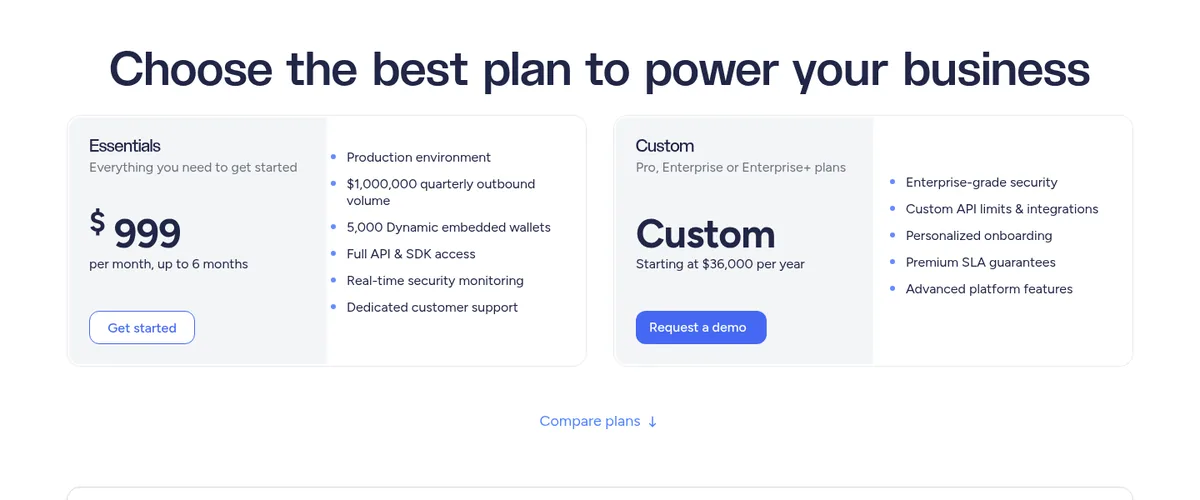
| Public price | Billing method; free self-service tier | Porto from $750 a month | Essentials $999 a month; Custom from $36,000 a year |
Which Legal Entity Holds Your Assets
Brand names hide the part that matters to auditors: which legal entity signs your custody agreement, and which regulator supervises it. Ask every finalist to name the entity, its regulator and whether your assets sit in a bankruptcy-remote, segregated account at that entity.
| Provider | Entity | Regulator and status | What it does |
|---|---|---|---|
| BitGo Bank & Trust, N.A. | OCC, national trust bank with fiduciary and custodial powers | US qualified custody, all three keys held in Class III bank vaults |
| BitGo New York Trust Company | NYDFS qualified custodian | New York custody |
| BitGo Singapore, Custody MENA, Europe GmbH, GmbH Switzerland | MAS MPI, Dubai VARA, MiCAR via BaFin, VQF under FINMA | Regional custody and wallet services |
| Anchorage Digital Bank N.A. | OCC, first federally chartered crypto bank (January 2021) | US custody, staking and settlement |
| Anchorage Digital Singapore; Anchorage Digital NY | MAS MPI; NYDFS BitLicense | Singapore custody; New York agency trading |
| Anchorage Innovations, LLC (Porto) | Not a custodian | Self-custody wallet software |
| Fireblocks Trust Company, LLC | NYDFS limited purpose trust company | Qualified custody, separate onboarding and contract |
| Fireblocks LLC | FinCEN MSB, US money transmitter licences | Payments and platform services |
For registered advisers, the SEC Division of Investment Management’s 30 September 2025 staff letter lets advisers and funds treat a qualifying state trust company as a bank for crypto custody, provided the conditions are met. That brings Fireblocks Trust Company into the conversation alongside the two OCC banks. The OCC charters remain the simpler answer for an auditor, because federal supervision is not conditional on a staff letter.
Key Models and Security Controls
All three avoid a single full private key in one place, but they get there differently. BitGo built its platform on multisig, Fireblocks is built on MPC, and Anchorage Digital centres on HSMs with biometric approvals, so the recovery story is different for each.
- BitGo: 2-of-3 multisig and threshold signature (TSS) wallets. In qualified custody BitGo holds all three keys offline. In its self-custody hot wallets the client holds the user and backup keys and BitGo holds the platform key, per its self-custody page.
- Fireblocks: MPC key shares stored in secure enclaves, a policy engine for amounts, destinations and approvers, and a cold wallet that signs on air-gapped iOS devices by QR code. KeyLink lets banks bring their own FIPS 140-3 HSMs.
- Anchorage Digital: HSM-based key storage with biometric approvals and 24/7 support, per its custody page. Porto, its self-custody wallet, says Anchorage cannot recover keys if you lose them.
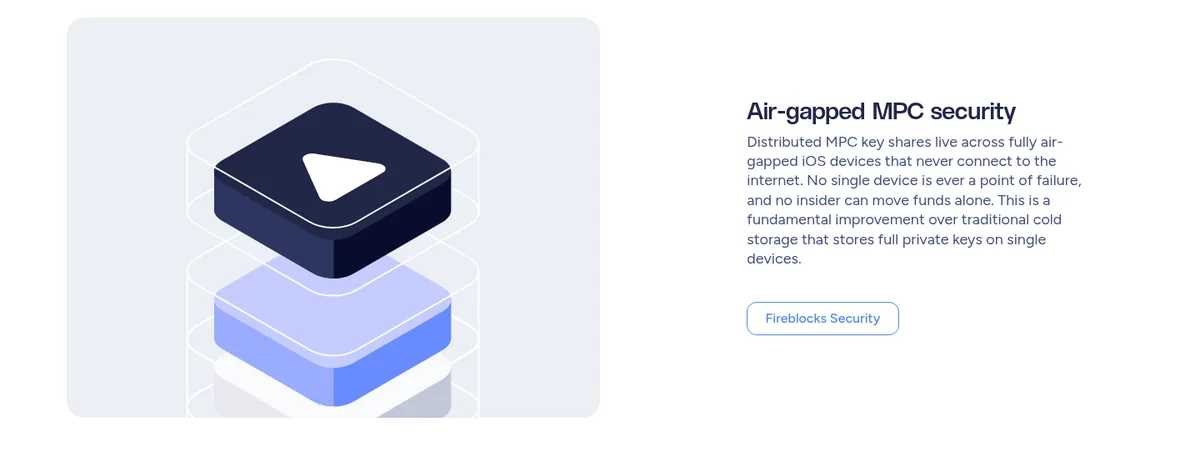
Withdrawal speed is part of security design: BitGo states 24/7 withdrawals from custody wallets processed within a 24-hour SLA. Fireblocks Trust lists multiple daily deposit and withdrawal windows, and Anchorage Digital offers 24/7 biometric approvals. Test each path in a pilot before you sign.
Audits, Insurance and Disclosure
Due diligence teams ask for the charter, the SOC reports, ISO 27001, insurance and price. We checked each provider’s pages for each item. No single provider discloses everything: Fireblocks names the most audits, BitGo is the only one with an insurance figure, and Anchorage Digital is the only one with a public price for its self-custody product tiers.
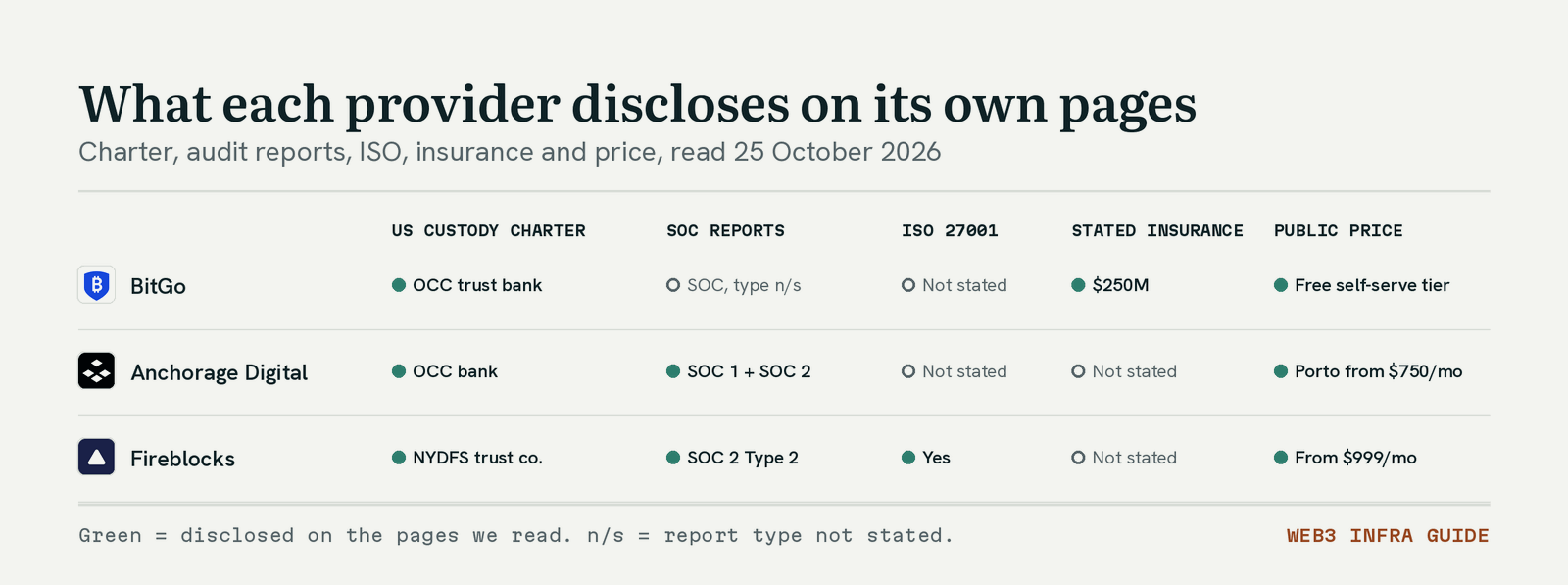
- BitGo insurance: up to $250M for assets where BitGo Bank & Trust holds all keys, placed with a Lloyd’s of London and European syndicate. BitGo pays the deductibles, and excess specie cover is available through its broker, per its insurance page.
- Fireblocks audits: SOC 2 Type 2 with zero material findings, ISO 27001, CCSS QSP Level 3, penetration testing and NCC-audited cryptography libraries, per its security page.
- Anchorage Digital: SOC 1 and SOC 2 Type II audited controls. It states that digital assets in custody are not guaranteed and are not FDIC insured; fiat is held with an FDIC-insured sub-custodian.
- What to request: the latest SOC reports and bridge letter from all three, and the insurance certificate, insurer, limit and exclusions from any provider that cites cover.
Staking, DeFi and Settlement Networks
Custody is increasingly judged by what you can do without moving assets out. All three now offer a way to trade or post collateral while assets stay in custody, but the networks are not interoperable, so pick the one your counterparties already use.
| Capability | BitGo | Anchorage Digital | Fireblocks |
|---|---|---|---|
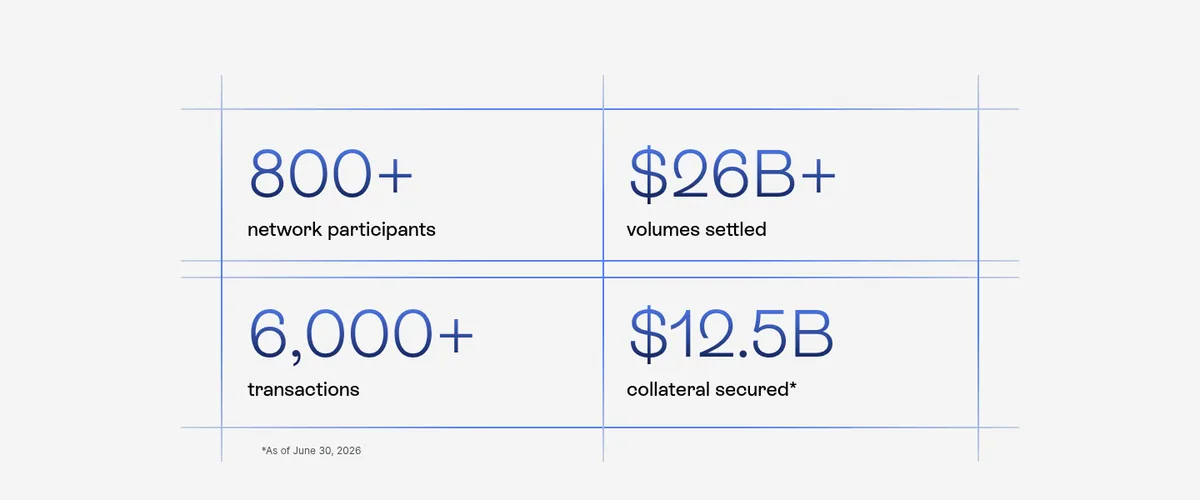
| Off-exchange settlement | Go Network OES: assets stay in bankruptcy-remote custody and are mirrored to partner exchanges | Atlas: 800+ participants, $26B+ settled, $12.5B collateral secured (as of 30 June 2026) | Off Exchange: collateral vault accounts, 3 to 30 bps on AUC as an add-on |
| Staking | Protocol staking from custody or hot wallets, no pooling; Babylon and Core BTC staking | 20+ networks, rewards never pooled or rehypothecated | 8 assets, 7 validator providers including Figment and Kiln, plus Lido |
| DeFi access | Vaults from custody; WalletConnect for hot wallets | Porto Web3 portal with curated Ethereum and Solana protocols | Policy-controlled DeFi and smart contract interactions |
| Counterparty network | Partner exchanges on Go Network | 800+ Atlas participants, 800+ Prime trading entities | 2,000+ counterparties, 30+ exchanges |
Pricing and Year-One Cost
None of the three publishes a qualified custody rate card. BitGo’s billing methodology comes closest: basis points on each asset’s monthly average of hourly USD balances, plus basis points on transfers out of your BitGo enterprise. Every 10 bps of custody fee on $25M is $25,000 a year, more than most software plans.
BitGo’s own worked example uses two transaction tiers, 25 bps up to $1M and 20 bps above. On $1.5M of sends that is $2,500 plus $1,000, or $3,500 in transaction fees for the month. These are BitGo’s illustrative tiers, not a quote.
Self-custody software is where public prices exist, so we modelled three team sizes for year one, before any custody add-on.
| Scenario | Fireblocks | Porto by Anchorage Digital | BitGo self-custody |
|---|---|---|---|
| A: $800K balance, $1M outbound a quarter | $23,994 (6 months Essentials, then Custom floor) | $7,650 (Starter, annual upfront) | $0 (self-service tier, free, may change) |
| B: $5M balance, $2M outbound a quarter | $27,994 (adds $2,000 of 0.20% overage) | $15,300 (Advanced, annual upfront) | Not stated (enterprise terms) |
| C: $25M balance, $10M outbound a quarter | $36,000 Custom floor; overage terms not stated | Quote only (Premium, over $10M balance) | Not stated (enterprise terms) |
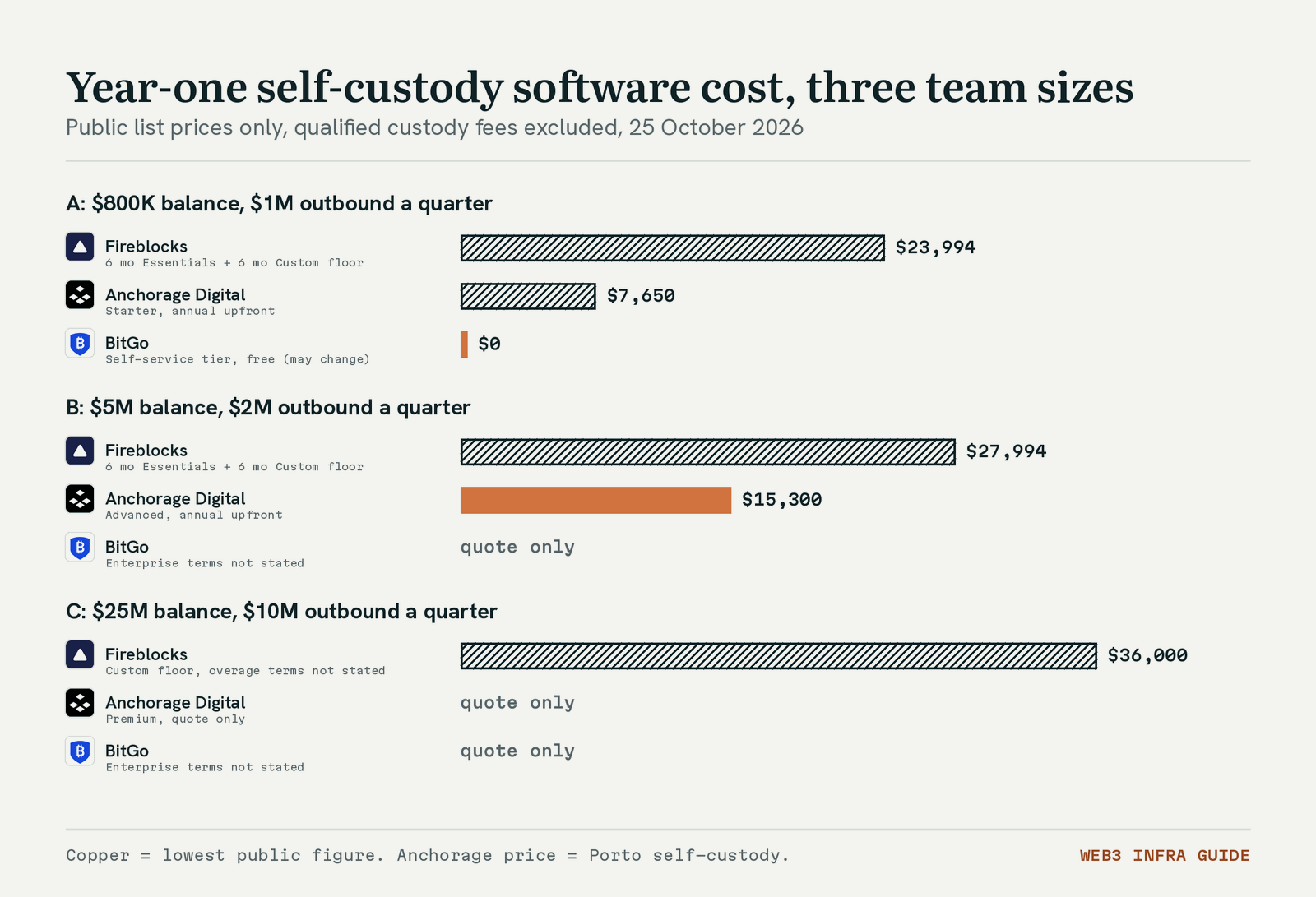
The math: Fireblocks Essentials is $999 a month for up to 6 months and includes $1M of outbound volume a quarter, with 0.20% overage. After 6 months you move to Custom, which starts at $36,000 a year. Porto bills by average balance, not volume, and the annual upfront price saves 15% against $750 or $1,500 a month. At scenario C, Essentials overage would reach $18,000 a quarter, so Custom is cheaper from day one.
# Scenario B, year one
essentials_q = 999 * 3 + (2_000_000 - 1_000_000) * 0.002   # $4,997 a quarter
fireblocks = 2 * essentials_q + 36_000 / 2                  # $27,994
porto_advanced = 15_300                                      # annual upfront, balance under $10M

# BitGo worked example, transaction tiers 25 bps to $1M, 20 bps above
bitgo_tx = 1_000_000 * 0.0025 + 500_000 * 0.0020            # $3,500

# Custody fee sensitivity, illustrative only
aum, bps = 25_000_000, 10
fee = aum * bps / 10_000                                     # $25,000 a year
Swap in your own balance, volume and quoted tiers. The bps / 10_000 step turns basis points into a rate, so a 20 bps custody quote on $25M is $50,000 a year, which is more than any self-custody plan in the table.
1. BitGo
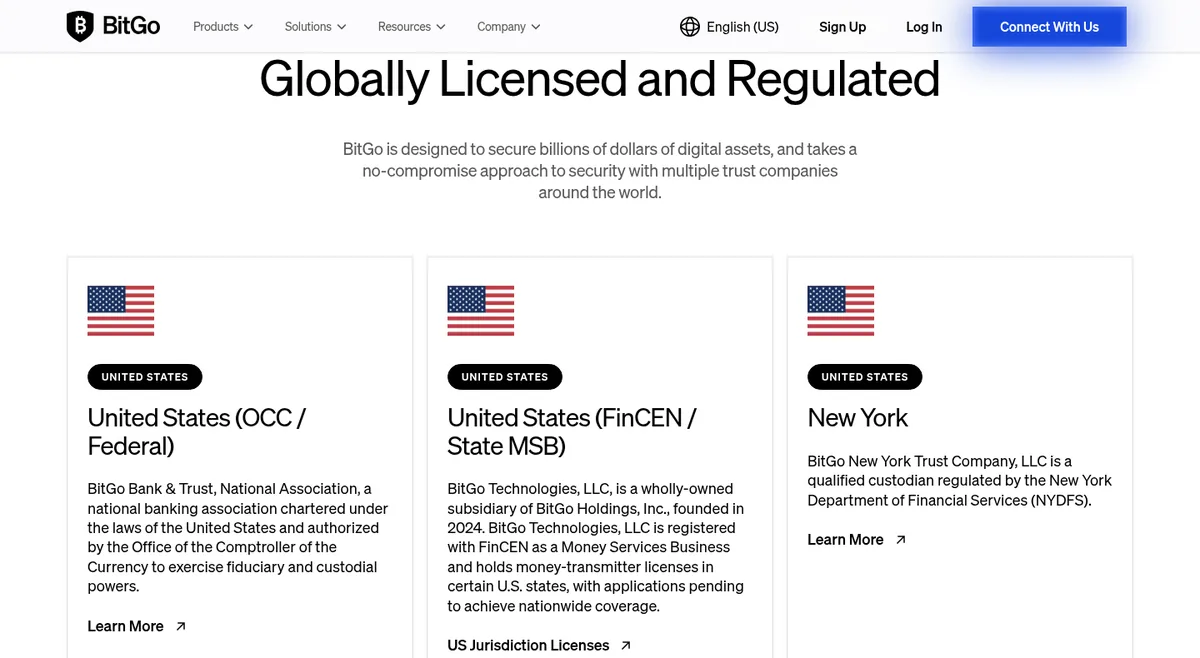
- Custody: qualified custody is 100% cold storage, with BitGo holding all three keys in Class III bank vaults, plus whitelisting, velocity controls and user policies.
- Withdrawals: 24/7 requests processed within a 24-hour SLA from custody wallets.
- Billing: a published method with AUC bps and transaction bps, and a free self-service self-custody tier from BitGo, Inc. that it says may change.
- Weaknesses: no public custody rate, and its security page names SOC attestations without the report type.
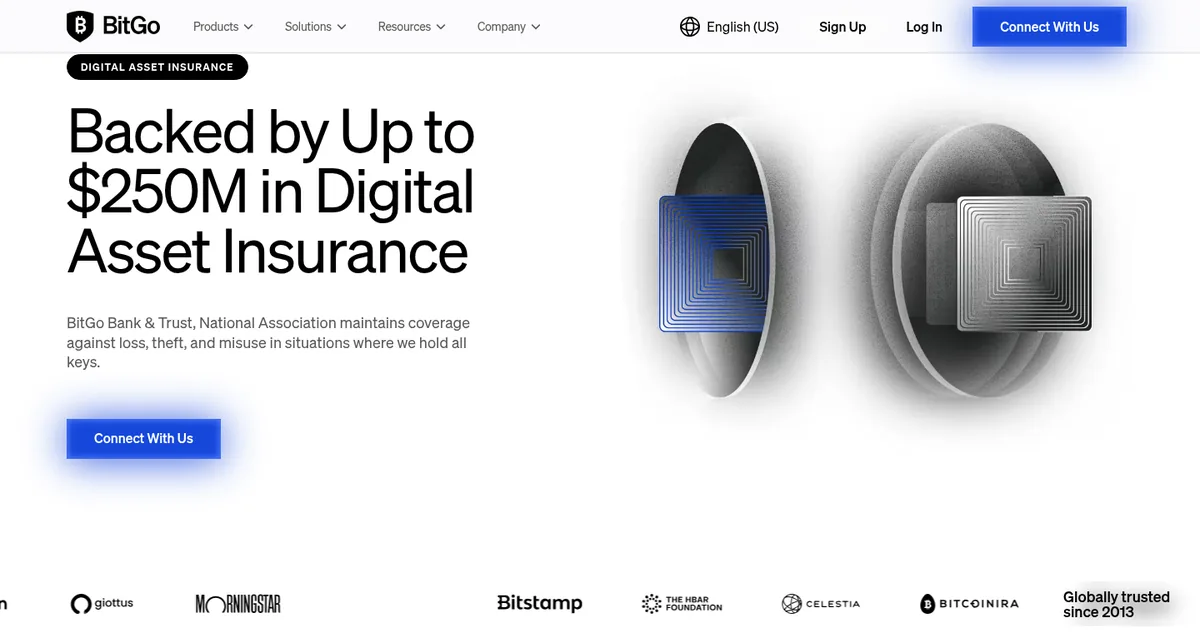
Verdict: BitGo scores 9.3. It is the default for funds, advisers and corporates that need a federally chartered qualified custodian with broad asset and regional coverage. Our BitGo vs Coinbase Prime vs Fidelity Digital Assets comparison weighs it against two other qualified custodians.
2. Anchorage Digital
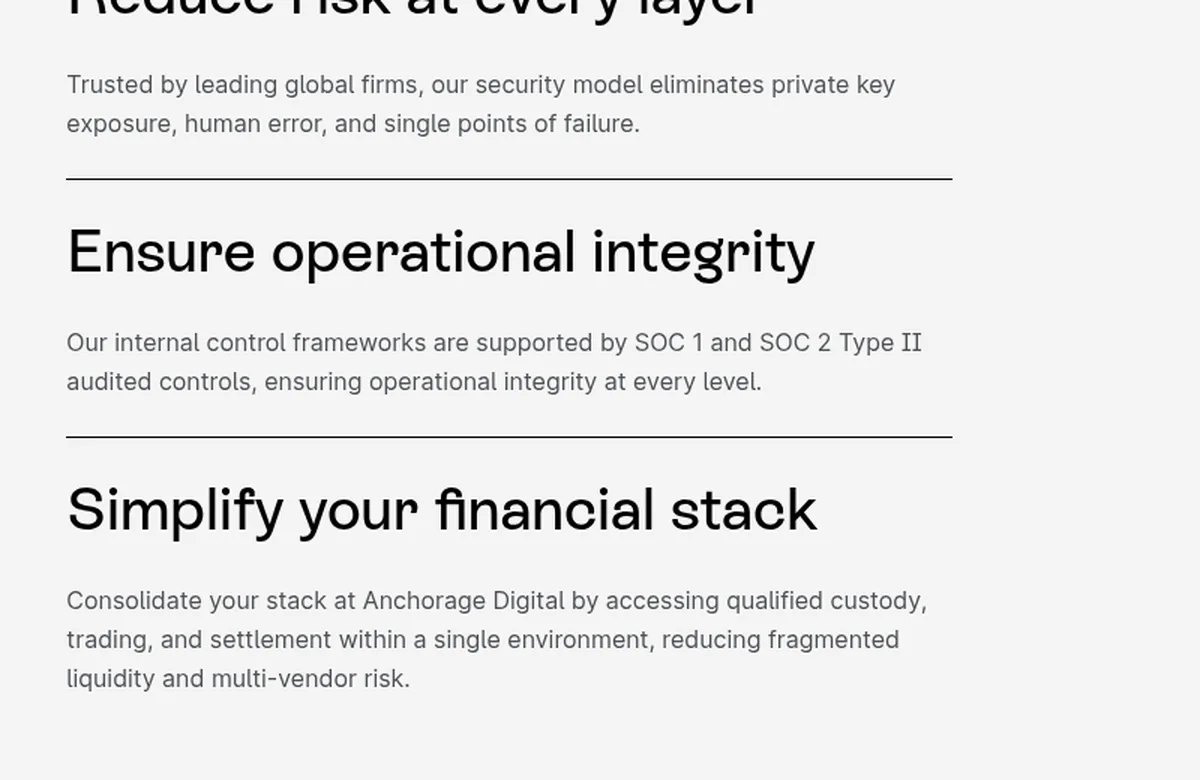
- Licences: OCC charter for the bank, an MAS licence for Anchorage Digital Singapore and a New York BitLicense for agency trading, per its about page.
- Coverage: about 780 assets on its supported assets list (our count on 25 October), and 400+ assets to trade through Anchorage Digital Prime.
- Porto: self-custody from $750 a month (balance under $1M) or $1,500 a month (under $10M), with a custom Premium tier above that.
- Weaknesses: no stated insurance amount, ISO 27001 not named, and no public price for bank custody.
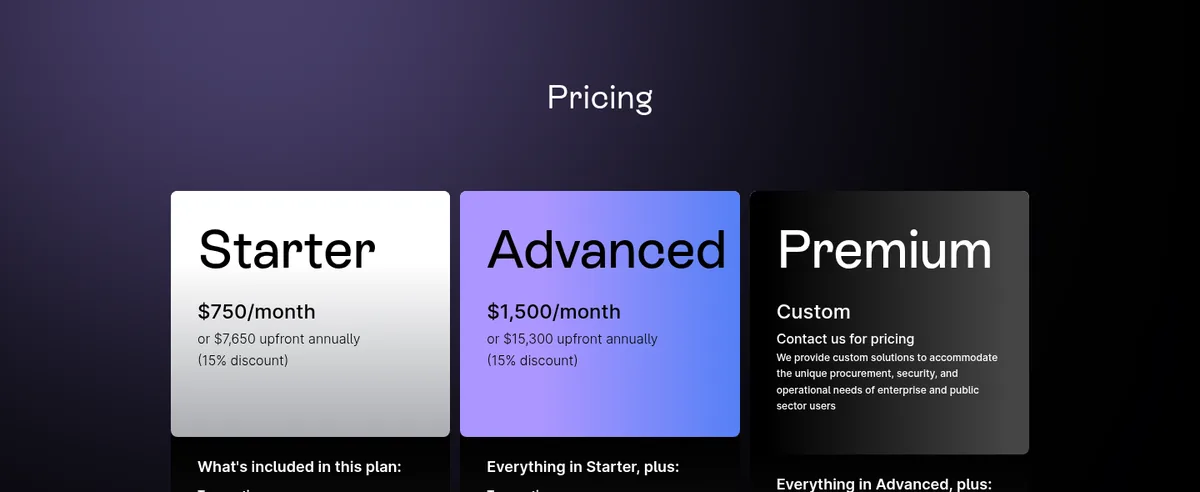
Verdict: Anchorage Digital scores 9.0. Choose it when an OCC bank charter, staking and an institutional settlement network matter more than the longest asset list.
3. Fireblocks
- Network: 80+ chains, 2,000+ counterparties, 30+ exchange integrations and 99.97% monthly uptime, per its pricing page.
- Trust company: Fireblocks Trust offers segregated, bankruptcy-remote qualified custody with air-gapped cold storage and staking through Figment and Kiln, under a separate contract.
- Assets: 1,022 entries on its supported assets page, which cites over 150 blockchain integrations.
- Weaknesses: Essentials is capped at 6 months and $1M of outbound volume a quarter, no insurance amount is stated, and trust company pricing is not public.
Verdict: Fireblocks scores 8.8. Pick it when your team should control signing, connect to many counterparties and scale wallets through an API.
Running Two of Them Together
Many institutions do not pick one. A common split is a qualified custodian for long-term reserves and MPC software for the operating float. If you combine providers, write down which entity holds each balance and who can approve a transfer between them, because that is where audits find gaps.
- BitGo custody plus Fireblocks: cold reserves at BitGo Bank & Trust, trading and payments on Fireblocks with its counterparty network.
- Anchorage Digital custody plus Porto: one vendor, bank custody for reserves and Porto for on-chain activity, with the clear line that Porto keys are yours alone.
- Fireblocks software plus Fireblocks Trust: one vendor for both, under two contracts, useful if you started on software and now need a qualified custodian.
- For more options, see our institutional custodians hub and our MPC wallets and key management hub.
Due Diligence Checklist
Send the same questions to all three finalists and compare the written answers side by side. Each item maps to a row in the tables above, so gaps in public disclosure become explicit questions in your request for proposal rather than assumptions.
- Name the exact legal entity that will hold your assets, its regulator and its charter.
- Ask for the latest SOC 1 Type II and SOC 2 Type II reports and the bridge letter covering the gap since the period ended.
- Get the insurance certificate if cover is cited: insurer, limit, whether it is shared across clients and what it excludes.
- Read the custody agreement for segregation, rehypothecation, bankruptcy treatment and fee calculation.
- Run a pilot withdrawal: approval quorum, time from cold storage to chain, and who can recover a lost key share.
- Confirm asset and chain support, staking terms and whether rewards are passed through net of fees.
- Plan the exit: how to move assets to another custodian, how long it takes and what it costs.
Final Ranking
BitGo wins on breadth and disclosure of insurance. Anchorage Digital is a close second with a federal bank charter, deep staking and the most transparent self-custody pricing. Fireblocks ranks third on our weights only because its core product is software rather than custody, and it is first if you want to hold your own keys.


Verdict: Shortlist BitGo and Anchorage Digital if you need a qualified custodian, and Fireblocks if your team will hold its own keys. Ask all three for SOC reports and a written fee schedule before signing.
Frequently Asked Questions
Is BitGo or Fireblocks better for institutional custody?
For qualified custody, BitGo is stronger: it runs an OCC chartered trust bank, holds keys in cold storage and states up to $250M of insurance, scoring 9.3 against 8.8. Fireblocks is better when your own team should hold MPC key shares and sign transactions across 80+ chains and 2,000+ counterparties.
Is Anchorage Digital a qualified custodian?
Yes. Anchorage Digital describes itself as a federally chartered, SEC-qualified custodian. Anchorage Digital Bank N.A. received the first OCC national charter for a crypto bank in January 2021, and it holds client assets in segregated, bankruptcy-remote accounts with SOC 1 and SOC 2 Type II audited controls.
What is the difference between Fireblocks and BitGo key management?
BitGo uses multisig and threshold signature wallets, and in qualified custody it holds all three keys offline in bank vaults. Fireblocks uses MPC, splitting each key into shares stored in secure enclaves so no full key ever exists, with a policy engine controlling who can approve each transaction.
How much do Fireblocks, BitGo and Anchorage Digital cost?
Fireblocks Essentials is $999 a month for up to 6 months, then Custom from $36,000 a year. Porto by Anchorage Digital costs $750 or $1,500 a month. BitGo offers a free self-service tier and publishes a billing method. None of the three publishes a qualified custody rate.
Which is insured, BitGo, Fireblocks or Anchorage Digital?
Only BitGo states an amount: up to $250M through a Lloyd’s of London and European syndicate for assets where BitGo Bank & Trust holds all keys. Anchorage Digital says custody assets are not FDIC insured, and Fireblocks states no figure. Ask each for its certificate, limit and exclusions.
Which supports more assets, BitGo, Fireblocks or Anchorage Digital?
BitGo lists 1,700+ supported assets, the most of the three. Fireblocks supports 80+ chains and shows 1,022 entries on its supported assets page. Anchorage Digital lists about 780 assets for custody, with 400+ available to trade through Anchorage Digital Prime, as checked on 25 October 2026.