
Last updated: 3 November 2026 · every coverage figure, response time and price below rechecked on the vendor’s own page on 3 November 2026
The best KYT tools in 2026 are Chainalysis KYT (9.2/10), TRM Labs (8.9) and Elliptic Lens (8.7) for licensed exchanges, banks and custodians, with Crystal Intelligence (8.4) when your chain list is long. If you need a price you can see today, Global Ledger sells KYT at $400 a month for 10,000 requests and BlockSec Phalcon starts from $0.10 a check.
KYT (Know Your Transaction) is the live check on crypto moving in and out of your platform. It scores each deposit and withdrawal for exposure to sanctioned, stolen or high-risk funds, raises an alert when a rule fires, and leaves a record an examiner can read. It is a narrower job than full blockchain investigations, so the right tool depends on volume, chains and where in your flow the check sits.
This guide ranks eight KYT tools on the same rubric as our blockchain analytics tools ranking, puts the response times and per-check prices vendors actually publish side by side, and shows the monthly bill at three volumes. The scoring rules are on our methodology page. Nothing here is legal advice.
TL;DR
- Chainalysis KYT (9.2) states the most networks of any tool here, 400+ networks and 50M+ tokens, and says alerts arrive within seconds of the on-chain transaction.
- TRM Labs (8.9) is the only top vendor that publishes an API speed: wallet screening answers in under 400 milliseconds, on 184+ blockchains.
- Elliptic Lens (8.7) is the only top-tier KYT product with a public list price: $50,000 per unit a year on AWS Marketplace.
- Global Ledger KYT Starter is $400 a month for 10,000 requests, or $0.04 a check at full use. API access and monitoring alerts start on the $900 Essentials plan.
- Pay-per-check prices run from $1.00 (AMLBot smallest bundle) down to $0.10 (BlockSec Phalcon and AMLBot largest bundle).
- Screen withdrawal addresses before you send, and score deposits before you credit them. A KYT tool that only alerts after the fact cannot stop a payout.
The Decision Kernel
Pick a KYT tool by who checks your work and how many transfers you screen. Licensed firms that answer to a bank or regulator should shortlist Chainalysis, TRM Labs or Elliptic; payment firms under about 10,000 checks a month can start with a published-price tool. Then confirm chain coverage.
- Exchange, broker or custodian with a licence: Chainalysis KYT, TRM Labs or Elliptic Lens, with Crystal if long-tail chains matter.
- Payment company or wallet, up to 10,000 checks a month: Global Ledger KYT Starter or Essentials, or BlockSec Phalcon per check.
- EU CASP that wants EU hosting: Scorechain (EU-hosted private cloud) or Crystal (EU data residency).
- Testing or a side project: Scorechain’s free sanctions API, 100 requests an hour, non-commercial only.
Verdict: Licensed and high-volume teams buy an enterprise KYT engine. Everyone else should price Global Ledger and Phalcon first and move up only when the chain list or examiner demands it.
What a KYT Tool Has to Do
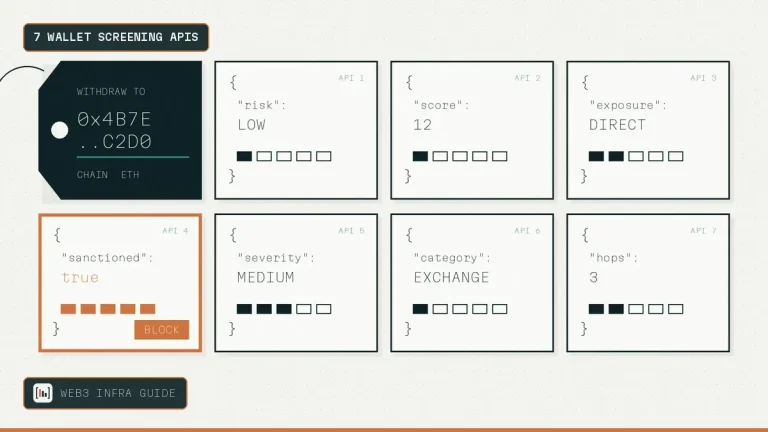
A KYT tool sits on two moments in every transfer. On a withdrawal you screen the destination address before you sign, because once funds leave you cannot pull them back; on a deposit you score the incoming transaction before you credit the user. The vendors describe both jobs in their own words.
TRM says it can detect risks prior to authorizing transactions, Elliptic says to screen a wallet before you process a withdrawal, and BlockSec says to screen withdrawal addresses before payout. The table maps each job to the tools that state it, and our wallet screening API comparison covers the pre-send check in more depth.
| Job | When it runs | What it checks | Who says they do it |
|---|---|---|---|
| Withdrawal pre-screen | Before you sign and send | Destination address risk and ownership | TRM Wallet Screening, Elliptic Lens, BlockSec Phalcon, Chainalysis Address Screening |
| Deposit scoring | After the transfer lands, before you credit | Source of funds, direct and indirect exposure | Chainalysis KYT, TRM Transaction Monitoring, Crystal Expert, Global Ledger |
| Ongoing monitoring | Continuously after onboarding | Re-screen wallets when new risk appears | Elliptic Lens, Chainalysis KYT, Scorechain, Global Ledger Essentials |
| Behaviour rules | On patterns over time | Velocity, structuring, amount and category rules | TRM, Chainalysis, Scorechain, AMLBot Business |
Indirect exposure is the part that separates KYT from a sanctions list lookup. Chainalysis says KYT can set thresholds for the proportion of funds exposed to high-risk categories and flag sanctions exposure both before and after a designation, which a static blocklist cannot do. Ask every vendor how many hops its indirect exposure follows and whether you can change that.
Here is the hold logic most teams wire around a KYT call. The vendor returns a score and the rules that fired; your code decides whether to credit, hold or block. Keep the thresholds in config, not in code, so compliance can tune them without a release.
HOLD_AT, BLOCK_AT = 6, 9          # risk score 0-10, set by your compliance policy

def decide(direction, kyt):
    """direction: 'deposit' or 'withdrawal'; kyt: vendor response mapped to score + flags"""
    if kyt["sanctions_hit"]:
        return "block_and_report"
    if kyt["score"] >= BLOCK_AT:
        return "block_and_review" if direction == "withdrawal" else "freeze_and_review"
    if kyt["score"] >= HOLD_AT:
        return "hold_for_analyst"
    return "release"   # withdrawal: sign and send; deposit: credit the user
Log the raw vendor response, the rule version and the decision for every transfer. When a regulator or bank asks why a transfer passed, that log is the answer, and it is also what you replay when you test a second vendor. Field names differ by vendor, so map them once into a shape like the kyt object above.
Verdict: A KYT tool is only as good as where you call it. Pre-screen every withdrawal, score every deposit before credit, and keep the decision log.
KYT Tools at a Glance
| Tool | KYT product | Coverage (vendor stated) | Security (vendor stated) | Published price | Score |
|---|---|---|---|---|---|
| Chainalysis | KYT, Address Screening | 400+ networks, 50M+ tokens | SOC 2 Type 2, FedRAMP | Quote only | 9.2 |
| TRM Labs | Transaction Monitoring, Wallet Screening | 184+ blockchains, 1.9B+ assets | Annual SOC 2 audit, 99.95% uptime SLA | Quote only | 8.9 |
| Elliptic | Lens | 60+ blockchains, 250+ bridges | SOC 2 Type 2, ISO 27001 | $50,000 or $100,000 per unit a year (AWS) | 8.7 |
| Crystal Intelligence | Crystal Expert | 330+ blockchains | SOC 2 Type II, EU data residency | Quote only | 8.4 |
| BlockSec Phalcon Compliance | Phalcon Compliance | 600M+ address labels | Not stated on pages read | From $0.10 a check | 7.2 |
| Scorechain | Transaction Monitoring | 25+ blockchains (21+ on other pages) | EU-hosted private cloud | Quote; free sanctions API | 6.7 |
| Global Ledger | KYT Starter to Enterprise | All blockchains it supports, per plan | Private server option (Enterprise) | $400 or $900 a month for 10,000 requests | 6.6 |
| AMLBot | AML/KYT checks, KYT API (Business) | Nine named chains on Personal | ISO 27001 | $1.00 down to $0.10 a credit (Personal) | 5.9 |
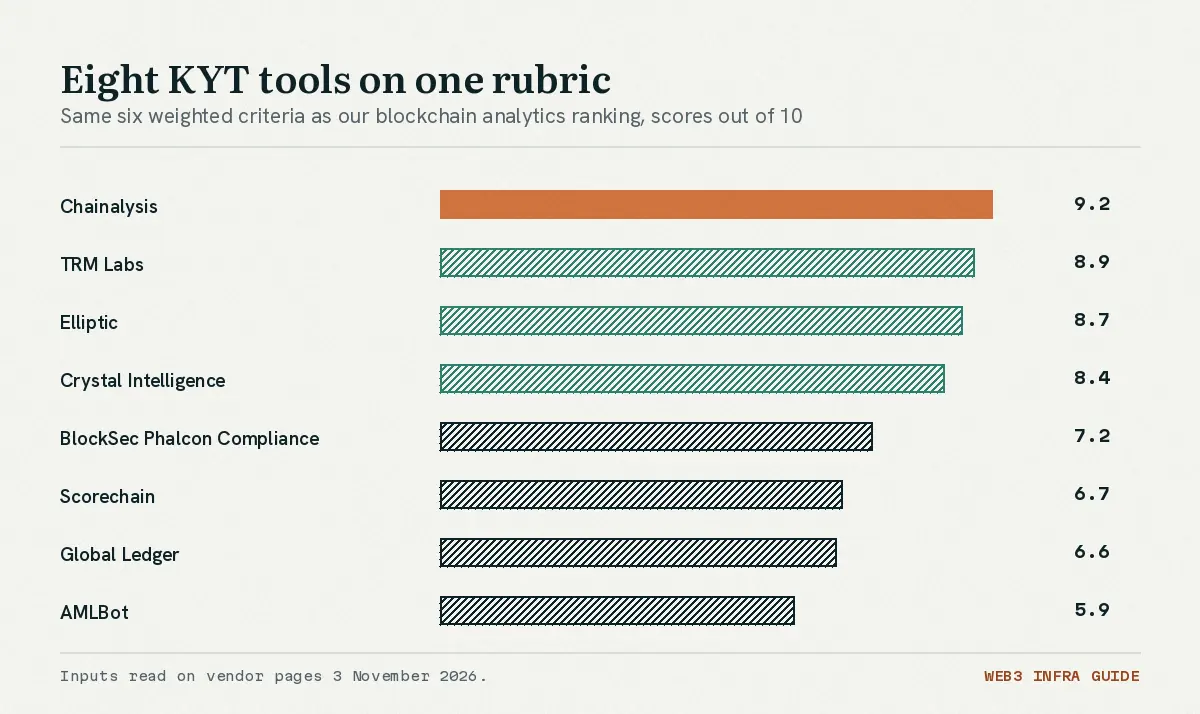
Each tool gets 0 to 5 on six criteria: chain coverage (20%), attribution data (20%), compliance workflow (20%), investigations (15%), security attestations and deployment (15%) and price transparency (10%). These are the same weights and inputs as our analytics ranking, so a tool scores the same here as there; nothing changed on the vendor pages we rechecked today. Merkle Science is in that ranking but not here, because its monitoring product page returned a 404 today and it publishes no KYT price.
1. Chainalysis KYT: 9.2/10
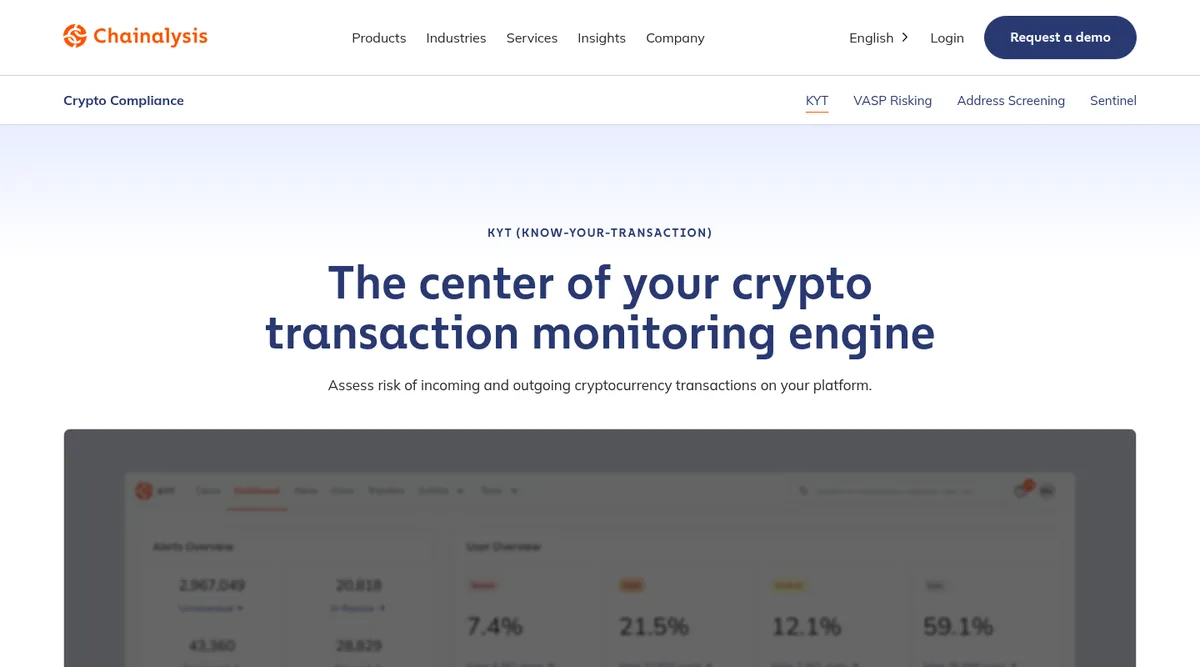
Chainalysis KYT is the benchmark every other tool in this list gets compared with. Its KYT FAQ says it supports 400+ networks and 50M+ tokens. Chainalysis says KYT monitors activity in real time and generates alerts within seconds of a transaction occurring on-chain.
- Rules: behavioural alerts, direct and indirect exposure alerts, custom groups, and thresholds on the share of funds exposed to high-risk categories.
- Sanctions: monitors exposure to sanctioned entities both before and after sanctions are imposed.
- Pre-screen: Address Screening runs through a low-latency API for real-time checks, with automatic alerts in the UI when a risk changes.
- Security and price: SOC 2 Type 2 and FedRAMP on its platform page; no public price.
Verdict: The safest pick when a bank partner or examiner expects the market default. Budget for a quote and ask how many of your chains get full KYT, not just screening.
2. TRM Labs: 8.9/10
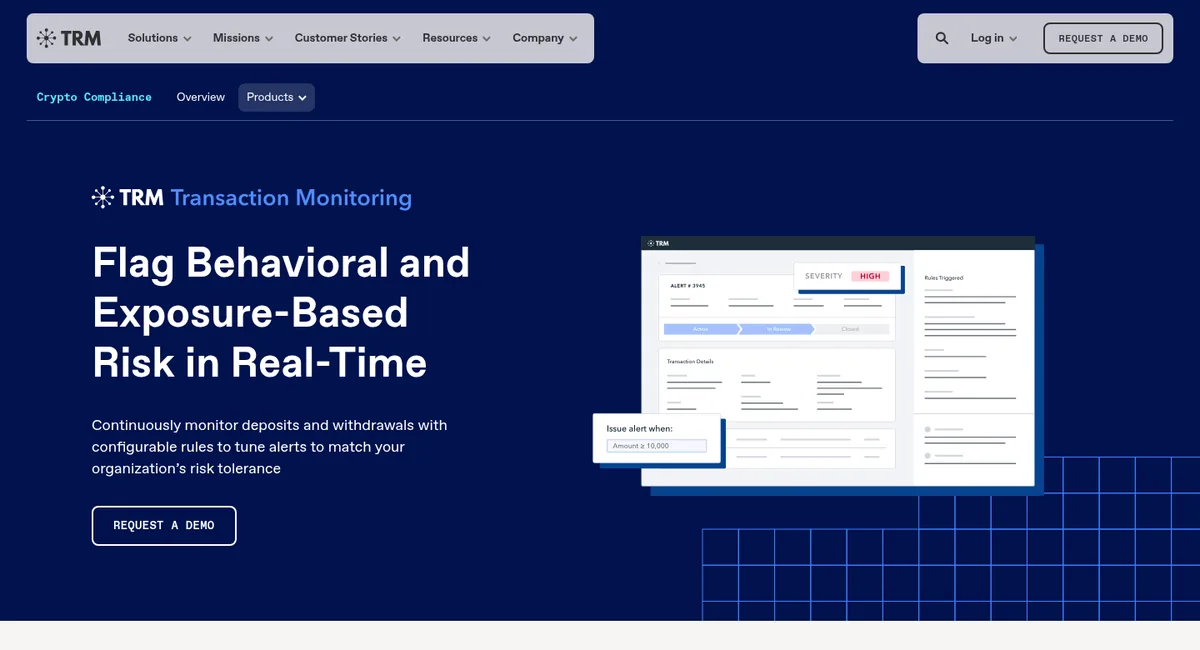
TRM Labs splits KYT into Transaction Monitoring for deposits and withdrawals and Wallet Screening for pre-screening addresses. Wallet Screening covers 1.9B+ digital assets across 184+ blockchains. Of the four enterprise vendors, TRM is the only one whose pages we read publish an API speed: submit a wallet address and receive results in under 400 milliseconds.
- Rules: multi-condition rules on amount, aggregation to a category, velocity, blockchain and counterparty risk indicators.
- Workflow: review and close alerts in TRM’s case management, or pull results into your own system through the API.
- Reliability: a stated 99.95% uptime SLA and an annual SOC 2 audit.
- Price: quote only.
Verdict: The best fit when withdrawal latency matters and you want screening and monitoring on one graph. Test the 400 millisecond claim on your own peak traffic.
3. Elliptic Lens: 8.7/10
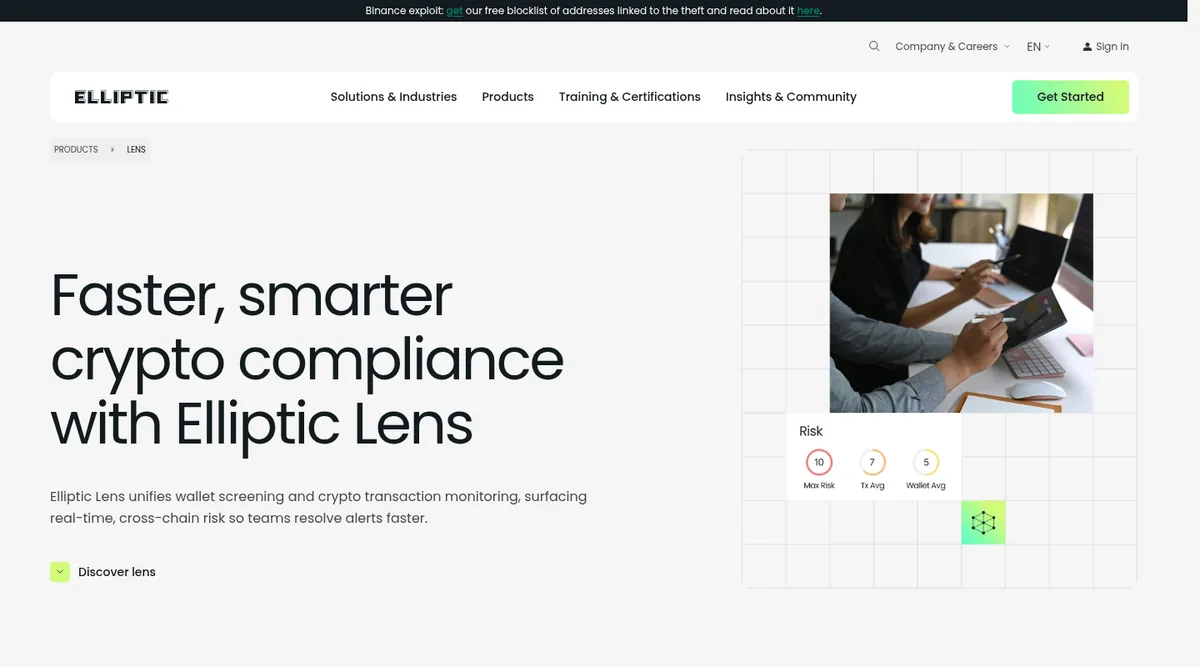
Elliptic puts KYT in Lens, one workspace for wallet screening and transaction monitoring across 60+ blockchains and 250+ bridges. Lens says you can screen a wallet before you onboard a customer or process a withdrawal, then re-screen it automatically when new risk appears. It is the only top-tier KYT product with a list price: $50,000 per unit a year on Tier 1 or $100,000 on Tier 2 through AWS Marketplace.
- Rules: set your own risk rules for a consistent, explainable score, with configurable alerts.
- Security: the trust page lists a SOC 2 Type 2 report and ISO 27001.
- Units: the AWS listing sells an annual subscription priced per unit, so ask how many units your screening volume needs.
- Budget line: one Tier 1 unit is about $4,167 a month.
Verdict: The pick for banks and custodians that need a known budget line and audit-ready rules. Get the unit count in writing before you buy.
4. Crystal Intelligence: 8.4/10
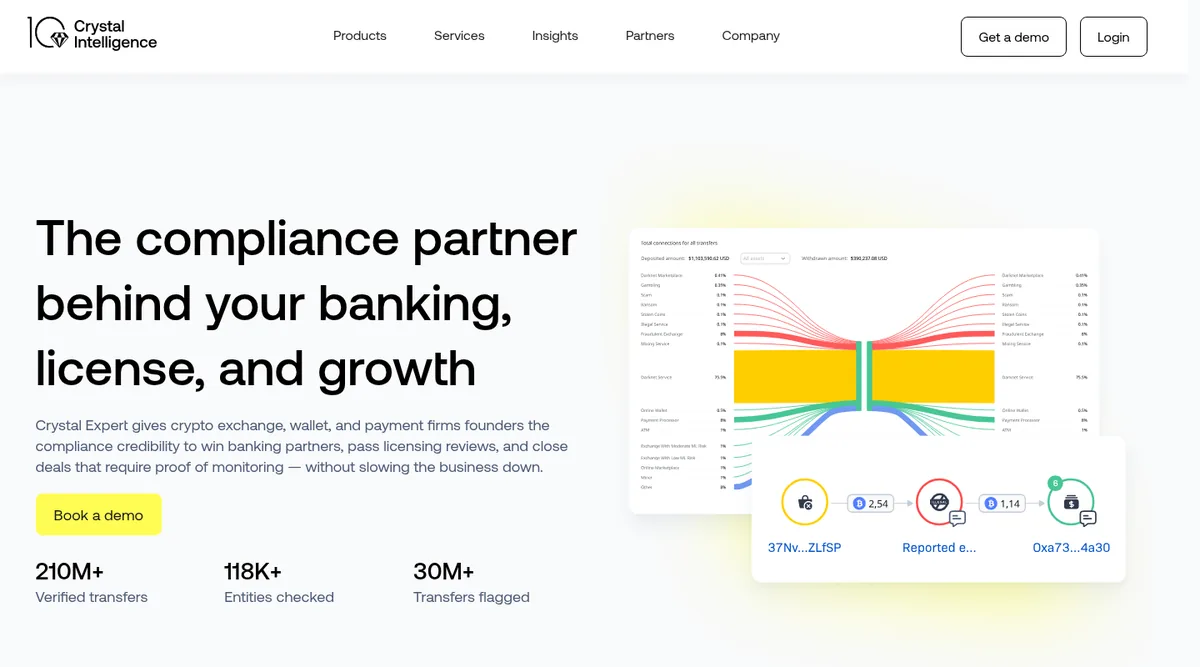
Crystal Expert is Crystal’s KYT product for exchanges, wallets and payment firms. It says it screens every deposit and withdrawal in real time across the blockchains your business handles, with wallets attributed by Crystal’s analysts. Crystal states real-time KYT across 330+ blockchains, second only to the 400+ networks Chainalysis lists, with wallet and counterparty risk scored in seconds.
- Scale: the home page cites 210M+ verified transfers and 118K+ attributed entities.
- Security: SOC 2 Type II, GDPR compliance, EU data residency, and SSO and SAML.
- Check depth: on 330+ chains, ask which get full attribution and scoring rather than bare address lookup.
- Price: quote only.
Verdict: The KYT engine to test when your long-tail chains are the problem. Run it on the exact assets you list before you sign.
5. BlockSec Phalcon Compliance: 7.2/10
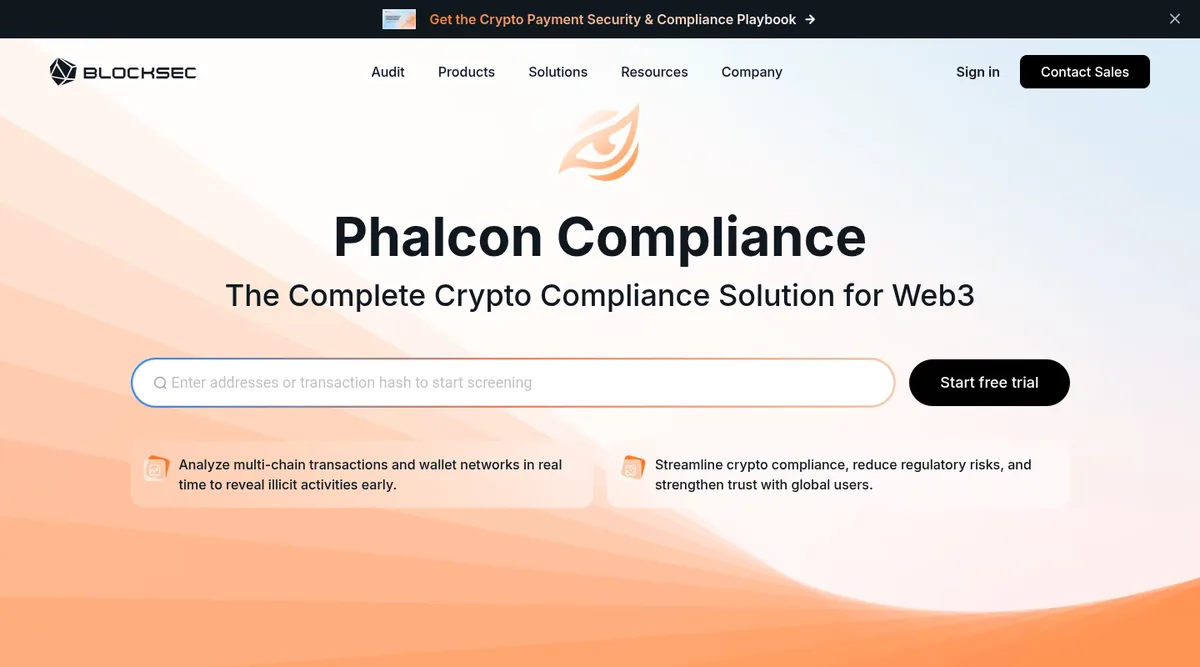
Phalcon Compliance is the self-serve option from a security firm. It covers screening, monitoring, investigation and reporting, and cites 600M+ address labels drawn from 200+ risk signals. Phalcon has the lowest pay-as-you-go entry price among the eight, from $0.10 a check, with 3 free risk check credits when you sign up.
- Payments fit: detects high-risk deposits in real time and screens withdrawal addresses before payout.
- Reporting: one-click STR and SAR exports for regulators.
- Investigations: pairs with BlockSec’s MetaSleuth tracer.
- Security: no SOC 2 or ISO certificate stated on the pages read.
Verdict: A strong start for payment companies and wallets that want to go live without a sales call. Ask for security documents if a bank partner will review your vendors.
6. Scorechain: 6.7/10
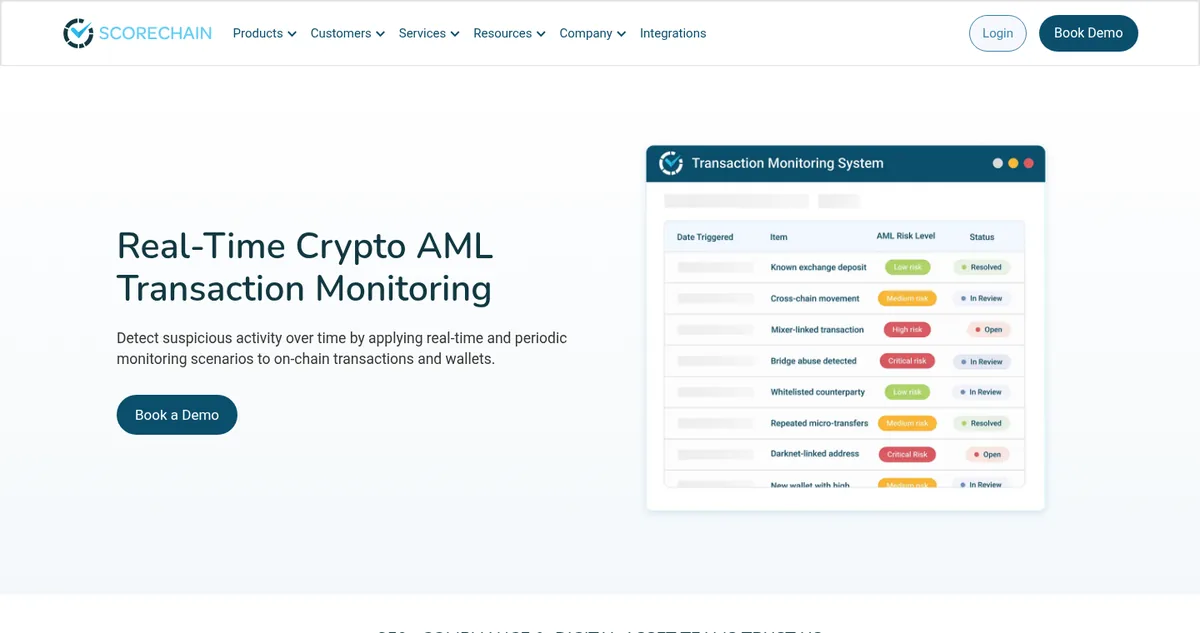
Scorechain’s Transaction Monitoring applies real-time and periodic monitoring scenarios to on-chain transactions and wallets. It is the EU-hosted option: Scorechain runs a private cloud hosted in the EU and says it is designed to meet MiCA requirements. Its pages give two coverage figures, 25+ blockchains on the monitoring page and 21+ on the home page and free API page.
- Customisation: you can adapt scenarios, indicators, scoring and alerts.
- Due diligence: 2,800+ VASP due-diligence profiles.
- Free tier: a sanctions API for non-commercial use, 100 requests an hour, no SLA.
- Price: platform on quote.
Verdict: The pick for EU CASPs on major chains that want EU hosting. Confirm which coverage figure applies to full monitoring.
7. Global Ledger: 6.6/10
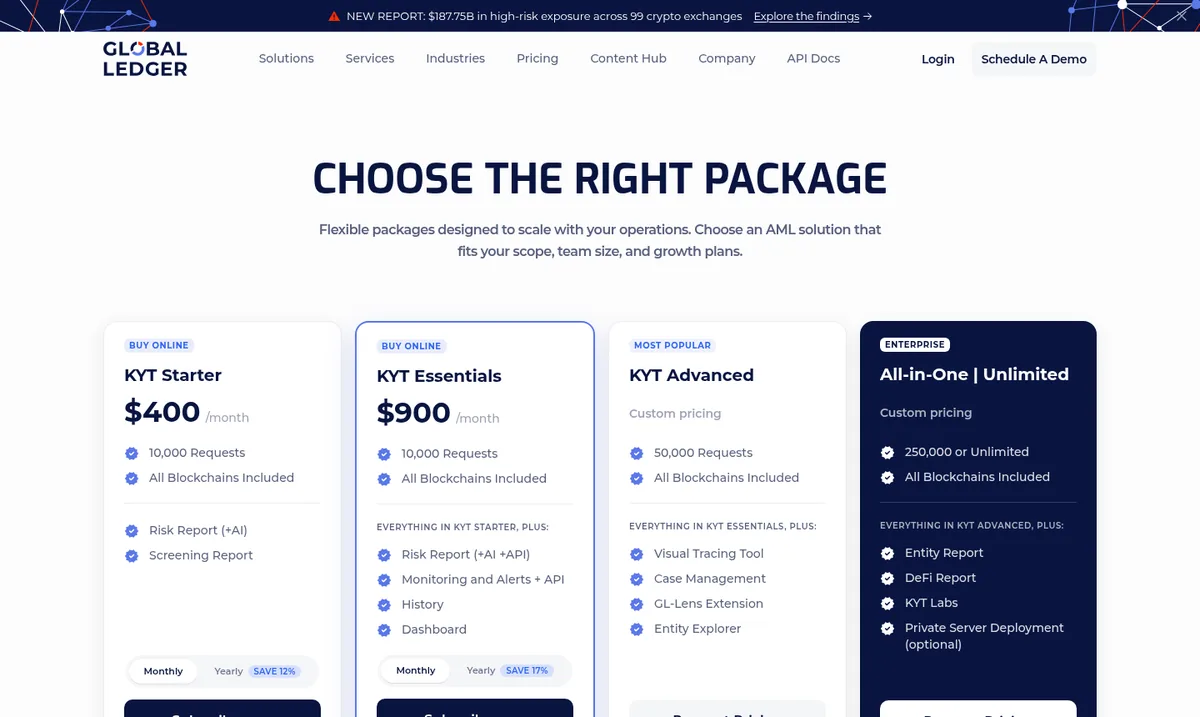
Global Ledger sells flat monthly KYT plans online, which none of the enterprise vendors do. KYT Starter costs $400 a month and KYT Essentials $900, each for 10,000 requests across all the blockchains it supports. Read the plan table closely: Starter has no API, and monitoring with alerts, the API and history start on Essentials.
- Higher tiers: KYT Advanced (custom price, 50,000 requests) adds visual tracing and case management; Enterprise adds private server deployment and KYT Labs, a sandbox for testing alert rules without touching live systems.
- Speed and scale: an average response time of 500 milliseconds and 40K+ AML checks a day, per its pricing page.
- Discount: yearly billing saves 12% on Starter and 17% on Essentials.
- Coverage: Bitcoin, Ethereum, Tron and other major chains across support tiers; ask sales for the full list.
Verdict: The cheapest way to put real KYT in a payment flow under 10,000 checks a month. Choose Essentials if you need the API, which most production flows do.
8. AMLBot: 5.9/10
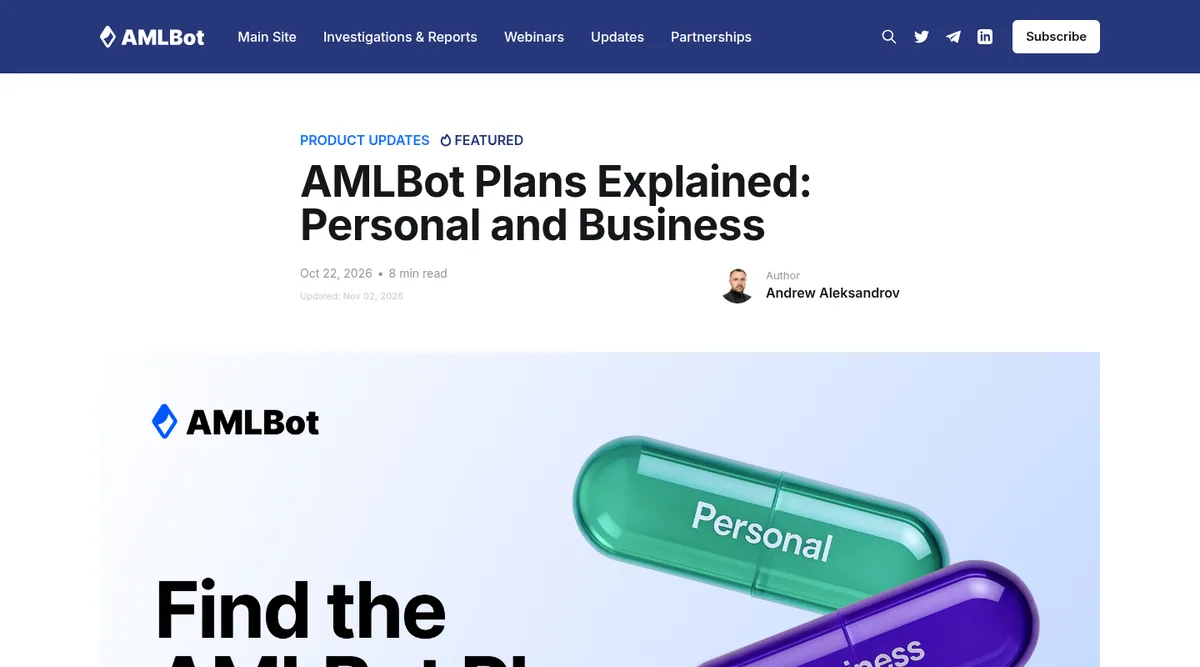
AMLBot sells AML and KYT checks in two plans. On Personal, one standard check costs 1 credit, and credits run from $1 down to $0.10 depending on bundle size. KYT proper, with the API, real-time transaction monitoring and behavioural alerts, sits on the Business plan, which is priced on request.
- Chains: Personal names Bitcoin, Ethereum, BNB Chain, TRON, Polygon, Arbitrum, Base, Avalanche and Optimism; TON and Litecoin need Business.
- Delivery: check results in Web, PDF, API and webhook formats.
- Security: ISO 27001 certification on its home page.
- Extras: a Travel Rule Suite was recently added.
Verdict: Good for spot checks and small teams on Personal credits. For automated KYT you are buying Business, so get that quote before you compare.
How Fast KYT Answers
Speed matters most on withdrawals, where the user waits while you screen. Three vendors put a clear number on wallet screening: TRM under 400 milliseconds for wallet screening, Global Ledger a 500 millisecond average, and Alpha AML, which we did not rank, about 2.5 seconds. Chainalysis and Crystal say seconds without a figure.
Didit, also unranked, says wallet screening adds about 200 milliseconds to its transaction check.
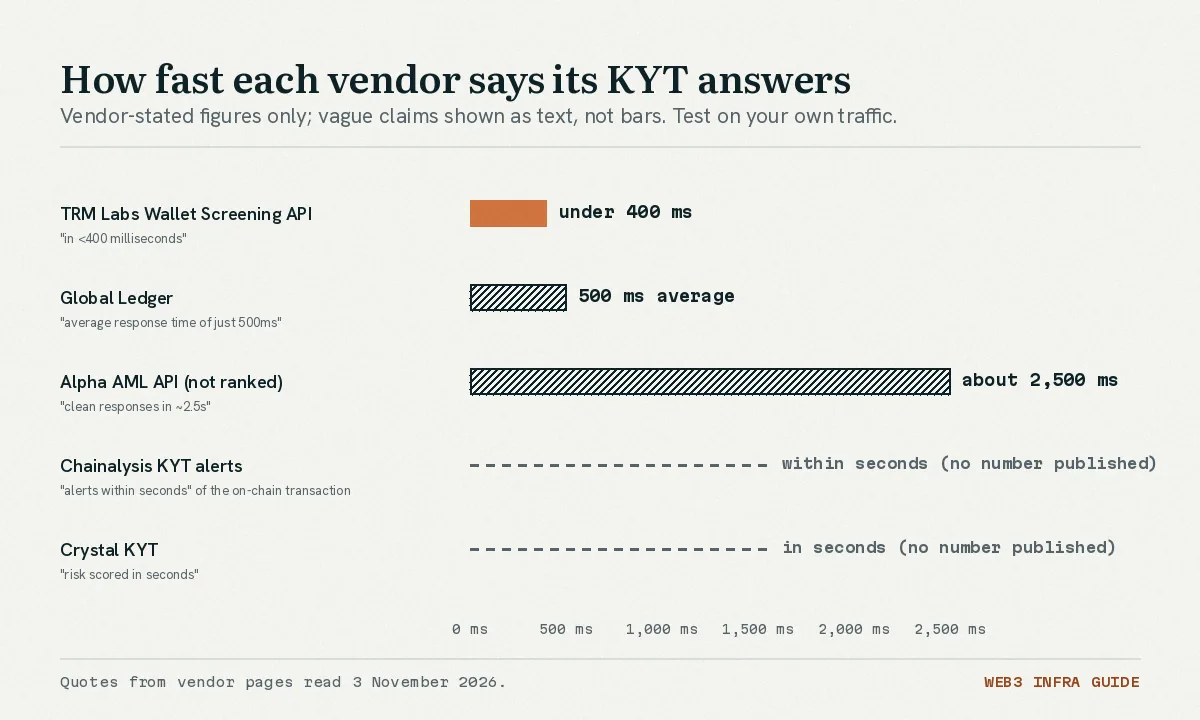
Treat these as marketing claims until you measure them. Send the same 1,000 recent withdrawal addresses through each trial account and record the 50th and 95th percentile response times at your peak hour. A tool that averages 500 milliseconds but spikes to several seconds at the 95th percentile will still stall a payout queue.
Verdict: If you pre-screen withdrawals in the user’s path, shortlist the vendors that publish a speed and measure the 95th percentile yourself.
What KYT Costs at Published Prices
Chainalysis, TRM Labs and Crystal publish no price, so we leave out the unverified annual ranges some articles print. Seven offers publish a per-check or plan price, from $1.00 down to $0.04 a check, and Elliptic publishes a unit price on AWS. The chart shows the range for each, including three tools we did not score.
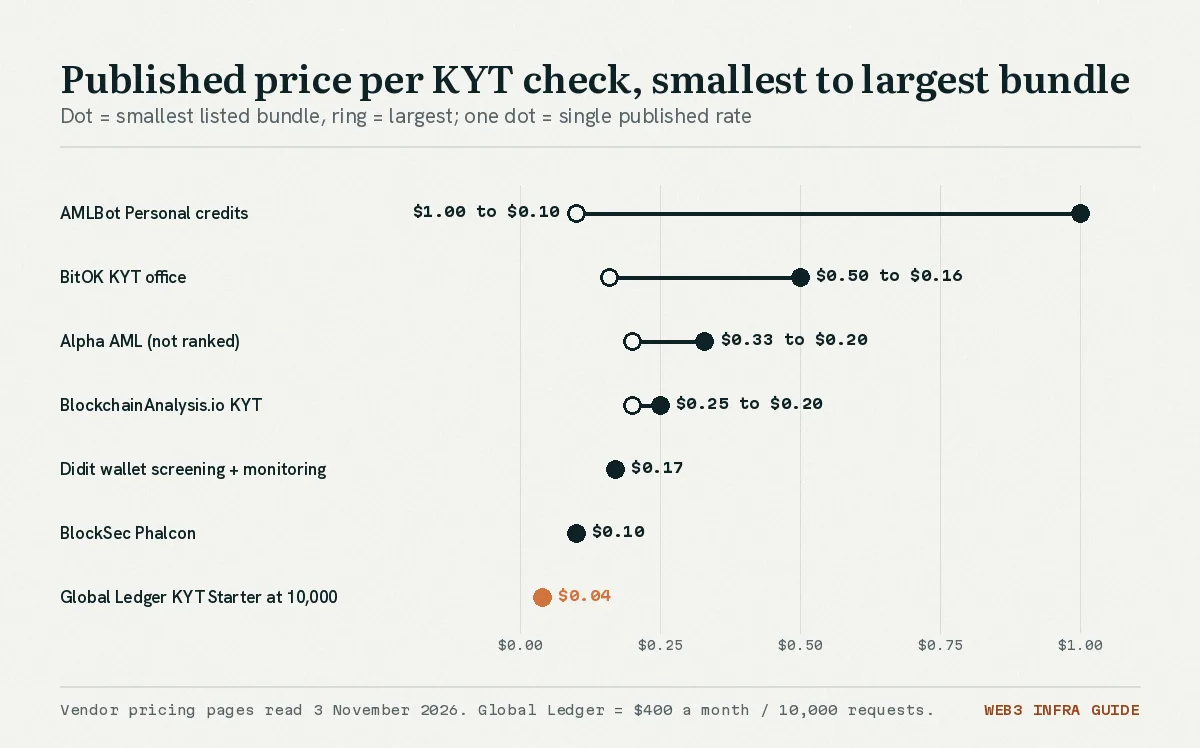
| Offer | Published price | 1,000 checks a month | 5,000 checks a month | 10,000 checks a month |
|---|---|---|---|---|
| Global Ledger KYT Starter | $400 a month, 10,000 requests | $400 | $400 | $400 |
| Global Ledger KYT Essentials | $900 a month, 10,000 requests, API | $900 | $900 | $900 |
| BlockSec Phalcon | From $0.10 a check | $100 | $500 | $1,000 |
| Didit (not ranked) | $0.02 a transaction plus $0.15 a wallet screen | $170 | $850 | $1,700 |
| BlockchainAnalysis.io KYT (not ranked) | $215 per 1,000; $999 per 5,000 | $215 | $999 | $1,998 (two 5,000 packs) |
| BitOK KYT office (not ranked) | $1,000 per 2,000 down to $0.16 at 200,000 | $1,000 (smallest pack) | $2,300 | $4,200 |
| Elliptic Lens on AWS | $50,000 per Tier 1 unit a year | About $4,167 per unit | About $4,167 per unit | About $4,167 per unit |
Three break-even points fall out of this table. Global Ledger Starter at $400 beats Phalcon’s $0.10 above 4,000 checks a month, beats Didit’s combined $0.17 above about 2,350, and beats BitOK’s smallest pack at any volume up to its 10,000-request cap. Essentials at $900 beats $0.10 a check only above 9,000 checks, so most buyers pay for it to get the API and alerts, not the unit price. At 10,000 checks a month all year, Starter costs $4,800, against $50,000 for one Elliptic Tier 1 unit.
These are list prices for the check itself. Analyst time on false positives usually costs more than the licence, so compare alert rates on the same traffic before you pick the cheapest line. Small teams asking on r/fintech about affordable KYT got replies naming Chainalysis, TRM Labs, Sumsub, Notabene and Nominis, and none of them quoted a price.
Verdict: Under 4,000 checks a month, pay per check. Between 4,000 and 10,000, Global Ledger is cheapest if it covers your chains. Above that, every serious option is a quote.
How to Test a KYT Tool Before You Sign
Never pick a KYT tool from a demo. Replay your own history through a trial account and compare the result with what your current process decided. The checklist below is what a bank partner or examiner will ask you to show anyway.
- Export 90 days of deposits and withdrawals, including every transfer you held, blocked or reported.
- Send each vendor your chain and token list and get a yes or no per chain at full KYT depth.
- Replay the history through each trial and record alerts, scores and response times.
- Count alerts per 1,000 transfers and the share an analyst would clear as false positives.
- Check that new sanctions designations flag within the vendor’s stated window.
- Confirm every alert exports with its reasons, rule version and timestamps.
| Check | Pass if | Why it matters |
|---|---|---|
| Chain match | Every chain you support gets full KYT | A missing chain is a blind spot in your control |
| Known bad hits | Every transfer you blocked before also flags | Proves the data sees the same exposure |
| False positives | Analyst hours per 1,000 transfers stay flat or fall | A cheaper licence can cost more in staff time |
| Withdrawal latency | 95th percentile fits your payout queue | Slow checks stall the user at the worst moment |
| Evidence export | Alerts export with reasons and rule versions | Examiners ask why a transfer passed |
Verdict: The vendor that matches your past blocks with the fewest false positives wins, even at a higher list price.
Which KYT Tool Fits Your Business
Match the tool to your licence, your volume and your chains. Many regulated firms run one enterprise KYT engine and keep a published-price tool for second opinions. For the wider stack, including Travel Rule messaging and VASP due diligence, see our crypto compliance tools guide; treasury teams can compare payout and wallet platforms in our crypto treasury management guide.
| Business | First choice | Add | Why |
|---|---|---|---|
| Licensed exchange or broker | Chainalysis KYT or TRM Labs | Crystal for long-tail chains | Market-default data, published or audited security |
| Custodian or bank | Elliptic Lens | Chainalysis or TRM | AWS list price, SOC 2 Type 2 and ISO 27001 |
| EU CASP on major chains | Scorechain | Crystal | EU hosting or EU data residency stated |
| Payment company or wallet | Global Ledger Essentials | BlockSec Phalcon | Published prices, API and pre-payout screening |
| Small team or spot checks | AMLBot Personal or Phalcon | Scorechain free sanctions API | Per-check credits with no contract |
Verdict: Licensed firms buy Chainalysis, TRM Labs or Elliptic. Payment firms and wallets should start with Global Ledger or Phalcon and move up when volume or examiners require it.
Final Verdict
Chainalysis KYT remains the reference engine, TRM Labs is the one to pick when withdrawal speed matters, and Elliptic Lens is the only top-tier tool with a price you can budget before talking to sales. For teams below 10,000 checks a month, Global Ledger and BlockSec Phalcon make real KYT affordable on published prices.
- Chainalysis KYT (9.2): 400+ networks and alerts within seconds.
- TRM Labs (8.9): under 400 millisecond screening on 184+ blockchains.
- Elliptic Lens (8.7): $50,000 per unit a year on AWS, SOC 2 Type 2 and ISO 27001.
- Global Ledger (6.6): $400 or $900 a month for 10,000 requests.
Verdict: Buy KYT for where it sits in your flow: an enterprise engine if an examiner reads your logs, a published-price tool if you are still small, and always pre-screen withdrawals.
Frequently Asked Questions
What is a KYT tool in crypto?
A KYT (Know Your Transaction) tool scores crypto deposits and withdrawals for exposure to sanctioned, stolen or high-risk funds. It screens addresses before you send, scores incoming transfers before you credit them, raises alerts when rules fire and keeps an audit trail. Vendors include Chainalysis, TRM Labs, Elliptic and Crystal.
What is the best KYT tool in 2026?
Chainalysis KYT scores highest in our ranking at 9.2 out of 10, covering 400+ networks with alerts within seconds. TRM Labs follows at 8.9 with under 400 millisecond wallet screening on 184+ blockchains, and Elliptic Lens at 8.7 is the only top-tier tool with a public list price on AWS Marketplace.
How much does KYT cost?
Chainalysis, TRM Labs and Crystal quote privately. Published prices on 3 November 2026 include Global Ledger KYT Starter at $400 a month for 10,000 requests, BlockSec Phalcon from $0.10 a check, AMLBot credits from $1 down to $0.10, and Elliptic Lens at $50,000 per unit a year on AWS Marketplace.
What is the difference between KYT and wallet screening?
Wallet screening checks one address, usually before you send funds or onboard a user. KYT is wider: it scores each transaction, follows direct and indirect exposure, applies behaviour rules such as velocity and amount, and keeps monitoring over time. Most vendors sell both, and production flows normally use the two together.
Is there a free KYT tool?
Not for production compliance. Scorechain offers a free sanctions API for non-commercial use, limited to 100 requests an hour with no SLA, and BlockSec gives 3 free risk check credits at sign-up. These suit testing. A regulated business needs a paid KYT tool with rules, alerts and an exportable audit trail.
How fast should a KYT check be?
Fast enough not to stall withdrawals at peak traffic. TRM Labs states under 400 milliseconds for wallet screening and Global Ledger a 500 millisecond average, while Chainalysis and Crystal say seconds. Measure the 95th percentile response time on your own traffic during a trial, because averages hide the slow checks.