
Last updated: 25 October 2026 · Prices, method costs, quotas and benchmark figures rechecked on vendor pages on 25 October 2026
The best Infura alternatives in 2026 are Chainstack for overall value, Alchemy for its free tier and developer tooling, and dRPC for the cheapest flat meter. We ranked eight providers on the same six weighted criteria as our main RPC ranking, priced three Ethereum and L2 workloads on every meter, and mapped what changes when you leave Infura’s daily credit quota.
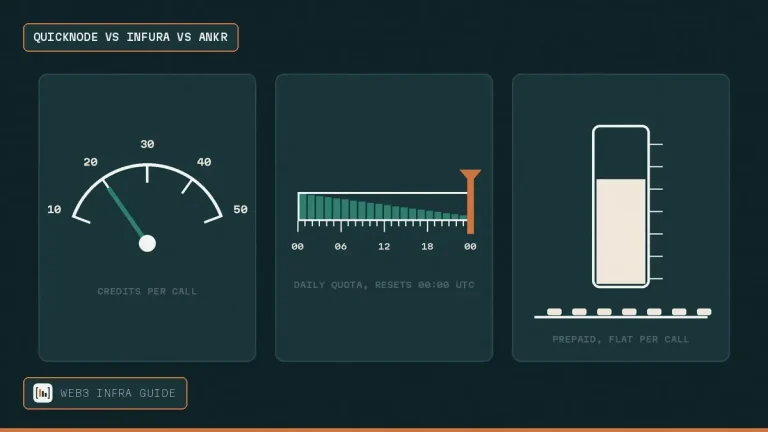
Most teams start looking for Infura alternatives when the daily quota bites. Infura bills 80 credits for a standard call and 255 for eth_getLogs, and once a day’s credits run out it returns 402 errors and drops WebSocket connections until the reset. This guide expands the Infura entry in our ranking of the 12 best RPC node providers, and our methodology page explains how we collect prices and screenshots. If Alchemy is also on your list, our Alchemy alternatives guide covers the same providers from the other side, and our QuickNode vs Alchemy vs Chainstack comparison puts the top three side by side.
TL;DR
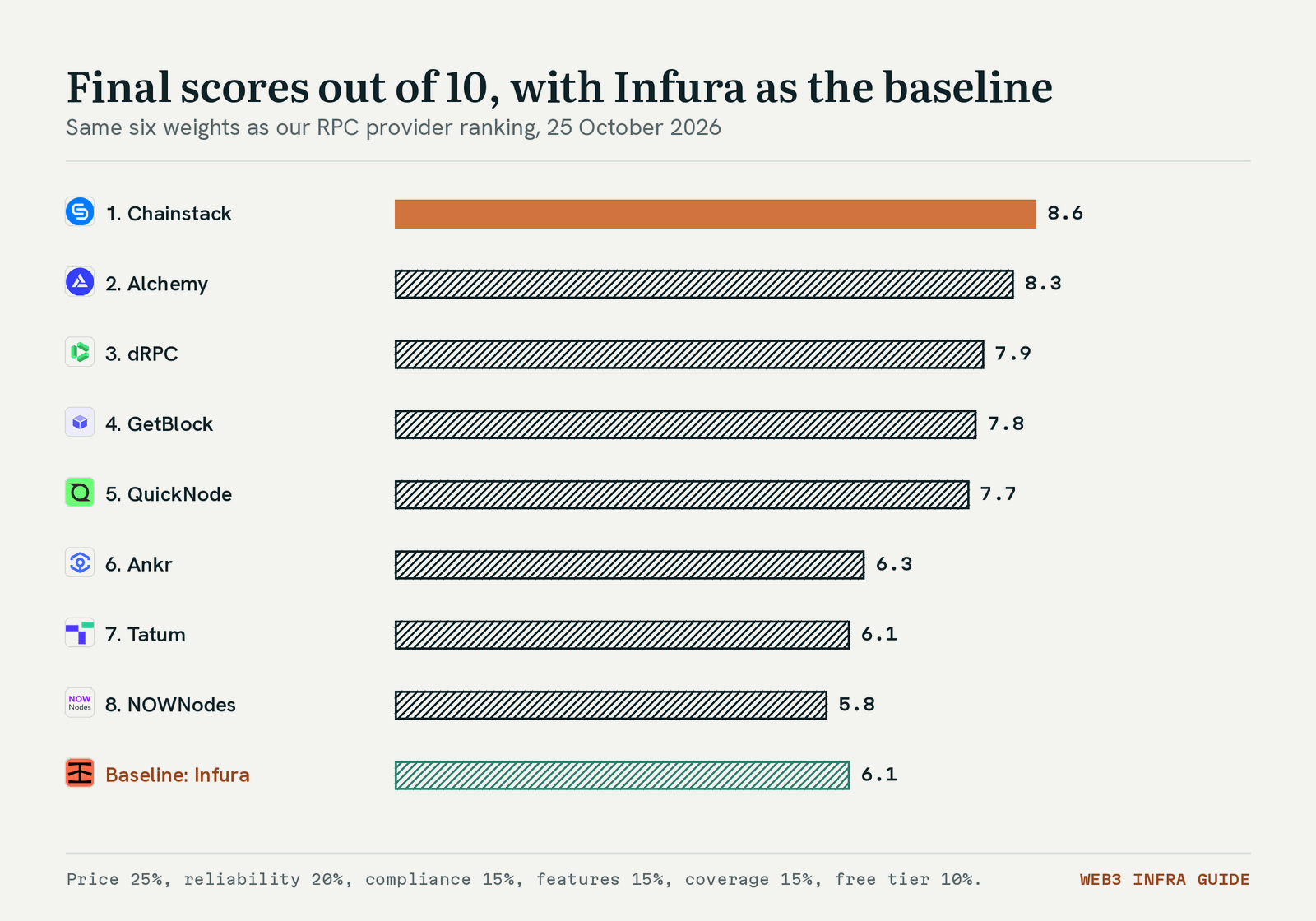
- Overall: 1. Chainstack (8.6), 2. Alchemy (8.3), 3. dRPC (7.9), 4. GetBlock (7.8), 5. QuickNode (7.7), 6. Ankr (6.3), 7. Tatum (6.1), 8. NOWNodes (5.8). Infura scores 6.1 on the same weights.
- Fully used, Infura Developer costs $8.89 per million
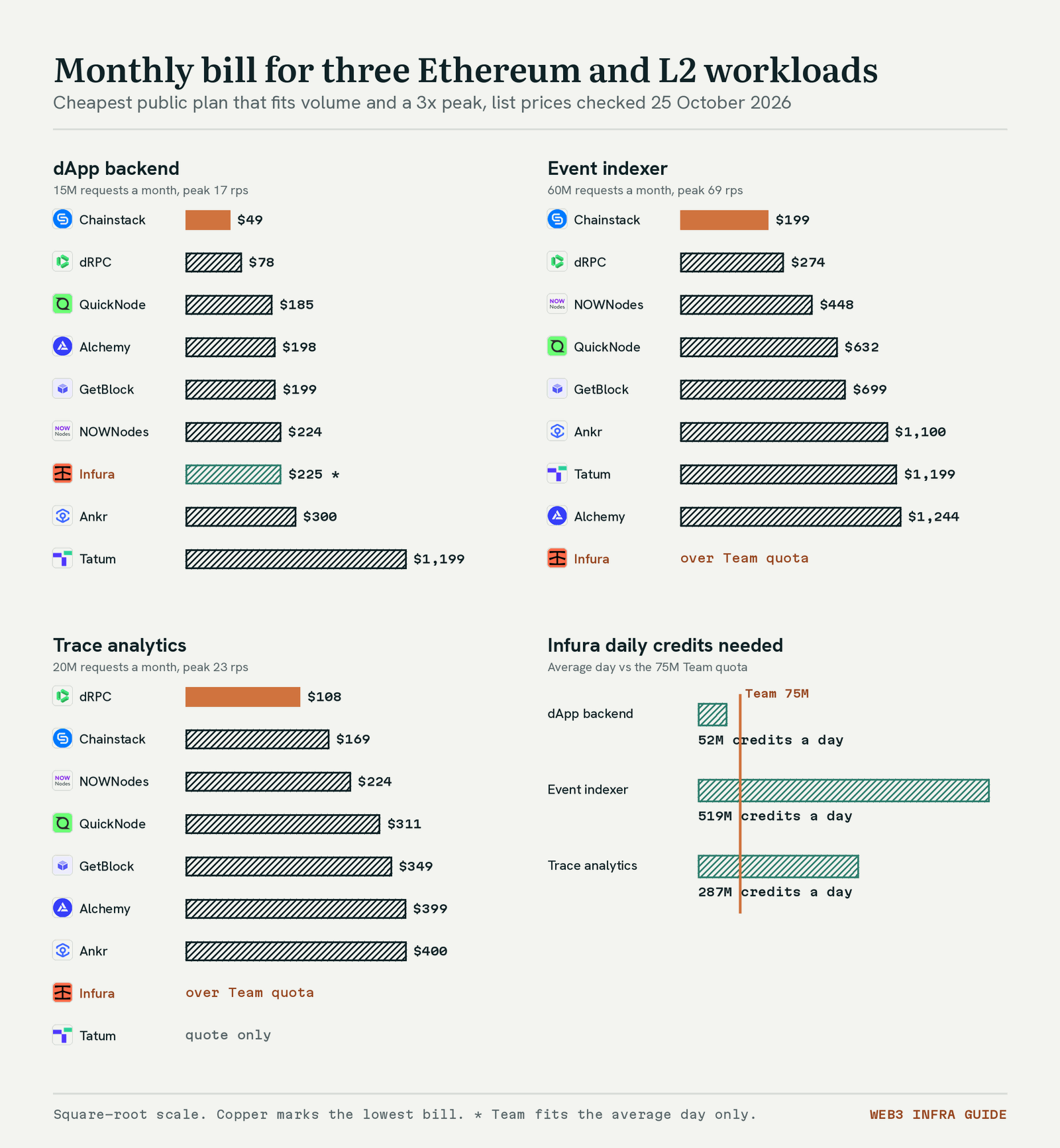
eth_call, $28.33 per millioneth_getLogsand $111.11 per million debug traces. Chainstack Growth costs $2.45, $2.45 and $4.90. - Our 15M-request dApp backend fits Infura Team at $225 on an average day but needs about 79M credits on a busy day, above the 75M quota. The same traffic costs $49 on Chainstack and $78 on dRPC.
- A 60M-request event indexer needs about 519M Infura credits a day, roughly seven times the Team quota. Chainstack Pro covers it for $199 a month.
- The L2 you run on changes two bills: GetBlock charges 80 CU per call on ZKsync and 100 on Scroll against 20 on Ethereum, and QuickNode 30 credits against 20.
- On OpenChainBench’s keyed runs read 25 October 2026, QuickNode had the lowest warm median on Ethereum, Base and Arbitrum, between 5.4 and 6.6 ms. Infura is not in that benchmark.
The Decision Kernel
Pick the replacement by the reason you are leaving. A team hitting the daily quota needs a monthly meter and a team paying 255 credits per log query needs a flat meter. Export one week of Infura usage by method and network before you compare any plan. The shortcuts below cover the common cases.
- Lowest bill with audits: Chainstack, which charges 1 request unit for most Ethereum calls and states SOC 2 Type II and ISO 27001.
- Free tier and tooling: Alchemy, with 30M compute units a month free and a SOC 2 Type II trust page.
- Cheapest log-heavy and trace-heavy traffic: dRPC, which bills every method at a flat 20 compute units.
- Lowest measured latency: QuickNode on warm connections and GetBlock on cold starts, per OpenChainBench on 25 October 2026.
- Widest audit set: QuickNode, which lists SOC 1 Type 2, SOC 2 Type 2 and ISO 27001.
- Simple per-request billing in euros: NOWNodes, where every call counts as one request.
Verdict: Chainstack for most Ethereum and L2 teams, dRPC when the bill is driven by logs and traces, QuickNode when latency and audits matter more than price. Keep a second endpoint either way.
How We Ranked the Infura Alternatives
We scored each provider from 1 to 5 on six criteria, weighted them and doubled the total. The weights and scores match our 12-provider RPC ranking, so Infura sits on the same scale as its rivals. Every price, quota and audit claim links to a vendor page checked on 25 October 2026. The full process is on our methodology page.
- Price per call, 25%: the monthly bill for Ethereum and L2 method mixes, converted from each vendor’s billing unit.
- Reliability, 20%: public latency benchmarks, uptime claims and support response targets.
- Compliance, 15%: SOC 2, ISO 27001 and other audits stated on the vendor’s own pages.
- Features, 15%: debug and trace APIs, archive data, WebSockets, dedicated nodes and data APIs.
- Coverage, 15%: Ethereum L2s and other chains on one account.
- Free tier, 10%: how many Ethereum calls a team can make before paying.
| Provider | Price (25%) | Reliability (20%) | Compliance (15%) | Features (15%) | Coverage (15%) | Free tier (10%) | Score |
|---|---|---|---|---|---|---|---|
 | 5 | 4 | 5 | 4 | 4 | 3 | 8.6 |
 | 3 | 4 | 4 | 5 | 5 | 5 | 8.3 |
 | 5 | 4 | 2 | 3 | 5 | 4 | 7.9 |
 | 3 | 5 | 4 | 4 | 5 | 2 | 7.8 |
 | 3 | 4 | 5 | 5 | 4 | 2 | 7.7 |
 | 2 | 3 | 4 | 3 | 4 | 4 | 6.3 |
 | 1 | 3 | 5 | 4 | 5 | 1 | 6.1 |
 | 4 | 3 | 1 | 2 | 5 | 1 | 5.8 |
 | 4 | 3 | 1 | 3 | 3 | 4 | 6.1 |
Why Teams Move Off Infura
Infura is a long-running Ethereum API with a fair free tier and 25 mainnets on its endpoints list. Its pricing has three traits that push growing teams elsewhere. The quota resets daily, so one busy day can stop your app even when the monthly total is fine. The credit cost table also weights log, trace and receipt calls heavily.
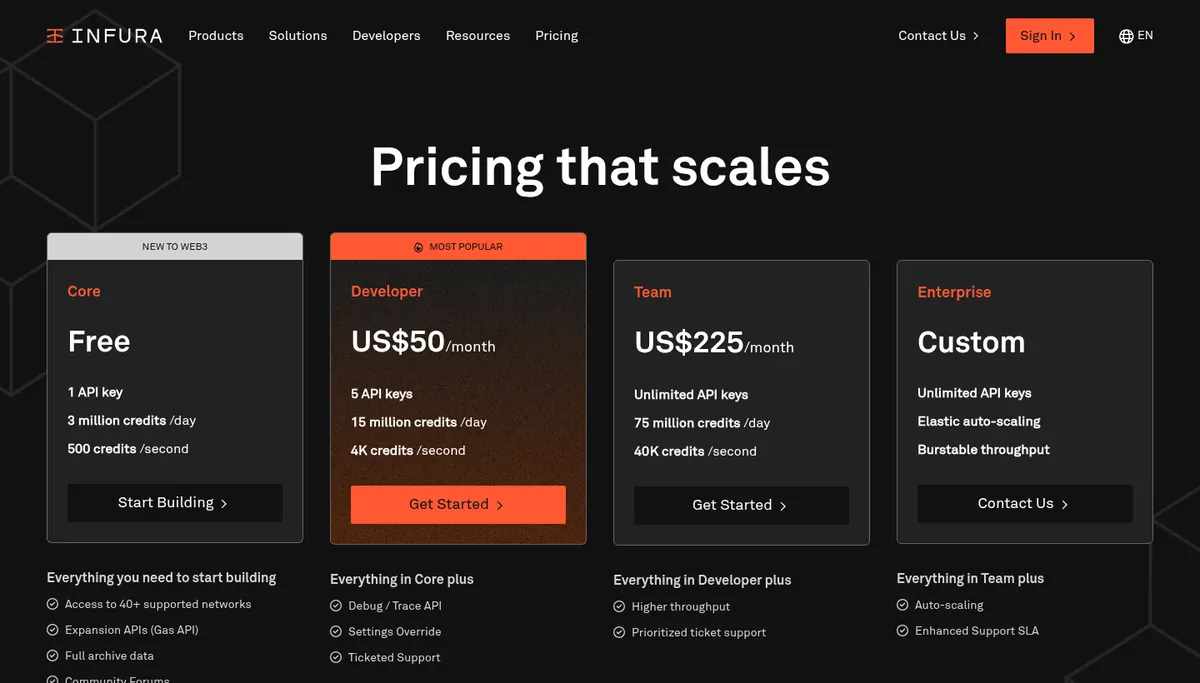
- Plans: Core free (3M credits a day, 500 credits per second), Developer $50 a month (15M a day, 4,000 per second), Team $225 (75M a day, 40,000 per second), Enterprise custom. An add-on sells 55M more credits for $200 a month.
- Method weights: 80 credits for
eth_call,eth_getBalanceand most reads, 255 foreth_getLogs, 300 foreth_estimateGasandtrace_*, and 1,000 foreth_getBlockReceiptsanddebug_*. - At the limit: requests past the daily quota return unbilled 402 errors, and WebSocket connections are severed until the quota resets.
- Gaps: Debug and Trace start on Developer, Solana access is for select customers only, and we found no SOC 2 or ISO 27001 report on Infura’s pages.
Verdict: Infura still suits low-volume Ethereum apps that fit the 3M daily credits on Core. Apps with heavy logs, traces or uneven daily traffic pay more on Infura than on any monthly meter below.
Infura Alternatives at a Glance
The table lines up each provider’s billing unit, what an eth_call and an eth_getLogs cost in that unit, the entry paid plan and its throughput. Prices are monthly list prices from each pricing page on 25 October 2026, before annual discounts.
| Provider | Billing unit | eth_call / eth_getLogs | Entry paid plan | Rate limit |
|---|---|---|---|---|
| Credits per day | 80 / 255 | Developer $50: 15M credits a day | 4,000 credits per second |
| Request units (RU) | 1 / 1, 2 for archive | Growth $49: 20M RU | 250 rps |
| Compute units (CU) | 26 / 60 | Pay as you go: $0.525 per 1M CU | 300 rps |
| Compute units | 20 / 20, 16 inside the Pro pool | Pro $49: 163M CU, about 10M requests | 300 rps |
| Compute units | 20 / 20 on Ethereum | Starter $49: 90M CU | 250 rps |
| API credits | 20 / 20 on Ethereum | Build $49: 80M credits | 50 rps |
| API credits | $0.02 per 1,000 EVM requests | Pay as you go from $10 | 1,500 rps |
| Credits | 5 / 2 | Starter $49: 4M credits | 200 rps |
| Requests | 1 / 1 | Pro €20: 1M requests | 15 rps on the free plan |
Verdict: Infura, Alchemy and Tatum are the only three meters here that charge more for a log query than for a basic read. Every other alternative bills both at the same rate on recent blocks.
What One Million Calls Cost by Method
Converting each unit to dollars shows how far apart the meters sit. We used the entry paid plan fully used, which is what a small team pays. A million debug traces cost $111.11 on Infura Developer and $4.81 on dRPC Pro. NOWNodes is converted at the ECB rate of $1.1193 per euro from 23 October 2026.
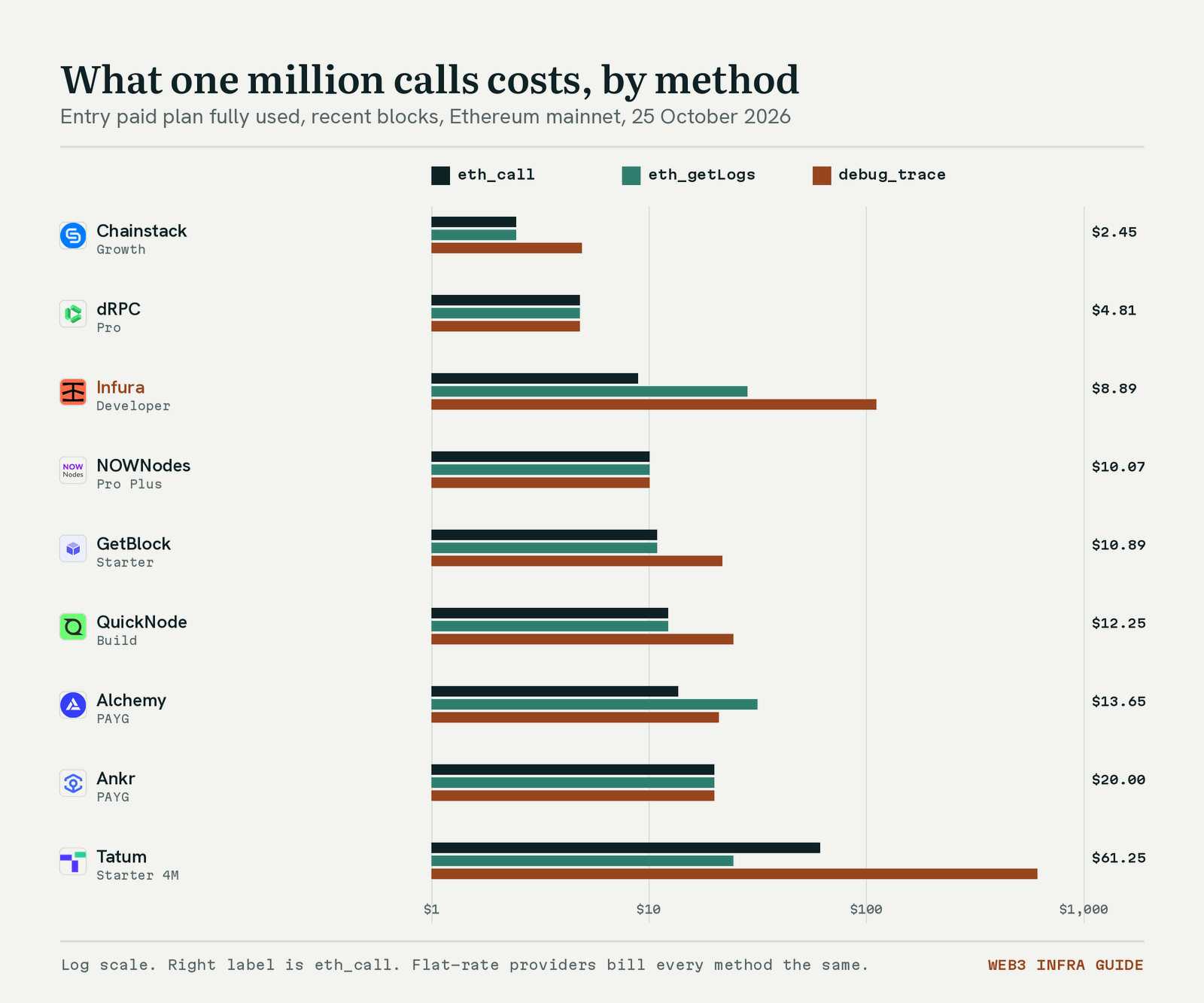
| Plan | eth_call | eth_getLogs | debug_traceTransaction | Above the allowance |
|---|---|---|---|---|
| $8.89 | $28.33 | $111.11 | None. 402 errors, or $200 for 55M credits |
| $2.45 | $2.45 | $4.90 | $15 per 1M RU |
| $13.65 | $31.50 | $21.00 | Same $0.525 per 1M CU |
| $4.81 | $4.81 | $4.81 | $6 per 1M requests |
| $10.89 | $10.89 | $21.78 | Top up CUs or change plan |
| $12.25 | $12.25 | $24.50 | $0.62 per 1M credits |
| $20.00 | $20.00 | $20.00 | Same rate, prepaid |
| $61.25 | $24.50 | $612.50 | Move up a plan |
| $10.07 | $10.07 | $10.07 | €5 per 100,000 requests |
Two caveats change these numbers for real traffic. Chainstack bills a call as archive, at 2 RU, when it targets a block 127 or more behind the tip, and it judges eth_getLogs by its fromBlock. Alchemy and Infura weight receipts and traces differently, so a mix with many eth_getBlockReceipts calls costs 1,000 credits each on Infura against 20 CU on Alchemy.
Verdict: Chainstack has the lowest included rate on every method we priced, and dRPC is the cheapest flat meter. Tatum’s 50-credit traces make it the most expensive place to run debug traffic.
What Three Ethereum and L2 Workloads Cost
We built three common method mixes across Ethereum, Base and Arbitrum, converted each into every vendor’s unit and picked the cheapest public plan that covers the volume and a peak of three times the average rate. Chainstack had the lowest bill in two of three workloads, and dRPC won the trace-heavy one at $108.
| Provider | dApp backend, 15M | Event indexer, 60M | Trace analytics, 20M |
|---|---|---|---|
| $225 (Team, busy days over quota) | Enterprise quote | Enterprise quote |
| $49 (Growth) | $199 (Pro) | $169 (Growth) |
| $198 (Pay as you go) | $1,244 (Pay as you go) | $399 (Pay as you go) |
| $78 (Pro) | $274 (Scale) | $108 (Pro) |
| $199 (Advanced) | $699 (Premium) | $349 (Scale) |
| $185 (Build) | $632 (Scale) | $311 (Accelerate) |
| $300 (Pay as you go) | $1,100 (Deal ($500)) | $400 (Pay as you go) |
| $1,199 (Scale 150M) | $1,199 (Scale 150M) | Quote, above public plans |
| $224 (Business) | $448 (Business Plus) | $224 (Business) |
- dApp backend, 15M requests: 35%
eth_call, 15%eth_getBalance, 10% each ofeth_blockNumber, receipts andeth_getLogs, and 5% each of gas estimates, sends, block reads andeth_chainId. - Event indexer, 60M requests: 50%
eth_getLogs, 25%eth_getBlockByNumber, 10%eth_getBlockReceipts, 10% receipts and 5%eth_blockNumber, all on recent blocks. - Trace analytics, 20M requests: 30%
debug_traceTransaction, 10%trace_block, 30%eth_getLogs, 20% block reads and 10% receipts.
The Infura numbers come from its daily quota. The dApp backend averages 104.8 credits per request, or about 52M credits a day, and a day at 1.5 times the average needs about 79M, above Team’s 75M. The indexer averages 519M credits a day and the trace job 287M, so both need an Enterprise deal or stacked add-ons.
Plan limits changed a few answers. Tatum needs 45.75M credits for the dApp backend, just above its 40M Pro tier, so the cheapest public fit is Scale at $1,199. A backfilling indexer that reads old blocks would pay 2 RU per call on Chainstack, which lifts its bill from $199 to $499 on Business.
Verdict: Chainstack and dRPC are the cheapest meters for every Ethereum workload we modeled. Infura’s daily quota is the binding limit well before its monthly price looks high.
L2 Coverage and Chain Multipliers
Most Infura alternatives cover the main Ethereum L2s, but two of them price L2 calls differently from Ethereum. On GetBlock, one million eth_call requests on Scroll cost five times what they cost on Ethereum. The coverage table checks eight networks against each vendor’s own chain list.
| Provider | Ethereum | Base | Arbitrum | OP Mainnet | Polygon | Linea | ZKsync Era | Scroll |
|---|---|---|---|---|---|---|---|---|
| Yes | Yes | Yes | Yes | Yes | Yes | Yes | Yes |
| Yes | Yes | Yes | Yes | Yes | Yes | Yes | Yes |
| Yes | Yes | Yes | Yes | Yes | Yes | Yes | Yes |
| Yes | Yes | Yes | Yes | Yes | Yes | Yes | Yes |
| Yes | Yes | Yes | Yes | Yes | Yes | Yes | Yes |
| Yes | Yes | Yes | Yes | Yes | Yes | Yes | Yes |
| Yes | Yes | Yes | Yes | Yes | Yes | Yes | Yes |
| Yes | Yes | Yes | Yes | Yes | Not listed | Yes | Yes |
| Yes | Yes | Yes | Yes | Yes | Yes | Yes | Not listed |
| Network | Infura credits | QuickNode credits | GetBlock CU | QuickNode Build, per 1M calls | GetBlock Starter, per 1M calls |
|---|---|---|---|---|---|
| Ethereum, Base, Arbitrum, OP Mainnet, Polygon, Linea | 80 | 20 | 20 | $12.25 | $10.89 |
| ZKsync Era | 80 | 30 | 80 | $18.38 | $43.56 |
| Scroll | 80 | 30 | 100 | $18.38 | $54.44 |
Chainstack, Alchemy, dRPC, Ankr and NOWNodes bill the same unit on every EVM chain we checked. GetBlock’s CU rules also double the count for archive endpoints and for debug and trace methods, and QuickNode doubles credits for trace and debug calls.
Verdict: Teams on ZKsync Era or Scroll should avoid GetBlock’s shared plans and price QuickNode with its 30-credit L2 rate. Tatum users on Linea and NOWNodes users on Scroll need a second provider.
Migration Effort From Infura
Moving off Infura is mostly an endpoint swap, since every provider here serves standard Ethereum JSON-RPC. The work sits in quotas, method weights and network gaps. Plan for a monthly meter: a busy day now draws down a month of usage instead of hitting a daily wall. The table rates the effort for a typical Ethereum and L2 app.
| Provider | Quota model | At the limit | Debug and trace | Network gaps | Effort |
|---|---|---|---|---|---|
| Monthly RU | Overage from $15 down to $5 per 1M RU | 2 RU per call | None in our set | Low |
| Monthly CU, pay as you go | Billed per CU | Pay as you go and up | None in our set | Low |
| Monthly CU pool | $6 per 1M requests | Flat 20 CU | None in our set | Low |
| Monthly CU | Top up or change plan | 2x CU | ZKsync 4x and Scroll 5x Ethereum CU | Medium |
| Monthly credits | $0.62 down to $0.50 per 1M credits | 2x credits | ZKsync and Scroll at 1.5x | Low |
| Prepaid credits | Top up the balance | Listed on paid plans | None in our set | Low |
| Monthly credits | Move up a plan | 50 credits per call | Linea not listed | Medium |
| Monthly requests | €5 down to €0.5 per 100,000 | 1 request per call | Scroll not listed | Medium |
Infura puts the key in the URL path, as in https://mainnet.infura.io/v3/KEY, and most rivals do the same with their own hostnames. Alchemy, for example, uses https://eth-mainnet.g.alchemy.com/v2/KEY. Keep the URL in one environment variable, then swap and test it.
# before
export RPC_URL="https://mainnet.infura.io/v3/$INFURA_KEY"
# after: paste the HTTPS endpoint from the new provider dashboard
export RPC_URL="$NEW_PROVIDER_ETH_URL"
curl -s -H "Content-Type: application/json" \
  -d '{"jsonrpc":"2.0","id":1,"method":"eth_blockNumber","params":[]}' \
  "$RPC_URL"
Infura’s Gas API is an Infura add-on outside the JSON-RPC spec, so apps that call it need eth_feeHistory or the new vendor’s own gas tooling. Check eth_getLogs block-range limits on the new plan as well, since each vendor caps ranges differently.
Verdict: Chainstack, Alchemy, dRPC, QuickNode and Ankr are drop-in swaps for a standard Ethereum and L2 app. Budget a little more testing for GetBlock, Tatum and NOWNodes.
Latency on Ethereum, Base and Arbitrum
OpenChainBench probes API-key endpoints for QuickNode, Chainstack and GetBlock every few minutes from three regions, with matching boards for Base and Arbitrum. Alchemy is listed but fell below the 50% success floor. QuickNode had the lowest warm median on all three chains, and GetBlock the lowest cold-start median.
| Provider | Ethereum | Base | Arbitrum |
|---|---|---|---|
| 6.6 ms warm, 29.7 ms cold | 5.4 ms warm, 29.1 ms cold | 5.6 ms warm, 30.3 ms cold |
| 16.6 ms warm, 68.0 ms cold | 5.7 ms warm, 28.4 ms cold | 6.6 ms warm, 66.8 ms cold |
| 8.8 ms warm, 26.8 ms cold | 8.8 ms warm, 22.2 ms cold | 8.1 ms warm, 24.0 ms cold |
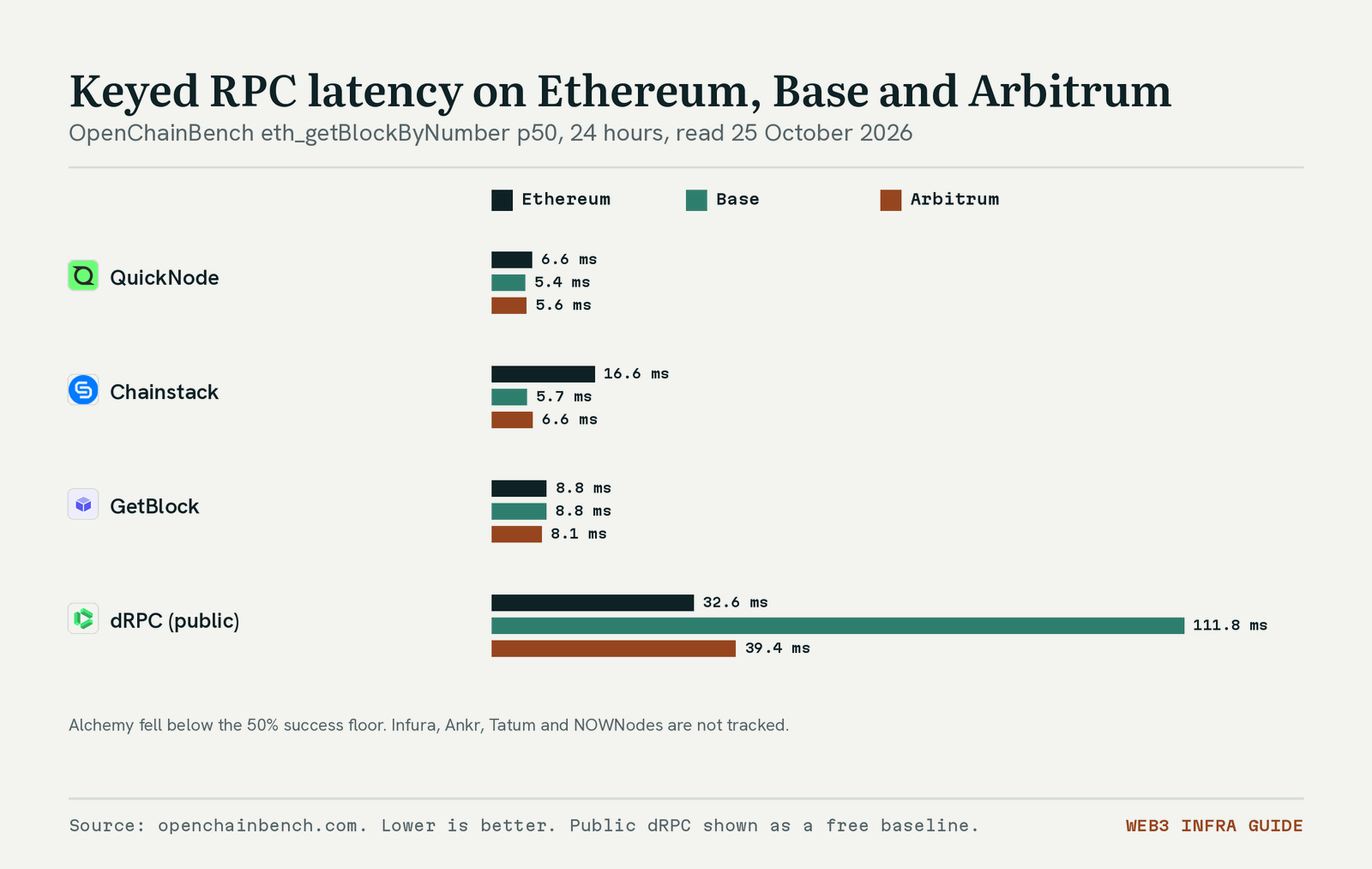
The free public endpoints are far slower. Public dRPC posted 32.6 ms on Ethereum, 111.8 ms on Base and 39.4 ms on Arbitrum, and the public NOWNodes Ethereum endpoint posted 129.7 ms. Infura, Ankr and Tatum are not tracked, so test them from your own region.
Verdict: QuickNode is the warm-latency pick and GetBlock the cold-start pick on independent data. Chainstack sits within about 10 ms of QuickNode on every chain while billing far less.
1. Chainstack
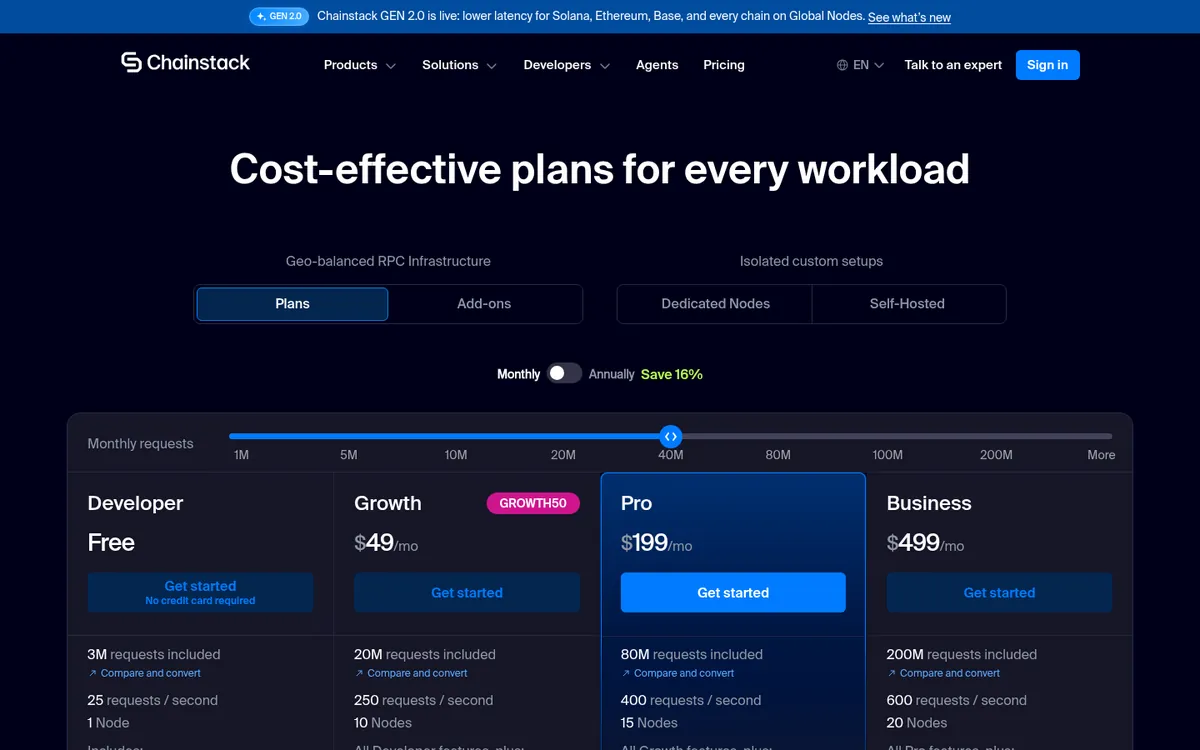
- Plans: Developer free (3M RU, 25 rps), Growth $49 (20M, 250 rps), Pro $199 (80M, 400 rps), Business $499 (200M, 600 rps), Enterprise from $990 (400M). Annual billing saves 16%.
- Ethereum and L2 meter: 1 RU for full requests, 2 RU for archive calls 127 or more blocks behind the tip, and 2 RU for all
debug_*andtrace_*methods, per its request unit rules. - Strengths: lowest bill in two of our three workloads, SOC 2 Type II and ISO 27001, a 99.99%+ uptime claim, and all eight networks in our L2 set.
- Weaknesses: overage of $15 per 1M RU on Growth, six times the included rate, and log backfills bill as archive.
Verdict: Chainstack scores 8.6 and takes first place. Pick it as the default Infura replacement for cost control with audits. See its entry in our full RPC ranking.
2. Alchemy
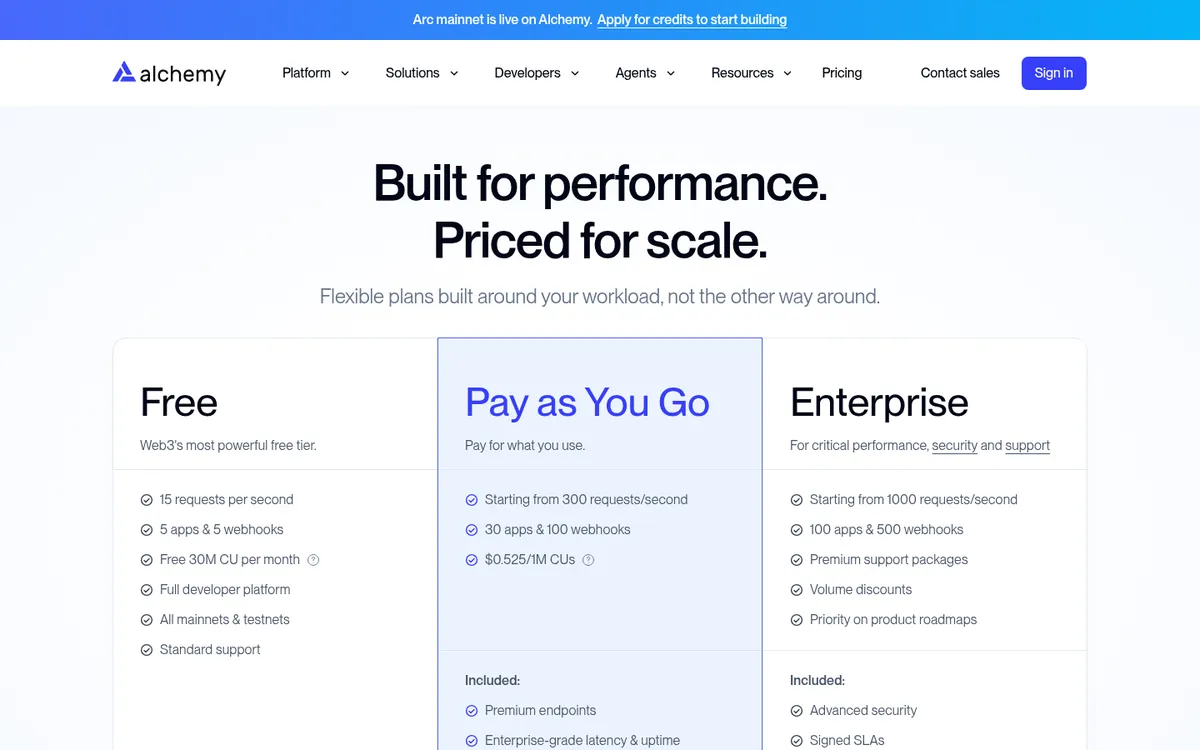
- Plans: Free (30M CU a month, 15 rps), Pay as you go at $0.525 per 1M CU from 300 rps with Debug and Trace, and Enterprise with signed SLAs and larger
eth_getLogsranges. - Ethereum meter: 10 CU for
eth_blockNumber, 20 for balances, receipts and gas estimates, 26 foreth_call, 40 for sends anddebug_traceTransaction, and 60 foreth_getLogs, per its CU table. - Strengths: the largest permanent free tier here, SOC 2 Type II on its trust page, and all eight networks in our L2 set.
- Weaknesses: $31.50 per million log queries, the highest rate here, which put our indexer at $1,244 a month, and support targets of 48 hours on Free and 24 hours on pay as you go.
Verdict: Alchemy scores 8.3. It is the easiest move for teams that want a free tier and tooling, as long as logs are a small share of traffic. See its entry in our full RPC ranking.
3. dRPC
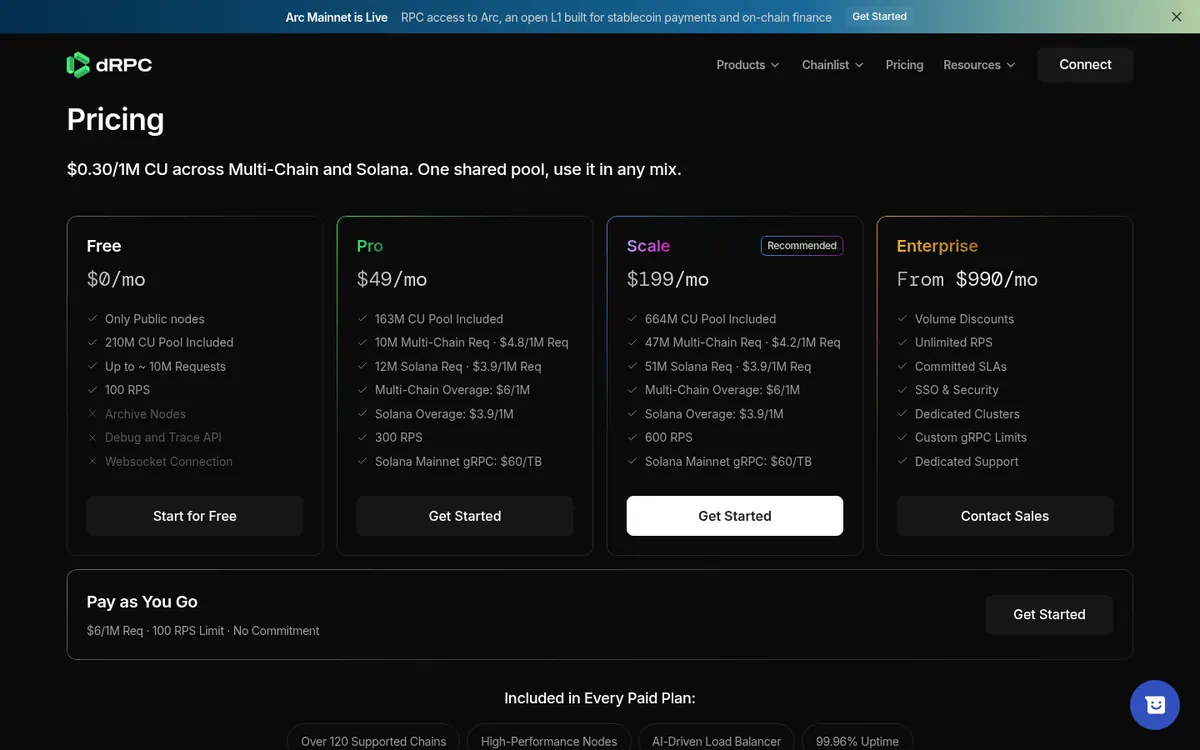
- Plans: Free on public nodes (210M CU, 100 rps), Pro $49 (163M CU, about 10M multi-chain requests, 300 rps), Scale $199 (664M CU, about 47M requests, 600 rps), Enterprise from $990. Pay as you go costs $6 per 1M requests.
- Ethereum meter: $0.30 per 1M CU on its compute unit page, so traces, logs and receipts all cost the same as a balance check.
- Strengths: cheapest bill for trace analytics at $108, a 99.96% uptime claim, 120+ chains and every network in our L2 set.
- Weaknesses: no audit report on its own pages, and the free tier uses public nodes only.
Verdict: dRPC scores 7.9. Pick it for log-heavy and trace-heavy Ethereum work where Infura’s 255 and 1,000 credit weights hurt most. See its entry in our full RPC ranking.
4. GetBlock
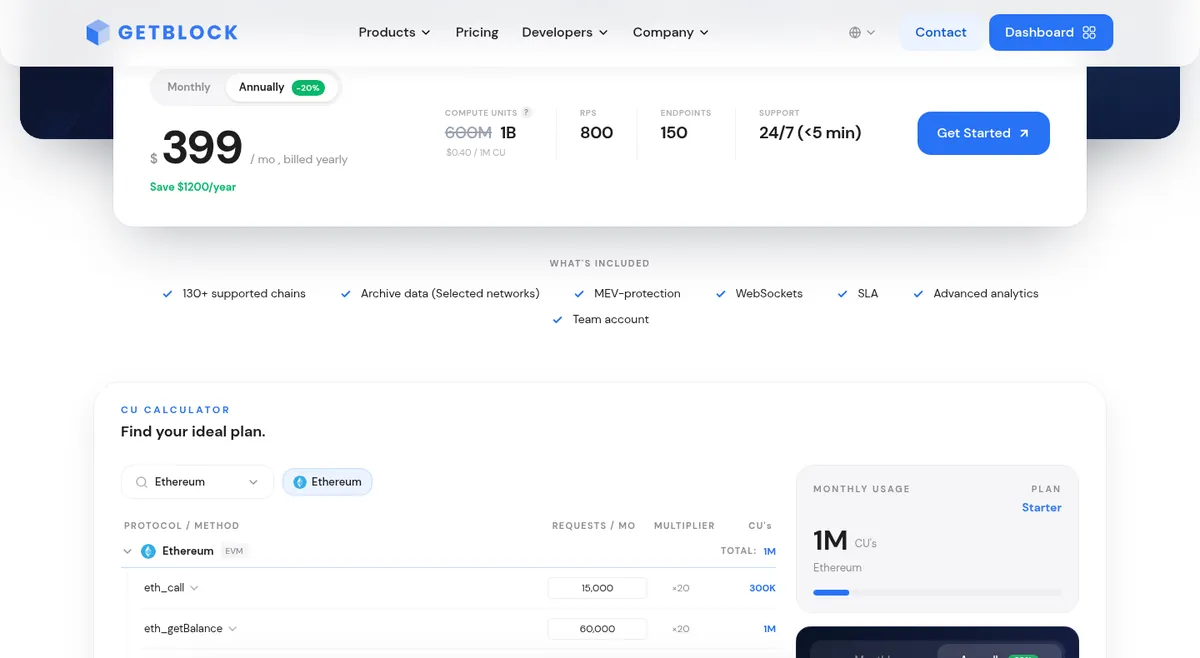
- Plans: Free (50,000 CU a day), Starter $49 (90M CU, 250 rps), Growth $99 (185M), Advanced $199 (385M), Scale $349 (700M), Pro $499 (1B CU, 800 rps), Premium $699 (1.6B). Annual billing cuts Starter to $39.
- Method rules: debug and trace calls count double,
trace_replayTransactionfour times, and archive endpoints double again. - Strengths: lowest cold-start medians on Ethereum, Base and Arbitrum, the tightest p99 on Ethereum at 16.6 ms, and SOC 2 Type II.
- Weaknesses: steep L2 multipliers, no published overage rate, and a free tier of about 2,500 Ethereum calls a day.
Verdict: GetBlock scores 7.8. It suits latency-sensitive apps on Ethereum, Base and Arbitrum that stay off ZKsync and Scroll. See its entry in our full RPC ranking.
5. QuickNode
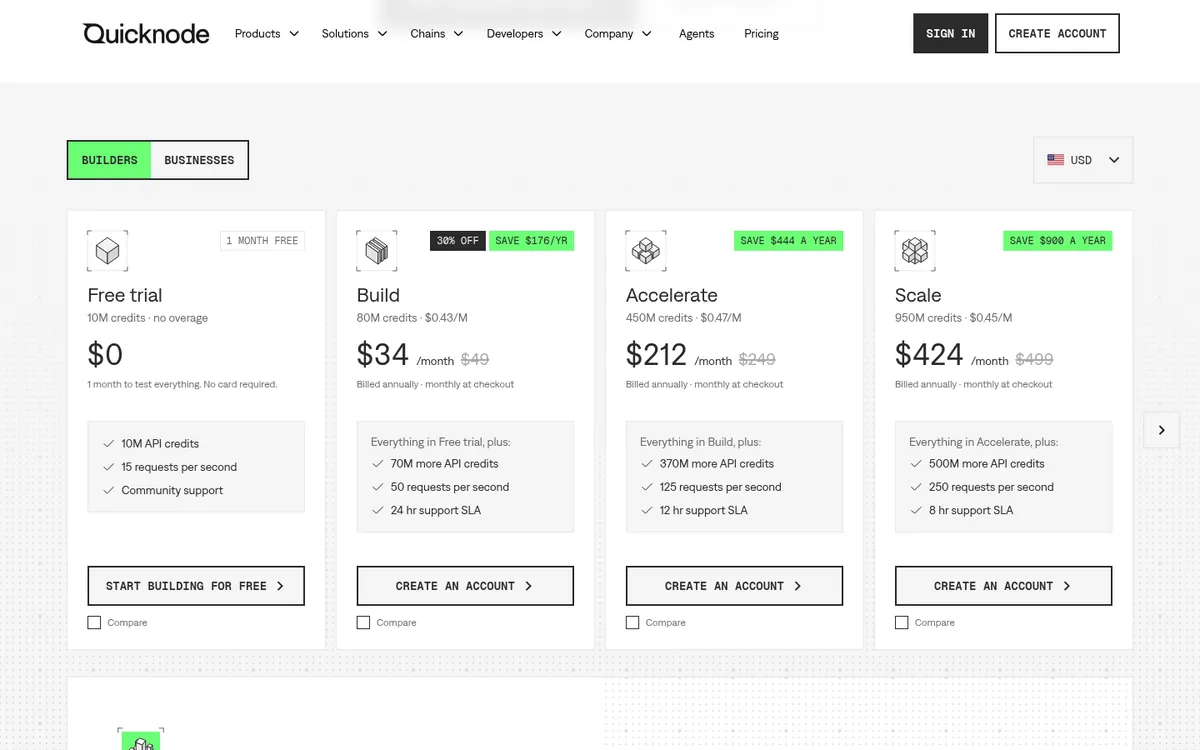
- Plans: Free trial (10M credits for one month, 15 rps), Build $49 (80M, 50 rps), Accelerate $249 (450M, 125 rps), Scale $499 (950M, 250 rps), Business from $999 (2B, 500 rps). Annual billing cuts Build to $34.
- Ethereum and L2 meter: 20 credits per call on Ethereum, Base, Arbitrum, Optimism, Polygon and Linea, 30 on Scroll and ZKsync, and double for trace and debug, per its API credit pages.
- Strengths: SOC 1 Type 2, SOC 2 Type 2 and ISO 27001 on its security page, warm medians of 5.4 to 6.6 ms, and overage from $0.62 down to $0.50 per 1M credits.
- Weaknesses: Build allows only 50 rps, and the free tier is a one-month trial.
Verdict: QuickNode scores 7.7. Pick it when latency and audit coverage outweigh the per-call price. See its entry in our full RPC ranking.
6. Ankr
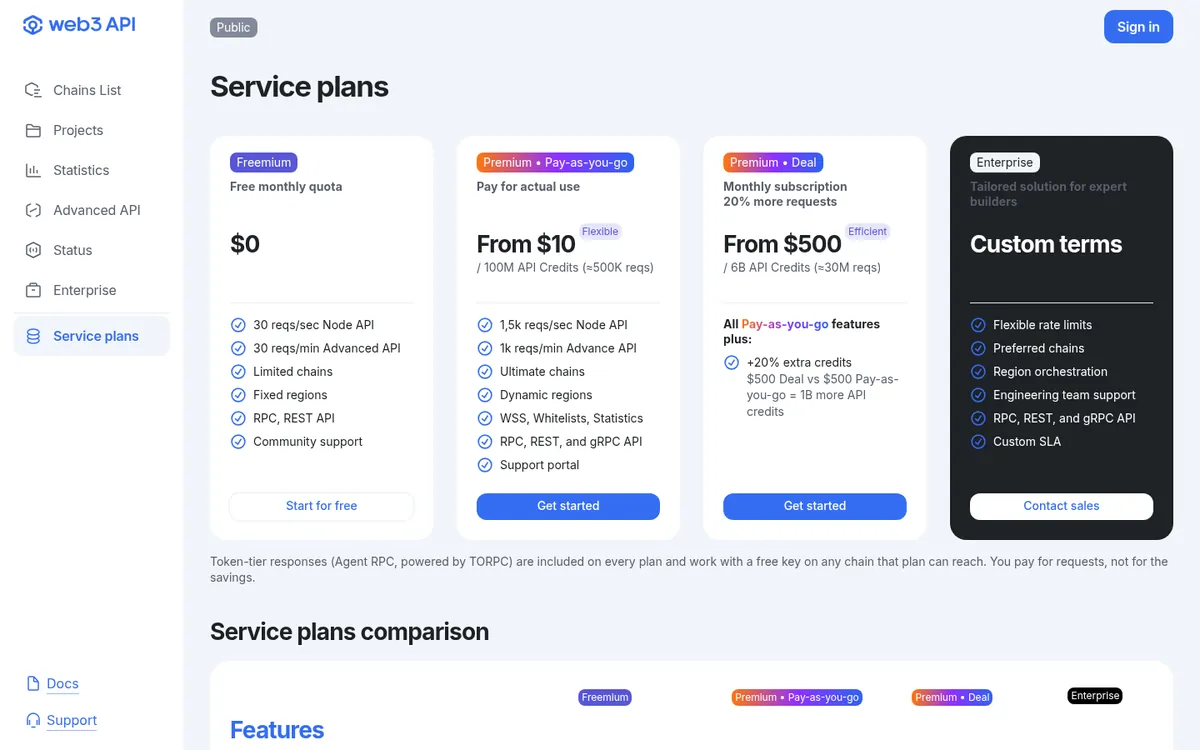
- Plans: Freemium (200M credits a month, about 1M requests, 30 rps), Pay as you go from $10 per 100M credits, Deal from $500 for 6B credits, about 30M requests with 20% extra.
- Coverage: 75+ chains on paid plans, with all eight networks in our L2 set on its chain list.
- Strengths: the highest public rate limit here, flat pricing across methods, and SOC 2 Type II through its operator Asphere on its trust page.
- Weaknesses: $20 per million is the highest flat EVM rate in this list, and no independent keyed latency data.
Verdict: Ankr scores 6.3. It fits bursty apps that need a high rate ceiling on prepaid credits. See its entry in our full RPC ranking. Our QuickNode vs Infura vs Ankr comparison covers Ankr against QuickNode and Infura.
7. Tatum
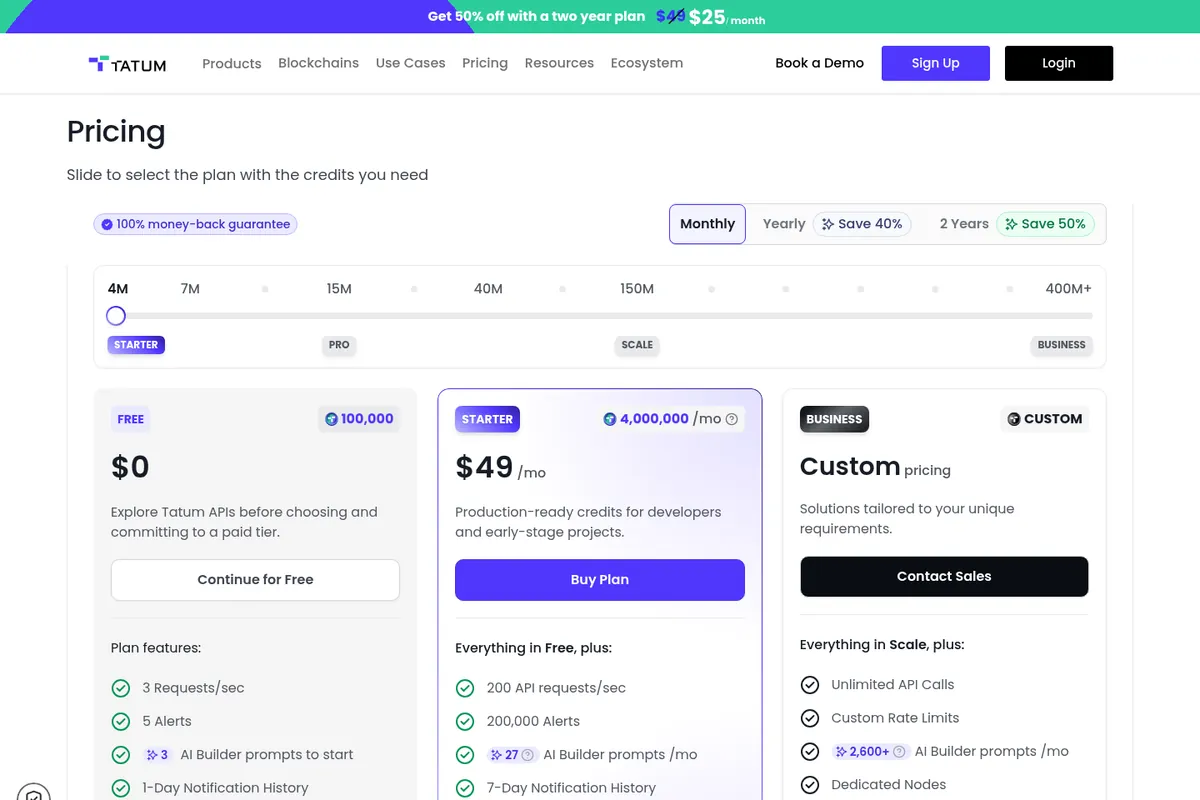
- Plans, billed monthly: Free (100,000 credits, 3 rps), Starter $49 (4M credits) or $79 (7M), Pro $139 (15M) or $349 (40M), Scale $1,199 (150M), all at 200 rps. Two-year billing cuts Starter to $25 a month.
- Ethereum meter: 2 credits for standard calls, 5 for
eth_calland 50 fordebug_*andtrace_*, per its RPC docs. - Strengths: SOC 2 Type II and ISO 27001 on its security page, and broad chain coverage.
- Weaknesses: the highest bill for our dApp backend, no public plan big enough for the trace workload, no overage on current plans, and Linea is not on its supported list.
Verdict: Tatum scores 6.1, level with Infura. It suits teams that want notifications and data APIs with light RPC traffic. See its entry in our full RPC ranking.
8. NOWNodes
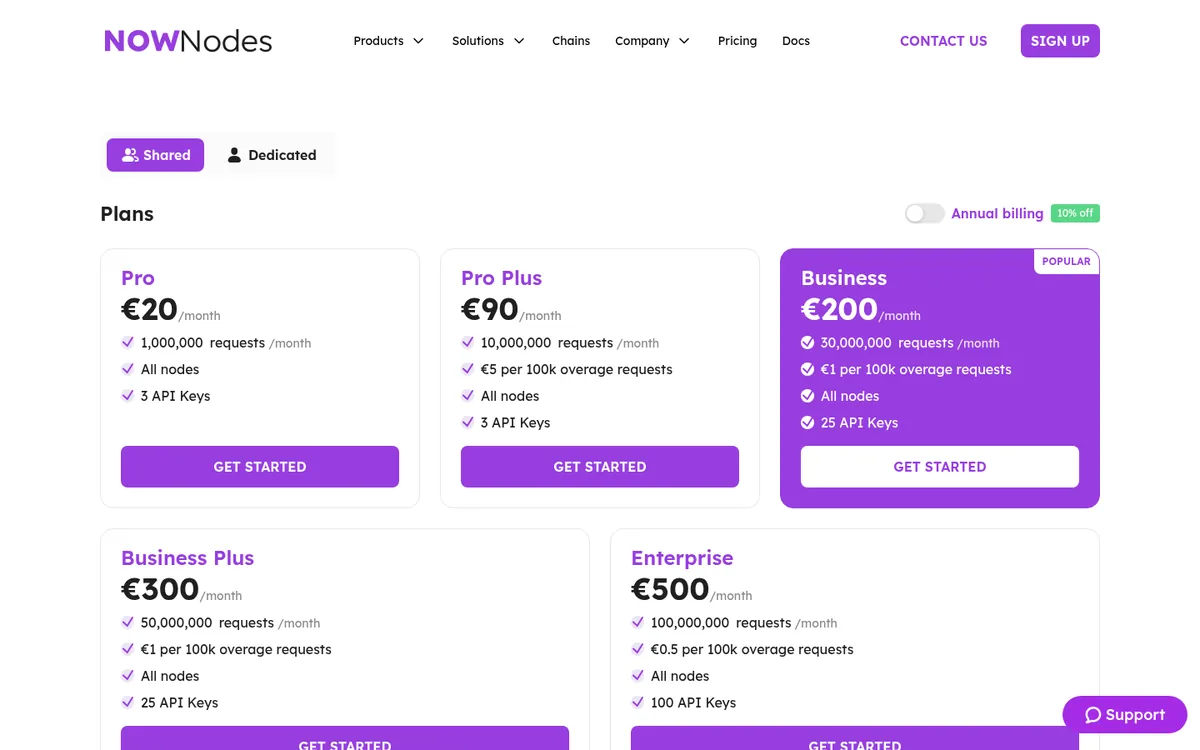
- Plans: Start free (100,000 requests, 15 rps, five networks, one month), Pro €20 (1M), Pro Plus €90 (10M), Business €200 (30M), Business Plus €300 (50M), Enterprise €500 (100M). Annual billing saves 10%.
- Overage: €5 per 100,000 requests on Pro Plus, €1 on Business and Business Plus, €0.5 on Enterprise.
- Strengths: flat per-request pricing, a stated 3-minute support response and third place in two of our workloads.
- Weaknesses: no audit report found, Scroll is not on its nodes list, and its public Ethereum endpoint posted 129.7 ms on OpenChainBench.
Verdict: NOWNodes scores 5.8. Pick it for simple euro billing on mixed-method traffic. See its entry in our full RPC ranking.
Providers We Left Out
Helius scores 7.0 in our main ranking but serves Solana only, so it cannot replace an Ethereum or L2 endpoint. CDP Node and Lava scored 4.4 and 4.3 on the same weights, below every pick here. Their full entries sit in our RPC node provider ranking.
Self-hosting is the other route off Infura. An Ethereum full node needs fast NVMe storage, two clients and constant upgrades, and an archive node needs far more. Our RPC providers hub covers when shared plans stop paying off.
Final Ranking
Chainstack wins on our weights because it pairs the lowest included rate with audits and full L2 coverage. Alchemy is close behind for its free tier and tooling, and dRPC leads on raw price for heavy methods. GetBlock and QuickNode trade price for speed.


Verdict: Move your main endpoint to Chainstack, add QuickNode or dRPC as the second endpoint, and reprice your method mix every quarter.
How to Test Infura Alternatives in One Week
A week of side-by-side traffic answers what a pricing page cannot. Keep Infura live and mirror a share of reads to two candidates from the region where your servers run. Log median and tail latency, error rates and the block number each endpoint returns, then price that week’s method mix on each meter.
for url in "$INFURA_URL" "$CHAINSTACK_URL" "$QUICKNODE_URL"; do
  curl -s -o /dev/null -w "%{time_total}\n" \
    -H "Content-Type: application/json" \
    -d '{"jsonrpc":"2.0","id":1,"method":"eth_blockNumber","params":[]}' \
    "$url"
done
Run the loop from a long-lived server and from a serverless function to see warm and cold behavior. Repeat it on Base and Arbitrum endpoints, and compare returned block numbers to spot lagging nodes before you cut over.
Frequently Asked Questions
What is the best Infura alternative in 2026?
On our weighted scorecard, Chainstack is the best Infura alternative at 8.6 out of 10. It bills 1 request unit for most Ethereum calls, covers every major L2 and states SOC 2 Type II and ISO 27001. Alchemy is second at 8.3 for its free tier, and dRPC is third at 7.9 for flat pricing.
What is the cheapest Infura alternative?
Chainstack Growth has the lowest included rate at $2.45 per million Ethereum calls on recent blocks. dRPC is cheapest for logs and traces at a flat $4.81 per million on Pro, and it won our trace-heavy workload at $108 a month. Infura Developer works out to $8.89 per million basic calls.
Is Alchemy better than Infura?
On our weights, yes. Alchemy scores 8.3 against Infura’s 6.1, with 30M free compute units a month, a monthly meter with no daily cap and a SOC 2 Type II report. Infura is cheaper per log query, at $28.33 per million against Alchemy’s $31.50, so log-heavy apps should price both.
Why does Infura return 402 errors?
Infura returns a 402 error when a project has used its daily credit quota, and it does not bill those failed requests. WebSocket connections are also severed until the quota resets. Moving to a higher plan, buying the 55M credit add-on or switching to a provider with a monthly meter removes the daily wall.
Do Infura alternatives support Base, Arbitrum and other L2s?
Yes. Chainstack, Alchemy, dRPC, GetBlock, QuickNode and Ankr list Ethereum, Base, Arbitrum, OP Mainnet, Polygon, Linea, ZKsync Era and Scroll. Tatum does not list Linea and NOWNodes does not list Scroll. GetBlock and QuickNode charge more per call on ZKsync and Scroll than on Ethereum.
How hard is it to migrate from Infura?
For a standard Ethereum app, migration is mostly an endpoint swap, since every provider here serves the same JSON-RPC methods. Plan extra work for Infura’s Gas API, which is not part of the spec, for different eth_getLogs range limits, and for L2 networks your new provider prices differently or does not list.