
Last updated: 25 October 2026 · Prices, archive rules, method costs and eth_getLogs limits rechecked on vendor pages on 25 October 2026
The best Ethereum RPC providers in 2026 are Chainstack for overall value with audits, Alchemy for the biggest free archive allowance, and dRPC for the cheapest flat meter on archive calls. We ranked eight providers on six weighted criteria, priced three archive-heavy workloads on every meter, and tested public endpoints against blocks from 2015.
Archive access is where Ethereum RPC plans differ most. Some vendors include it on the free tier, some charge double for it, and some cap how many blocks one eth_getLogs call can scan. This guide expands the Ethereum side of our ranking of the 12 best RPC node providers, uses the same weights, and our methodology page explains how we collect prices and screenshots. If you are leaving a current vendor, our Infura alternatives and Alchemy alternatives guides apply the same scorecard, and our Base RPC providers ranking covers the leading L2.
TL;DR
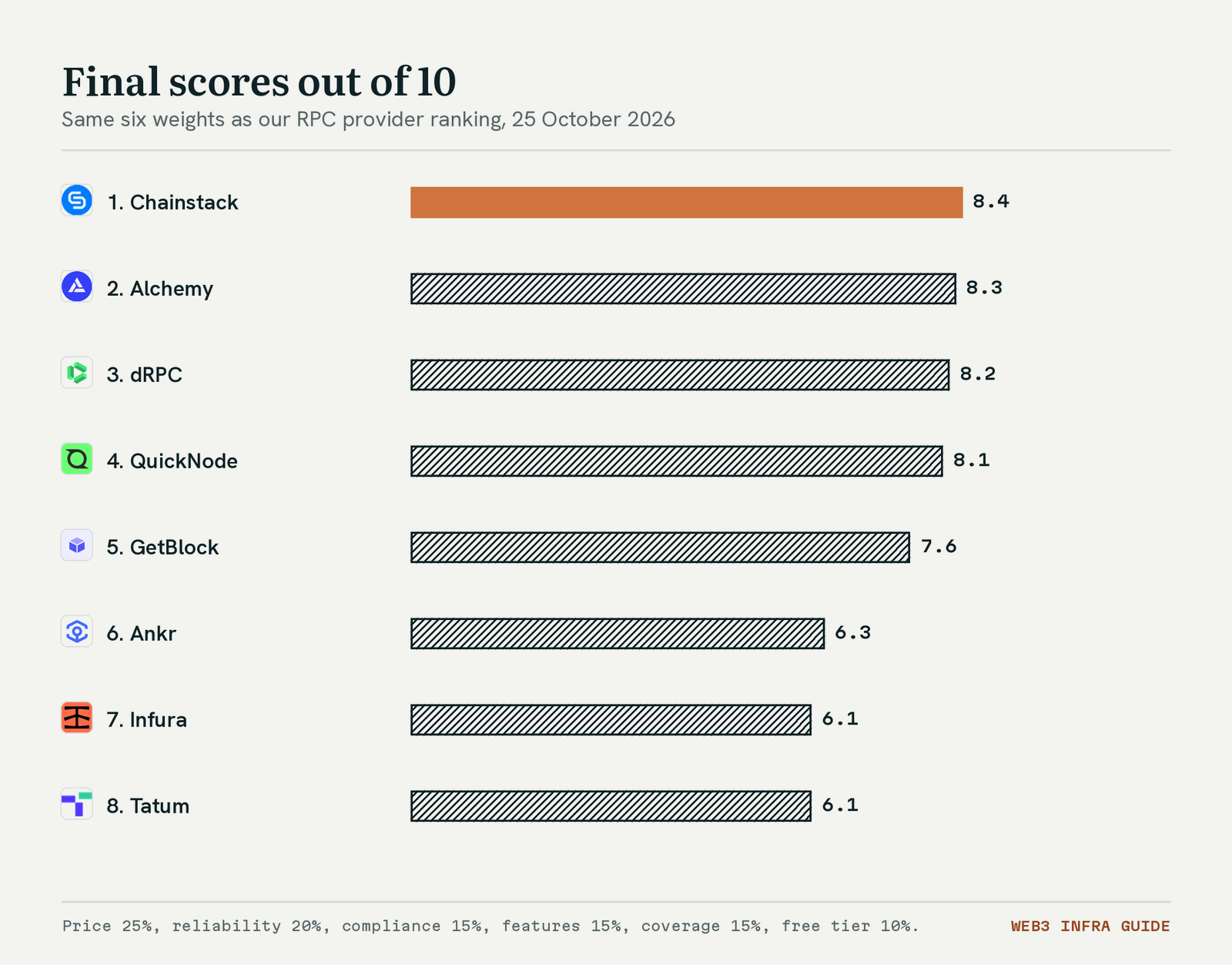
- Overall: 1. Chainstack (8.4), 2. Alchemy (8.3), 3. dRPC (8.2), 4. QuickNode (8.1), 5. GetBlock (7.6), 6. Ankr (6.3), 7. Infura (6.1), 8. Tatum (6.1).
- Fully used, an archive
eth_getBalancecosts $4.81 per million on dRPC Pro and $4.90 on Chainstack Growth, against $10.50 on Alchemy, $12.25 on QuickNode Build and $21.78 on a GetBlock Starter archive endpoint. - dRPC had the lowest bill in all three archive workloads we modeled: $108 for a 20M-request wallet history app, $274 for a 60M-request indexer backfill and $108 for 20M trace calls. Chainstack was second each time.
- Alchemy, Infura, dRPC, Ankr and Tatum include archive data on their permanent free tiers, and QuickNode on its one-month trial. Chainstack’s free Developer plan does not, and GetBlock lists free archive as limited.
- Free
eth_getLogsranges are tiny: 5 blocks on QuickNode, 10 on Alchemy and 100 on Chainstack. Paid plans open 10,000 blocks on Chainstack, QuickNode and Ankr Premium, and Alchemy pay as you go has no block cap on Ethereum. - On OpenChainBench’s keyed Ethereum runs read 25 October 2026, QuickNode had the lowest median at 6.0 ms, GetBlock 8.8 ms and Chainstack 17.0 ms.
The Decision Kernel
Pick an Ethereum RPC provider by how much of your traffic reads old state. A wallet that shows balances at past blocks, an indexer that replays logs from genesis and a forensics tool that traces old transactions all hit archive nodes. Tag each request as head or archive for one week before you compare a single plan. The shortcuts below cover the common cases.
- Lowest bill with audits: Chainstack Growth at $49, which charges 2 request units per archive call and states SOC 2 Type II and ISO 27001.
- Largest free archive allowance: Alchemy, with 30M compute units a month and archive data on Free, or about 1.5M archive balance reads.
- Cheapest archive and trace meter: dRPC, which bills every method at the same flat rate, including
debug_*andtrace_*. - Lowest latency and the widest audit set: QuickNode, with archive on every plan and SOC 1, SOC 2 and ISO 27001 reports.
- Dedicated Ethereum archive node: GetBlock from $1,500 a month, or Chainstack and QuickNode dedicated nodes on request.
- Bursty traffic on prepaid credits: Ankr pay as you go at 1,500 requests per second.
Verdict: Chainstack for most Ethereum teams, dRPC when archive and trace calls drive the bill, Alchemy when you want archive data before you pay anything. Run a second provider for failover either way.
How We Ranked the Ethereum RPC Providers
We scored each provider from 1 to 5 on six criteria, weighted them and doubled the total, using the same weights as our 12-provider RPC ranking. For this Ethereum list, the free tier score depends on archive access, and the features score counts archive, debug, trace and log range limits. Every price, limit and audit claim here links to a vendor page we checked on 25 October 2026. Our methodology covers the rest.
- Price per call, 25%: the monthly bill for archive-heavy Ethereum method mixes, converted from each billing unit.
- Reliability, 20%: public latency benchmarks, uptime claims and support response targets.
- Compliance, 15%: SOC 2, ISO 27001 and other audits stated on the vendor’s own pages.
- Features, 15%: archive data, debug and trace APIs,
eth_getLogsrange limits, WebSockets and dedicated nodes. - Coverage, 15%: Ethereum L2s and other chains on one account.
- Free tier, 10%: how much Ethereum archive traffic a team can run before paying.
| Provider | Price (25%) | Reliability (20%) | Compliance (15%) | Features (15%) | Coverage (15%) | Free tier (10%) | Score |
|---|---|---|---|---|---|---|---|
 | 5 | 4 | 5 | 4 | 4 | 2 | 8.4 |
 | 3 | 4 | 4 | 5 | 5 | 5 | 8.3 |
 | 5 | 4 | 2 | 4 | 5 | 4 | 8.2 |
 | 3 | 5 | 5 | 5 | 4 | 2 | 8.1 |
 | 3 | 5 | 4 | 4 | 5 | 1 | 7.6 |
 | 2 | 3 | 4 | 3 | 4 | 4 | 6.3 |
 | 4 | 3 | 1 | 3 | 3 | 4 | 6.1 |
 | 1 | 3 | 5 | 4 | 5 | 1 | 6.1 |
Why Archive Access Changes the Bill
A full Ethereum node keeps recent state, roughly the last 128 blocks, and can rebuild older state only slowly. An archive node keeps the state at every block since genesis, which is why it answers a balance query at block 1,000,000 in one call. QuickNode’s full vs archive guide puts an archive node at about 12 TB on Geth and about 2 TB on Erigon, and growing. Most providers draw the archive line at about 128 blocks behind the tip, and two of them charge double past it.
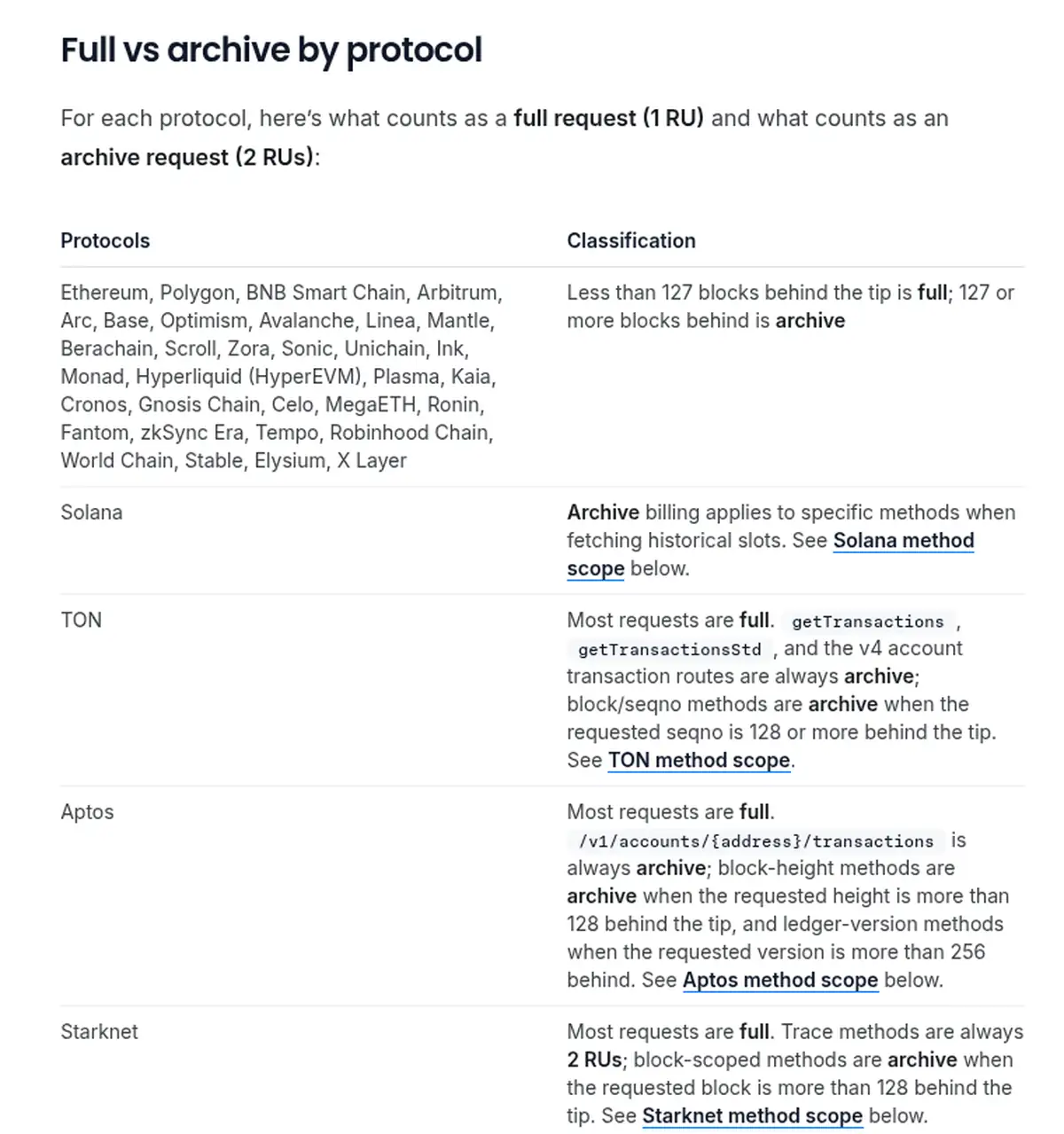
- Charged double: Chainstack bills 2 request units for calls 127 or more blocks behind the tip, and judges
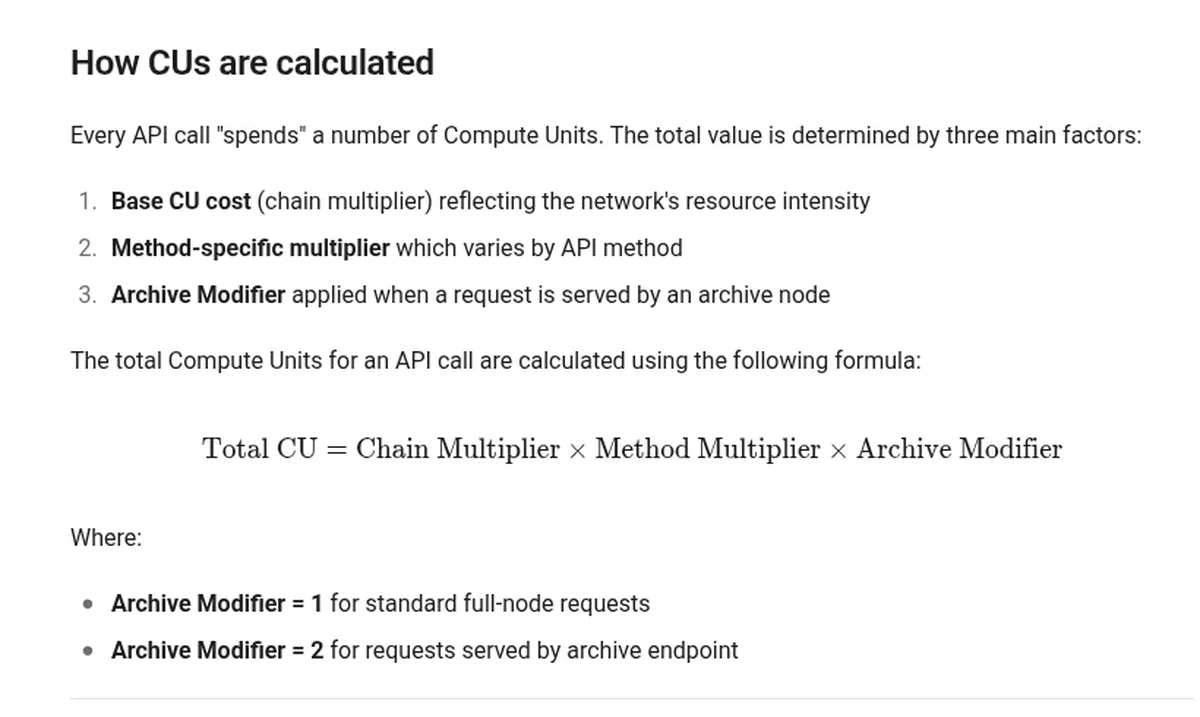
eth_getLogsby itsfromBlock, per its request unit rules. GetBlock applies an archive modifier of 2 to calls served by an archive endpoint, per its CU formula. - Same price: Alchemy, QuickNode, dRPC and Ankr bill archive calls at their normal rates. Infura’s credit cost page says archive requests older than 128 blocks currently cost the same as recent ones, and warns this might change.
- Method weights still apply: Infura charges 255 credits for
eth_getLogsand 1,000 fordebug_*, and Tatum charges 50 credits for debug and trace calls, which Tatum’s docs label as archive methods that may cost more.
Verdict: If more than a third of your calls read old blocks, the archive rule matters more than the headline plan price. Price the archive share separately.
Ethereum RPC Providers at a Glance
The table lines up each provider’s billing unit, how it treats archive calls, the entry paid plan and its throughput. Prices are monthly list prices from each pricing page on 25 October 2026, before annual discounts.
| Provider | Billing unit | Archive call cost | Entry paid plan | Rate limit |
|---|---|---|---|---|
| Request units (RU) | 2 RU, against 1 RU at the head | Growth $49: 20M RU | 250 rps |
| Compute units (CU) | Same CU as head calls | Pay as you go: $0.525 per 1M CU | 300 rps |
| Compute units | Flat 20 CU, 16 inside the Pro pool | Pro $49: 163M CU, about 10M requests | 300 rps |
| API credits | 20 credits, 40 for trace and debug | Build $49: 80M credits | 50 rps |
| Compute units | 40 CU on an archive endpoint | Starter $49: 90M CU | 250 rps |
| API credits | $0.02 per 1,000 EVM requests | Pay as you go from $10 | 1,500 rps |
| Credits per day | Same credits as head calls, for now | Developer $50: 15M credits a day | 4,000 credits per second |
| Credits | 2 standard, 5 for eth_call, 50 for traces | Starter $49: 4M credits | 200 rps |
Verdict: Chainstack and GetBlock are the two meters with a published archive surcharge, yet Chainstack still has one of the lowest archive prices because its base rate is so low.
What One Million Archive Calls Cost
Converting each unit to dollars shows how far apart the meters sit on old-block traffic. We used the entry paid plan fully used and Ethereum mainnet calls more than 128 blocks behind the tip. A million archive debug traces cost $4.81 on dRPC Pro, $111.11 on Infura Developer and $612.50 on Tatum Starter.
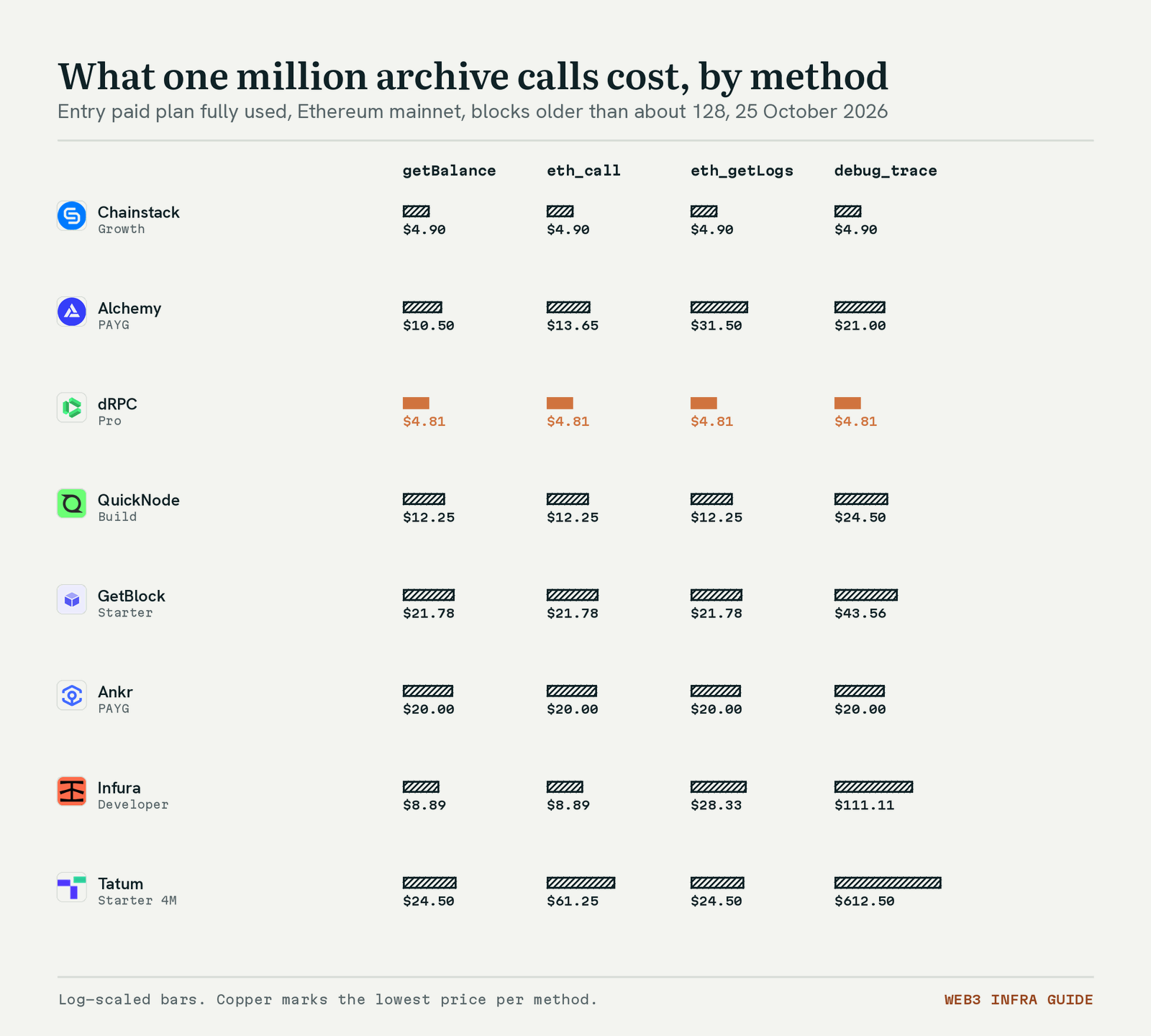
| Plan | Archive getBalance | Archive eth_call | eth_getLogs | debug_traceTransaction | Above the allowance |
|---|---|---|---|---|---|
| $4.90 | $4.90 | $4.90 | $4.90 | $15 per 1M RU |
| $10.50 | $13.65 | $31.50 | $21.00 | Same $0.525 per 1M CU |
| $4.81 | $4.81 | $4.81 | $4.81 | $6 per 1M requests |
| $12.25 | $12.25 | $12.25 | $24.50 | $0.62 per 1M credits |
| $21.78 | $21.78 | $21.78 | $43.56 | Top up CUs or change plan |
| $20.00 | $20.00 | $20.00 | $20.00 | Same rate, prepaid |
| $8.89 | $8.89 | $28.33 | $111.11 | 402 errors, or $200 for 55M credits |
| $24.50 | $61.25 | $24.50 | $612.50 | Move up a plan |
Overage changes the picture once you outgrow the entry plan. Chainstack’s extra request units cost $15 per million on Growth, which makes an archive call $30 per million past the allowance. QuickNode overage runs $0.62 down to $0.50 per million credits, and dRPC bills $6 per million requests past its pool.
Verdict: dRPC and Chainstack sit together at about $4.90 per million archive calls on every method. Alchemy is mid-priced for balances and the most expensive mainstream option for logs.
What Three Archive Workloads Cost
We built three archive-heavy method mixes, converted each into every vendor’s unit and picked the cheapest public plan that covers the volume, archive access and a peak of three times the average rate. dRPC had the lowest bill in all three workloads, and Chainstack was second in each.
| Provider | Wallet history, 20M | Indexer backfill, 60M | Trace forensics, 20M |
|---|---|---|---|
| $199 (Pro) | $499 (Business) | $199 (Pro) |
| $277 (Pay as you go) | $1,386 (Pay as you go) | $378 (Pay as you go) |
| $108 (Pro) | $274 (Scale) | $108 (Pro) |
| $247 (Build) | $632 (Scale) | $355 (Accelerate) |
| $349 (Scale) | $979 (Premium) | $611 (Pro) |
| $400 (Pay as you go) | $1,100 (Deal ($500)) | $400 (Pay as you go) |
| $225 (Team, busy days over quota) | Enterprise quote | Enterprise quote |
| $1,199 (Scale 150M) | $1,199 (Scale 150M) | Quote, above public plans |
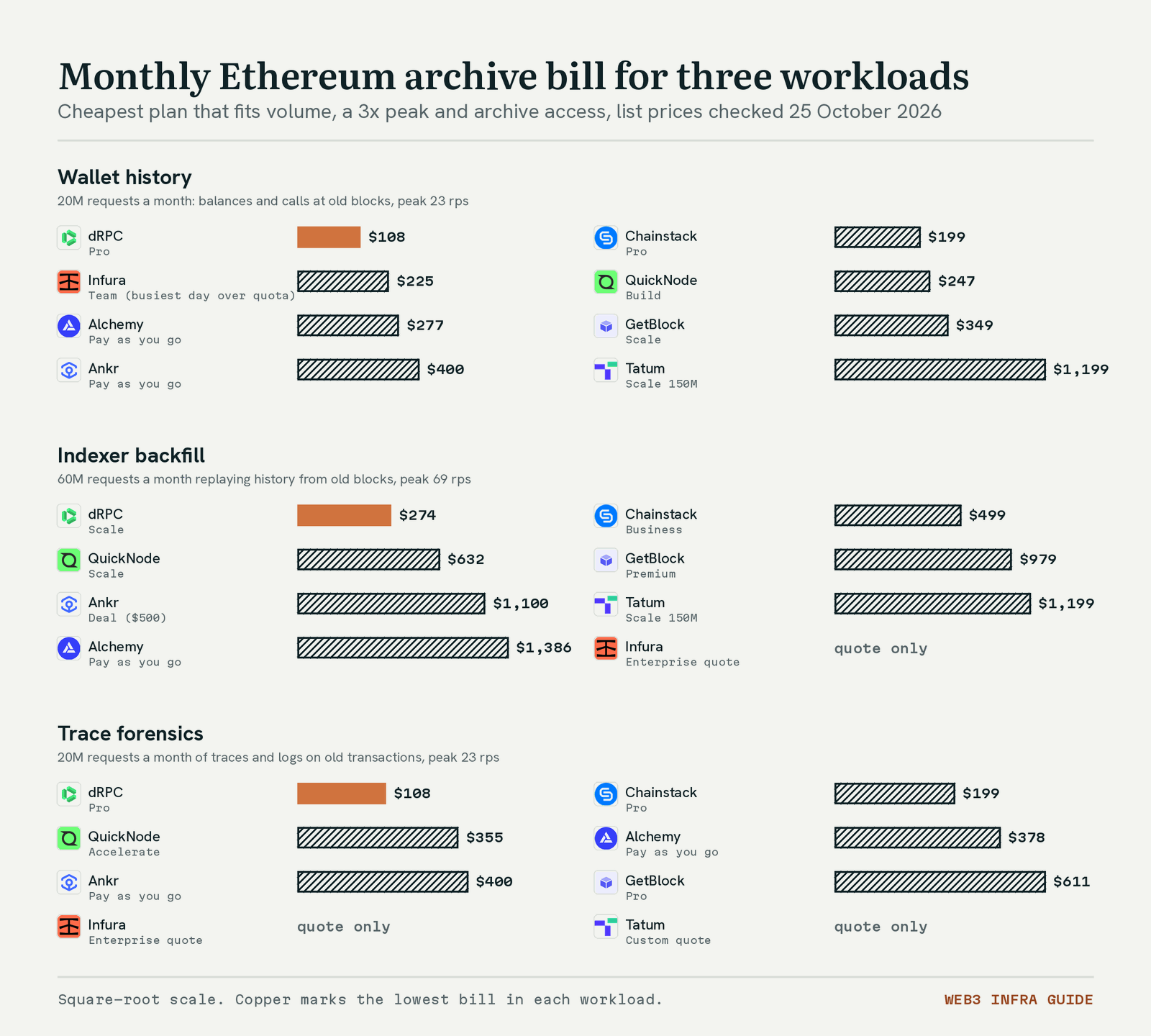
- Wallet history, 20M requests: 40% archive
eth_getBalance, 20% archiveeth_call, 20% headeth_call, 10% head block reads and 10% archiveeth_getLogs. - Indexer backfill, 60M requests: 60% archive
eth_getLogs, 25% archiveeth_getBlockByNumberand 15% archiveeth_getBlockReceipts. - Trace forensics, 20M requests: 40%
debug_traceTransaction, 20%trace_block, 20%eth_getLogsand 20% block reads, all on old blocks.
Infura’s numbers come from its daily quota. The wallet mix averages 97.5 credits per request, about 65M credits a day, and a day at 1.5 times the average needs about 97.5M, above the Team plan’s 75M. The indexer needs about 646M credits a day and the trace job about 351M, so both need an Enterprise deal.
Plan limits moved several answers. Chainstack’s wallet mix needs 34M request units, so Pro at $199 beats Growth plus overage. QuickNode’s indexer needs 69 requests per second at peak, above Build’s 50, and its trace job doubles credits, so both land on bigger plans. Tatum’s trace mix needs about 616M credits, four times its largest public plan.
Verdict: dRPC is the cheapest place to run archive-heavy Ethereum traffic on list prices, and Chainstack is the cheapest option that also carries SOC 2 and ISO 27001.
eth_getLogs Block Range Limits
Indexers live on eth_getLogs, and the block range a single call can cover decides how many calls a backfill needs. Free plans are the tightest. Scanning one million blocks takes 200,000 calls at QuickNode Free trial limits and 100 calls on a 10,000-block paid plan.
| Provider | Free plan | Paid plans | Other limits |
|---|---|---|---|
| 100 blocks (Developer) | 10,000 blocks on Growth, Pro, Business and Enterprise | Larger ranges on dedicated nodes |
| 10 blocks | Unlimited on pay as you go and Enterprise | Responses capped at 150 MB |
| 5 blocks (Free trial) | 10,000 blocks | Per-method limits adjustable on request |
| 1,000 public, 3,000 Freemium | 10,000 blocks (Premium) | Up to 200,000 logs per response |
| 100 blocks passed, 500 failed in our public test | Not published on its pricing page | Error cites a free-plan range limit |
| No block cap published | No block cap published | 10,000 results, 10 seconds and 5,000 parameters per query |
| Not published | Not published | Ask before a large backfill |
| Not published | Not published | Ask before a large backfill |
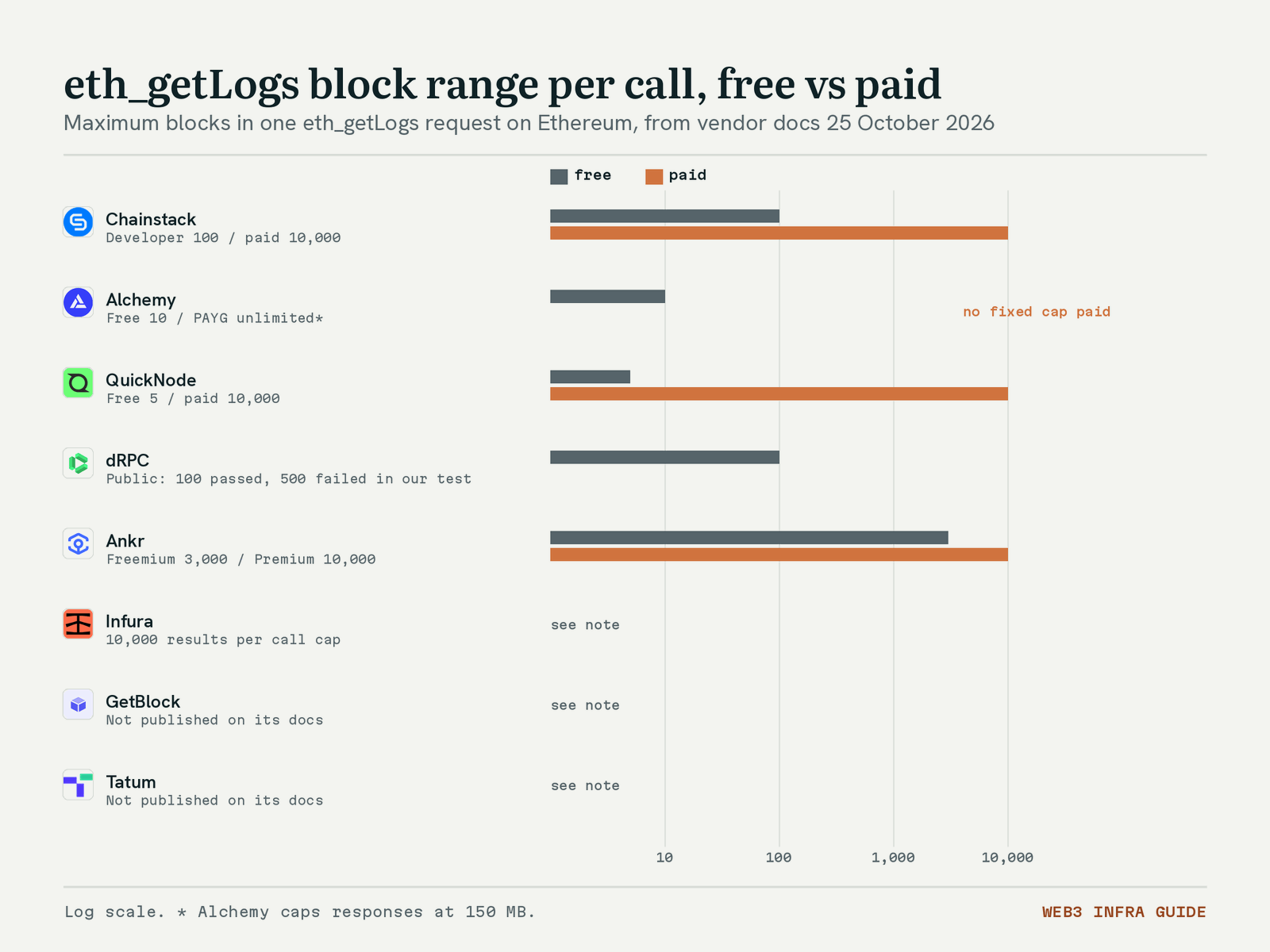
Verdict: For a backfill, Alchemy pay as you go removes the block cap and Chainstack, QuickNode and Ankr Premium give 10,000 blocks. No free plan here is usable for a serious backfill.
Free Tier Archive Allowance
Free tiers decide where prototypes start, and archive access is the line that separates them. We converted each free allowance into archive eth_getBalance calls at each vendor’s own rate.
| Provider | Free plan | Archive on free? | Archive balance reads |
|---|---|---|---|
| 30M CU a month, 15 rps | Yes | About 1.5M a month |
| 210M CU, 100 rps, public nodes | Yes | About 10M requests |
| 200M credits, 30 rps | Yes, full and archive | About 1M a month |
| 10M credits, 15 rps, one-month trial | Yes, on all plans | About 500,000 |
| 100,000 credits, 3 rps | Yes, full history | About 50,000 |
| 3M credits a day, 500 per second | Yes, full archive data | About 37,500 a day |
| 50,000 CU a day, 20 rps | Limited | About 1,250 a day |
| 3M RU, 25 rps | No, from Growth | None |
Verdict: Alchemy is the best free archive tier for a single developer, and dRPC the most generous by raw volume. Chainstack’s free plan is for head-of-chain testing only. For a wider free-plan shortlist, see our free RPC providers guide.
Our Public Endpoint Archive Test
Free public Ethereum endpoints are useful for scripts, so we tested which ones actually serve archive data. On 25 October 2026 we called eth_getBalance on the Ethereum Foundation’s original address at the latest block, 1,000 blocks back, block 1,000,000 and block 46,147, then tried eth_getLogs and an old debug_traceTransaction. Only dRPC and Tenderly returned balances from 2015 blocks, and only dRPC also returned a debug trace.
| Public endpoint | Latest block | 1,000 back | Block 1,000,000 | Block 46,147 | eth_getLogs | Old debug trace |
|---|---|---|---|---|---|---|
| dRPC (eth.drpc.org) | OK, 107 ms | OK, 98 ms | OK, 122 ms | OK, 103 ms | 100 blocks OK, 500 rejected | OK |
| Tenderly gateway | OK, 183 ms | OK, 135 ms | OK, 179 ms | OK, 176 ms | 1,000 blocks OK | Rate limited (429) |
| PublicNode | OK, 124 ms | 403 | 403 | 403 | 1,000 blocks OK | Method not available |
| Ankr public | Needs an API key | |||||
| NOWNodes public | Error 422 |
Public endpoints carry no SLA and change their rules without notice. Ankr’s public endpoint now requires a free API key, which is still a fair trade for its 3,000-block Freemium log range. Treat any public URL as a fallback for scripts, never as production infrastructure.
Verdict: For quick archive scripts, the dRPC public endpoint is the most complete free option we tested. For production, use a keyed plan with a published limit.
Latency on Ethereum Mainnet
OpenChainBench probes keyed Ethereum endpoints for QuickNode, GetBlock, Chainstack and others with eth_getBlockByNumber from three regions, and ranks public endpoints separately. Alchemy is listed but fell below the 50% success floor in the keyed cohort. QuickNode posted a 6.0 ms keyed median, GetBlock 8.8 ms with the tightest p99 at 16.8 ms, and Chainstack 17.0 ms.
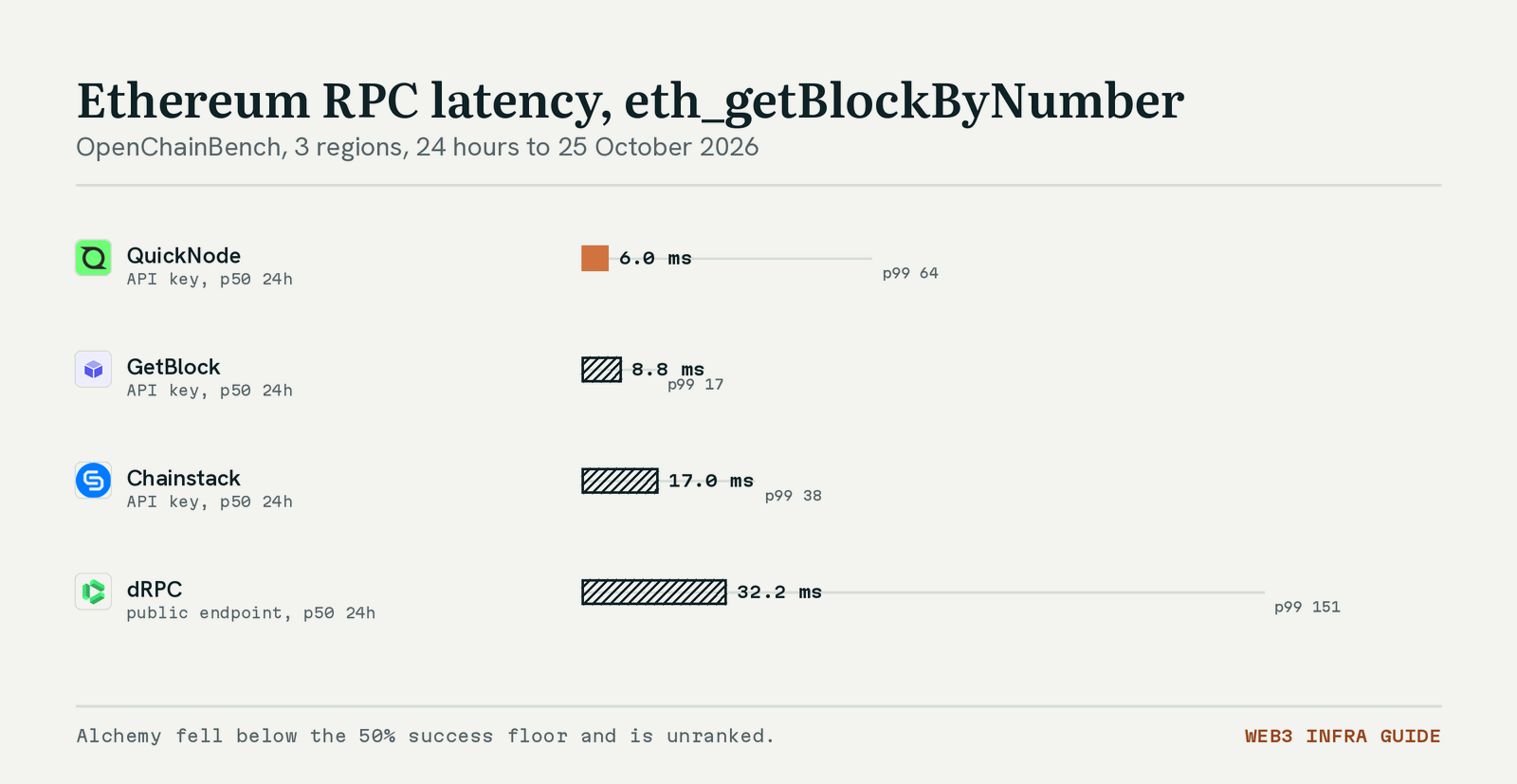
Among public endpoints, dRPC led at 32.2 ms, ahead of PublicNode at 73.5 ms and Tenderly at 115.8 ms. Infura, Ankr and Tatum keyed endpoints are not in this benchmark, so test them from your own region. Note that this benchmark measures head-of-chain block reads, and archive calls are usually slower.
Verdict: QuickNode is the latency pick and GetBlock the consistency pick on independent data. Chainstack is within about 11 ms of QuickNode at the median while billing far less per archive call.
1. Chainstack
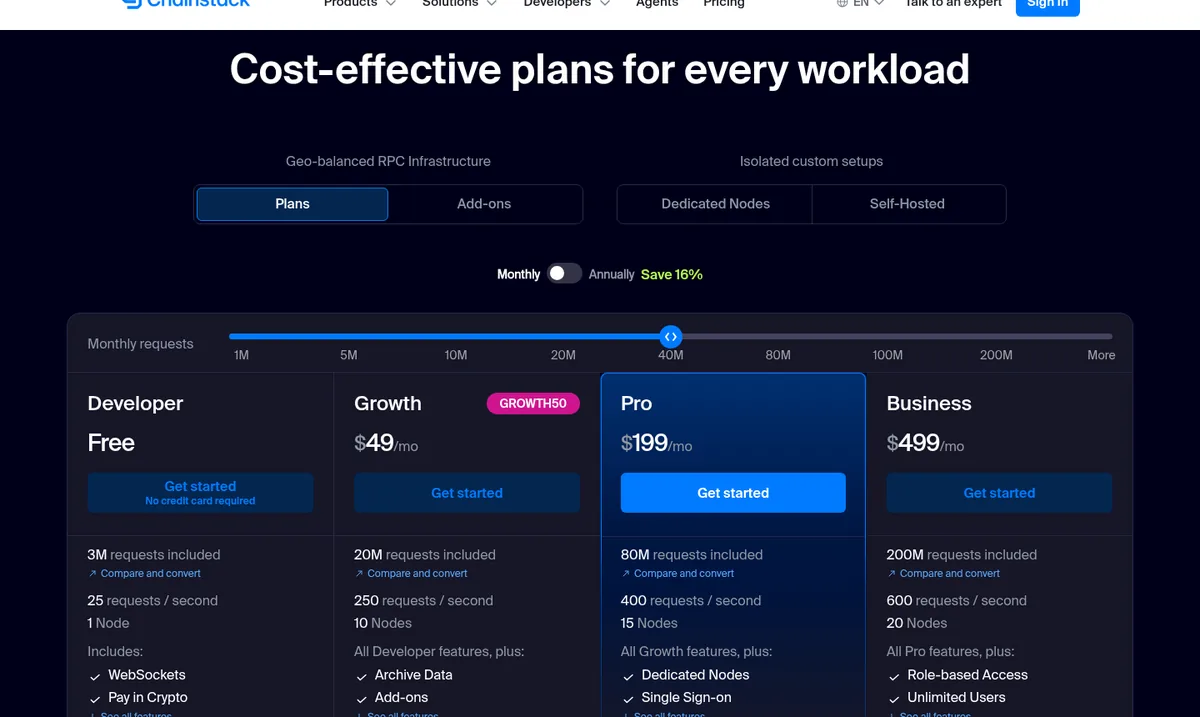
- Plans: Developer free (3M RU, 25 rps, no archive), Growth $49 (20M RU, 250 rps, archive data), Pro $199 (80M, 400 rps), Business $499 (200M, 600 rps), Enterprise from $990 (400M). Annual billing saves 16%.
- Archive rules: 2 RU for calls 127 or more blocks behind the tip and 2 RU for all debug and trace calls.
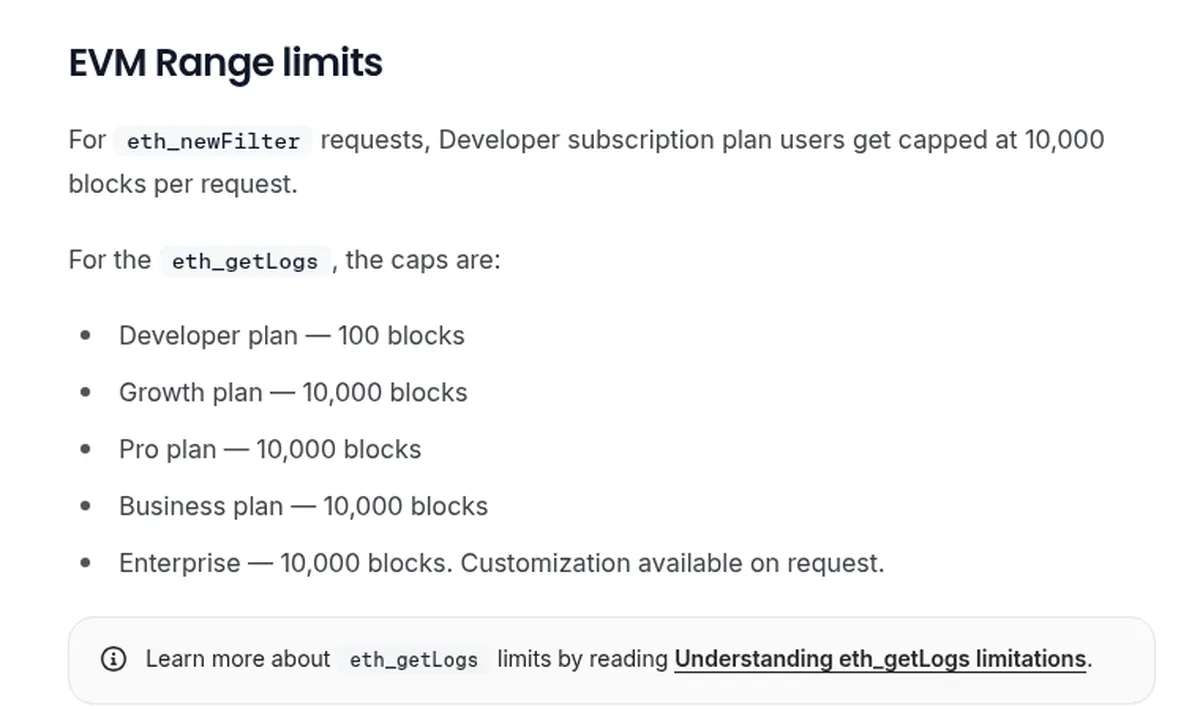
eth_getLogscovers 10,000 blocks on paid plans and 100 on Developer, per its limits page. - Strengths: second-lowest bill in all three workloads, SOC 2 Type II and ISO 27001 on its security page, and a 99.99%+ uptime claim.
- Weaknesses: no archive on the free plan, and Growth overage of $15 per million RU doubles to $30 per million archive calls.
Verdict: Chainstack scores 8.4 and takes first place. Pick it as the default Ethereum archive provider for cost control with audits. See its entry in our full RPC ranking.
2. Alchemy
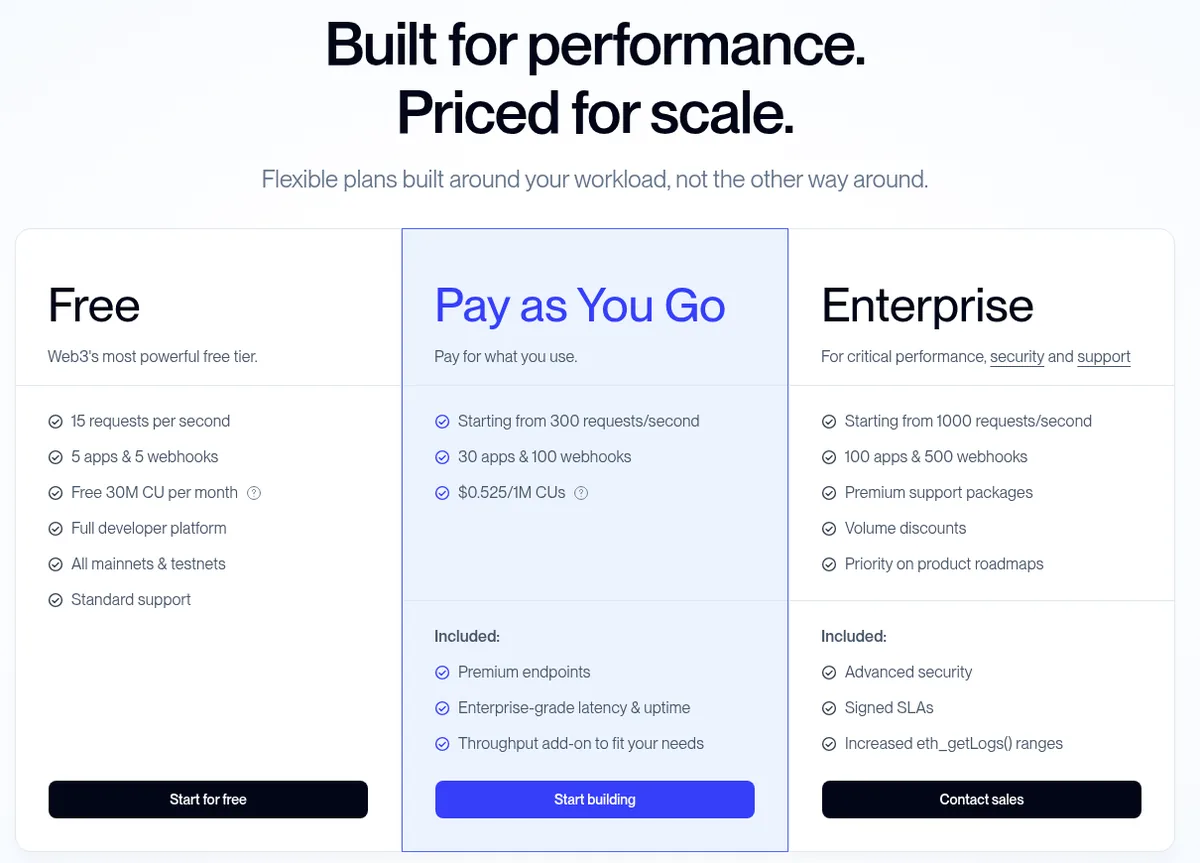
- Plans: Free (30M CU a month, 15 rps), Pay as you go at $0.525 per 1M CU from 300 rps with Parity trace and Geth debug, and Enterprise with signed SLAs.
- Ethereum meter: 20 CU for
eth_getBalanceand block reads, 26 foreth_call, 40 fordebug_traceTransactionand 60 foreth_getLogs, per its CU table. - Strengths: the best free archive tier here, no
eth_getLogsblock cap on pay as you go, and SOC 2 Type II on its trust page. - Weaknesses: $31.50 per million log queries, which put our indexer backfill at $1,386 a month, and support targets of 48 hours on Free and 24 hours on pay as you go.
Verdict: Alchemy scores 8.3. It is the easiest start for archive work, and stays a good fit while logs are a small share of traffic. See its entry in our full RPC ranking.
3. dRPC
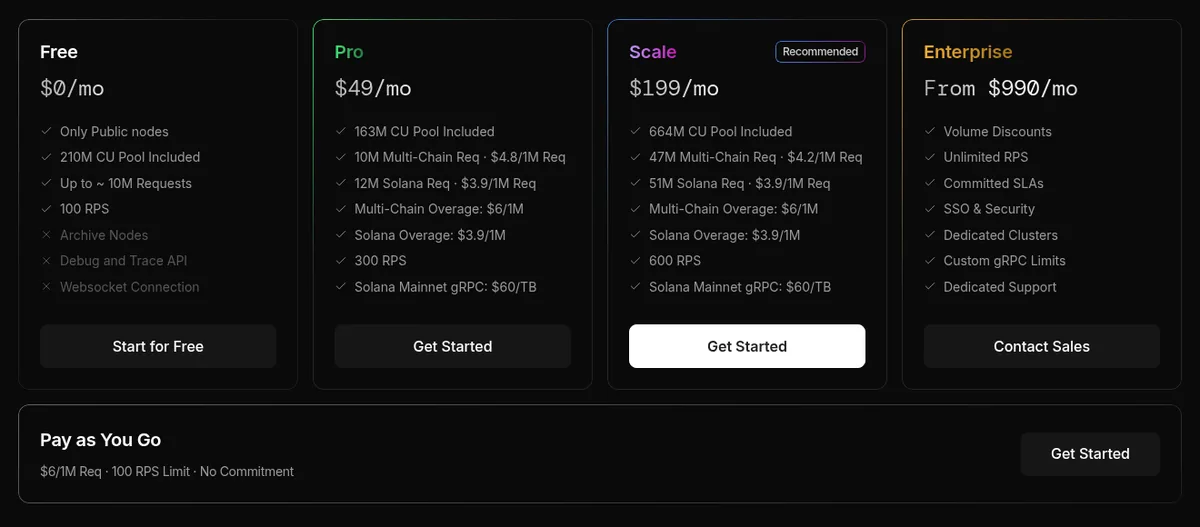
- Plans: Free on public nodes (210M CU, about 10M requests, 100 rps, archive and debug included), Pro $49 (163M CU, about 10M requests), Scale $199 (664M CU, about 47M requests), Enterprise from $990. Pay as you go costs $6 per million requests.
- Archive: its archive node docs describe archive nodes on popular networks, and our public endpoint test returned balances from block 46,147 and an old debug trace.
- Strengths: lowest bill in all three of our archive workloads, a 99.96% uptime claim and 120+ chains.
- Weaknesses: no audit report on its own pages, the free tier runs on public nodes only, and paid
eth_getLogsranges are not published on its pricing page.
Verdict: dRPC scores 8.2. Pick it for archive-heavy and trace-heavy Ethereum work where compliance paperwork is not a gate. See its entry in our full RPC ranking.
4. QuickNode
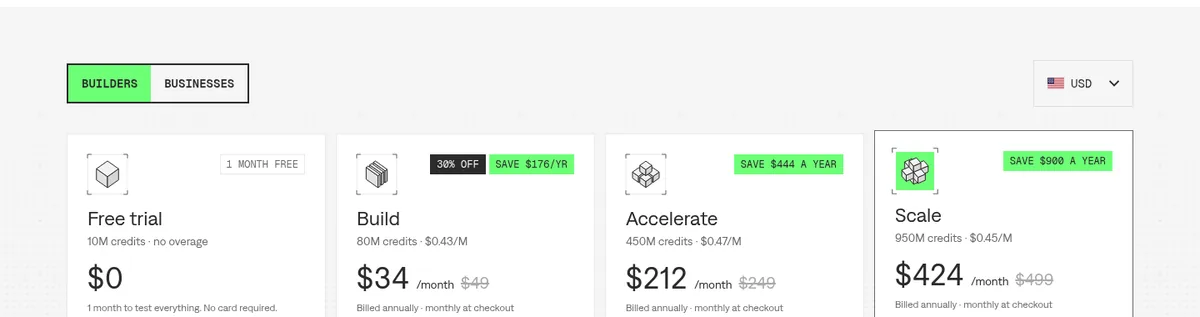
- Plans: Free trial (10M credits for one month, 15 rps), Build $49 (80M, 50 rps), Accelerate $249 (450M, 125 rps), Scale $499 (950M, 250 rps), Business from $999 (2B, 500 rps). Annual billing cuts Build to $34.
- Ethereum meter: 20 credits per call, 40 for trace and debug from Build up, and four times for
trace_replay*, per its API credit page.eth_getLogscovers 5 blocks on Free and 10,000 on paid plans. - Strengths: SOC 1 Type 2, SOC 2 Type 2 and ISO 27001 on its security page, archive even on the free trial, and overage from $0.62 down to $0.50 per million credits.
- Weaknesses: the free tier is a one-month trial, Build allows only 50 rps, and archive calls cost $12.25 per million on Build, two and a half times Chainstack.
Verdict: QuickNode scores 8.1. Pick it when latency and audit coverage outweigh the per-call price. See its entry in our full RPC ranking.
5. GetBlock
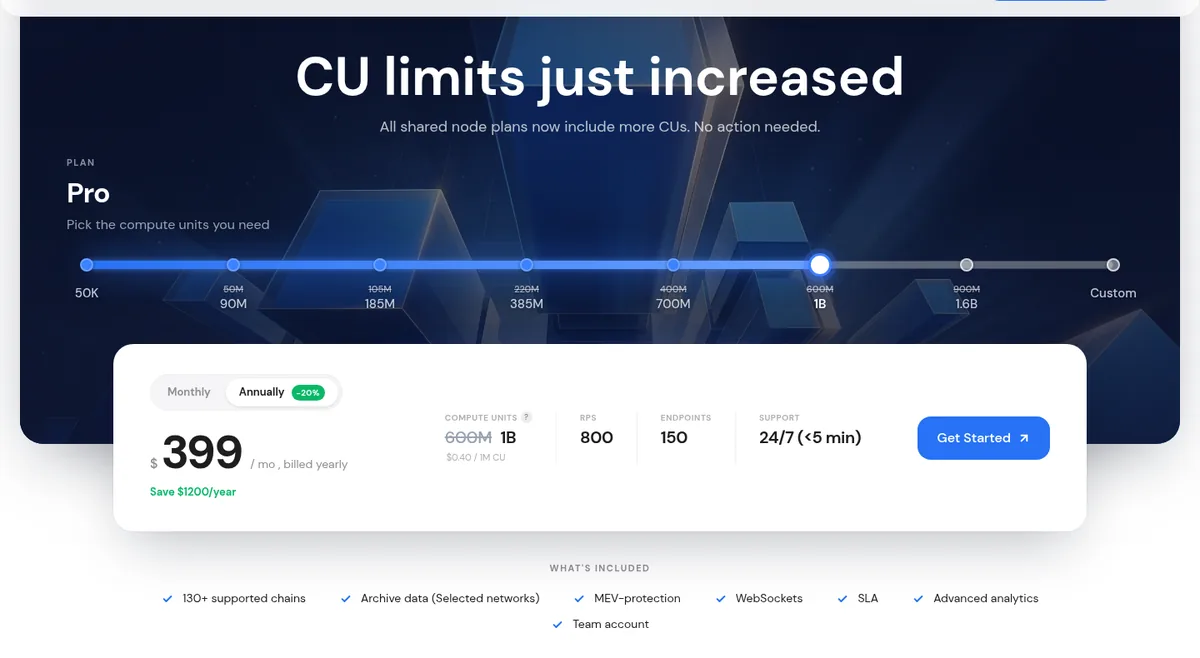
- Plans: Free (50,000 CU a day, limited archive), Starter $49 (90M CU, 250 rps), Growth $99 (185M), Advanced $199 (385M), Scale $349 (700M), Pro $499 (1B CU, 800 rps), Premium $699 (1.6B). Annual billing cuts Starter to $39.
- Archive rules: an archive modifier of 2 on archive endpoints, per its CU formula. Dedicated archive nodes start at $1,500 a month and full nodes at $1,000.
- Strengths: the tightest Ethereum p99 on OpenChainBench at 16.8 ms, SOC 2 Type II attested in Q2 2026, and a stated support response under 5 minutes.
- Weaknesses: $21.78 per million archive calls on Starter, no published overage below Pro, and no published
eth_getLogsrange.
Verdict: GetBlock scores 7.6. It suits teams that want consistent latency or a dedicated archive node with a published price. See its entry in our full RPC ranking. Our GetBlock vs dRPC vs Tatum comparison compares its plans with dRPC at real volumes.
6. Ankr
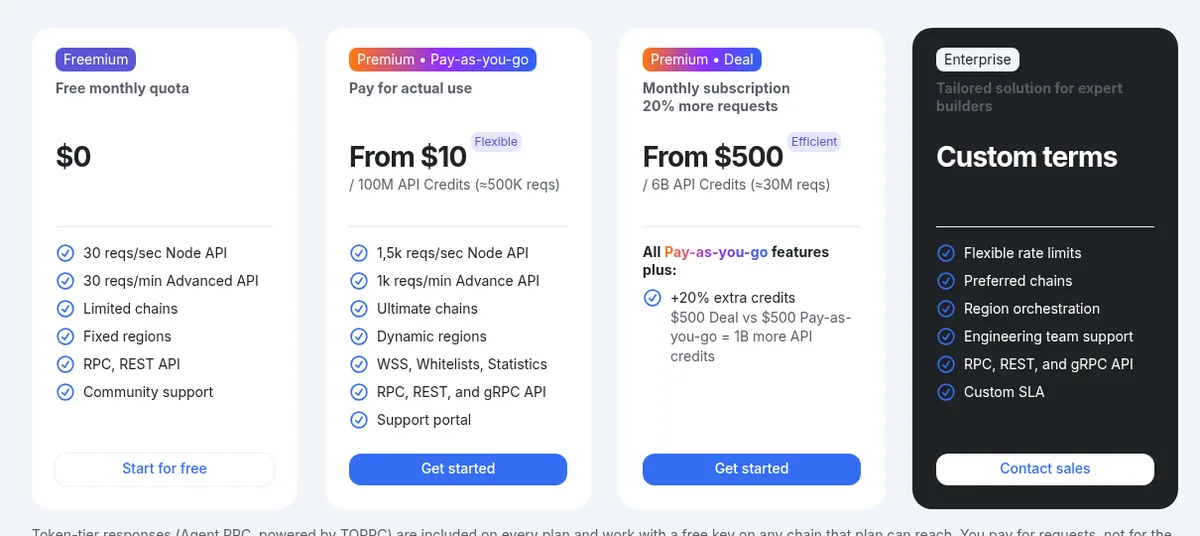
- Plans: Freemium (200M credits a month, about 1M requests, 30 rps), Pay as you go from $10 per 100M credits, and Deal at $500 for 6B credits, about 30M requests with 20% extra.
- Archive and logs: full and archive data on Public, Freemium and Premium, and
eth_getLogsranges of 1,000, 3,000 and 10,000 blocks, per its service plans page. Trace and debug need Premium. - Strengths: the highest rate limit here, flat pricing across methods, and SOC 2 Type II through its operator Asphere on its trust page.
- Weaknesses: $20 per million is four times dRPC’s flat rate, and no independent keyed latency data.
Verdict: Ankr scores 6.3. It fits bursty archive jobs that need a high rate ceiling on prepaid credits. See its entry in our full RPC ranking.
7. Infura
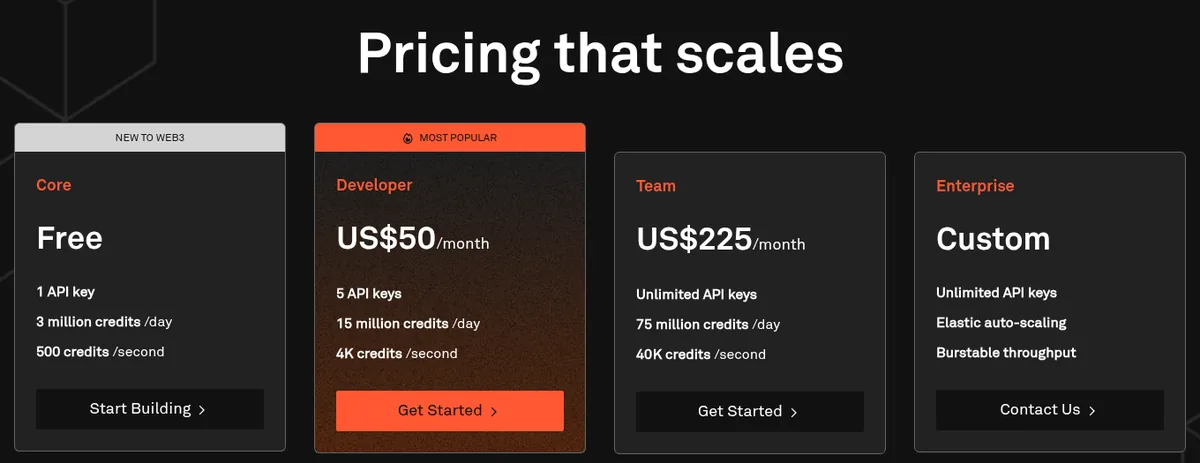
- Plans: Core free (3M credits a day, 500 per second), Developer $50 (15M a day, 4,000 per second, debug and trace), Team $225 (75M a day, 40,000 per second), Enterprise custom. An add-on sells 55M credits for $200 a month.
- Archive rules: requests older than 128 blocks cost the same credits as recent ones, though its credit cost page says this might change.
eth_getLogsis capped at 10,000 results and 10 seconds per query. - Strengths: archive data on the free tier and a cheap rate for archive balance reads at $8.89 per million.
- Weaknesses: a daily quota that our wallet mix breaks on busy days, $111.11 per million debug traces, and no SOC 2 or ISO 27001 report on its pages.
Verdict: Infura scores 6.1. It still suits light archive balance lookups that fit its daily quota. See its entry in our full RPC ranking.
8. Tatum
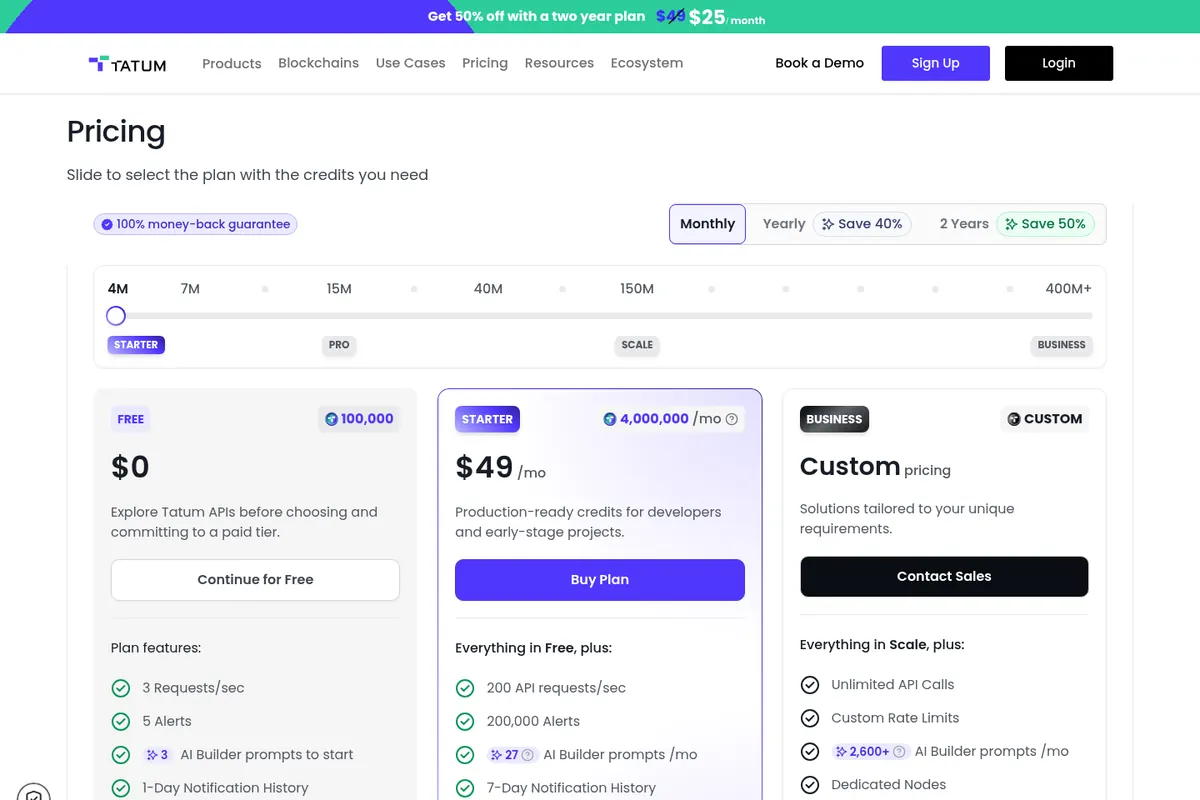
- Plans, billed monthly: Free (100,000 credits, 3 rps), Starter $49 (4M credits) or $79 (7M), Pro $139 (15M) or $349 (40M), Scale $1,199 (150M), all paid plans at 200 rps, per its plan limits.
- Ethereum meter: 2 credits for standard calls, 5 for
eth_calland 50 fordebug_*andtrace_*, per its RPC docs, which flag archive methods as possibly costing more. - Strengths: SOC 2 Type II and ISO 27001 on its security page, and cheap archive balance reads at 2 credits.
- Weaknesses: the highest bill for wallet history at $1,199, no public plan big enough for trace forensics, and no published
eth_getLogsrange.
Verdict: Tatum scores 6.1. It suits teams that want notifications and data APIs with light archive reads and no traces. See its entry in our full RPC ranking.
Providers We Left Out
Helius scores 7.0 in our main ranking but serves Solana only. Dwellir posted a 35.3 ms keyed median on OpenChainBench but is not yet in our scored set. NOWNodes, CDP Node and Lava scored lower on the same weights, and none of them published a clear Ethereum archive policy we could verify on 25 October 2026. Their entries sit in our RPC node provider ranking.
Self-hosting is the other route. An Erigon archive node needs about 2 TB of fast NVMe storage and growing, plus a consensus client and regular upgrades. Our dedicated nodes hub covers when a dedicated or self-run archive node beats shared plans.
Final Ranking
Chainstack wins on our weights because it pairs one of the lowest archive rates with audits. Alchemy is close behind for its free archive tier and tooling, and dRPC leads on raw price. QuickNode and GetBlock trade price for speed and consistency.


Verdict: Put your main Ethereum endpoint on Chainstack, use dRPC or QuickNode as the second endpoint, and reprice your archive share every quarter.
How to Test Archive Endpoints in One Week
A week of side-by-side traffic answers what a pricing page cannot. Send the same archive queries to two or three candidates from the region where your servers run. Log median and tail latency, error codes and whether each endpoint returns the same balance at the same old block.
for url in "$CHAINSTACK_URL" "$DRPC_URL" "$QUICKNODE_URL"; do
  curl -s -w " %{time_total}s\n" \
    -H "Content-Type: application/json" \
    -d '{"jsonrpc":"2.0","id":1,"method":"eth_getBalance","params":["0xde0B295669a9FD93d5F28D9Ec85E40f4cb697BAe","0xF4240"]}' \
    "$url"
done
Block 0xF4240 is block 1,000,000, so a node without archive data returns an error instead of a balance. Repeat the loop with an eth_getLogs call at your real block range and a debug_traceTransaction on an old hash before you commit to a plan.
Frequently Asked Questions
What is the best Ethereum RPC provider in 2026?
On our weighted scorecard, Chainstack is the best Ethereum RPC provider at 8.4 out of 10. Its Growth plan includes archive data for $49 a month, archive calls cost 2 request units, and it states SOC 2 Type II and ISO 27001. Alchemy is second at 8.3 and dRPC third at 8.2.
Which Ethereum RPC providers include archive data on the free plan?
Alchemy, Infura, dRPC, Ankr and Tatum include archive data on their permanent free plans, and QuickNode on its one-month free trial, based on vendor pages checked on 25 October 2026. Alchemy’s 30M monthly compute units give the most usable allowance. Chainstack starts archive access on Growth, and GetBlock lists free archive access as limited.
Do RPC providers charge more for archive calls?
Some do. Chainstack bills 2 request units for calls 127 or more blocks behind the tip, against 1 at the head, and GetBlock doubles compute units on archive endpoints. Alchemy, QuickNode, dRPC and Ankr charge the same as head calls, and Infura does too for now, though it says that might change.
What is the cheapest Ethereum archive RPC?
On list prices, dRPC Pro and Chainstack Growth are the cheapest Ethereum archive RPC options at about $4.81 and $4.90 per million archive calls when fully used. dRPC won all three archive workloads we modeled, including $108 a month for 20M trace calls. Infura charges $111.11 per million debug traces on Developer.
What is the eth_getLogs block range limit?
Limits vary by plan. Free plans allow 5 blocks on QuickNode, 10 on Alchemy, 100 on Chainstack and 3,000 on Ankr Freemium. Paid plans allow 10,000 blocks on Chainstack, QuickNode and Ankr Premium, and Alchemy pay as you go has no block cap on Ethereum, with responses capped at 150 MB.
Should I run my own Ethereum archive node?
Only at high, steady volume. An Erigon archive node needs about 2 TB of fast storage and growing, plus a consensus client and upkeep. GetBlock sells dedicated archive nodes from $1,500 a month, while shared plans cover 20M archive calls for about $108 to $199, so most teams should start shared.