
Last updated: 4 November 2026 · Plan prices, allowances, unit costs and rate limits rechecked on the GetBlock, dRPC and Tatum pricing pages and docs on 4 November 2026
In GetBlock vs dRPC vs Tatum, dRPC is the cheapest for almost every workload in 2026: about $6 per 1M standard Ethereum calls on every plan, with a $49 Pro plan that covers roughly 8M calls. GetBlock costs more per call but includes archive data, WebSockets and MEV protection from $49. Tatum is the priciest per call, except for archive-heavy reads, where its 2-credit calls undercut GetBlock.
We read each vendor’s pricing page and unit table on 4 November 2026, including all 13 monthly stops on Tatum’s price slider, and turned three different billing units into monthly bills for three workloads at six volumes. Our methodology page explains how we collect prices.
TL;DR
- Budget scores: dRPC 9.0, GetBlock 7.2 and Tatum 4.2 out of 10, on price per call, the $49 plan, the free plan, features and billing predictability.
- For $49 a month you get about 8,150,000 standard Ethereum calls on dRPC Pro, 4,500,000 on GetBlock Starter and 2,000,000 on Tatum Starter.
- At 10M dApp calls a month the cheapest published option is $60 on dRPC, $199 on GetBlock and $349 on Tatum.
- GetBlock doubles compute units on archive endpoints, so for 10M archive reads Tatum ($179) beats GetBlock ($349). dRPC is still cheapest at $60.
- Tatum charges 50 credits for each debug or trace call, so 1M trace calls needs its $649 Pro 80M tier. The same 1M calls cost $6 on dRPC and $49 on GetBlock.
- Free plans differ more than paid ones: dRPC covers about 10.5M calls every 30 days, GetBlock about 2,500 Ethereum calls a day, and Tatum 100,000 lifetime credits.
Which Budget RPC Provider Should You Pick
Pick by the workload you will run most, since each vendor prices methods differently. dRPC charges the same 20 CU for almost every EVM method, so its bill depends only on call count, not on which methods you use. GetBlock and Tatum both charge more for heavy methods, in different ways.
- Lowest bill for most dApps and bots: dRPC, at about $6 per 1M calls on Pay as You Go, Pro and Scale.
- Archive data, WebSockets and MEV protection on a $49 plan: GetBlock Starter, with 90M CU and 250 requests per second.
- A flat monthly fee with no metering: GetBlock Limitless Node, from $150 a month for 25 requests per second on EVM full nodes.
- Archive-heavy indexing at low volume: Tatum, where a standard call costs 2 credits on archive or full data.
- Notifications and wallet APIs from the same vendor: Tatum, whose paid plans bundle 200,000 alerts with RPC credits.
- Paying in crypto: dRPC or GetBlock. Tatum’s pricing page says it does not accept crypto payments yet.
Verdict: Start on dRPC for raw cost. Add GetBlock if you need MEV-protected sends or a flat-rate endpoint, and pick Tatum only if you also want its notification and data APIs.
How We Scored the Three
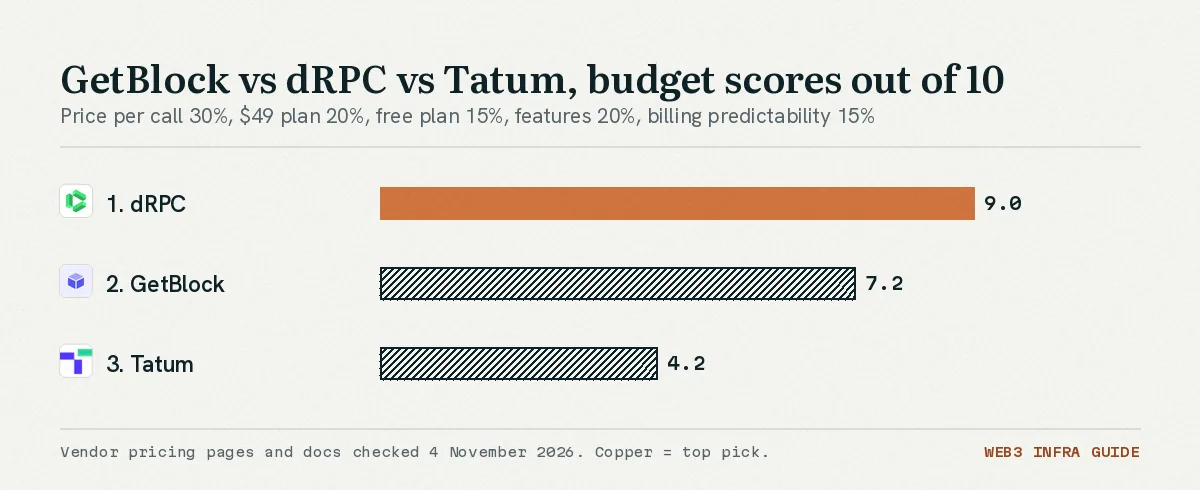
Our main RPC provider ranking weighs compliance and support for production buyers. This comparison is for teams with a tight budget, so it uses a separate rubric. Each provider gets 1 to 5 on five criteria, and the weighted sum is doubled to give a score out of 10. All inputs come from vendor pages checked on 4 November 2026.
| Provider | Price per call (30%) | $49 plan (20%) | Free plan (15%) | Features (20%) | Predictability (15%) | Score |
|---|---|---|---|---|---|---|
 | 5 | 5 | 5 | 4 | 3 | 9.0 |
 | 3 | 4 | 2 | 5 | 4 | 7.2 |
 | 1 | 2 | 1 | 4 | 3 | 4.2 |
Features covers archive data, WebSockets, trace and debug access and MEV protection. Predictability rewards billing you can forecast, and loses points for unpublished overage rates or pricing pages that disagree with the vendor’s own docs.
Plans Side by Side
The three vendors use three different units. A standard Ethereum call costs 20 CU on GetBlock, 20 CU on dRPC and 2 credits on Tatum, so the headline allowances are not comparable until you divide them out. The table converts each entry plan into calls.
| Plan | Price a month | Allowance | Standard Ethereum calls | Rate limit |
|---|---|---|---|---|
| $0 | 210M CU per 30 days | About 10.5M | 100 requests a second, public nodes |
| $49 | 163M CU | About 8.15M (dRPC states 10M) | 300 requests a second |
| $199 | 664M CU | About 33.2M (dRPC states 47M) | 600 requests a second |
| $0 | 50,000 CU a day | About 2,500 a day | 20 requests a second |
| $49 ($39 billed yearly) | 90M CU | About 4.5M | 250 requests a second |
| $499 ($399 billed yearly) | 1B CU | About 50M | 800 requests a second |
| $0 | 100,000 lifetime credits | About 50,000 in total | 3 requests a second |
| $49 (from $25 on a two-year plan) | 4M credits | About 2M | 200 requests a second |
| $649 | 80M credits | About 40M | 200 requests a second |
Verdict: Per dollar, dRPC Pro buys about 1.8 times GetBlock Starter’s calls and about 4 times Tatum Starter’s.
1. dRPC
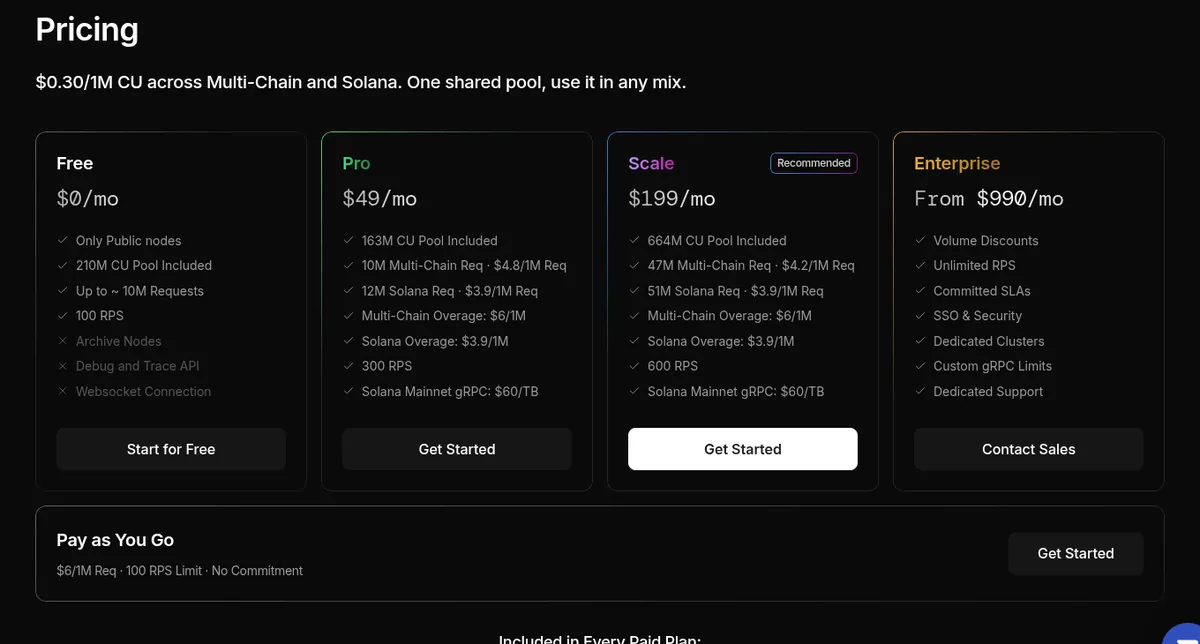
- Overage: $6 per 1M multi-chain requests and $3.9 per 1M Solana requests on Pro and Scale.
- Free plan: 210M CU every 30 days on public nodes only, at 100 requests a second, with no archive, no debug or trace and no WebSockets. Its rate limiting docs add a 2-second timeout and batches of 3.
- Paid plans include: 120+ chains, 99.96% uptime, unlimited API keys, frontrunning protection, team access and crypto payments.
- Enterprise: from $990 a month with volume discounts, unlimited requests per second and committed SLAs.
Verdict: dRPC scores 9.0. It is the cheapest per call at every volume we modelled. The gap between its stated request counts and its CU math is the one thing to check before you buy.
2. GetBlock
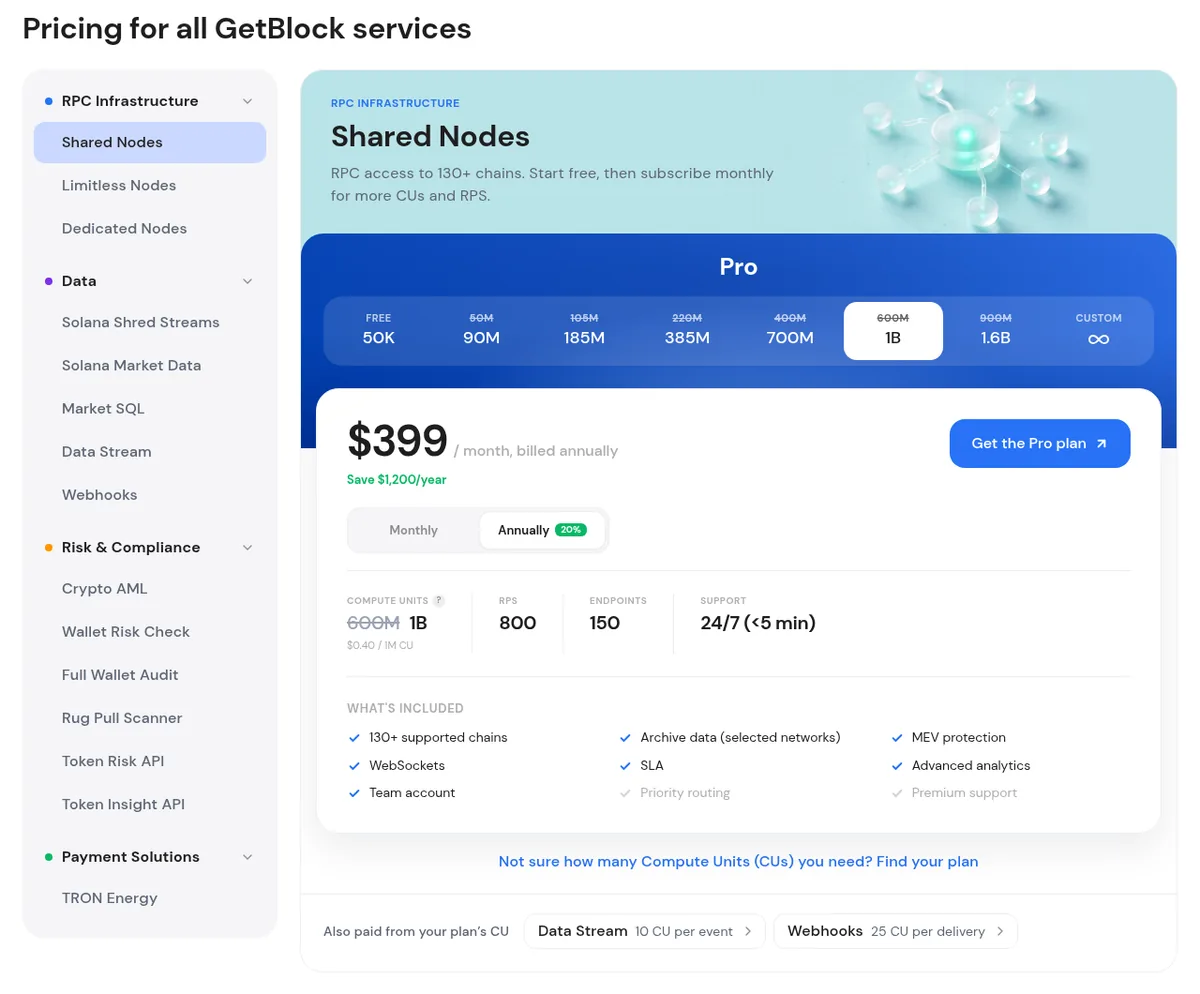
- Method costs: most methods 20 CU on Ethereum, trace and debug 40 CU, and
trace_replayTransaction80 CU on full nodes. - A conflict to know: its Compute Units page lists 120 CU for archive debug and trace calls, while the docs formula gives 80. Budget for the higher figure.
- Solana: a chain multiplier of 50, so a Solana call costs 2.5 times an Ethereum call.
- Extra CU: top-up packages on any paid plan, down to $0.40 per 1M CU on Pro and $0.35 on Premium. Bought CU carries over while the subscription stays active.
- Included from Starter: archive data on selected networks, WebSockets and MEV protection, with payments by card or crypto.
Verdict: GetBlock scores 7.2. It costs about $9 to $11 per 1M standard calls, more than dRPC, but it has the widest feature set at $49 and a flat-rate option for steady traffic.
3. Tatum
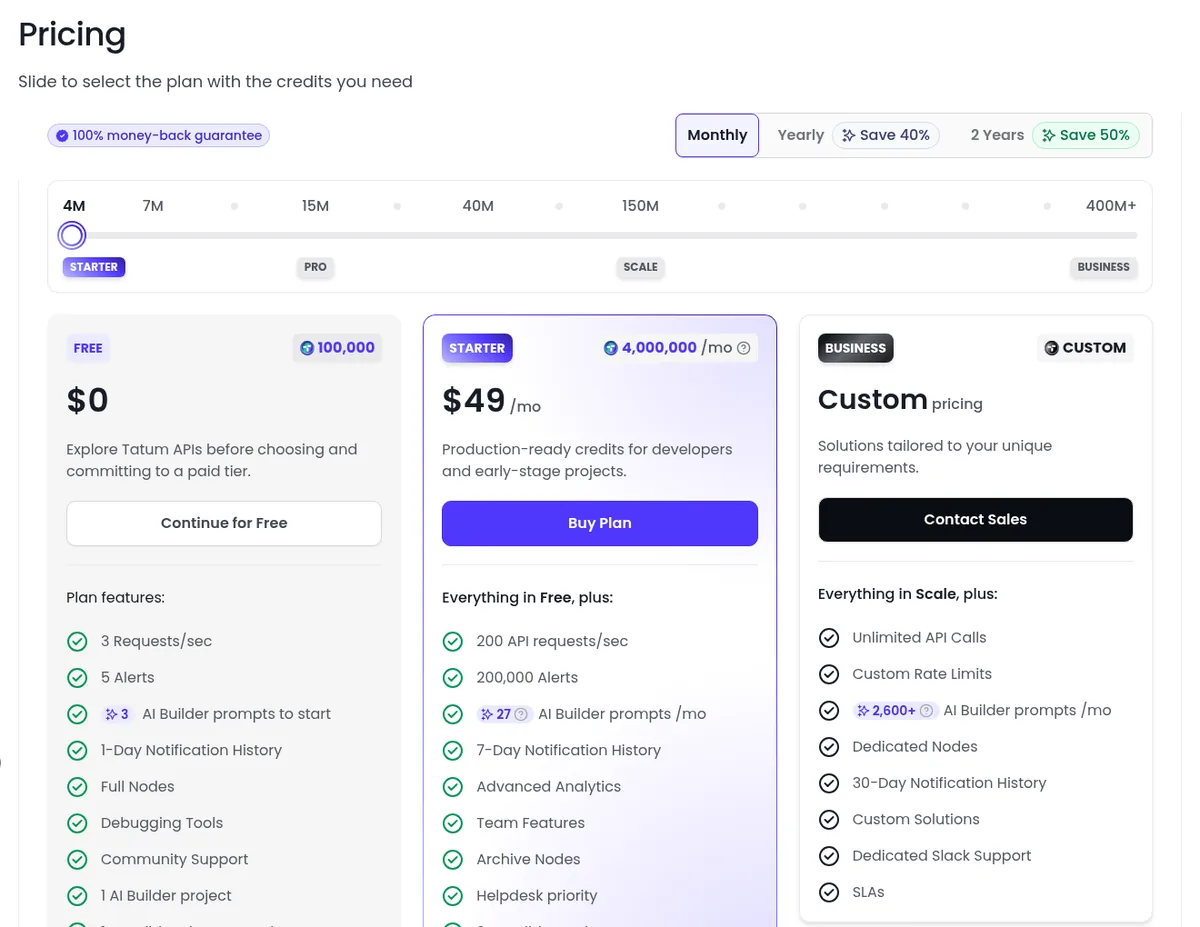
eth_call 5 credits and debug_* and trace_* methods 50 credits, per its RPC docs. Tatum Starter buys about 2M standard calls for $49, a quarter of what the same $49 buys on dRPC Pro. The yearly toggle saves 40% and the two-year toggle 50%.
- Slider stops: Starter 4M ($49), 7M ($79) and 10M ($99); Pro 15M ($139), 20M ($179), 40M ($349) and 80M ($649); Scale 150M ($1,199) up to 400M ($2,799).
- Free plan: 100,000 lifetime credits at 3 requests a second. Its gateway limits page lists
eth_call,trace_callanddebug_traceCallas unavailable on Free. - Running out: the pricing page says plans auto-upgrade to the next tier when credits run out, which you can switch off. Credits do not roll over.
- A conflict to know: its plans and limits docs list Pro at 10M to 20M credits and Scale at 40M to 80M, while the live slider puts those amounts in Starter and Pro. We used the slider.
- Paid plans include: 200 requests a second, archive nodes, 200,000 alerts and team features, paid by card or bank transfer.
Verdict: Tatum scores 4.2. It is the most expensive of the three for RPC alone. It makes sense when you also use its notification and data APIs, or for archive reads at low volume.
What Each Costs at Real Volume
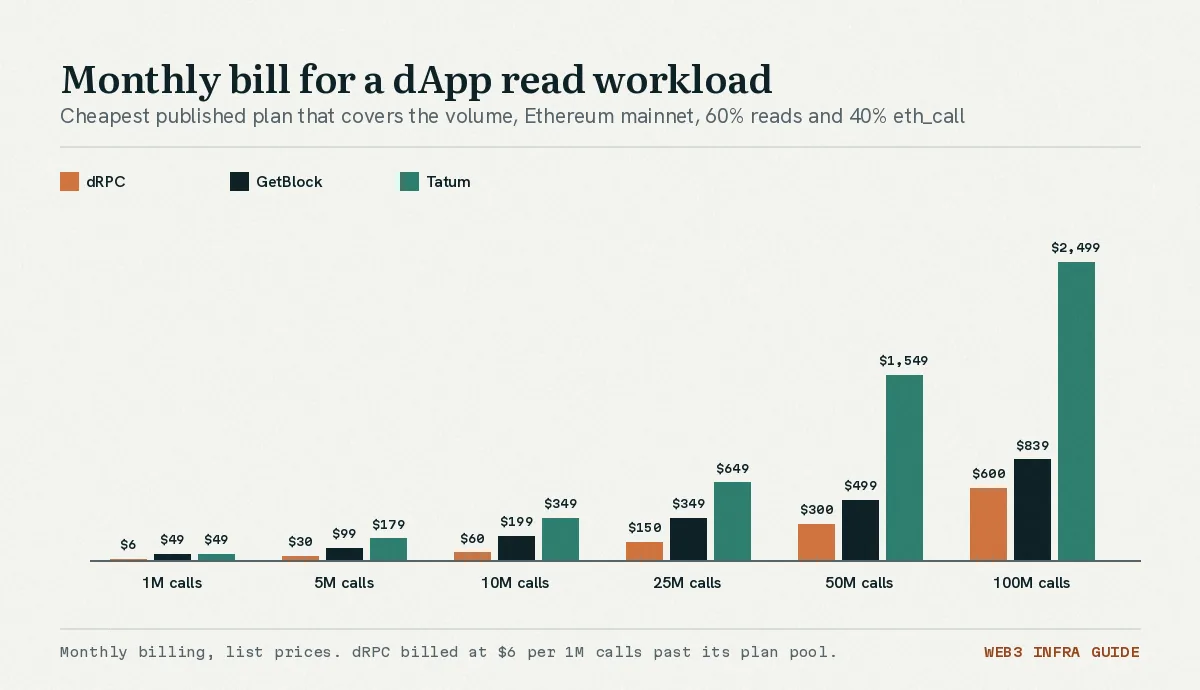
For this GetBlock vs dRPC vs Tatum cost test we priced three Ethereum workloads at six monthly volumes, using the cheapest published plan that covers each one. dRPC is the cheapest option in all 18 cases, and Tatum beats GetBlock only on the archive indexer workload. Tatum has no published price above 400M credits, so heavy trace volumes need its custom Business plan.
| Workload | Calls a month | dRPC | GetBlock | Tatum |
|---|---|---|---|---|
| dApp reads | 1M | $6 (Pay as You Go) | $49 (Starter) | $49 (Starter 4M) |
| dApp reads | 10M | $60 (Pay as You Go) | $199 (Advanced) | $349 (Pro 40M) |
| dApp reads | 50M | $300 (Scale + overage) | $499 (Pro) | $1,549 (Scale 200M) |
| dApp reads | 100M | $600 (Scale + overage) | $839 (Premium + extra CU) | $2,499 (Scale 350M) |
| Archive indexer | 1M | $6 (Pay as You Go) | $49 (Starter) | $49 (Starter 4M) |
| Archive indexer | 10M | $60 (Pay as You Go) | $349 (Scale) | $179 (Pro 20M) |
| Archive indexer | 50M | $300 (Scale + overage) | $839 (Premium + extra CU) | $1,199 (Scale 150M) |
| Archive indexer | 100M | $600 (Scale + overage) | $1,539 (Premium + extra CU) | $1,549 (Scale 200M) |
| Trace and debug | 1M | $6 (Pay as You Go) | $49 (Starter) | $649 (Pro 80M) |
| Trace and debug | 10M | $60 (Pay as You Go) | $349 (Scale) | Custom (Business (custom)) |
| Trace and debug | 50M | $300 (Scale + overage) | $839 (Premium + extra CU) | Custom (Business (custom)) |
| Trace and debug | 100M | $600 (Scale + overage) | $1,539 (Premium + extra CU) | Custom (Business (custom)) |
- dApp reads: 60% standard reads such as
eth_getBalance,eth_getLogsand receipts, and 40%eth_call. That averages 20 CU on GetBlock and dRPC and 3.2 credits on Tatum. - Archive indexer: standard reads against archive data, 40 CU on GetBlock archive endpoints, 20 CU on dRPC and 2 credits on Tatum.
- Trace and debug:
debug_traceTransactionon full nodes, 40 CU on GetBlock, 20 CU on dRPC and 50 credits on Tatum.
Our free-tier figures match the independent OpenChainBench comparison of dRPC and GetBlock, which lists 10.50M and 75.0K requests a month. That page does not cover Tatum. For a wider look at paid tiers, see our RPC provider pricing guide.
Verdict: If your traffic is mostly standard reads and calls, dRPC costs roughly a third of GetBlock and a sixth of Tatum at 10M calls a month.
Cost Per 1M Calls on Every Plan
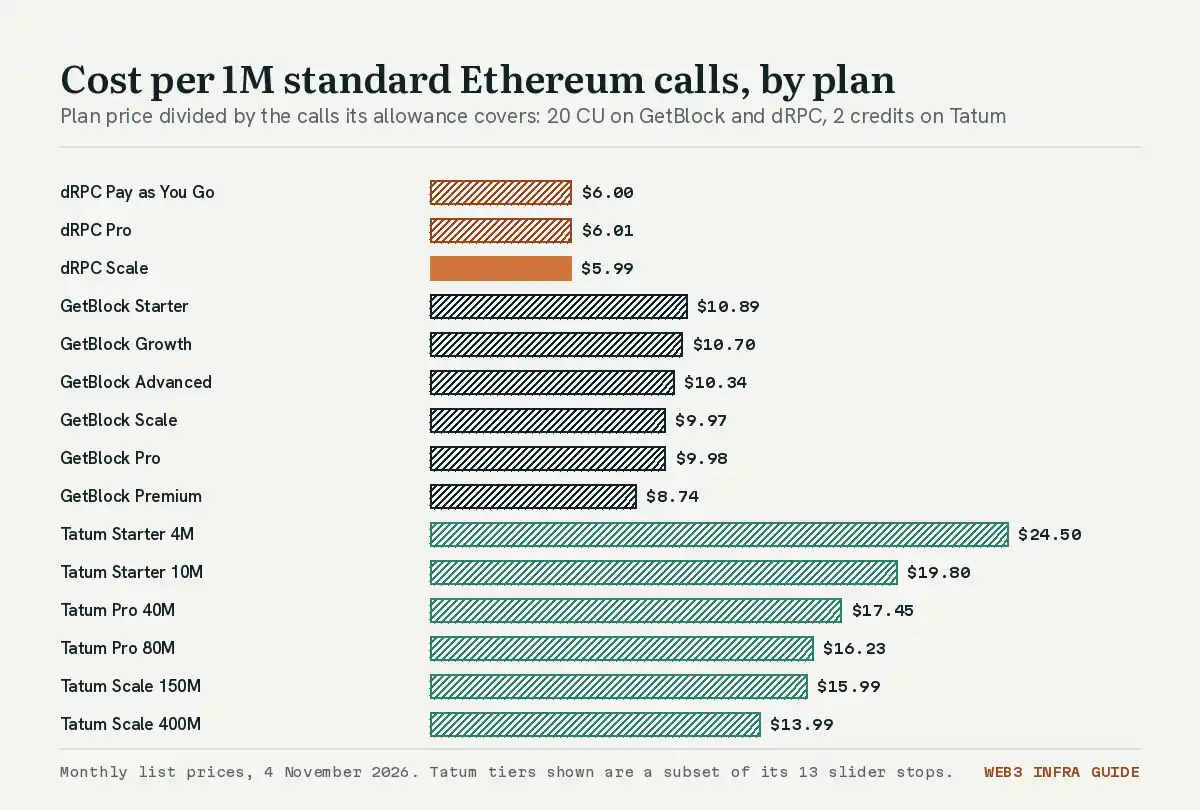
Dividing each plan price by the calls it covers shows how much bigger plans save. dRPC costs about $6 per 1M calls on every plan, while GetBlock falls from $10.89 on Starter to $8.74 on Premium and Tatum from $24.50 to $13.99. Volume discounts on GetBlock and Tatum never close the gap with dRPC at list prices.
| Provider | Entry plan | Largest self-serve plan | Cost per 1M calls |
|---|---|---|---|
| Pro, $49 for 163M CU | Scale, $199 for 664M CU | About $6.00 on every plan |
| Starter, $49 for 90M CU | Premium, $699 for 1.6B CU | $10.89 down to $8.74 |
| Starter, $49 for 4M credits | Scale, $2,799 for 400M credits | $24.50 down to $13.99 |
Verdict: Bigger plans help on GetBlock and Tatum, but even their largest self-serve tiers cost more per call than dRPC’s entry plan.
Flat-Rate Options for Steady Traffic
GetBlock’s Limitless Node charges a fixed fee per requests-per-second tier with no CU metering, and Tatum sells dedicated API keys outside plan credits. A 25 RPS GetBlock Limitless endpoint at $150 a month beats dRPC metering once you pass 25M calls a month, about 10 requests a second on average. dRPC has no flat tier.
| Option | Price a month | Throughput | Calls at full use |
|---|---|---|---|
| $150 / $300 / $500 / $1,000 | 25 / 50 / 150 / 300 RPS | About 64.8M at 25 RPS |
| $150 / $300 / $500 / $1,000 | 15 / 30 / 50 / 100 RPS | About 38.9M at 15 RPS |
| $150 / $450 / $900 / $1,500 | 5 / 15 / 30 / 50 RPS | About 13M at 5 RPS |
| $99 / $249 / $509 / $1,049 | 10 / 25 / 50 / 100 RPS | About 25.9M at 10 RPS |
Real traffic is bursty, so you rarely reach those full-use figures. Size the tier to your peak rate, then compare the fee with your metered bill from the table above. GetBlock Limitless is self-serve on 16 chains, with archive mode on 9 of them.
Verdict: For steady bots and indexers above about 10 requests a second, GetBlock Limitless is the cheapest predictable option of the three. When you need a full private node instead, see our dedicated node providers guide.
Run Two Budget Providers in a Fallback
Budget plans throttle at their rate caps, so a second provider is cheap insurance. Route standard reads to dRPC and keep GetBlock as the fallback for archive reads and MEV-protected sends. The viem fallback transport moves to the next endpoint when one fails or times out.
import { createPublicClient, fallback, http } from "viem";
import { mainnet } from "viem/chains";

const client = createPublicClient({
  chain: mainnet,
  transport: fallback(
    [
      http(process.env.DRPC_URL),     // lowest cost per call
      http(process.env.GETBLOCK_URL), // archive, WebSockets, MEV
      http(process.env.TATUM_URL),    // last resort
    ],
    { rank: true, retryCount: 2 }
  ),
});
Keep trace calls off Tatum unless you have priced them, since each one costs 25 times a standard call. For more options on Ethereum, see our Ethereum RPC provider ranking, and for Solana see our Solana RPC provider ranking.
Verdict: A dRPC plus GetBlock fallback gives you the lowest per-call cost and the wider feature set for little more than one plan.
Final Verdict
dRPC is the best budget RPC provider of the three in 2026, at about $6 per 1M calls on every plan. GetBlock is the pick when you need archive data, WebSockets or MEV protection on a $49 plan, or a flat-rate endpoint. Tatum fits teams that want its notification APIs. See our Alchemy alternatives and Infura alternatives guides.


Verdict: Use dRPC for cost, add GetBlock for features, and browse the RPC providers hub for more comparisons. For no-cost plans see our free RPC providers guide, and for mainstream paid options see our QuickNode alternatives guide and our QuickNode vs Infura vs Ankr comparison.
Frequently Asked Questions
Which is cheapest: GetBlock, dRPC or Tatum?
dRPC, for nearly every workload. It charges about $6 per 1M standard Ethereum calls on Pay as You Go, Pro and Scale. GetBlock costs $8.74 to $10.89 per 1M on its shared plans, and Tatum $13.99 to $24.50. At 10M dApp calls a month that is $60, $199 and $349.
Does dRPC Pro really include 10M requests?
Its pricing card says 10M multi-chain requests for 163M CU. Its compute unit table charges 20 CU for nearly every EVM method, which gives 8.15M calls. Plan on about 8M calls a month, and budget for overage at $6 per 1M multi-chain requests after the pool runs out.
How much does Tatum cost per month?
Tatum’s monthly slider runs from Starter at $49 for 4M credits to Scale at $2,799 for 400M credits, with 13 stops and custom Business pricing above. A standard RPC call costs 2 credits, eth_call 5 and debug or trace methods 50. Yearly billing saves 40% and two-year billing 50%.
Is GetBlock good for archive data?
Yes, with a cost catch. Archive data is included from the $49 Starter plan, but archive endpoints double the compute unit cost, so a standard Ethereum archive read costs 40 CU instead of 20. For archive-heavy indexing at modest volume, Tatum’s 2-credit calls can cost less than GetBlock.
Which has the best free plan?
dRPC. Its free plan gives a 210M CU pool every 30 days, about 10.5M standard EVM calls at 100 requests a second, on public nodes without archive or trace. GetBlock Free gives 50,000 CU a day, about 2,500 Ethereum calls, and Tatum Free gives 100,000 lifetime credits.
Can I pay for these RPC plans with crypto?
dRPC and GetBlock both accept crypto. dRPC lists crypto payments on every paid plan, and GetBlock takes card payments or a one-time crypto payment by QR code. Tatum takes cards and bank transfers, and its pricing page says crypto payments are not accepted yet.