
Last updated: 1 November 2026 · FATF, EU, FinCEN and OFAC sources and every vendor page and price below rechecked on the original source on 1 November 2026
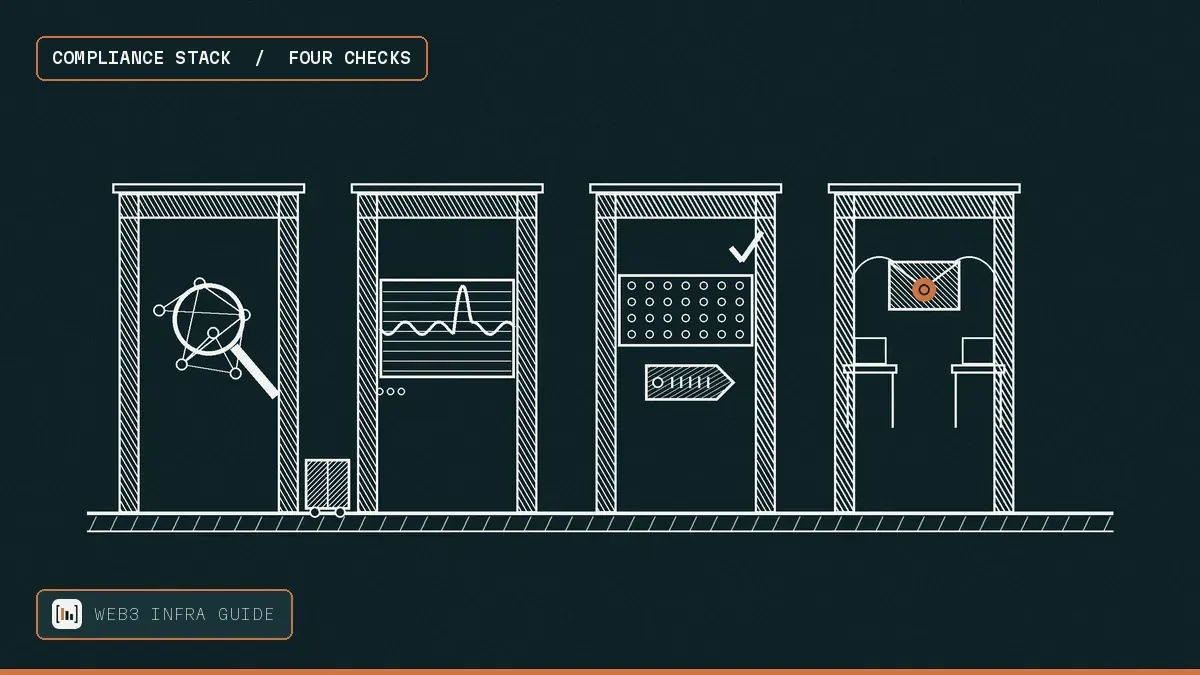
Crypto compliance tools fall into four groups, and each answers a different question. Blockchain analytics asks where funds came from, KYT (know your transaction) monitoring asks whether a transfer is risky as it happens, wallet screening asks whether an address is safe before you send, and a Travel Rule tool sends sender and recipient identity to the other regulated firm. Most exchanges, custodians and payment companies need all four plus KYC. We rank the best KYT tools and the best wallet screening APIs in separate guides.
This pillar compares the four groups on what they check, which rule drives them and what they cost, using only figures published by the regulators and vendors themselves. It anchors our crypto compliance hub, and our scoring rules are on the methodology page. Nothing here is legal advice.
TL;DR
- Four tool types: blockchain analytics for tracing and investigations, KYT for live transaction monitoring, wallet screening for pre-transfer address checks, and Travel Rule tools for sharing identity data with the counterparty firm.
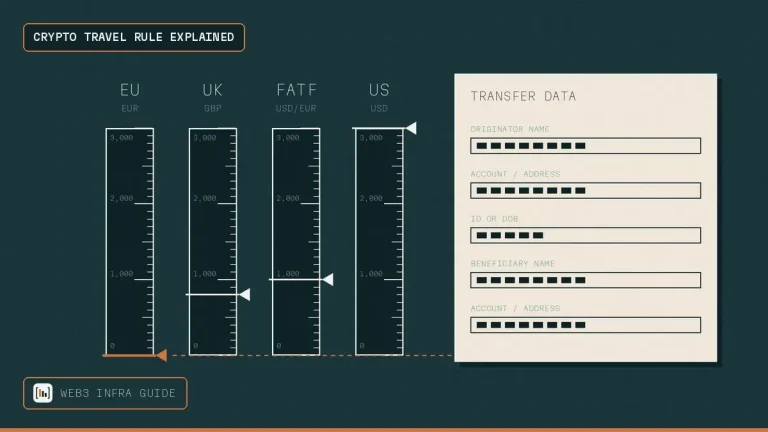
- The FATF lets countries set a USD/EUR 1,000 de minimis threshold for the Travel Rule; 99 jurisdictions had passed or were passing Travel Rule laws by June 2025.
- The EU Transfer of Funds Regulation has applied since 30 December 2024 with no minimum for CASP-to-CASP transfers, plus an ownership check on self-hosted wallets above EUR 1,000.
- In the US, FinCEN’s Funds Travel Rule covers transmittals of $3,000 or more, and OFAC lists crypto addresses on the SDN List with no amount floor.
- Analytics vendors publish coverage, not prices: Chainalysis KYT lists 400+ networks, TRM wallet screening 184+ blockchains and Elliptic Lens 60+ blockchains with 250+ bridges.
- Published prices exist at the edges: Notabene has a free tier for up to $10k of outgoing transfers a month, and Sumsub KYC starts at $1.35 a verification with a $149 monthly minimum.
The Decision Kernel
Start from the rule, then the money flow, then the vendor. If you send crypto for customers to other regulated firms, you need a Travel Rule tool and an address screen before the first transfer leaves. Analytics depth and investigation tooling matter more as volume and risk grow.
- Every regulated VASP or CASP: KYC, wallet screening, KYT and a Travel Rule tool, wired into one case queue.
- Payment company or fintech adding crypto: wallet screening and KYT first, Travel Rule as soon as you send to other exchanges.
- Custodian or bank: all four, with investigation-grade analytics for law enforcement requests and audit trails.
- DAO or protocol treasury with no customers: address screening on counterparties; the Travel Rule rarely applies without a regulated service in the flow.
Verdict: Buy by obligation. Screening and the Travel Rule are the minimum for anyone moving customer funds, KYT comes next, and deep investigation tooling earns its cost at exchange or custodian scale.
Crypto Compliance Tools at a Glance
| Tool type | Question it answers | When it runs | Rule that drives it | Examples | Published price |
|---|---|---|---|---|---|
| Blockchain analytics | Where did these funds come from and go? | Investigations, periodic reviews | AML programme, law enforcement requests | Chainalysis Reactor, Elliptic, TRM Labs | Quote only |
| KYT monitoring | Is this transfer risky right now? | Live, on every deposit and withdrawal | Suspicious activity monitoring and reporting | Chainalysis KYT, Elliptic Lens, TRM Labs | Quote only |
| Wallet screening | Is this address safe to deal with? | Before a transfer and on rescreen | Sanctions (OFAC SDN addresses), AML | Chainalysis Address Screening, TRM Labs, Elliptic Lens | Quote only |
| Travel Rule tool | Who sent this and who receives it? | Before or with each covered transfer | FATF R.16, EU TFR, FinCEN Funds Travel Rule | Notabene, Sumsub, Sygna | Notabene free tier; others quote |
| KYC and identity | Who is the customer? | Onboarding and periodic review | Customer due diligence | Sumsub | From $1.35 a verification (Sumsub Basic) |
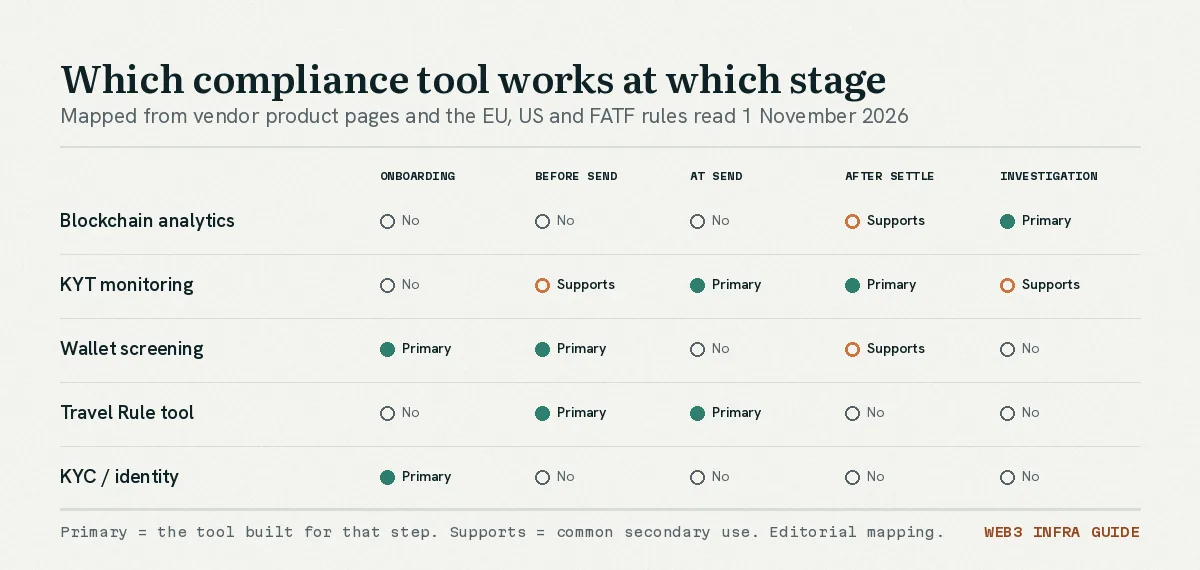
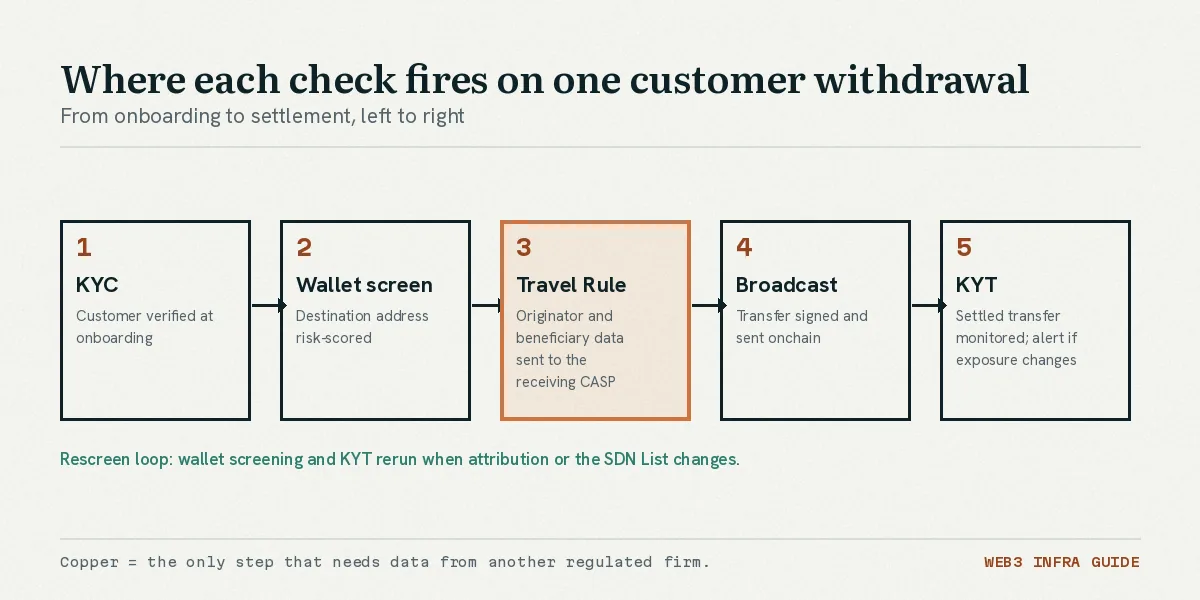
The map shows why buyers mix these products up. KYT and wallet screening often ship in one product, yet they fire at different moments: screening before the send, KYT after the transfer hits the chain. Only the Travel Rule step needs data from another regulated firm.
What the Rules Actually Require
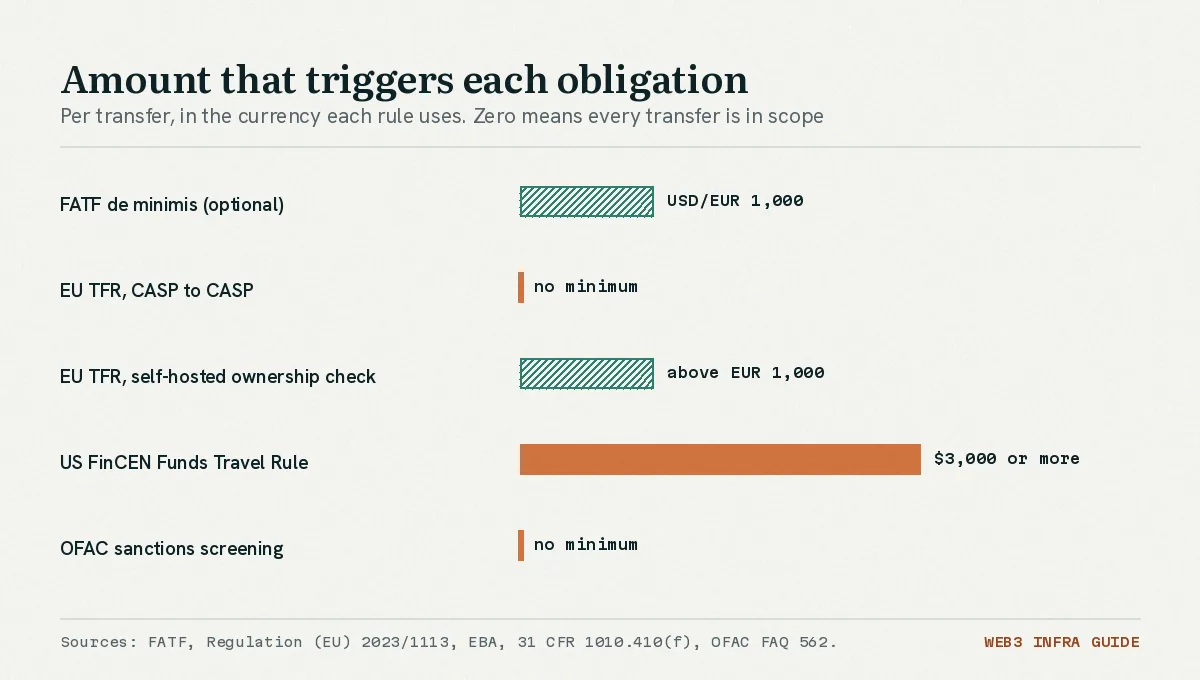
Four rule sets drive almost every crypto compliance budget. The FATF sets the global standard, the EU and US turn it into law, and OFAC adds sanctions screening on top. The thresholds differ by rule, so a single transfer can be below one threshold and above another.
| Rule | Who it covers | Amount trigger | What you must do |
|---|---|---|---|
| FATF Recommendation 16 (VA guidance) | VASPs in FATF member jurisdictions | Optional USD/EUR 1,000 de minimis | Obtain, hold and transmit originator and beneficiary data immediately and securely; below the threshold still collect names and wallet addresses |
| EU Regulation 2023/1113 (TFR) | CASPs in the EU | None for CASP-to-CASP; above EUR 1,000 for self-hosted ownership checks | Send originator and beneficiary data with every transfer; for self-hosted wallets collect the data and verify ownership above EUR 1,000 |
| 31 CFR 1010.410(f), FinCEN | US financial institutions, including money transmitters dealing in crypto | $3,000 or more | Pass required transmittor and recipient information to the next institution |
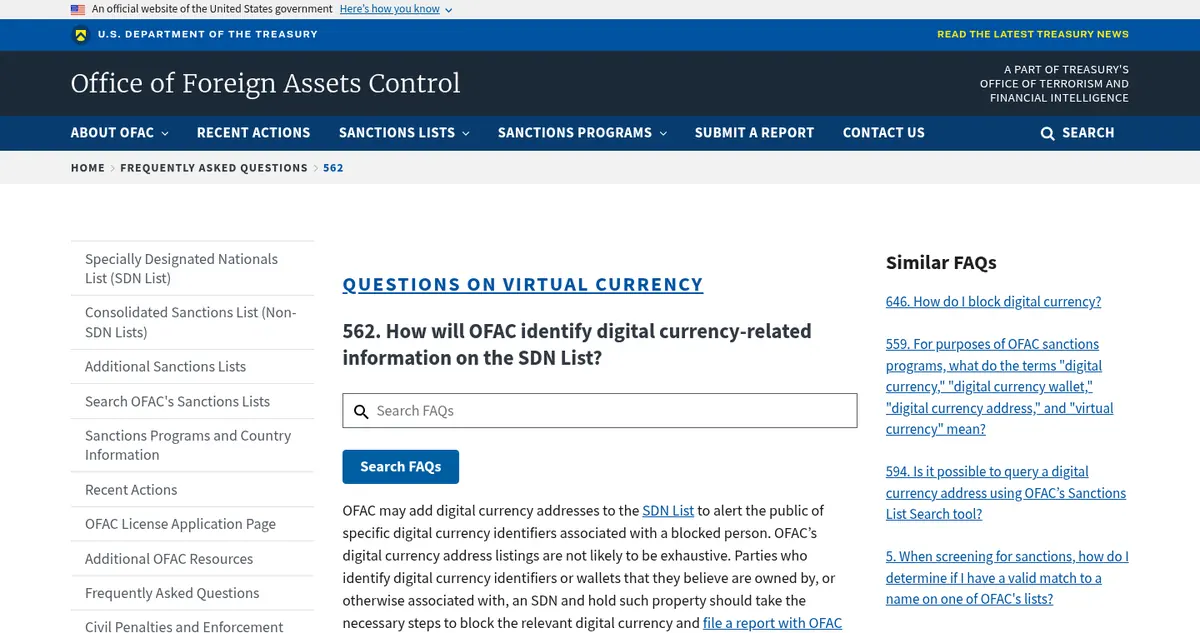
| OFAC SDN List | US persons | None | Block property of listed persons, including transfers involving listed crypto addresses |
- FATF progress: its June 2025 targeted update says 99 jurisdictions have passed or are passing Travel Rule laws, and that DPRK actors stole $1.46 billion from Bybit, the largest single crypto theft on record.
- EU verification methods: the EBA Travel Rule Guidelines list a signed message, a predefined test amount, attended or unattended checks, or other reliable technical means, and they apply from 30 December 2024.
- EU licensing: ESMA notes that MiCA grandfathering could run for up to 18 months after December 2024, which ended by 1 July 2026.
- US crypto scope: FinCEN’s 2019 CVC guidance says a transmittal of $3,000 or more, or its equivalent in crypto, may trigger the Funds Travel Rule.
- Sanctions lookups: OFAC’s FAQ 594 confirms its Sanctions List Search matches crypto addresses by exact ID only, so a vendor feed or list download is the practical route.
Verdict: Map each product you offer against these four rows before you shortlist vendors. The rule tells you which category is mandatory and which is a judgement call.
Blockchain Analytics and Investigations
Blockchain analytics groups addresses into entities, labels them and traces funds across hops, chains and bridges. It powers every other category on this page, because screening and KYT scores come from the same attribution data. Attribution coverage, the share of addresses a vendor can tie to a known service, matters more than the headline chain count.
- Elliptic: Lens covers 60+ blockchains and 250+ bridges and logs every screen and alert with the risk factors behind it, per its Lens page.
- Chainalysis: lists Reactor for tracing funds across blockchains, alongside KYT, Address Screening and VASP risking, on its KYT page.
- TRM Labs: sells investigation and compliance products built on one attribution graph; it contributed data to the FATF 2025 update alongside Chainalysis, Lukka and Merkle Science.
- What to test: run a sample of your own past alerts through each vendor and compare which addresses each one can attribute.
Verdict: Analytics is the engine, so judge it on your own data. Ask each finalist to score the same 50 historical deposits and compare attribution and false positives. Our blockchain analytics tools ranking scores nine vendors on that engine, and our Chainalysis vs TRM Labs vs Elliptic comparison puts the three largest side by side. If you are moving off Chainalysis, our Chainalysis alternatives guide ranks eight replacements.
KYT Transaction Monitoring
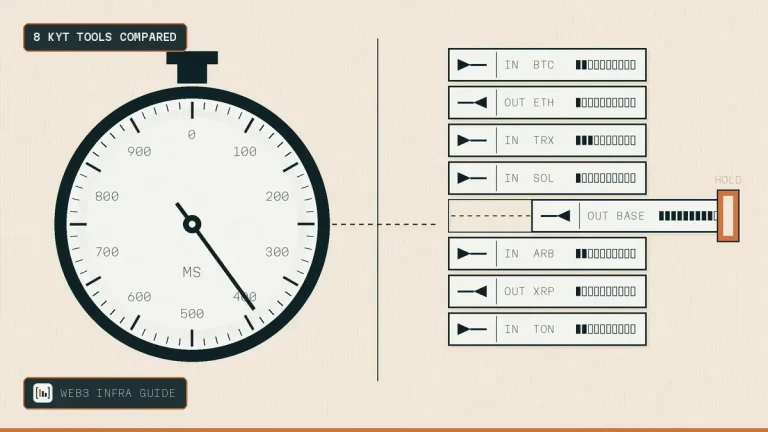
KYT watches deposits and withdrawals as they settle and raises an alert when a transfer touches a risky entity directly or through intermediate hops. Chainalysis says its KYT supports 400+ networks and 50M+ tokens and alerts within seconds of a transaction appearing onchain. A KYT alert is only useful if it lands in a queue where an analyst can freeze, escalate or file a report the same day.
- Direct vs indirect exposure: direct means the counterparty is the risky entity; indirect means funds passed through it earlier. Set separate thresholds for each.
- Behavioural rules: Chainalysis lists behavioural alerts and custom groups, so structuring or rapid in-and-out patterns can trigger review.
- Sanctions timing: Chainalysis says KYT can flag exposure to sanctioned entities both before and after a designation date.
- Case flow: confirm the vendor pushes alerts by API or webhook into your case tool so analysts work from one queue.
Verdict: Pick KYT on alert quality and integration, then chain coverage. Test noise on a week of real traffic before you sign a multi-year contract.
Wallet Screening
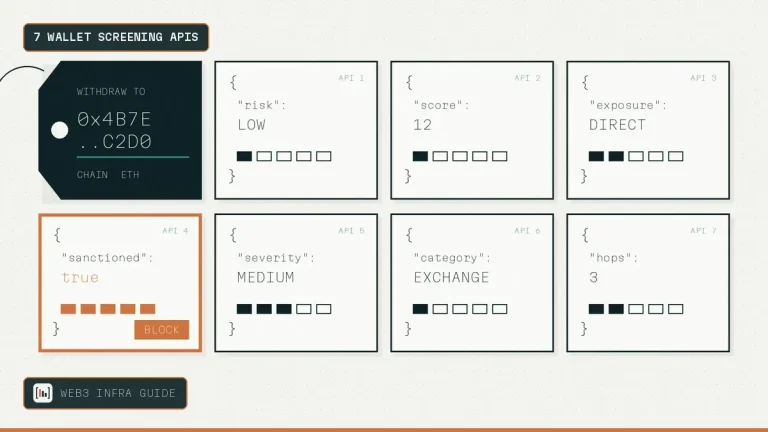
Wallet screening scores an address before you send funds to it or accept them from it. TRM Labs says its wallet screening covers 1.9B+ digital assets across 184+ blockchains. A clean score on day one can go stale, so set a rescreen trigger for new SDN listings and for vendor risk-score changes.
- Continuous monitoring: Chainalysis Address Screening sends alerts when an entity’s risk score changes, which removes manual rescreening.
- Practitioner view: compliance staff on r/AMLCompliance in August 2026 argued that point-in-time screening is not enough because attribution keeps changing after a transfer.
- Self-hosted wallets: in the EU, screening sits next to the ownership check above EUR 1,000; a clean score does not prove who controls the address.
- Latency: screening runs in the withdrawal path, so ask for p95 response times and a fallback rule if the API times out.
Verdict: Screen every external address at first use and rescreen on list or score changes. A screen with no rescreen loop leaves a gap that regulators look for.
Travel Rule Solutions
A Travel Rule tool finds the counterparty firm, agrees a protocol with it and sends originator and beneficiary data before or with the transfer. Counterparty reach decides how many of your transfers clear without manual follow-up, so compare networks before features. The three tools below publish network figures on their own pages, and our travel rule solutions ranking compares eight options in full, while our Notabene vs Sumsub vs Sygna comparison goes deeper on three of them. For the rules behind these tools, read our crypto Travel Rule explainer.
| Tool | Network figure (vendor stated) | Protocol and interop | Published price |
|---|---|---|---|
| Notabene | 2,300+ regulated institutions, 110+ jurisdictions, $3.0T+ volume | Own network plus TAP; works across protocols | Free tier up to $10k sent a month |
| Sumsub Travel Rule | 1,050+ VASPs in its directory, 5,000+ assets, $1.7T secured over two years | SDK, API and multiple protocols | Quote; KYC plans listed separately |
| Sygna | Bridge supports 3,000+ virtual assets | Sygna Bridge; interop with TRISA and Veriscope | Quote |
- Notabene free tier: its pricing page lists SafeTransact-Rise at no cost for up to $10k of outgoing transactions a month with unlimited incoming responses.
- Sygna Hub: bundles third-party analytics and sanctions data from Chainalysis, Elliptic, Merkle Science, Coinfirm, Dow Jones and ComplyAdvantage with its Travel Rule protocol.
- Sumsub: runs Travel Rule inside the same platform as its KYC and transaction monitoring, so one vendor covers identity and data exchange.
- Unhosted wallets: ask each vendor which EBA ownership methods it supports, such as message signing or a test amount.
Verdict: Choose the network your counterparties already use, then check the self-hosted wallet flow. Sending to a firm outside your network turns every transfer into email follow-up.
Where Each Check Fires in a Transfer
Put the checks in order on a single withdrawal and the overlap disappears. KYC runs once, screening and the Travel Rule run before the broadcast, and KYT runs after settlement and again whenever risk data changes. The code below routes a withdrawal to the checks the EU and US rules above require.
def required_checks(amount_eur, amount_usd, regime, counterparty):
    # counterparty: 'casp' (regulated firm) or 'self_hosted'
    checks = ['kyc_on_file', 'wallet_screen', 'sanctions_screen']
    if regime == 'EU':
        if counterparty == 'casp':
            checks.append('travel_rule_send')          # no minimum amount
        else:
            checks.append('collect_and_hold_tr_data')
            if amount_eur > 1000:
                checks.append('verify_wallet_ownership')  # EBA methods
    if regime == 'US' and counterparty == 'casp' and amount_usd >= 3000:
        checks.append('funds_travel_rule')
    checks.append('kyt_after_settlement')
    return checks

print(required_checks(1500, 1620, 'EU', 'self_hosted'))
# ['kyc_on_file', 'wallet_screen', 'sanctions_screen',
#  'collect_and_hold_tr_data', 'verify_wallet_ownership', 'kyt_after_settlement']
The EUR and USD amounts in the example are illustrative; use the exchange rate at the time of the transfer, as the EBA guidelines require. Local rules outside the EU and US can set other thresholds, so add a row per regime you serve. Keep the required_checks output in the case record as evidence of which rule applied.
What Crypto Compliance Tools Cost
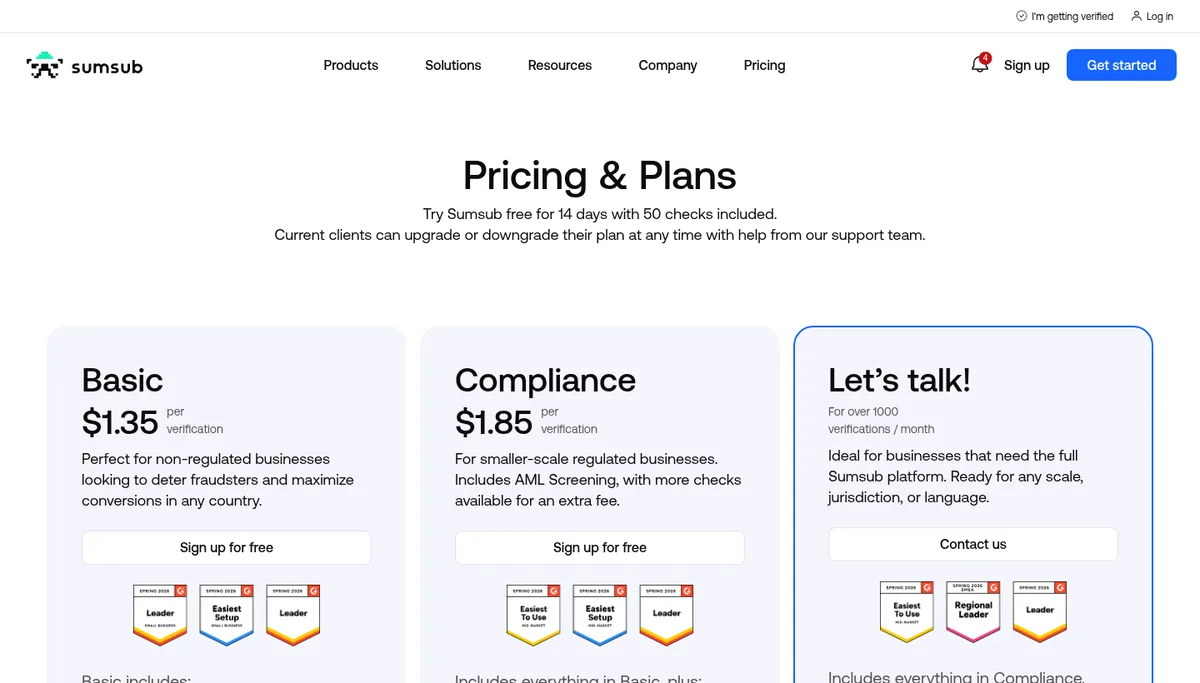
Most analytics, KYT and screening vendors sell on annual quotes, and none of the three large analytics vendors publishes a list price. We leave out the price ranges some comparison sites print for Chainalysis, TRM Labs and Elliptic, because the vendors themselves publish none. The published prices below still give a floor for budgeting.
| Product | Published price | Volume in the example | Example monthly bill |
|---|---|---|---|
| Sumsub Basic (KYC) | $1.35 a verification, $149 monthly minimum | 100 verifications | $149 (minimum applies) |
| Sumsub Basic (KYC) | $1.35 a verification | 2,000 verifications | $2,700 |
| Sumsub Compliance (KYC + AML and PoA) | $1.85 a verification, $299 monthly minimum | 2,000 verifications | $3,700 |
| Notabene SafeTransact-Rise | Free | Up to $10k sent a month | $0 |
| Chainalysis, TRM Labs, Elliptic, Sygna | Quote only | Any | Ask for a written quote |
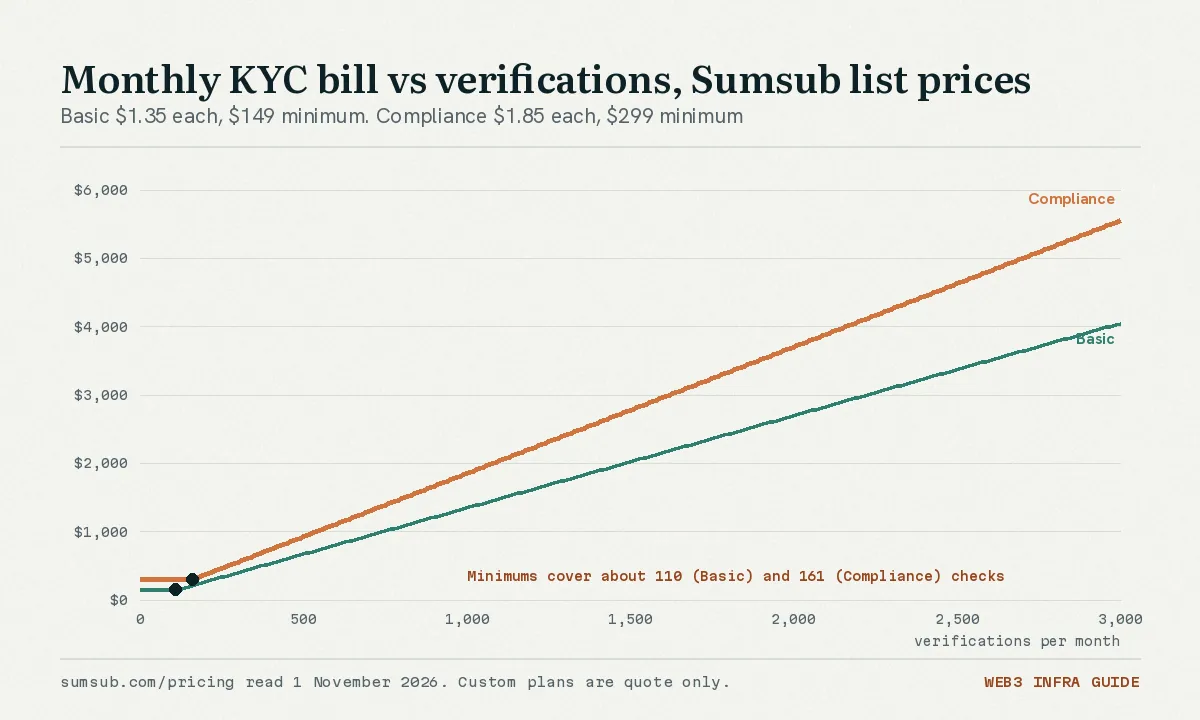
The monthly minimum covers 110 Basic checks ($149 divided by $1.35) or 161 Compliance checks ($299 divided by $1.85), so a team onboarding fewer customers pays the floor. At 2,000 verifications a month the gap between the two plans is $1,000, or $12,000 a year. Notabene’s free tier stops at $10k of outgoing transfers a month, so a live exchange outgrows it quickly.
Verdict: Budget KYC from published per-check prices and treat analytics as the largest quoted line. Ask every analytics vendor to price your actual chains and monthly transfer count.
Which Compliance Stack Fits Your Business
Match the stack to the obligations you carry, then to transfer volume. A firm that only accepts crypto payments needs far less than an exchange that sends customer funds to other exchanges every day. The table gives a starting point by business type.
| Business | Must have | Add next | Reason |
|---|---|---|---|
| Exchange or broker (CASP) | KYC, wallet screening, KYT, Travel Rule | Investigation-grade analytics | Every rule row applies; high volume and law enforcement requests |
| Custodian or bank | KYC, screening, KYT, Travel Rule | Analytics with audit trail exports | Examiners ask why each alert was cleared |
| Payment company accepting crypto | Wallet screening, KYT | Travel Rule once you send to other firms | Sanctions exposure from day one |
| Corporate treasury | Counterparty screening | KYT on treasury wallets | Few transfers, but sanctions apply to every one |
| DAO or protocol treasury | Address screening on payees | Periodic KYT review | No customers, so the Travel Rule rarely applies |
Treasury teams that hold reserves with a custodian can compare platforms in our crypto treasury management guide, and custody buyers in our institutional crypto custody guide.
Due Diligence Questions for Vendors
Send the same written questions to every finalist and compare the answers side by side. Each item maps to a gap in the vendor pages above, so missing public detail becomes a direct question for the sales call, and the answers become part of your vendor risk file.
- Analytics: what share of our last 50 deposits can you attribute to a named service?
- KYT: what is the alert rate per 1,000 transfers on our traffic, and how many alerts were false positives in the trial?
- Screening: what is the p95 API response time, and what happens if a call times out?
- Screening: how soon after a new OFAC SDN address listing does your feed flag it?
- Travel Rule: which of our top 20 counterparties are reachable on your network today?
- Travel Rule: which EBA ownership methods do you support for self-hosted wallets?
- All vendors: can we export every alert, decision and reason for an examiner?
Verdict: A vendor that cannot answer the counterparty and attribution questions with your own data is not ready for your volume.
Final Verdict
Crypto compliance is a stack of four checks, and the rules decide which ones you cannot skip. Start with the obligations in the rule table, buy screening and the Travel Rule for any customer transfer, add KYT on all live flows, then deepen analytics as volume grows.
- Blockchain analytics: the shared engine for tracing and attribution; test it on your own history.
- KYT monitoring: live alerts on settled transfers; judge it on noise and case flow.
- Wallet screening: pre-transfer address checks with a rescreen loop for list and score changes.
- Travel Rule tool: pick the network your counterparties already use.
Verdict: Regulated firms need all four. Payment companies and treasuries can start with screening and KYT, and add the Travel Rule once they send to other regulated firms.
Frequently Asked Questions
What is the difference between KYT and wallet screening?
Wallet screening scores an address before you send or accept funds, so it acts as a gate in the withdrawal path. KYT monitors transfers after they settle and raises alerts when funds touch risky entities directly or through hops. Many vendors sell both in one product, but they run at different moments.
Do I need a Travel Rule solution if I already use Chainalysis?
Usually yes. Chainalysis, TRM Labs and Elliptic score risk, while the Travel Rule requires sending sender and recipient identity data to the other regulated firm. Tools such as Notabene, Sumsub and Sygna handle that data exchange. Some analytics vendors integrate with Travel Rule networks, so check the integration list.
What is the Travel Rule threshold for crypto?
Thresholds vary by jurisdiction. The FATF allows an optional USD/EUR 1,000 de minimis threshold. The EU applies its rule to every CASP-to-CASP transfer with no minimum and adds a wallet ownership check above EUR 1,000 for self-hosted wallets. US FinCEN rules apply at $3,000 or more.
Does OFAC list crypto wallet addresses?
Yes. OFAC says it may add digital currency addresses to the SDN List to identify addresses tied to blocked persons, and its Sanctions List Search matches them by exact ID. Sanctions have no amount floor, so screen every external address and rescreen when new listings are published.
How much do blockchain analytics tools cost?
Chainalysis, TRM Labs and Elliptic do not publish list prices; they quote annually based on chains, volume and products. Published prices exist for adjacent tools: Sumsub KYC starts at $1.35 a verification with a $149 monthly minimum, and Notabene offers a free Travel Rule tier for small senders.
Which crypto compliance tools does a small exchange need first?
A small exchange needs KYC, wallet screening and a Travel Rule tool before its first customer withdrawal to another regulated firm, then KYT on all deposits and withdrawals. Investigation-grade analytics can wait until volume or law enforcement requests grow. Check local licensing rules for any extra requirements.