
Last updated: 4 November 2026 · Dedicated node prices, plan requirements and limits rechecked on each vendor’s pricing page, docs and public price feeds on 4 November 2026
Of the dedicated node providers we checked, the best for most Ethereum and Solana teams in 2026 is GetBlock, which publishes a full Ethereum node at $1,100 a month and a full Solana node at $2,900, with 10% and 20% off for 6 and 12 month terms. Allnodes is the cheapest published option, from $320 a month for Ethereum, but its entry tiers share hardware. Chainstack has the most transparent hourly pricing.
We read the pricing of eight dedicated node providers on 4 November 2026, including the price feeds behind the Chainstack and NOWNodes configurators and the Dwellir cluster selector, then compared Ethereum and Solana list prices, what counts as dedicated, and what each node leaves out. Our methodology page explains how we collect prices.
TL;DR
- Scores: GetBlock 9.2, Allnodes 8.8, Chainstack 8.4, NOWNodes 7.9, Triton One 7.7, Helius 6.5, Dwellir 6.2 and QuickNode 5.6 out of 10.
- Cheapest published Ethereum full node: Allnodes Advanced at $320 a month, a dedicated node on a shared server. Its Enterprise tier on a dedicated server costs $640.
- Fully dedicated Ethereum full nodes start at $1,100 a month on GetBlock, EUR 1,300 on NOWNodes and $1,841.50 on Chainstack once you add the $199 Pro plan it requires.
- Solana dedicated nodes cluster at $2,900 a month on GetBlock, Helius and Triton One. Allnodes Enterprise costs $3,840 and Chainstack $3,776 with its Pro plan.
- Helius documents that its dedicated nodes have no archive data and poor sendTransaction landing, and Triton One meters standard RPC calls at $10 per million on top of the node price.
- QuickNode sells Dedicated Clusters only on Enterprise with a custom quote, and Dwellir lists an Ethereum archive cluster at $12,600 a month.
Which Dedicated Node Provider Should You Pick
Pick by chain and by how much isolation you actually need. A dedicated node removes shared rate limits and noisy neighbours, but it does not add archive data, transaction landing or failover unless the vendor says so. Shared plans are still cheaper below a few hundred million calls a month, as our RPC provider pricing guide shows.
- Best overall for Ethereum and Solana: GetBlock, with published prices for both chains, unlimited requests per second, a 99.99% SLA and term discounts.
- Lowest published price: Allnodes, from $320 a month for an Ethereum full node and $1,920 for Solana, billed hourly up to 672 hours a month.
- Hourly pricing you can calculate yourself: Chainstack, at compute from $0.50 an hour plus storage, with debug and trace on every dedicated node.
- Solana gRPC streaming: Triton One or Helius, both from $2,900 a month, with Yellowstone gRPC included.
- Ethereum archive at scale: Dwellir archive clusters or Chainstack archive nodes, with published list prices.
- Compliance-heavy enterprise buyers: QuickNode Dedicated Clusters, if a custom quote and SOC reports matter more than list price.
Verdict: Start with GetBlock for a published price on both chains. Move to Allnodes if budget rules, or to Triton One if Solana streaming is the main job.
How We Scored the Eight Providers
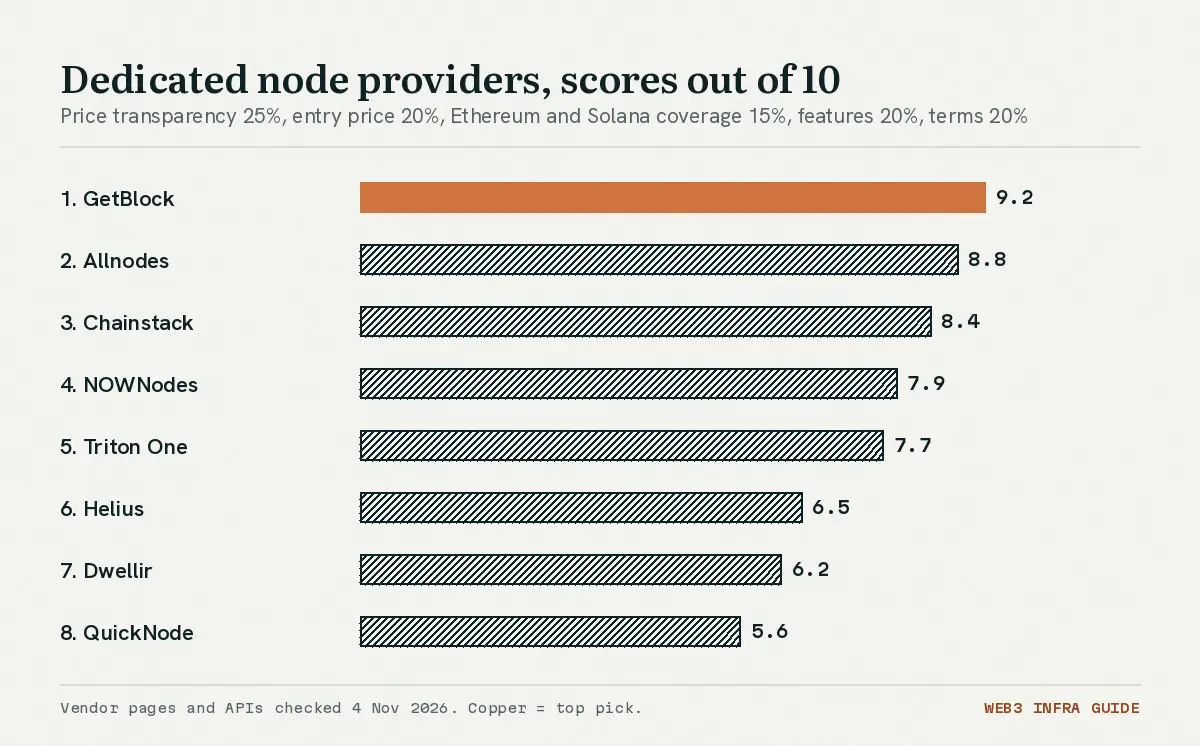
Our main RPC node provider ranking covers shared plans. This list only covers single-tenant nodes and clusters, so it uses its own rubric. Each provider gets 1 to 5 on five criteria, and the weighted sum is doubled to give a score out of 10. Every input comes from a vendor page, doc or price feed checked on 4 November 2026.
| Provider | Price transparency (25%) | Entry price (20%) | ETH and SOL coverage (15%) | Features (20%) | Terms (20%) | Score |
|---|---|---|---|---|---|---|
| GetBlock | 5 | 4 | 5 | 5 | 4 | 9.2 |
| Allnodes | 5 | 5 | 5 | 3 | 4 | 8.8 |
| Chainstack | 5 | 3 | 5 | 4 | 4 | 8.4 |
| NOWNodes | 4 | 4 | 5 | 3 | 4 | 7.9 |
| Triton One | 4 | 3 | 3 | 5 | 4 | 7.7 |
| Helius | 4 | 3 | 3 | 3 | 3 | 6.5 |
| Dwellir | 4 | 2 | 2 | 4 | 3 | 6.2 |
| QuickNode | 1 | 1 | 5 | 5 | 3 | 5.6 |
Price transparency rewards a number you can see before a sales call. Features covers archive data, trace and debug, gRPC streaming, regions and failover. Terms covers billing granularity, term discounts, setup fees and free months, and loses points for limits that only show up in the docs.
Ethereum Dedicated Node Prices
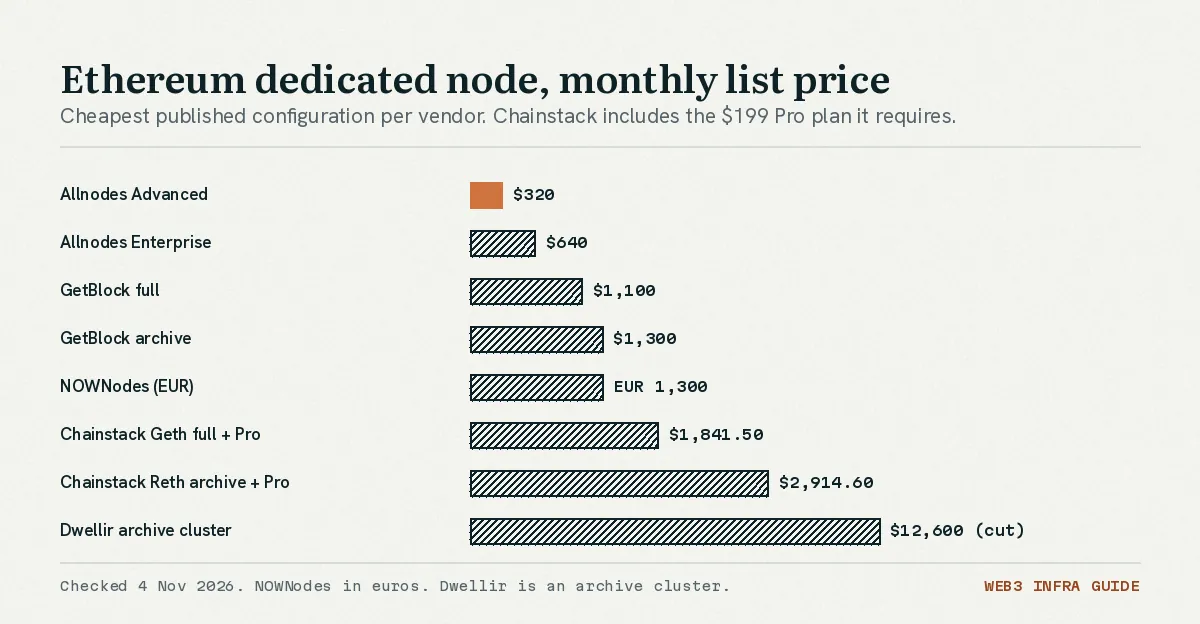
Ethereum prices split into three groups. Allnodes is far cheaper than everyone else, but only its $640 Enterprise tier runs on a dedicated server, while its $320 Advanced tier runs a dedicated node on a shared server. GetBlock and NOWNodes sit near $1,100 to $1,300, and Chainstack costs more because you pay for compute, storage and a plan.
| Provider | Configuration | Monthly list price | 12 months at published terms | Notes |
|---|---|---|---|---|
| Allnodes Advanced | Full node, shared server | $320 | $2,880 (25% annual discount) | 99.90% SLA, 4 locations, 1 Gbit/sec |
| Allnodes Enterprise | Full node, dedicated server | $640 | $5,760 (25% annual discount) | 99.98% SLA, 3 locations, 10 Gbit/sec |
| GetBlock | Full node, standard | $1,100 ($1,400 high performance) | $10,560 (20% for 12 months) | Archive from $1,300, 3 regions |
| NOWNodes | Full node | From EUR 1,300 | EUR 15,600 at list | First month free on Business and lower plans |
| Chainstack | Geth full node + Pro plan | $1,841.50 | $22,098 at monthly list | Reth full $2,168.10, Reth archive $2,715.60 before the plan |
| Dwellir | Archive cluster, redundant nodes | $12,600 | $151,200 at list | Final quote depends on regions and cluster size |
| QuickNode | Dedicated Clusters | Custom | Custom | Enterprise plan only |
Verdict: For a single Ethereum full node, GetBlock is the cheapest fully dedicated option with a public price, and Allnodes Enterprise is cheaper still if three locations are enough.
Solana Dedicated Node Prices
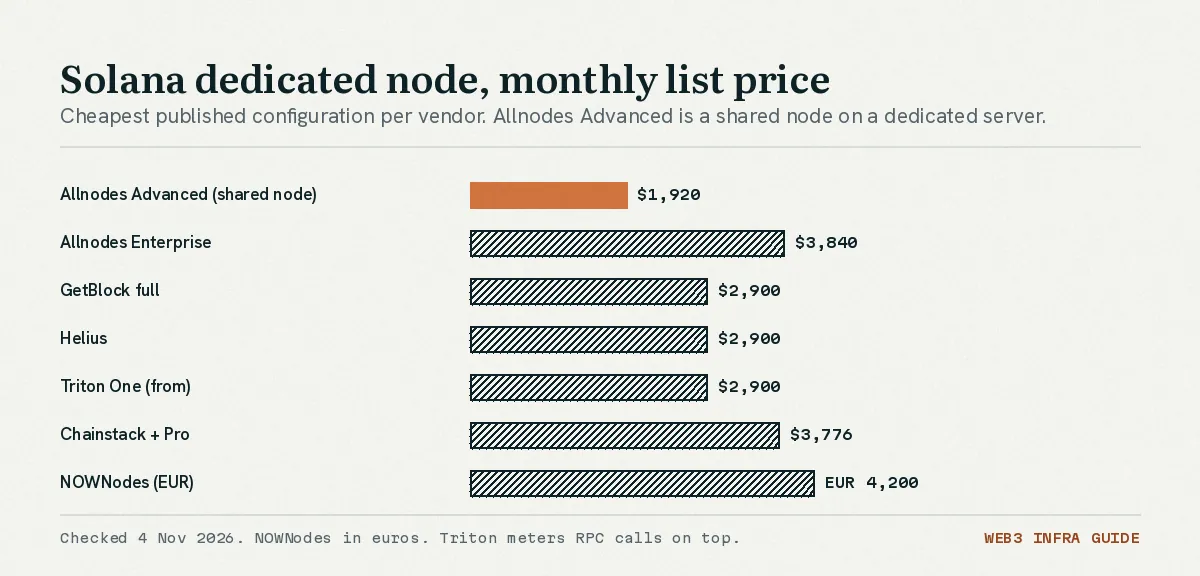
Solana nodes cost more because of the hardware they need. Chainstack’s price feed lists 128 vCPUs and 1 TB of RAM for a Solana full node. Three vendors land on the same $2,900 a month, so the choice between GetBlock, Helius and Triton One comes down to what the node includes, not the sticker price.
| Provider | Monthly list price | What is included | Watch out for |
|---|---|---|---|
| Allnodes Advanced | $1,920 | Yellowstone gRPC, unlimited requests, 10 Gbit/sec | Shared node on a dedicated server |
| GetBlock | $2,900 ($3,200 high performance) | Unlimited RPS, 99.99% SLA, free Shared plan worth $49 | Archive through sales only |
| Helius | $2,900 | Yellowstone gRPC, Agave or Jito client, choice of region | No archive data, poor sendTransaction landing |
| Triton One | $2,900+ | Unmetered Dragon’s Mouth gRPC, GeoDNS failover | $10 per million standard calls plus $0.08 per GB |
| Chainstack | $3,776 with Pro plan | Unmetered requests, 5 regions | Price set by compute and storage hours |
| Allnodes Enterprise | $3,840 | Dedicated node, 50 Gbit/sec, 99.98% SLA | Account indexing is $1,920 a month extra |
| NOWNodes | From EUR 4,200 | Unlimited RPS, 99.99% uptime | Highest published Solana entry price |
Verdict: For Solana streaming, Triton One and Helius are the specialists. For plain RPC on a dedicated box, GetBlock includes more at the same price. See our Helius vs QuickNode vs Triton comparison for their shared plans.
1. GetBlock
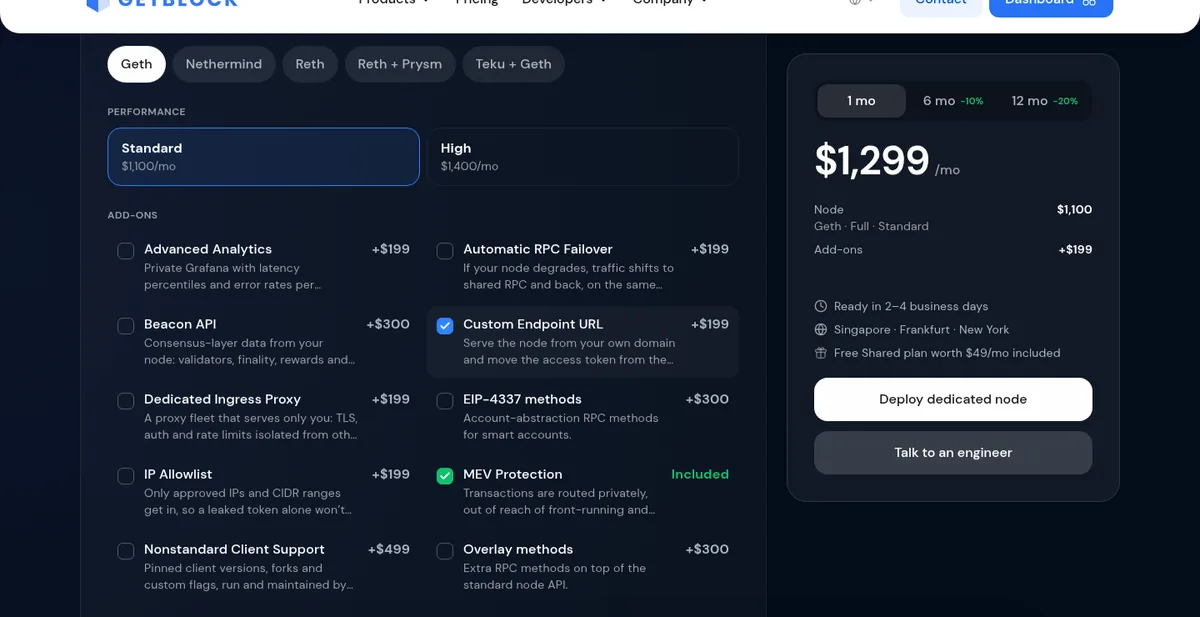
GetBlock prices dedicated Ethereum full nodes at $1,100 a month on standard hardware and $1,400 on high performance hardware, with archive from $1,300, per its Ethereum node page. Its pricing file takes 10% off dedicated nodes on a 6 month term and 20% on a 12 month term, so a year of Ethereum full node costs $10,560. Solana full nodes cost $2,900, or $3,200 on high performance hardware, and Solana archive goes through sales.
- Regions: Frankfurt, New York and Singapore, per its dedicated nodes page.
- Included: unlimited requests per second, a 99.99% SLA, MEV protection on Ethereum and a free Shared plan worth $49 a month.
- Add-ons: a consensus layer API and EIP-4337 at $300 each, failover, analytics, IP allowlist and custom URL at $199 each, and a nonstandard client at $499.
- Setup: the pricing file says nodes are ready in 2 to 4 business days.
Verdict: GetBlock scores 9.2. It is the easiest pick for teams that need both chains at a known price. Budget for add-ons, which can add $199 to $499 each. For its shared and Limitless meters, see our GetBlock vs dRPC vs Tatum comparison.
2. Allnodes
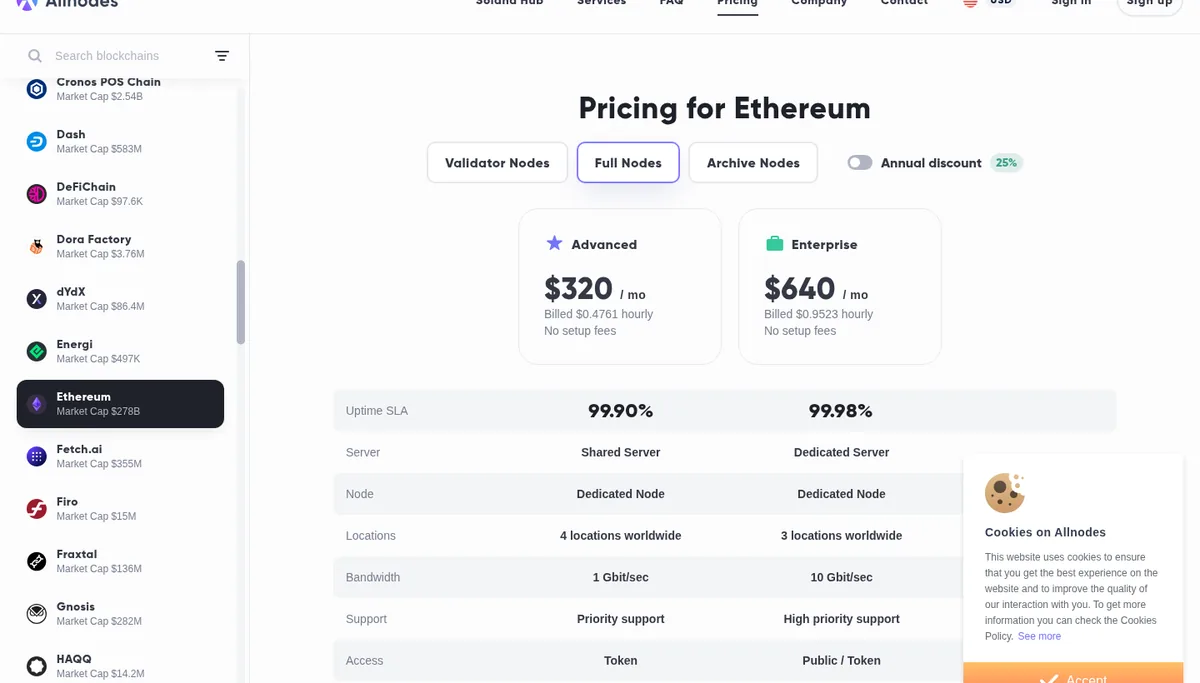
Allnodes publishes the lowest prices here: an Ethereum full node at $320 a month on Advanced and $640 on Enterprise, per the Ethereum tab of its pricing page. Billing is hourly and capped at 672 hours a month, so a node that runs all month is charged for 28 days. The trade-off is isolation, because the cheap tiers share something.
- Ethereum Advanced: dedicated node on a shared server, 99.90% SLA, 4 locations, 1 Gbit/sec.
- Ethereum Enterprise: dedicated node on a dedicated server, 99.98% SLA, 3 locations, 10 Gbit/sec.
- Solana: Advanced at $1,920 is a shared node on a dedicated server, and Enterprise at $3,840 is a dedicated node, per the Solana tab of its pricing page. Both include Yellowstone gRPC.
- Extras: a 25% annual discount, no setup fees, failover nodes from $160 a month on Ethereum and account indexing at $960 or $1,920 a month on Solana.
Verdict: Allnodes scores 8.8. It is the budget pick, as long as you buy Enterprise when you need a node that is fully yours.
3. Chainstack
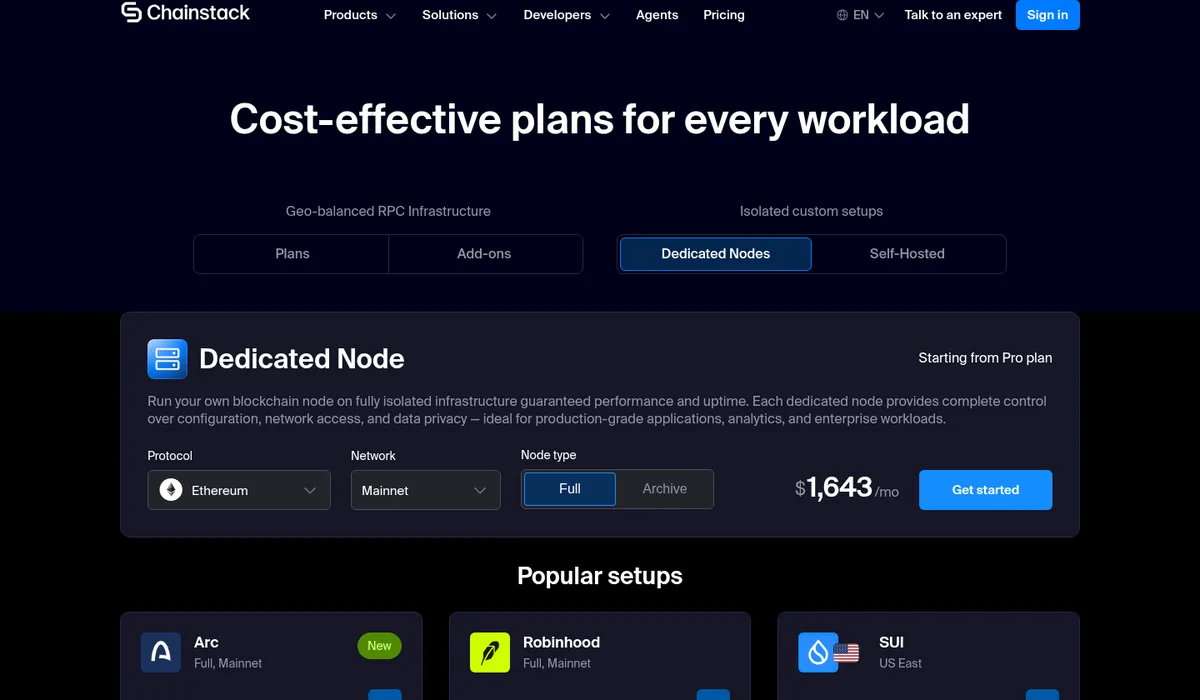
Chainstack prices dedicated nodes by the hour: compute from $0.50 an hour and storage at $0.01 per 20 GB an hour, on top of a Pro ($199 a month), Business or Enterprise plan, per its pricing page and docs. Its live price feed, updated 31 October 2026, gives $1,642.50 a month for an Ethereum Geth full node and $3,577 for Solana. Chainstack blog posts quote a full Ethereum node at about $1,279 a month including the plan, but its own calculator shows $1,643 for the node alone.
- Debug and trace: turned on for all dedicated nodes for protocols that support it, with no request metering.
- Ethereum options: Reth full at $2,168.10 and Reth archive at $2,715.60 a month before the plan, from the same feed.
- Regions: London, Singapore, New York, Los Angeles and Ashburn appear in the price feed.
- Heads-up: its docs say Trader Nodes will be deprecated on 1 December 2026. That change does not affect dedicated nodes.
Verdict: Chainstack scores 8.4. It is the clearest pricing model, but trust the calculator, not the blog estimate, when you budget.
4. NOWNodes
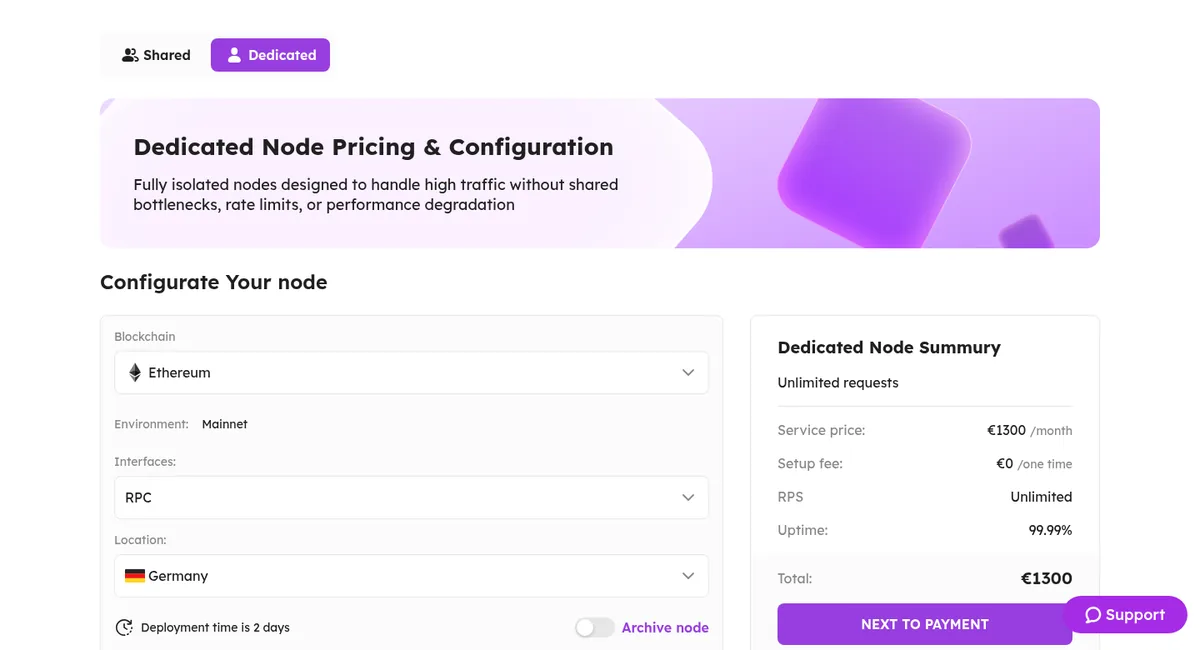
NOWNodes sells dedicated nodes through a configurator on its dedicated nodes page. The list of chains behind it gives minimum prices of EUR 1,300 a month for Ethereum, EUR 4,200 for Solana and EUR 800 for Bitcoin. NOWNodes offers the first month free on your first dedicated server for Business and lower plan customers, the only free month in this list.
- Included: unlimited requests per second, 99.99% uptime and no setup fee in the configurator.
- Coverage: 120+ networks, one chain per node, and custom chains on request.
- Clusters: multiple node instances across regions you choose when one node is not enough.
- Currency: prices are in euros, so dollar costs move with the exchange rate.
Verdict: NOWNodes scores 7.9. It is competitive on Ethereum and pricey on Solana, and the free month softens a first trial.
5. Triton One
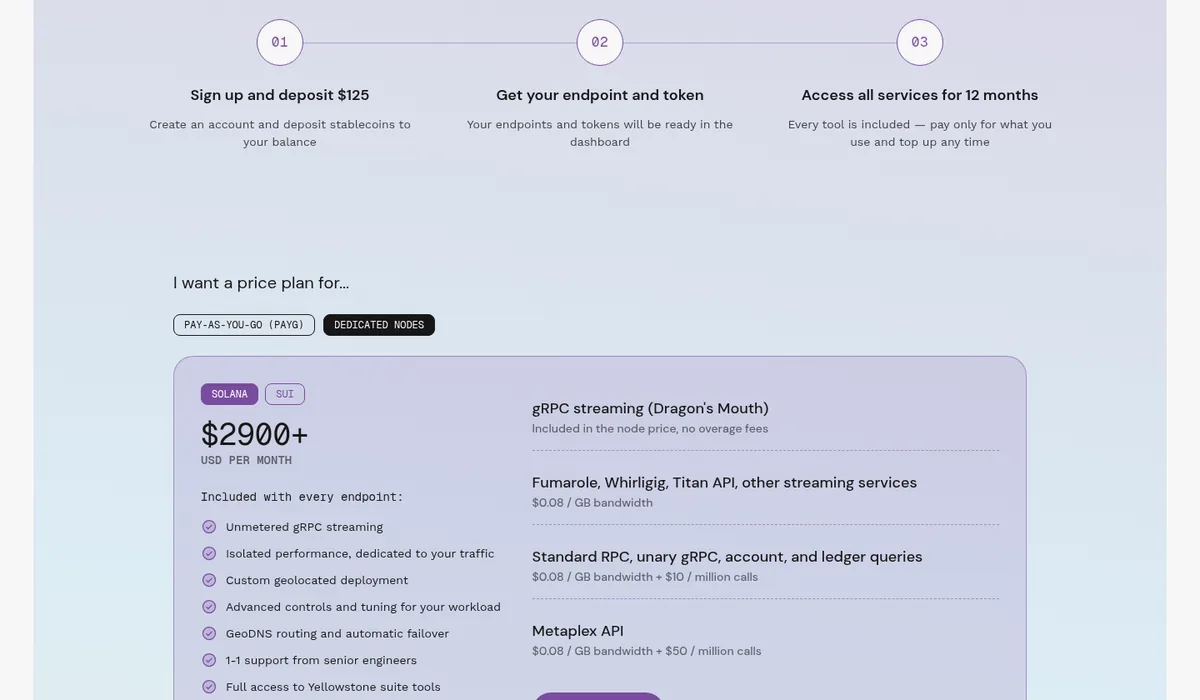
Triton One lists Solana and Sui dedicated nodes from $2,900 a month on its pricing page, with unmetered gRPC streaming through Dragon’s Mouth, custom geolocated deployment, GeoDNS routing and automatic failover. Standard RPC, unary gRPC, account and ledger queries on a dedicated node still cost $0.08 per GB plus $10 per million calls. Other streaming services cost $0.08 per GB.
- Best for: trading bots, market makers and indexers that live on gRPC streams.
- Support: one-to-one support from senior engineers and full access to its Yellowstone tools.
- Not covered: Ethereum. Triton One sells Solana, Sui and Monad, and dedicated nodes for Solana and Sui.
Verdict: Triton One scores 7.7. It is the strongest Solana streaming node, but estimate your call volume, because standard RPC is metered.
6. Helius
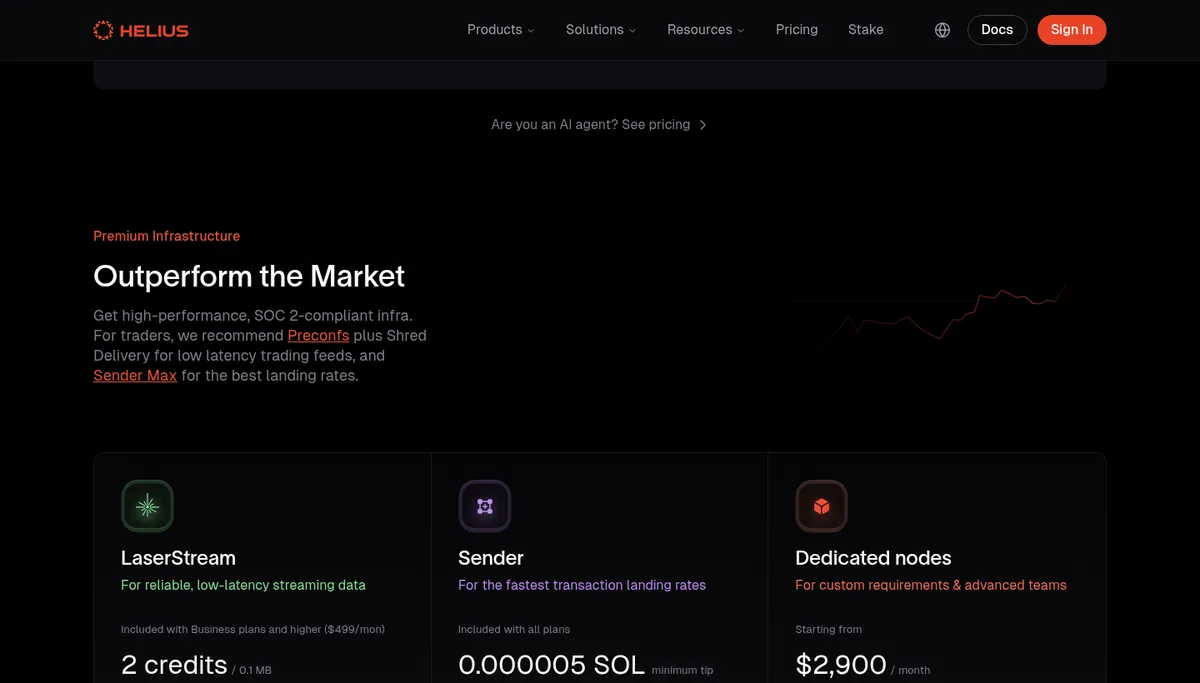
Helius sells Solana dedicated nodes from $2,900 a month, ordered from its dashboard with your choice of region and the Agave or Jito client, per its pricing page. Hardware options are AMD EPYC 7443p, 7543p and 9254. Its own docs say dedicated nodes have no archival data, poor sendTransaction landing and a getProgramAccounts performance risk, and should be paired with a shared plan.
- Built for: Yellowstone gRPC streaming, per its dedicated nodes docs.
- Needs a shared plan for: APIs, webhooks, staked connections and transaction sending.
- Alternative: Helius recommends its LaserStream product for most streaming workloads.
Verdict: Helius scores 6.5. Buy it as a streaming add-on to a Helius shared plan, not as a standalone RPC node.
7. Dwellir
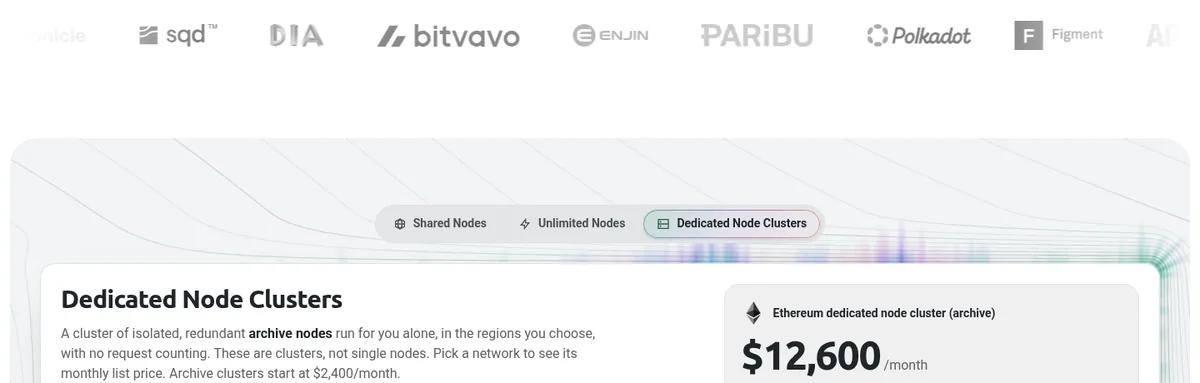
Dwellir sells clusters of isolated, redundant archive nodes rather than single nodes, with no request counting, per its pricing page. Archive clusters start at $2,400 a month. An Ethereum archive cluster lists at $12,600 a month, the highest published Ethereum price here, because it is several archive nodes rather than one. Arbitrum lists at $4,200 and Base at $3,366.
- Best for: indexers and analytics teams that need redundant archive data on EVM chains.
- Not covered: Solana is not in its dedicated cluster selector.
- Quote: the final price depends on regions and cluster size.
Verdict: Dwellir scores 6.2. It is a niche pick for redundant Ethereum archive data, not for a single full node.
8. QuickNode
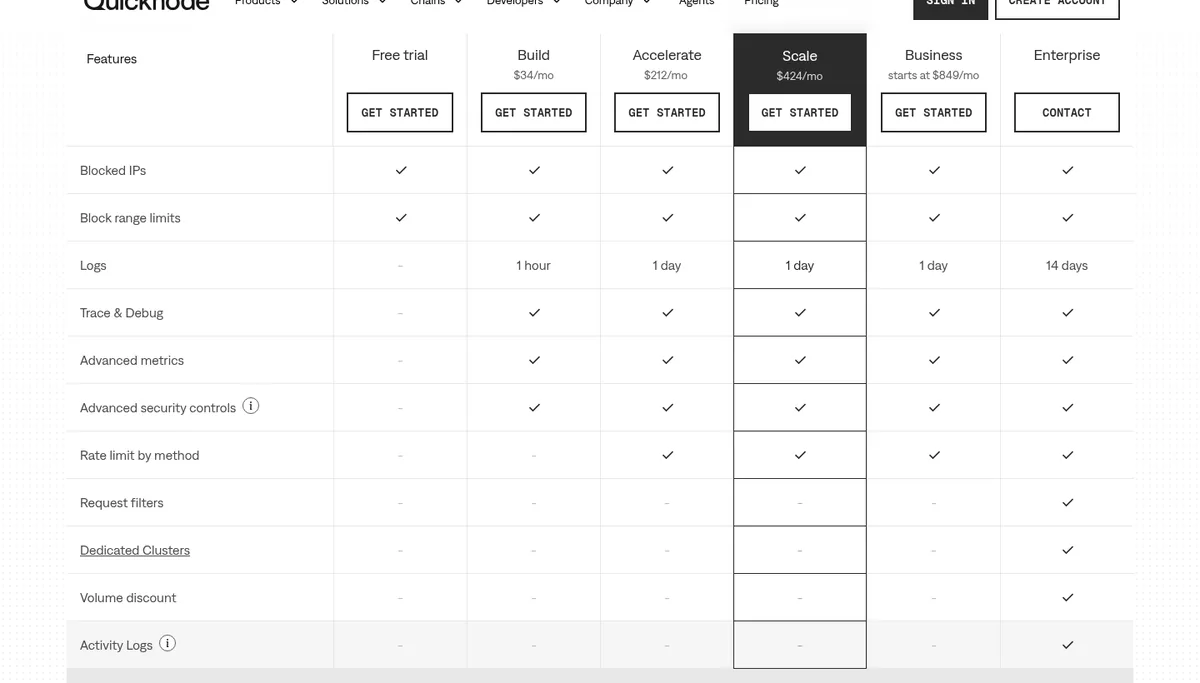
QuickNode offers Dedicated Clusters, described as single-tenant infrastructure for custom performance, isolation or compliance needs, only on its Enterprise plan, per its pricing page. There is no public dedicated price, so you need a sales call before you can compare it with the other seven. Its enterprise page lists SOC 1 Type 2, SOC 2 Type 2 and ISO 27001 reports on request.
- Best for: enterprises that need compliance reports and custom SLAs.
- Chains: Ethereum, Solana and many more through its shared platform.
- Self-serve plans: shared tiers run from $49 to $2,999 a month before Enterprise.
Verdict: QuickNode scores 5.6. Ask for a quote if compliance reports matter, and benchmark it against the published prices above.
Dedicated vs Shared: When a Dedicated Node Pays Off
A dedicated node pays off when shared limits or metered credits cost more than its fixed fee. A dedicated node only beats a shared plan once traffic outgrows the top shared tiers or you need unmetered trace and gRPC. Below that, a shared plan from our Ethereum RPC ranking or Solana RPC ranking costs less.
- Choose dedicated for: high-frequency trading, heavy trace or debug use, gRPC streaming and strict data isolation.
- Stay shared for: dApps with bursty traffic, multi-chain apps and teams without an on-call engineer.
- Mix both: run a dedicated node for the hot path and keep a shared endpoint as failover, as Helius recommends.
Verdict: Most teams should start shared and move to dedicated when bills or limits prove the case. Our Alchemy alternatives and Infura alternatives guides cover shared options.
Check a New Dedicated Node Before You Switch
Before you move production traffic to a new dedicated node, confirm it is fully synced and reachable from the region where your app runs. Call eth_syncing on Ethereum or getHealth on Solana, and compare block height against a shared endpoint. A healthy Ethereum node returns false for eth_syncing.
# Ethereum: false means fully synced
curl -s -X POST "$DEDICATED_ETH_URL" -H "Content-Type: application/json" \
  -d '{"jsonrpc":"2.0","id":1,"method":"eth_syncing","params":[]}'

# Solana: "ok" means healthy
curl -s -X POST "$DEDICATED_SOL_URL" -H "Content-Type: application/json" \
  -d '{"jsonrpc":"2.0","id":1,"method":"getHealth"}'
Run the same calls against your shared endpoint and compare the latest block numbers. A gap of more than a few blocks means the node is still catching up.
Verdict: Do not cut over until the dedicated node matches your shared endpoint for at least a day of normal traffic.
Final Verdict
GetBlock is the best dedicated node provider for Ethereum and Solana in 2026, with published prices for both chains and term discounts. Allnodes is the budget pick, Chainstack is the most transparent, and Triton One leads for Solana streaming. Browse the RPC providers hub to compare more dedicated node providers.
- GetBlock, 9.2: Ethereum full $1,100, Solana $2,900, 10% or 20% off for 6 or 12 months.
- Allnodes, 8.8: Ethereum from $320, Solana from $1,920, hourly billing capped at 672 hours.
- Chainstack, 8.4: compute from $0.50 an hour plus storage and a $199 Pro plan, trace on every node.
- NOWNodes, 7.9: Ethereum from EUR 1,300, Solana from EUR 4,200, first month free on lower plans.
- Triton One, 7.7: Solana from $2,900 with unmetered gRPC, standard calls at $10 per million.
- Helius, 6.5: Solana from $2,900 for gRPC streaming, no archive data.
- Dwellir, 6.2: Ethereum archive cluster $12,600, archive clusters from $2,400.
- QuickNode, 5.6: Dedicated Clusters on Enterprise only, custom quote.
Verdict: Pick GetBlock for both chains, Allnodes for price, Chainstack for transparency and Triton One for Solana streaming.
Frequently Asked Questions
How much does a dedicated Ethereum node cost in 2026?
Published prices for a full Ethereum node start at $320 a month on Allnodes Advanced, which uses a shared server, and $640 on Allnodes Enterprise. Fully dedicated full nodes cost $1,100 on GetBlock, EUR 1,300 on NOWNodes and $1,841.50 on Chainstack with its required Pro plan, as checked on 4 November 2026.
How much does a dedicated Solana node cost?
Most providers start near $2,900 a month: GetBlock, Helius and Triton One all list that price. Allnodes Advanced costs $1,920 but runs a shared node on a dedicated server, while its Enterprise dedicated node costs $3,840. Chainstack works out at $3,776 with its Pro plan, and NOWNodes starts at EUR 4,200.
Is a dedicated node better than a shared RPC plan?
Only at high volume or for special workloads. A dedicated node removes shared rate limits and credit metering, and suits trading, heavy trace calls and gRPC streaming. Shared plans cost far less below the top tiers, so most dApps should start shared and move to dedicated once limits or bills prove the case.
Do dedicated nodes include archive data?
Not always. GetBlock sells Ethereum archive from $1,300 a month, Chainstack lists a Reth archive node at $2,715.60 before its plan, and Dwellir sells archive clusters from $2,400. Helius says its Solana dedicated nodes have no archival data, and GetBlock handles Solana archive through sales.
Which dedicated node is best for Solana gRPC streaming?
Triton One and Helius are the specialists. Triton One includes unmetered Dragon’s Mouth gRPC from $2,900 a month but meters standard RPC calls. Helius dedicated nodes also start at $2,900 and focus on Yellowstone gRPC. Allnodes includes Yellowstone gRPC from $1,920 on a shared node.
Can I get a discount on a dedicated node?
Yes, with some vendors. Allnodes lists a 25% annual discount, GetBlock takes 10% off for 6 months and 20% for 12 months, and NOWNodes gives the first month free on your first dedicated server for Business and lower plans. Chainstack, Helius and Triton One publish no term discount.