
Last updated: 25 October 2026 · Prices, limits and chain counts rechecked on vendor pages on 25 October 2026
The best RPC node providers in 2026 are Chainstack, Alchemy, dRPC, GetBlock and QuickNode, in that order, with Helius as the clear pick for Solana. We ranked 12 providers on price per call, published uptime terms, security audits, features, chain coverage and free tiers, using numbers from each vendor’s own pages.
Every provider sells the same basic product: a remote procedure call (RPC) endpoint that answers JSON requests from a synced blockchain node. The differences sit in the meter. Each vendor counts usage in its own unit, so the plan with the lowest sticker price can produce the highest bill. Read how we test for how we collect prices and screenshots.
This page is the pillar for our Node Infrastructure hub. Shortlists, head to head comparisons and setup guides sit under RPC Providers and Dedicated Nodes.
TL;DR
- Our ranking: 1. Chainstack, 2. Alchemy, 3. dRPC, 4. GetBlock, 5. QuickNode, 6. Helius, 7. Ankr, 8. Infura, 9. Tatum, 10. NOWNodes, 11. CDP Node, 12. Lava.
- Chainstack wins on price per call and audits. Alchemy has the best free tier and data APIs. dRPC sells the cheapest published request price across the most chains.
- For about $49 a month, Chainstack Growth buys 20M full-node requests. Tatum Starter buys about 800,000
eth_callrequests at the same price. - Log-heavy apps should avoid per-method meters. CDP Node charges 3.3 times as much for
eth_getLogsas foreth_call, Infura 3.2 times and Alchemy 2.3 times. - Only GetBlock and NOWNodes publish formal SLA terms on self-serve plans. Most vendors keep contractual SLAs for enterprise deals.
- Run production traffic through at least two providers, and move to a dedicated node only when a measured limit blocks you.
How We Ranked the 12 Providers
We scored each provider from 1 to 5 on six criteria, weighted them, and converted the result to a score out of 10. Price per call carries the most weight because it drives the monthly bill. Every input comes from a vendor page or a public benchmark we can link to. Our full process lives on the methodology page.
| Criterion | Weight | What we measured |
|---|---|---|
| Price per call | 25% | Standard calls a $49 entry plan or $49 of pay as you go usage buys, from each vendor’s method cost table |
| Reliability | 20% | Published uptime terms, who gets them, and OpenChainBench latency where it exists |
| Compliance | 15% | SOC 2 Type II and ISO 27001, as stated on the vendor’s own pages |
| Features | 15% | Archive data, Trace and Debug, data APIs, streaming and dedicated node options |
| Chain coverage | 15% | The vendor’s own chain count, checked against its docs where possible |
| Free tier | 10% | Calls a month on the free plan, rate limit and expiry |
Where a vendor does not publish method weights, we score its price as 2 out of 5 and say so. Ties go to the provider with the better price score. No vendor saw this ranking before publication, and none paid for placement.
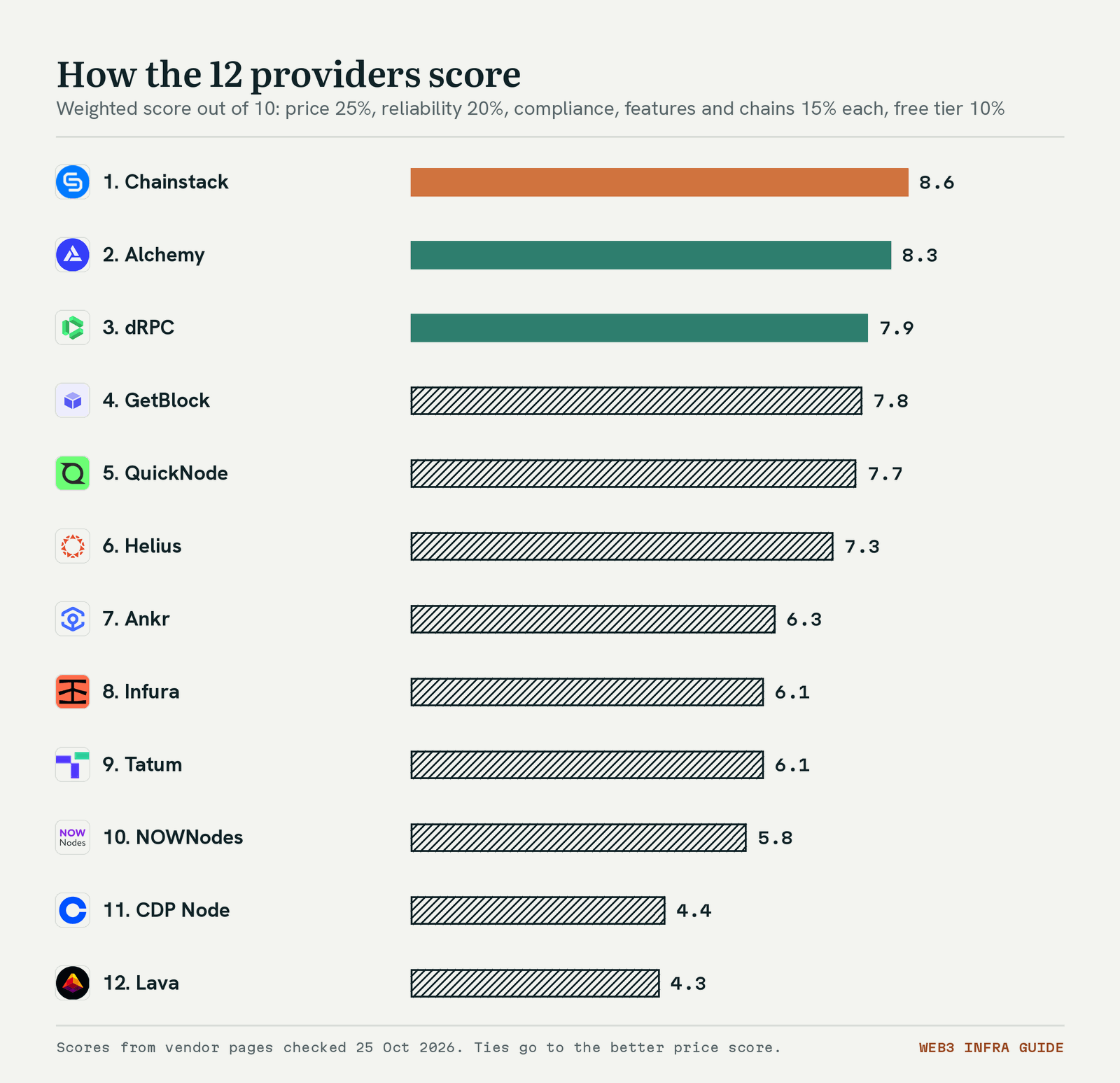
| Rank | Provider | Price | Reliability | Compliance | Features | Chains | Free tier | Score |
|---|---|---|---|---|---|---|---|---|
| 1 |  | 5 | 4 | 5 | 4 | 4 | 3 | 8.6 |
| 2 |  | 3 | 4 | 4 | 5 | 5 | 5 | 8.3 |
| 3 |  | 5 | 4 | 2 | 3 | 5 | 4 | 7.9 |
| 4 |  | 3 | 5 | 4 | 4 | 5 | 2 | 7.8 |
| 5 |  | 3 | 4 | 5 | 5 | 4 | 2 | 7.7 |
| 6 |  | 5 | 3 | 4 | 5 | 1 | 3 | 7.3 |
| 7 |  | 2 | 3 | 4 | 3 | 4 | 4 | 6.3 |
| 8 |  | 4 | 3 | 1 | 3 | 3 | 4 | 6.1 |
| 9 |  | 1 | 3 | 5 | 4 | 5 | 1 | 6.1 |
| 10 |  | 4 | 3 | 1 | 2 | 5 | 1 | 5.8 |
| 11 |  | 3 | 2 | 1 | 3 | 1 | 3 | 4.4 |
| 12 |  | 2 | 2 | 1 | 3 | 3 | 2 | 4.3 |
Verdict: Chainstack, Alchemy and dRPC form the top tier for EVM teams. Helius ranks sixth overall only because it serves one chain, and it is the first call for Solana.
What RPC Node Providers Do
An RPC node provider runs blockchain nodes for you and exposes them through an HTTPS or WebSocket endpoint. Your wallet, decentralized application (dApp) or backend sends JSON requests such as eth_call or getBalance, and the provider answers from a synced node. You pay for uptime, sync speed and capacity you would otherwise have to build.
Most providers bundle extras on top of plain node access. Common ones include archive history for old blocks, Trace and Debug methods for replaying transactions, streaming feeds, and indexed data for tokens and NFTs. Two providers can serve the same Ethereum Virtual Machine (EVM) call at very different prices, so the extras and the meter matter more than the raw endpoint.
The Decision Kernel
Answer three questions before you open any price table: which chains you need next year, which methods dominate your traffic, and how much downtime your product can absorb. Those three answers remove most of this list before pricing enters the picture. Use the shortcuts below to pick a starting shortlist of two or three.
- Solana first: start with Helius, then add QuickNode or Alchemy as a second endpoint.
- Many chains, one bill: shortlist dRPC, GetBlock and Chainstack, then test the chains you actually use.
- Heavy log reads or indexing: pick a flat meter such as Chainstack request units, GetBlock compute units or QuickNode credits.
- Data APIs alongside RPC: Alchemy and QuickNode sell token, NFT and transfer APIs on the same account.
- Procurement needs SOC 2 and ISO 27001: Chainstack, QuickNode and Tatum state both on their own pages.
- Base only: CDP Node gives 10M billing units free each month, with GetBlock or Alchemy as backup.
- Small team on a tight budget: start on a free tier, measure real traffic for a week, then price that mix on two providers. Our free RPC providers guide ranks seven no-cost options for testing and small dApps.
The 12 Providers at a Glance
The table lists each provider’s billing unit, free tier, entry paid plan and claimed chain coverage. Chain counts come from the vendors and change often, so check your own chains on each vendor’s list before you sign up. Prices are monthly list prices in US dollars unless marked in euros, as shown on 25 October 2026.
| Provider | Billing unit | Free tier | Entry paid plan | Chains (vendor claim) |
|---|---|---|---|---|
| Request units (RU) | 3M RU a month, 25 requests per second | Growth $49: 20M RU | 70+ |
| Compute units (CU) per method | 30M CU a month, 15 requests per second | Pay as you go: $0.525 per 1M CU | 100+ |
| CU pool, sold as requests | Public nodes, 210M CU pool | Pro $49: 10M requests | Over 120 |
| Compute units with chain multipliers | 50K CU a day, 20 requests per second | Starter $49: 90M CU | 130+ |
| API credits, flat per chain | One-month trial, 10M credits | Build $49: 80M credits | 76+ |
| Credits, mostly 1 per call | 1M credits, 10 requests per second | Developer $49: 10M credits | Solana only |
| API credits per request | 200M credits a month, 30 requests per second | From $10 per 100M credits | 50+ free, 75+ paid |
| Credits, daily quota | 3M credits a day | Developer $50: 15M credits a day | 25 chains in docs |
| Credits per method | 100K lifetime credits, 3 requests per second | Starter $49: 4M credits | 130+ |
| Requests | 100K requests for one month | Pro €20: 1M requests | 120 |
| Billing units (BU) per method | 10M BU a month | Pay as you go: $0.50 per 1M BU | Base only |
| Compute units | 750K CU a month, 25 requests per second | Developer $29: 50M CU | 28+ |
Verdict: dRPC, Chainstack and GetBlock publish the simplest meters with wide chain lists. Alchemy, Infura and CDP Node price by method, so model your real call mix before you compare them. Our GetBlock vs dRPC vs Tatum comparison prices the three budget meters head to head.
What $49 a Month Buys
We converted each entry plan into calls per month with the vendor’s own method cost table. For the pay as you go sellers, Alchemy, Ankr and CDP Node, we spent $49 at list rates. Included volume differs by a factor of 25 between the most and least generous options. Ethereum rows use eth_call where the meter varies by method. Our RPC provider pricing comparison breaks down compute units, credits and request plans in more detail.
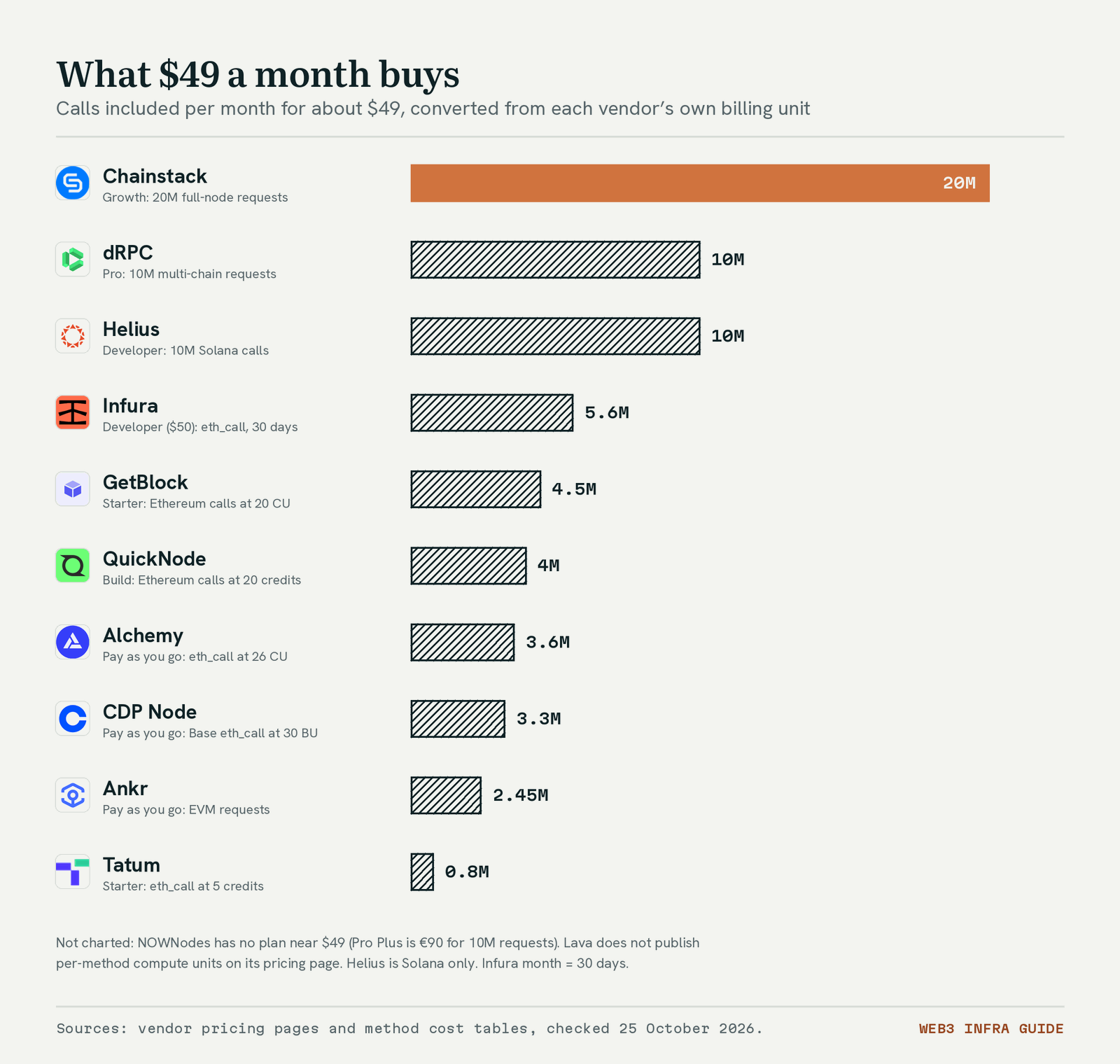
| Provider and plan | Monthly price | Unit math | Calls per month |
|---|---|---|---|
| $49 ($40 billed annually) | 20M RU; archive calls cost 2 RU | 20M full-node or 10M archive |
| $49 | 163M CU pool | 10M multi-chain requests |
| $49 | Most RPC calls cost 1 credit | 10M Solana calls |
| $50 | 15M credits a day; 80 credits per eth_call | About 5.6M eth_call over 30 days |
| $49 ($39 billed annually) | 90M CU; 20 CU per Ethereum call | 4.5M Ethereum calls |
| $49 ($34 billed annually) | 80M credits; 20 credits per Ethereum call | 4M Ethereum calls |
| $49 of usage | $0.525 per 1M CU; 26 CU per eth_call | About 3.6M eth_call |
| $49 of usage | $0.50 per 1M BU; 30 BU per eth_call | About 3.3M Base calls, plus the free 10M BU |
| $49 of usage | $0.02 per 1,000 EVM requests | About 2.45M EVM requests |
| $49 | 4M credits; 5 credits per eth_call | About 800,000 eth_call |
The math has limits. Infura’s quota resets daily, so a spike cannot borrow from quiet days. Helius serves only Solana and CDP Node serves only Base, so their rows do not compete directly with multi-chain plans. Rate limits, archive access and support levels also differ by plan, and the table does not price them.
Two providers sit outside the chart. NOWNodes has no plan near $49: Pro costs €20 for 1M requests and Pro Plus costs €90 for 10M, per the NOWNodes pricing page. Lava does not publish per-method compute unit costs on its pricing page, so we cannot convert its plans into calls.
Verdict: Chainstack Growth and dRPC Pro give the most EVM calls for the money. Pay as you go plans cost more per call but suit spiky traffic you cannot forecast.
Why Method Weights Change the Bill
Per-method meters charge more for expensive calls, and log queries show the gap most clearly. CDP Node charges 100 billing units for eth_getLogs against 30 for eth_call, Infura charges 255 credits against 80, and Alchemy charges 60 compute units against 26. An indexer that reads logs all day can pay three times more on a per-method meter.
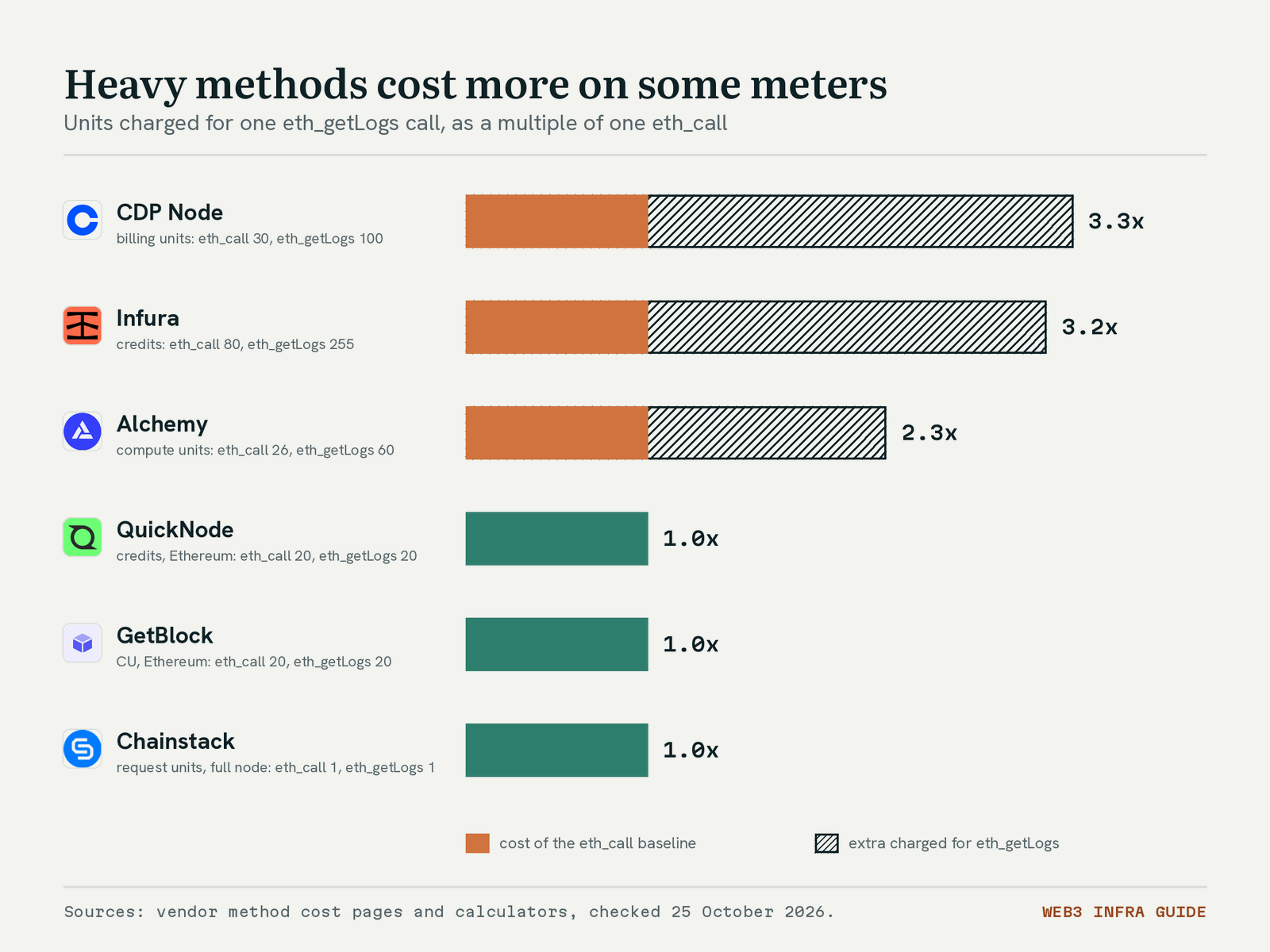
QuickNode charges a flat rate per call on each chain and doubles it for advanced APIs such as Trace and Debug, per its API credit table. GetBlock multiplies a chain factor by a method factor, and its calculator shows 20 CU for both calls on Ethereum. Chainstack charges one request unit per full-node call whatever the method. Alchemy publishes its weights in a compute unit cost table and Infura in its credit cost documentation. For a head-to-head on three of these meters, see our QuickNode vs Alchemy vs Chainstack comparison.
Verdict: Export one day of request logs, count calls by method, and price that mix on each shortlisted provider. That single step beats any plan comparison.
Uptime SLAs and Compliance
Procurement teams ask two questions before price: what uptime does the contract promise, and which audits can the vendor show. Most providers reserve contractual service level agreements (SLAs) for enterprise deals. GetBlock and NOWNodes are the only two that publish formal SLA terms for self-serve plans. The table shows what each vendor states on its own pages.
| Provider | Published uptime terms | SOC 2 | ISO 27001 |
|---|---|---|---|
| Custom SLA on Enterprise; pricing page shows 99.99%+ uptime | Type II | Yes |
| Signed SLAs on Enterprise | Type II (Trust Center) | Not stated |
| 99.96% uptime listed on paid plans; committed SLAs on Enterprise | Compliance claimed; no report listed | Not stated |
| 99% shared nodes from Starter, with a 20% discount if missed; 99.9% dedicated; 99.99% dedicated with load balancer | Type II | Not stated |
| 99.99% contractual SLA with service credits on Enterprise | SOC 1 and SOC 2 Type 2 | Yes |
| Latency and uptime SLAs on enterprise plans | SOC 2 Type II | Not stated |
| Custom SLA on Enterprise | Type II (operator Asphere) | In progress |
| 99.9% minimum uptime on its Ethereum page; committed SLAs on Enterprise | Not stated | Not stated |
| Support response SLA; 99.99% uptime claim | Type II (via Trust Center) | Yes (27001:2022) |
| 99.95% API uptime and 3-minute support response on every plan | Not stated | Not stated |
| None published | Not stated on Node docs | Not stated on Node docs |
| SLA on the $2,499 Enterprise plan | Not stated | Not stated |
Read the fine print on any SLA. GetBlock’s SLA page measures shared-node downtime as HTTP 503 responses and excludes scheduled maintenance. NOWNodes publishes its targets in a service quality standard that also lists a 200 ms API response time. Audit reports for SOC 2 usually ship under a non-disclosure agreement, so ask for them during your security review.
Verdict: If your buyer needs SOC 2 Type II and ISO 27001 on day one, shortlist Chainstack, QuickNode and Tatum. If you need written uptime terms without an enterprise contract, look at GetBlock and NOWNodes.
Latency: What Public Benchmarks Show
OpenChainBench publishes open RPC latency data under a CC BY 4.0 license. Its Ethereum benchmark sends the same eth_getBlockByNumber call from US East, EU West and Singapore, and reports the 24-hour median round trip. QuickNode’s keyed endpoint led at 6 ms, with GetBlock and Alchemy at 9 ms. We quote only figures shown on 25 October 2026.
| Provider | Endpoint type | Median latency (p50, 24h) | Success rate |
|---|---|---|---|
| Private, API key | 6 ms | 100% |
| Private, API key | 9 ms | 100% |
| Private, free plan key | 9 ms | 7.62% |
| Private, API key | 18 ms | 100% |
| Public, no key | 30 ms | 98.17% |
| Public, no key | 129 ms | 95.27% |
Three cautions apply. The benchmark measures one light call, so it says little about heavy methods such as eth_getLogs. Public endpoints are free shared gateways, so the dRPC and NOWNodes rows describe their free URLs and not their paid keys. Ankr’s public Ethereum endpoint now needs an API key, so OpenChainBench does not list it, and the other providers in this guide are not in its Ethereum set.
The cross-chain view on the OpenChainBench RPC hub covers more than 150 chains, and Tatum and Ankr lead several of them on public endpoints. Run your own test from your server region before you trust any single number.
Verdict: Use public benchmarks to rule providers out, then confirm with a one-week test from your own region.
1. Chainstack
| Key fact | |
|---|---|
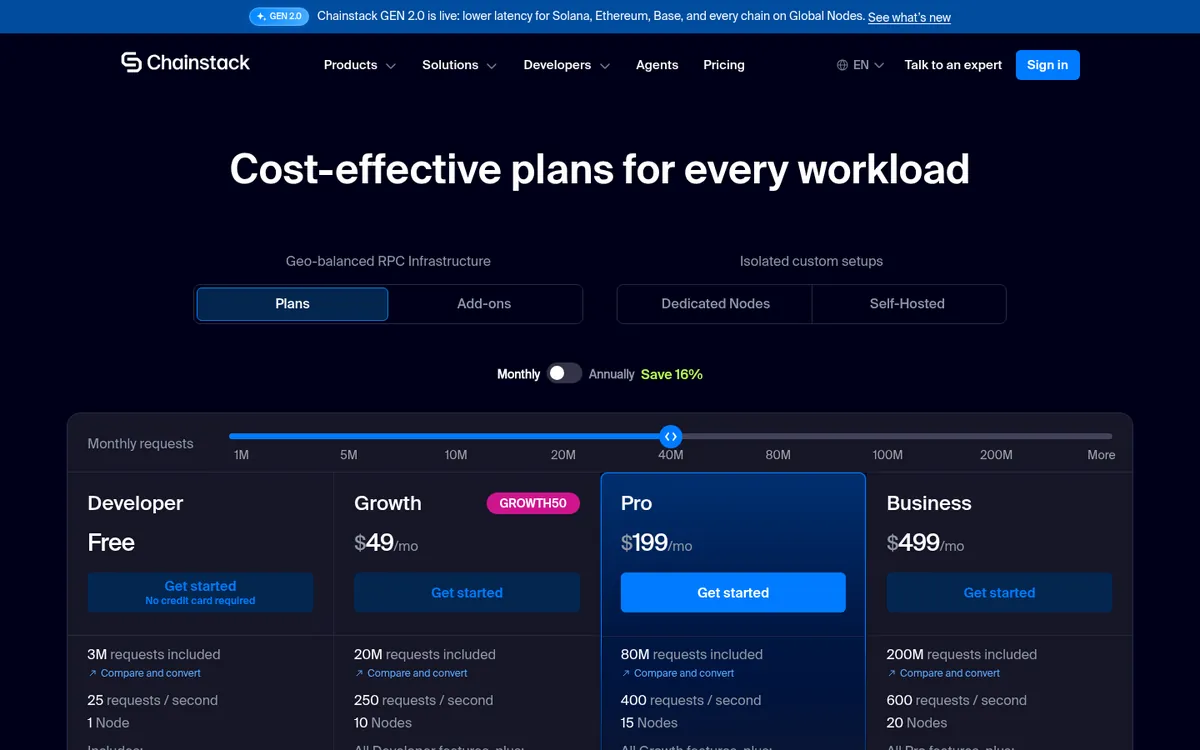
| Pricing | Growth $49 for 20M request units (RU), Pro $199 for 80M, Business $499 for 200M, Enterprise from $990 for 400M |
| Free tier | Developer: 3M RU a month, 25 requests per second, no archive data |
| Chains | 70+ |
| Uptime SLA | Custom SLA on Enterprise; 99.99%+ uptime shown on the pricing page |
| Compliance | SOC 2 Type II and ISO 27001 |
| Our score | 8.6 out of 10 |
Chainstack counts one request unit per call on full nodes and two on archive nodes, whatever the method. Growth allows 250 requests per second, Pro 400 and Business 600. Extra usage gets cheaper as you move up, from $15 per 1M RU on Growth to $5 on Enterprise, per the Chainstack pricing page.
It earned first place on price and audits. Its keyed Ethereum endpoint measured 18 ms at the median on OpenChainBench with a 100% success rate. It buys the most EVM calls for $49, and it lists both SOC 2 Type II and ISO 27001 on its own pages. A flat request unit is the easiest meter in this guide to forecast.
Dedicated nodes start at $0.50 an hour, so a team can move one busy chain to its own node without changing vendor. Pro adds single sign-on, and Business adds role-based access for larger teams.
Best for
- Indexers and analytics jobs with heavy
eth_getLogstraffic. - Teams that want shared RPC and dedicated nodes from one vendor.
- Buyers whose security review asks for both SOC 2 and ISO 27001.
Watch for
- The free Developer plan has no archive data.
- Archive-heavy traffic, which uses request units twice as fast.
- Contractual uptime terms, which start at Enterprise.
Verdict: Best overall value for EVM teams. Check your archive needs before you pick a tier.
2. Alchemy
| Key fact | |
|---|---|
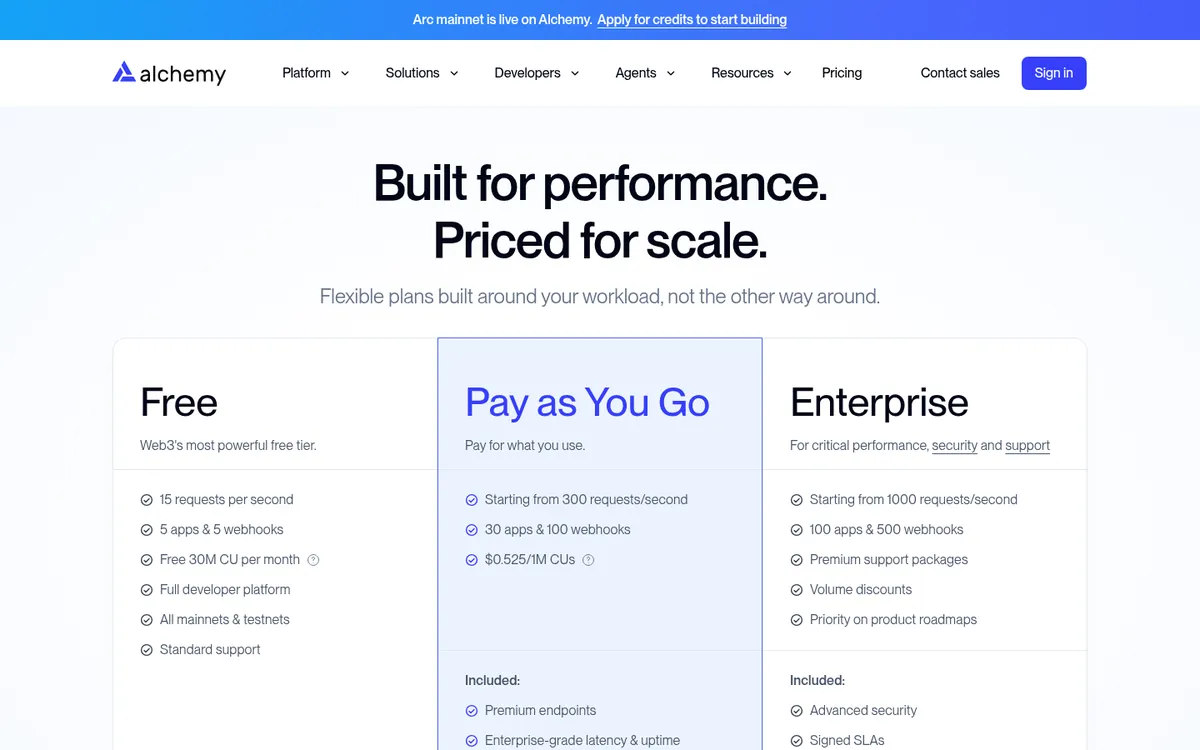
| Pricing | Pay as you go: $0.525 per 1M compute units (CU), 300 requests per second included; Enterprise on request |
| Free tier | 30M CU a month, 15 requests per second, 5 apps |
| Chains | 100+ |
| Uptime SLA | Signed SLAs on Enterprise |
| Compliance | SOC 2 Type II, with a public Trust Center |
| Our score | 8.3 out of 10 |
Alchemy pairs node access with a broad set of data products, including token balances, NFT metadata, asset transfers and transaction simulation. Pay as you go includes 10,000 CU per second, about 300 requests per second, and sells more in blocks of 5,000 CU per second for $160 a month, per the Alchemy pricing page.
Its free tier is the most useful in this guide: 30M CU covers about 1.15M eth_call requests a month. The keyed Ethereum endpoint measured 9 ms at the median on OpenChainBench, though only 7.62% of probes on the benchmark’s free-plan key succeeded in the latest 24 hours. The Alchemy Trust Center offers a SOC 2 Type II report on request. Alchemy suits teams that want RPC and indexed data from one vendor.
Debug and Trace methods sit on paid plans only. Support targets a 48 hour response on Free and 24 hours on pay as you go, and Enterprise adds signed SLAs and larger eth_getLogs ranges. Teams weighing a switch can compare options in our Alchemy alternatives guide.
Best for
- Product teams that need token, NFT or transfer data without running an indexer.
- Prototypes that need a generous free tier.
- Apps with a light read mix of
eth_calland balance checks.
Watch for
- Log-heavy or trace-heavy workloads, which burn compute units faster.
- Throughput above the included 300 requests per second, which costs extra.
- No ISO 27001 claim on its own pages.
Verdict: Strong default for app teams that value data APIs. Price your method mix first if you index logs.
3. dRPC
| Key fact | |
|---|---|
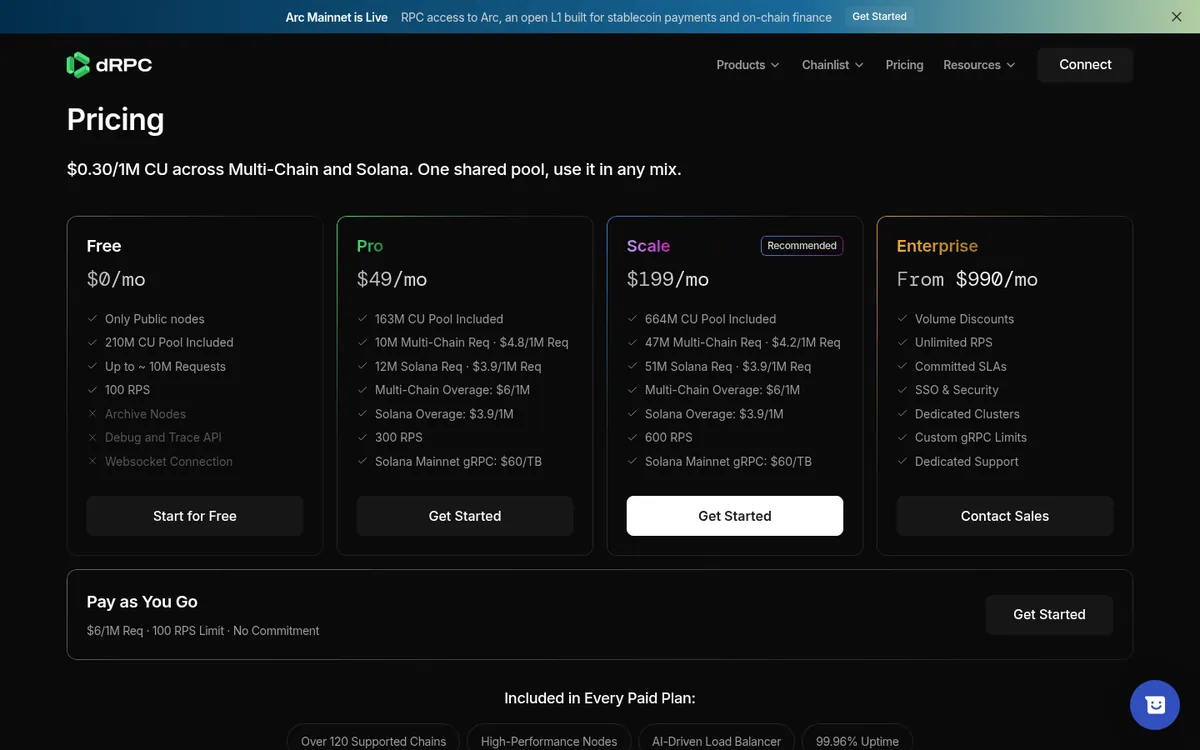
| Pricing | $0.30 per 1M CU; Pro $49 for 10M requests, Scale $199 for 47M requests, Enterprise from $990 |
| Free tier | Public nodes only, 210M CU pool |
| Chains | Over 120 on paid plans |
| Uptime SLA | 99.96% uptime listed on paid plans; committed SLAs on Enterprise |
| Compliance | SOC 2 compliance claimed; no report listed |
| Our score | 7.9 out of 10 |
dRPC routes requests across independent node operators with an AI-driven load balancer, and sells one compute unit pool that covers multi-chain and Solana traffic. Pro allows 300 requests per second and charges $6 per 1M requests above the plan. Scale allows 600 requests per second, per the dRPC pricing page.
It has the cheapest published request price in this guide and the widest chain list among the top five. Its free public Ethereum endpoint led the OpenChainBench public cohort at 30 ms with a 98.17% success rate. dRPC sells requests at a published price, which makes forecasting simple.
The score loses ground on compliance. dRPC describes its infrastructure as SOC 2 compliant in announcements, but we found no audit report or ISO 27001 claim on its own pages.
Best for
- Teams spread across many chains that want one shared pool.
- Developers who want low-commitment access at a known price per request.
- Backup endpoints with wide chain coverage.
Watch for
- The free tier runs on public nodes only.
- Security reviews that need an audit report on file.
- Contractual SLAs, which start at Enterprise.
Verdict: Best price per request across the most chains. Ask for compliance evidence before a regulated rollout.
4. GetBlock
| Key fact | |
|---|---|
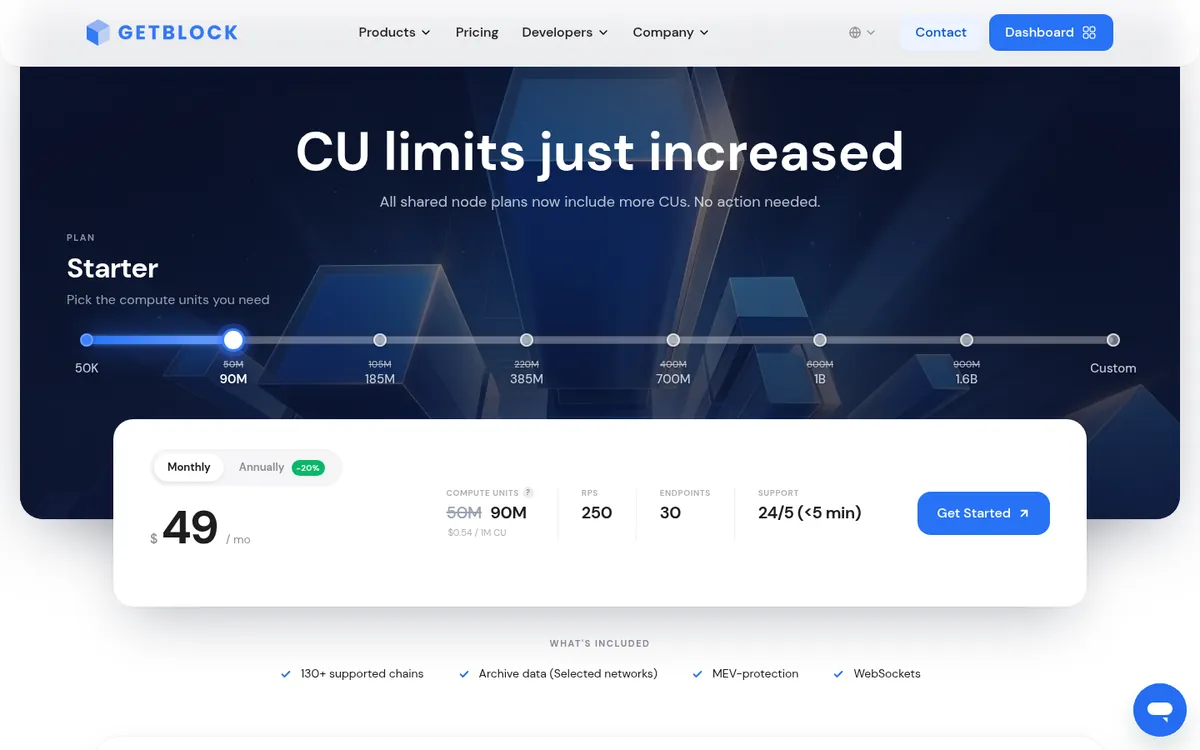
| Pricing | Starter $49 for 90M CU, Growth $99, Advanced $199, Scale $349, Pro $499 for 1B CU, Premium $699, Enterprise from $999 |
| Free tier | 50K CU a day, 20 requests per second |
| Chains | 130+ |
| Uptime SLA | 99% on shared nodes from Starter; 99.9% to 99.99% on dedicated nodes |
| Compliance | SOC 2 Type II |
| Our score | 7.8 out of 10 |
GetBlock meters compute units as a chain multiplier times a method multiplier, doubled for archive calls. Ethereum carries a multiplier of 20, so Starter’s 90M CU buys about 4.5M Ethereum calls at 250 requests per second. Pro raises the limit to 800 requests per second and sells extra CU at $0.40 per 1M, per the GetBlock pricing page.
GetBlock is the only top-five provider with a written SLA, including a remedy, on a $49 plan. Its SLA promises 99% monthly availability on shared nodes, with a 20% discount if it misses. Its keyed Ethereum endpoint matched Alchemy at 9 ms on OpenChainBench.
The Starter plan includes 30 endpoints, WebSockets, archive data on selected networks and 24/5 support. Dedicated nodes start at $1,000 a month with a 99.9% SLA, and GetBlock states SOC 2 Type II in its pricing documentation.
Best for
- Multi-chain teams that need a written uptime target without an enterprise contract.
- Ethereum apps with steady read traffic.
- Teams that want shared and dedicated nodes from one vendor.
Watch for
- Chain multipliers, which make some chains far more expensive per call than others.
- The free tier, which covers only about 2,500 Ethereum calls a day.
- Archive calls, which cost twice as much.
Verdict: A strong all-rounder with the clearest self-serve SLA in the top five. Check the multiplier for each chain you use.
5. QuickNode
| Key fact | |
|---|---|
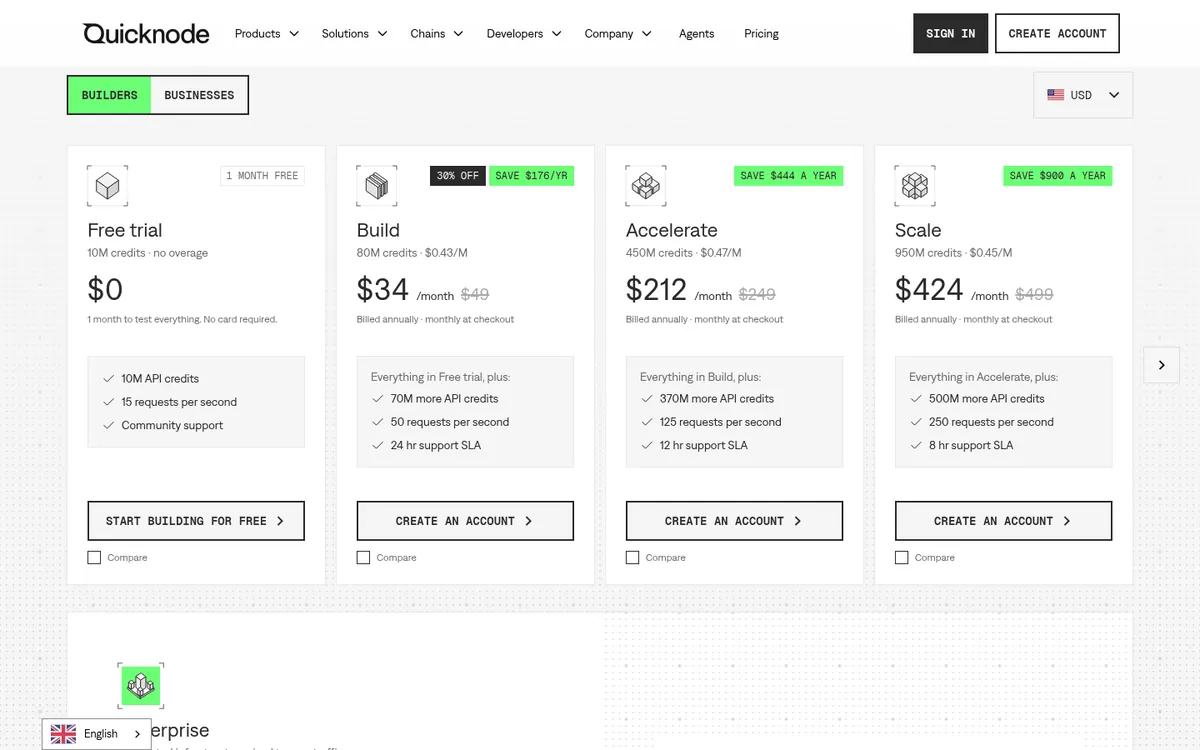
| Pricing | Build $49 for 80M credits, Accelerate $249 for 450M, Scale $499 for 950M, Business $999 for 2B, Business+ from $1,499 |
| Free tier | One-month trial with 10M credits, 15 requests per second |
| Chains | 76+ |
| Uptime SLA | 99.99% contractual SLA with service credits on Enterprise |
| Compliance | SOC 1 and SOC 2 Type 2, ISO 27001 |
| Our score | 7.7 out of 10 |
QuickNode sells tiered monthly plans, and extra credits get cheaper on each tier: $0.62 per 1M on Build down to $0.50 on Business. Build allows 50 requests per second and Business allows 500, per the QuickNode pricing page. Archive data comes on every plan, and Trace and Debug start on Build.
QuickNode has the strongest compliance record in this guide. Its security page lists SOC 1 Type 2, SOC 2 Type 2 and ISO 27001, and its enterprise page offers a 99.99% uptime SLA with service credits. Flat per-chain credits make QuickNode bills easy to budget.
Price held it at fifth. Its $49 plan buys 4M Ethereum calls, a fifth of Chainstack Growth, even though its keyed Ethereum endpoint posted the lowest median latency in the OpenChainBench private cohort at 6 ms.
Best for
- Enterprises that need audited controls and a contractual uptime SLA.
- Multi-chain teams that want predictable credits per call.
- Teams that need Trace and Debug on a mid-priced plan.
Watch for
- Chain multipliers: Solana and some layer 2 calls cost more credits than Ethereum calls.
- Advanced APIs that double the credit cost.
- No permanent free tier after the trial month.
Verdict: The safest enterprise pick and easy to budget. Price-sensitive teams get more calls elsewhere. See our QuickNode alternatives for eight priced options. Our QuickNode vs Infura vs Ankr comparison puts the three side by side.
6. Helius
| Key fact | |
|---|---|
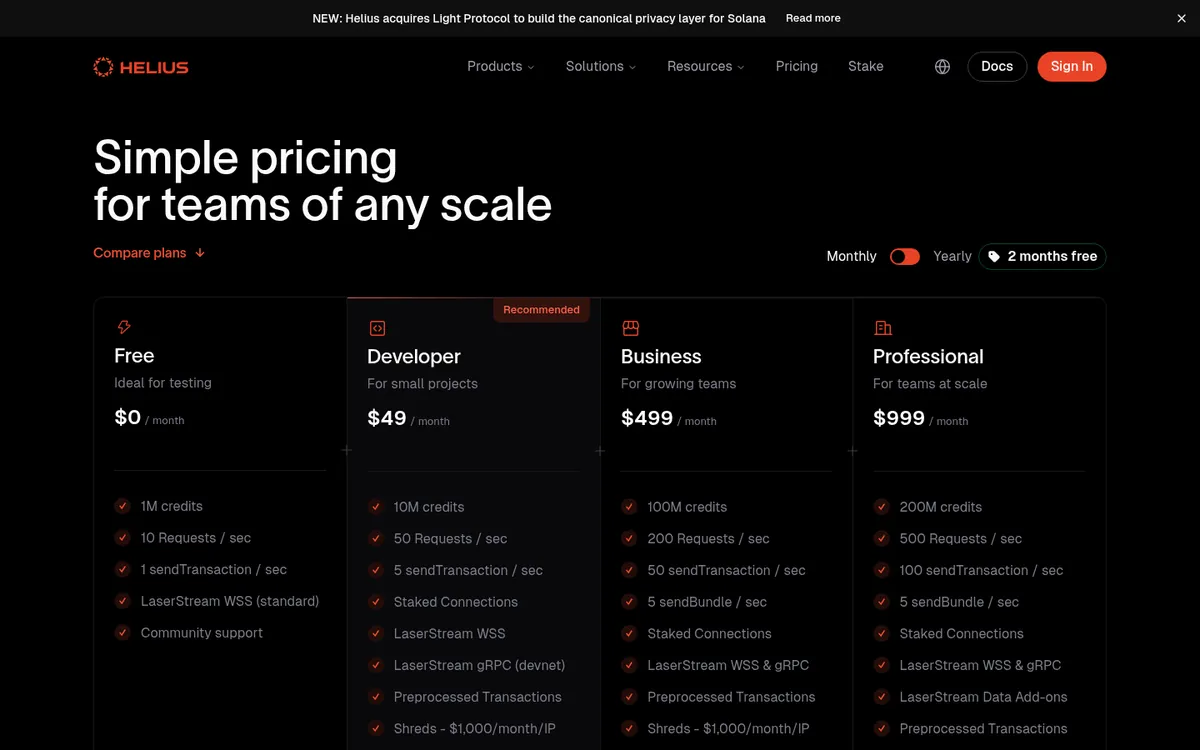
| Pricing | Developer $49 for 10M credits, Business $499 for 100M, Professional $999 for 200M; dedicated nodes from $2,900 |
| Free tier | 1M credits, 10 requests per second |
| Chains | Solana only |
| Uptime SLA | Latency and uptime SLAs on enterprise plans |
| Compliance | SOC 2 Type II |
| Our score | 7.3 out of 10 |
Helius builds only for Solana. Most RPC calls cost 1 credit, while heavier calls such as getProgramAccounts and its Digital Asset Standard (DAS) API cost 10. Developer allows 50 requests per second and sells extra credits at $5 per 1M, per the Helius pricing page.
Staked connections start on Developer, and LaserStream gRPC streaming arrives with Business. For Solana-only teams, a specialist beats a generalist on features. Its overall score trails the top five only because chain coverage carries 15% of the weight and Helius serves one chain. For Solana-only shortlists, see our Solana RPC providers comparison and our Helius vs QuickNode vs Triton head-to-head.
Helius states SOC 2 Type II, audited by Sensiba LLP, and shares the report on request through its Trust Center. Enterprise plans add latency and uptime SLAs, and dedicated nodes start at $2,900 a month.
Best for
- Solana dApps, wallets and trading systems.
- Teams that need fast transaction landing and streaming data.
- Builders who want Solana-specific APIs such as DAS.
Watch for
- No EVM support, so multi-chain teams need a second provider.
- Streaming bandwidth, which bills separately from credits.
- Heavier methods at 10 credits each.
Verdict: The first call for Solana builders. Pair it with an EVM provider if you span both ecosystems.
7. Ankr
| Key fact | |
|---|---|
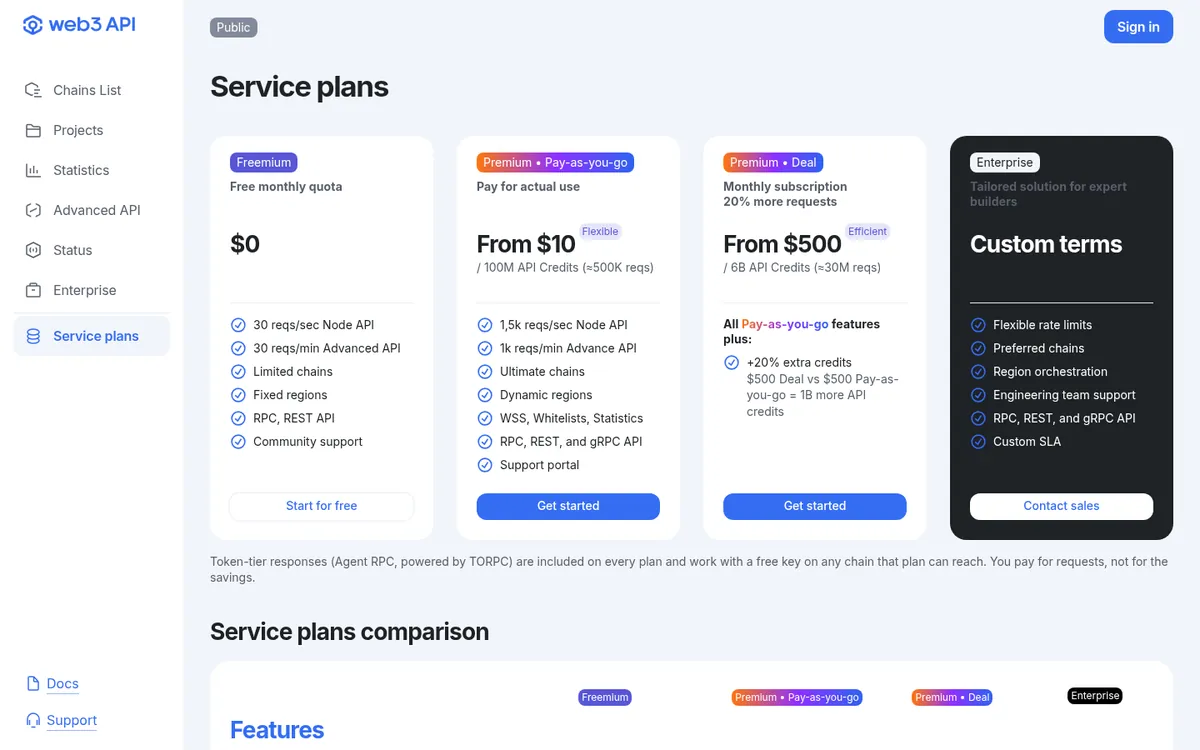
| Pricing | Pay as you go from $10 per 100M credits; EVM $0.02 per 1,000 requests; Deal $500 to $3,000 a month |
| Free tier | 200M credits a month, 30 requests per second |
| Chains | 50+ free, 75+ paid |
| Uptime SLA | Custom SLA on Enterprise |
| Compliance | SOC 2 Type II for its operator; ISO 27001 in progress |
| Our score | 6.3 out of 10 |
Ankr sells prepaid API credits. An EVM request costs 200 credits, so $10 buys about 500,000 requests, and paid access runs at up to 1,500 requests per second. Solana requests cost $0.05 per 1,000 and Advanced API calls $0.07, per the Ankr pricing page. A Deal subscription adds 20% more credits.
The free tier is generous at 200M credits, about 1M EVM requests a month. Ankr’s trust page says its RPC operator, Asphere, holds a SOC 2 Type II attestation audited by A-LIGN, with ISO 27001 still in progress. Ankr works best as a prepaid backup endpoint.
Paid plans add WebSocket, gRPC and allowlists for IPs, domains and contracts. Its public Ethereum endpoint now requires an API key, which is why it does not appear in the OpenChainBench Ethereum cohort.
Best for
- Backup or failover endpoints with low fixed cost.
- Teams that want to prepay and top up as they go.
- Prototypes that need a large free monthly allowance.
Watch for
- Higher cost per request than flat-plan rivals at steady volume.
- Fewer chains on Freemium than on paid plans.
- Contractual SLAs, which need an enterprise deal.
Verdict: A cheap, audited secondary endpoint. Less competitive as the primary provider for steady traffic.
8. Infura
| Key fact | |
|---|---|
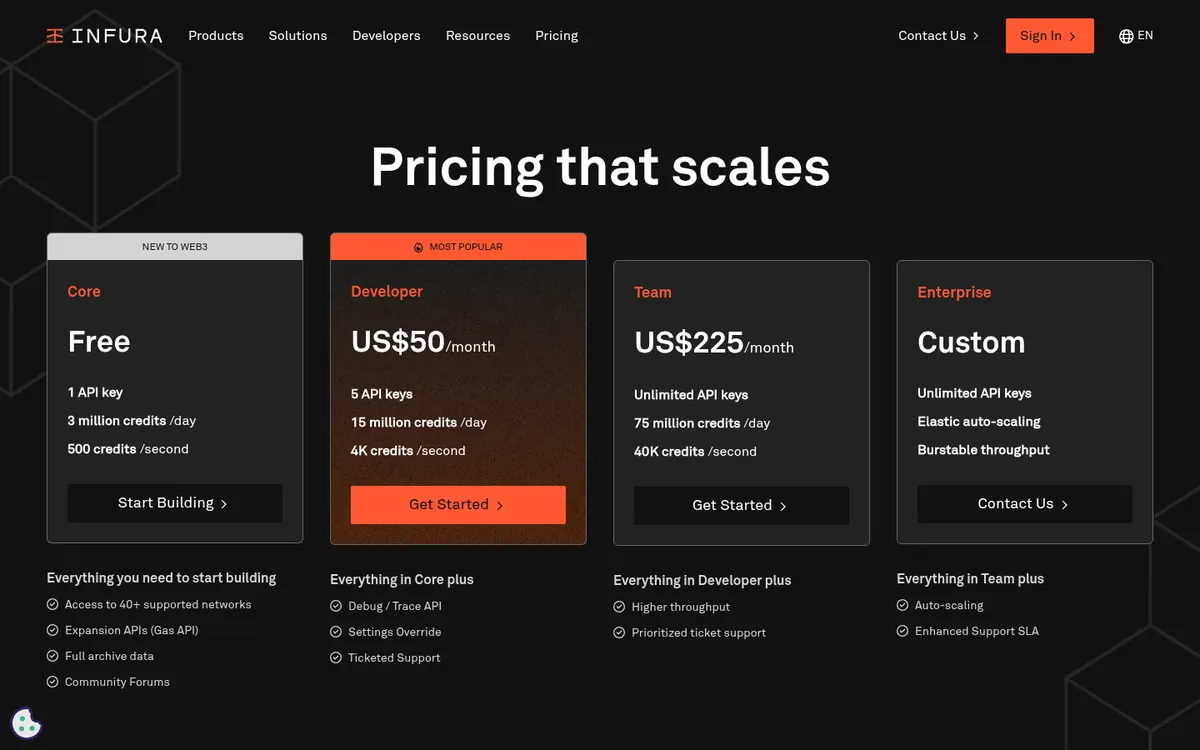
| Pricing | Developer $50 for 15M credits a day, Team $225 for 75M a day; extra credits $200 a month; Enterprise on request |
| Free tier | Core: 3M credits a day, 500 credits per second, archive included |
| Chains | 25 chains in its endpoint docs |
| Uptime SLA | 99.9% minimum uptime on its Ethereum page; committed SLAs on Enterprise |
| Compliance | No SOC 2 or ISO 27001 claim found on Infura pages |
| Our score | 6.1 out of 10 |
Infura is the long-running Ethereum provider from Consensys, the company behind MetaMask. Plans meter credits per day with a per-second ceiling: 500 credits per second on Core, 4,000 on Developer and 40,000 on Team, per the Infura pricing documentation. For an Ethereum-only shortlist that includes archive node access, see our Ethereum RPC providers comparison.
The pricing page says 40+ networks, which counts mainnets and testnets. Its endpoint list names 25 chains, including Ethereum, Base, Arbitrum, Linea and Solana, which is open to select customers only. Daily quotas punish traffic spikes more than monthly pools do.
Core includes archive data, and Debug and Trace start on Developer. Its Ethereum product page advertises a 99.9% minimum uptime, but we found no SOC 2 or ISO 27001 claim on Infura’s own pages, which cost it points on compliance. If those gaps rule Infura out, our Infura alternatives guide ranks replacements for Ethereum and L2 apps.
Best for
- Ethereum-focused apps with steady daily traffic.
- Teams already using MetaMask tooling.
- Prototypes that need free archive access.
Watch for
- Bursty workloads that can exhaust a daily quota before it resets.
- Log and fee estimation calls, which carry heavy credit weights.
- A narrower chain list than the top five.
Verdict: Reliable for steady Ethereum traffic. Pick a monthly pool if your load arrives in bursts.
9. Tatum
| Key fact | |
|---|---|
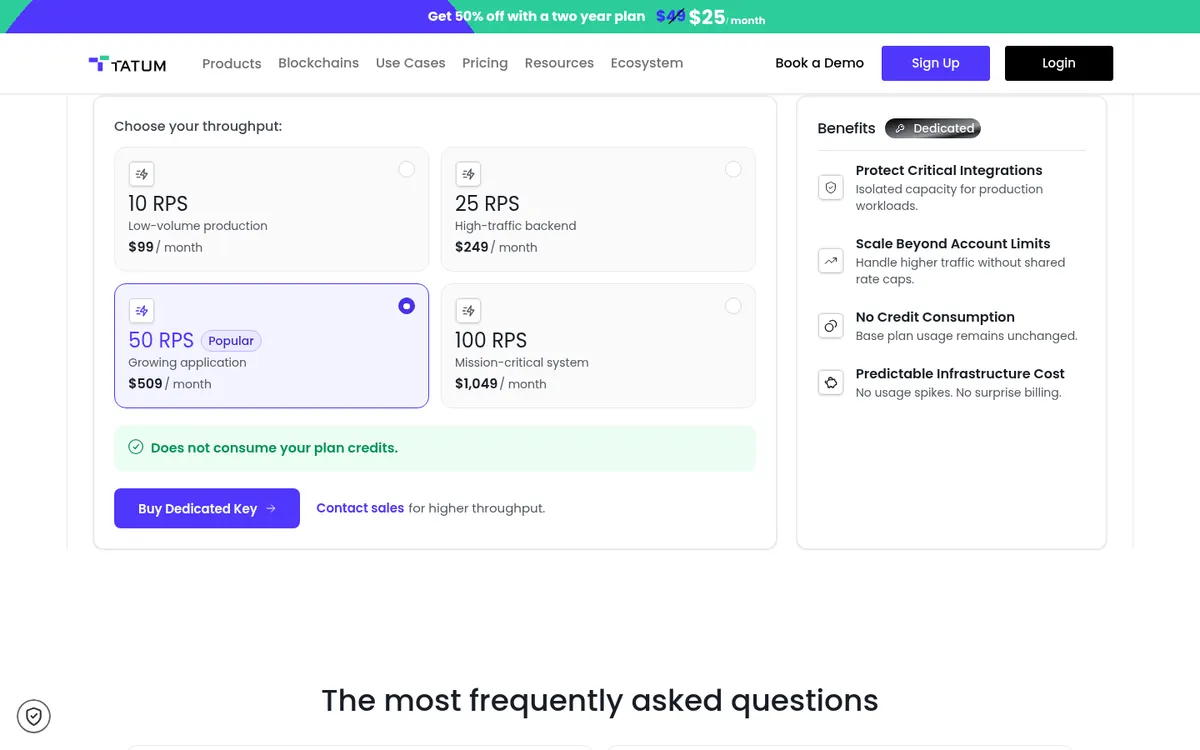
| Pricing | Starter from $49 for 4M credits; Pro and Scale up to 80M credits; dedicated keys $99 to $1,049 a month |
| Free tier | 100K lifetime credits, 3 requests per second |
| Chains | 130+ |
| Uptime SLA | Support response SLA; 99.99% uptime claim |
| Compliance | SOC 2 Type II and ISO 27001:2022 |
| Our score | 6.1 out of 10 |
Tatum charges 2 credits for a standard RPC method, 5 for eth_call and 50 for Debug and Trace methods, per its RPC docs. Paid plans allow 200 requests per second, and its plans page lists Starter at 4M or 7M credits, Pro at up to 20M and Scale at up to 80M.
Dedicated API keys sell guaranteed throughput separately: $99 a month for 10 requests per second, up to $1,049 for 100, and they do not consume plan credits, per the Tatum pricing page. Tatum ties QuickNode and Chainstack for the best compliance score in this guide.
Its security docs state SOC 2 compliance and ISO/IEC 27001:2022 certification. The weak spot is price: Starter buys about 800,000 eth_call requests, the fewest per dollar in our math, and the free tier’s 100K credits never renew.
Best for
- Teams that need RPC plus wallet, notification and data APIs from one vendor.
- Buyers who need ISO 27001 and SOC 2 evidence.
- Workloads that need a fixed throughput guarantee via dedicated keys.
Watch for
- High cost per
eth_callcompared with flat meters. - A free tier of lifetime credits, which suits a trial only.
- Plan prices that sit behind an interactive slider.
Verdict: A sound pick for compliance-led teams that use its wider API set. Expensive for raw RPC volume.
10. NOWNodes
| Key fact | |
|---|---|
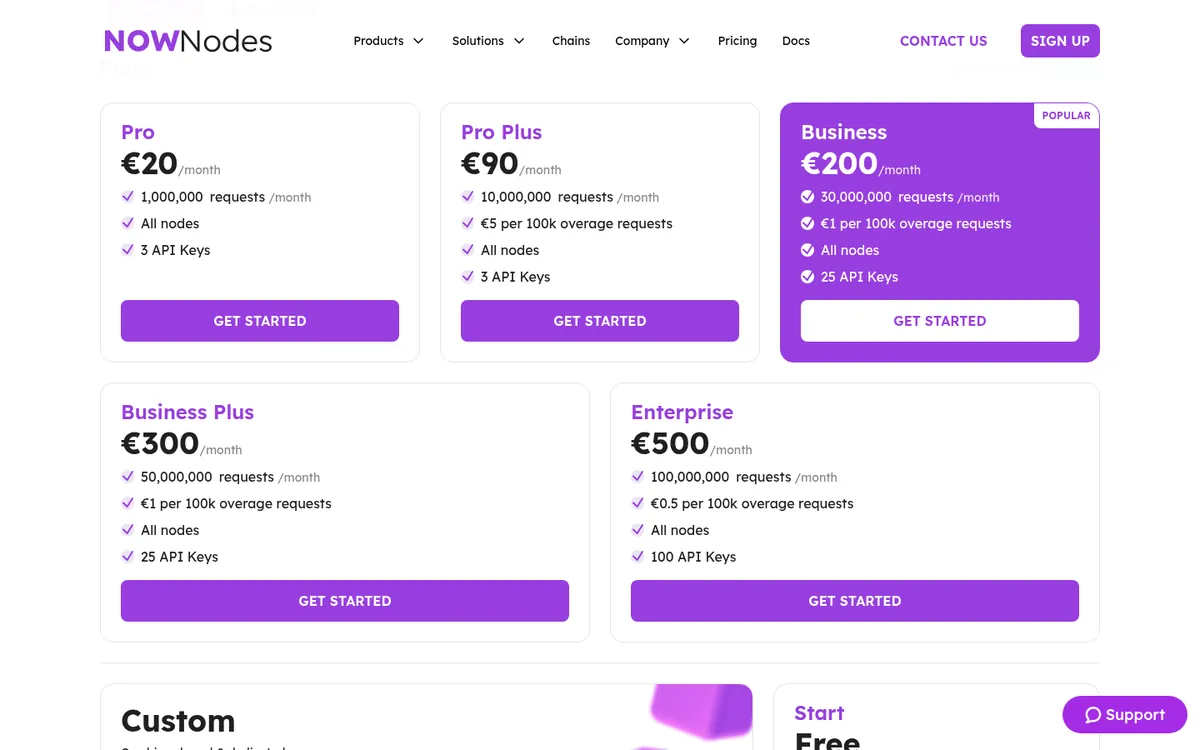
| Pricing | Pro €20 for 1M requests, Pro Plus €90 for 10M, Business €200 for 30M, Business Plus €300 for 50M, Enterprise €500 for 100M |
| Free tier | Start: 100K requests, 15 requests per second, 5 networks, one month only |
| Chains | 120 networks |
| Uptime SLA | 99.95% API uptime on every plan |
| Compliance | No SOC 2 or ISO 27001 claim found on NOWNodes pages |
| Our score | 5.8 out of 10 |
NOWNodes counts plain requests and prices in euros. Overage falls from €5 per 100K requests on Pro Plus to €0.50 on Enterprise, per the NOWNodes pricing page. Pro Plus works out to €9 per 1M requests.
Its service quality standard lists 99.95% API uptime, a 3-minute support response on any plan and a backup node within 10 minutes. Few vendors publish support targets this specific for every plan.
The public data is mixed. Its free Ethereum gateway measured 129 ms at the median on OpenChainBench with a 95.27% success rate, the lowest success rate in that cohort, and we found no audit claims on its own pages.
Best for
- Teams that want simple request counting across many networks.
- Projects that value fast human support on small plans.
- Wallets that need Bitcoin-family chains alongside EVM chains.
Watch for
- A free plan that expires after one month and covers 5 networks.
- Euro pricing, which adds currency risk for dollar budgets.
- No published audit reports.
Verdict: Simple meter and strong support targets. Ask for security evidence and test latency before you commit.
11. CDP Node
| Key fact | |
|---|---|
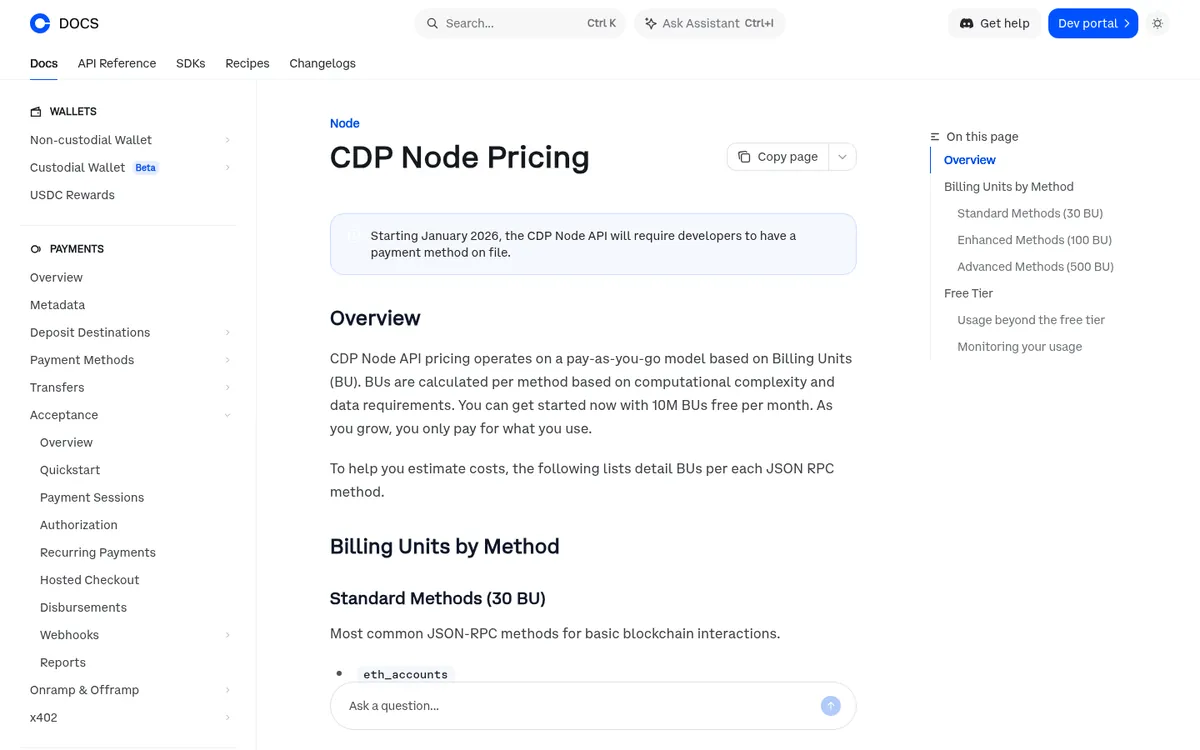
| Pricing | Pay as you go: $0.50 per 1M billing units (BU) |
| Free tier | 10M BU a month; payment method required since January 2026 |
| Chains | Base mainnet and Base Sepolia only |
| Uptime SLA | None published |
| Compliance | Not stated on the CDP Node docs |
| Our score | 4.4 out of 10 |
CDP Node is the Coinbase Developer Platform endpoint for Base. Standard methods cost 30 BU, enhanced methods such as eth_getLogs cost 100, and Debug, Trace and eth_sendRawTransaction cost 500, per the CDP Node pricing docs.
The free 10M BU covers about 333,000 standard calls a month, and the project limit is 7,500 BU every 5 seconds, roughly 50 requests per second. Sending a transaction costs nearly 17 times as much as reading a balance. The Node overview bundles Paymaster gas sponsorship and wallet history methods on the same endpoint.
It ranks low on this list because it serves one network, publishes no uptime terms and states no audits on its Node pages. For a Base-only app, those trade-offs can still make sense. For Base specifically, our Base RPC providers comparison ranks the options side by side.
Best for
- Apps built only on Base that want gas sponsorship on the same endpoint.
- Prototypes that fit inside 10M BU a month.
- Teams already using other Coinbase Developer Platform tools.
Watch for
- Write-heavy apps, since transaction sends cost 500 BU each.
- No published SLA.
- Rate limit increases that need a request in Discord.
Verdict: A convenient free endpoint for Base builders. Keep a second provider for production traffic.
12. Lava
| Key fact | |
|---|---|
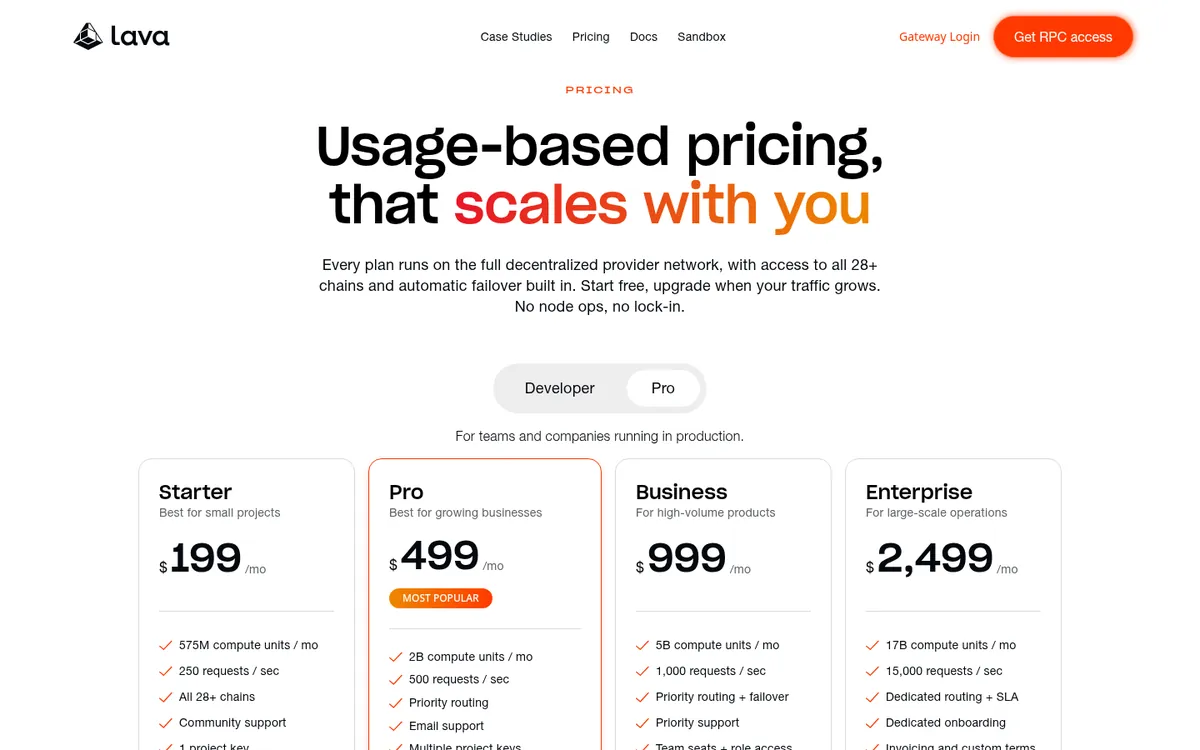
| Pricing | Developer $29 for 50M CU, Starter $199 for 575M, Pro $499 for 2B, Business $999 for 5B, Enterprise $2,499 for 17B |
| Free tier | Hobby: 750K CU a month, 25 requests per second |
| Chains | 28+ |
| Uptime SLA | SLA on the Enterprise plan |
| Compliance | No SOC 2 or ISO 27001 claim found on Lava’s pricing page |
| Our score | 4.3 out of 10 |
Lava routes each request across a decentralized network of providers with automatic failover, and every plan reaches all of its 28+ chains through one endpoint. Developer allows 100 requests per second, and Enterprise allows 15,000, per the Lava pricing page.
The pricing page says nothing breaks when you exceed your plan, which suits teams that fear hard cutoffs. Lava does not publish per-method compute unit costs, so we could not price a call. That opacity drives its low price score.
Uptime terms appear only on the $2,499 Enterprise plan, and we found no audit claims on its pricing page. Chain coverage is the narrowest of the multi-chain providers here.
Best for
- Teams that want failover across many node operators without building it.
- Projects on the chains Lava supports that dislike hard rate cutoffs.
Watch for
- Cost forecasting, since method weights are not published.
- A narrower chain list than most rivals.
- SLAs only at the top tier.
Verdict: An interesting routing model. Ask for method weights before you compare its bill with anyone else’s.
Providers We Left Out
We considered three more providers and left them out for stated reasons. Blockdaemon sells RPC through sales, and its old pricing page now redirects to a data services page. Allnodes focuses on dedicated nodes priced per chain, mostly for staking. Grove, the Pocket Network gateway, wound down its Portal in November 2025 and closed in July 2026.
We also looked at providers without a public price list. We will add any provider that publishes pricing we can verify and screenshot, and we will retest the list each quarter.
Shared RPC, Dedicated Nodes or Self-Hosting
Shared RPC fits most teams because the provider absorbs sync, upgrades and failover. Dedicated nodes make sense when shared rate limits cap growth, when you need custom client flags, or when latency targets demand a node near your servers. Self-hosting pays off only when you have node operators on staff.
| Option | Choose it when | Main cost |
|---|---|---|
| Shared RPC | Traffic fits plan limits and you span several chains | Usage-based plan fees |
| Dedicated node | You need fixed throughput, custom methods or isolation | Hourly or monthly node fee |
| Self-hosted node | Data control or compliance rules require your own hardware | Servers, storage and engineer time |
Dedicated node prices vary widely by chain and client, from $0.50 an hour on Chainstack to $1,000 a month on GetBlock and $2,900 a month on Helius. Our Dedicated Nodes section covers that market, and our Blockchain Data hub covers indexers that replace heavy log reads.
Verdict: Stay on shared RPC until a measured limit forces a change. Add a dedicated node for the one chain that hits it. Our dedicated node providers guide ranks published Ethereum and Solana node prices.
How to Test an RPC Provider Before You Commit
A one-week trial on real traffic tells you more than any spec sheet. Run each shortlisted provider side by side from the same region as your servers, and log latency, errors and block freshness. Keep a second provider wired in from day one so failover is a config change.
- Create a free or trial key on two or three providers.
- Send the same requests to each endpoint from your production region.
- Record median and slow-tail latency, error rates and the newest block number each endpoint returns.
- Price one day of your real method mix on each provider.
- Check status page history and incident reports for the last 90 days.
This command times a single block number request. Run it in a loop against each endpoint and compare the results.
curl -s -o /dev/null -w "%{time_total}\n" \
  -H "Content-Type: application/json" \
  -d '{"jsonrpc":"2.0","id":1,"method":"eth_blockNumber","params":[]}' \
  "$RPC_URL"
Most client libraries accept a list of endpoints and retry on the next one when the first fails. Pair a primary from the top five with a cheap backup such as Ankr or dRPC.
Frequently Asked Questions
What are the best RPC node providers in 2026?
Our ranking puts Chainstack first, then Alchemy, dRPC, GetBlock and QuickNode. Chainstack leads on price per call and audits. Alchemy has the best free tier and data APIs, and dRPC has the cheapest published request price. Solana teams should start with Helius, which ranks sixth only because it serves one chain.
Which RPC provider has the best free tier?
Alchemy’s 30M compute units a month cover about 1.15M eth_call requests, the most useful free allowance we found. Ankr’s 200M credits cover about 1M EVM requests. Infura resets 3M credits daily with archive data, and CDP Node gives 10M billing units on Base. Test two free tiers with your real requests first.
How do I compare compute units, credits and request units?
Convert each unit into calls for the methods you actually use. Count one day of requests by method, multiply each count by the vendor’s published weight, and divide the plan allowance by that total. Flat meters need little math, while per-method meters such as compute units need the full calculation.
Which RPC providers have SOC 2 and ISO 27001?
Chainstack, QuickNode and Tatum state both SOC 2 Type II and ISO 27001 on their own pages. Alchemy, GetBlock and Ankr state SOC 2 Type II, with Ankr’s ISO 27001 in progress. Audit reports usually ship under a non-disclosure agreement, so request them during your vendor security review.
Which RPC provider is fastest?
On the OpenChainBench Ethereum benchmark for 25 October 2026, QuickNode’s keyed endpoint measured 6 ms at the median, GetBlock and Alchemy 9 ms, and Chainstack 18 ms. On free public endpoints, dRPC led at 30 ms. Results vary by region and method, so test from your own servers.
Should I use more than one RPC provider?
Yes, for any production app. Providers have outages, rate limit spikes and chain-specific bugs, and a second endpoint turns those into short slowdowns instead of downtime. Most client libraries accept a fallback list. A cheap prepaid or free plan is enough for the backup role on most chains.